
Monthly Archives: March 2026

717. Don’t Start at the Beginning, Part Two.

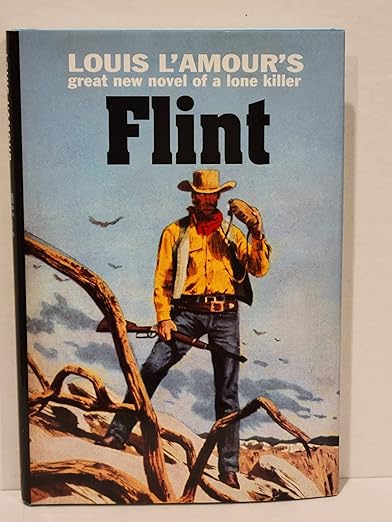
Last week I said you should buy a copy of Flint, by Lous L’Amour, and have it in hand as I take you through the first five pages. I have left out more than I have provided, so you need the original. Don’t read this and think you have read L’Amour. Now let’s begin —

Flint, Chapter 1, Paragraph 1-3  =>  It is given to few people in this world to disappear twice but, as he had succeeded once, the man known as James T. Kettleman was about to make his second attempt.

If he did not succeed this time he would never know it, for he would be dead.

When a man has but a few months to live, he can, if he so wills, choose the manner of his going, and Kettleman had made such a choice. He was now on his way to a place of which he alone knew, and there he would die. He would die as he had lived — alone.

If that doesn’t grab you by the lapels, I don’t know what it would take.

Be sure to read the paragraphs I don’t provide. The ones I am giving you are just landmarks.

Paragraph 6 => There were five people in the car. The lights were dim, the passengers lay sprawled in uncomfortable sleep. The train rushed westward through the cold, clear night, carrying the man steadily toward his final destination.

First who he is, now where he is. Next we will get a glimpse of his love interest and his antagonist, both of who will appear later in the novel. Read on . . .

Paragraph 10-14 => The country outside was invisible. The windows had steamed over, and the train moved as if through an endless tunnel.     (I am trying to maintain the letter and spirit of the copyright laws, which allow short excerpts, so you will have to have a copy of Flint to read the longer sections.)

Now we know where he is going, and that the place is intimately familiar to him. If you are a fan of the genre, you also know that it is a place you want to spend the next few hours. In a different genre, it would be different place.

Paragraph 15-23 =>      Next in your copy, but too long to reproduce in this post, is the essential flashback that establishes Flint’s deep background. This gunfight is a classic of the genre, but it is told briefly since it exists to establish character and motivation. There will be other gunfights to bring the book to its necessary conclusion. This is a Western, after all.

In another genre, say a romance, this might be be an early or failed romance to set up THE ONE in the closing pages.

Paragraph 24 => In the instant of silence that followed the shooting they heard the click of a drawn-back gun hammer, and every head turned. “He was my friend,” the youngster said, and he started shooting.

This is a triple set-up. First it establishes Flint’s relationship to the man who is killed. This will be fleshed out later in the novel. It also shows Flint’s gun skills, and finally it sets-up an essential mistake of identity, when “Kettleman” is later thought to be the legendary hired killer Flint.

Paragraph 27-28 => The train whistled, the lonely sound trailing off across the wind-swept plains. Kettleman got out his pipe and lighted it. His two bags and haversack were at the back of the car. When he opened that door there would be a moment when the cold air might awaken the others, but he would be gone.

Up to a point he had planned every move, but once arrived at Flint’s old hideout there would be nothing to do but wait. Some time ago his doctor had told him he would not live a year, and most of that year had passed.

The next five paragraphs are skipped just to speed the process. Of course you will read them in that novel in your other hand.

Paragraph 33-34 => There had been more than fifteen hundred dollars in Flint’s pockets when he died on that rain soaked Kansas hillside, following the shooting at The Crossing. The boy who was to become James T. Kettleman had sixty dollars of his own, which he used to buy an outfit of store clothes in Kansas City.

He travelled to New York City and sold his four horses for an additional four hundred dollars. With this stake he started in business. It was more money than either Jay Gould or Russel Sage had started with.

Again, some paragraphs are skipped.

Paragraph 41 => In the fifteen years following that night at The Crossing he had built his small stake into many millions, making many enemies and no friends in the process. He married a wife who tried to have him killed, and had no children.

That last sentence is a masterpiece of brevity. It tells a little, but leaves volumes unsaid. It leaves us dying to know more about this woman. When she shows up more than half-way through the book, we will find that she has been worth waiting for.

Paragraph 43 => Thirty years earlier, when he was two years old, he had been picked from the brush near a burned wagon train, where he had been overlooked by raiding Comanches. There were no other survivors. Nothing remained to tell who he was, and those who found him had no interest in learning. During the next four years he was handed around from family to family and finally abandoned on a cold night in a one-street Western town.

Having established Flint as a youth and as a grown man, L’Amour finally tells us about the very early life which set him on his path.

Paragraph 47-49 => The dry grass bent before the wind, and seed pods rattled in the brush along the right of way.

James T. Kettleman was ended, and the man who had borne that name, making it feared and respected, stood now where he had stood so many years before, without a name. He was now a man without a past as he had been a boy without one.

“Good-by,” he said, but there was nobody to say the word to, and nothing to remember.

<< == >>

So now we are five pages into the novel. I dare you — or any reader — to stop now.

There is a lot to be learned in these few pages about grabbing your readers, whether you like Westerns or not. And if you didn’t get a copy of Flint to read, causing you to miss 90% of what the rest of us learned, aren’t you sorry now?

Of course you can still go get a copy. This post will still be here. Just type Syd Logsdon 716. Don’t Start at the Beginning, Part 2 into your browser.
716. Don’t Start at the Beginning, Part One.

Genesis 1:1 In the beginning God created the heaven and the earth.

The Bible starts that way but you shouldn’t. When I say that, I am assuming that your are or want to be a writer.

The days of beginning at the beginning of a story passed a couple of centuries ago. Now we begin in medias res, which is Latin for in the middle of things. Then we fill in with flashbacks, as needed.

It’s quite an art, and it is often done badly.

In a recent Christmas movie, two young women were standing on stage at the Grand Ole Opry. One said, “I can’t believe I still get nervous before a live show.” The other replied, “You’re Suzie Smith, country western star, and I’m your manager. You’ve got this!”

Awkward, awkward, awkward.

You need to get your story going at full speed, then introduce the necessary background early so your reader or viewer doesn’t close the book or change the channel before being properly hooked. It’s a skill that takes time to master.

AI devours ten thousand reports in order to learn how to produce one report. Writers read a thousand novels before they are ready to write one, starting it in medias res. I am about to offer you a novel that should be on your list.

The novel is Flint, by Lous L’Amour. It doesn’t matter if you are a fan of westerns or not, this is business. You can learn from any genre, and this novel is a masterpiece at grabbing the reader by the lapels in the first sentence and never letting him escape.

In the first five pages, L’Amour introduces his character, paints a compelling picture of his surroundings, tells you that his character is dying (he isn’t, but he thinks he is), shows the girl who will later be his love interest, as well as the man who will be his future enemy, tells Flint’s origin story (it’s a good one), tells the story of his life so far, and introduces the woman (who happens to be his wife) who will bring him no end of misery.

But here is a twist. Before I tell more, I’m going to give you a homework assignment.

You can buy Flint in many new bookstores, in many used bookstores, or you can go to Amazon and find it new, used, as kindle, or as an audiobook. Get a copy and have it handy on March 11th. Then I will walk through the first five pages with you.

I can’t compress five novel pages into one of these posts, and it would probably be illegal anyway. Also, I’m not ChatGPT. If I am going to use another author’s novel, I will expect him (or his estate) to get at least a few pennies.

Of course, you may be reading this post years from now. The same rules apply. Get a copy of Flint and then go to the March 11, 2026 post.

Join me next week, same time, same place,
with a copy of Flint in your hand.

715. Pettus Bridge, a fable

Once upon a time, there was a lovely young woman. Unfortunately, she was black, enslaved, and living in Alabama. The year was 1815.

Her owner was just back from fighting beside Andrew Jackson at the Battle of New Orleans. He was a hero.

His wife didn’t think so. She had been running the plantation all the time he was gone. She hadn’t enjoyed that, but she enjoyed having him home again even less. In bed, he was quick and crude, and after three weeks his wife moved into a different bedroom.

A week later, he found the lovely young black woman in the fields. He ordered her to take off her clothes and lie down on her back in the shade of a tree. Ten minutes later he was on his way again.

Nine months later, the woman gave birth to a beautiful daughter. Nineteen years later, the hero’s son caught the daughter in the fields and did the same thing to her that his father had done to her mother. Nine months later, another lovely black girl-child was born, but now things had changed.

The plantation was failing. The hero’s son had become too fat to chase women, even slave women, and too drunk most of the time to miss the chase. The plantation was sold, the slaves were broken up and scattered. The girl-child stayed with her mother a few years, then was sold to a plantation south of Birmingham. When she turned seventeen, she was sold to a brothel.

When she was twenty-four, she gave birth to twins — but not identicals. One she named Flo; it had been her mother’s name. The other she named Cécile, since the father had been a Frenchman. She thought so, anyway.

The blood of Cécile’s white father, and grandfather, and great grandfather were strong in her makeup. He nose was small, her skin was pale, She would be a great addition to the brothel when she grew up. Flo had inherited the other side of the genetic lottery.

Both would remain slaves. Both were black, Cécile’s white looks notwithstanding, since the doctrine of that day was the one drop of blood was all it took to make you black.

Little Cécile was a favorite of all the men who came to the brothel. When her head was only up to their elbows, she had already learned how to lean against them, smile up at them, and laugh like she didn’t have a care. She earned coins that way and she kept them hidden. She listened to what they talked about as they waited their turn upstairs, and she remembered. She stored everything away in her finely tuned mind and she planned. She learned about Birmingham, but more importantly she learned about Memphis from a traveler who came often. Soon she knew all the street names, where blacks lived, and where they didn’t.

When she was fifteen, she ran away. Two months later, she was in Memphis. Her name was Celia, now. Celia White, because she had a sense of humor. Her name was White, and she was white, because she was intelligent enough to know that that was the only way to survive. Her husband never knew. Her children never knew.

Celia had eight children. Every time a child was born, she was in mortal fear that the child would have dark skin and kinky hair, but it never happened. When one of Celia’s grandsons had a black appearing child, he beat his wife for her infidelity, since the child clearly could not be his. Celia said nothing.

When Celia was 53, her husband moved to Selma, Alabama. Within a year most of the children and grandchildren had followed. Now Celia was only seventeen miles from the town that held the brothel where she had been born. She said nothing.

Celia’s mother was emancipated in 1865, but Celia never contacted her.

Celia had emancipated herself already. While the others traded slavery for Jim Crow, Celia had made herself white. Her emancipation was real, and she had no intention of jeopardizing it.

Celia live to be 71. They buried her in Selma, in a cemetery that black folks couldn’t use — but she did.

She had eight children, forty-seven grandchildren, and one hundred six great-grandchildren. Most of them remained in and around Selma, and many went into law enforcement.

In 1965, Celia would have been 116 if she had lived that long. She never saw her mother again after she ran away from the brothel. She never saw her twin, Flo, either. For most of Celia’s life, Flo was alive and in the area, having children, and grandchildren, and great-grandchildren, just like Celia, but they never met again.

On March 7, 1965 near the Edmund Pettus Bridge in Selma, Alabama, Celia’s great-grandchildren, thinking they were white, brutally attacked Flo’s great-grandchildren who knew that they were black and always would be.

Behold, America, clubbing itself to death over the myth of race.