Author Archives: sydlogsdon

Raven’s Run 149

“The central fact of our lives,” I said, “is that I love you and you love me.”

“Yes, Ian, I love you. I ran away from you because I loved you. I came back to you because I loved you, not out of guilt or duty. Eric was just someone to run away with.”

“I knew that in Paris.”

“How? How did you know?”

“Because compared to you he was an empty vessel. He could never be enough for you.”

After a moment, she said, “That’s why I chose him.”

Tears streaked her face. I touched her arm. She shook her head and could not speak. I pulled her out of the chair into my arms. She was trembling. She raised her wet face to mine; thrust her straining body against mine. Her pain and need were strong; it was no time for words. I carried her to the bedroom.

*          *          *

“Why did you follow me all over Europe?”

The afternoon had gone cloudy. A rectangle of cold, lifeless light hugged the far wall of the bedroom, inching its way minute by minute out of the room. In the long, sleepy silence after love making, Raven had wrapped the sheet around her as the room cooled.

“Because I loved you. But that wasn’t all. I wouldn’t have followed you if you hadn’t been in danger. If you had just left because of Eric or because you didn’t want to be with me, I would have let you go. I almost stopped looking, anyway.”

“When?”

“Venice.”

“Where you made love to Susyn?”

“Yes.”

Mad violet eyes. Raven felt the tremor that shook me and stroked my arm. 

Susyn had lived four days with spine and skull shattered.

Raven shook my arm and said, “Let go!” 

I tried.

“You don’t wake up screaming her name any more,” Raven said.  “Do you still dream about her?”

“Probably. I still wake up in the night, sweating and exhausted. But now the dreams fade before I can remember them.”

“Because of her, you were ready to give up the search?”

“No. I made love to her when I had already decided to give up the search. There is a difference.”

Raven’s fingers touched the scars on my side. She sighed. She said, “Susyn meant a great deal to you, didn’t she?”

“I cared about the person I thought she was. I cared about an illusion.”

“And you made love to her.”

“Yes. That matters. It isn’t something I do lightly.”

“You loved her – or loved what you thought she was?”

“Somewhat.”

“And you still do – somewhat.”

“No.”

“Don’t lie to me.”

“Whatever I felt, I felt for a person that never really existed. Whatever I felt, ended when she shot at you. When she shot me.”

Mad violet eyes. The sound of her scream. The spine-shattering, skull-shattering sound of her landing.

“No,” Raven said, drawing closer, “that isn’t so. You don’t fool me. I hope you aren’t trying to fool yourself.”

The light had fled the room. I got up and dressed. Raven reached for the blanket and wrapped it around her. I was aware of waves crashing on the beach below. A storm was brewing somewhere out in the Mediterranean. Soon our retreat would become a cold, gray place.

“She mattered,” I said. “The person I thought she was mattered to me. That’s really all we have anyway – our perceptions. We don’t fall in love with people; we fall in love with what we think they are.”

“Ian, you see things in people that aren’t there. You saw goodness in Susyn. You look at me and see someone you could live the rest of your life with. I am not that person.” final post Monday

354. Cattle Junkies

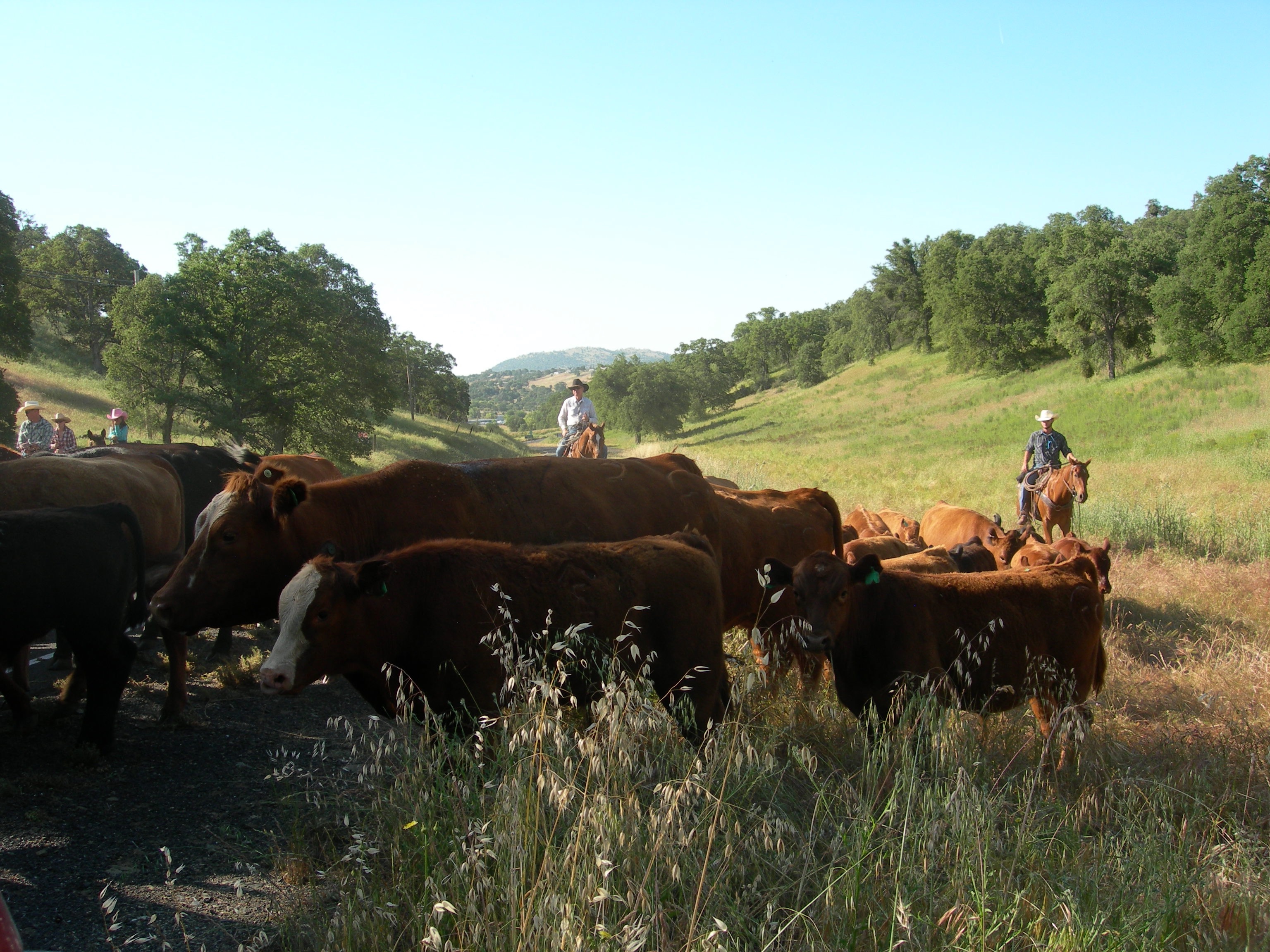
This morning (May 3rd) they moved the cattle toward their high pastures. Where I live, that movement normally happens twice a year.

Here in the foothills of the Sierras, we are coming to the end of the green season, in a year that was unseasonably wet. For five or six months every year the hills are covered with lush grass and cattle. The rest of the year is dry, burned brown, and mostly free of livestock. Most of the cattle that disappear in May migrate directly to your local grocery store meat counter. Some of the mothers and calves which will provide next spring’s herds move up the mountain to summer pasture.

Mostly, this is by trucks hauling specialized trailers. You see them everywhere on the roads and in the fields during this season. But one local rancher still holds a biannual cattle drive. I get the impression that some the herders are paid hands, but most are volunteers. After all, if you were a cowboy, or worked cattle from your pickup truck and wished you were a cowboy, wouldn’t you jump at a chance to join a cattle drive? Even if it only lasted three days?

They pass only a short distance from my house, and my wife and I never miss an opportunity to watch.

I grew up on a dairy farm in Oklahoma. Twice a day from age eleven until I left for college I was in the close company of cows, and I miss them. My wife just loves animals of any kind.

What does this have to do with A Writing Life? If you were Truman Capote, probably nothing. If you were Gore Vidal — well maybe. After all, Vidal worked for a time for his grandfather who was Senator from Oklahoma. But probably nothing; Vidal, like so many writers, was an urban type.

I’m quite the opposite, and the natural world permeates my writing. While I will never write an Andre Norton pastiche about herding frawns across Arzor (a statement Norton aficionados will instantly recognize), watching the cattle go by is likely to inspire me to rush to the keyboard. Like I just did.

I took these pictures, and picked those which would leave place and people unidentifiable. We all like some privacy.

=================

“Post”script, May 17: By coincidence, the second herd of the spring drive went by about six hours ago.

Raven’s Run 148

November 10, 1989, Antibes, France

Raven had gone to walk the beach. I let her go alone, sensing that she wanted it that way. I had things to think about anyway.

In mid-August, the Austrian-Hungarian border had opened and all those East Germans had made their way to West Germany by the long way around. I missed it; I was in ICU when it happened.

In late September, more escaping East Germans made their circuitous way to the West German embassy in Prague, and from there to West Germany. I followed their flight in the newspapers, in an outpatient center in Bergen while waiting to find out if I was going to be tried for murder, or released on self-defense.

Then last night, the Berlin wall fell. Just like that. 

It would be years before all of the confusions, clumsiness, and accidents of that event were fully understood, but in today’s newspaper it was clear that it had all happened in one night. There were pictures of young men and women with sledge hammers, breaking down the concrete barriers and walking away with souvenirs.

They built the wall the year I was born, and now it was history. All across eastern Europe, vast changes were taking place, and I was chafing to get in on the action. 

*          *          *

November can be a cruel month, even on the Riviera. By two o’clock a chill wind drove Raven up from the beach. Her bikini was more conservative than the one she had inherited on the Wahini, but not by much, and her smile was radiant as she came up the stairs to the balcony.

I followed her into the apartment and went to our bedroom for clothing. As I passed the mirror, I checked my reflection. Sun and exercise were beginning to put me back together again. My torso and legs were honey colored with new tan. My left side was a mass of jagged, interconnecting scars where the Norwegian doctors had probed for broken rib fragments. There were perfect coins of untanned scar tissue on the front and back of my left thigh where the other bullet had passed cleanly through.

In the kitchen, Raven set out food on the tiny iron table by the picture window. The Mediterranean beyond was that same wine dark sea that Homer had sung of millennia ago. Raven had slipped a shawl around her shoulders. I kissed her, and held her for a long time before we sat down. Later, when the meal was done, she said, “We need to talk.”

“I don’t like the sound of that.”

She patted my hand, and said, “It’ll be okay.”

“Are you going to marry me?”

“Wait. Let’s talk first. Do you remember the note I left you in Paris?”

I would forget my own name before I forgot that note.

Ian,
I am not like most people. You surely know that by now. Every day with you has been an adventure, and I thank you for all of them. But love can be bondage, for a person like me. Lately, I have been afraid that I was falling in love with you, and last night I proved to myself that I was. For someone else, that would be cause for happiness. Not for me. It would spell the end of all I have tried to become. Maybe we will meet again some day, and we will no longer be enthralled with one another. Then I can explain. I can’t explain now. The explanation would also tie me to you. I’m sorry. More sorry than you can ever know.
                                  Raven

“The central fact of our lives,” I said, “is that I love you and you love me.” more tomorrow

353. Two Times Gordon Dickson

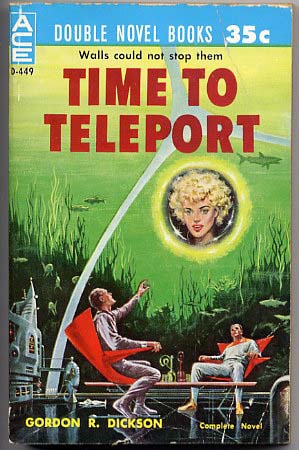
I have on the desk in front of me a book, Ace Double D-449, which was previously owned by Mrs. Elffa E. Philbrick (address redacted) of Urbana, Illinois. I don’t know her. I have never met her, and I don’t know if she is still living. At some point, she placed a return address sticker on the first page – an ordinary person’s version of the ex libris stickers used by fancy people. You don’t see ex libris stickers in Ace Doubles.

I presume Mrs. Philbrick was the first owner of the book. It was published in 1960 and the sticker has no zip code (zip codes came out in 1963). The sticker and the book are equally age-yellowed. That’s all the detective work I could accomplish. There is no way to know how many people owned the book after her, but before I bought it at a local used book store.

One of the minor pleasures of buying used books is occasionally seeing the metaphorical fingerprints of previous owners. They always leave me speculating on how they lived their lives. Was Elffa, perhaps, a suburban housewife with six kids, laundry, PTA, and all the rest, who led a secret life of the mind by traveling, via novel, to distant worlds?

She might also have been a pioneer female engineer working in a local defense plant after a childhood of reading Jules Verne and Edgar Rice Burroughs. But in 1960, which was more likely?

Ace doubles are paired short novels, printed back to back. They are important in the history of science fiction, and will get a post of their own later. This one has The Genetic General on the front, with Time to Teleport on the flip side, both by Gordon R. Dickson.

The Genetic General is part of Dickson’s multi-book Child cycle, AKA the Dorsai books. They include some of my favorites novels and a few that were, in a family phrase, half a bubble off of plumb. Someday I will do a full treatment of them, for the sake of any SF fans – if there are any – who have not already become addicted. Today I’m going to concentrate on Time to Teleport, which is quite a lot better than its title and cover suggest.

(Aside: One of the nicest things about Ace Doubles is that they have two covers, which leaves no space for lying back blurbs.)

Brief summary, sans spoilers:   The world has progressed beyond war, by rearranging its allegiances. Territorial states no longer exist. The Groups which replaced nations are global in scope, and defined by function, such as Communications, Transportation, or Underseas. As the story opens, Groups have been in place for eighty years and have served mankind well, but times have changed and a crisis impends.

The story centers on Eli Johnstone, former head of the Underseas Group. Eli has a secret, deeply buried, that holds the key to the future of mankind.

I bought this book because I realized that, although Ace Doubles had been a staple of my reading during the sixties, I didn’t have one in my library. I chose one which had a proven winner on the front. Since I don’t always like Dickson’s non-Dorsai work, I had small expectations for Time to Teleport, but I was pleasantly surprised. It was a refreshing dip into the-way-things-used-to-be.

It was also a preview of things to come in Dickson’s work. Eli has a bad knee (as did Cletus Grahame), used a cane in the beginning (as did Walter Blunt), and teleportation is a key element. By the second chapter I was expecting an early version of a key scene from Necromancer, but that didn’t happen.

What did happen was a story that tasted like vintage Dickson, and a little like Heinlein’s Lost Legacy (see 148. Lost Legacy). Eli, as the genetically superior man who saves mankind, reminded me of every other science fiction story from the sixties and seventies. So did the heavy reliance on psi forces.

Time to Teleport had an almost naive hopefulness about mankind’s future which I haven’t seen in science fiction lately, and which I miss.

Raven’s Run 147

The eye is a sphere about the size of a target’s bullseye. Don’t look at the visible lids and lashes. See the eyeball behind it. See it as the bull of a target.

Sgt. Davenport had told me that, in Germany. His voice echoed in my ears as the sight picture came into focus. There was a tearing jolt that staggered me and the picture wavered. Then the sights settled again and I squeezed the trigger.

I shot the stranger through the right eye with my last bullet. Small, fast, and jacketed, the round went in and out of his skull with little fuss. He staggered and fell, rolled over twice and ended face down, staining the water of the lovely green seep.

I had to get to his revolver, but there was some confusion about how to get there. Something fierce had a Rottweiler grip on my leg. I looked down and saw blood spreading across my thigh. Then the pain hit, and I had to fight it down. I started forward, stumbled, then lunged up and staggered toward where I had seen the revolver fall. I heard another shot and the whip of the bullet as it passed. 

Susyn was there; she had circled beyond us and was standing near the verge of the drop. The revolver was on the grass, closer to her than to me, and she was looking over the sights of Alan’s automatic. Her violet eyes were mad. She would not miss. And she would not fire once. She would empty that cavernous magazine, and every shot would go home.

Then her eyes wavered. Someone else was behind me, moving away, drawing Susyn’s gaze with her as she moved. Someone Susyn hated nearly as much as she hated me. Raven. 

As Susyn’s eyes followed Raven, and the gun muzzle moved, I lunged forward. Susyn twisted the gun back and fired. Something hit me hard and I staggered. Left handed, I slapped the gun aside. 

Right handed, I hit her in the mouth. 

I tried to break her neck with the blow, but most of my strength was running out of bullet holes in my side and leg. She flipped backward and went gracelessly heels over head down the short slope to the brink of the cliff. I went after her, dragged by my own momentum. I dug my heels in and slid to a stop at her feet as she staggered for balance. She had kept hold of the gun. I knocked it upward, and that was all it took to overbalance her again. She fell backward. 

Some things are automatic. Like man overboard drill.

I reached out for her. I grabbed for her flailing hand and I swear I could have caught it. Could have dragged her back, even then. Could have calmed her. Could have convinced her, eventually, that there was nothing she could do for her brothers and no need to die trying to avenge them.

But I saw her eyes. I saw the violet madness in them, and knew that nothing would ever calm them. That as long as she lived, neither Raven nor I would have peace. I saw that madness just as she reached – instinctively – to grab my hand and save herself.

I saw her eyes and closed my fist. 

She reached for a hand no longer open. Her straining fingers brushed my knuckles and she fell away screaming. I saw her eyes when I closed my hand, saw them as she fell away, saw them in my mind all the way down until the clatter and whump told me the fall was over.

Saw them still, when Raven stood over me, wrapping my wounds and stuffing them with torn clothing to keep the life in. Saw them through the endless time of waiting, lying in the mud and grass, through the dimness and cold of a long Norwegian evening while Raven went for help.

See them still, in these fever dreams. more tomorrow

352. A Modern Maverick

The old TV show Maverick has been on local channels lately. It was one of my favorite programs when I was twelve years old, but I’ve pretty much outgrown it. I don’t watch the reruns, but they started me thinking about an American archetype — the lovable con man.

There are a lot of them in literature, and a lot more moving among us in our everyday lives. You know him, weird Uncle Bob who always has a beer in his hand but never buys drinks. Or Uncle Jim who thinks it is wonderful that you are planting trees in your mother’s yard, and drives home to get his favorite shovel, but never comes back.

What all these slick dealers have in common is that they are funny, charming, and it is almost impossible to stay mad at them. They’ll steal your beer, or steal your heart, or steal your money, and leave you laughing at how easy you were to take.

In the movie version of Maverick, he says, “There is no more deeply moving religious experience, than cheating on a cheater.” Cute, but in point of fact, Bret and Bart and Beau cheated everybody. It doesn’t matter though, because they were charming.

There were others before Maverick. Starbuck, in The Rain Maker, teaches Lizzie that she is beautiful, but she marries her home town swain. Good thing. If she had run off with Starbuck, it would not have ended well.

Harold Hill, in The Music Man, made a career of separating suckers from their money. He was charming and slick and thinks faster than the locals. When he falls in love with the librarian, it changes his attitude. She reforms him. Okay, fine, but for me that doesn’t saves the movie; the line that saves the movie is when he tells Winthrop, “I always think there’s a band.”

See, he didn’t mean it. He thinks he’s giving something back. He’s a good Joe at heart.

If a con man believes his own lies, does that make us forgive him? In the movies it frequently does. But what if a real Marian the librarian married a real Harold Hill. We would probably find her later with eight kids, hungry and living on skid row, after Harold Hill moved on. I like the movie version better.

Does our charming American con man believe his own lies? Does he even know himself where the truth is? Does it matter to him? Does it matter to us?

If he is slick enough, and fast enough, and plausible enough — if he can tell one lie to cover another until we get lost in the shell game — there is no limit to how far he can go.

He could even become President.

Raven’s Run 146

He was alert and ready, unhurried and unworried. If he had known that I only had one bullet left, he would have worried even less.

I bellied forward in the direction Raven had gone. The ground sloped away gently toward the valley below. Someone, probably the gunman, took a shot at the moving grass but I never heard the bullet sing. I crawled into moisture and turned with it, following an inch deep seep until it tumbled over a lip of rock, and I tumbled over with it. I sensed motion behind me, rolled over, and brought the Tokarev up. 

It was Raven.

She was crouched down behind the low bank, with her muddy knees driven deep into the loam. She wore loose, light pants and shirt, some kind of silk jogging outfit, with a windbreaker and a band to tie back her hair. She had muddy elbows and knees, and a dark smear of mud across her cheek. Her eyes were wide with fear.

Then puzzlement. Then the fear disappeared as she recognized me.

She gave a little yelp and fell forward into my arms. She was breathing heavily, perhaps crying a little. She buried her face in my neck, holding me tightly. I could feel her body trembling, and then she pressed her face upward and I had the sweet taste of her mouth on mine.

I pushed her off, although it was the last thing I wanted to do. She shook her head in wonder and said, “Where did you come from. Why . . . ; what . . .”

I grinned at her and shook my head. “Later. Now get down.”

Susyn and her dark companion were out there somewhere, and I had only one bullet. Things didn’t look good, but the electric charge that had passed between Raven and me was worth more than adrenaline. There was no way I was going to die now. I had more important things to do.

Before sticking my head up, I listened hard and heard a strange, penetrating sound. Susyn’s voice. Susyn’s death lament for her brother, the fourth and last, all dead by violence. Two of them dead at my hands.

I looked over the grassy rim. Susyn was kneeling with Alan’s lax and bloody head against her breast, rocking back and forth, crying out with a high and rhythmic keening. It set my hair on end. The dark man was crouched beside her, unmoved. If I had had two bullets, I would have spent one on him.

I slid back and motioned to Raven to follow. We went downslope on knees and elbows, but within three hundred meters, the seep tumbled over the verge of a grassy cliff. It was a steep, green and lovely drop, but the grass and mosses did not disguise the granite beneath. We could go no further in that direction.

I looked back. Susyn and her man were coming our way, walking fast and separating as they came. Susyn’s path was carrying her away to the left. The Levantine was coming directly toward us.

I eased down. He had been looking to his left. A quick movement on my part would have caught his eye. Raven put her hand on my ankle and I shook my head. I motioned her back upstream and whispered, “Get twenty feet away and draw his attention the moment you see him.”

She moved away without protest. I checked the Tokarev briefly. Seconds. I had only seconds to wait – seconds to live or die.

I heard Raven draw a sharp breath as the stranger came into sight. He turned toward her, raising his revolver, but in that same moment he had sensed the trap and begun to turn back downslope. I raised the Tokarev two handed, in classic Weaver stance, and brought the sights to bear on his face. more tomorrow

351. Who Is Listening?

When EDGE accepted Cyan for publication, I was less than enthused about publishing in eBook format. I’ve changed my mind.

It wasn’t the notion that science fiction authors should embrace technology that got to me. It was who responded to my website.

Building a website has been a learning experience, and I sometimes feel I’ve only begun. At first, no one was reading, but I expected that. Eventually, views began. Even later, likes began. I kept writing. I knew that gaining readership is a long-haul process.

I found it addictive to view the websites of the people who responded to me. One of the most surprising things I found was the number of respondents who were clearly from somewhere in the world other than America.

I regularly put out eight posts a week, many of which require research, and I have a life to live. That doesn’t leave me a lot of time to spend under the hood of WordPress, but I did find 

           https://wordpress.com/stats/day/(insert your own url here) 

which lets you click see how many views and visitors you had on any given day. More interesting, it shows a map that tells you which countries those views came from.

I was blown away.

To be specific, these are the results from this year, January 1 through April 21.

USA                    45%
Canada              28%
India                   8%
Australia            5%
U K                      4%
Switzerland       3%
South Africa       2%
Hong Kong       about 1%
Morocco           about 1%
Ukraine             about 1%
Romania          about 1%
Singapore        about 1%
Ireland             about 1%
Czech Rep.      less than 1%
Spain               less than 1%
Philippines      less than 1%
Japan               less than 1%
Kenya              less than 1%
Germany         less than 1%
Jordan             less than 1%
Israel               less than 1%

Global, indeed.

So, back to the initial statement — Yes, I would like to have Cyan on every bookstore shelf and in every library, not just available on line. However, no matter what happens from now on, I will insist that whatever I publish in the future will also be released as an eBook.

This goes back the the very beginning, to my childhood. Growing up on a farm, at first I had only G&D books (Tom Swift and the like) purchased from a local hobby store. Then I found the county library. I didn’t see a real bookstore until I was in college.

Those books were my window to the world.

Today, a book hungry young person with access to the internet can find — and afford — eBooks, even if her or she lives in India, South Africa, or Ukraine. I like that, and I’m proud to be part of it.

Raven’s Run 145

Chapter Thirty-eight

In that brief moment, Raven had not seen me, and she did not look back again. I stripped off my windbreaker and tossed it aside as I ran, pulled out the Tokarev and racked back the slide. 

The new man was faster than Susyn. He sprinted ahead, closing the gap on Raven as I closed on Susyn. Raven was moving well, and he was only marginally faster. Perhaps she would make it to Flam before he caught her. We could not be far above the village now.

Then Raven rounded a curve and pulled up, faltered, and headed off to her left across the grass. The stranger turned with her and then I saw why. Skinny Alan had come up from below to block her path.

The grass was knee deep in the fullness of it’s summer growth. Raven was having hard going. Her pursuer was gaining fast, and Skinny Alan was moving up at a diagonal to cut her off. He looked over his shoulder to call to Susyn and saw me. He almost fell over his own feet in his hurry to straighten up and change direction. Susyn looked over her shoulder and I was right there. I smashed into her as I passed, knocking her rolling across the meadow. Alan was pulling out a pistol. I raised the Tokarev, thought better of it, and took a forward roll. I had no bullets to waste on a moving target. Alan sprayed the air, triggering one of those double stacked wonder-nines as fast as he could pull the trigger. It was one step below a submachine gun. I went flat, hugging the earth and scuttling sideways.

Then silence. Alan would be reloading. The grass was half a meter high, and I could not see him without raising my head. I shoved the Tokarev in front of me and gently parted the grass, moving it from the roots with my left hand. I saw blue cloth, probably Alan’s shirt. He moved out of my sight to my left and I slid carefully to the right.

There was motion behind me and Alan fired again. I heard Susyn’s scream of fright and anger; then I jerked upright and fired once into Alan. He spun on me, raising his pistol and I had to fire again, taking an extra fraction of a second to line up the sights. He jerked mightily, firing again into the air, and fell back into the grass.

Susyn screamed in rage and I dove for the ground as she fired in my direction.

The long summer grass saved my life. Susyn’s bullets were like steel bees as I scuttled away, belly flat. The air smelled of decaying vegetation, that sweet mushroom smell of a wild, wet meadow. After a hundred feet of wild scrambling, I chanced a backward look. Susyn was kneeling beside Alan, and the stranger she had brought with her was watching impassively, waiting for orders. The revolver in his hand looked businesslike. He glanced up, then back to Susyn. He was alert and ready, unhurried and unworried. more tomorrow

350. Master Basho’s Dojo (2)

Regular readers will notice that these posts are coming later in the day.

Keir, back from Cyan, has found Uke Tomiki after his disappearance. You really should read yesterday’s post first, if you missed it.

They ate supper with the master of the dojo as the evening fog rolled in to mask the hillside and hide the view of the slum. The old man introduced himself as Basho. At Keir’s puzzled expression, he explained, “The name is familiar, perhaps? Basho was a seventeenth century poet, famed for his haiku. I took his name when I opened this dojo. I was born under another name.”

They sat on tatami and ate rice with scraps of vegetables and fish. It was not fancy, but there was plenty of it. Keir suspected Uke’s back salary assured that.

Keir had wanted privacy to talk to Uke, but the master of the dojo was soon engrossed in his meal, and ignored them so completely that it was as if they were alone.

Keir said, “Uke, I need you.”

“For what, Keir?”

“Will you come with us to Cyan?”

“Of course,” Uke smiled. “I was only waiting for you to ask.”

“Why did you wait? You knew that you would be welcome.”

Uke looked serene, but it was apparent that it was a hard won serenity. Much pain lay beneath it. He said, “Keir, my arrogance almost cost you your life. Or made your life a thing not worth living.”

“How so.”

“My testimony.”

“You were in pain, and you only told what you knew.”

Uke shook his head. “No. If I had acknowledged my pain, I would have never put you in danger. I hid my pain, hid my uncertainty, and attacked the court-martial board. Their whole lives were dedicated to the acquisition of power, and I threw in their faces the fact that they had no power over me. If I had gone in meekly, they would have treated me gently, and I would never have been badgered into giving them the testimony they used against you.”

“You can’t blame yourself for what they did. I don’t.”

“Blame is not the issue, Keir. I cannot control what they were and what they did. But I should be able to control what I am and what I do – and I didn’t. I attacked when I should have been silent. I would never jump a kavine with my bare hands, because I recognize its danger. I did not recognize the danger that panel represented. Worse, I did not realize that my attack would put you in danger. And I should have.”

“And so . . .?”

“And so, I compounded my failure. I went from stupidity to stupidity. For a while, after the trial, I spent my time drinking, taking drugs, and walking dark streets alone, as if I were searching for death so that I would not have to face my failure. Eventually, I came to my senses and returned here, to regain my balance.”

“Returned?”

Uke nodded. Keir pushed his empty rice bowl aside and said, “When Stephan told me you had come here, we agreed that it was unlike you. You never seemed to have much feeling for your Japanese heritage.”

“That is largely true. My father was a fifth generation citizen of USA. He and his elder brother were most unlike one another. His brother embraced zen, became a black belt in several disciplines and spent much of his adult life in Japan. My father, on the other hand, loved football, beer, and everything American. What he knew about Japan, he learned in college. When he became ambassador, he went to Japan as much a foreigner as if his name had been John Smith. And I am my father’s son.”

“But . . .?”

“But even as a boy, I loved my uncle and, odd as his ways seemed to me, I spent time with him when he returned to San Francisco to found a dojo.”

They were silent for a moment, and the old man raised his chopsticks in a kind of salute. Keir said, “How old are you, Uncle?”

With mock formality, Uke’s uncle replied, “I have had the privilege of seeing the year ’06 once before, although I was too young to remember it.”

“Uke, are you ready to take on the world again?” Keir asked.

Uke looked toward his uncle, who nodded and said, “It is time.”

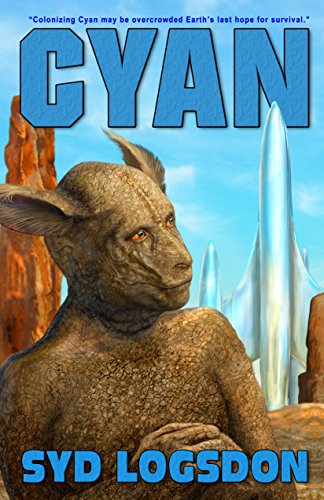
This is your last freebie. What are you waiting for – go download Cyan.