Author Archives: sydlogsdon

Raven’s Run 139

There was nothing to do but wait. I settled in on a bench across from the Movenpick ice cream store and watched. So late in the season, most of the Americans had flown home. Some Germans, French, and British remained, but it was mostly a lean, blonde, fit stream of Nordic pedestrians that wandered by.

Ron stayed with me for half an hour, protecting his investment, but he eventually got bored and left. He said he would be back. I doubted it.

I moved with the sun as the hours passed. Just sitting and waiting was chilly, as well as tedious. The fountain in the middle of the grassy area had a quartet of bronze statues of innocent, playful, basically sexless children, getting ready to leap into the fountain for a swim. About eleven o’clock, some real ten year olds actually went wading, but they were Norwegians, and tougher than I was. Seven years in California had spoiled me.

Scores of brown-headed gulls came by to be fed. Young lovers, old men in conference about the world’s troubles, and even a trio of tough looking sailors, kept them happy.

Singly and in small groups the street musicians began gathering as noon approached. Apparently they knew something I didn’t, because about that time groups of overdressed, camera clicking tourists began to wander through. The effluvium of a cruise ship, perhaps? 

I didn’t talk to any of the musicians. There would be time for that if Raven or Eric did not show up. A very talented young flamenco guitarist set up and began to play. Half a dozen of his friends drank beer and talked quietly behind him. An occasional kroner fell into his guitar case, but he wasn’t making expenses.

Down the street, a nine year old kid was playing electric guitar very badly and singing in an untrained voice. He was using a thousand dollars worth of equipment and making a hundred dollars a day on charm and youth instead of talent. The flamenco player was breaking my heart with his music and starving.

A drunk came up and began strumming his beer bottle. He put his arm around the flamenco player; the guitarist cringed, probably singed by hundred horsepower breath. One of the guitar player’s friends tried to lead the drunk away. The drunk was obstinate. Another of the friends came to help and the two of them dragged the drunk off. He resisted, there was a scuffle, and the drunk ended up on the ground. He thrashed around like a beetle while the friends returned, shaking their heads. Then he began wailing. His plaintive voice drowned out the music, and the guitarists had to stop. I was glad he was speaking Norwegian; the sound was irritating enough without understanding the words. Eventually, he staggered to his feet and went off muttering.

The joys of performing.

I looked left and Eric was there, opening up his instrument case. Raven was nowhere in sight. more tomorrow

344. Teachers

This is teacher appreciation week, and I certainly do appreciate teachers. Most of them anyway. I’ve known a few who needed to find another profession, and a very few who needed to be shot. Sorry if that offends you, but I stand by it.

The overwhelming majority of the teachers I have known have been hard working, caring, dedicated and competent. I understand that better than most people, because I was one of them, and working along side of them. How I came to be a teacher, is another story.

First I wanted to be an astronaut, but claustrophobia and bad eyesight killed that dream before I got to high school. Then I wanted to be a scientist studying ecology, but I got to college when everyone was infatuated with the double helix, ten years before ecology burst on the scene. I studied South Asia as an anthropology major for five years, through my first MA, before reality set in and I realized that I would hate the field work. That was when I started writing, and started my second MA in History. Now I had found something I could have loved writing and teaching at the college level, but about that time there were two would-be professors for every available position.

Timing is a killer.

Money got short so I decided to do a little substitute teaching. It was a revelation.

I taught kindergarten one day and it was a disaster. I taught fourth graders — every teacher’s first choice — and almost died of boredom. I taught middle school — every teacher’s nightmare — and loved it. So I went back to college (for the fourth time), got a credential and spent the next twenty-seven years teaching sixth, seventh and eighth graders.

I have been told several times by parents that there is a special place in heaven for me because I chose to teach middle school kids. I don’t see it that way. Middle school kids are more fun than a bucket of puppies, if you don’t have to take them home with you at the end of the day. I think those parents may have been projecting some of their own feelings.

I remember one meet-the-parents night, sitting down with one of my girl students and her mother. The girl had been a fine student, not troublesome at all, and I had thought of her as mature for her age. Sitting next to her mother, she squirmed like an eight year old, talked back, and generally gave her mother hell. It was amazing to see how different her at-home personality was from her at-school persona.

Not having middle school kids at home probably accounts, in part, for liking them so much in the classroom.

I’ll tell you another secret about teaching. It takes all kinds — assuming decency and competence. Some kids will think you are great because of what you teach, or because of how you teach, or because your personality happens to mesh with theirs. Other kids will hate you for exactly the same reasons. These are your choices — if you are a good teacher, some will love you and some will hate you. If you are a bad teacher, most of them will hate you, and a few will just be happy to go to class without having to work..

If you want to be universally loved, you should choose another profession.

Raven’s Run 138

He was tall and rawboned, with a bushy blond beard, long hair, dressed in jeans and a U-2 tee shirt, with a relaxed and bemused expression that said “American.” He should have been fit and strong; you could tell by his bone structure that he had the genes for it. But he hadn’t done the work, so everything looked soft and toneless.

I walked up to him and said, “I’m Ian Gunn.”

He stuck out his hand and said he was Ron Anders. Of Norwegian ancestry, even though his folks lived in Kentucky now. He had come for the summer, and had taken up with a girl from his home state that played Appalachian dulcimer. That was why he was wandering around with musicians. He couldn’t play a note or carry a tune himself. That was how he had come across the flyer with Raven’s picture on it and why he had been keeping an eye out for her ever since. 

I listened with what patience I could muster. I was afraid that if I stopped his rambling, I might not get him talking again. I needn’t have worried about that.

He had gotten the flyer in Copenhagen, and that was three weeks ago, and he had not seen hide nor hair of Raven from that day until just two days ago when he had seen her here.

“Where? Where exactly did you see her?”

He would show me. But first, he wanted to be sure that he would get the reward. It was important to him. He tried to tell me why, but I couldn’t listen any longer. I gave him my card. I gave him Senator Cabral’s card. I wrote him an IOU that said if he showed me Raven, I would personally see to it that he got his money. He nodded over the paper, then had me sign it, even though it was in my handwriting. Then he folded it carefully and put it into his wallet and said, “Come along this way.”

He led me up Karl Johans Gate north from the train station through a fashionable pedestrians-only walkway. Within half a mile we came to a small park with a large triple fountain beneath columns of young, well kept trees. The grassy strip was a hundred feet wide and a block long, dotted with benches of concrete and steel.

Ron Anders gestured and said, “This is where I saw her. Two nights ago. She was with a guy who played violin.”

“A blonde guy? Well built? Good looking? Hardanger fiddle?”

“Yeah, that sounds like him,” Anders said, “but what kind of fiddle are you talking about?”

I shook my head. “And you call yourself a Norwegian. Was his violin decorated with ink drawings and did it have eight tuning pegs.”

“Man, I don’t know. Who notices things like that?”

Not Ron, certainly. 

It was only eight in the morning. There would not be many street musicians until later in the day, and the best of them might not come out until afternoon. I asked Ron where they were staying.

“I don’t know. I didn’t talk to them.”

No need to ask why. He hadn’t wanted Raven to call Marseilles herself and screw up his chance at the reward money. more tomorrow

343. Black Shuttles

Atlantis, first launch, DOD mission.

Regular readers will notice that these posts are coming later in the day.

During the planning stage of the Space Shuttle, some changes were called for by the National Reconnaissance Office. That is an organization which, at that time, was not acknowledged to exist, but which is the home of sophisticated space hardware and a big budget. Specifically, NRO wanted the cargo bay on the shuttles to be bigger, presumably to accommodate their oversized spy satellites. They got their way, and the money they provided helped keep the struggling shuttle program afloat during the hard early days.

We’ve been looking at the Air Force in space this week and NRO isn’t the Air Force — quite. However, the head of NRO has traditionally been an undersecretary or Assistant Secretary of the Air Force. So, close enough.

It would not be unreasonable to think of the Air Force as an organization run by pilots and ex-pilots. MISS was a program designed to put men into space; so were the Dyna-soar and the MOL. But none of them ever succeeded in putting Air Force astronauts into space.

During this period of public failure, there were secret successes in the form of more and more military satellites. One of the earliest class of mission was reconnaissance, and the Air Force/NRO success with unmanned satellites was the primary reason MOL was abandoned. Through the sixties and into the seventies, these satellites used sophisticated film cameras, and their findings came back to earth via film canisters dropped from satellites and snagged out of the air by military aircraft. After digital imaging came to maturity, that was no longer necessary.

Sidebar.      Just how successful those satellites were, and how rich the NRO is, became embarrassingly obvious in 2012. The NRO gave NASA two Hubble-quality space telescopes that they had ordered, but weren’t using. One of these is slated to become the Wide Field Infrared Survey Telescope, due for launch in 2024.

At the same time that the Air Force, through NRO, arranged to have the shuttle’s cargo bay expanded, it began to build a shuttle launching facility at Vandenberg Air Base in California. To understand what this means requires knowledge that every space nerd had in the sixties, but which is never talked about these days.

Why do we launch space missions from Florida? Because it is the only place in the US which is both far south and on the eastern seaboard. Rockets are typically launched as close the the equator as practical so that the rotation of the Earth is added to the rocket’s speed — something vitally important when crude, early craft were being launched. They are launched from the eastern seaboard to provide thousands of miles of open ocean for first stages — or fiery, falling failures — to land in.

Vandenberg is situated on the western edge of the nation, ideally located for launching rockets north or south into polar orbit — that orange-peel path spy satellites need. Advanced Titans and Atlases launch from there as needed, without fanfare. But not with complete secrecy. It is a California cliché for a UFO scare to be debunked as “just another night launch from Vandenberg”.

The Johnson Space Center is in Huston because Texan LBJ was President when it was built. Orbital physics had nothing to do with it.

No shuttle was ever launched from Vandenberg. Shortly after the second classified Department of Defense shuttle mission, the Challenger was lost. Important secret launches were delayed by the hearings that followed.

The relationship between NASA and the Air Force had never been a happy one, and the Air Force shifted as quickly as possible back to its own resources. They used the shuttle to take up satellites too large to be launched by other means, and otherwise returned to using their own missiles, typically out of Vandenberg.

The Luke Skywalker picture of Air Force pilots in their space fighters has never come about. The closest to that idea is the robot X-37b, which we will look at in some future post.

——————————

The Smithsonian Air & Space magazine carried an article in 2009 on the eleven black shuttle missions. Since most details are still classified, the article is frustrating, but will provide about as much as you will find anywhere outside of alien-influence websites.

Raven’s Run 137

Now their eyes were weary, glazed, and often drunken. They sat together in national groups; Americans, or British, or Germans seeking the familiarity of their own kind. No more reaching out to strangers. No more open acceptance. Somewhere along the line, each one had found his own personal disillusionment and nursed his own personal betrayal.

Innocence would not ride the trains again until June returned next year.

*          *          *

Since early May, when West German television had shown Hungarians beginning to remove the fence that lay between their country and Austria, East Germans, smarting from their own stolen election, had been going south on “vacation” and not returning. Now uncounted thousands of East Germans were refugees, scattered all over Hungary. The Honecker government wanted them sent back. Hungary demurred, but had no way to deal with such an influx.

I knew it was a major event, but I didn’t realize how important it would become. I decided if I didn’t find Raven in Innsbruck or Vienna, I would stop in at Budapest to see things for myself.

I never got that far. 

In Innsbruck, I called Will from the train station, while I watched the hikers in their Tyrollean hats and lederhosen waiting for the next train. They brought a smile. Their outfits were outrageous to American eyes, yet they were as genuine for the locals who wore them as Stetsons were in Texas.

“Ian,” Will said as he came to the phone, “they found her. Some tourist saw her in Oslo.”

*          *          *

I could fly out of Innsbruck, but connections were bad. I could take the train to Munich or Vienna to fly to Oslo, but that was get me there at two AM. It made more sense to get back on the next northbound express and take the train all the way.    

At three in the morning, I was awake watching them put the train on the ferry at Helsingor, and at four I was wide awake watching out the window as we rolled up the Swedish coast. A month ago it would have been daylight at this hour, but in mid-August the long days of summer were fading and the long, cold nights of winter were not far ahead.

The last hour coming into Oslo seemed to drag on forever as the train worked its way slowly through the dense sprawl of tracks. I was the first one off the train; swinging along the concrete apron, I could feel the tension jumping in my stomach. Even if Cameron Davis kept his agreement, Raven would not be safe until Susyn was called home.

I rode the slide ramp into Oslo’s Sentralstasjon, crowded with people arriving and departing for every part of Europe. Outside was an open square of cobblestone and marble, surrounded by nineteenth century buildings. Taxis were coming and going; busses waited across the street. In the center of the square was an ultramodern steel and glass clock tower, and beneath it was my contact. more tomorrow

342. Dyna-soar

Regular readers will notice that posts are now coming later in the day.

MISS, Man in Space Soonest, was a USAF project to put a man into a capsule and boost him into space on top of a converted ICBM. It was cancelled, resurrected, and passed on to the new organization NASA, where it became Project Mercury.

Times were tense. The Soviets had launched a satellite into orbit in 1957, beating America into space by a few months. They added to the humiliation by beating the US again in 1961, this time with a man in space. Worse than either accomplishment, was they booster that was used. It was far more powerful than anything America had in service, or in development. A booster that powerful presented all kinds of doomsday scenarios.

Eisenhower had plenty of problems at the time. He was using U-2 spy planes to illegally overfly the Soviet Union, and recognized that it was only a matter of time before that blew up in his face — which it did in 1960 when one of the U-2s was shot down while spying. MISS being transferred to NASA made it a civilian project, and less objectionable. The same logic led the Navy originated Project Vanguard to be passed on to NASA, and also to the use of underpowered rockets to launch it because they were not military hardware.

Sputnik and the Soviet manned missions were on top of a military booster, rendering that concern moot.

NASA went on to success in manned space flight, but in the fifties and early sixties, that was not a foregone conclusion. The Air Force moved on to the Dyna-soar.

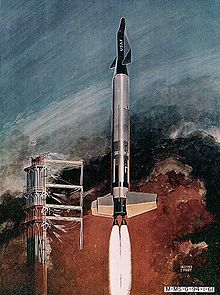
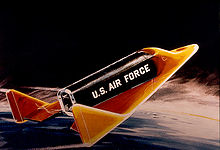
Project Dyna-soar (from the phrase dynamic soaring) had begun in 1957, when it was to be the next step after MISS. It was based on the theories of Eugen Sänger, who had a suborbital bomber on the drawing board for the Germans during WWII.

The basic idea was to send a winged vehicle above the atmosphere on top of a rocket, whether in a sub-orbital flight or returning from orbital flight. That craft would skip repeatedly off the upper atmosphere on returning, dissipating the heat of reentry, and ultimately land as a glider.

This sounds a lot like the Space Shuttle, but there are two main differences. STS was designed as a single stage to orbit vehicle, and it dissipated heat by shock waves while being protected by insulated tiles, much like the Mercury through Apollo missions had used shock waves off ablative heat shields. Dyna-soar was designed to ride into orbit on top of a military rocket and to lose its heat by skipping — that is, by dipping into the atmosphere, then bouncing back into space to radiate away the heat it had built up, followed by repeat, repeat, repeat, until cool enough to finally land as a glider.

That would make for a long, hard, bumpy ride. If you are simply thinking of reentry, it would be a unnecessarily tough way to go. To understand why the skip-glide method was so inviting, you have to project yourself back to dawn of the 1960s when rockets were small and space exploration was new. With skip-glide, a relatively small and not particularly powerful rocket could send the Dyna-soar anywhere on Earth.

When Alan Shepard made his sub-orbital flight, he traveled 116 miles above the Earth but landed only about 300 miles downrange. With that initial altitude, Dyna-soar could probably have circled the Earth before landing.

Dyna-soar was developed as a reconnaissance and bombing vehicle. It was, after all, an Air Force project.

Had it gone to completion, the Dyna-soar (also called the X-20 later in its development) would have been the most sophisticated space craft of its era. Unfortunately, money was scarce, and while in orbit, the Gemini could do anything the Dyna-soar could do.

Gemini was a monumentally successful project (see Gemini) that sucked up all of America’s attention. In December of 1963, the Dyna-soar project was cancelled.

Again, the Air Force had lost out to its civilian counterpart. It didn’t give up. The next time around, the Air Force co-opted the Gemini. That third chapter in the Air Force’s bid for space was told here last November as The Space Station That Never Was. We’ll cover the rest of the story – so far –  tomorrow.

Raven’s Run 136

“We? Who is we?”

“Don’t be a fool. Don’t ask what you know won’t be answered.”

Our voices had risen. The driver straightened up and I got a glint of metal as he half drew his pistol. Behind me, Ed would be sighting his rifle. 

Davis waved the driver back. His lips were pulled back from his teeth and his eyes were wild. He made quick, chopping gestures with his hands and hissed, “Fuck it! You want Cabral’s daughter – you’ve got her. She never was anything to me, but my goddamned Susyn tried to get cute and clever and made a bad thing worse. Next time she calls, I’ll bring her home. That’s all I can do.”

“If you call off your dogs, and if Raven comes out of it safely, we will bury what we have on you. If you can’t get to your daughter quick enough, the deal is off.”

“No! If you use that list, Cabral’s daughter is dead.”

It was the best deal I was going to get. I said, “Done.”

“That’s not all!”

I waited. He moved up so close I could smell his sweat. He said, “You are buying safety for Cabral’s daughter. You have no part in the deal. Go set things up with Cabral. Make it real clear, ’cause you aren’t going to be around for long. I give you three days. Then you’re a dead man.”

*          *          *

Cabral stepped down from the truck as I walked up. His face was drawn with worry as he asked, “No deal?”

“He bought the whole package. He’ll call off his troops when Susyn reports in next time. We bury the evidence and Raven goes free.”

Senator Cabral slowly shook his head. “I saw his face through binoculars, Ian. There was more than that. What about you?”

“That’s my problem.”

Chapter Thirty-six

A phone call and some more of the Senator’s money bought me a ticket on the redeye from San Francisco to Paris, a Eurail pass, and a new wad of traveler’s checks. I picked them up three hours later when I dropped the Pinto off at Joe Dias’, and he gave me a ride to the airport.

My backpack was at the embassy, and a call to Marseille told me that none of the flyers Colin McAdam and his friends had circulated had brought any response. Thirty-one hours and nine time zones after Davis had given my death sentence, I was looking out of the train window at the Loire Valley, heading for L’Orient.

Raven wasn’t there. I wandered around for two days, listening to Breton bagpipe bands, and gave it up.

She wasn’t in Amsterdam, or Delft, or Harlem. She wasn’t in West Berlin. I stood in front of the wall thinking of the hundreds who had died trying to cross it, and wondering how long it would stand.

Only months, in fact, but no one knew that then.

She wasn’t in Prague, or Munich. Riding the train south from Munich toward Innsbruck, I knew that the summer was over. Outside there was a haze of brown among the green grasses, but that wasn’t the real clue. I could read the end of things in the faces of the passengers. Kids, mostly, in late teens and early twenties. In June they had been full of promise, with faces bright and full of wonder. Everything they saw was fresh and new; if it wasn’t Omaha, then it must be wonderful. They were ready to laugh at every banal and ordinary thing.

Now their eyes were weary, glazed, and often drunken. more tomorrow

341. Air Force in Space, Almost

Regular readers will note that posts now come later in the day.

See if you can find anything wrong with this sentence:

Throughout 1943, U. S. Air Force  B-17 bombers carried out raids over Germany.

Give up? The place is right, the time is right, the B-17s are right, but the United States Air Force did not exist yet. The service in question was the United States Army Air Force, previously called the United States Army Air Corps. From the beginning of American military aviation, planes flying from ships belonged to the Navy and planes flying from air fields belonged to the Army.

That changed with post-war reorganization. The War Department became the Department of the Army, which then joined the Department of the Navy and the newly created Department of the Air Force to become the Department of Defense.

The Air Force was new and hungry, and it soon found plenty to feed on.

By dropping atomic bombs on Japan, the United States had changed the face of warfare. A bombs, and soon H bombs, became our first line of defense against expected Soviet aggression, and it was the Air Force’s job to deliver them if needed. Within a decade, missiles were ousting planes as the primary means of delivery, and the Air Force became the proprietor of such missiles as the Atlas, Titan, and Minuteman.

But not of all missiles. The United States Army developed the Redstone IRBM which launched the first two American astronauts into space, if not orbit. The Redstone was later succeeded by the Pershing which was a cornerstone of the defense of Europe until the eighties. The Navy developed the Polaris and then the Poseidon submarine launched missiles, which were probably, due to their stealthy deployment, a greater deterrent than the missiles developed by the Air Force.

Meanwhile, the Army continued to maintain some aircraft for support missions, and with the onset of war in Korea and later Viet Nam, Army helicopters became a major force in the air. Naval jets launched form aircraft carriers were the equal of Air Force planes. Soon the Marine Corps came to maintain what amounts to a mini-air force all its own.

It looked like everybody has aircraft and everybody had missiles.

The Air Force had additional, more ambitious plans. They intended to launch manned Air Force vehicles into space, first on top of a Thor, then atop an Atlas. The project was called MISS, Man in Space Soonest. The Air Force announced its nine astronauts on June 25, 1958. They included X-15 pilots Scott Crossfield, Joe Walker, John McKay, Robert Rushworth, Robert White — and Neil Armstrong.

A month later, MISS was cancelled.

Two months later a new government organization called NASA was formed and took up the concepts pioneered by the Air Force. MISS became Project Mercury.

The Air Force, however, was not through trying for space. More on that tomorrow.

Raven’s Run 135

I got my first look at Cameron Davis. There was a family resemblance. He was lean and straw haired, like a more powerful version of Skinny Alan. His eyes were ice blue, and without mercy. For a full minute, he looked at me. If we met in Hell a thousand years from now, he would remember every detail. 

So would I.

He said, “Follow the car,” and motioned. The window went up, and the car went forward. I followed. When I thought I had gone far enough, I stopped. 

It was no longer a matter of rifle range. Davis wasn’t going to shoot me. Not now. There was no need. In his eyes, I was already dead. It was just a matter of choosing the time and place.

I waited, standing calmly as if the sun were not baking my brain. Minutes passed. If he sends his driver again, I thought, we are at an impasse. If he comes himself, it’s a done deal.

The Lincoln started up again and swung a wide arc that brought it into the shade of a tree, about fifty feet closer to where Ed waited. The door opened. Cameron Davis got out and leaned against the side of the car. I walked over and leaned up against it myself, arms crossed, about four feet away from Davis. The young black man stood off thirty feet with his hand inside his windbreaker.

“You could still have a long range mike,” Davis said. “You know, like they use at football games.”

“I don’t.”

“How do I know that?”

“You’re recording this, of course.”

He didn’t reply.

“You don’t have to talk,” I said, “just listen. You probably know part of this story, but you don’t know it all.”

So I told him the whole thing, from his sons’ attack on Raven, to the firebombing of the motel. I told him what I knew, and what I suspected about Harvey Jacks. I didn’t tell him that I had killed his son James. 

“I know you were back of part of this,” I said, “particularly at the end. But I don’t think you were in on the beginning. I don’t think you are that stupid.”

“No, I’m not stupid.”

“Other than that, I’m not asking what part of this business you had a hand in.”

“That’s good,” he said carefully.

“Will you agree that it should never have begun?”

“Of course this is all news to me, but I can say that it appears to have been a mistake from the beginning.”

“And now it can end?”

Suddenly, his mask of civility dropped away. “Do you stand in front of a landslide and shout, ‘Stop!’ Some things, once begun, have to carry through to their conclusion.”

He knew about Venice. I could read it in his face. Susyn must have called him.

There was death between us.

“Can it end for Raven Cabral?”

“Why should it?”

“Because if it does not, we will destroy you. You have the list we sent you. You know we can do it.”

“We? Who is we?” more tomorrow

340. Federated Space Service

Regular readers will note that posts now come later in the day.

A week ago today, Cyan was delivered to those who preordered from Amazon, and went on regular sale. If you’ve read past the opening segment, you know that the explorers who returned to Earth found it greatly changed.

From Cyan: All seemed well, on the surface, but something profound was happening to the people of Earth. They were waking up to reality. When interstellar exploration had begun, few had taken it seriously. Now the process was flushed with success, and that success carried the seeds of its own downfall.

Suddenly, all over Earth, people who had been indifferent to space travel, except to mutter about a waste of resources, became truly aware of what was happening. And they didn’t like it. In the vague common mind of the beast, numbers began to move in slow, painful calculations.

A few thousand colonists; billions of the rest of us.

They — the rich, the powerful, the smart, the educated, the lucky — they will go to the stars and walk the green valleys of paradise. We — the downtrodden, the ordinary, the workers, the plodders, the ones who really make things happen, the ones who always get screwed — in short, you and me. We will stay behind.

In the general elections of 2103, and in a hundred scattered elections and revolutions in 2104, the people of Earth turned on their leaders and said with a loud voice that the spacers who brought in the ore from the belt, and the workers of L-5, and especially those who were finding new worlds, were no longer heroic friends but dangerous enemies. They would no longer be given freedom to do as they pleased, but would be harnessed to the common good.

This was the Earth Darwin returned to in 2105. When Tasmeen signaled Ganymede Station, she received a taped reply.

“Welcome home, Darwin. You will find the language of this year somewhat different from when you left. When the Dog Star returned in 2088, we found that it would be best to train comtechs in the jargon of your departure year, and that is the reason for this tape.

“The biggest change you will have to be ready for is that NASA no longer exists … because after the general elections of 2103 the people of North America decided to combine all space efforts into one military organization. You are all now members of the Federated Space Service.”

Tasmeen said, “I have a bad feeling about this.”

– – – – – – – – – – –

In point of fact, on our world, the war between NASA and the Air Force began on October 1. 1958, the day NASA came into existence and began to encroach on Air Force prerogatives. We’ll look at some of those early battles this week.