Author Archives: sydlogsdon

Raven’s Run 134

That’s how I came to be sitting on the back bumper of the Pinto wagon with the gate up, in dubious shade. The day was hot, nearly one hundred, with an oceanic heaviness to the air that is unusual for California. Brassy blue sky, cougar colored grass, pale dusty live oaks throwing dark pools shade. I was fifty yards from the nearest tree. Under that tree was a forest green pickup. In the back of the pickup, Ed was waiting with a rifle. Further up the valley, Barton sat on a folding chair outside the panel truck with a rifle across his knees. I had talked Cabral into waiting inside, out of sight.

Davis arrived in a Lincoln Town Car. It pulled up in a swirl of dust and lurched to a stop. A lean young black man got out from behind the wheel. Despite the heat, he was wearing a 49ers windbreaker to cover his gun. He left the motor and air conditioning running and walked over to me. He circled the Pinto, looking in. I let him. Then he said, “Step away from the car.”

“Why?”

I knew why, but it was not the right time to let him think he could give orders.

“You want this meeting or not?”

Not needing to push the point, I walked away with him about twenty feet. 

He looked at me, and looked over my shoulder to where Ed had his rifle half raised. It was a touchy situation, and he was feeling it. He said, “I gotta search you.”

I nodded and he did a quick and efficient frisk. Then he said, “Wait here,” and went back to report that I wasn’t armed or wired.

In this slow, deliberate unfolding of negotiations, there was plenty of time for fear. Here was a man whose son I had killed. No matter how this meeting came out, I had business with him that would not be completed soon or easily.

The young man came back and said, “We are going to drive over by that tree. You walk over, okay?”

“No. You want to chose a spot where we won’t have a microphone planted. That’s all right. I expected that. But not out of rifle range.”

“You scared?”

“Don’t try to talk for yourself. You’re just an errand boy. Go ask your boss.”

“Look man . . .”

I spoke over him. “Don’t waste my time. Just trot on back over there and relay the message.”

He didn’t like it, but he took it, because he was an errand boy. A tough errand boy. He wasn’t scared of me. He might be scared of Davis.

I scrubbed my hands up over my face, pushing the sweat back behind my ears. My clothes were wet through and the sun was relentless. The driver got back in and drove up. The window on the back right went down with a low, electric whine and I got my first look at Cameron Davis. more tomorrow
339. Teaching Space

I taught middle school science for twenty-seven years. It was often fun, but not always. Helping the kids make projects to demonstrate simple machines was a blast, but chemistry was no fun at all. It was a challenge to make astronomy appeal to my kids, but I think I managed.

Teaching space had its ups and downs.

The space race had everything, exploration, political intrigue, danger – both in space and in the Cold War which was the real reason for going to space – technology and a chance to participate. When I taught Gemini IV, I would put two chairs on their backs on a table and have two students lie back in them to represent McDivitt and White. Then I would take “Ed White” for a  space walk.

I was big and they were small. I would pick “Ed” up by the waist and take him spinning and “floating” around the classroom before he returned to the capsule. Great fun for both of us. I always chose the smallest student to play Ed White and, of course, always a boy. Sorry feminists, but if you think about it for a moment, you’ll see why.

I could use the movies Apollo 13 and parts of The Right Stuff, and that was a big help. But the space race was teaching history. What was happening in the world outside the classroom during my teaching career was less fun.

The Space Shuttles were practical. Five craft made 135 trips into space, expanded our knowledge, launched the Hubble, and built the ISS. They called the shuttle NASA’s pick-up truck. It was a good analogy, but what twelve year old wants to go to space in a pick-up truck?

Nothing was really new, just more and better of the same old stuff. Nobody was going beyond low Earth orbit.

(“When are we going to the moon again, Teacher? When are we going to Mars?”
“Damned if I know kid. It’s beginning to look like never.)

There were promising new programs. I watched several of them as they were announced, begun, and then cancelled. I’ll recap them later.

I taught the space shuttle with more enthusiasm than I actually felt. We followed its progress, and there was a lot of it during my teaching career. There was also tragedy.

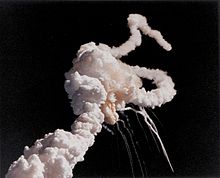
When the Challenger blew up, my class wasn’t watching. Our school got TV’s for the classrooms a couple of years later, so I didn’t know what had happened until recess when I went to the teacher’s lounge and saw faces suitable for a wake on my fellow teachers. It was a long afternoon, first explaining to the students what had occurred, and then going on with our work as if nothing had happened.

I didn’t face another day like that until 9/11.

I remember sitting with my friends in the teacher’s lounge after Challenger blew up, listening to the radio. When the announcer said that the mission commander had flown fighter jets during Viet Nam, I knew that he had found a more honorable death than that war could have given him.

When Columbia returned from orbit the last time, I was excited to see it. By that time I had moved to the foothills. Columbia’s flight path was to pass north of my new house, and I was up before daylight to watch its fire trail across the sky from my balcony. Instead, I only saw dense fog. I waited around until the projected time and at least heard it’s sonic boom. Five minutes later and a thousand miles to the east, it broke up and fell to earth.

It was Saturday morning. I had two days before it would be time to talk to my students about what had happened.

Raven’s Run 133

Chapter Thirty-five

We sent a list of Cameron Davis’ properties to his house, with no note and no signature. That would get his attention. Another letter would follow, demanding a meeting. I went back to Eureka to wait. Ed got busy making arrangements to pull this stunt off without getting us all killed. Daniel Cabral flew back from France. 

Four days later, I met Ed in Garberville and followed him out of town. He drove toward the Davis mansion, then turned off a mile short and lead me by a narrow dirt road to where a panel truck was parked on a hill overlooking a broad valley. Oaks and a few redwoods were scattered across the landscape.

There was a dish antenna on top of the panel truck. A middle aged man with a rifle was waiting for us, relaxed but ready. He nodded as we approached and said, “I’m Barton.”

“FBI?”

“I’m on vacation.”

“Don’t you guys ever work for a living?”

He just grinned and motioned toward the truck. Ed and I went inside. Senator Cabral was waiting; he shook hands and said, “Are you sure you want to do this?”

“I’m sure. Are you sure you should be here?”

“No. Politically, this is the stupidest thing I’ve ever done. But I’m not Richard Nixon. I don’t send people out to do things I wouldn’t do myself.”

I had to admire that. He had a lot more to lose than I did. But maybe he had even more to gain. “You should at least stay in the truck,” I said. “It doesn’t make any sense for you to talk to Davis face to face. We are here to use leverage on him, not give him a lever to use on you.”

“I will let you begin the meeting. If Davis sends a messenger, send him away. If Davis actually shows up, I want to see him.

“Ed,” Cabral added, “please step outside for a moment.”

Wilkes nodded and withdrew. The Senator studied me for a minute, then said, “Ian, why are you doing this?”

I shrugged. It wasn’t something I wanted to talk about. I just said, “For Raven.”

“Even though she ran off on you?”

I nodded.

“Do you love her that much?”

“God damn it, is this the right time for this conversation?”

“I am her father,” he said simply.

There wasn’t much I could say to that, except, “I love her.”

“Enough for this?”

“Enough to protect her.”

“And to live with her?”

“For as long as we could stand each other. I don’t know if that would be a week or a lifetime.”

“She needs you,” he said. “She may run from you, but she needs you. Those pasty boys she finds . . .” He made a gesture of disgust. “They are not enough for her. She needs more. She needs a genuine man; a serious man. A man of honor.” more tomorrow

338. The Benson Murder Case

I just read The Benson Murder Case for the second time. It was an accident. All of the Philo Vance mysteries are titled The (whatever) Murder Case, and they are mostly indistinguishable on the library shelf. I didn’t recognize Benson as one I had already read.

The setting is New York City in the twenties, among the upper class and the demi-monde. Since I’m an ex-Okie farm boy, these people would look down on me as white trash. That places the novel somewhat outside my comfort zone, but it also gives a kind of anthropological interest to the proceedings.

Anyway, there aren’t that many non-bloody and non-cozy mysteries to choose from, and Philo Vance is good fun.

The author is Willard Huntington Wright. The putative author is S. S. Van Dine, who also appears in the novel as the narrator. We are told that Philo Vance, the main character, is a pseudonym for a famous real person who will never be named, so we start out with layers of misdirection. I like that touch. It is as if Conan Doyle had used John Watson, M.D. as a pseudonym. We already know that Holmes was real; just ask any genuine fan.

Vance is an aesthete, immaculate in dress, loquacious, self-centered, quite convinced of his own superiority, and independently wealthy. If an actor were to play him on television today, enunciating all the words that Wright put into his mouth, he would be seen as gay as hell.

I need to explain that. In a sex-ed class I was teaching, during a question and answer period, a student asked me if I had any gay friends. It was a teachable moment. I said, “I don’t know,” then pointed out that a gay person could pass for straight, and a straight person could pass for gay, if either wanted to. We control how we present ourselves. It is a form of communication.

That exchange took place back in the era of Will and Grace, when LGBT portrayals were rare and relatively unsophisticated, but even then the behaviors we associate with gayness were mostly learned from television.

So I repeat, if Vance were portrayed today as he appears in the books, he would not look straight. That’s probably our prejudice. I see no evidence that he was perceived that way in the twenties when the novels were published, except, perhaps, when the villain at the climax calls him “you damned sissy.”

I don’t really care if the author was presenting Vance as gay, or just snooty with a British education, but it does cause a bit of disconnect. Like reading a book in translation, the sub-text can get a bit muddied. This is especially true since this first novel is less about solving a crime than it is about the friendship between Vance, the layabout, and Markham, the hard working District Attorney.

Alvin Benson is shot. Vance tags along with his friend Markham to the scene of the crime, and Van Dine, Vance’s shadow, tags along as well to narrate the story. Vance instantly knows who did the deed, working from his understanding of psychology. Markham is confused by clues. For the next 348 pages, Markham suspects a half dozen people, and Vance follows along showing him the error of his ways, finally leading him to find the murderer.

It sound dumb in précis, but it works. Even the first time I read the story, when I was distracted by Vance’s irritating personality, it worked. The second time through the book, I realized that the real story, hidden behind the unfolding of the mystery, was Vance at work keeping his good friend from making a fool of himself, or worse, enduring the guilt of sending an innocent person to execution.

C. J. Verburg, in a one star Goodreads review, calls Vance a more smug and racist version of Lord Peter Wimsey. She really doesn’t like him, and I can’t say I blame her. She probably speaks for the typical modern reader.

Those who do like him, like him a lot. I’m rather in that camp — I think. Most Goodreads reviews are stellar or stinking, with very few in the middle.

Raven’s Run 132

“And then what?”

“He goes to jail. Susyn and Alan go to jail.”

“When? How soon do they go to jail? How certain are you of a conviction, and how long will it take to complete the trial? What about bail? What about hiring outside help from inside prison? Ed, what are we trying to do here? Make a bust, or make Raven safe?”

“Don’t get mad at me, Gunn. I didn’t cause this situation.”

“Then think, man. What is our objective here? Let’s keep that in clear focus.”

I stopped talking and drummed my fingers on the table. I had gotten loud. The problem was, I was getting mad. Not a quick, adrenaline anger that comes and goes, but the kind of mad that builds up over weeks and months until it gnaws away inside of you and makes you do violent things that are not normally in your nature. I wanted Skinny Alan right here in this room so I could take him apart with my bare hands. And I wanted this Cameron Davis that I had never met, who hid in the shadows and pulled the strings; who hired Chicano punks to wait for me at Jacks’ office and sent a henchman to burn me up in my sleep. And I wanted Susyn for lying to me and causing me to betray Raven. 

And deep down I was mad at Raven for leaving me.

I fought it off. It was not useful to me now. I put that anger away, deep down in the sub-basement of my soul, where so many other angers are already stored. A day will come. But not today. Today I had to find a way to let my enemies live, so that Raven could live. It would not be satisfying, but it was necessary.

But someday, someone was going to pay. Where or when, I didn’t know, but I would not forget.

“What I propose,” I said finally, “is to leave the old man in place. If we attack his position, Raven will still be in danger. She is a witness to two attempted murders. Cameron Davis might be able to avoid prosecution for that, but Susyn and Alan can’t. We’ve got to show the old man what we have, threaten to bust him wide open, and offer to leave him in place if he calls off his dogs.”

“I don’t think he got where he is by being scared of threats.”

“No,” I said, “not a threat. A negotiation. I’ll have to show him his alternatives and convince him that leaving us alone is the only thing that benefits him. The timing is right. Harvest is in three months. If he gets busted now, even if he escapes prosecution it will cost him millions. After harvest, we could not do him nearly so much harm.”

“How do we get to him?”

“The only way – face to face. And not we. Me.”

Ed shrugged. “It might work. Assuming he is rational.”

“Yes. There’s always that.”

“But we have to tell the senator.”

“No.”

“Yes. There is no other way, if you want my help. And you can’t pull this off by yourself.”

I just looked at him. “Then you’d better convince him,” I said evenly. “I’ve been lied to and betrayed, threatened with gun and knife, beat up, slashed, and firebombed. I’ll let that go, if I have to. But if I can’t protect Raven any other way, I’ll get a rifle and start hunting, and if I do that there are going to be dead Davises all over Humbolt county!” more tomorrow

337. The Year Without a summer

The Little Ice Age (yesterday’s post) was vague and questionable in its outlines and origin. The Year Without a Summer was precisely delineated, and there is no question of how it came about. It was the result of volcanic activity.

There is, however, a smaller mystery. In 1808, a very large eruption took place, but no westerner saw it. It is memorialized in ice samples from Greenland and Antarctica, and scientific detective work places the eruption somewhere between Tonga and Indonesia. It began a period of northern hemispheric cooling.

Then in 1815, the largest and most destructive volcanic eruption in human history took place at Mount Tambora in what is now Indonesia. The explosion was heard 1600 miles away. (Krakatoa, a better known eruption in the same region in 1883, was less intense.) Between the mystery eruption of 1808 and the Mount Tambora eruption of 1815, the second decade of the 1800s became the coldest on record. 1816 became known as The Year Without a Summer.

(As always seems the case with science, nothing is simple. 1816 fell within the Little Ice Age and was also associated with a low in the cycle of sunspots. If you really want to understand, I suggest a Ph.D. and a lifetime of study. That will give you some answers and a cartload of more sophisticated questions.)

The Year Without a Summer was disastrous. Crops, which had already been bad, probably because of the 1808 eruption, failed. Famine was everywhere in Europe, followed by typhus. There were massive storms and floods; an estimated 200,000 died in Europe.

In America, the northeast was hit hardest. Frosts continued through the summer. In August ice floated on Pennsylvania rivers. Snow fell in June in Massachusetts. Food was scarce and in 1816 there was no way to move it from less affected regions to those hardest hit. That year and shortly after, masses of northeasterners moved to the midwest, swelling the populations of Indiana and Illinois.

The event left echoes in literature. In 1816 Mary Shelley, Lord Byron, J. W. Polidori and others were storm bound together in a villa overlooking Lake Geneva. A contest of writing ghost stories ensued. Byron wrote a fragment, which Polidori later turned into the first vampire story (The Vampyre), Mary Shelley began what later evolved into Frankenstein, and Byron also wrote Darkness, a long poem inspired by the lightless days.

Here is a bit of that poem, which brings back memories of those old science fiction stories from my youth when the glaciers moved in to destroy humanity.

The crowd was famish’d by degrees; but two
Of an enormous city did survive,
And they were enemies: they met beside
The dying embers of an altar-place
Where had been heap’d a mass of holy things
For an unholy usage; they rak’d up,
And shivering scrap’d with their cold skeleton hands
The feeble ashes, and their feeble breath
Blew for a little life, and made a flame

Raven’s Run 131

“There is a regular complex of buildings right in the center of that three hundred acres.”

“His processing and storage facility.”

“What else?”

“You didn’t notify anybody official, I hope.”

“Don’t talk dirty. But I can in five minutes, if the senator gives the word.”

“Don’t do it. We need to talk first. And don’t contact Cabral.”

“Why not?” Ed was instantly suspicious.

“Because he has to think about moral consequences and political consequences as well as Raven’s welfare. There are things he wouldn’t do. You and I don’t have to be so careful.”

“There are things I won’t do, too,” Ed said.

“How soon can you get to Garberville?”

“Maybe four hours?”

“Meet me at my motel room at noon.”

*          *          *

I spent the morning wandering around the marina, enjoying the yachts and fishing boats, and drowsing in the sun. I tried not to think about Raven. Sometimes I succeed for ten minutes at a time. Then I headed back toward Garberville. It was a nice drive. Midweek traffic was fairly light and the road wound through heavily forested hills. I was in a pretty good mood. 

It didn’t last.

*          *          *

I pulled into the motel parking lot, braked, put the Pinto in reverse, and backed out again, all in one motion. Good reflexes made it look like I had only used the place for a U turn. 

The cops who were gathered in front what what had been my motel room only glanced up, and I mentally thanked Joe Dias for keeping such dull and unlikely cars in his stable.

The place had been firebombed.

The motel rooms had been strung out in a row, single story, along the parking lot. I had only had a brief look, but there wasn’t much left of the unit I had been staying in, and the units on either side had been badly damaged as well.

If I hadn’t taken a day off to recover from my pot hangover, I would be dead.

*          *          *

Because he was FBI, Ed Wilkes had a phone in his car, so a pay phone call to Cabral’s headquarters rerouted him. I waited at the first off ramp south of Garberville, parked in the meager shade of a live oak and listened to the endless rubber hissing of the freeway. Within ten minutes, a tan Buick took the exit and rolled in beside me. I motioned to Ed to follow and went back south down highway 101. It took twenty miles to satisfy me that we were not being followed. Then I took an exit and we went into a roadside restaurant for lunch and a council of war.

I brought Ed up to date on the details of my investigation. He raised an eyebrow at my breaking and entering. The FBI can’t do things like that. At least, they can’t admit it. Finally, he said, “I don’t understand your hesitation. We have what we need. Let’s call in the troops and put him away. Him and his whole family.”

“And then what?” I asked. more tomorrow

336. The Little Ice Age

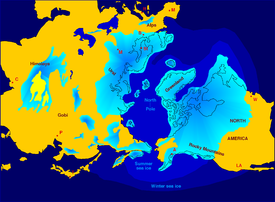
Hannes Grobe/AWI – own work – redrawn, supplemented and modified graphic from John S. Schlee (2000) Our changing continent, United States Geological Survey.

The writing of this blog is a pleasure, but it is like a fireplace on a deep winter’s day — it takes a lot of fuel. Sometimes topics fall into short supply. Sometimes I don’t know where my next blog is coming from.

Sometimes I get on the internet and put my conscious mind on cruise control. I let my fingers on the keyboard seek out half remembered images, phrases I have heard, interesting titles from catalogs of books I’ve never read, and half understood events I always meant to research and write about.

Today was that kind of day. I chased down, among other things, two similar phrases I had run across: The Year Without a Summer and The Little Ice Age.

They aren’t the same thing, it turns out. The Little Ice Age was a cool period that purportedly lasted about half a millennium, but its cause, degree, beginning, and ending are frustratingly difficult to pin down. NASA suggests three separate cooling periods in the 1600s, 1700s, and 1800s but the UN panel !PCC suggests that it is only a series of local events, not a unified world-wide phenomenon.

Locally, the increased cold brought famines, ice blockage of harbors, and shifts in agriculture. Some have suggested that the prevalence of winter scenes in Dutch paintings of the era, and even denser wood leading to better violins by Stradivarius, are byproducts of the Little Ice Age. Yeah, right. Scientists can be frivolously imaginative when pushing their theories, especially if proofs aren’t easily measured.

The Little Ice Age is a really cool name though, no pun intended, and it caught my attention because death by ice age was a common theme in the science fiction stories I read when I was young. Visions of glaciers coming down from the north to obliterate civilization lived in my head for years. They still do, sometimes.

Fifty years ago people — science fiction writers, anyway —  were afraid of global cooling. Now we are all afraid of global warming. That doesn’t set aside what we now know about retreating glaciers, but it does cause a slight pause on the way to full acceptance.

I was late coming to the table where global warming is concerned, for reasons that were entirely sensible twenty years ago, but no longer suffice today. I’m still not convinced that the warming is entirely man made, but it doesn’t matter. That the glaciers are retreating and the polar caps are disappearing is beyond question. That fossil fuel emissions are part of the picture is reason enough for action, even if we don’t know the whole story.

Science never knows the whole story, but people have to take action based on the preponderance of the evidence.

___________________

While I was cruising the web, I also found these estimates of human population.

     1804, Earth’s population, 1 billion.
     1927, Earth’s population, 2 billion.
     1960, Earth’s population, 3 billion.
     1974, Earth’s population, 4 billion.
     1987, Earth’s population, 5 billion.
     1999, Earth’s population, 6 billion.
      2011, Earth’s population, 7 billion.

I think there’s a pattern here, don’t you?

The answer to global warming isn’t an end to the use of fossil fuels — not exactly. It is an end to the need for fossil fuels. It is fewer people.

Oh, and that other thing, The Year Without a Summer, we’ll take a look at it tomorrow.

Raven’s Run 130

I took a change of clothing and went out to the car. The world had stopped spinning, and a meal would go a long way toward quieting my headache, but what I needed most was to be in another town, seeing different scenery and thinking different thoughts. I drove north toward Eureka. 

Fifty miles made a lot of difference. Here the highway skirted the coast; the air was cool and foggy. High clouds obscured the sun and there was a smell of the sea in the air. I found a rustic motel near the center of town and checked in, then spent the rest of the afternoon and evening walking off the excesses of the night before. 

Eureka was one of those towns that had gotten rich and then lost it. It was full of Victorian houses, built during the lumber boom, that had fallen on hard times and were now being restored. The atmosphere was laid back, with an odd mix of northwoods outdoorsman and post-hippie boutique. Underlying it all was the hardscrabble economic reality of boom and bust lumbering and commercial fishing. It gave the place an edge. I liked it.

I watched the sun set behind a fog bank, then went back to the motel. I left my new number with Cabral’s office manager so Ed could find me, and turned in early.

The phone rang at seven the next morning. Ed came on and said, “Touch me, Ian, I can walk on water.”

“Congratulations,” I replied, with some sarcasm.

“I mean, I’ve performed miracles.”

“Good for you. Tell me.”

“Like you said, Cameron Davis only owns one piece of property in Humbolt county. It’s the house he lives in. Its a mansion, really, secluded and well guarded and I would bet that no one who comes near it is allowed to have even a pot seed in his pants cuff. The man really keeps himself separated from his work.”

“That’s what Johnson said.”

“I checked the surrounding counties. Just like you suspected, nothing. Then I started our troops looking for pieces of land owned by corporations. I could give you a list, but take my word for it, Cameron Davis has kept half the lawyers in northern California busy. We found thirty-two corporations which owned land and were themselves fully owned subsidiaries of another eight corporations. Those eight were all owned by another three corporations. Those three were owned by a single corporation called Davicam, which was owned by . . .”

He was in a better mood than I was. When I didn’t feed him a straight line, he finished lamely, “By Cameron Davis.” 

“There’s more?”

“Yes. Altogether, Davis owns ninety-six pieces of land, not counting the seventeen you found that his kids and in-laws own. There may be more. I’d say we’ve got him. All of Davis’ land is in small parcels except one. He owns a three hundred acre section of open oak woodland near Willits. According to topographic maps, there is only a shack near the road, but I wondered. Why own a hundred small parcels and only one with a real perimeter? So I contacted a friend of mine in the CIA. He and Daniel and I helped BTF on a case ten years ago. He got me satellite photos of the place and guess what. There is a regular complex of buildings right in the center of that three hundred acres.”

Of course today any six year old kid with a smart phone can get satellite photos. Just Google it. In 1989 only the military had that capacity. more tomorrow

*****

Obviously that last paragraph wasn’t in the original written in the early nineties, but was added for this 2016 flashback version.

335. To Save a Life

I once saved a little girl’s life. True, but not as exciting as it sounds. I’ll tell you about it further down in the post.

In 1975, a whole bunch of things came together. I came back to California with a master’s degree and started writing novels. My wife’s parents lived in the same small city. Her father was a life long Red Cross volunteer, so when help was needed in the Swine Flu clinics, we all three volunteered. I had spent four years as a surgical tech in a Naval Hospital, so it was natural that I continued to volunteer after everybody had had their shots and the Swine Flue had not appeared.

(Cynics called the Swine Flu the cure for which there was no disease, but no one knew that at the time. Hindsight is always accurate, but sometimes cruel.)

About that time, the Red Cross was given the responsibility of teaching the then-new technique of cardiopulmonary resuscitation. My wife, my father-in-law, and i took the county’s first CPR class one week, then took the first CPR teacher training the following week. After that we taught as a team.

At that time there were no EMTs. We taught the local ambulance drivers to do CPR, then my father-in-law taught the park rangers at the local lake. We taught civilian classes every week or so and after a few years, we had trained hundreds.

In those days CPR training included the Heimlich maneuver and many other things I won’t even tell you about. Year by year, the training contained less and less. Dumbed down, in my non-medical opinion. To be fair, we weren’t teaching doctors and nurses. The amount that you can expect a civilian to learn in a short class, and remember in an emergency a year later, has to be fairly well restricted.

When I wrote my second published novel, I had the hero save a life using CPR, and in the front pages, placed a statement about CPR with a call for the reader to get training.

I never had to actually use CPR. That just means that nobody ever dropped temporarily dead in my presence, and I’m glad they didn’t.

However . . .

About twenty years later I was teaching middle school. It was the end of the day. The bell had just rung and my students had started getting into their back packs to file out, when one of them yelled, “Suzy’s in trouble!” and another student yelled, “She’s choking.”

The girl (not named Suzy) had slipped a hard candy about the size and shape of a marble into her mouth. She wasn’t supposed to do that until she was outside the classroom, so she was being sneaky instead of careful, and it lodged in her windpipe.

I slipped into the mode teachers use for bleeding, fainting, and fist fights. I went to her at a walk that resembled a run. Her face was desperate. I spun her around and stripped off her backpack while calmly saying, “Let’s get this off you. Let’s get you turned around so I can get that out, so you can breathe.” I put my hands in the right position and jerked up sharply — but carefully, since I was three times her size. The candy shot across the room.

That was it. It was over. She was shaken, but unhurt.

Humility would have me say that she would probably have been all right anyway, but I don’t think so. I really don’t think so.

So, what is the takeaway — that I’m a hero? Not likely. People’s lives are saved every day by the Heimlich maneuver. I have a friend, a teacher, who used it successfully twice during her career.

The takeaway is that CPR, rescue breathing, and the Heimlich maneuver are easy to learn, and if you ever have the chance to same the life of a loved one, or even a stranger, and you don’t know how, it will haunt you for the rest of your life.

End of sermon.