Author Archives: sydlogsdon

Raven’s Run 119

If I wanted to be a big pot grower today, I would have lots of little plots of land scattered all over the area . . .”

“Like the seventeen plots owned by the Davises.”

“Yeah, only maybe more so. You know of seventeen. How many are there you don’t know about? Anyway, I wouldn’t want to have too much direct contact with the farming. I’d be management. I’d supply the means, pay salaries, and skim my take off the top.”

Rusty stopped in mid-sentence, then looked at me sharply and said, “Mostly, Gunn, I’d enforce discipline. If your man could do that, he could make millions. But he would have to be ruthless. A guy like that couldn’t hesitate at a few killings.”

Rusty wiped up the last of his eggs with a piece of toast and asked, “How are you armed?”

I told him about the Bulldog. He just shook his head and said, “Wait.” He headed off downstairs to his shop and five minutes later came back with an ancient double-barreled shotgun. It was a basket case. Apparently someone had let it rust and then had sanded the rust off. Instead of having it reblued, they had covered the metal, and half the stock, with black spray paint. The stock was wrapped with duct tape.

Rusty was polishing it with a rag. Not to make it look good; he was removing his fingerprints. He handed it to me along with a couple of boxes of shells.

“I took this in trade, thinking I’d rebuild it in my spare time. It’s old, and it’s never been registered. It’s sound, despite what it looks like. I’d like to give you something better, but you need something that ballistics can’t trace. I’m giving you double-ought buck and in case things get real serious, slugs. They aren’t accurate past twenty yards, but they’ll stop a grizzly in his tracks.”

Chapter Thirty-three

I headed north across the Golden Gate and took Highway 101 through the oak and gold clarity of a Marin County morning. Choosing a speed was a delicate task. The last thing I needed was to be pulled over while I was carrying a pair of unregistered weapons. Cars were slamming past me in true California fashion, going eighty and ninety. Fifty-five miles per hour was the law then, but it would have been suicidal, so I kept pace with the slowest traffic at just under seventy.

I was heading into country that I knew only by hearsay. During all my years in San Francisco, I had not had the leisure or the money to explore the state. I had been to Sacramento a number of times, on business for Joe Dias or doing research for my thesis, but I had only gone as far north as Mendicino once, on a fishing trip. Garberville was about fifty miles inland from there, and further north.

I came off the freeway about noon and rolled through the town from end to end to get a feel for the place. There wasn’t a lot to see. One main street ran north and south, a second dead ended into it and carried traffic back toward the freeway. Restaurants, gas stations, a lumberyard, two hardware stores, a movie theater, two grocery stores, an antediluvian five and dime still hanging on long after the main chain had died, and four or five video rental stores. Since it was California, there were also two health food stores, a new age bookstore, and a palm reader. more tomorrow

324. Scientific Entrepreneurs

ksc-20160408-ph_kls0001_0005_25704320894In Heinlein’s original stories, a visionary entrepreneur named D. D. Harriman put the first man on the moon. In our world, NASA did it.

Recently, NASA has been in one of its periodic slow periods and entrepreneurs like Elon Musk have been taking center stage. Just this week (I’m writing this on March second) both groups were in the news. Musk announced that two unnamed underwriters had put down sizable deposits for a trip around the moon in the near future, riding in a Dragon spacecraft on top of one of his Falcon rockets. And NASA has announced that the first launch of its Space Launch System booster might carry astronauts around the moon again, for the first time since 1972.

Both are big news, if they happen. Of course, if you follow the space program, you know that there are always more big stories of upcoming events than there are actual events. We’ll have to wait and see.

There are many space enthusiasts who feel that private enterprise should lead in the exploration of space. “Boy genius builds rocket in basement and travels to Alpha Centauri” has a long history in science fiction. I don’t see it.

American industry built all the components of the Apollo missions, and the government paid the bill. Elon Musk has built the Falcon rocket (see photo) on his own, but a NASA contract to supply the ISS pays at least part of the bill. Different, yes, but how different? Privately owned trucks carry goods to your town every day, but on government built roads. Private enterprise is always entangled with government support.

Perhaps it all comes down to a case of, “Who do you trust?” Do you trust private enterprise? Or do you trust the government? Personally, I don’t trust either one of them, so I don’t care who carries the torch for space exploration, as long as it happens.

All this brings us to the anniversary of the day.

Since innumerable interesting things have happened throughout history, and there are only 365 days in a year, you can find something worth celebrating almost any day.

On March 26 (yesterday) or March 25 — depending on which side of the international date line you’re sitting on as you read this — in 2012, James Cameron made a solo descent to the deepest point in the ocean.

The Challenger Deep, in the Marianas Trench, had not been visited by humans since 1960. That expedition was sponsored by the government, specifically the U. S. Navy. Cameron’s visit was self-financed.

Rich men spending their money on their passions, without regard for profit, is not just a twenty-first century phenomenon. Rockefeller made his money in oil, then set up the Rockefeller Foundation. Alfred Nobel made his fortune in armaments, then set up a Peace Prize. Andrew Carnegie made his money in railroads, then set up a chain of libraries across America, including one which illuminated my youth.

Cameron became rich through such films as Titanic and Avatar. His passion for undersea exploration is of long standing. Like Musk with manned space flight, Cameron is continuing an exploration that the government began, then partially abandoned.

Tomorrow we will look at earlier explorers of Challenger Deep.

Raven’s Run 118

“I don’t mean everybody. There are a lot of pacifists up there in the hills. People who still stand by what they stood for twenty years ago – who would rather be robbed than shoot someone. But there are a lot of people squirreled away up there, and if even a small percent is armed, that’s a lot of firepower.

“That’s the little guys. The big growers went Nazi. At harvest time, those counties started looking like Army maneuvers. Everyone wearing camouflage gear and carrying rifles. Outside the town, they were carrying machine guns. Seventeen year old kids dropping out of school to sit out in the forest all dressed up to play soldier with a real Uzi in their hands.

I said, “It sounds like Viet Nam.”

Rusty snarled, “You weren’t there, man, so don’t tell me what Nam was like.”

I just shrugged and hoped I hadn’t set him off. Then he nodded, and said, “Yeah, I guess. No discipline; kids with guns; most of them with no real sense of why they’re there. A little like Nam, but only like a pale shade of it. Way, way watered down.

“Bad enough to make me leave, though,” he added. “I grew up in that area and knew it when you could be free there. When the paranoia set in, I left. It got so I couldn’t walk into the woods to take a pee without worrying if someone was going to shoot me. ‘Course, the chances were nothing would ever have happened. Like living here. Man, people get killed in San Francisco every week, but nobody has taken a shot a me yet. Still, it spoiled things. I used to hunt and fish all over that area when I was a kid and all I ever had to worry about was bigfoot. Now kids the age I was then are driving big cars, carrying AK-47s, and snorting coke bought with their earnings. I just didn’t like living there any more.”

Rusty slammed his chair back from the table and went to the refrigerator. He took out bacon and eggs, and started cooking. I didn’t say anything. He was worked up, and he had to do something with his hands before he could go on. I understood that, and you don’t push Rusty if you want his help.

There was a lot of slamming of frying pans and low voiced cussing. Eventually, he tossed a plate of eggs and bacon in front of me and sat down to eat his. It was edible. Just. I choked it down and waited.

Finally, Rusty said, “About your problem. The man you want would be a big grower, but things have changed in the last few years. About the time things got too weird, a bunch of drug control agencies started working together and put a lot of big growers out of business. They started using helicopters and concentrating on the biggest growers. Some of those guys would clear an acre of timber in a national forest, sell the logs, then plant a whole field of pot. That only worked until they started air surveillance. A lot of big guys went down.

“This was after I left. I only know the details by hearsay. If I wanted to be a big pot grower today, I would find some way to spread the risk around. I would have lots of little plots of land scattered all over the area . . .” more tomorrow

323. Five by Heinlein

Most of the reviews of science fiction novels are primarily plot summaries, with personal comments. When they are good, it is usually as much from the voice of the reviewer as for the novel in question. A case in point is Schlock Value, my inevitable Sunday night guilty pleasure, which cracks me up weekly with reviews of novels you couldn’t pay me to read.

I don’t write that kind of review myself. I only review favorite books, so I am usually saying, “Here is something great you may have missed. You should consider finding a copy, because it’s worth reading.” That being the case, I prefer giving an appreciation with a bare minimum of summary.

All this makes for short reviews, so I am able to offer you five of Heinlein’s pre-Stranger, non-juvenile, short and polished novels in one post. They are in order of book publication, although two were serialized in magazines years before they were published independently.

Beyond This Horizon, 1948, original serial 1942, is interesting in part because it doesn’t exactly sound like Heinlein. Future society is gun-toting and very polite, rather slow moving and just a little bit prissy. Beyond This Horizon’s tone reminded me a little of Bellamy’s Looking Backward, which I read because it was mentioned as an early influence on Heinlein.

Hamilton Felix (everybody’s name reads like an alphabetical list with the commas dropped, which is actually a pretty neat bit) is looking for the meaning of life, and finds it, more or less. If you’ve read a dozen Heinleins and are curious about what he sounded like before he was fully formed, I recommend this one.

The Puppet Masters, 1951, is probably familiar to everybody, if only from movie versions. This is not one of my favorites. It’s too much of an alien possession horror story for my taste, although, to be fair, it’s a pretty good alien possession horror story. There is one thing about the novel I don’t understand. Heinlein always complained about Star Trek’s tribbles being a rip-off of his flat cats (from The Rolling Stones), so why didn’t he complain about the Star Trek episode Operation: Annihilate!, which is a full blown rip-off of The Puppet Masters?

Double Star, Hugo winner, 1956, has as a main character an out of work actor who is hired to stand in for a prominent politician who has gone missing. He starts out very much unlike a typical Heinlein hero, but grows into one as the story progresses. Heinlein had several of what he called “the man who learned better” stories, and this is probably the best of them.

Door Into Summer, 1957, is my favorite of the early, short, polished Heinlein novels. Daniel Davis, inventor, is duped out of his work and exiled, only to return for revenge and more. He is a bit of a sap at the beginning, but gets over it. The opening page alone, which sets up the title, it worth the price of admission.

Methuselah’s Children, 1958, original serial 1941, is the first appearance of Lazarus Long who later appeared prominently in just about everything Heinlein wrote during the last third of his career. That alone is reason enough to read the book, but if Heinlein had stopped writing after completing this novel, Methuselah’s Children would still rank as a classic of science fiction.

For those who remember the seventies – or lived through them and therefore don’t remember them – this is the novel that launched the Jefferson Starship album Blows Against the Empire.

(No, not that empire! The Viet Nam bashing American empire.)

Raven’s Run 117

“They wanted to live off the land and be independent. Man, you just can’t do that. It’s fucking impossible. You can make a living in farming – if you’re lucky – if you have a half a million dollar investment in farm machinery and two hundred acres of good, black Kansas land. Not in the hills up north. They starved. And they all grew pot. And they sold a little to get by, just like they had in the cities, only now they were growing their own. Sort of cut out the middle man, see. That started it.”

I said, “This doesn’t sound like what I’m looking for.”

“It isn’t. It’s how most of the pot farmers do business, and why. It isn’t how most of the pot gets grown. You follow the distinction?”

I nodded.

“Most of the growers are small time. They think and act like overage hippies. Or like kids who grew up with hippie parents. Most of them are pretty decent people, really, although their thinking is too damned sappy for me.

“The thing that came later and turned the whole business around was sinsemilla. That’s an improved strain of marijuana and an improved way of growing it. You separate the male and female plants and frustrate the reproduction urge. The plant responds with more of the chemicals that make it good to smoke. It gets real potent.

“Pot was already bringing some money into the back country and keeping the homesteaders afloat, but sinsemilla would sell for real money. That’s when some guys started farming it on a mass basis, with plantations of pot cared for by hired workers. It started to be a real crazy scene. Guys would bring workers out into the back country, especially around harvest time, and leave them stranded miles from nowhere. The workers would make good money, by local standards, but sometimes they got stiffed, and sometimes they were treated no better than slaves. The guys running the show, the plantation bosses and their lieutenants, weren’t your top-of-the-line folks. They had new money and lots of it, and most of them used it to spend their time smashed, sometimes on their own product or booze, but more often on coke.

“It was the money that changed everything. It was still hard work, but now you could hire people to do it, and get rich as ‘management’. It was easier still to wait until someone else had raised a crop, then swoop down at harvest time and throw five thousand dollars worth of plants in the back of your pickup. Or wait until the plants were processed and carry away fifty thousand dollars worth at gun point. So the growers started arming themselves. The big guys were first, but even some of the small time growers started to carry guns. You’d see people who went through the peace movement – who used to shove flowers down the barrels of National Guard rifles – sitting out all night among their plants with a rifle across their knees.” more tomorrow

322. Time Enough for Love

tefljpg

Heinlein gets mentioned in this blog fairly often. I can’t really say he is my favorite, although I probably read him more often than any other science fiction writer. He isn’t the smartest writer, or the most thoughtful, certainly his longer novels drag, and his writing style doesn’t sing. But he’s the most fun.

I’ve heard several reviewers bemoan the lumbering style of the novels from the late part of his career, then admit that they still read them all the time. I get that.

It recently occurred to me that I have said I don’t much like his two most famous works, Starship Troopers and Stranger in a Strange Land, but I’ve never named my favorites.

Favorites. Plural. There have to be two, because books from the first half of his career are utterly different than books from the second half. In the beginning, Heinlein novels were short, tightly plotted, and polished to a high shine. Most of them are very good, but the pinnacle of that era for me is The Door into Summer. It and four others will be presented in tomorrow’s post.

Stranger . . .  was the watershed in Heinlein’s career. It was long, disjointed, and sloppy. He attempted to shake up the status quo after the rest of the culture had already moved on. Worst of all, it was boring.

He wrote other short, polished works in his middle period, but the long novels gradually prevailed. Twelve years later, Time Enough for Love was published and quickly became my favorite among the new type.

(My near favorite is The Number of the Beast. I read the opening to that novel a couple of times a year, but when they all set of for Mars, I close the book. It goes down hill into useless, irritating bickering, then wanders out of science fiction altogether into fairy land. Sorry, that’s not a place I care to go, but that first hundred-plus pages are perfect.)

If you like tightly plotted novels, don’t waste your time on Time Enough for Love. If you like long winded, rambling stories like your Grandpa used to tell, that is closer, but not fully accurate either. Lazarus Long, the grumpy, selfish, charming oldest man alive is at the center of the novel, but there is also a large cast of (mostly interchangeable) characters to break up the storytelling with current events. Oddly, the most compelling character other than Long is a computer.

One of the stories buried in the middle of the book is of novella length. It isn’t named, but I call it the Happy Valley interlude. If you’ve read the book, you know which part I mean. When I wrote my novel Cyan, it was largely because I had never found a novel that told the story of a planet from exploration through colonization, without getting sidetracked by ray guns and space battles, or some lame bit about lost Earth colonies, parsecs from home. The Happy Valley interlude was the sole exception to that lack, although it was way too short to satisfy me.

After Happy Valley, the story wanders on, stumbling from one interesting bit to another, with lots of throwaway philosophy, and sex about as exciting as seeing your dad pat your mom on the butt as they wander off to bed.

Sounds like I hated it. No, I loved it. i can’t explain it, and I don’t plan to try.

Heinlein is a storyteller with a voice that many find charming – and many dislike intensely. I can’t argue with those who hate him, but he’s got my number. I could sit and listen to him ramble on for hours and, metaphorically, I often do.

Raven’s Run 116

I knew a bit about Rusty. We weren’t friends – he didn’t have friends – but Joe Dias and I were as close to friends as he had. On the surface, the three of us couldn’t be more different, but Rusty had recognized something at core level that we all shared. I couldn’t say what; Rusty’s mind works too differently from anyone else for me to say with certainty what goes on inside it. I think it might have been a willingness to look life in the face, without illusions.

Rusty was in his forties. He had been in Viet Nam. No one complained louder than Rusty about the mismanagement of that war, but his complaints hadn’t kept him from volunteering for second tour of duty. He came home, as he said, “shot full of holes and leaking like a bloody sieve.” Once he had recovered, he headed north to Fort Bragg where he was born, and spent the next decade or so there. That was right in the heart of the country I was about to enter.

“If you want to understand pot farming, you have to forget what you read in the papers,” Rusty said. “Pot farming is farming. It’s damned hard work. To do it right is not easy and no one in their right mind would work that hard if there wasn’t a big money payoff.

“You hear people talk about throwing out a few seeds and coming back months later to harvest a fortune. That’s bullshit. The land they raise pot on wouldn’t raise anything if they didn’t work it, fertilize it, and irrigate it. And harvest – man, harvest is a bitch. You have to cut it and trim it and dry it and if you don’t do the job just right, it goes moldy and worthless. You have to do all that at just the right time because of the plant, but also because at that time, the weed is worth big bucks and someone will steal it if you don’t stand guard night and day.

“Most of the growers are small time. Some of them just grow a few plants for their own use, and others just try to make enough money to keep them going. You’ve got to understand where these people are coming from.

“People have been growing weed and smoking it since the Indians were there, and nobody thought anything about it. It grew wild and you smoked weed when you couldn’t afford booze. My granddaddy was a deacon in the local Methodist church and wouldn’t touch liquor, but he smoked it just as easy as he smoked cigarettes. It wasn’t illegal. Nobody thought it was wrong. Nobody cared.

“Then along came the sixties. Some of us went off to Viet Nam and landed in pot heaven. Other kids my age went down to the cities and became hippies. When all that peace and love shit started to fall apart, a big bunch of hippies, lots of them from San Francisco and L.A., decided the new big thing was to go ‘back to the land’. Course most of them had never been on the land, so they weren’t really going back to it. If they had, they’d have known better. I mean, I never saw any kid raised on a farm that went in for that shit.” more tomorrow

321. Home Grown Ecosystems (2)

Cyan is now available for pre-order through Amazon, with the eBook arriving April 17th. Meanwhile, I plan to repeat a few year old-posts that were designed to stir the blood of would-be readers just before an earlier release date that didn’t happen.

 —————————————-

Continuing our look at the creation of an ecology for Cyan. If you missed yesterday’s post, you might want to go there first.

We can take grasses and weeds for granted. Let’s give our trees multiple trunks bound together, like a strangler fig without its victim, and that should be enough. We need something like insects. We’ll call them Chitropods – chitro sounds like chitin, and pod means foot, so our reader will infer an exoskeleton without any further work on our part. Continuing the idea of inference, if we call the flying creatures who eat the chitropods pouchbats, the reader will draw a better picture in his mind that we could on paper.

The number of legs is important to Terrestrial arthropods, but lets bypass that by giving all our chitropods many legs, but with only one joint each where it meets the body. Now they have a rolling gait “like caterpillars on crutches”. Humor helps keep description from limping along. (Sorry, couldn’t resist!)

These are throw-away inventions. They could have been applied to any ecosystem and they are not systemically related to each other. They alone would be good enough for almost any SF novel, but not for one about scientists teasing out the essence of their planet.

Here we need a key differentiation, from early in evolution, from which a thousand lesser differences can be derived. Here it is for Cyan. Early in the development of chordate life, the vertebral column doubled at the posterior, giving the Cyanian version of fish twin tails. That changed everything. I’ll explain more fully later in a separate post.

On Cyan, the classes are Pseudo-pisces, Amphibia, and Inturbia. No reptiles, no birds, no mammals, no dinosaurs. The Amphibia are cold blooded. Inturbia are inefficiently warm blooded. The term Inturbia should imply “internal body temperature un-perturbed by external changes”. Not every reader will get that, but we need to reward our best readers by not spelling out everything.

There are a thousand other details, but for that, you will just have to download the book when it comes out July 5th.

***

I do have one more thing to share. I wouldn’t bother you, but since you’re reading a post about the backstage secrets of writing science fiction, I can assume that we are all nerds together here .

Inturbia have live birth. Cyanian amphibs have to return to water to lay their eggs, except for one group, the Sphaeralvids, who produce globewombs.

(Globewombs were) the closest thing to an amniote egg that Cyan’s fauna had developed – a transparent, leathery sac extruded by a Sphaeralvid mother and filled with a clear fluid like seawater. Into this she deposited fertile ova, then defecated. Then she separated from the globewomb and left it cached in the crotch of a tree, high up where it would receive full sunlight. On a bright day millions of these globewombs glinted in the treetops.

Algae from the Sphaeralvid mother’s bowels converted the feces into biomass and the Sphaeralvid nymphs fed off the algae.  When the feces were gone, the globewomb walls would break down, leaving the now sizeable nymphs free to face Cyan on their own.

Neat, huh? The globewombs are glinting in the treetops from the first day planetside. By the time the explorers understand what they are, the reader will have been wondering for some time. Globewombs don’t contribute anything to the plot, but since these are scientists trying to tease out the ecology of Cyan, we need some concrete examples of their work. Globewombs provide that.

They make me want to be there when they make the discovery – but that’s why I wrote the book.

Raven’s Run 115

Now there was a witness who could identify Alan and James Davis for attempted murder, and implicate Susyn as an accessory. A quick flight to Marseilles would solve that problem, except that the pair had once again failed to kill Raven and now they had two witnesses.

My death must have been planned before Susyn and I ever met.

Who was running the show? Not Susyn or Jim or Alan. Seventeen pieces of property that I knew of, and probably more that I hadn’t found, meant an organization with real leadership. Someone running that kind of an organization couldn’t move to another city for years to infiltrate Cabral, and wouldn’t fly across the Atlantic twice to make hits. There had to be at least one echelon above the players I knew, and that was what I had to uncover if I wanted a lever to pry Susyn and Alan off Raven’s back.

Chapter Thirty-two

I called Ed Wilkes again, early, then loaded up the Pinto in the pre-dawn light. I drove to a filling station for gas and a road map, then headed a mile deeper into the city to Rusty Dixon’s shooting range. He lived in an apartment over his business. I walked up the outside stairway and rattled his door, then made sure I was in plain sight through the uncurtained window. Rusty is a bit trigger happy.

A few minutes later he came to the door dressed in ragged jeans and shower sandals. His bare chest was scar pocked and hairless. In the years I had known him, his ponytail had gotten longer, and his hairline had receded, but nothing else seemed to change or age. He had Norman Rockwell red hair and the coldest pair of eyes you would ever want to look into.

He said, “What?” in the same irritated tone I would use on a Jehovah’s Witness.

I said, “Good morning to you, too, Rusty.”

He grunted and stepped away from the door, and I followed him into the ancient kitchen. It was a relief to know that he was going to be in such a good mood. There were weeks at a time that I wouldn’t go near him. This was about as friendly as he got.

“Are you in trouble?” he asked.

“A guy tried to kill me about a week ago, and I had to fight off a small Chicano gang yesterday, but that’s about all. Nothing I can’t handle. I need some information.”

Rusty won’t talk to anyone unless he thinks they’re tough enough to chew up nails and spit out tacks. He said, “What do you want to know?”

“Tell me about pot farming on the north coast.”

Rusty’s eyes went far away and his face became very still. He was going into paranoid mode, and I couldn’t afford that, so I quickly gave him an abbreviated version of Raven’s problem. His face cleared and he became talkative. more tomorrow

320. Home Grown Ecosystems (1)

Cyan is now available for pre-order through Amazon, with the eBook arriving April 17th. Meanwhile, I plan to repeat a few year old-posts that were designed to stir the blood of would-be readers just before an earlier release date that didn’t happen.

——————————-

Over in Backfile, you will find an eleven part document called How to Build a Culture, inspired by Poul Anderson’s How to Build a Planet.

I could also write a paper called How to Build an Ecosystem, but who needs to read all that. A couple of posts here should cover the subject, without boredom or overload.

The fact is, simply peppering your planet with a few well chosen and deeply odd critters is enough in most cases. Andre Norton did it all the time, and it worked for her. The frawns and yoris on Arzor are simply transmogrified bighorn sheep and alligators, but so what? They provide plot points and local color, and that is all that is asked of them. Marion Zimmer Bradley gave us a mammalian snake, a hyper-weasel, and an intelligent dinosaur who sent out pheromone soaked calling cards in Hunters of the Red Moon. What more could you want?

When I wrote Cyan, I faced a different situation. My crew was set down on an alien planet for one year, with the task of coming to understand its weather, geology, and ecology in order to prepare for colonization. They were all scientists, so their actions and conversations called for a deeper understanding of their new world than any other kind of science fiction novel would have required. That challenge was half the fun.

When I began Cyan, I had been studying ecology for about twenty years, starting back when I had to explain what the word meant. I later came to understand the essence of Earth’s taxonomy in the most rigorous possible way – I had had to condense it to a level which middle school students could understand without dying of boredom.

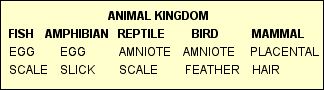
Scientists should forgive the following chart and paragraph.taxon

Drop a salmon egg on the gunwale of your canoe and it will dry out in minutes. A chicken or turtle egg would survive the same treatment. This is the meaning of amniote egg (although there are other, competing meanings). Creatures who lack them, must lay their eggs in water. The rest of the chart should be clear, although simplified. For example, birds have scales on their legs as well as feathers elsewhere, and I skipped Dinosauria altogether.

Now pull up a chair and lets build Cyanian ecology. It needs to be wierd but recognizable – that’s the key to all science fiction invention. We also need restraint. You can only explain so much to your reader without losing them, and beyond a certain point, your backstory is wasted effort.

Come back tomorrow and we’ll dive more deeply into Cyanian ecology.