
Author Archives: sydlogsdon

Raven’s Run 109

I made a detour back to my place for a shower and a change of clothes. I hoped none of the gang bangers were dead, but it wasn’t out of concern for the good of their souls, or mine. If they lived, they would probably murder their grandmothers before the month was out. But if a body was found in that burned out room, my fingerprints would be on every charcoal smudged surface in the place.

The more I thought about it, the more surprised I was that they had come after me. I had known that more than Davis, Susyn, and Allen/Alan were after Raven, but I had not expected an organization with enough resources to stake out Jacks’ burned out office.

I had Jacks’ home address from Joe Dias, so I went there next. It was a plain one-story brick house on Vicente. Most of the houses on the block seemed to have been built by the same builder, maybe fifty years ago. The lawn was small, brown and close cropped, like a Marine haircut. The front door was overdue for painting. There was a low chain link fence, but no dog or child to be kept back by it.

The woman who answered the door was small, dark, and wiry. There was a touch of gray in her black hair; her eyes were bright and suspicious. She would not remove the chain from the door until I passed her my card, left over from a previous life, that showed my name under the logo of Dias Investigations.

Once I got inside, she was friendly enough. Whatever grief she felt at losing her husband, she was showing no signs of it. She said her name was Laura Jacks. She sat me down on the couch, fed me coffee, and listened to an abbreviated version of my story.

“I don’t know much about Harvey’s current business,” she told me. “He kept that strictly to himself. He would occasionally mention a client, but that was about all. He did say that he was working for a big-wig’s daughter from Sacramento. He didn’t say who.”

“Did he say why she hired him?”

“No.”

“Did he tell you what he found out?”

“No. He never said nothing. I told you that.”

And so on. Eventually I ran out of things to ask, and “No” was the only answer she seemed to know.

“Did your husband keep any records at home?”

“Oh, sure.  Mostly on old cases that he was finished with. Nothing valuable, or he would have hidden them. Harvey hid everything, and he never told me where.”

She sighed deeply and shifted her weight on the chair. In the ten minutes of our conversation, he whole pose had changed. The initial stiffness had had gone out of her, as if she were melting. She had a small, muscular body; very trim for a woman of forty. As I watched, she slid deeper into the embrace of the chair and the lines of her face softened with interest. “Did you know,” she said, “that I am about to lose this house? Harvey made lots of money, but he always squirreled it away. He had bank accounts all over the city, and I can’t find any of them. All his bank books burned up with his office. Now I should be a rich woman, and I’m about to lose my house.” more tomorrow

314. Fleming Fellows

300px-oklahoma_medical_research_foundation_nimaphoto by Nima Kasraie

The Oklahoma Medical Research Foundation is a major research institution, but not a household word. Let me explain its importance in my life.

Everything that happens to a writer passes into his memory, sinks to the bottom, and grinds around there, knocking sparks off every other experience. Years later, it emerges, transmogrified, as stories or parts of stories.

My soul as a writer and as a human being was forged on a small farm, working essentially full time in addition to going to school. I was an only child. School and home were kept strictly separated. Except for one treasured cousin, none of my school friends ever entered my house.

I was a very smart child in a very small place. I worked hard, got strong, and loved the outdoor life, but my mind lived in other worlds, brought to me by books of science fiction. I decided to become a scientist. In that pursuit, I was torn between space science and ecology. When I was a high school junior, I put those two together (yesterday’s post).

That same year, among the many standardized tests we took, was the test to become a Fleming Fellow. There was also an application to be filled out in which I was to explain my aspirations and offer any personal projects to prove my capacity. I wrote up my ecosystem in space project.

I was notified that I was a finalist, and scheduled for an interview in Oklahoma City. At that time, I knew almost nothing about the fellowship or the OMRF.

Incorporated in 1946, the Oklahoma Medical Research Foundation was dedicated in 1949 by Nobel Laureate Sir Alexander Fleming. In 1957, OMRF started a summer program for students, which was quickly named the Fleming Scholar Program. It has evolved over the years, but in that era, from four to seven Oklahoma High School juniors were recruited, and spent eight weeks at the OMRF the following summer.

In the spring of 1965, I sat before a panel of scientists for my interview. I had expected questions on science. Instead, they asked questions on meaning and morality. What did I think of the bombing of Hiroshima? What did I think of capital punishment? Behind the questioning, they were clearly trying to find out my level of self-confidence, as the interview became quite adversarial at times. After I said that I was still uncertain about my stance on executions, one of the scientists asked, rather sharply, “Don’t you think it is our duty to think about such things?” I remember being irritated at his high-handedness. I snapped back, “I didn’t say I hadn’t thought about it. I said I hadn’t decided yet.”

I said to the panel that I intended to pursue a Ph.D. The whole panel tried to convince me that I should be getting an M.D. instead. I held my ground, and when the interview was over, one of the panelists admitted that most of them had Ph.D.s, not M.D.s.

Fortunately, self-confidence – or arrogance, if you prefer – is something I have never lacked. I received a Fellowship. I’ll tell you about it tomorrow.

Raven’s Run 108

Two hours later I heard footsteps in the hallway. The door jiggled and someone laughed. 

I prepared to bluff my way out. I needn’t have bothered.

The door swung back and a slick haired young hood slipped into the room, moving to his right. A second followed, moving left, then a third came through and straight ahead. They wore wide legged pants, slung low, earrings, and tattoos. Chicano gang bangers.

Five years ago, they would have been Asian. Ten years ago, they would have been Black. Fifty years ago, they would have been Italian. A hundred years ago, they would have been Irish. There are always gangs; only the nationalities change. And they are always for hire for the kind of head smashing, knee breaking enforcement that fits in with their limited self-image.

Their leader carried a baseball bat. The two outriders no doubt had knives, but they were still out of sight. Three-to-one gave them confidence. It was a good thing for me that it did.

Suddenly, I was pissed. The anger I had had bottled up since Raven left me had not come out in Venice. That had been too serious. Davis with a gun was as dangerous as ten of these street punks. Last night, in my apartment, the wheels had begun to come off of my restraint, and the sight of these three smug faces finished the job.

I came around from behind the desk and went to meet them, moving lightly through the debris. Nothing in the room retained enough structural integrity to make a weapon. The only implement of destruction in sight was the baseball bat, and I meant to have it.

The leader slapped it lightly against his palm and snarled an insult. There was such a roaring in my ears that I missed the actual words he said.

He read my eyes and brought the bat up. I kept coming. He swung.

I went under the swing and pivoted. I hit the kid to the leader’s right with an open palm to the chin, hard. His skinny neck snapped back and I could feel something important give way. Continuing to pivot, I put a hard heel in the batboy’s kidney. He went to his knees and the bat spun out of his suddenly lax grip. I caught it in mid air as I jumped for the door.

The third kid went for his knife – only it wasn’t a knife. It was a small automatic.

So much for running. I dropped forward in a shoulder roll that brought me back to my feet right in his face with both hands on the bat, high and low. I hit him, double handed, with the center of the bat, right across the nose. He hit the floor spraying blood.

Their leader was coming to his feet. I hit him full bore with the bat. It took him in the forehead and slammed him back into the room. Then I was gone. more tomorrow

313. Weightless Ecology

ecoopwegt-lessI’ve been putting off this post since I started the blog. It’s embarrassing. I’m proud of what I did, but telling it makes me feel a little like one of those old guys who never stops talking about the night his forward pass won the big game.

Still, if I hadn’t done what I’m going to tell you about today, I would never have done what I did the summer after (tomorrow’s post), and if not for that, I would still be driving a tractor in Oklahoma. So here goes.

1964-5 was my junior year in high school. That was the year I took both junior and senior English because I was running out of classes to take, and that was the year I discovered science fairs. We didn’t have one in our tiny school, but their was a regional competition one county over. I had recently discovered Shirley Moore’s Science Projects Handbook, which was the bible for the science nuts (nerd wasn’t a word yet) of my generation.

America was in space; the Mercury project was completed and Gemini was waiting in the wings. I was enthralled with space, but also with ecology. Rachel Carson’s Silent Spring was about to make ecology a household word, but no one in my world had heard of it yet. I decided to put the two together and build an “Ecosystem Operable in Weightlessness”.

Lets get real. Boy scientist builds spaceship and flies to Arcturus only happens in the very old pulp stories. I wasn’t going to build something that would actually fly in space. It was an exercise in design, with as much building as I could pull off with limited resources.

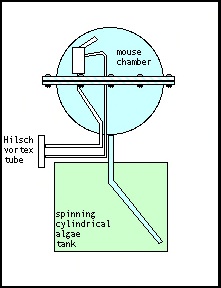
The idea was that at that time NASA needed to keep to keep some creature in weightlessness long enough to see what it would do to its body. Laika the Russian space dog hadn’t lasted long, and the longest Mercury flight had been 34 hours. I proposed a design that would put two mice in a closed ecosystem with algae. It was set up so that the algae tank would spin to provide just enough gravity to keep the water separate from the air, but the mice would be weightless in a separate chamber.

The fun was in the details. The mice would be housed in a two part plexiglas bubble, with a wire mesh floor at its equator. Waste would pass through he mesh, carried by the airstream and drop down into the algae tank.

That part actually got built. I made the algae tank of plexiglas, heated and formed around two round pieces of wood. I blew two half domes with a plywood form, an air compressor dragged up from shop class, and an oven borrowed from the home-ec teacher.

As I’ve said before, most of my education came outside of the classroom, thanks to indulgent teachers. They did the right thing, but it would get them fired if they did it today.

I bolted the half domes together through flanges formed during the blowing process. With two mice, Hing and Ho (named after the meerkats in Andre Norton’s Beast Master) in the upper chamber of the dome and a mass of Ankistrodesmus from a local stream in the algae chamber, connected by an aquarium pump, the ecosystem was as far finished as I could manage by the time of the science fair.

The physical result was limited by my resources, but the design went much further. To transfer the food to the mice, I had designed a pump, patterned after a Wankel engine (all the rage in Popular Mechanics that year). It was to send algae laden water up through a tube where it would be flushed over a fine mesh screen. The water would return to the tank on the airstream, leaving the algae for the mice to eat.

I did actually experiment with feeding them Ankistrodesmus. I strained it out of the water, dried it over a light bulb and passed the algae wafer into the mice’s cage. They went wild. You would have thought it was ice cream.

The design called for a small tube to carry a continuous airstream from above the algae water to strike the inside center of the upper dome, bringing the mice fresh air and carrying away waste as it returned. There a larger tube would carry the waste to the bottom of the algae tank.

To get water to the mice under weightlessness, the design called for the airstream from the algae tank to first pass through a Hilsch vortex tube, which split the airstream into hot and cold halves. The cold half was to pass between two thin metal plates. The warm (and moist) half of the air was to play onto the outside of these plates, leading to condensation and a continuous source of water for the mice to drink.

So why am I telling you this? Because this was the first step toward my future.

I didn’t know that at the time. I just did it because it was a challenge and more fun than I had ever had, but it led to a Fleming Fellowship, and that changed my life. more tomorrow.

Raven’s Run 107

I parked three blocks away. The ground level entrance to Jacks’ office was a door to a steep stairway. At the top was a long hall. No one was in sight. Down the hall I could hear the hum of voices and light from an open doorway laid a yellow rectangle against the grimy opposite wall. Jacks’ office was behind the first door, with windows on the street. The door itself was charred but sturdy, and the frosted glass window had been nailed up with plywood. The next door down was also boarded. Presumably the fire had spread that far before the fire department had put it out. The only other door in the hallway was the open one down and on the opposite side. I moved quietly down to see what it was. There was a hand lettered cardboard sign in the window advertising acupuncture. Hot needles off a sleazy hallway sounded about as appetizing as a back alley abortion, but the poor have pain as well as the rich.

The padlock on Jacks’ door was impressive, and so was the hasp. But whoever put it up hadn’t turned the screw plate back under the arm of the hasp. The screws holding it to the door frame were exposed.

I walked down to the hardware store and bought a screwdriver and a roll of masking tape. Five minutes later I had unscrewed the hasp. It was still attached to the door with the lock in place. I stuck the masking tape to the back of the screw plate to hold it in place and stepped inside, closing the door behind me. To a casual passer-by the door would look undisturbed.

Jacks office had been completely destroyed. The fire department must have come quickly to save the building, but this space was reduced to charred stubs of wall studding.  You could still tell that there had been two rooms. I was standing in a reception area and the far side of the burned out shell had been Jacks’ office, but the wall that had separated them was mostly gone. You could step through it any place.

Jacks had used a metal desk, the kind you buy as industrial surplus. It had survived the fire, barely. The ceiling was gone and the fire had cut through to daylight. There was a jagged, ten foot hole in the roof, which was fortunate since I hadn’t brought a flashlight and all the windows were boarded up.

I circled the room briefly, getting my bearings, then got down to business. I had to work quietly; beyond that, I was not worried about being disturbed. If my shadow enemy had an interest in this place, they would have searched it right after it burned. And if there had been anything worth finding, it was probably already gone.

On the floor behind the desk was a scattering of charred papers. I went through that first. The desk itself was empty, of course. I pulled the drawers and upended the carcass, looking for hideaways, and found nothing.

I was reasonably sure there was nothing to find, but I kept after it. Two hours later, I had turned over every spongy, black piece of debris twice, when I heard footsteps in the hallway. more tomorrow

312. Popular Science

full-futurecars-4When I was twelve or thirteen, my great grandfather said to me, “I used to read Popular Mechanics. You should, too.” And he handed me a quarter. It was the best piece of advice any relative ever gave me.

I bought my first popular science magazine, and I was hooked. I was soon buying three a month every month, and occasionally a fourth. Science and Mechanics, no longer published, was the best. Popular Science came next, then Popular Mechanics. Mechanix Illustrated was a lame imitation, but I always looked and occasionally bought, if there was a particularly interesting article.

In school, I usually devoured my science textbooks by the end of the first month of the school year. They provided an important, basic, bare bones understanding. But the popular science magazines put exciting flesh and blood on those bones. I learned more science from those three popular science magazines than I ever learned from a textbook.

Those were the days when GEMs were new. Ground effect machines, that is. There were articles that explained how they worked (what shape plenum chamber do you prefer?) but better still, there were articles that showed guys who had built their own out of plywood and a lawn mower engine, flying down the street of their suburban neighborhoods, six inches off the ground.

When I sent ten scientists to explore Cyan, they used skimmers, which were clearly ground effect machines.

There were always articles on how to take care of your car, and there was the new car issue every fall. You didn’t have to be a science nut to like cars.

There were always stories about the newest, hottest jet plane, including a story about a new safety device that gave pre-recorded error messages into the earphones of a pilot. The Air Force had discovered that the pilot never missed the message if the recording was a sultry female voice. Any thirteen year old boy in America could have told them that. The illustration of that article was a realistic drawing of a helmeted pilot with a tiny, bikini-clad femme whispering into his ear the words that would save him.

These guys knew their target audience.

Not everything between those covers would be politically correct today. I remember the pistol crossbow, a powerful hand-held weapon that shot sharpened six-inch pieces of quarter inch rod. Try making that in your seventh grade shop class. Maybe you could get a merit badge in Boy Scouts?

Probably not.

There were always articles on how to build something in your shop, about the latest tools, or about how to build the tools you couldn’t afford. I was hooked on that, too. My father was a farmer, not a craftsman. If a nail in a board would do the job, he was satisfied, and moved on to the next of an unending set of chores. I wanted more. I wanted to be a craftsman. Today I am, and these are the magazines that got me started on that path.

Eventually, I stopped reading popular science magazines. You can only read so many thousand articles at that level until you have absorbed enough. I moved on, but I didn’t forget how powerfully they ignite young imaginations.

When I became a teacher in a small middle school, all the other teachers were happy to load science onto me, and I was glad to accept. I taught all subjects the first year, but after that it was “science-and”. Every year I taught more science and less “and”.

The first year I subscribed to Popular Mechanics and Popular Science (Science and Mechanics was long dead), and soon I added Smithsonian Air and Space. I bought a magazine rack at a garage sale and put it up in my room. I never threw a magazine away until it was too tattered to read, and after a few years there were a hundred magazines in the rack.

Occasionally, at the end of an hour, there would be a few minutes to spare and I would say, “You can either do homework for another class, or read one of the science magazines.” It was the best advice I ever gave them.

And nobody chose homework.

Raven’s Run 106

“Here is the report on the Jacks investigation. There isn’t much more than I told you on the phone. He was killed execution style and dumped into the Bay. I know you think it was done by the same people you have been up against, but don’t count on that. Harvey was mean spirited, dishonest, and clumsy. I don’t know how he kept alive as long as he did. There must be three or four dozen people who would have happily put a bullet in his head. It may not have anything to do with your investigation at all.”

“For now, I’ll have to assume that it did. I told you he was investigating someone in Senator Cabral’s office. I now know that it was Alice Susyn Johnson, maiden name Davis.”

“Then you know more than I do. Jacks’ wife claimed to know no details of the investigation, although she knew it was going on. Apparently that was the way Jacks normally did business.”

“Because . . .”

“Bluntly, he was a blackmailer. He did investigations for hire just so he could find leads to develop. It made him rich, for all the good it did him.”

“Raven would not have known this.”

“Of course not,” Joe said. “She undoubtedly hired him in good faith, believed the report he gave her, and went on her way. Afterwards, Jacks put the squeeze on someone and started the train of events that put Raven in danger. But we don’t know who that person was, or what the nature of the squeeze was, or why Raven got caught up in a reaction that should have been aimed at Jacks alone.”

“Maybe he told his victim that he had sent information to Raven. Or maybe the victim found records of Raven’s hiring Jacks before he torched his office.”

“Possibly. But speculation is dangerous. You start thinking you know something when you are actually only guessing.”

“True. What about ballistics?”

“Probably a jacketed bullet. Probably 9 mm. It went in the back of his head and came out his nose. The bullet wasn’t recovered.”

“So, that leaves Jacks’ torched office and his wife.”

Joe agreed.

*       *       *

Joe keeps a stable of rough looking cars and pickups. They are never washed, and he has been known to dress them up with a sledge hammer and graffiti, but they all have fine tuned, oversized engines and new tires. He loaned me an ancient Pinto wagon. On the outside, it looked like a war orphan, but someone had shoehorned a rebuilt slant six under the hood.

I drove to Jacks office. It had been on the second story of a brick building in a block of brick buildings, in a neighborhood that was just holding its own against becoming a slum. Still respectable, but just barely. The storefront below his office was boarded up. There was an old style neighborhood pharmacy on one side, a hardware store on the other, and a liquor store down the street. The second story windows that faced the street were mostly blanked by shades or venetian blinds and some of them had gilt lettering advertising the businesses inside. Jacks’ windows were nailed shut with plywood panels. You could tell there had been a fire from the smoke trails that ran up across the bricks above each boarded window. more tomorrow

311. Boys at Work: Starman Jones

By at Wk atwOn August 2 through 4, 2016, I wrote posts on what I called apprenticeship literature. This is another in that series.

I discovered Heinlein’s juveniles after I had already been reading science fiction for a few years. I was past their target age, but those books are good novels as well as good juveniles and I still enjoy reading them.

Most of Heinlein’s juvenile heroes were young men who found their way to maturity through work, but they were not apprentices. Have Spacesuit Will Travel comes to mind. Kip worked hard to win and then restore his spacesuit, but he did it on his own. His distant father was no help at all.

The twin Tom in Time for the Stars gets his berth through an accident of genetics.
Although he works his way to the stars, and has a relationship with a wise elder, it isn’t really an apprenticeship since he is doing a new job that no one has done before.

Max in Starman Jones is also an anomaly with an eidetic memory, but the book is essentially about a young man working his way up through the ranks. In fact, Max works his way up two separate ranks.

In this future, work in space is controlled by hereditary guilds. Max, a near orphan, has an uncle who is an astrogator. The uncle has died, but not before leaving his astrogation manuals with Max. Max memorizes them. When conditions at his step-parent’s home become intolerable, Max head out, hoping that his uncle has declared him his heir.

He meets up with Sam, a mostly honest – by his own standards – con man. This is a stock character for Heinlein. When Max finds out that his uncle has not named him, shutting him out of space, Sam procures false papers and gets them both berths on the Asgard, in the steward’s guild.

Max is almost pathologically honest. He agonizes over the decision to deceive, then worries about what he has done for the rest of the book. Still, his need to go to space outweighs his honesty. Sam, the con-man-with-a-heart-of-gold, becomes Max’s first mentor, showing him how to survive in a world so closed down that honesty is not enough. Max learns from Sam, but his innate honesty keeps him from being like him.

On board ship, Max’s eidetic memory lets him quickly absorb the steward’s manual. Don’t we all wish it were that easy? He is put in charge of the animals on board, which puts him in contact with a young passenger who learns of his past and uses her influence to get him moved into the astrogation department. There his early training by his uncle is honed by the Chief Astrogator, and he begins to move up the ranks. He has to admit that he came on board by fraud; the issue is tabled pending their return to Earth, but the knowledge of his coming punishment hangs over Max’s head.

Unexpected events plunge the ship into danger and Max is called upon to save the day. I won’t tell you how. Even though the book was published 64 years ago, if you haven’t read it, you deserve my silence on climactic events.

They don’t all die – you could have guessed that much – and Max makes it back to Earth where he has to pay a heavy fine for his false papers, and ends up a junior officer on another ship. He has found a place in space.

Self-reliance, and technical competence make Max a typical Heinlein hero. Add naiveté and clumsiness with girls, and he becomes a typical Heinlein juvenile hero. Heinlein’s young men always work, and always have some kind of older mentor. Starman Jones is the novel where these two factors come together to fully become apprentice literature.

Raven’s Run 105

“The guy just pushed the knife into Talant’s throat until the blood started to trickle. I had to shoot him.”

“You were armed?”

“I had my old army .45 in a shoulder holster under a loose jean jacket. I was young and I wasn’t drawing attention to myself, so no one was looking at me. I shot the guy through the elbow. It was the only clear shot I had. It ruined him. He was never really able to use that arm again.

“The police came, and the ambulance, and Talant and I had to go down to the police station to make statements. They questioned us separately. It took hours, and when we were ready to leave, I asked Talant why he hadn’t used his famous piece. He said it wasn’t loaded. He had never fired it. He said he just carried it to ‘put the fear’ into people.

“It irritated me.”

Ed chuckled. “I should think so.”

“On the way back I pulled him into an alley and slapped him silly. Then I took his ‘piece’ away from him and told him not to show his face again. Last time I saw him, he was slumped against a dumpster with a glassy look and blood running down his face.”

I left Ed sitting on the couch and went to stare out the window again. I didn’t want to embarrass myself. Since Raven left, I had been holding my feelings tight inside. Now, in retelling the story of Talant, I had worked myself into a fine wrath. I didn’t want Ed to see my face, or the way my hands trembled.

Chapter Thirty

Ed dropped me off at Joe Dias’ the next morning, and went off to pursue some ideas of his own. He gave me a number to call, a couple of hundred dollars, and said he would be available if I needed help. Otherwise, I was on my own. It suited me just fine. I like Ed well enough, but I didn’t need a nursemaid.

Carmen was at her usual place in the reception room. When I first met her, she was cute. Pert. Not quite chubby. She had been growing an inch or two a year since then, and I don’t mean taller. Now she pretty much filled the space behind the desk.

“Hey, Stud, you’re looking good,” she said. “What happened? Job in Europe didn’t pan out?”

“Something like that. Is Joe busy?”

“Just paper work. Go on in.”

Joe looked up, then came around the desk to pump my hand. He was about five ten, wiry; his skin was like golden leather with laugh wrinkles on his face. His warm brown eyes had seen every kind of depravity during thirty years in a dirty business, and somehow remained human. 

The walls of his office were covered with framed pictures of his daughters, grandchildren, cousins, aunts, uncles, and every other known species of relative. He came from a huge extended family of Diases, mostly scattered around Livingston in the central valley. Joe’s grandparents had settled there early in the century after leaving the Azores. That section of California was practically a Portuguese colony, and Joe went back as often as he could.

In the years I worked for Joe, he had become a real friend. We took a while to update each other’s lives before we got down to business. more tomorrow

310. Boys at Work: Howard Pease

By at Wk atwOn August 2 through 4, 2016, I wrote posts on what I called apprenticeship literature. Here are two more in that series.

More than any other writer, apprenticeship literature is the domain of Howard Pease.

Pease’s fame was world wide and his stories spanned the globe as well, but where I live he is a local author. Not many people remember him, since his best known books were written in the 20s and 30s. Those who read him, tend to love his work. A glance at Goodreads will find few but uniformly high ratings.

Pease was born in Stockton, California. He wanted to be a writer from grade six. He spent his professional life as an English teacher near San Francisco. Between school years, he shipped out on freighters, and based most of his novels on what he learned there.

He is best known for his Tod Moran books, in which Tod begins at the bottom of the hierarchy of shipboard life and works his way up to first mate over thirteen novels. His friend and mentor through most of those novels is Captain Jarvis.

The Tod Moran books are not politically correct by today’s standards. The anti-bullying squad would burn them if they ever got close enough to read them. Although Jarvis is a mentor, his shipmates are the dregs of the harbors. Tod has to fight – literally – to maintain his place on board. Hazing is a constant theme in all Pease’s books, but the message is not “hazing is bad.” The message is that you have to fight every day to survive in a man’s world.

Try writing that in a children’s book today.

Tod comes on board his first ship having devoured his favorite book, The Lookout: a romance of the sea. What he learns in that book does not serve him well. He discusses with Jarvis how different his world is from his expectations.

Tod smiled ruefully. “But everything is so different from what I was taught to expect.”

“It always is, Joe Macaroni. Before a boy grows up, he has to unlearn all those pretty myths about life and death which have been taught him by tender-minded ladies of both sexes. I feel sorry for the poor kids. They have to go through hell. … Most of them don’t, though. Instead, they commit intellectual suicide; they remain simply children.” Jarvis fixed his keen eye on Tod and his face softened. “Somehow, I feel you won’t do that. You’ll kick off those swaddling clothes. … But I pity you in the process – I pity you.” The Tattooed Man, p. 90

This sounds like the address Pease made to an ALA conference in 1939, where he called children’s literature “wholly and solely a woman’s world . . . (under) tender-minded feminine control.” That address reminds me of Heinlein’s ongoing argument with his editor at Scribner’s, which eventually caused him to stop writing juveniles.

One final note for anyone who is already a fan of Howard Pease: the Summer 2000 issue of the San Joaquin Historian was entirely devoted to him. You will find it on line at www.sanjoaquinhistory.org/documents/HistorianNS14-2.pdf