
Author Archives: sydlogsdon

Raven’s Run 68

Chapter Nineteen

Raven wasn’t in Montreaux. I hit the cheap hotels, the youth hostel, and found out that the only campground was two stops east by steamer. I reasoned that Eric would have too much pride to let Raven pay his way, so I decided not to worry about the more expensive places. I had to set some limits on my search.

The steamer passed the Château de Chillon, a lovely pile built out in the waters of Lac Léman, then moved on down to Villeneuve. It was a short walk to the campground, where the operator did not recognize either picture. It was nearing evening, so I took a place and pitched my tent. I walked around the campground, through the nearby parks, down by the lake, out onto the docks, and back to the steamer pier without seeing a familiar face.

The campground at Villeneuve was as beautiful a place as I could remember. The whole length of Lac Léman stretched westward toward the setting sun. High cirrus clouds were taking fire in an impossibly blue sky, above an impossibly blue lake. On either side of the lake and surrounding Villeneuve itself were huge rounded hills cloaked with intense green, and southeastward, dominating everything, were the snowy peaks of the main Alps.

As I approached the steamer pier, I heard bagpipes. It was Colin MacAdam, a street musician I had met in Paris, striding up and down in full kilt. He had a swatch of tartan spread over a cardboard box to collect the tourists’ money. I tossed in a few francs as he passed. He nodded without breaking rhythm. When he finished the piece he was playing, Colin grinned at me and said, “I haven’t seen them yet, Ian. I’ll keep looking and asking if you want.” I thanked him, scribbled the number of the consulate at Marseille on a piece of paper, and told him to ask for Will Hayden if he got any news.

He went back to work and I stayed for the pleasure of the pipes. They are an acquired taste. I probably would not have given them the repeated hearing it takes to accustom American ears to the drone and the strange intonation of the notes if I had not been interested in my own Scottish ancestry.

After Colin had finished his set, I went down to the docks near the campground. The sun was just setting. The sky was maroon and gold. The lambent light reflected off the varnished sailboats and painted golden reflections in the still waters. A mother duck had made a temporary home on one of the finger piers, with her brood of half-fletched young piled up around her. I said hello, but she only hissed a warning. I skirted them carefully to avoid disturbing them. I unlaced my boots and sat on the end of the pier, dangling my feet in the cold waters of Lac Léman while I watched the sky turn Prussian blue.

I wanted to reach out and take Raven’s hand, and share this beauty with her. At the same time, I felt a kind of bitter freedom.

I walked back to the campground. The tents were crowded together on a lovely, treeless lawn. Even here, where the beauty of nature was as wild and moving as any American national park, there was no thought of giving each camper a space of his own, and there were no campfires. European campgrounds are a Sunday picnic, not the Frontiersman conquering the wilderness. more tomorrow
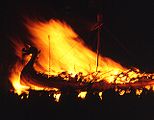
277. Fire and Ice

Some say the world will end in fire,
Some say in ice.
From what I’ve tasted of desire
I hold with those who favor fire.
But if it had to perish twice,
I think I know enough of hate
To say that for destruction ice
Is also great
And would suffice.
            Robert Frost

Both Dante’s inferno and a comment to Frost by astronomer Harlow Shapley are given as the inspiration for Frost’s poem. I’m in no position to argue with scholars, but for me it reeks of the North, of Up Helly Aa, of Bifrost and Valkyries, mead halls and winter warfare among Viking people.

Imagine yourself there, in your stave hall before the fire. Surrounded by your kinfolk, safe from the howling wind and deep frost outside your walls. Feasting on meat and mead.

Midwinter has come and gone. You have celebrated with bonfires. Now begins the long wait for spring, for the return of the absent sun.

It is a time for feasting, and for the telling of tales. Tales of Frost Giants and the Fenris Wolf. Tales of Odin sacrificing his eye for wisdom. In the great north, even the Gods live a harsh life. See him there in the corner, in the shadows near the roofbeam, just an image carved in swirling smoke, with Huginn and Muninn on either shoulder.

Old tales and new.

Agnar is speaking now. A third mead has loosened a tongue normally silent. He tells of last summer, of the fogs and waves and heaving seas, of cliffs towering black and high, wet with spume and crowned by the massed nests of fulmars. And of the soft coast, the green coast, the coast of Ireland where soft monks in black robes keep food and drink in quantity and spend their days illuminating manuscripts.

Look at the manuscript there, leaning against the wall at Dagmar’s elbow. Drawings of strange men tangled with curling letters that no one in the hall can read. Tales, no doubt, but of what value? Soft tales, by soft monks, without blood or fire.

The monks had no fire, no courage, but they had blood. Agnar and his men set that blood free to wet down the stones of their chapel. A short fight, and much treasure. Not much battle for a Viking’s tale, but sometimes it is good to tackle an easy foe.

Then Fannar raised his hand and hissed, and all fell silent. Fannar’s ears were legendary. He could hear a sword whispering from an oiled sheath, or a fur clad foot falling in a snowdrift.

They all heard, now, what Fannar had already heard. A thump and hiss, followed by another, and then a third. Soft. Almost like a clump of snow falling from a pine.

Or like torches falling on thatch.

There were no windows in the hall and only one door. They had told their tales and drunk their mead in darkness, lighted only by the hearthfire, but now it began to grow light as the thatch above began to glow, and to stare down at them with a hundred crimson eyes.

Then came the shout. Fifty voices if there was one; fifty strong male voices. In Agnar’s hall were nine men, and their women, and their children. The men leaped to their feet together and went weaving and staggering to take up their swords and axes. Hanne, Agnar’s younger wife bent double, placing her body between the child she was nursing and the burning thatch that now began to fall like rain.

Even if nine could win against fifty, the hall was burning. There would be no more shelter and no more food. It took the heart out of a man, and they screamed out their hatred to bring fire back to their blood, so they would not die soft, like the monks of summer.

Agnar threw open the door, axe in hand. Hanne crouched on the floor, protecting her infant a few seconds more, though her hair and clothing were afire.

Agnar plunged out into the frigid night. Hanne curled tighter around her daughter.

Some say the world will end in fire,

Some say in ice.

Take your choice.

Raven’s Run 67

I remembered one more incident with Raven. It was the afternoon we had climbed to the Monmarte, a few hours before we met Eric. We had entered the cathedral of Sacre Couer, and were sitting side by side. The roof was lost in shadow and the stained glass windows were rich with the light of afternoon. There were only a few tourists; they seldom get past Notre Dame. Most of the people coming and going were genuine worshippers. I watched one old woman as she entered, genuflected, and made her slow and painful way to an alter in a side chapel. She lit a candle and remained there on her knees for a time, then with equal slowness, came back past us and went back out into the world. It was a simple thing, repeated a thousand times a day in every cathedral in Europe, but it touched me.

Raven gave me an odd look as I wiped my eyes and made a deprecating mouth. We had never talked about religion. I asked, “Are you Catholic?”

“Sort of. I go a few times a year, and I feel a little guilty that I don’t go more often. I don’t think about it much. You?”

I shook my head. “Protestant background. Fire and brimstone Baptist, to be exact. My folks would give me hell for even being in a Catholic cathedral. I stopped believing a long time ago, but I think about it a lot.”

“Why?”

“Because I don’t have a superstructure of priests to do my thinking for me.”

She was silent for a while. I thought I had offended her. I could have added that Reverend Billy Thompson had been as willing to do the thinking for his Baptist congregation as any Catholic priest ever could be. But that wasn’t what was on her mind. She finally said, “Doesn’t it scare you?”

“Sure.”

“So why don’t you go back?”

“Faith isn’t something you can turn off and on. When it’s gone, it’s just gone.”

“Don’t you ever think maybe you’re wrong?”

I shook my head.

“Just like that?”

I shrugged.

“And when you die?”

“I just die.”

“I couldn’t live like that.”

“I wouldn’t want you to. I don’t try to talk people into thinking my way. It’s much more comfortable to believe in God.”

“Don’t you ever miss it – miss Him?”

I shuffled the words around in my mind to get them just right. It was something I didn’t want Raven to misunderstand.

“What I miss,” I said, “isn’t the assurance or the comfort. Not any more. That’s what a kid misses. What I miss is . . . like this: I go out in the evening and I’m alone and I see a beautiful sunset. The clouds are on fire and the sky is so blue it’s almost green. It is so beautiful it makes me hurt and I just want to look up and say, ‘Thank you.’ But there’s no one to say it to. That’s what I really miss. Having someone to say ‘thank you’ to.”

#          #          #

The steamer was pulling into Montreaux. The other passengers were gathering up their baggage. I dropped my feet from the rail and slipped my arms into the packs traps.

I could still see Raven’s face as it had looked there in Sacre Coeur. It was as if she had stepped back three paces while sitting still. Her body was still there, but in her mind, she had gone far away.

Just like she had gone away, completely away, two mornings later. There was a connection between the two events. I could feel the connection, but I could not define it. And unless I did, she was lost to me forever. I might find her, warn her, and save her from the assailants who had attacked her, but unless I unlocked the greater puzzle of Raven herself, I would never hold her in my arms again. more tomorrow

276. Wild Parties Never End

154px-uphellyaa7anneburgess30jan1973Wild parties never end, they just get organized. And maybe slightly domesticated. Consider Mardi Gras. Better still, consider Up Helly Aa.

It is said that fishermen can never get far enough north. Fishermen from Indiana go to Michigan. Fishermen from Michigan go to Ontario. Fishermen from Ontario head for the Arctic.

I found the same thing to be true when I visited Scotland. The first trip I made it north to Caithness. The second trip I made it to the Orkneys. Eventually I made it to Shetland, and once there I worked my way up to the northernmost point on the British Isles.

I didn’t see Up Helly Aa. It comes the last Tuesday in January, and in January I will always be in California, not standing in the wind off the pack ice. But I wouldn’t mind beaming in, watching the festivities, then beaming back before my liver froze.

Up Helly Aa is a relatively new celebration of the end of the Christmas season, mixed with a revival of old Viking themes. As early as 1824, on Christmas eve, a diarist recorded:

the whole town (of Lerwick, Shetland’s capital) was in an uproar; from twelve o clock last night until late this night blowing of horns, beating of drums, tinkling of old tin kettles, firing of guns, shouting, bawling, fiddling, fifeing, drinking, fighting.

If you followed the posts on The Battle for Christmas, this will sound very familiar. Christmas has been domesticated since this report, but the spirit of riot is well represented in Up Helly Aa.

It began as “tar-barreling”. Mobs of masked young men dragged barrels of burning tar through the streets of Lerwick, often colliding with other mobs, and clogging the narrow streets of the town as they made their way toward the harbor. Sober citizens were not amused. The Town Council appointed constables to keep things in check.

About 1870, the participants themselves began to change the proceedings. They invented the name Up Helly Aa, began a torchlight procession, and introduced ‘guizing – going in disguise. Soon Viking themes became common. By the 1880, Viking longships were being dragged through the streets instead of flaming tar barrels, and the ‘guizer Jarl (Jarl is the Viking equivalent of Earl) had become master of ceremonies.

Is there anyone who doesn’t know that dead Viking chiefs were put on their longships, and the ships burned? That’s what happens in modern Up Helly Aa. The purpose-built longship is dragged by torchlight, by masses of young men in Viking costume, down through he narrow streets to the harbor where the torches are all tossed aboard for the fiery finale.

Then the drinking starts in earnest. Who wouldn’t love that?

The day after Up Helly Aa is an official holiday so everyone can recover.

Raven’s Run 66

On April thirteenth I picked Raven up out of the sea. On June thirteenth, she left me. Two months to the day, and in all that time we were never separated more than the few hours. Such a strange beginning; such a swift, cruel end. So much to remember, yet so few really intimate conversations.

I remembered the day we finally entered the Mediterranean. The levante had brought warm, clear skies and more wind than the damaged sails could use. It was the kind of day that made me hunger to have the Wahini functioning properly again. We slipped smoothly through a rippled sea, making three knots under conditions that should have given us twice that speed.

Raven and I were nestled together, naked. We had found a favorite position. I sat with my back braced against the weather davit. Raven sat in front of me, leaning back against me, with her foot on the wheel lazily keeping Wahini on course. My hands were locked beneath her breasts, with fingers free to make occasional teasing excursions upward to her nipples. We could keep that position for hours if I was in post-coital lethargy, but no matter how worn out I was, the gentle swaying of the boat would eventually take my mind off seamanship and we would make love.

Today, we hadn’t reached that stage. We were simply talking. I had told Raven about my father and how he had abandoned my sister and me after my mother died. It is not something I talk about easily, and I had eventually grown tired of the bitterness in my own voice and had shut up. There followed a long silence, until Raven said, “You would like my father.”

“Oh?”

“You’re a lot like him. He is a powerful man. I don’t mean physically, and I don’t mean his political clout. He is a man who knows his mind and doesn’t swerve once he has decided on a course of action. He has enormous self-confidence. Like you.”

I didn’t know what to say. I do have a lot of self-confidence, but it isn’t polite to say so. I just said, “It must be nice to have a father like that.”

“It’s hell.”

“What?”

“Oh, it’s okay for my mother. She loves him, worships him, almost; and my sister gets along fine with him. They are both the shy, retiring types.”

“And you aren’t?”

It was a joke, of course. I said it lightly, but she replied, “Damned straight!” Then she got up so fast that she almost tore herself out of my arms, and walked stiffly away, a firm, fine, living, cafe-au-lait statue of Venus. She disappeared below, and I didn’t see her again for two hours. When she came back up, she had dressed in Will’s jeans and shirt, and she didn’t mention her father again.

An omen perhaps. Certainly a warning, but it had not made sense to me at the time. It still didn’t, not where my thinking mind lives, but in the undermind where all is groping after glimpses of pattern against a background of chaos, it fit. It rang true. Her words on that fine Mediterranean day and her leaving me without warning or explanation were like two pieces of an enormous jigsaw puzzle. They fitted together, but while the rest of the puzzle lay scattered, they meant little. more tomorrow

275. Christmas for Lupe

Today is Thursday, December 22, 2016. Christmas will be Sunday, and this is my last post until then.

I’m going to tell you a story about a little girl I know. This is how she will spend her time today, as you enjoy preparing for Christmas.

*          *          *

Ramon came in, stamping the snow from his feet, and shook the snow from his jacket before closing the door. The sun was low in the eastern sky behind him as Lupe moved up and hugged his leg. He smelled of sweat and manure and soured milk, but she didn’t mind. She had hugged him this way every morning for as long as she could remember, and he always smelled the same. For Lupe, the smell was as familiar and welcome as his cold fingers on the top of her head.

Every morning Ramon rose before the sun was up, and left the house. His daughter greeted him when he returned hours later, and saw him off again in the afternoon. She was usually asleep when he came home at night.

It is hard work milking cattle twice a day, and the pay is low. The cattle march in from the muddy lots to take their turns in the stalls, where fast moving men attach the milking machines. The cattle resent the process and the workers have to move quickly to avoid having their hands caught against he stanchions. It goes on for hours, in heat or cold, beginning every morning before daylight, and continuing again every evening until long after dark.

Lupe stepped aside to make room for her mother. Today she seemed worried; her voice was unusually sharp as she asked, “What did he say?”

Ramon said, “I didn’t tell him.”

I translate, of course. Every word was in Spanish.

“You got your money for the week?”

Lupe’s father nodded, “I told him I needed it today, to buy things for Christmas. I was afraid to tell him the truth. He is a good man, but it seemed best that he should not know.”

Lupe’s sister came out of the single bedroom with a cardboard box in her arms, tied up with twine. Lupe looked up with interest. It was not wrapped in paper, but any box is interesting so close to Christmas. Carmella put the box down on the floor and returned a moment later with blankets and bedding, also rolled up and also tied up with twine. Lupe asked what she was doing, but Carmella ignored her.

Her father carried the box and roll outside. Her mother came out of kitchen with a box of food, and that began a procession of boxes, coming from various parts of the house and out to the car. Lupe’s mother and sister had gathered their possessions during the pre-dawn, while Lupe slept.

Now Lupe dragged at her mothers leg asking questions, but she was ignored until Carmella pulled her aside and said, “We are going away.”

“Where?”

“I wish I knew Lupita. I wish I knew.”

“But why?”

“It’s only a month until he becomes President. Everyone here knows who we are. We have to go away, somewhere where people don’t know us.”

“But why? I was born here. This is home.”

“So was I, Lupe, but mother and father were not.”

When they pulled out an hour later, Lupe stared back at the little house where she had spent her whole, short life, until it disappeared around a bend. Then she looked out the windshield, past her mother and father’s silent heads. It was a long road, wet with melted snow. Her father would not leave the house tonight before the sun went down and go to the cows. There would be no more money, no more warmth, no more little house. It would be again as it had been, before the job at the cows, before she was born. Lupe knew what that was like from hearing her parents talk. Now it would be like that again.

*          *          *

Is Lupe real? She was born from the hundreds of little Mexican-American girls I taught over twenty-seven years. How many were undocumented? I never knew. I never asked. I didn’t need to know.

Is she real? She is as real as heartache. She is as real as fear. She is as real as dislocation, cold, hunger, and injustice.

Raven’s Run 65

At my elbow, a heavy American tourist with a Texas accent talked about triple compound expansion, and from the references he made it was clear that he owned a small steam engine of some kind. Whether it was the kind you put in a launch, or one of those silly live-steam trains that you see grown men riding around on top of, he didn’t say.

Technical conversations fascinate me, and dedicated enthusiasts fascinate me. Another time, I would have made an excuse to engage the man in conversation to learn more about these steamers I liked so well. But not today. Today was for solitude.

I went on to the upper deck. Since I was using the Senator’s money, I had bought a first class ticket. The view was the same as it had been from the second class section on the main deck. Gorgeous. Steep, grassy hillsides dotted with chalets, cattle grazing, and all reflected in the glassy perfection of the lake. In the distance off the bow, beyond Montreaux, the snow clad peaks of the true Alps were playing peek-a-boo among the clouds.

Eventually, I became aware that one of the other passengers was eyeing me. She was young and lovely, in a tight mini-dress and sandals. She had hair cut shorter than mine, very black and straight, and lashes too long to be real. Her companion was blonde and frilly with a habit of hiding her mouth when she talked. They were leaning against the rail, talking, and giving me covert looks.

I don’t know why girls do that. I would not call myself handsome. Not like Will is. I am just six feet, one ninety, broad where a man should be broad and narrow where a man should be narrow, but no one would ever put me on the cover of Gentlemen’s Quarterly. Field and Stream, maybe. Not that I mind the attention, but it confuses me. My first reaction is always to wonder if they are joking. Did I forget to zip something?

Normally, I like the attention, but today I had Raven on my mind. When the girl with the lashes finally sent me a smile that would have melted a statue, I shook my head and turned away. When I looked around later, she was gone.

So then, naturally, I found myself regretting the lost opportunity. Consistently inconsistent.

I wedged my pack against the seat, put my feet up on the rail, and made myself comfortable. Fifty-two hours. That was how long it had been since I woke up to find Raven gone. Fifty-two hours, and I was still in shock. I was walking through my life half awake. I was eating, sleeping, making conversation, making decisions, choosing logical courses of action, not falling overboard. But I was doing it all with my mind only half engaged.

I sighed. It was one of those sighs that starts in the back of your throat and shudders you all the way down to your feet. It was good that no one was sitting near; they would have called the paramedics. And then I chuckled. Pitiful. Pathetic. Too sad to live. You can only take yourself so seriously, and then all your actions turn into farce. more tomorrow

274. Solstice: a poem

DSCN4794This is the day that the sun has turned it face furthest away from our northern lands. The veil between the worlds is thin today. Among pagans, there is expectation of visitation from those who have gone on before, and among all men there is an understanding that individuals, like the years they inhabit, have ends as well as beginnings.

Solstice

It hardly seems an hour
since the sun rose up
into the crystal sky.

Now it sinks westward into clouds
like a crimson bird, descending
slowly into gray.

A bitter wind cuts deep.

I was young this morning
and worried already
about the end.

Now that I’ve known
both youth and age . . .
They are no different

Tonight I am cold,
        but I’ve been cold before.
I’ll sleep well under blankets
        that trap what little warmth remains.

Good evening, sun.
I thank you for the day you gave me.
Now the long night begins.


I will see you in the morning
           And if not
That will be all right, too.

Raven’s Run 64

Chapter Eighteen

When I traveled in Europe after I got out of the Army, I was stretching out my money by camping and eating grocery store picnics. It was then that I discovered the oddly opposed set of feelings that establish the rhythm of living close to the ground. Whenever I set up camp, there was always a feeling of relief and belonging, like a little homecoming. Even if it was only for one night, the campsite became my home, my own personal piece of the Earth. For a person traveling far and fast, there was great comfort in falling asleep looking at the same walls every night, even if those walls were blue nylon.

But whenever I broke camp, there was an equally strong feeling of freedom. Once my tent and sleeping bag were stored in the pack, and everything I owned was on my back, there came a transcendent feeling that I was once again unfettered. I could go anywhere.

As I left the hotel the next morning, I had that feeling again. The comfort of well worn pack straps, the snug grip of well worn shoes, the solid weight of the pack, and the beckoning sun filled me with joy. Oddly, not a little of that joy came from leaving Susyn behind. She was delightful, but she was not Raven. And I needed time to be alone. Since Raven was thrown off the cruise ship, I had not had an hour of true solitude, and I was feeling the lack.

I took my time walking down to the steamer dock, enjoying the town. When I reached the lake, I still had an hour to wait. I walked around the marina, admiring the sailboats, then went down through the park to the water’s edge. It was too early for any of the street musicians to be out; Susyn would come by here in the afternoon asking her questions. Now there was only sunlight, deep blue water, green grass, and young lovers strolling about. And swans. Sometimes I think half of the charm of Europe is her swans. Now, in early summer, the cygnets were big and awkward, gray and ugly-cute, just like Hans Christian Andersen described them. I squatted at the edge of the lake, a hundred yards from the steamer pier, and held out my hand. A pair of waddling adolescents came up to beg, found me breadless, pecked at my boots, and wandered off looking for a better handout.

I watched the steamer come in, and went on board with the tourists. The rest of the tourists. When you live close to the ground there is a tendency to forget your real status and believe that you are more a part of the landscape than you actually are.

Most of these lake steamers were built around the turn of the century. Their lines speak of better days, or at least days with greater attention to style. They are long, lean side-wheelers, with massive steam engines on the main deck, huffing and wheezing in plain sight. I leaned on the brass rail to watch. Fine machinery is always fascinating, and this was kept polished and shining. At my elbow, a heavy American tourist with a Texas accent was explaining it all to his wife. She listened with polite disinterest, patting his arm from time to time. You could see that the words meant nothing to her, but she was happy to see him happy. more tomorrow

273. Jesus and Joseph

I have a mental image that I would convert into a painting, if I had the skill. I don’t. I can draw; I can paint; but I lack the spark that turns such work into art. It’s frustrating — I’ll have to make do with words.

Imagine the interior of a carpenter’s ship, two millennia ago, somewhere in the middle east. Research won’t help much on this one. The best you can find is a painting from the European middle ages, or the Japanese middle ages, and then you have to reason backward with few facts to help you.

There will be two figures in the painting, and of course, you already know who they are. Joseph is planing a board he has just riven. Jesus is sweeping the floor. From time to time their glances meet, but there is little conversation.

If you have read many of these posts, you know I am not a Christian, but I started out as one, and Biblical images live in my bones. I have always wondered at the strangeness of the Son of God growing up apprenticed to his human father. And I’ve wondered how Joseph must have felt about it all.

Joseph gets little respect. Catholics give their affection to Mary. Protestants ignore him altogether. The ancient Cherry Tree Carol sees him as an insensitive doubter who thinks Mary is carrying another man’s child.

I have also wondered how Jesus must have felt. Even if you believe he was God, he was also a boy, with a child’s limitations, trying to understand his human father.

So . . .   Joseph and Jesus are in the carpenter’s shop. Jesus is sweeping the floor, since he is not yet trained. HIs father is planing the board he has just riven. Jesus looks up from time to time. There is affection in his gaze, even though he knows that his father’s love is limited by Jesus’s own strangeness. Then he drops his eyes back to his sweeping.

Joseph looks up in turn, stern and a little puzzled by the child’s silences. His hands pause a moment at his work. A traditional picture would fill his eyes with wonder. I don’t think so. I see them filled with frustration and resentment. And yet, with affection. The two sides of the moment are at war in his eyes. Then he draws back his hands and the plane moves through another stroke, because, for God or for man, there is always work to do.

Father – it’s a tough job description. Son isn’t much easier.