
Author Archives: sydlogsdon

203. Leap on the Bandwagon

This series starts with 178. Leap Boy, back in the news and continues in 192. Billy Joe Takes a Leap and then in 200. The Last Sane Man.

It’s hard to say who made the first mistake. Certainly Leap’s mother should never have named him Leap, even if he was born on Leap Day. Some temptations just have to be resisted. Worse, she should have spoken his name out loud when she named him. Leap Alan Hed, for heaven’s sake. How could she have missed that Alan would become A., and no one could ever meet her son without saying Leap A. Hed.

Leap wasn’t blameless himself. By fighting back to the point of absurdity, he made himself famous enough to come to public attention. Counting his age by leap-day-birthdays and calling himself 16 when he was in his sixties — that’s just asking to be noticed.

Of course Billy Joe Barker was to blame for touting him as a write-in candidate for President. Then when he said that Leap was sane because he really didn’t want to be President, it was the last nail in Leap’s coffin.

People never give you what you want, but they always give you what you don’t want. Didn’t anybody know that?

Shelia Barnstaple of Wilmington, Ohio started a blog called I Want Leap for President. Wilton Damonson of Ash Fork, Arizona started a competing blog called Leap on the Bandwagon, also using the hashtag #LeaponforLeap. You would not believe how many people have 140 characters worth of something to say.

Throughout August, as Donald sank in the polls, people first sighed with relief, then suddenly realized that Hillary would probably win. Someone published a poem anonymously that read:

When Donald came I feared the worst,
If he won it just might kill me.
He surely was the worst of worst,
But second worst was Hillary.

Within days the doggerel was re-posted four million times, and a hundred and ninety-two people were claiming authorship.

Meanwhile, Shelia Barnstaple and Wilton Damonson combined forces and the draft Leap movement really took off. Leap found his house in Dannebrog surrounded by reporters. It looked like Marilyn Lovell’s lawn in Apollo 13. Leap came out with a shotgun to run them off, but they only clicked their cameras faster. He retreated. The shotgun was never loaded, since Leap was basically a peaceful fellow, but the hashtag #Leapforlawandorder raced around the globe at the speed of light.

Leap drew the shades and locked his doors, turned out all the lights but one, and settled in to wait out the silliness with his paperback collection of Nero Wolfe novels. After an hour, the reporters started pounding on his door, then on his windows, and finally on the walls of his house. He couldn’t call for help since he didn’t have a phone, but his neighbors took pity and brought in the county sheriff. He drove the mob back into the street.

That night, Barnstaple and Damonson posted a call to join Leap in his Silent Vigil for America. Three hundred thousand people promised that they would.

Sometime during the night, a darkly clothed figure joined the reporters breifly, then quietly faded away. Once it was light the next morning, Armin Arkin of WFUD noticed that the back door was ajar and announced that he was going in. Within minutes, the street was empty and the house was jammed with anchors and their cameramen elbowing for room to broadcast, but Leap had disappeared.
Jandrax 87

In the months that followed, Jandrax and Jean shared in the hunt and in the telling of tales. Jean learned from his father of the precursor ruins scattered about Harmony and they speculated on the nature of the presence. Jandrax questioned Jean closely about the colony, the details of Angi’s life after the purge. They discussed how old Marcel Dumezil had been killed mysteriously in his sleep. Jandrax refused credit for that act and pointed out that it had been done during low winter when the tribe was elsewhere. They speculated as to who might have done it and concluded that it could very well have been his son Anton.

“The other Anton, old Dumezil’s grandson, the one who betrayed you. What did you do about him? Did you kill him?” Jean stung under the implied criticism and explained, then added, How could I challenge him when I don’t know that he withheld fire? Primers do fail.”

“Rarely.”

“Rarely – but they do fail and I am not content to take his life while my reasoning may be wrong.”

Jandrax merely nodded, offering no advice. “What about your son?”

“Once again, I don’t know that he is mine.”

“But you are sure in your own mind?”

“Yes.”

“What will you do about him?”

Jean shrugged, “I don’t know – yet. Before I decide that, I must know if I am welcome here. I am a stranger, after all. My original intention was to return to the colony.

“And now? . . . ”

“Now I am not sure. There is little for me there, but I wonder if there is anything for me here. Your people are independent to the point of cruelty. They have your arrogance, but they have never had to face up to the opinions of others. They consider themselves the lords of creation and the colonists as subhumans.”

“They accept you.”

“Yes, they accept me. But did they ever inquire as to whether or not I accept them?”

Do you?”

“No, not entirely, although I confess a certain respect for their independence. But it it is an independence based on childish bravado and an unwarranted sense of superiority.”

Jandrax was silent then, pondering. He stirred his chota and sipped. “It is an old story, Jean, played out on Earth centuries before either of us was born the story of the nomad and the oasis. The nomad lives his life wild and, he thinks, free, looking down upon the dwellers in the oasis while all the time he is dependent on them. It is thus with us. Likewise the oasis dweller looks with a mixture of fear and derision at the ignorant nomad, whose crude existence lies beyond the pale of civilization.”

“You don’t depend on the colony.”

“No? Where did our women come from?”

Jean waved his hand as if to brush away a side issue. “You have women enough now. Nightwind could have found a woman without kidnapping Paulette.

Jandrax shook his head. “There is more to it than having an equal number of males and females. Our gene pool is too small, not only among us but on the whole planet. We – the tribe and the colonists – need each other. The day will come when we trade together again. I think it is inevitable.”

“The elders don’t even acknowledge your existence.”

“So? We exist. Let them acknowledge or not, they can’t keep their children in ignorance forever. Did you not speculate on the disappearances? The day will come when they can no longer ignore us.” more tomorrow

202. Planetary Scale

     Everything in a writer’s life is grist for the mill. For a science fiction writer that includes science itself and, in my case, the teaching of science.
     Here is some more teacher geek. In a book on teaching middle school astronomy, this would be an appendix.

When I was in my early teens and discovered the local library, it not only gave me science fiction, but science as well. I remember the dozen or so books on popular astronomy. I particularly remember How to Build a Telescope, which aroused my lust then dumped me when I found out I didn’t have enough money to but the mirror blanks.

The single issue that most challenged the writers of those books was how to convey the scale of things. Now, if you are under forty, you will have to project your mind back to the days when print technology did not include glossy paper and color photography. Visualize a few grainy black and white photos, a few drawings, and lots and lots of words. Like, “If the distance from the Sun to the Earth were equal to the thickness of a sheet of paper, then the distance to Alpha Centauri . . . “

I grew up figuring out that kind of analogy, but if I gave such a book to one of my modern students, their eyes would glaze over and the wheels would stop turning. The children of Sesame Street have to be shown.

Would you like a simple example? Did you know that a softball is moon-size in comparison to a 12 inch classroom globe of the Earth? And if you hold the softball 30 feet away from the globe, it will be proportional in distance as well as size.

For the rest of the solar system, you can’t show both proportional size and proportional distance in a classroom. You can buy a poster with the proportional sizes, but the planets are all on top of each other. If you make a chart of proportional distances, the individual planets will be too small to see.

You can do both, however, if you are willing to take the exercise outside.

We are about to make a model of the solar system. If you want to get out your calculator, be my guest, but I’ve already done the math and I’m willing to share. The scale I used was one to one billion. It would be easier in metrics, but we will eventually be using a local road map for this, so the good ole American system will have to do.

The chart below is in miles and double-steps. That’s because we want your students to get into the act and count the distance to the planets. A double step is normal walking, counting every time your left foot hits the ground, one-and-two-and-three-and . . .

Your sun will be about five feet in diameter. I looked for years for a balloon that size and never found one, so each year I made a new five foot diameter circle of paper and taped it to the outside wall of my classroom. The distances you need are:

Mercury        38 double steps
Venus            71 double steps
Earth             99 double steps
Mars            150 double steps
Jupiter         513 double steps or 0.5 miles
Saturn                                           0.9 miles
Uranus                                         1.7 miles
Neptune                                       2.7 miles
Pluto                                            3.5 miles

You can skip Pluto if you want, but when I first started doing this, it was still a planet.

Give some of your students models of the planets (we’ll talk about sizes below) and take off with the whole class, counting double steps. At 38, leave the student with the Mercury model and continue with the rest of the class. Et cetera.

My double steps go through Jupiter because our playground allowed us to get almost that far. When we reached the boundary fence, I would tell them, “Jupiter is just beyond that house.” Then I would reel off where Saturn through Pluto would be found. My recital would mean nothing to you; you need to make up your own. Find a large scale local map, measure out distances from your classroom, and memorize them. (For us, Pluto was in the next village.)

None of this would be worthwhile without models to show how small our planets are in comparison to the space they inhabit. I made Mercury, Venus, Earth, Mars, and Pluto out of  beads or glass headed pins, stuck into dowels. Be sure to paint the dowels orange for when Johnny loses one in the long grass. The rest of the planets were made of rubber balls found after multiple trips to toy stores, and painted with artists’ acrylics.

You need these sizes, and this time I’m going metric because it’s way easier.

Mercury       5 mm
Venus        12 mm
Earth         13 mm
Mars           7 mm
Jupiter     143 mm
Saturn     121 mm
Uranus      52 mm
Neptune    50 mm
Pluto            3 mm

Feel free to pass this on to anyone who might want to make this model.

Jandrax 86

He forced her back to the mud and overcame her.

She lay on her back, panting, and the entire camp was leaping about in mad abandon. He grinned down at her and she smiled, this time without derision.

“Stubborn would be a good name for you, but I don’t think you’re afraid of women at all.”

“Ha!” came an exclamation from beyond the fire, “I see I got back just in time for the entertainment.” The speaker entered the firelight. Jean would have known him even if his express pistol had not hung at his side like a badge of authority. His pale hair had turned white, but otherwise his face and frame were ageless. Jean grinned up at him, never letting go of Mist-on-water’s struggling form and said, “Welcome back, Papa.”

Jan Andrax squatted down beside his son, ignoring his squirming rug, and nodded with satisfaction. “I don’t know how you got here, but I’ll bet it’s some tale.”

***

Jean ate that night with Jandrax and his wives and retold his story, including the details of his encounter on the island. Jandrax shook his head and asked, “Did you tell anyone else this story?”

“Of course. Everyone else has heard it.”

“Damn! How did they take it?”

“With skepticism.”

“Only skepticism, not outright disbelief?”

“No.”

Jandrax cursed. Jean was taken aback by his vehemence. “Come, Papa; even Mentor Louis Dumezil recognized the possibility of further enlightenment.”

“Jean, we aren’t even speaking the same language. You know that the original crew members were cast out for religious reasons.”

“Yes,” Jean answered, “But only Nur Mohammet was not a Monist, so Helene told me; you were tarred with the same brush, but you surely haven’t all become Muslims since then.

Jandrax got up to pace. “Jean, for twenty years Helene has been preaching Monism and I have been scoffing.”

Jean was bewildered now. “Are you trying to tell me that you don’t accept the Monomythos? That’s absurd.”

Jandrax opened and closed his hands spasmodically.

That old, hated, trapped feeling had returned at this reminder that he was enmeshed in a community too small for anonymity. “I do not believe in your presence,” he said, “or your winged girl. I do not accept the Monomythos or any supernatural being. I believe only in life, death, and oblivion.”

“My God! That’s horrible.”

“At times, Son. At times – do you want to be a prophet?”

“No!”

“You will be if you don’t watch yourself. I have infected the tribe with enough of my discontent to make them susceptible to a new doctrine.”

“I am a Monist,” Jean snapped. “I don’t want to start a new religion.

“Neither did Jesus.”

Jean could only shudder at the blasphemy.

“They are ripe for a religion tied to this particular planet. Earth is three planets and five generations removed. They no longer need the Gods of Earth.”

“I cannot deny what I have seen.”

“Visions always come to lone and lonely men, cast out from their people and suffering great personal tribulations. They are nothing more than projections of unconscious needs in conditions of deprivation.”

“No. I saw what I saw.”

“I don’t believe it.”

“And if you are wrong?”

Jandrax scowled still more deeply. “Then I would truly fear. I have seen what men can do under the delusion that they have a god’s approval. If they really had it . . . unthinkable!” more tomorrow

201. Teaching by Feel

I taught science for 27 years in a small school in California. At first it was science and everything else, but each year I had more science classes until I retired teaching science full time. A few years before that, while I was teaching five science classes and one class of perspective drawing, our shop teacher left. I volunteered to keep his class open, so for two semesters, I taught shop. That is when I instituted Pounding Day.

Pounding Day came from my firm belief that kids learn best with their minds when they are also learning with their bodies. This is not the same thing as “hands on”, which is a good idea that too often deteriorates into doing arts and crafts instead of science.

Pounding Day is practice. If you want to learn to add, you practice your addition tables. If you want to be LeBron James, you practice basketball. Driving nails is no different. It makes no sense to drive your first nail into a project you have just spent a week measuring and cutting. Your first nail should be into something disposable, because is it will kink and flatten.

During the first week of class, I gave each student a hammer, two dozen 16 penny nails, and a chunk of 2 x 4. After minimal instruction, I turned them loose.

You’ve never heard such noise. OSHA would not have approved. My friend Adrianna did, however. Every Pounding Day she waved encouragement as she drove her herd from the exercise yard to the playing fields. Adrianna taught PE; she understood kinesthetic learning.

Kinesthetic learning also works for science.

Old science texts used to have kids making up pulleys from sewing thread spools. Modern technique uses prepackaged kits with flimsy plastic pulleys and underweight weights. You tell a kid that he has doubled his mechanical advantage, but he can’t tell because the whole setup is so lightweight he could easily pick it up and hurl it at his buddy in the next row.

Not good enough. Not at all good enough. When I was a new teacher, I built 2 x 4 frames, bought sash weigh pulleys and down-rigger cannonballs. Cannonballs are two and a half pound lead weights used for summer deep lake fishing. When one of my students doubled his mechanical advantage, he could feel the difference.

(Yes, I painted the cannonballs so my students would not be handling lead.)

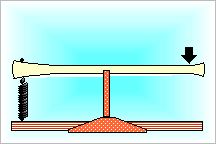
I also built a leverage demonstrator, consisting of a 2 x 4 base with a moveable fulcrum, heavy spring load, and a mattock handle lever. I only built one because there was a dangerous amount of force involved, so I never let students use it unless it was braced by my adult strength.

fulcrum demo

With the fulcrum in the middle of the handle, the downward force is equal to the force of the spring. With the fulcrum near the end of the handle, I couldn’t budge the thing myself. With the fulcrum near the spring, the smallest girl in the class could move the handle with one finger.

If you have earned your students’ trust, and if you are careful not to bruise fragile egos, you can have a lot of fun pitting big boys against little girls in contests of strength rigged to let the little girls win.

[Safety notes: If the fulcrum is next to the spring and a student pushes down, then lets go, the handle will fly 180 degrees to the left and conk whoever is sitting there. Beware. If the fulcrum is far from the spring and your heaviest student jumps up and throws himself on the end of the handle – and they will – you had better be strong enough to keep the whole mechanism from tipping sideways and crunching you both. If you aren’t strong enough, don’t let them do it.]

Our final pulley experiment moved outdoors where I had suspended a bosun’s chair from a basketball goal. Students sat in the chair with the arrangement of pulleys over their heads and lifted their own weight off the ground.

When we did inclined planes, I brought a wheelbarrow, 2 x 12, and concrete blocks from home for the day. I let a student sit in the wheelbarrow while another ran him up increasingly steep ramps. Change students and repeat.

If the subject is force, middle schoolers need to feel that force in their hands and arms, not just calculate forces and imagine how they would feel.

Jandrax 85

Jean sat beside the fire one night as Vapor made the rounds of the young girls, teasing each in turn and caressing where they would allow it. The girls were as fiercely independent as their brothers and their prowess as hunters and survivors was no less. Vapor dropped beside Jean with a grin and began his customary teasing. As always Jean took it in serious silence.

“Jean Dubois. What a name; you need a good name like mine. Vapor – now there is a name.”

“Vapor is the promise of substance which fades away when confronted,” called one of the girls who was watching from the edge of the firelight. Vapor snarled back at her, then turned his attention back to Jean.

“Let’s see, what would be a good name for you? Turtle for your speed, hey. I’ve never seen a turtle, but you remind me of the tales the Old Man tells.”

“1 am happy with my name as it is.”

“Ha, girls, do you hear that? I try to do him a favor and he is ‘happy with my name as it is’,” Vapor mocked. “What you need is a name to suit you. Let’s see, Mud? No. Herby? No, you aren’t domesticated.” The girls broke into laughter at this.

“I know what I’ll call you – Stubborn. Then every time you refuse to answer to your name you will be proving it.” 

Jean looked straight at Vapor and said, “Go ahead. Call me Stubborn and I’ll call you Big-mouth-without-teeth.”

Vapor dissolved into laughter, rolling on the ground and leaping up to pound Jean on the back. Jean smiled within himself; he was learning to hold his own with these wildly independent people. He knew that his solitary march had been watched for weeks before he was contacted and that if he had not made it on his own, they would not even have bothered burying him. But he had made it, and they were willing to accept him because he had shown himself not to need them. It was backward logic by his own life-way, but he respected and understood it.

Mist-on-water stood up and cast her knife aside. Even around the fire the tribe seldom went unarmed. “Stubborn-Jean,” she said, “I think I’ll call you Afraid-of-women. Eleven times I have said that I wrestle better than you and eleven times I have been spurned. I swear, Stubborn-Jean-afraid-of-women, that I will never ask you again.”

Jean realized that the entire camp was silent, watching, and he knew that there was more to this challenge than met the eye. Helene sat near the fire, watching, her eyes sparkling slightly. He stood up, casting his blade aside also. Vapor whooped and Mist-on-water charged.

She hit him low on the left side, driving her shoulder into his scarred thigh and striking up at his crotch with her fist. Completely unprepared for this, Jean took both blows and went down in agony. His head swam and his throat tightened on the surge his stomach sent rising. He rolled over and looked up to where she stood, legs straddled, her firm breasts pushing against her fur vest, head cocked to one side, taunting. The others were hooting their derision.

He staggered to his feet and ignored her, starting back toward the fire. All around him were taunting voices. Mist turned away in contempt and he moved when she turned, lunging forward on his good leg and reaching for her. His fingers caught in the waistband of her hide trousers and he heaved as he fell, jerking her down so that her rump hit the muddy ground with a splat.

He was upon her before she could retreat and they fought in earnest. She had been schooled by Jandrax himself, but Jean’s training had been but little worse and he was both angry and aroused. She was vicious, kicking, biting, and tearing his hair, but he would not be moved. He forced her back to the mud and overcame her. more tomorrow

200. The Last Sane Man

It was a bad week in mid-August.

Donald was imploding and Hillary should have been, but Donald kept grabbing the microphone. Nobody was thinking about e-mails because Donald kept spinning out one-liners. The Democrats were simultaneously frightened that he might win, and exulting in the poll numbers that said he wouldn’t. The Republicans were furious at lost opportunities, and tearing their hair out over the poll numbers.

On Sunday, August 14th, Billy Joe Barker sat down in front of his computer to compose his weekly commentary for the Tulsa World. The column was called Thank God Its Monday, but this night he simply couldn’t find anything to be thankful for. He had had such high hopes for Trump, but that was only a bitter memory now.

Then inspiration took him by the throat. His fingers flew across the keyboard and he hummed happily as he typed out the doom of a poor schmuck who had never done him any harm.

Please Mr. Custer

If you are old enough, you may remember a novelty song from 1960 called Please Mr. Custer. A trooper was complaining to commanding officer, who happened to be George Armstrong Custer, that he really didn’t want to go with him on his ride out to see what the Indians at the Little Big Horn were up to.

I don’t blame him. Nobody blamed him. It was a good laugh and nobody thought the trooper was unpatriotic for yelling, “I don’t want to go.”

I thought of that trooper today as I remembered my column of August first. It was about Leap Alan Hed, the boy who was born on leap day. Kids teased him so much when he was young about his name, Leap A. Hed, that he got back by counting his age by leap-year birthdays. He told me himself, when I interviewed him over the phone, that it was a piece of silliness he regrets to this day.

I invited him to run for President as a humor candidate, and offered to carry his campaign in this column. He turned me down flat, and I called him the sanest man in America because he really doesn’t want to be President. He didn’t even want to pretend he wanted to be President.

The trooper in the old song said, “I don’t want to go,” and Leap said, “I don’t want to be President.” Fifty-six years apart – the last two sane men in America.

I wanted to vote for Trump, I really did, but I can’t. Hillary – never mind. And the outliers, not them either.

On November 8, I am going to write in Leap Alan Hed, the last sane man in America. If you find Donald and Hillary as unpalatable as I do, I invite you to join me.

The piece was picked up by AP and UPI. All across the nation, every anchor with two minutes to spare read part of it on his broadcast. It became a phenomenon.

The reason was clear to those who paid attention. For a year, Donald Trump had given the talking heads something to cover. He was fun; he was colorful. He was safe. Nobody in his or her right mind thought he would ever win anything, and the rest of the Republican candidates were a dreary lot.

Then he won the nomination. The talking heads felt panic, and a massive sense of guilt at the idea of “What have we done?”

By the time relief arrived through Donald’s spiraling self-destruction, they were really tired of him. And they had always been tired of Hillary. Leap was a breath of fresh air. Leap was something different they could talk about, and he was safe. No one could ever take seriously the candidacy of a man who refused to run.

It seemed as safe as betting against Donald had seemed.

How quickly we forget.

Jandrax 84

Nightwind in turn had taken a wife from the daughters of the colony Paulette Dumezil.

She was called Moccasin for some reason Jean could not comprehend. All of the tribe except the elders took fanciful names for themselves. Why Nightwind had taken Paulette instead of one of the girls of the tribe was a mystery to Jean. She was quiet and reserved, clearly a captive rather than a member of the tribe, while the others were laughing and forward. Jean was quite unused to their actions.

One, called Miston-water, was particularly trying.

She never failed to show off her prowess with a bow or lance in Jean’s presence and offered twice daily to best him in a wrestling match, ignoring his crippled condition. It shamed him as nothing had done before and bewildered him as well. Helene watched the proceedings out of wise old eyes that told nothing.

Jean could not get Mist out of his mind, nor could he forget Paulette. His training cried out for him to rescue Paulette from her slavery but he was powerless to do so. He tried to get near enough to speak to her on several occasions, but it was a danger to do so for she was Nightwind’s woman. She in turn evaded him, perhaps in shame.

Jean kept up with the company well enough but could not hunt with them. They hunted in quintets; two would go out without warding amulets while the other three would circle about scaring game toward the waiters. Then all five would close in to share the kill if the animal was dangerous.

They did not need rifles and Jean felt worse than useless. Twice he slipped away in the night and stalked a herby or humpox, killing them with his rifle along the path the tribe must take.

The elders did not make the trek entirely afoot, though Helene and Valikili were fit enough. They often rode in the flatboats made from light wood cut in the mountains and drawn by domesticated herbies. These creatures were another of Jandraxs triumphs and they made the nomadic life easier by serving as beasts of burden. Domestic herbies were not eaten since there was an abundance of wildlife to serve that purpose. The boats were slim, flat boxes which would float in water and could be dragged like sleds through mud, allowing them to be used in the two media which were the natural habitat of the tribe.

The Old Man had gone off alone as he was wont to do and none of the tribe worried for him. Of them all, he was the fittest and the one most immune to discipline. His fierce independence had affected them all.

He would return when he chose, bringing with him prime furs, or precious wood for the repair of the flatboats, or perhaps some precursor relic.

Jean became a mass of ill concealed excitement at the mention of the precursors, but the tribe took them in stride. Jandrax had found numerous ruins of an ancient civilization and was always looking for more. What, Jean wondered, would he say to his son’s tale of the island?

*****

As a matter of full disclosure, the idea a species or civilization predating our own is a very old one, and has frequently appeared in science fiction. Atlantis comes to mind. My own strongest personal debt in that direction is to Andre Norton, who always seemed to have some elder race lurking in the background. I call mine precursors because she has already used the better word, forerunners. more tomorrow

199. Lost in Juarez

This is a continuation of yesterday’s post. You really should read it first.

Chapter 1

I spent my first week drunk in Juarez. Or rather, drinking steadily; a controlled drip of Corona that kept me looking and smelling intoxicated while I watched the other Gringos and learned their ways with the natives. Then I moved north to El Paso and spent a few days learning how men treated American barmaids in 1944. I moved on to Austin where I learned how to talk to waitresses and librarians and store clerks. 

Sure, America was my native country, but my year of birth was still in the future. I remembered how Dad and my uncles had acted when I was young, but they were always on their best behavior – married church-going Christians in front of the kid. How they had talked and acted when I was not around, or when they were younger, was another matter. There are subtleties, and the subtleties will trip you up.

By comparison, my stop off in San Francisco in ’67 has been a cakewalk. Everyone was crazy, or expected craziness. The weirder you were, the more you fit in. Not so this era.

I wasn’t the only spy in America in 1944. Posters said it in four words:  Loose lips sink ships. The stock answer to excessive curiosity was, “Whadda you need to know that for, Buddy?” That didn’t cause me problems because I wasn’t gathering military information. I already knew how the war was going to turn out. I was just learning how to pass as a native of the era.

In Tulsa I pissed in Whites Only toilets and drank from Whites Only water fountains. It gave me chills. Linda had been black; cafe au lait, actually. Marrying her in this era would have landed me in jail – or worse.

I had acquired a limp and a scar that all but closed one eye, and a feigned irritability that kept people at a distance. The shirt I wore was khaki with stitching scars where the sergeant’s stripes had been. I was a wounded veteran who just didn’t want to talk about it. I didn’t claim that identity; I wore it like a second skin and no one questioned me.

All in all, I used a dozen disposable identities during those days while I learned who I had to be for my mission. I made my mistakes under those other names.

How far can you joke with a waitress? About what subjects? What will be taken as humor, and what will get your face slapped, or win you a night in jail? What will a cop wink at, and what will get you a nightstick upside the head? I had to know because, ultimately, I had to become invisible.

I wandered west to the Rockies, then east to New York, and finally back southward toward Georgia.

It was odd to find out what felt the most strange. Segregation and Jim Crow depressed me, but did not surprise me. The absence of computers and instantaneous communication I took for granted. It was the heat that came as a sheer physical shock.

I used to think that Thomas Edison was the greatest benefactor of mankind, bringing light to dispel the darkness. After a summer in Texas, I changed my allegiance to Willis Carrier and his air conditioner.

By February of 1945, I was settled into Warm Springs, Georgia, under the relatively stable identity of Bill Taylor, electrician. I shaved my hair back at the hairline, gave it a hint of gray, let my stubble grow, and tinted it gray as well. I gained twenty pounds, walked with rounded shoulders and a forward slump, and wore clothes two sizes too big. That added twenty years to my age, and I no longer looked out of place in a country where all the young men had gone to war.

Now it was time to manufacture an electrical problem at the Little White House at Warm Springs, so I could plant the mechanism under the floor that would reach the dying Roosevelt and give him an extra decade of life.

Will you ever read the rest of this story. Maybe. I like where it’s going, but there are these dozens of other ideas vying for my time. We’ll see.

Jandrax 83

Chapter 16

Jean had traveled with the others, who referred to their collectivity as the tribe, for three weeks before the Old Man returned. The Old Man got his name not because he was especially old, but through his singular character. He was not the Old Man, but the Old Man. He was Jan Andrax and he was Jean’s father.

Helene had explained it all. The refugees from old Marcel Dumezil’s pogrom had taken to the hills knowing they were too few to survive. When the melt returned and the hunters left the colony, Jandrax Jean still thought of him by the name the colonists called him – and Sabine Conners had stolen all the children under the age of six, and the refugees and the kidnapped children had gone on to follow the melt. They had been on the move ever since. Helene remembered twenty-two separate circuits and they had long since come to know their trek as well as a farmer knows his fields.

Jandrax had outdone himself. Every member of the tribe, however young, whichever sex, had learned at his knee. All were trained in scout lore and geology, geography, natural history, and survival on the planet they called simply – the land.

On the second circuit, Jandrax had spent three days hiding in the rafters of a house in the colony and none had known of his presence. He learned that Angi Dumezil and Lucien Dubois had married, knew they had an infant son, and knew, by simple arithmetic, the son was not Lucien’s but his.

Helene had advised him to steal the child and had offered to raise it herself but Jandrax refused. He still loved Angi, Helene was sure, and would not deprive her of her child. Jan watched the lad’s growth each year. He saw his son become a toddler, then an adolescent, then a man. Then he saw him as a man preparing for the hunt.

The last circuit he had not seen him at all, but the rumors were there for any who chose to listen outside the hunting kraals. It was a game that the young ones played for fun and the elders for information. Jandrax learned that his son was now a cripple through the inattention or malice of another and that he had disappeared.

Jandrax had told no one but Helene and Valikili. Even his wives did not know what had happened to his first born, and old Henri, the other surviving elder, was too senile to trust with the information.

Jandrax had many sons and daughters by his two living wives and by his first wife, now dead. In the early years, the refugees stole wives as they needed them and Marie and Helene had not objected, for survival had depended on increasing their numbers. Still, Jandrax was concerned for his firstborn, probably in part out of memory of Angi. When Vapor told his tale, Helene had known immediately that the stranger was Jean.

Jean in turn told his story. Helene was impressed and the youngsters, who were constantly underfoot, were enthralled. Even those of his own generation gave him respect, though they smiled their skepticism of the events on the island.

Vapor and Jean became friends of a sort, but Nightwind remained distant. They were of the first children stolen from the colony, though they remembered only the tribe and the marches. Nightwind in turn had taken a wife from the daughters of the colony Paulette Dumezil. more tomorrow