
Category Archives: A Writing Life

166. Nonstop Before Lindberg

Nonstop over water is a big deal. In the early days of aviation, planes failed frequently, and forced landings were standard procedure. Landing in a cow pasture was problematical. Landing in the ocean would likely be fatal.

In 1909, Louis Bleriot flew nonstop (there wasn’t any other way to do it but nonstop) across the English Channel. He would certainly have set off a round of longer and longer first flights, but WW I got in the way.

After WW I, there was a surplus of newer, more sophisticated aircraft. Two British flyers, John Alcock and Arthur Whitten-Brown, along with several other competing teams, set out to cross the Atlantic nonstop, beginning their flights in Newfoundland. Hawker and Grieve took off first, crashed a thousand miles into the flight, and were picked up by a passing steamer. Raynham and Morgan tried an hour later, but crashed during takeoff.

Alcock and Brown left Newfoundland on June 14, 97 years ago today. Alcock, the pilot, had waited as long as he dared for better weather, but finally decided to chance the near gale force winds. The two aviators, in a single open cockpit, took off at 4:10 PM, barely clearing the trees at the end of the runway. They headed east toward Ireland, with the wind behind them to hurry them along.

Shortly after takeoff, Brown discovered that their wireless was not working. He crawled out of the cockpit onto the wing to get a look at the small propeller mounted under the fuselage which powered the radio. Three of four of the blades had sheered off. They would remain out of communication until their flight either succeeded or failed.

At 7 PM, the exhaust pipe on the starboard motor overheated, split, and burned away. This left the motor running erratically, but there was no way to fix it.

They were flying at 3000 feet; Brown was navigating by sextant. When they entered a fog bank. Alcock had to rise to 12,000 feet so they could see the stars again. About sunrise, they entered an even higher bank of fog. They could not tell left from right or up from down, but the instruments showed the plane listing and then entering a spin. They dropped down, blind, almost to the ocean itself. Fifty feet above the water they cleared the fog and clouds with wings vertical. Alcock pulled up just above the water.

For hours they flew in alternating clouds and clear air, until the storm turned the sky black in front of them. Then they entered snow, sleet, and freezing rain. Alcock tried unsuccessful to fly above the storm, but the only result was that a critical gauge, fixed to a strut outside the cockpit, iced over. Again Brown had to leave the cockpit to chip away the ice, but this time he had to remain, clinging to the cross wires, to repeat the process every time the gauge re-iced.

Eventually they had to drop down through the storm again to see the ocean below so they did not overfly their destination. At 8:15 AM, June 15th, they sighted the Irish coast.

Alcock and Brown were knighted for their efforts, and lionized in Britain.

In America, not so much. Eight years later, Lindbergh flew nonstop from New York to Paris, following the same route overwater as Alcock and Brown, and became famous throughout the world as the “first man to fly the Atlantic”.

***

These posts are necessarily short, so details get missed along the way. Like Bleriot before them, Alcock and Brown, and their competitors, were in pursuit of a monetary prize. This time it was for the first single plane to cross from North America to Britain in under 72 hours. The “single plane” rule was to avoid someone flying from Newfoundland to Iceland, jumping into a second, newly fueled and serviced plane, and completing the trip. Stops along the way were allowed, as long as the same plane was used.

A decade later, Lindbergh was also in a race with a bunch of other flyers to win a monetary prize for the first non-stop flight from New York to Paris. There was nothing in the prize about a solo flight. The other competitors were in larger planes, with crews. Lindbergh flew solo to save the weight of a second person, so he could carry more fuel.

Does this sound familiar? The X-prize, recently won by Burt Rutan’s Space Ship One, was modeled after these early aviation prizes. Even the moon landing was the result of competition, not for money, but for prestige and the military high ground.

If you want more information on early aviation feats, check out Famous First Flights That Changed History, by Lowell Thomas, junior and senior.

165. Hopping Across the Atlantic

In False Fame on June 7, I gave Lindbergh a bit of a hard time. That was fair, but there is more to the story.  Lindbergh left New York, flew to Newfoundland, then crossed the Atlantic and landed in Paris, all in one unbroken flight and solo. No one had done that before and he deserved credit for his achievement.

During the New York to Newfoundland part of the flight, and crossing France at the other end, Lindbergh could have tried to set his plane down in a cow pasture if it had faltered. He would probably have lived to tell the tale. It is the over water part of his flight that scared those who followed his exploits and made him a hero.

However, eight other men had already crossed the Atlantic by air and two of them were on a non-stop flight.

***

A great deal of progress in aviation had taken place between the Wright brothers first flight and the end of WW I. By 1919, the U. S. Navy was ready to attempt a flight across the Atlantic, using Curtiss flying boats.

There was a generation of world wide flight, now largely forgotten, between world wars one and two, that used flying boats. The reason was simple – there were few airfields. If you wanted to fly to Cuba, for example, your only choice was to land in the water at Havana harbor. All that changed in the 40s when warring nations, especially the US and Britain, built military airfields across the globe. When peace returned, the day of the flying boat was over.

300px-Curtiss_NC-4_four_engine_configuration-detailIn 1919, that generation of flight was just beginning. The U. S. Navy had commissioned Glenn Curtis to build four flying boats before the end of WW I, and now planned to use them in an attempt to cross the Atlantic by air.

On May 8, the NC (Navy Curtiss) 1, 3, and 4 left New York on a three jump flight to Newfoundland, where they were repaired and readied for the longest over water part of the journey. They left Newfoundland on May 16, heading toward the Azores. A string of naval ships were set out along the way for navigation or rescue. The NC-4 arrived at the Azores after a 15 plus hour flight. The NC-1 and -3 didn’t make it. The NC-1 landed in the open ocean; it crew was rescued but the craft later sank. The NC-3 also landed in open water, then taxied the last 200 miles to the Azores.

The NC-4, now alone, left for Portugal on May 20, but didn’t get far. After repairs, it again departed on May 27 and arrived at Lisbon harbor ten hours later. From North America to Europe, the trip took just under 27 hours – or just under 11 days, depending on how you spin your figures. Subsequently, the NC-4 flew on to Portsmouth, England, making it the first flight from the United States to Great Britain.

All in all, three aircraft with six-man crews and 53 Naval support ships were involved in the journey. The crew of the NC-4 were Albert Cushing Read, Walter Hinton, Elmer Fowler Stone, James Breese, Eugene Rhodes, and Herbert Rodd.

Two weeks later two British aviators made the Atlantic crossing non-stop. We’ll look at their flight tomorrow.

164. Flight into Space

The golden age of (fill in item of your choice) is thirteen.

I first read that phrase in reference to science fiction, but it works for quite an array of things. Certainly the music of our youth is the music we will always prefer, although that may come to us a couple of years after thirteen. It certainly works for automobiles and aircraft.

For me that golden age revolves around the F-104 and the X-15.

***

The entire focus of Edwards AFB, including most of the X-craft, was to fly higher and faster. The higher part caused problems with loss of control as the atmosphere thinned. The faster part brought about heating problems from atmospheric friction. Both lines of research culminated in the X-15.

The X-15 was first contracted in 1954. Early in its development, a follow-up aircraft to be called X-15B was considered. It was to be launched atop a Navaho missile in order to reach into space. NASA dropped the idea in favor of the Mercury program. The Air Force followed up with the proposed X-20, but that too was cancelled after Mercury became successful. Actual flight into orbit by a winged craft would not occur until the first Space Shuttle launch.

The first X-15 flight took place in 1959 and it was still flying nine years later, less than a year before the first moon landing. Like the earlier X-planes, the X-15 was dropped from a larger plane, in this case a converted B-52 bomber. Rather like a two stage rocket, this piggybacking allowed the X-15 a head start. The first 8.5 miles of altitude and 500 mph of speed came out the the B-52’s fuel tank, leaving the X-15’s fuel supply intact for the final push.

During that near decade, there were almost 200 flights. Thirteen of those flights went above 50 miles. The maximum speed reached in level flight was 4,520 mph.

The Air Force awards astronaut wings for flights above 50 miles – international rules do not agree. Two of those thirteen flights went above 100 kilometers. The Federation Aeronautique Internationale counts 100 kilometers as the edge of space, making Joseph Walker officially the thirteenth man in space. (Also the fourteenth.) One of those who gained Air Force astronauts wings was Joe Engle who later flew the Space Shuttle. Neil Armstrong flew the X-15 seven times, but never above fifty miles. He had to settle for a consolation prize on July 20, 1969 when he landed on the moon.

To successfully fly at such altitudes requires a series of small rocket motors strategically placed around the spacecraft to control attitude when the rudder, elevator, and ailerons have nothing to work against.

On high speed flights by the rebuilt X-15A-2, an ablative coating was sprayed onto the surface of the aircraft to protect it from overheating due to atmospheric friction, an issue that the SR-71 and the Space Shuttle would also have to face.

For my generation, the X-15 was the ultimate, and it looked the part. It’s pilots flew to the edge of space; they were not blown there in a capsule on top of a converted ICBM. Mercury and Gemini were wonderful. I followed them religiously. But the X-20, proposed descendant of the X-15, riding on top of a Titan missile would have done it with more class. And it would have landed under the pilot’s control, not on the end of a parachute in the middle of the ocean.

Scott Crossfield, the X-15’s designer and first pilot said it was one of the few aircraft that caused grown men to cry upon its retirement.

163. X-craft

Jay Miller wrote a book called The X-planes: X-1 through X-31, and later revised it to include craft through X-45. (Presently, the number is up to X-56.) If you are any kind of a space aficionado, you need to look it up in your local library. The only thing wrong with the book is its title; not all X-craft were planes.

When I was growing up, I was in love with the F-104 Starfighter and the X-15 rocket plane, two aircraft with markedly similar outlines. The F-104 was designed, a few prototypes were built and tested, then it went on to become one of the most successful fighter jets in history. The X-15 was designed, three were built (and rebuilt after various incidents), and tested. There were never any more X-15s, nor had there ever been a plan to build more. The X-15 was never a prototype, because a prototype is a first iteration, built to be tested, perfected and turned into a series. That is true whether you are talking about fighter jets or can openers, but not true of X-craft.

X-craft were something different. They were flying laboratories – a much overused term, but still accurate, although technology demonstrator is preferred.

After World War II, advances in flight by Germans, British, and Americans, along with nascent cold war tensions, put us on the edge of an unknown frontier. The “sound barrier” loomed as the best known obstacle to further advances in aviation, but there were a hundred other unknowns that never made it into the popular press. Wind tunnels could only tell so much, computer modeling was decades in the future, and it made no sense to build a squadron of high-performance aircraft that might or might not fly.

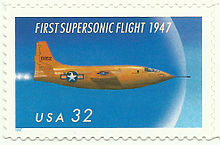
First_Supersonic_Flight_1997_Issue-32c

A glance at the first X-plane, the Bell X-1, gives clues to what was known and what was not known. We already knew that turbulence off the wing would foul up the tail controls at high speed, so the horizontal stabilizer was attached high up on the vertical stabilizer, not on the body. It was not known what negative effect the cockpit bubble would have, so the windscreen was faired into the shape of the fuselage. It was shaped like a 50 caliber bullet – everybody says that without explaining. It is a reference to the machine guns carried on fighter planes. Fired from a ground rest, those bullets would have been sub-sonic. The planes they were mounted on flew at subsonic speeds, but bullets fired from a plane in flight had been going supersonic for a long time.

An aside here for the non-nerd. Planes flying slower than the speed of sound are subsonic. That includes all commercial aviation except the Concorde. Planes flying faster than the speed of sound are supersonic. The X-1 and its follow-ons proved that supersonic flight is not problem. The problem is the transition zone, the trans-sonic region. Slower than sound, the accumulated shock wave is out in front of you. Faster than sound, it is behind you. At the speed of sound, it is right in your lap, trying to tear your plane apart. No modern, supersonic plane lingers at that speed.

The X-1 broke the sound barrier (i.e., passed through the transonic region into the supersonic region) on October 14, 1947, with Chuck Yeager at the controls.

Since this is A Writing Life, I’ll add that I was born about two months after the sound barrier was broken. I was present on the planet for almost all of the early X-craft explorations, although far too young to notice. When I became aware of the X-craft, I fell gloriously in love with them and the infatuation never passed.

The X-2 was a more normal looking aircraft, with swept wings and a pilot’s bubble. It carried supersonic speeds to new heights, but killed its pilot in the process. I will tell that story next Wednesday.

The X-3 was an extreme aircraft, stretched out and incredibly streamlined right down to the tip of its needle nose. It looked faster than any plane before or since, but it wasn’t. All that streamlining couldn’t make up for the fact that the engine slated for the plane wouldn’t fit, and the one that did fit was underpowered. The fastest (looking) plane in the sky flew slowly.

The X-4 was tailless and not successful. The X-5 tested variable sweep wing technology. The X-6 was an aborted project testing out the possibility of a nuclear powered aircraft. The X-8 was a small, unmanned rocket designed for upper atmospheric research. The X-7, and X-9 through X-12 were test beds for missile research. X-13 and X-14 were early attempts at Vertical TakeOff and Landing (VTOL).

Then came the coolest aircraft/spacecraft in the history of mankind, the X-15, which will be the subject of tomorrow’s post.

162. False Fame, reprise

In October, 2015, I wrote a post about the people who got fame they didn’t deserve, or failed to get the fame they did deserve, or who deserved fame, but for reasons other that what the public believed to be true. Since we are going to visit a bunch of forgotten heroes in the next two weeks, I am reprising that post here.

True or false: Charles Lindbergh was the first man to fly across the Atlantic.
False. He was the ninth.

True or false: Charles Lindbergh was the first man to fly nonstop across the Atlantic.
False. He was the third.

The first flight across the Atlantic was by the NC-4, a flying boat with a crew of six, which left New York on May 8, 1919 and arrived at Lisbon, Portugal on May 27, after several stops and numerous problems. (coming June 13)

Less than three weeks later, John Alcock and Arthur Whitten Brown flew nonstop from Newfoundland to Ireland in a converted WWI bomber. (coming June 14)

Lindbergh flew nonstop from New York, north to Newfoundland, then across the Atlantic ending up in Paris. His flight was longer, but the Atlantic crossing was identical to the one made by Alcock and Brown eight years earlier.

Ask anyone in America today who was the first to fly across the Atlantic, and they will either say nothing or name Lindbergh. Alcock, Brown, and the crew of the NC-4 have all been forgotten. It’s not enough to be first, or best, if you don’t also catch the public imagination, or fall under the anointing power of the press.

*****

John Glenn was the most famous astronaut until Neil Armstrong replaced him. If you asked anyone in America during the sixties who was the first man in space, they would have said John Glenn. Nope, he was fifth.

All right then, he was the first man in orbit. Nope, he was third.

First American in space? Nope, third.

Russian Yuri Gegarin was the first man in space and in orbit. (see 130. First in Space) Alan Shepard’s sub-orbital flight was next, followed by Gus Grissom, also in a sub-orbital flight. Russian Gherman Titov orbited next, then John Glenn. For the completist who is reaching for his reference materials, the first X-15 pilot to win his astronaut’s wings came in just after Glenn. (We’ll look at the X-15 tomorrow and Thursday)

John Glenn earned his fame, and he never asked to be better remembered than his fellow astronauts. But he was.

Gegarin is still remembered by a very few, but ask any American who Gherman Titov was and you will either get a blank stare or be told that he was the Communist dictator of Yugoslavia. (And if you’ve forgotten him, it was Josip Broz Tito.)

*****

Okay, let’s not be sexist. True or false: in 1928 Amelia Earhart became the first woman to fly a plane across the Atlantic.

False. She was only a passenger on that flight; the pilot was Wilmer Stultz and the copilot was Louis Gordon. The flight was a bit of a stunt, and a successful one. On arrival in England, Earhart became instantly famous. There was a ticker tape parade and a reception at the White House when she returned to America. The press called her Lady Lindy. She wrote a book, went on tour, designed luggage and clothing, and generally became rich and famous – essentially before she had done anything.

But that’s not the whole story. Earhart later came to deserve the fame she had already gained. She became the first woman to fly solo across the North American continent, participated in the Santa Monica to Cleveland Woman’s Air Derby, and in 1932 she became the first woman to fly nonstop alone across the Atlantic, finally earning the fame she had received four years earlier.

It is a final irony in the fame-for-the-wrong-reasons game that Earhart is best remembered today for the flight in which she died, while failing to finish.

161. The Month Ramadan

Welcome to Ramadan.

What does a month of religious observations, in what is very much a minority religion in America, have to do with a blog which is largely about science fiction? A great deal, as it turns out.

Beyond simple humanity, an interest in those whose view of the universe is not identical to most Americans, and a sense of fairness that impels us to look at Islam as a full fledged way of life, there are also non-religious, even scientific aspects of this season. When you realize that Ramadan cycles around the year, it becomes apparent that there is a lot of astronomy behind this month of observance.

So first, what is a month?

A month is the time it takes for the moon to orbit once around the Earth – oh, if it were only that simple.

For a start, science recognizes five kinds of months. A sidereal month of 27.3 days and the tropical month, also of 27.3 days, refer to one passage past a “fixed star” and an equinox point respectively. An anomalistic month is the time from perigee to perigee, 27.5 days, and a draconic month is the time from a node to the same node, about 27.2 days. A node is a point where the plane of the moon’s orbit crosses the plane of the Earth’s orbit.

Astronomy was not one of my fields of study. Every time I look up something like this my head spins, but no wonder. Everything in astronomy consists of measuring moving objects in reference to other moving objects.

The synodic (aka normal) month is the only one non-astronomers worry about. At 29 and a half days, it is the time it takes to go through one cycle of new to new moon. It is a little over two days longer than the others because it also includes chasing the Earth through roughly one twelfth of its orbit.

If that wasn’t complicated enough, none of the months come out in a even number of days and none of them divide evenly into the length of a year. If we were using a lunar calendar, as Muslims do in their religious life, our months would cycle around the calendar and only appear in the same season every (?) years. I didn’t give you a number there, because there are dozens of varieties of lunar calendar.

That works fine for religious observances, and it worked fine in the Arabian desert where the Islamic calendar got its start, but it doesn’t work in a globally connected world or in agricultural societies. You need to plant or harvest during the same month each year, and you need a common calendar to schedule happenings outside your area.

Non-Muslims who know anything about Ramadan, know that it is a month of fasting. It is more than that, and of course it doesn’t mean no one eats for a month. Fasting takes place during the daylight hours. A meal is taken just before sunrise, and another just after sunset, and fasting is not required of the ill, pregnant women, children below a certain age – there is a list, although it varies by sect.

In the mid-latitudes, when Ramadan falls during winter, the fasting hours are short; when it falls in summer, fasting if more arduous. There are special rules for those who live near the Arctic and Antarctic circles, otherwise they would have to fast nearly twenty four hours of each day when Ramadan falls in the land of the midnight sun.

160. Stranger in a Strange Land

Stranger in a Strange Land proves that Heinlein was a hippie guru. Starship Troopers proves that he was a right wing madman. —-  From last post.

That’s nonsense, of course, but they do seem to stake out the two ends of the Heinlein continuum.

I’m a great fan of Heinlein, but neither of these books is a favorite of mine. I first encountered Stranger hiding in plain sight. It was 1963; we had just moved into a new high school. I was special assistant to an English teacher who was too lazy to shelve books himself. He let me put up all the new arrivals for the new library and Stranger was one of them, looking innocent in hardback with a Rodin statue on the cover. It wouldn’t have lasted long in rural Oklahoma, except no one else ever read it.

Stranger talks a lot about sex, in a fashion the hippie generation (in full disclosure, that would be my generation) took to be an anthem of free love. To many, it was the answer. That was a silly reaction, because Heinlein wasn’t in the answer business; he was in the question business. If you want to know what Heinlein was trying to do, just read what he said:

NOTICE:
All men, gods, and planets in this story are imaginary. Any coincidence of names is regretted.

In other words, “I dare you to to believe I’m not talking about you.” Compare it to the introduction to Huck Finn.

NOTICE
PERSONS attempting to find a motive in this narrative will be prosecuted; persons attempting to find a moral in it will be banished; persons attempting to find a plot in it will be shot.
BY ORDER OF THE AUTHOR, Per G.G., Chief of Ordnance.

If that sounds just a trifle similar, remember that Heinlein was a great fan of Mr. Clemens.

Heinlein had always been a chatty writer. It was a big part of his charm, and why he was able to get scientific ideas across so painlessly. Look at the first part of Have Spacesuit, Will Travel. It is a highly technical exposition of how a space suit works, that nobody else could have managed successfully. Heinlein put his technicalities into the words of a naive young enthusiast, and the boy’s personality pulled us along.

Stranger was a project that Heinlein had wrestled with for years, and when he finally wrote it, he took no heed of market pressures – including length. Even after Putnam asked him to cut the book, it still ran 160,000 words.

For the religious right, it was blasphemy; for the hippie generation, it was the word. For me, even as a teenager, it was a wet firecracker. All chit-chat about sex and everything else, but nothing ever happened. A book that sets out to disrupt society cannot be dull. Stranger was dull.

For me, the best thing about Stranger was that its success allowed Heinlein more freedom from constraints, especially length constraints. He had been a master of compression. Look at Time for the Stars or Door into Summer. Every sentence, even the chit-chat, carries the story forward at a brisk pace. 

Heinlein never wrote like that again, but his later, longer stories – despite occasional clunkers – are fine in a new way. They allowed him to sit in a metaphorical easy chair and tell long, rambling stories to those of us who loved to hear him talk.

159. Starship Troopers

Stranger in a Strange Land proves that Heinlein was a hippie guru. Starship Troopers proves that he was a right wing madman.

Nonsense, of course.

I was talking to a book store owner in the early seventies who said, “We get hippies in here who just read Stranger and want something else by Heinlein. We always give them Starship Troopers.” He had a nasty look of self-satisfacton on his face.

Heinlein was an honest workman, who set up cultures and situations to see where they would take him; sometimes we enjoy the ride, sometimes not. Citizen of the Galaxy, for example, is an important book, but it’s not much fun to read about slavery. 

Starship Troopers is one of his views of the problem of the military in a democratic society. One of his views; that is crucial. He has presented other positions in other novels such as Friday and to Time Enough for Love, and in his lost novel For Us the Living.

In summary, Starship Troopers presents an Earth under attack by non-human aliens with an ant-like society too different from Earth’s society for understanding or compromise. Earth has a democratic society; the vote is open, but only to veterans. There do not appear to be any prisons; crime is punished by whippings or hangings, both public.

It is a trap to believe that this Earth is at war because it has a militaristic society. Earth is at war because the aliens attacked. Any society would have fought back; many kinds of society would have survived. For a writer to display a militaristic society well, he needs a war and Heinlein gives us a dandy.

Starship Troopers is a fast read, with few challenges to those who are willing to sit back and enjoy the ride. The action is inventive and exciting. There is a lot of talk between bits of action, but that is appropriate to the hurry-up-and-wait reality of military life. Besides, if you don’t like chatty books, Heinlein is not for you.

Troopers and Stranger mimic the right wing/left wing divide in America, making each controversial, and making the contrast between them even more controversial. They get the most ink in the press, but neither is Heinlein at his best.

For me, Starship Troopers is a good, fast read whose central character is a bit too dim to hold my interest. To be fair, he is just the right wattage for what little he has to do in the story.

People who are not fans- who have read Stranger and Troopers and not much else – have a tendency to think Starship Troopers is Heinlein’s prescription for society. Nope. He is presenting one society; whether the reader would like to live there is up to the reader.

Heinlein is a child of the depression, Annapolis, and World War II. I am a child of Viet Nam. You would be right in guessing that I disagree with him often, but he is honestly seeking answers (plural) to knotty problems.  Next post, Stranger in a Strange Land.

158. The Cost of Starflight

Whatever his faults, Saloman Curran, from the novel Cyan,  is no coward, as he shows at a news conference called when the USNA government tries to shut down the colonization of Cyan because of the high casualty rate associated with cold sleep.

“Chairman Curran,” the reporter asked, “how can you advocate cold sleep, even plan an entire colonization project around it, when it will result in a ten percent mortality rate. That seems more than a little inhumane.”

“A bit cold?” Curran asked. A grudging chuckle greeted his gallows humor. “Your facts are not quite right,” he continued. “That figure of ten percent is inaccurate.”

“You aren’t going to tell us that it is lower. We have that figure from NASA research.”

“Ten percent was the estimated loss for a five year cold sleep. We will be sleeping our people twenty years. We expect a mortality of 19.7 per cent.”

That silenced the room for a moment. Curran went on, “What you are missing is a lesson history has to teach. When the Irish were driven to America by the famine of the mid-nineteenth century, reliable historians estimate that more than twenty percent of them died of disease, starvation, or shipwreck on the way across the Atlantic. When your ancestors crossed the American prairie by covered wagon, they died by the thousands. Indians killed some, but mostly they died as they always had, of cold, hunger, infection from wounds received in their everyday work, and from disease. Influenza, tuberculosis, and a dozen other diseases that no longer exist sapped their strength and killed them wholesale. 

“Settlement of a new land has never been easy. It has never been for the timid. It has been for those whose faith in the future led them to defy the odds.

“And there is more. The Irish who did not leave Ireland, died in even greater numbers. The Americans who did not cross the prairie, faced the same wounds and overwork and diseases, and faced poverty and hunger besides. For all the dangers, the toil, and the hardships faced by the ones who went on ahead, there were as great dangers and greater hardships behind them. They went forth to find a future, but also to leave behind an unacceptable present.

“Look around the USNA. What do you see? Hunger, crowding, and death. What other motivation does a brave man or woman need to risk death, with the odds four to one in his favor?

“No one is being coerced. Every colonist will be a volunteer and we expect a hundred volunteers for every colonist we can take. Maybe a thousand for every one we can take. You may not have that kind of courage. Your viewers may not. If not, they should not apply. But the colonists who go out to settle Cyan will have that kind of courage.

“Will I find enough to accompany me? I will find a million who will cry bitterly that they were not chosen.”

Curran paused to adjust his jacket, with the look of a man overcoming an emotional outburst.

“To come back to your original question,” he continued; “Is cold sleep safe? No, it is not! But I will go to Cyan in cold sleep, and if I die en route, my life will have been well spent.”

157. Heinlein and Harriman

As a science fiction writer, I have many debts to Robert Heinlein. One of those is for his character D. D. Harriman, who is both the inspiration and antithesis of my character Saloman Curran.

D. D. Harriman first appeared in a short story Requiem published in 1940 and then in its prequel The Man Who Sold the Moon which was published in 1951and won a retro Hugo in 2001. There are two collections of short stories called The Man Who Sold the Moon, each containing both its title novella and Requiem.

The Man Who Sold the Moon

At a point in future history when government sponsored spaceflight has temporarily failed, D. D. Harriman decides to send a rocket to the moon. His motivation is not profit, but the sheer love of exploration. The technical challenges are immense,  but the political and economic difficulties are worse. He overcomes all obstacles, first by entrepreneurial brilliance, and when the odds become overwhelming, by chicanery. There is a cost, beyond money. D. D. Harriman himself can’t take the flight. There is only room for one jockey-sized pilot.

Having proved his ideas by the successful flight, D. D. Harriman expands his business to send fleets of ships and begin a lunar colony. But now his co-owners of his enterprise deem him too valuable to the company, and again he is cheated out of his chance to go to the moon.

Much later, Heinlein retold the story from another perspective in his 1987 novel To Sail Beyond the Sunset.

Requiem

Decades have passed. Spaceflight is well established when an old man befriends a pair of down-and-out spacemen who are selling rocket rides in a decrepit, surplus spacecraft. He talks them into taking him to the moon, without letting the authorities know, and they agree. The flight ends in a crash, and the old man – who is , of course, D. D. Harriman – dies there, happy to have finally achieved his life’s ambition.

*****

The Man Who Sold the Moon is a romp and Requiem is a tear-jerker. The two halves of the story are stronger read together.  Heinlein had an ability to bring sentimentality into his story that was rarely seen in science fiction. It was either brilliant or sappy, depending on the reader’s individual taste. For my taste, it was brilliant.

*****

As I said at the top, Harriman was both inspiration for and antithesis of Saloman Curran in my novel Cyan. 1978, the year Harriman “sold the moon” is not 2106, the year Curran set the Cyan colonization in motion. Writing in the 1940s, Heinlein had confidence in the future. Writing through the last third of the last century, I was less optimistic.

Heinlein never paid much attention to overpopulation. When he talked about it, he showed that he understood its dangers, but he usually ignored it. To me, overpopulation is the central problem of the next century – which may well be our last century, if we don’t solve it.

So Curran is no Harriman, because 2016/2106 is not 1940-51/1978. Harriman was a lovable scalawag who would lie, cheat, and steal to get to the moon. Curran is capable of mass murder on the road to the stars. No one would write a Requiem for Curran.

But Curran is not without courage, as he will show in tomorrow’s post.