
Category Archives: A Writing Life

127. Not a Frog, Not a Kangaroo

220px-Litoria_tyleri220px-RedRoo

Flashback: 1963, riding in a car, reading an article, probably by Arthur C. Clarke, on why humans should go into space. A little fish, swimming in shallow water, said to his father, “Why don’t we go up on the land and see what we can find?” The father fish responded, “Why would you want to do that?”

I read the passage out loud, but no one was interested, so I relapsed into nerdy silence.

Years later I found that the now accepted theory is that fish in shallow waters, accustomed to using their fins against the sea bottom, began to use them to navigate mud flats at low tide as mud skippers still do in mangrove swamps today. Legs evolved from fins.

It didn’t happen this way on Cyan. (This is a follow-on to yesterday’s post. If you missed it, we’ll wait for you to read it. Done? Good.)

On the planet Cyan, hundreds of millions of years ago, primitive chordates developed a split vertebral column, which resulted in twin tails. When they moved onto land, their tiny front steering fins were never used for locomotion and their twin tails (they had no back fins) became legs.

As Gus Lienhoff said when he dissected the first one Cyanian creature the explorers had collected:

Look, no pelvis. Look at this complex of bones. Some are fused, some flex, and these four are cantilevered. And look up here; no scapulae, just three extra thick, specialized vertebrae. Tiny front legs, powerful back legs with twice as many joints as you would expect, and absolutely no hint of a tail. Not even anything like a coccyx. A truly tailless, truly hopping biped. I wouldn’t have believed such a thing was possible.

Not a frog, not a kangaroo.

Frogs are quadrupeds with overdeveloped hind legs, like rabbits. They have a vestigial tail, like a human coccyx. If you look at a frog’s skeleton, it looks a bit like a massively deformed human. They can leap, but they also walk.

Kangaroos have a five-legged gait when walking. They lift up on a tripod made of small front legs and a powerful tail to shift their massive hind legs forward. Then they stand balanced on their hind legs while moving their forelegs and tail forward. 3 – 2 – 3 – 2, etc.

Cyanian bipeds, from the simplest to the most complex are hoppers. They all have short, grasping forelimbs; not quite T-rex hands, perhaps, but too weak to knuckle walk. They can move miles with grace and speed, but moving inches puts them into a condition of stumbling clumsiness. There are tree dwelling bipeds; how they navigate is a mystery I didn’t get around to investigating

When a trio of Cyl (intelligent Cyanian creatures created through recombinant DNA – its a long story) first enter a human habitat . . .

They were awkward inside the dome where the furnishings of the place made a maze for them to negotiate. As bounders, they were creatures of the unobstructed open plain. This human habitation was utterly foreign to them, not because of the steel from which it was made, or the interlocking triangles of its geodesic construction, but because it was cluttered. How could one hope to move about in it?

I don’t claim to be an artist, so I have made no effort to draw or paint these critters. I also haven’t seen the cover EDGE is putting on Cyan. If it has Cyanian hoppers, I sure hope they don’t look like frogs or kangaroos.
126. Let’s Build an Ecosystem – 2

Continuing our look at the creation of an ecology for Cyan. If you missed yesterday’s post, you might want to go there first.

We can take grasses and weeds for granted. Let’s give our trees multiple trunks bound together, like a strangler fig without its victim, and that should be enough. We need something like insects. We’ll call them Chitropods – chitro sounds like chitin, and pod means foot, so our reader will infer an exoskeleton without any further work on our part. Continuing the idea of inference, if we call the flying creatures who eat the chitropods pouchbats, the reader will draw a better picture in his mind that we could on paper.

The number of legs is important to Terrestrial arthropods, but lets bypass that by giving all our chitropods many legs, but with only one joint each where it meets the body. Now they have a rolling gait “like caterpillars on crutches”. Humor helps keep description from limping along. (Sorry, couldn’t resist!)

These are throw-away inventions. They could have been applied to any ecosystem and they are not systemically related to each other. They alone would be good enough for almost any SF novel, but not for one about scientists teasing out the essence of their planet.

Here we need a key differentiation, from early in evolution, from which a thousand lesser differences can be derived. Here it is: on Cyan, early in the development of chordate life, the vertebral column doubled at the posterior, giving the Cyanian version of fish twin tails. That changed everything. I’ll explain more fully tomorrow in a separate post.

On Cyan, the classes are Pseudo-pisces, Amphibia, and Inturbia. No reptiles, no birds, no mammals, no dinosaurs. The Amphibia are cold blooded. Inturbia are inefficiently warm blooded. The term Inturbia should imply “internal body temperature un-perturbed by external changes”. Not every reader will get that, but we need to reward our best readers by not spelling out everything.

There are a thousand other details, but for that, you will just have to download the book when it comes out. From EDGE. Soon.

***

I do have one more thing to share. I wouldn’t bother you, but since you’re reading a post about the backstage secrets of writing science fiction, I can assume that we are all nerds together here .

Inturbia have live birth. Cyanian amphibs have to return to water to lay their eggs, except for one group, the Sphaeralvids, who produce globewombs.

(Globewombs were) the closest thing to an amniote egg that Cyan’s fauna had developed – a transparent, leathery sac extruded by a Sphaeralvid mother and filled with a clear fluid like seawater. Into this she deposited fertile ova, then defecated. Then she separated from the globewomb and left it cached in the crotch of a tree, high up where it would receive full sunlight. On a bright day millions of these globewombs glinted in the treetops.

Algae from the Sphaeralvid mother’s bowels converted the feces into biomass and the Sphaeralvid nymphs fed off the algae.  When the feces were gone, the globewomb walls would break down, leaving the now sizeable nymphs free to face Cyan on their own.

Neat, huh?

125. Let’s Build an Ecosystem – 1

Over in Backfile, you will find an eleven part document called How to Build a Culture, inspired by Poul Anderson’s How to Build a Planet.

I could also write a paper called How to Build an Ecosystem, but who needs to read all that. A couple of posts here should cover the subject, without boredom or overload.

The fact is, simply peppering your planet with a few well chosen and deeply odd critters is enough in most cases. Andre Norton did it all the time, and it worked for her. The frawns and yoris on Arzor are simply transmogrified bighorn sheep and alligators, but so what? They provide plot points and local color, and that is all that is asked of them. Marion Zimmer Bradley gave us a mammalian snake, a hyper-weasel, and an intelligent dinosaur who sent out pheromone soaked calling cards in Hunters of the Red Moon. What more could you want? In Jandrax, showing up now in Serial, my native animals were distinctive, but most were mammalian, as one would expect from ice age migrators.

When I wrote Cyan, I faced a different situation. My crew was set down on an alien planet for one year, with the task of coming to understand its weather, geology, and ecology in order to prepare for colonization. They were all scientists, so their actions and conversations called for a deeper understanding of their new world than any other kind of science fiction novel would have required. Actually, that challenge was half the fun.

When I began Cyan, I had been studying ecology for about twenty years, starting back when I had to explain what the word meant. I later came to understand the essence of Earth’s taxonomy in the most rigorous possible way – I had had to condense it to a level which middle school students could understand without dying of boredom.

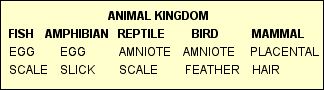
Scientists should forgive the following chart and paragraph.taxon

Drop a salmon egg on the gunwale of your canoe and it will dry out in minutes. A chicken or turtle egg would survive the same treatment. This is the meaning of amniote egg (although there are other, competing meanings). Creatures who lack them, must lay their eggs in water. The rest of the chart should be clear, although simplified. For example, birds have scales on their legs as well as feathers elsewhere, and I skipped Dinosauria altogether.

Now pull up a chair and lets build Cyanian ecology. It needs to be wierd but recognizable – that’s the key to all science fiction invention. We also need restraint. You can only explain so much to your reader without losing them, and beyond a certain point, your backstory is wasted effort.

Come back tomorrow and we’ll dive more deeply into Cyanian ecology.

April Fool

I taught school for twenty-seven years and in that time there were few things I hated more than April Fools Day. By the second year I had seen every prank any kid ever thought was new and clever, and still had decades to go. When April first fell on a weekend, it was a good year.

This year April first falls on a Friday, and I don’t post on Fridays. What a relief.

No joke.

124. We Are Not Alone

“The Blue Book say’s we’ve got to go out, and it doesn’t say a damn thing about having to come back.” Captain Patrick Etheridge, keeper of the Cape Hatteras Life Saving Station.

That could be the motto of space exploration. Not everyone will survive. That is why, in this excerpt from Cyan,  Ramananda Rao is making this report. You will note that I have suppressed a name to avoid a spoiler.

from the Logs of the  Darwin/Cyan Expedition
S.Y. 601, Day 239 (corrected)
entry by Ramananda Rao, acting geologist
at Venturi Station

Today, everything changed.  Our entire outlook on our work and on Cyan can never be the same again.

We have been at Venturi station for three weeks now, doing the work *** should have done.  The working conditions are miserable.  We are too far south and the land is too hot.  We arrange to work by the light of Procyon’s lesser companion, or early in Cyan’s morning, but still the heat is stifling.  Since I arrived here with Viki Johanssen, we have worked like dogs, taking core samples with our mole to map the extent of this ore field.

I can do the work; I have the training.  But I don’t have the inclination.  I would much rather be studying the weather.

When I first saw that Cyan stands straight up in orbit, I thought it would be meteorologically barren. How wrong I was. True, it has no seasons, but her slow rotation brings daily temperature variations of almost seasonal proportions.  Her storms are vast and powerful – and unpredictable.

Yet today, the weather and the ore fields became insignificant in a heartbeat when Viki leaned down to pick up a stone – and saw a row of flakes chipped away from one edge.

We are not alone here.

 When the exploration of Cyan moves into colonization, humans will face critical choices. Our knowledge of ecological consequences will always be incomplete, but we understand enough to know how badly we can screw things up.

Humans will go to the stars. But cattle? Horses? Wheat? Cockroaches and boll weevils? The chances for ecological disaster are huge.

And what will we do if we find a species evolving toward human level intelligence, but not there yet? The explorers of Cyan will have to face that dilemma.

123. Trump on Cyan?

This blog is about writing, not politics, but sometimes you just have to speak out. I hadn’t planned to post this excerpt from Cyan, but today’s (March 20) Face the Nation, and an interview with Stephanopoulos on This Week, changed my mind.

For months, the media has become increasingly open in their bias against Donald Trump. Well, so am I, but I’m not sworn to neutrality. On today’s show, Stephanopoulos’s gotcha questioning actually made Trump look like the wiser man, and that’s hard to do. I fear that the media’s abandonment of neutrality will further inflame Trump’s supporters, and that protesters trying to silence him will harden his supporters’ resolve.

It made me think about Saloman Curran.

I created Curran as a villian, or adversary, or strong-man, or malign father-figure in my upcoming novel Cyan. My protagonist Keir finds himself working for Curran, much against his will, and trying to figure him out

*****

“What do you think of Saloman Curran?”

That was the question Keir asked a dozen times during the following days. The words varied with circumstances, and he was careful to ask it when his respondents would feel free to answer honestly. Keir had realized that his own opinion was colored by his needs, and by the power that Curran held over him, and he wanted to know what the other people who shared the Curran International building with him thought of their boss.

They loved him.

They thought he was the smartest, strongest man in the world. They thought he was one of the few men who could help pull mankind out of the mess it had gotten itself into.

Their feelings were close to worship, but it was not like a Christian’s love of Jesus. It was closer to the distant, worshipful fear of an angry Jehovah. Not one person had any faith that his position with Curran was secure. Any one of them could be fired at any time; they knew that; they accepted it.

“Nels got fired last week, but he was screwing up.” What do you expect?

The second sentence was never voiced, but always implied. If anyone was fired, demoted, or punished in any way, it was assumed that that person was at fault. No one ever thought of blaming Curran.

Keir had never seen an organization like Curran International, and at the end of a week he decided that it was not the organizational structure, or even Curran himself, that was different. These people loved Curran, not because he was loveable, but because they had set out to find someone to love.

*****

Jeeze, that sounds familiar, and it scares hell out of me.

122. First-in Scout (post 2)

Cyan, the novel about this planet, will be out shortly from EDGE. Here is a sample from the opening minutes that the crew spend on the surface.

Tasmeen cut the jets.  Silence came in to fill the landing craft, and she said, “All right, Keir.  It’s yours.”

“Acknowledged.”  His response was recorded, and at that moment he became commander of the expedition.  Stephan had brought them here.  It was up to Keir to keep them alive until Stephan could bring them home again.

Practically, he had been in command ever since Tasmeen put the landing craft into polar orbit ten days earlier.  Now he slipped out of his couch, moved sideways toward the door and cracked the seal.  There was a faint hiss of incoming air as the pressures equalized, and for the first time they smelled Cyan.  Keir shoved the hatch back and pale morning sunlight entered the cabin.

Big Bug, a combination automatic bacteriological laboratory and homing beacon, sat a hundred meters away where it had landed five days earlier.  It had already determined that no Cyanian microorganism would harm them.  The base DNA of the planet’s creatures was too dissimilar.  Now Keir sat in the hatchway, getting used to the light, the smells, and the vegetation.  He had spent hours studying the images sent up by Big Bug, but reality was always different. He scanned the flash perimeter where their landing jets had scorched the earth, then let his eyes move slowly outward to the still living vegetation. There were grasses — or what passed for grasses on Cyan — within thirty meters of the landing craft, and they were half a meter high.  Crawling, crushing, fanged and poisoned death could be lying in wait.  There was no way to know.

Keir’s eyes moved on over the grasses, noting the direction of the wind, seeing how they moved and looking for discontinuities in the pattern of its motion that might tell of unseen things waiting in hiding.  They were in the center of a meadow that stretched away for nearly a kilometer in every direction.  Keir had chosen this place for its clear field of view.

When he could no longer stand the discipline of searching just for danger, Keir looked about with a tourist’s eye.  Points of light scintillated in the trees along the river.  He had no idea what they were.

“Petra,” he said, “rifle at the ready.  Stay in the hatch and stay alert.  Leia, you go out first.”

There was a smell of tension in the cabin.  Leia was the smallest of them all, the fastest, the meekest, and the most likely to run rather than fight.  Those were the reasons Keir had chosen her.  She squeezed past Keir and started down the chain ladder.  Keir went down on his belly with his pistol out while Petra stood over him with a rifle.  Leia worked her way down and dropped to the ground.  No one made any historic pronouncements.  Keir and Petra were too intent on watching for danger, and the others were holding their breaths.

“I’m down,” Leia said and her throat mike carried the words into the cabin.

“Walk straight away from the craft ten meters,” Keir said.

Leia complied.

“Do you see anything?” Keir asked.

“Nothing that looks dangerous.”

“Ten more meters.”

“Okay.”

“Petra, watch Leia, not me.  Gus, take my place.  You watch me.”

Keir swarmed down the ladder and dropped to the ground.  Burned grasses crunched beneath his feet.  He cradled his 12 mm. automatic pistol at the ready and moved up beside Leia.  Nothing moved in the grass but fleet and tiny insect-like creatures.

Leia took a deep breath and said, “My God, it’s beautiful.”

Keir nodded.  He smiled to himself as he noticed that her pistol was still in its holster.  No matter.  That was why he was here.  “Be ready to run back to the ship,” he said, “and if I give the word, don’t look back.  Don’t wait for me.”

“Are you sure?”

“If you hesitate, I’m going to make cleated tracks up your backside when I run over you.”

Leia chuckled and said, “Sure you would.”

121. First-in Scout (post 1)

When Kirk, Spock, and an anonymous crewman in a red shirt beam down onto an unexplored planet, things never go well. Whether you view the events that follow as high drama or low soap opera is a literary judgment, but did you ever consider what you would really face if you were the first down on a new planet?

The closest thing in history would be Captain Cook landing at Botany Bay (Australia, not Ceti Alpha V). The natives were as black as Africans, but otherwise resembled them very little. The animals couldn’t run, but they hopped at super speed. The trees shed their bark instead of their leaves.

But these were humans and animals and plants. Explorers of other planets won’t find that level of similarity. I considered this in my first novel Jandrax. Jan Andrax, a Scout, is stranded with a group of untrained colonists. Talking to a friend among the crew of the damaged starship, he says . . .

”Jase, do you know what the mortality rate is for Scouts on a new planet? Trained men whose whole life is dedicated to survival?”

“No.”

“Ten percent for each new planet.”

Jason greeted that with stunned silence.

“Jase, the first planet I explored, three of my twenty companions died; nor was it an exceptionally dangerous planet. On my second planet two of my friends were cut down before my eyes by an innocuous-looking flying mammal whose poison was deadly to humans.

“I came through my third planet with no particular difficulty, but on the last one I tangled with a large, horned herbivore during my first day planetside and left in a coma. I spent a total of two hours on her surface.

“Those were planets which had been properly scanned from orbit. I was working with trained and experienced scouts and the latest equipment. Here . . . I’d give odds there won’t be a human alive inside ten years.”

The day I wrote those lines, I decided the life of first-in scouts deserved to be to explored further. Three books later I began the novel Cyan about a group of them. More about that next post.

120. Still Inclined

Six months and four days ago, this site was new. I was making my best efforts, knowing that no one would be reading yet, and knowing that if I didn’t make a start, nothing good would ever come. The post below was first placed at the time of that equinox.

The novels Cyan and Jandrax were involved in that post. Since Cyan is coming out shortly from EDGE and Jandrax is being presented in its entirety over in Serial, its time to try again.

Axial Tilt

Earth’s inclination causes our seasons. It would be hard to find a more ordinary fact, or one less valued. Yet everything about the Earth derives from that inclination, even our religions and our philosophy . . .

Those were the words of Gus Leinhoff from the novel Cyan.

I like axial tilt as a means of individuating planets, so much so that I have run the bases, hitting all the possible extremes. Cyan has no axial tilt and no seasons; Stormking, around Sirius in the as yet unwritten sequel Dreamsinger, lies back at a Uranian inclination and has seasons you wouldn’t believe. Harmony, from the novel Jandrax has a tilt of 32 degrees resulting in heavy glaciation with a narrow habitable band around the equator; it has two summers and two winters each year.

So does Earth – at the equator.

I’ll bet you didn’t know that. One of the great pleasures of world building is finding things you should have realized, but missed. This is one of them.

Let’s imagine the changing tilt of the Earth as the seasons progress. Of course I know the tilt doesn’t change; it only appears to do so from an earthbound perspective. But three decades of teaching science to middle schoolers has taught me that casual language gets the message across better than an excess of formality.

Today is the equinox, autumnal in San Francisco, vernal in Sydney (In September, it was. All this is reversed today). The sun lies above the equator at noon, and will (seem to) move southward in the coming weeks. I won’t waste your time telling you what you already know, but consider these facts from a new perspective.

Today at the equator the sun is overhead (call it summer) and for the next three months it will move southward until it gets as low and ineffective as it will ever be (the equivalent of winter), then it will come north for three months until it is overhead again (summer), and continue northward to its other lowest position (winter again), and so forth. Two “summers”; two “winters”.

Earth’s dual seasonality is masked by local conditions, at least in its oceanic regions. The world in the novel Jandrax has a stronger tilt and its oceans are tied up in glaciation. The refugees naturally settle at the equator, where summer and winter really do come twice a year.

119. Brevity

The publication of Jandrax is underway over in Serial. This post looks back at the spirit of the times during which it was published.

Things have changed since 1979, but probably not in ways you are aware of. Several barriers were broken shortly thereafter, and five years later there was technological breakthrough that opened the floodgates.

The first barrier was not racial, nor of gender, nor moral, nor technological. At the time, it was called the two-dollar barrier. I first heard it discussed at Charlie Brown’s house (publisher of Locus) in the Oakland hills where I had been invited along with a batch of other newbie authors just after Jandrax was published. It was a firmly held belief among the publishers gathered there that readers would not pay more than two dollars for a paperback novel.

Like the sound barrier, the two-dollar barrier disappeared with a poof and was forgotten soon after, but until then it had a critical effect on what kinds of books could be published.

Short books.

You see, if you could only charge two dollars for a book, printing costs limited how long that book could be. Throughout the sixties and seventies, science fiction books were short. Jandrax, at 50,000 words, came in near the end of that era. I’ll say more about the full effect that had in a moment.

You don’t have to take my word for it, by the way. Go to any well stocked used book store and make a stack of science fiction novels from that era. Make another stack of recently published science fiction novels. Prepare to be amazed.

The second barrier was related to the first. It was the big-money barrier. It was the notion that advances for science fiction or fantasy novels were and always would be peanuts. David Harwell broke that barrier by offering a massive advance on the fantasy novel The Book of the Dun Cow, which was slated to shake up the world. It didn’t, but the massive advances remained and set us on the path to today when new authors get no advance and Stephen King could single-handedly retire the national debt.

Then, in the early to mid eighties, computers became readily available. They didn’t make writing easy, but they made typing – or rather, re-typing – easy. Every pro switched over and refused to go back. No wonder; I know that in the early days I spent much more time repairing mangled typescript than I did actually writing.

Suddenly, new writers were multiplying like fruit flies. Books were getting longer, and cost more. Advances to the elite were soaring. Advances to newbies were shrinking.

Welcome to now.

Before all this happened, books were different. Not better, not worse, just different. There was a premium on brevity and conciseness. Take a look at Dorsai! by Dickson, then look at his Final Encyclopedia for the maximum shock version of the contrast.

New books are not just longer; they are leisurely. Books of the seventies were frenetic. Newer, longer books have a little more story and a lot more words.

Jandrax is short and fast, but that was the norm. It could use fewer shock cuts and more phrases like “the next day …” or “they returned to the compound where they …” or “after the hunt was over, they …”. About another seven thousand words would smooth things out nicely.

It’s a good book and I recommend you slip on over to Serial and start reading. But finish your coffee first. You’ll need the caffeine to keep up.