Category Archives: A Writing Life

34. A Very Young Teacher

101One sultry afternoon in late spring the principal came running into my ninth grade classroom and shouted, “Boys, get on the bus. There’s a prairie fire.” All the boys from all four grades – about fifty of us – piled into the school bus and roared off west of town. Local farmers with milk cans of water in their pickups and bales of gunny sacks were already there. We grabbed wet sacks and went to work, and during the next three hours we fought the fire to a standstill.

Not one boy hesitated and not one parent complained. Small town Oklahoma in 1962 was a very different place than anywhere in America today. It was a good place to grow up if you wanted to become a man, and the sooner the better.

Two years later, I was one of two students in second year German when the English and German teacher was severely injured in a car accident. He was out for six weeks. The only substitute teacher in the area was a million years old, and she didn’t speak German. She got the job.

About the second day, the principal pulled me aside and said, “I want you to teach the first year German class.” I said yes. Then or now, I can’t imagine giving any other answer.

He put the substitute into the library during the hour German was taught and pulled me out of the class I was supposed to be in. It was tough. My German wasn’t as strong as it should have been, but it got better fast. Every night I typed up worksheets on my old manual typewriter, and every morning the school secretary made copies. I worked the kids hard and put up with a lot of silliness. A class full of sophomores is never going to really listen to a junior, even when the principal comes in regularly.

Can you imagine the lawsuits if that were to happen today? After about a week, the principal asked me how I was doing. I said, “It’s working. I’m studying at night, staying one chapter ahead of them, and trying to seem like I know more than I do.”

He patted me on the shoulder and said, “Son, that’s how we all do it.”

33. Here Come the Bombs

170px-Fat_man

I was a child of the cold war. I loved science, science fiction and I studied atom bombs with a gleeful avidity that embarrasses me as I look back on it. Our nearest city was Tulsa, which would probably have been a target, but we were forty miles away and no one took the Russian threat seriously except me; and I wasn’t scared, just fascinated.

Eventually my high school spent an hour on Civil Defense training. I was a sophomore, but they gave it to me to present. That kind of thing could happen fifty years ago in a small school when none of the teachers knew anything about a subject and didn’t want to learn, but just wanted to check off an obligation to the state bureaucracy.

It was my first experience with a captive audience. I can still see the looks of massive boredom as I explained what we could expect if Tulsa got hit.

In literature, this period saw the beginning of a subgenera that might be called what terrible tragedy will technology visit upon us next? Next. Not someday, but tomorrow. This immediacy drove some of these novels into best seller status, and fed Hollywood with movie plots.

Fail-Safe detailed an inadvertently launched airstrike by the US against Russia. It’s ending was chilling, but unbelievable. On the Beach was all too believable, a slow downsliding as nuclear survivors in the far southern hemisphere succumb one by one to fallout. In its final pages, the elegiac tone resembles the empty Earth after all the transformed children have gone in Clarke’s Childhood’s End.

Believability was not an issue in Level Seven. Told in academic prose, the story of a group of scientists sent to the deepest level of the most advanced fallout shelter unfolds with the unemotional certainty of an equation as these men of science carry on their lives deep underground while all life on the surface has been destroyed.

I had read these books and understood their messages, but I was a teenager. I wanted light and life and excitement, interesting technical exposition, and a hopeful ending. That’s what Philip Wylie provided.

Wylie’s novel Tomorrow is the book I liked best. Most of what I gave to my long-suffering fellow students at that high school event came from it. There were bombs, there was massive destruction, but there was also survival. Wylie’s Tomorrow ended with hope.

A real nuclear strike would not have been so benign. Looking back over fifty years, I still can’t believe any of us got out of the twentieth century alive.

32. Roses, out of the dry ground

220px-Queen_Mary's_Gardens_P6110014

I like poetry a lot, but my personal taste pretty much stops with Frost and Yeats.

I like to pepper my novels with quotations from the Rubyiat, Masters, Tagore, and poetic scriptures from various religions. When an appropriate quotation is not available, I never hesitate to write a bit of poetry to develop a character or move a story along. Poetry written to purpose is not real poetry, but I will be including some of it in later posts as illustrations of the writing process.

Roses, out of the dry ground is a real poem, and the first I wrote as an adult.

Novels come over time, with a few flashes of inspiration and a lot of grinding work. I have enough novels waiting to keep me writing for the next three hundred years.

Poems only come when they come. For me that means rarely, but they are a treasured gift when they do come.

Roses, Out of the Dry Ground

The child fled
From harsh words and rough hands
And the uncaring glance that kills the soul,
To hide among the weeds and brambles,
The lizards and the hard cased beetles,
Where no voice comforts,
And no voice condemns.

There he found a rose, growing
          out of the dry ground.

Out of dirt, caked and broken,
Webbed down by spiders;
With dusty leaves,
          yet blooming.

The child reached out and touched a thorn
So gently that his finger did not bleed.
(For the child knew thorns)
Reached further, and touched the blossom, so gently
That its fragrance filled the desert air.

He sat long among the weeds
And gazed in wonder, that the rose,
So ragged, could still be sweet.

Never knowing,
          it was a mirror that he saw.

31. Discovering Khyyam

412px-033-Earth-could-not-answer-nor-the-Seas-that-mourn-q75-829x1159My novel A Fond Farewell to Dying opens with a quatrain from the Rubyiat of Omar Khyyam.

Oh, threats of Hell and Hopes of Paradise!
One thing is certain – This life flies;
        One Thing is certain and the rest is Lies;
The Flower that once has bloomed forever dies.
Khyyam/FitzGerald quatrain LXIII

It was the perfect setup for a book about people deeply aware of the fleetingness of life and trying to find their own kind of immortality.

Edward FitzGerald is the scholar whose translation of Khyyam is most widely known. He took a mass of unrelated quatrains, translated and arranged them, and gave them a unified voice. Although called a translator, he might better be called the co-author.

Khyyam was a Persian, but not a Muslim. He was one of the leaders of the old order, recently deposed by Muslim conquest. This accounts for the wine bibbing and the questioning attitude toward God, which otherwise would seem odd, even dangerous, among the Sultans, camels, turbans, and oases which fill the poems.

I first encountered Khyyam on a high school field trip to visit nearby University of Tulsa. I managed to sneak a moment in the university bookstore, and bought the most interesting paperback I could lay hands on quickly. It was the Rubiyat. I read it on the bus ride home and was immediately hooked.

The Rubiyat is the perfect book for a questioning young man just beginning to find his own voice and his own mind. Khyyam questions authority; in fact, he questions the ultimate authority, God himself. It is not a book for atheists though, unless they are simply looking for literary support for their opinions. Khyyam was no atheist. You can’t call God to task as he does, unless you believe in Him.

Oh, Thou who Man of baser Earth didst make,
And ev’n with Paradise devise the Snake:
For all the Sin wherewith the Face of Man
Is blacken’d – Man’s forgiveness give – and take!
Khyyam/FitzGerald quatrain LXXXI

A book full of rebelliousness will catch a young man’s eye, but it is the beauty and wisdom in every line which makes it remain a treasure in later life.

30. You Have Spent Your Life

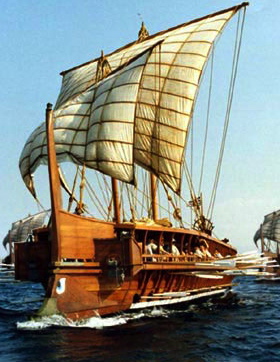
Greek_GalleysWhen I began teaching, I found companionship among fine people. It was the best part of the job, especially after of the solitude of writing full time. I learned from them all, although I never became like any of them. Teaching, more than any other job, except perhaps writing, is all about personal style.

Many of my friends said they envied my knowledge. Fair enough; I envied their strengths as well. Adrianna could keep fifty kids in order on the athletic field. Crystal gave her kids the love they needed, and was patient beyond when patience was reasonable. Dan arranged the math department so the strong were challenged and the weak were not overwhelmed.

I give thanks for the companionship of these colleagues and friends, particularly for Barbara, who took me under her wing when I had just begun to teach. We taught different students from the same stories, which I referred to when I wrote a poem for her on her retirement.

For Barbara

You have spent your life
     growing barley beside the Tigris;
          building pyramids along the Nile.

Rowing beside Odysseus
     going home to Ithaca.
Walking the night
     with Harriet Tubman.
          And dreaming with Dr. King.

A thousand children
     you have taken with you
          on your journey,
     as they struggled toward
          maturity and grace.

You have spent your life well.

I never planned to be a teacher. I called it my day job until it became apparent that I was going to teach all the way to retirement. I would have preferred to be a full time writer; or a professor, as I would have been if writing had not seduced me. But I would have missed much.

By my best estimate, nearly 4000 children moved through my classroom. Sometimes I can still hear their laughter.

29. Worthy of Praise

WOPI started out to be a scientist, then defined myself as a writer, but along the way I became a teacher. Not an educator; that term is ruined for me by the fools in high places who have all but destroyed our schools.

I want to acknowledge some of my own teachers, but since I didn’t live a traditional childhood, this won’t be traditional praise. None of what follows will make sense unless you remember that my elementary school class had only eight students and my consolidated high school only brought the number up to thirty-seven. A larger school would have led to a different experience, even in Oklahoma in the early sixties.

My typing teacher was tough, knuckle slapping perfectionist, and she wasn’t afraid of public opinion. We called her The Warden. She was the only teacher who ever gave me a B. Dyslectic fingers killed me, no matter how hard I tried. She gave me exactly what I deserved and I respected her for it.

Later, when I was teaching science, my favorite exercise was a long term project where students had to build a gizmo to perform some physical feat. It was different every year, and they could only build it in class to keep their parents’ sticky fingers out of the works. Every year kids who only knew computer games and multiple-choice tests found themselves depending on their teammates who knew how to use hammers and wrenches. It was humbling to them; I smiled serenely and remembered The Warden.

My math teacher had a sense of fun. Whenever an unknown appeared in an equation, he would draw something barely recognizable as the back view of a bunny and say “That represents the number of rabbits in Rogers County”. His grin was infectious; he always looked like he was about to break into laughter. He kept us moving at top speed and made it impossible to hate or fear math. From him, I learned how to teach.

In science, I typically had read the textbook by the fourth week. I sat quietly in class and answered only enough questions to show I knew the material, then let the other students take their turns. My science teacher’s gift to me was trust. He let me work in the lab unsupervised except for his presence next door. I spent my study halls there building science projects, and that is where my science education really happened.

My English teacher gave me similar freedom out of a mixture of wisdom and laziness. I turned in every assignment early and better than required; in exchange I frequently wandered the school at will when I was supposed to be in his classes. I would never let one of my students do that, but it worked for me. I spent my time running errands for teachers, building things for the school, or working in the science lab.

It would have been a disaster for most kids, but it was the perfect education for me.

At home, my parents were hyper-controlling. Freedom was not an option. When I scored high on the National Merit Scholarship test and wanted to go to Michigan State University, they would not let me apply. It would have let me to move beyond their control.

My high school counselor let me fill out the application forms in his office and use the school as a return address, so my parents would not know until it was too late. He was putting his career in jeopardy, but I think he saved my life.

28. Acronyms

USELESS

As children, we all learned that the word STOP on stop signs is an acronym. It means it’s time to “Spin Tires On Pavement”. Or was that just an urban legend?

There are quite a few urban legends centering on acronyms. I received an e-mail from a friend purporting to prove that shit is an acronym. Sorry; variations on that word are spread all across the Germanic language family. There is also a supposed acronym derived from Fornication Under Carnal Knowledge, but that seems a bit far fetched as well.

For a long time I was taken in by the urban legend surrounding posh. I first saw it authoritatively stated in a museum display in Shetland that posh stands for Port Out, Starboard Home, meaning that passengers with posh tickets got staterooms on the shady side both ways when P & O steamships traveled from England to India and back. John Ciardi’s A Browser’s Dictionary debunked that one.

Of course everyone knows that NASA is National Aeronautics and Space Administration, scuba is Self Contained Underwater Breathing Apparatus, and laser is Light Amplification by Stimulated Emission of Radiation.

Jack Cover, inventor of the taser, named his device after the novel Tom Swift and his Electric Rifle (1911), with the “a” added to make it pronounceable. That sounds like an urban legend, but isn’t.

Heinlein didn’t invent tanstaafl (There Ain’t No Such Thing As A Free Lunch) but he made it popular in his novel The Moon is a Harsh Mistress.

Wysiwyg (What You See Is What You Get, pronounced a bit like the name of Ebenezer Scrooge’s old boss) is one of my all time favorite acronyms. My first computer, a Mac SE, was part of a wysiwyg system. The screen had 72 pixels per inch and the matching printer was 72 dpi. Whatever you wrote or drew on the screen transferred to the page with absolute fidelity. Unfortunately, that also meant it was pixelated. As soon as crude bit-mapped fonts went the way of cave paintings, wysiwyg went away as well and it never really came back. When people use the term today, they actually mean “what you see is pretty darn close to what you get”.

I shouldn’t have to point out the difference between an acronym and an abbreviation, but since TV anchor persons no longer seem to know the difference, I will. Acronyms are pronounced as words; abbreviations are pronounced as letters. NASA is pronounced NASA, not N-A-S-A, making it an acronym. The USDA is pronounced U-S-D-A not youse dah, making it an abbreviation. An individual retirement account can be either, depending on whether you pronounce it I-R-A or IRA, like Ira Flatow.

Making up new acronyms can be fun. If you want to join with others in that pursuit, e-mail the United States Emergent Language Expression Society of Schenectady. Or not.

Sometimes the bad joke fairy takes over my keyboard. Sorry.

27. That Was My Childhood

1280px-Apollo_11_Lunar_Module_Eagle_in_landing_configuration_in_lunar_orbit_from_the_Command_and_Service_Module_ColumbiaIt was pledge week at PBS. They ran the biography of Neil Armstrong for the upteenth time. My wife and I watched it for about the third time, and when it was over, she said, “That was my childhood.”

I knew exactly what she meant. She and I were soul mates long before we met. Pardon the corn, but it’s true. She grew up in Michigan and I grew up in Oklahoma; we met in college. But when we were children, we were both science nuts long before Sputnik. We both repeatedly checked out Vinson Brown’s How to Make a Home Nature Museum and followed the instructions. We both checked out books on how to grind the lens on your own reflecting telescope, but neither of us made one because we didn’t have the money to buy the glass blanks.

On October 4, 1957, Russia orbited their first satellite. I was in fifth grade when the teacher went up to the front of the room and wrote Sputnik on the board. She said it meant Earth-moon in Russian. It didn’t, but we knew almost nothing about the Russians then. A few days later, she wheeled a cart into the room. It had beakers beneath, a tiny sink, and a hand pump. Oklahoma schools had instituted science as a middle school and elementary subject for the first time.

I kept track of every satellite we launched and every rocket that blew up on the pad. There were a lot of them. When the Russians launched Muttnik (the nickname was American) I was fascinated to see a living creature in space. All my schoolmates said only the stinking Russians would send a dog up there to die.

I watched the Mercury astronauts first press conference and quickly got to know them all. I was thrilled when Yuri Gagarin orbited the Earth. Everybody wrung their hands because a Russians got there first, but I didn’t care. We were in space – and we meant people, not Americans.

I watched Shepard’s and Grissom’s launches, and cheered when Grissom didn’t go down with his capsule. In Michigan, my future wife was collecting every magazine that covered the Mercury program.

I was at school while John Glenn was in orbit, so I missed something monumental in our family history. My father, who thought the space program was a waste of money, got off his tractor and came in to watch the televised coverage. He later said, “I just couldn’t work until we got that old boy back safe.”

The rest of Mercury, Gemini, the beginnings of Apollo – I never missed a mission.

I had discovered ecology, at a time when nobody knew what the word meant. I spent my junior year building an Ecosystem Operable in Weightlessness for the regional science fair. It was complicated, cutting edge, and more than I could actually complete by fair day. I won’t bore you with the details, but it helped get me a Fleming Fellowship the following summer. That gave me a chance to work with real scientists and to see some of the world beyond my tiny town. Those were the people who suggested I should apply to Michigan State.

At MSU the Biology department cared nothing about ecology. I was a few years too early; if you didn’t need an electron microscope to see something, it wasn’t interesting – to them. The closest thing to behavioral biology was Anthropology, and that is where I ended up. And where I found my wife.

We married in 1969 and took off for a long drive around the US, visiting relatives and national parks. We got back to to East Lansing in mid-July, following Apollo 11 on the car radio. On July 20 went went in to the student lounge of her old dorm and sat with dozens of college students watching a grainy black and white TV as Neil Armstrong set his foot on the moon.

*****

If you are old enough to remember those days, or younger and want more information, I recommend Jay Barbree. For fifty years, he was the voice of the space program for NBC news. In 1995 he received an award from NASA for being the only reporter to cover every manned spaceflight in US history. More importantly, he was the reporter the astronauts trusted.

Barbree has written Neil Armstrong (2014) and Live from Cape Canaveral (2007). His prose is only workmanlike, but his first hand knowledge is unparalleled.

Barbree’s personal friendship with Armstrong gives his biography an authenticity and intimacy that could not be provided by any other writer, and the same is true of Live from Cape Canaveral. Chapter nine of that book, ”I’ve got a fire in the cockpit!”, is required reading for anyone whose heart broke the day of the Apollo One fire, and a sharp reminder that we later lost two space shuttles because of lessons not learned.

26. False Fame

Spirit_of_St._Louis

True or false: Charles Lindbergh was the first man to fly across the Atlantic.

False. He was the ninth.

True or false: Charles Lindbergh was the first man to fly nonstop across the Atlantic.

False. He was the third.

The first flight across the Atlantic was by the NC-4, a flying boat with a crew of six, which left New York on May 8, 1919 and arrived at Lisbon, Portugal on May 27, after several stops and numerous problems.

Less than three weeks later, John Alcock and Arthur Whitten Brown flew nonstop from Newfoundland to Ireland in a converted WWI bomber.

Lindbergh flew nonstop from New York, north to Newfoundland, then across the Atlantic ending up in Paris. His flight was longer, but the Atlantic crossing was identical to the one made by Alcock and Brown eight years earlier.

Ask anyone in America today who was the first to fly across the Atlantic, and they will either say nothing or name Lindbergh. Alcock, Brown, and the crew of the NC-4 have all been forgotten.

It’s not enough to be first, or best, if you don’t also catch the public imagination, or fall under the anointing power of the press.

*****

John Glenn was the most famous astronaut until Neil Armstrong replaced him. If you asked anyone in America during the sixties who was the first man in space, they would have said John Glenn. Nope, he was fifth.

All right then, he was the first man in orbit. Nope, he was third.

Russian Yuri Gegarin was the first man in space and in orbit. Alan Shepard’s sub-orbital flight was next, followed by Gus Grissom, also in a sub-orbital flight. Russian Gherman Titov orbited next, then Glenn. For the completist who is reaching for his reference materials, the first X-15 pilot to win his astronaut’s wings came in just after Glenn.

John Glenn earned his fame, and he never asked to be better remembered than his fellow astronauts. But he was.

Gegarin is still remembered by a very few, but ask any American who Gherman Titov was and you will either get a blank stare or be told that he was the Communist dictator of Yugoslavia.

*****

Okay, let’s not be sexist. True or false: in 1928 Amelia Earhart became the first woman to fly a plane across the Atlantic.

False. She was only a passenger on that flight; the pilot was Wilmer Stultz and the copilot was Louis Gordon. The flight was a bit of a stunt, and a successful one. On arrival in England, Earhart became instantly famous. There was a ticker tape parade and a reception at the White House when she returned to America. The press called her Lady Lindy. She wrote a book, went on tour, designed luggage and clothing, and generally became rich and famous – essentially before she had done anything.

But that’s not the whole story. Earhart later came to deserve the fame she had already gained. She became the first woman to fly solo across the North American continent, participated in the Santa Monica to Cleveland Woman’s Air Derby, and in 1932 she became the first woman to fly nonstop alone across the Atlantic, finally earning the fame she had received four years earlier.

It is a final irony in the fame-for-the-wrong-reasons game that Earhart is best remembered today for the flight in which she died, while failing to finish.

25. Columbus, King of Explorers

250px-Landing_of_Columbus_(2)Poor Columbus; he has taken a beating over the years. We don’t see him for what he was, with all his strengths and weaknesses, but through the lens of our own times.

This excerpt from my upcoming novel Cyan gives a picture of how we might view him a century from now, when we have to change our calendar to meet the demands of the rest of the world.

Anno Domini
A Latin phrase meaning the Year of our Lord.

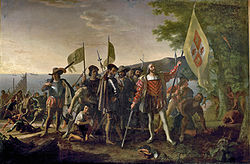
Before sunrise on October 12, 1492, Anno Domini, a lookout for Columbus’ expedition sighted land. Columbus had found two new continents (although he did not know it), following his own powerful vision of how the Earth was constructed (a vision that was wrong), and began a five hundred year reign as king of explorers.

Half a millennium later, Columbus was dethroned. Even school children were now being taught that Columbus was not the only one who knew the world was round. Sailors and scholars had known that for hundreds of years before him.  Columbus’ great vision was that the Earth was small, and in that he was wrong. By the late twentieth century, it was certain that the Vikings got to America first, likely that St. Brendan beat Columbus there, and there were a dozen other putative explorers who had their champions.

Besides, American popular thought was in one of its Noble Savage stages, and it was politically correct to echo the Native Americans who complained that Columbus was a destroyer of races and cultures.

But even at the height of Columbus bashing, it was apparent that his voyage had differed in one significant detail from the other explorers who had preceded him. After Columbus, America was never lost again. After Columbus, and those other explorers who sailed close on his heels, the Earth became entirely known and entirely interconnected for the first time.

*****

In the year A. D. 2037 (as Christians measure time), at the Conclave of Mecca, the Islamic world announced that they would no longer recognize, speak with, acknowledge, or deal with any person, nation, or document which forced them to use a calendar based on Christianity.

At the International Bureau of Weights and Measures Convention in Buenos Aires two months later, a new calendar was established, based on a sidereal year. It would have neither weeks nor months since Islam and the rest of the world could not compromise on the issue of lunar months. It could not start at Jesus’ putative birth, nor at Mohammed’s, and it quickly became apparent that the new Standard Year should date from the midnight preceding the day the Earth became one planet for the first time.

This whole Standard Year business came about by accident. When I wrote Jandrax thirty plus years ago, I had no idea that I would write other stories in the same universe. After all, I stranded all those poor people so far out that no one would ever find them.

However, I began wondering what circumstances, beyond what I had already written, might cause Dumezil to invent his pan-Earth religion, and I wondered what Jan Andrax’s ancestors were like. That led me to make Stephan Andrax, Jan’s multi-great grandfather, spaceside commander of the Cyan expedition.

In Jandrax, I had pulled the date Standard Year 873 out of thin air. Now I had to backtrack and make it work for Cyan, which I did my making Standard Year Zero start with Columbus’ discovery of America.