
Category Archives: Serial

Jandrax 6

“How long before Captain Childe admits that we’re stranded?”

Jason held his peace, not wanting to criticize the captain. Already lines had been drawn, separating the seven living crew members from the colonists. Andrax was supernumerary, a Scout hitching a free ride from Banex to Aleph Prime via New Harmony. He did not fit either classification but Jason was thankful to have him aboard. How they could hope to survive without his professional expertise was a question he preferred not to face.

“Well,” Jan continued, “if the announcement hasn’t been made yet, I intend to explore those so called ruins tomorrow. Once Childe starts ferrying down colonists, there won’t be any time. Want to come along?”

Jason said that he did, but later, as sounds from the temporary jungle that surrounded them kept him awake, he wondered why.

***

The landing craft descended with the sunrise, carrying half a dozen new colonists. Jan met them at the ramp, giving concise orders and turning them over to their more experienced comrades. There was something vaguely familiar about the fourth colonist, but a closer look did nothing to spark Jan’s memory. The man was named Adrian Dumezil, of indeterminate middle age and pleasant, but undistinguished features. Jan motioned him out of line, for no other reason than that he had caught his eye, and he had already intended to take one of the new colonists with him.

Jason and Dumezil carried packs; Jan did not. It was Jan’s order, strictly enforced, that those whose job it was to guard should not be burdened otherwise. More than one colonist had felt Jan’s anger after relaxing his guard momentarily to help a companion.

It takes only a moment of inattention to bring death on a new planet.

Jan set the pace, stepping out sharply. The land rolled gently and their vision was restricted by the fast-growing bushes, but not so restricted as it would have been even a week earlier. The herds of herbys, trihorns, and humpox had battered and browsed the bushes into a thick, tangled, dying mat.

Jason quizzed Adrian, seeking out the climate of opinion overhead.

“No one knows what to believe,” Dumezil replied. “The official word is that there was a computer malfunction, but rumor says that it was a major explosion and that we are stranded. Frankly, rumor is more convincing.” He looked sideways at Jan to ask, “Which is it?”

“Explosion,” Jan answered. Jason winced. “We are here for as long as we survive. Childe is a fool. When he gets around to telling the truth, he will have alienated all the colonists just when he needs them most . . . hit the deck!”

The Scout’s sudden change of tone caught his companions flat-footed. Jan had already gone to cover beneath a siskal bush with his express pistol at the ready. Jason and Dumezil tumbled in to join him.

There was a rustling in the brush and a coughing grunt, then a group of trihorns came into sight. They were magnificent beasts, fully two meters high at the shoulders with shaggy manes sloping away to low, naked rumps. Their heads were massive and sported a single central horn projecting forward and trifurcating, one point up and two down.

They were mammals, of course. Hair, live birth, warm blood, and suckling are all characteristics evolved in just such a harsh, cold climate. It was clearly a family group: a monstrous bull, an uddered female with two hornless suckling calves at her side, and a monopointed adolescent.

The three men remained motionless until they had passed. more tomorrow
Jandrax 5

It had been a close thing for D’Angelo – a two-shot weapon simply was not adequate for an untamed world.

Jason wiped blood from his face. It had been that close. Express pistols were a specialty tool issued only to Scouts. By twisting a dial with his off hand, Jan could tailor projectile size and velocity to the target at hand. If the dial was not touched the maximum charge was sufficient to stop a terrestrial elephant three times over. Jan had not dialed.

Jason searched for an appropriate response to the situation, but could only say, lamely, “Thanks.”

Jan smiled, but his eyes never left the perimeter of the clearing. “When I was scouting on Lando, I nearly got myself killed a couple of times, and – you know what? You never get used to it.

“However, you do learn not to let it throw you off. Put it out of your mind and get back to watching so that I can help get this carcass back to base.”

Stung, Jason turned his attention back to duty. They slung the field-dressed herby on a pole and returned to camp, passing through the tangle field that so far had kept the native carnivora at a reasonable distance.

The landing craft was in orbit, having carried up a load of meat to feed the colonists on the Lydia. In the early years of star travel each ship had been a self-contained ecosystem, but with the advent of the Synapse and nearly instantaneous interstellar travel, ships turned to processed food and mechanical recirculation of air and water. Three weeks in orbit had completely exhausted the Lydia’s food stores.

Jan Andrax dropped onto a camp stool made from the stems of a tough, fast-growing bush and began scraping from his boots the mucilaginous substance exuded by the local ground cover. Jason relinquished his rifle and another pair of colonists left to hunt. Hunting was a full-time occupation for those who had to supply meat to the many overhead.

Jan stopped scraping long enough to assure himself that they were not going to be overheard, then asked, “Any word on the computer?” Jason shook his head. Jan swept the area about him with a searching look before returning to his boots. Jason realized that he probably was not even aware of that mannerism. Jan was a Scout, trained for just such an environment; Jason was the ship’s astrogator. He had never felt more out of place or useless.

“They’ll never fix the computer,” Andrax continued. “You know that, don’t you?” Jason nodded. Both of them had seen the computer bay after the explosion. The Synapse jump had lasted over four seconds; the longest previous jump, under carefully controlled conditions, had been of less than a second’s duration and it had driven a ship clear outside the galactic lens. Instantaneous travel had its complications. “Jase, how long before Captain Childe comes to his senses and announces to the colonists that this is to be their new home – and ours?”

“It’s awfully hard for him to accept.”

“Humph. It’s hard for me to accept. This is one hell of a final landfall, but facts are facts.” more tomorrow

Jandrax 4

51jbN0bvqRL._AA160_Jason D’Angelo was on watch, his 10~mm double-barreled rifle cradled across his arm, when the leer broke cover. He heard its splayed webbed feet splatting on the muddy ground before he saw it. Lucien Dubois saw it at the same time and leaped back from the carcass he was gutting, bringing his knife up in futile defense.

Jason fired as the leer began its final rush toward the unprotected colonist. The leer staggered and turned on his new tormentor. Blood discolored the bird’s iridescent pink feathers, but did nothing to slow its charge. Jason aimed more carefully this time and shot it fair in the chest, just left of its massive sternum. The leer went down like a felled tree and Jason broke open his rifle.

The dead leer’s mate broke cover before he had time to reload. Jason spun around in time to see the bird explode soundlessly, scattering flesh and entrails across the clearing. For a moment Jason was too stunned to react, then he realized that Jan Andrax stood beside him holding his express pistol.

“You’d better finish reloading, Jase,” he said and turned away. Jason punched two new shells into the breech of his rifle and was grateful that there was no one to see how his fingers trembled.

Andrax swallowed hard. It had been a close thing for D’Angelo and through no fault of his own. The lO-mm rifle was part of a small consignment for New Harmony; it was designed for simplicity and reliability, not firepower. A two-shot weapon simply was not adequate for an untamed world.

He holstered his express pistol. Dubois had returned to gutting the herby, but the violence of his motions showed the degree to which he had been frightened. That was good; the fright was inevitable but he continued to function in spite of it. Jan made no move to aid him, but continued to scan the surrounding bushes.

*****

I’ll say this from time to time since readers may discover this serial at any point. I am making my comments under the assumption that many of my readers are new or would-be writers and want the nuts-and-bolts behind the story.

As I said yesterday in the other blog, brevity was the order of the day when Jandrax was written. Books were short and you had to talk fast to get your story in. I think I overdid it sometimes.

The technique used here is called in medias res, literally, into the middle of things. It works here because the prolog and few previous paragraphs have already told us, in large, where we are. The action in the first two paragraphs tells us more specifically where we are without slowing the story for landscape description.

These first two paragraphs work, but at the beginning of the third paragraph, the second leer comes at Jason (and the reader) too fast, and Jan’s actions come out of nowhere. Jason knows that Jan is nearby; the reader doesn’t. The paragraph should begin Andrax saw the dead leer’s mate . . . Then the reader wouldn’t get lost.

The third sentence in the fifth paragraph should have been saved for later. It slows the narrative.

Don’t expect this point by point exposition to continue. It isn’t sustainable. I insert it here because this is a classic case of a new author, a first book, and a first chapter that isn’t as good as the rest of the book will be.

We all have to start somewhere.

Jandrax 3

51jbN0bvqRL._AA160_PART I
From the log of Jan Andrax,
Standard Year 873 and of the colony,
Year 1

These are the bare facts about the planet fate has chosen for our last landfall: diameter somewhat smaller than Earth, day 21 hours, year 312 Earth-standard days (a little over 356 planet days), axial tilt 32°, considerably more than Earth, resulting in greater seasonal variation. Orbital ellipticity considerably greater as well, reinforcing that effect.

Damn!

Chapter 1

The planet hung like a cold jewel in the viewport the last planet most of them would ever see from orbit. Great icecaps stretched north and south, coursing together to touch hands at the equator along the one major north-south-tending mountain range. Of course the world was uncharted. The stars hanging beyond it were arrayed in a manner utterly strange.

The planet’s oceans were gone – locked into the massive polar caps – and what remained as seas would be extremely saline. The air would be very dry; it was likely that rain never fell, only winter snows.

A cold, barren, forbidding world hanging close in to a cool sun.

*****

(Dear reader, If you just want to read Jandrax and enjoy the story, no one will force you to go beyond the five asterisk barriers. What lies below, on this and many other posts, is for the geeks and nerds and new writers and would-be writers who want to pull back the curtain and see the wizard exposed.)

*****

This is how we do it in science fiction. Log entries, printouts stuck into journals, and excerpts from contemporary writing are all ways of getting information to the reader as quickly and painlessly as possible. You have to be careful, of course. These cliches are part of the DNA of science fiction, but so is their overuse. Don’t do too much of it. Unexpected, humanizing touches like the Damn! at the end of the log entry can sometimes help. Don’t overdo that, either.

And don’t be so careful that you mess up the flow of narrative. Here is a painful example – painful to me, that is; I’m sure no reader ever noticed it. In the first sentence the words “most of them” should have been “they”. I knew there was going to be a one-character exception to the statement, but I didn’t have to be so tediously accurate. It comes from all those master’s theses and academic papers.

In fact, fighting back academic speech is an ongoing struggle. Natural speech doesn’t come naturally to me, and the problem was much worse back when I was writing Jandrax. If I could remove about fifty instances of the word “thus” and replace them with less pretentious words, Jandrax would read more smoothly.

Oh, well, it gives us something to talk about.

Jandrax 2

51jbN0bvqRL._AA160_Jandrax began with a one page prolog designed to set the scene.

A sphere floating in space, silver against a backdrop of stars.

The stars shift their colors, doppler down, out. The sphere hangs alone in darkness where here and there are concepts yet unborn. Six antennae project; it is not so much moved as displaced. First it is here, then it is there, but it never crosses the space between here and there.

Within the sphere, eight souls are busy taming the nether energies, the Synapse, so that they might emerge from otherwhere in the place of their choosing. One prowls restlessly in a place foreign to his nature, and one moves quietly in the darkness with certainty in his mind and death in his right hand.

The dark figure paused outside the room where the computer split seconds into their million component particles and prepared to extract them from netherwhere. He watched the stars fade out on the screen past Dennison’s sandy head. Only a moment would pass until the stars returned and New Harmony lay below. Synapse drive can cross the galaxy in a heartbeat.

He released the trigger and hurled the grenade.

The explosion echoed through the sphere; Jan Andrax ran toward it. The bomber was gone when he reached the computer bay. Flames roared in the confined space as Staal staggered out, his clothing afire. Jan beat out the flames and leaped in to rescue his partner.

In the control room, Captain Georg Childe heard the explosion and shouted into the com. There was no answer. He tried again, then aborted without further hesitation and the stars returned.

Strange stars.

Synapse drive can cross the galaxy in a heartbeat.

Four seconds had passed.

*****

A lost and stranded starship is not a new concept. MZB used it in Darkover Landfall, her prequel to the Darkover series. Heinlein used it in Starman Jones, although he managed to let his young hero save the day and bring back his ship.

For me it was just a concise way of setting up a situation I wanted to explore. I gave about twenty minutes thought to Synapse drive, whatever that is, because it doesn’t figure into the story after it fails. If I ever need to write another story in this universe and time period (Cyan shares the universe, but takes place before the Synapse is discovered or invented), I’ll have to actually work out how it functions.

Incidentally, did you catch the beginners goof? Between paragraphs three and four I switched from present to past tense for no good reason. Jandrax continues next post.

Jandrax 1

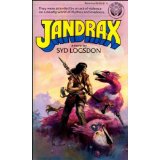
51jbN0bvqRL._AA160_We are just coming off Voices in the Walls, which, if you missed it, was a fragment of a novel presented with commentary. It was intended to provide young writers with a chance to look over my shoulder.

Like most experiments, I didn’t know if it would fly, but I think it worked out quite well. Now I intend to expand the idea by presenting Jandrax, my first published novel, as a serial, with commentary on world building, person, publishing, writing style (Be careful how you write, it will still be around to haunt you in your old age!), and changes in the world of fiction from then to now.

In August of 1978 I received this letter, which changed my life.

August 8, 1978

Mr. Syd Logsdon
(address)

Dear Mr. Logsdon:

I have just read Jandrax, the novel you sent to my  husband.  Lester handles the fantasy for the list, and I take care of the science fiction.

I like the book and would very much like to publish it–probably in the Spring.

I offer you (monetary and rights details, very modest)

If these terms are satisfactory, get back to me, and I will get a contact prepared.

Is this your first novel? It reads well, and I would hope to see many more from you.

Would you prepare a 200-word About The Author (in the 3rd person) to run in the book and send that along in the next few weeks.

I think readers like to know something about new authors.

I shall look forward to hearing from you.  Welcome to Ballantine.

Cordially,

Judy-Lynn del Rey
Editor-in-Chief
DEL REY Books

P.S. I’m not sure I love the title. Can you come up with something a little jazzier that captures the spirit of the book?

If you are a would-be writer – and why would you be reading this if you were not – you probably already know what a rejection letter looks like. I had certainly seen dozens by the time Jandrax was accepted. I’ve seen hundreds since.

Acceptance letters are a different breed of cat. This one hangs, framed, above my desk. I look at it from time to time to remind myself that I am a published author, when current events make that seem fantastic. I have had a few more acceptances, which are filed, not framed, because only the first one gives you that maximum heart thump.

Jandrax begins tomorrow

Voices in the Walls 34

6 of 6 of an outline of the remainder of Voices in the Walls.

One of the slaves is young, powerful, and pushy. He has always resented the whites above him; he is happy now to treat Matt as an underling. Matt is not about to buy that, and there is a lot of testosterone fueled head butting, complicated by black-white tensions.

Of course, this brings an image to mind – a white guy handcuffed to a black guy, running through the swamps ahead of the law. We’ve seen this show before, in any number of B movies. It will take careful writing to acknowledge that these emotions have to play out, without having the incidents take over the novel.

Eventually, Matt will have a climatic scene where he has to choose between the life of a white man and the freedom of a black man. The whole book points to this moment. It can’t come too soon, nor be delayed too long, but he finally has to take that pistol, given to him to protect his sister, and use it to protect one of the escaping blacks. Which white he shoots has to be carefully chosen. Not Meeker, that would be too pat. Not someone who is a complete innocent, nor a complete villain. The black he rescues is equally important. Probably not Alice – too easy and pat again, as well as being a sexual instead of a racial act. Not his black adversary among the runaways, that would be unbelievable. Probably Ben Sayre. Possibly one of the lesser characters among the runaways.

(Need I point out that this scene will be an obvious metaphor for the entire coming Civil War?)

This climax needs to come shortly before they all reach the Waterside area. There Matt will meet up with the old slave who taught him how to swing and axe and adz at his father’s shipyard. He has to experience again the servility that the old man offers him, and reject it.

Matt and his group steal a bugeye, an inshore vessel which Matt understands well. They work their way down to the Atlantic at night and out into a storm, then turn north and sail to freedom.

I’ve wanted to write this scene since I saw reference to an actual event years ago, long before I got the idea of Voices. A vessel designed for other purposes is exposed to a storm, and weathers it, to the surprise of those who thought they knew its capabilities. Like Matt. The storm is a massive threat from the outside, overshadowing white-black differences, and forcing them to work together or perish. And finally, the land is ripped apart by men in warlike contention, while the sea (aka nature) offers challenges men can overcome if they work together.

Yes, critics, writers are aware of the symbolism in their books. Readers, too. They don’t need you to point them out.

This also prefigures what Matt will do in the years to come. We find in the epilog, as he and Rachel and Sarah listen to Lincoln’s Gettysburg Address, that he will spend the war in the Northern navy and will be in command of a river steamer with a black crew which is lost at the siege of Vicksburg.

In the final scene Alice comes by with her child at her side and is embraced by Rachel. She and Matt face each other; he nods, she smiles, but they do not – cannot – embrace. Matt realizes, sadly and with feelings of personal inadequacy, that he still can’t treat Alice as he would a white woman, and he predicts in his thoughts – as Lincoln’s words echo in the background – that although the slaves are freed, it may take a hundred years before his kind can bring themselves to treat them as equals.

Voices in the Walls 33

5 of 6 of an outline of the remainder of Voices in the Walls.

I’ve even considered dumping the Alice altogether and having Saul be the one captured, but I can’t believe the story told that way. Maybe if Saul were five years old, but adult-saves-child is too easy a moral path for Matt.

I want Matt to change his feelings for a race, not an individual. Matt is young, good looking, and with a full complement of hormones. That means horny; it isn’t emphasized, but the reader knows. The girl is young, good looking, and forbidden fruit for two reasons. Young men of that era were supposed to save it for marriage, however often they didn’t. And slave owners – even ones like Matt and his father who strive for the moral high ground – would have been pulled two ways. Their “racial superiority” would tend to make them keep their distance, while knowledge that they could do as they pleased would tempt them to take those women who were unable to resist.

You could write a thousand stories out of that swamp of emotions: comedies, tragedies, or stories of moral affirmation and moral downfall. But those aren’t the story I’m trying to tell.

Matt is going to go into this rescue with massively mixed feelings. I want those feelings to be slave-owner vs. friend of a good, old black man. I’m afraid his inevitable sexual attraction to Alice will skew everything.

Nevertheless, logic notwithstanding, my gut tells me Alice needs to be in the story. The only way out of my conundrum may be to buckle my seat belt and write my way through the dilemma. If it fails, it won’t be the first couple of hundred pages I’ve thrown away.

So, let’s move on with the story. Alice gets rescued, and complications ensue.

For reasons I have yet to plot out, when Matt and Ben spirit Alice away, they are joined by a small group of other slaves who either have been planning an escape, or just take advantage of the situation. It may be that Alice invites them along, risking her life and freedom for strangers she had just come to know. That would be just like her.

Matt, Ben, Alice, and the others find themselves on the run. Matt has been found out. He can no longer pass as a southern gentleman. He has become a slave-stealer and his hosts know it. A hue and cry is raised. The road north is blocked.

They must now turn east and south, following a path that will eventually lead them to the tidewater region.

Here is a sidenote, concerning research: The journey from Gettysburg to the plantation where Alice is rescued has to take long enough for all the planned moral and personal dilemmas to play out. The distance from that plantation to the coast has to be be long enough for the remaining plot events to occur, but not be so far that the journey seems impossible for escaping slaves to accomplish. Beyond the linear distance, there is also the issue of time. Matt’s story begins with Lincoln’s election, and the number of weeks in Gettysburg, plus the trip south, plus the escape to the coast will probably push the end of the escape beyond the opening battles of the Civil War. All this has to be worked out in detail.

Accurate historical fiction is a lot harder than science fiction and fantasy.

From the beginning, I have planned for Matt to return to his own home, Waterside, passing through as a fugitive in the night. I want him to be fully committed to his new people by the time he gets there, and to fully realize what his change of heart has cost him; and to accept the change and the cost.

But before he gets there, he and his new people have to undergo a great deal of hiding, running, sneaking, a batch of close calls, a lot of fear, and a lot of interactions within the group, most of them harsh. Matt is no longer the man looking down from above. The slaves don’t know him and don’t trust him, and he is out of his element. He is not a city boy, but he isn’t Davy Crockett either. The knowledge the slaves bring with them is at least as useful as anything he knows.

Voices in the Walls 32

4 of 6 of an outline of the remainder of Voices in the Walls.

Eventually, Ben and Matt discover where Alice has been taken. Meeker and Bellows have sold her and left the story. There will be no shootout at the OK corral type confrontation with them. This is not a story about two evil men, but about an evil system. It would be fun for the reader, and Matt, and me, to shoot both of them, but that would cheapen the book.

Matt goes to the plantation where Alice has been bought, using his own identity for the first time on the mission, and is given the hospitality of the owner. This is a crucial scene. Matt is plunged fully back into his “real” life; he finds the plantation owner and his son to be kindred spirits. The father is nothing like the stereotyped evil owner; his son is a picture of what Matt would have hoped to become. Matt likes both of them immensely. They are so trapped in an evil system that they do not recognize it as evil. So was Matt, a month ago, and that old accomodation to slavery still calls to him. It was so much easier than the morass of emotions into which he is sinking.

Matt struggles with the knowledge that he is deceiving them and is about to betray their hospitality in a way that he would have found unthinkable a few weeks earlier.

Ben Sayre will discover where Alice is. Ben and Matt will plan the rescue and carry it out. The details of this will come to me as I need them.

Now we come to a crisis of conscience. Not Matt’s; mine. Once Alice is bought and brought to the plantation, being young and beautiful, she will be in danger of rape by her owners.

If a writer (typically) were to have Matt save a white girl from captivity, he would save her before she was raped. I am proposing to have him save a black girl from captivity after she has been raped.

Ugly. Ugly. Ugly.

It needs to happen this way for reasons of realism, and for plot reasons. This is how it would most likely have happened in reality. A good looking young slave woman would have been “sampled” by one or more of the whites, even if I paint the owner and his son as above that act. And when Matt sees her again at the end of the book, I want her to be raising the baby from that rape as a beloved child for whom she has no resentment, however much she may hate the father. That is how I see her personality, and part of my goal in Voices is to push the one-race idea that I hammered on throughout my Black History Month posts over in A Writing Life.

But it’s wrong. Logic and plot needs be damned, it’s wrong. It tastes like exploitation. A black woman author could write this story with the rape intact, but I can’t. At least, I don’t want to.

Turning away from the implications of her capture, simply writing the book without the rape, would dishonor our understanding of how helpless slaves were. Writing the rape, even though it occurs off camera, dishonors the young girl I have created and am responsible for.

Yes, characters in a book do become real for authors, as well as for readers. Alice, who didn’t even have a name two days ago, who has not yet appeared in the text, and whom Matt didn’t even know to exist at the end of what I previously wrote, is already real for me.

This is one of the sticking points that made me stop writing originally.

Voices in the Walls 31

3 of 6 of an outline of the remainder of Voices in the Walls.

Matt arrives at the Sayre home to find the front door ripped from it’s hinges. Inside, Sayre and his son are on the floor, badly beaten. Sayre is nearly unconscious and Saul is near death with a massive open wound on his skull. Alice is gone, taken by Meeker and Bellows to replace the slaves they have been unable to recapture. Saul was not taken only because he appeared dead.

The details of action will suggest themselves when I get to this point of the story. The essential part is that Matt is outraged, says to himself, “What can I do”, and then realizes that Alice’s capture into slavery is no different than what happened to tens of thousands of other slaves in Africa, and what will happen to her now is no worse than what happens to all other slaves, including the ones back home at Tidewater.

After a great deal of agonizing, Matt agrees to accompany Sayre as he follows his daughter. This means crossing the border into slave states. Sayre’s claim to be a freeborn man turns out to be untrue. He is an escaped slave who crossed into freedom before Matt was born. Discussion here of Dred Scott and how different things were twenty years earlier when the North still offered freedom for escaping slaves.

Sayre is going back into the land from which he escaped as a young man. He can’t go as a free black without papers (need to research this) and so goes as Matt’s slave. Playing the part of a slave owner is easy for Matt, but it affects the relationship he has built up with Sayre. Acting as if Sayre were a slave makes him think of Sayre as a slave. This slide back into what Matt normally would be is the first of several emotional reversals they both suffer as Matt is dragged back and forth between two visions of the meaning of slavery.

Matt talks to the whites they encounter, trying to find out where Alice has been taken, while trying not to raise suspicions. He hates the deception; it offends his sense of dignity. And he hates the silent disapproval on Sayre’s face as he falls too readily into easy give and take with those who have always been his peers, but whom he is now deceiving.

This emotional back and forth needs to be fully developed as the two of them work their way southward on Alice’s trail. There needs to be some humor and some adventure in these events as well. After all, this is a novel to be enjoyed. The modern reader should be in a position of watching Matt’s moral agonies without being sucked in to them. After all, the reader knows slavery is wrong, and Matt is just learning this. The reader needs to have some assurance that all will be well. At the same time, he needs to wonder what will be the cost in the end, and he needs just a little doubt. After all, things could go bad in a big way. Matt could betray Alice and Sayre. They could both be killed, or enslaved and left behind. The reader needs enough assurance that these things won’t happen to be able to enjoy the book, but he can’t be really sure, or he will lose interest.