Tag Archives: americana

717. Don’t Start at the Beginning, Part Two.

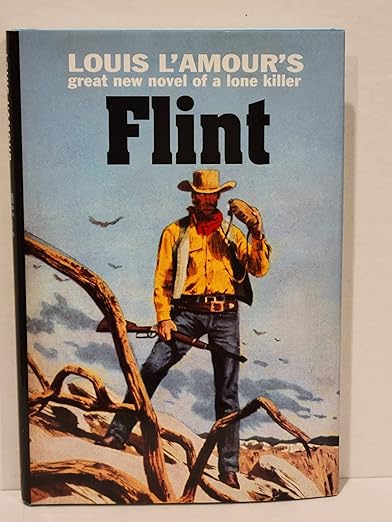
Last week I said you should buy a copy of Flint, by Lous L’Amour, and have it in hand as I take you through the first five pages. I have left out more than I have provided, so you need the original. Don’t read this and think you have read L’Amour. Now let’s begin —

Flint, Chapter 1, Paragraph 1-3  =>  It is given to few people in this world to disappear twice but, as he had succeeded once, the man known as James T. Kettleman was about to make his second attempt.

If he did not succeed this time he would never know it, for he would be dead.

When a man has but a few months to live, he can, if he so wills, choose the manner of his going, and Kettleman had made such a choice. He was now on his way to a place of which he alone knew, and there he would die. He would die as he had lived — alone.

If that doesn’t grab you by the lapels, I don’t know what it would take.

Be sure to read the paragraphs I don’t provide. The ones I am giving you are just landmarks.

Paragraph 6 => There were five people in the car. The lights were dim, the passengers lay sprawled in uncomfortable sleep. The train rushed westward through the cold, clear night, carrying the man steadily toward his final destination.

First who he is, now where he is. Next we will get a glimpse of his love interest and his antagonist, both of who will appear later in the novel. Read on . . .

Paragraph 10-14 => The country outside was invisible. The windows had steamed over, and the train moved as if through an endless tunnel.     (I am trying to maintain the letter and spirit of the copyright laws, which allow short excerpts, so you will have to have a copy of Flint to read the longer sections.)

Now we know where he is going, and that the place is intimately familiar to him. If you are a fan of the genre, you also know that it is a place you want to spend the next few hours. In a different genre, it would be different place.

Paragraph 15-23 =>      Next in your copy, but too long to reproduce in this post, is the essential flashback that establishes Flint’s deep background. This gunfight is a classic of the genre, but it is told briefly since it exists to establish character and motivation. There will be other gunfights to bring the book to its necessary conclusion. This is a Western, after all.

In another genre, say a romance, this might be be an early or failed romance to set up THE ONE in the closing pages.

Paragraph 24 => In the instant of silence that followed the shooting they heard the click of a drawn-back gun hammer, and every head turned. “He was my friend,” the youngster said, and he started shooting.

This is a triple set-up. First it establishes Flint’s relationship to the man who is killed. This will be fleshed out later in the novel. It also shows Flint’s gun skills, and finally it sets-up an essential mistake of identity, when “Kettleman” is later thought to be the legendary hired killer Flint.

Paragraph 27-28 => The train whistled, the lonely sound trailing off across the wind-swept plains. Kettleman got out his pipe and lighted it. His two bags and haversack were at the back of the car. When he opened that door there would be a moment when the cold air might awaken the others, but he would be gone.

Up to a point he had planned every move, but once arrived at Flint’s old hideout there would be nothing to do but wait. Some time ago his doctor had told him he would not live a year, and most of that year had passed.

The next five paragraphs are skipped just to speed the process. Of course you will read them in that novel in your other hand.

Paragraph 33-34 => There had been more than fifteen hundred dollars in Flint’s pockets when he died on that rain soaked Kansas hillside, following the shooting at The Crossing. The boy who was to become James T. Kettleman had sixty dollars of his own, which he used to buy an outfit of store clothes in Kansas City.

He travelled to New York City and sold his four horses for an additional four hundred dollars. With this stake he started in business. It was more money than either Jay Gould or Russel Sage had started with.

Again, some paragraphs are skipped.

Paragraph 41 => In the fifteen years following that night at The Crossing he had built his small stake into many millions, making many enemies and no friends in the process. He married a wife who tried to have him killed, and had no children.

That last sentence is a masterpiece of brevity. It tells a little, but leaves volumes unsaid. It leaves us dying to know more about this woman. When she shows up more than half-way through the book, we will find that she has been worth waiting for.

Paragraph 43 => Thirty years earlier, when he was two years old, he had been picked from the brush near a burned wagon train, where he had been overlooked by raiding Comanches. There were no other survivors. Nothing remained to tell who he was, and those who found him had no interest in learning. During the next four years he was handed around from family to family and finally abandoned on a cold night in a one-street Western town.

Having established Flint as a youth and as a grown man, L’Amour finally tells us about the very early life which set him on his path.

Paragraph 47-49 => The dry grass bent before the wind, and seed pods rattled in the brush along the right of way.

James T. Kettleman was ended, and the man who had borne that name, making it feared and respected, stood now where he had stood so many years before, without a name. He was now a man without a past as he had been a boy without one.

“Good-by,” he said, but there was nobody to say the word to, and nothing to remember.

<< == >>

So now we are five pages into the novel. I dare you — or any reader — to stop now.

There is a lot to be learned in these few pages about grabbing your readers, whether you like Westerns or not. And if you didn’t get a copy of Flint to read, causing you to miss 90% of what the rest of us learned, aren’t you sorry now?

Of course you can still go get a copy. This post will still be here. Just type Syd Logsdon 716. Don’t Start at the Beginning, Part 2 into your browser.
716. Don’t Start at the Beginning, Part One.

Genesis 1:1 In the beginning God created the heaven and the earth.

The Bible starts that way but you shouldn’t. When I say that, I am assuming that your are or want to be a writer.

The days of beginning at the beginning of a story passed a couple of centuries ago. Now we begin in medias res, which is Latin for in the middle of things. Then we fill in with flashbacks, as needed.

It’s quite an art, and it is often done badly.

In a recent Christmas movie, two young women were standing on stage at the Grand Ole Opry. One said, “I can’t believe I still get nervous before a live show.” The other replied, “You’re Suzie Smith, country western star, and I’m your manager. You’ve got this!”

Awkward, awkward, awkward.

You need to get your story going at full speed, then introduce the necessary background early so your reader or viewer doesn’t close the book or change the channel before being properly hooked. It’s a skill that takes time to master.

AI devours ten thousand reports in order to learn how to produce one report. Writers read a thousand novels before they are ready to write one, starting it in medias res. I am about to offer you a novel that should be on your list.

The novel is Flint, by Lous L’Amour. It doesn’t matter if you are a fan of westerns or not, this is business. You can learn from any genre, and this novel is a masterpiece at grabbing the reader by the lapels in the first sentence and never letting him escape.

In the first five pages, L’Amour introduces his character, paints a compelling picture of his surroundings, tells you that his character is dying (he isn’t, but he thinks he is), shows the girl who will later be his love interest, as well as the man who will be his future enemy, tells Flint’s origin story (it’s a good one), tells the story of his life so far, and introduces the woman (who happens to be his wife) who will bring him no end of misery.

But here is a twist. Before I tell more, I’m going to give you a homework assignment.

You can buy Flint in many new bookstores, in many used bookstores, or you can go to Amazon and find it new, used, as kindle, or as an audiobook. Get a copy and have it handy on March 11th. Then I will walk through the first five pages with you.

I can’t compress five novel pages into one of these posts, and it would probably be illegal anyway. Also, I’m not ChatGPT. If I am going to use another author’s novel, I will expect him (or his estate) to get at least a few pennies.

Of course, you may be reading this post years from now. The same rules apply. Get a copy of Flint and then go to the March 11, 2026 post.

Join me next week, same time, same place,
with a copy of Flint in your hand.

715. Pettus Bridge, a fable

Once upon a time, there was a lovely young woman. Unfortunately, she was black, enslaved, and living in Alabama. The year was 1815.

Her owner was just back from fighting beside Andrew Jackson at the Battle of New Orleans. He was a hero.

His wife didn’t think so. She had been running the plantation all the time he was gone. She hadn’t enjoyed that, but she enjoyed having him home again even less. In bed, he was quick and crude, and after three weeks his wife moved into a different bedroom.

A week later, he found the lovely young black woman in the fields. He ordered her to take off her clothes and lie down on her back in the shade of a tree. Ten minutes later he was on his way again.

Nine months later, the woman gave birth to a beautiful daughter. Nineteen years later, the hero’s son caught the daughter in the fields and did the same thing to her that his father had done to her mother. Nine months later, another lovely black girl-child was born, but now things had changed.

The plantation was failing. The hero’s son had become too fat to chase women, even slave women, and too drunk most of the time to miss the chase. The plantation was sold, the slaves were broken up and scattered. The girl-child stayed with her mother a few years, then was sold to a plantation south of Birmingham. When she turned seventeen, she was sold to a brothel.

When she was twenty-four, she gave birth to twins — but not identicals. One she named Flo; it had been her mother’s name. The other she named Cécile, since the father had been a Frenchman. She thought so, anyway.

The blood of Cécile’s white father, and grandfather, and great grandfather were strong in her makeup. He nose was small, her skin was pale, She would be a great addition to the brothel when she grew up. Flo had inherited the other side of the genetic lottery.

Both would remain slaves. Both were black, Cécile’s white looks notwithstanding, since the doctrine of that day was the one drop of blood was all it took to make you black.

Little Cécile was a favorite of all the men who came to the brothel. When her head was only up to their elbows, she had already learned how to lean against them, smile up at them, and laugh like she didn’t have a care. She earned coins that way and she kept them hidden. She listened to what they talked about as they waited their turn upstairs, and she remembered. She stored everything away in her finely tuned mind and she planned. She learned about Birmingham, but more importantly she learned about Memphis from a traveler who came often. Soon she knew all the street names, where blacks lived, and where they didn’t.

When she was fifteen, she ran away. Two months later, she was in Memphis. Her name was Celia, now. Celia White, because she had a sense of humor. Her name was White, and she was white, because she was intelligent enough to know that that was the only way to survive. Her husband never knew. Her children never knew.

Celia had eight children. Every time a child was born, she was in mortal fear that the child would have dark skin and kinky hair, but it never happened. When one of Celia’s grandsons had a black appearing child, he beat his wife for her infidelity, since the child clearly could not be his. Celia said nothing.

When Celia was 53, her husband moved to Selma, Alabama. Within a year most of the children and grandchildren had followed. Now Celia was only seventeen miles from the town that held the brothel where she had been born. She said nothing.

Celia’s mother was emancipated in 1865, but Celia never contacted her.

Celia had emancipated herself already. While the others traded slavery for Jim Crow, Celia had made herself white. Her emancipation was real, and she had no intention of jeopardizing it.

Celia live to be 71. They buried her in Selma, in a cemetery that black folks couldn’t use — but she did.

She had eight children, forty-seven grandchildren, and one hundred six great-grandchildren. Most of them remained in and around Selma, and many went into law enforcement.

In 1965, Celia would have been 116 if she had lived that long. She never saw her mother again after she ran away from the brothel. She never saw her twin, Flo, either. For most of Celia’s life, Flo was alive and in the area, having children, and grandchildren, and great-grandchildren, just like Celia, but they never met again.

On March 7, 1965 near the Edmund Pettus Bridge in Selma, Alabama, Celia’s great-grandchildren, thinking they were white, brutally attacked Flo’s great-grandchildren who knew that they were black and always would be.

Behold, America, clubbing itself to death over the myth of race.

709. Redneck Granny

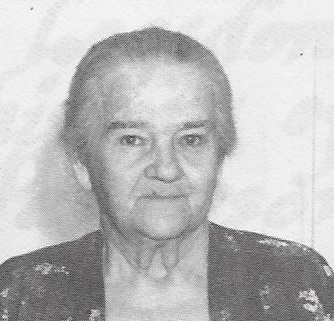
Here is my redneck Granny, who died long before the original of this was posted. I’m sure she would hate everything I have said here, but I love her anyway.

Redneck Granny

I started this blog late in 2015. When Black History Month rolled around in 2016, I had a lot to say — enough to fill the month with posts. This, somewhat modified, was one of them.

— << >> —

The first African slaves arrived in America about 400 years ago. If we count twenty-five years as a generation, that’s 16 generations.

Let’s look at the typical American today. He or she had two parents and they had four parents between them, and their parents had eight parents between them. And so forth. Up the line sixteen generations, that’s 32,768 direct ancestors. If you don’t believe me, do the math.

All those ancestors sent DNA down the line to make our average American. What are the chances that not one packet of DNA was out of Africa? What are the chances that there weren’t a lot more than one out of Africa in his/her lineage?

You might think whites didn’t mix with blacks in the olden days, but are you sure? Are you counting all the times when a white man was in charge, and a black woman didn’t have any say in the matter? They wouldn’t even have called it rape in 1619. Nor 1719. Nor 1819. In a lot of places they wouldn’t have called it rape in 1919. 2019 — maybe.

So much for black purity, but that isn’t any big secret. What about white purity?

How white do you have to look to pass for white? Three quarters? Seven eighths? How many generations does that take? Not many.

Now what are the chances that a whitish, black female would claim to be white if she could? Or a whitish, black male? Forget the twenty-first century when African-Americans are proud of what they are. Project your thinking back to when being white meant being free, and being black meant being a slave. Wouldn’t you pass for white, if you could get away with it?

I would. Some of my (and your) ancestors probably did.

More math. Lets say that by 1700 (eighty years into the era of American slavery, thirteen generations ago), one hundred partially negro girls could and did pass for white. That’s not a big number to surmise. In fact, it’s ridiculously small.

Let’s give doubters no excuse for their doubts. Let’s say that these passing girls only averaged two children who went on to have children. That’s certainly a minimal estimation. Their descendants are boys and girls who would disappear into the white gene pool.

That’s 408,000 offspring after 13 generations. Which is to say, in 2025.

Wow. And after a couple of generations, if Mom kept her mouth shut, none of them would know they were passing. They would believe they were white.

That doesn’t cover all the other blacks, male and female, who passed in the last four hundred years. That is only one hundred, starting in 1700. But there weren’t just a hundred, they didn’t start in 1700, and they haven’t stopped to this day.

There is one big change in the twenty-first century. People who are light skinned and could call themselves white, now often identify as black. It’s probably confusing for “white” folks who haven’t thought it through.

I don’t think it confuses “black” folks at all.

If math doesn’t impress you, if you think numbers lie, then let’s make it personal.

Rhett Butler was partly black. Scarlet O’Hara was partly black. Simon Legree was partly black.

You’re partly black. I’m partly black. And my Oklahoma relatives just disowned me.

That’s mighty white of them.

— << >> —

This was a modified version of a post from February 3, 2016. If you are wondering why this old “white” guy is so concerned with black identity, it is all a matter of upbringing. In my case, that means being raised on the edge of the South in the fifties in a culture that didn’t exactly hate blacks, but didn’t much like them either. My people fully believed in the separation of the races; the only good black was somebody who lived someplace else.

The problem with the community viewpoint was television. On the six o’clock news I saw black people being washed down the sidewalk by firehoses because they were marching for the right to be human.

They were right. We were wrong. Hardly anybody in my town got that message, but I did.

I escaped to college, where I studied Anthropology and got an extended view of what British imperialism had done to the black and brown people of the world.

Then I studied History, where I found out that English imperialism had been just as harmful to the ruddy-faced and red-haired poor in Scotland and Ireland. I also found out what white America had done to the Native Americans, the Chinese and Japanese immigrants, and even the Irish.

In California, where I now live, white incomers from the east now discriminate against the Latinos, who owned California after they took it away from the California Indians, and before the white east-coast Americans took it away from them.

Over the years I wrote about all of those displaced and disadvantage peoples in my blog and now that has all been gathered together for publication.

Originally I planned to call the book . . .

Your Redneck Granny is a Black Woman, and she doesn’t even know it

I had kept that provocative phrase in my back pocket for years, but when it came to reality, the title . . .

Your Redneck Granny has a secret

. . . seemed more likely to make a prospective reader curious enough to pick up the book.

I originally wanted to publish it early in 2026, but the five novels of the Menhir Series will take the whole year to release. Instead Redneck Granny is planned for release on January 20, 2027, just about a year from today. Keep it in mind and tell your friends.

706. Five Years Ago

Even though Trump just “took over” Venezuela, that isn’t what I want to talk about. That story is still unfolding and full of unknowns, but there is no confusion about what happened five years ago.

January sixth — you can’t say that any more without special meaning. It has become a time-bound phrase, as specific as 9/11.

January sixth came five years ago. No doubt every newspaper and television journalist will have something to say today. Me, too. It’s personal; it should be personal to every American.

I saw it all on television, starting at nine on the west coast. This posting will match that time. At first it seemed to be only another address by the outgoing crazy. Then Trump called on the crowd to “fight like hell”, and they did.

I saw it all as it happened. From the moment it became apparent that there was going to be trouble, continuing until the crowd dispersed, I never left the broadcast.

Even if you were elsewhere that day, everybody knows about the attack. Unfortunately, not everybody understands that the attack happened entirely because Trump lied.

Trump had lost the 2020 election. He refused to acknowledge that fact. He instituted multiple lawsuits against the result, and lost them all.

He called for a rally. He stoked the crowd. He sent them to march and told them to fight in order to keep the Congress from ratifying the vote.

Trump orchestrated and authorized the horrors that followed. There is only one word to describe his actions.

Treason.

Trump is responsible for his words and his deeds, despite the subsequent findings of the Supreme Court which ended attempts to bring him to justice.

Trump ran again four years later, and won a second term. He continued to lie and continued to be believed, but he did not win without help.

The gatekeepers who kept the American people from knowing of Biden’s decline have to share the blame for Trump’s return. When Biden came on stage at the June 24, 2024 Presidential debate, clearly inadequate to his task, the election was already lost before he ever opened his mouth.

And now Trump is back with a vengeance.

These are dark days. They must not continue. 2026 is our best chance to return to reason. It may be our last chance.

699. Thanksgiving Prayer

Dear God,

We thank you for the food before us,
We thank you for those who grew the food,
We thank you for those who keep us safe,
We thank you for our freedom,
         and for our Constitution.

Forgive us for the ways in which we have failed you
          by failing our fellow man.

Help us reunite the families we have separated.
Help us succor the allies we have abandoned.
Help us accept our own children,
          born beyond the border,
          but ours since childhood.
Help us to accept the refugees,
          crying out just beyond the wall.
Help us to free those incarcerated,
          guilty of believing
          that we would give them
          the refuge we had promised.

Help us to see clearly
          all the ways that we have failed you
          by failing our fellow men.

And forgive this nation.
          God knows we need it.

683. Dry Oklahoma

Greetings. I have been gone a long time and I did not intend to come back now, but a weird thing happened. Just before covid struck, I had finished two posts; when I decided to bow out for a while, I reset them for a month later than their original posting date. Then again, then again, as the year rolled on.

Then something else weird happened. WordPress completely changed the way posts have to be written. I opened it up one day and couldn’t make heads or tails of what was on the screen. Clearly I had to completely relearn their system, but there was no hurry, since I didn’t plan to post for a couple more months.

Then this morning, I saw that I had posted yesterday. My pushing the dates forward on those two old posts had caught up to me. Since I don’t really know how to post in the new fashion, and the other old post (this one) is scheduled out in three hours, I decided to just add this explanation and let things go. I don’t even know if these paragraphs will be added to the Dry Oklahoma post.

If you don’t see this information, ignore it.

=========================

I grew up during prohibition.

If you are mathematically challenged or historically challenged, that statement might seem possible. Otherwise, you have already calculated that this statement makes me over a hundred years old, which I’m not.

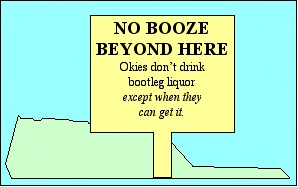
A lie? No, the twenty-first amendment did not end prohibition everywhere. States had the option of continuing it, and Oklahoma did until 1959 when the consumption of alcohol was made legal, but only under stringent conditions. For two and half decades, the Kansas-Oklahoma border was the starting line of a nightly race between bootleggers and the Highway Patrol.

That’s all behind us, right? Not quite. Today the Kansas-Colorado border straddles pot highways, but this time the product is flowing into Kansas. The history of Oklahoma as a dry state in a wet nation might be useful in 2020.

As for my tiny part in the story, when I was five years old our house was fifty feet from Highway 169 which ran from Coffeeville, Kansas down to Tulsa. As I watched the cars go by, many of them were carrying booze for personal consumption, and some of them were carrying booze in bulk for resale. Tales of high speed chases and big busts were common.

There was no checkpoint at the border. Bootlegging was as simple as buying a bottle of whiskey legally in Coffeeville, driving home, and drinking it illegally in your living room. And there were plenty of bootleggers who were willing to save you the trip, for a profit.

Oklahoma was dry. Okies weren’t. Local humorist Will Rogers said that Okies would vote dry as long as they could stagger to the polls.

All this started before statehood and continued until 1959. When national prohibition came along in 1919 with the eighteenth amendment, it only cut off the source of liquor from surrounding states.

During national prohibition no one in America got all that thirsty. There were always stills, along with mass smuggling from Canada and Mexico, and rumrunners on all three coasts. From 1919 to 1933, America was dry, but Americans weren’t. With the advent of the twenty-first amendment, the rest of America could legally drink again. Okies could not, but it didn’t even slow them down.

Actually a few other states also remained dry. Mississippi was dry longer than Oklahoma, and many counties remain dry or moist today. Moist means consumption is legal but only under severe restrictions.

Consumption of alcohol finally became legal in Oklahoma in 1959, fifty-two years after statehood, but only with great restrictions. For example, you could buy beer, but only with 3.2% alcohol or less, and only at room temperature. Cold beer could not be sold. The idea was that you had to take it home to refrigerate it, and then consume it in the shameful privacy of your own house.

So what does this have to do with pot in 2020?

Beyond the obvious issue of people from Kansas having to drive to Colorado to get pot, and bringing it home illegally, there is the issue of why prohibitions get overturned, and how wide is the overturn.

People in Oklahoma were convinced to overturn dry laws in part because of all the tax revenues they felt they were losing and because the cost of enforcement. That should sound quite contemporary.

Of course there was a lot of home brew being made and a lot of stills that went right on selling their wares after 1959 so drinkers could avoid the booze taxes.

The snarky part of me also wants to wonder if the booze tax revenue after 1959 in Oklahoma made up for the gas tax revenue that all those bootleggers were paying, but never mind . . .

In a similar way, there is still a thriving business in illegal pot in California today, causing disappointing tax returns on legal pot. What a shocker! Remember all those million dollar busts of pot in the old days? That was based on street prices. Once pot becomes legal, the street price goes down. Legal pot sales go up, but they never match those old inflated revenues. No problem, raise the pot tax. But then people go back to buying illegal pot, because it is cheaper.

Funny how politicians never think of that until it happens.

Also, to say that pot is legal in California is not quite true. It can still be made illegal county by county and city by city. In Calaveras County, near where I live, it is currently illegal to cultivate pot, illegal to manufacture (which I assume means process) it, but legal to sell it retail. There was a recent battle to change the local laws, with billboards for and against. The argument against was “keep out crime”. The argument for was “tax revenue”.

This should all seem familiar.

682. Hard Road to America

When I taught middle school science, I always took St. Patrick’s Day off from levers, rockets, and chemical reactions to teach a session on history. Irish history, but with a twist.

Those days very few of my students had an Irish background, but about half were Hispanic. There is a connection between St. Patrick’s Day and Cinco de Mayo which I will explain that at the bottom of this post.

The Irish immigrant story I taught on St. Patrick’s Day  was always new, since my student’s were always new. That is also somewhat true of those who read this blog. If you were here the last time I told a version of this story, my apologies. It has been several years and this one is somewhat changed.

It is a moving story, which eighth graders are old enough to appreciate. Potatoes from the new world were perfect for Irish soil; where a crop of oats had supported four people, a crop of potatoes would support eight; when previously hungry people were no longer hungry, they had more babies. Then the potato blight struck, and there was no going back to oats because the population had grown.

The land was largely owned by the English. They continued to export grain throughout the famine. Vast numbers of Irish starved. Those who could raise the money took ship for America.

The passage was hard. Ten percent of those who left Ireland died on the way. Their quarters were cramped, filthy, and unhealthy. Eighth graders both love and hate this part of the story; they have a very human capacity to be simultaneously moved and grossed out. I would walk about the room, measuring out the cubicles with hand movements, mimicking the heaving of the ship in a storm, telling of the bilge seeping up from below, pointing out the sound and smell of vomiting from seasickness, and reminding them that the cedar bucket behind the blanket at the end of the central aisle-way would fill to overflowing with human waste on those days when the hatches had to remain battened down.

Then I would quote a passage from a letter sent back to Ireland by an immigrant, who described the passage then said, “But I would endure all that ten times over, rather than see my children hungry.”

Once in the United States, things were still hard. The Americans who were already here didn’t want them. They could only obtain the jobs no one else wanted. Many were Gaelic speakers and did not speak English. They were segregated into the poorest part of the cities. They were disrespected.

They bettered themselves, generation by generation. They learned American democracy, and elected their own kind to office. They learned American capitalism and many became rich. Eventually, they elected one of their own, John F. Kennedy, to be president.

Along the way, they began to celebrate themselves. St. Patrick Day parades are an American invention. They have only recently begun to be celebrated back in Ireland, but they have been important in America for more than a century.

A teacher has to talk fast to get all that into forty minutes and still have time for the payoff.

St. Patrick’s Day isn’t about shamrocks and leprechauns. Its about Irish pride. Its about saying, “I’m as good as anyone.” It can even say, “I’m here — deal with it.” St. Patrick’s Day is American, not Irish, because America is where the Irish had to speak up for themselves.

Cinco de Mayo is an American holiday. It is not widely celebrated in Mexico. Just as St. Patrick’s Day is Irish Pride Day, Cinco de Mayo is Mexican Pride Day.

It is a message I got across most years, but no one would have listened if I had not first captured their emotions with the story of a politically neutral and sympathetic people with whom both Anglo and Mexican students could identify.

681. Anniversaries

I’m still here.

I’m not quite ready to come back to the blog yet. I have a lot of things planned, but they have all been impeded, first by covid, then by an unprecedented heat wave, and now by a layer of smoke that burns the eyes and hides the sun. Welcome to California.

The title of this interim post is Anniversaries, and I have two of them.

Forty-five years ago I sat down to write my first novel. The actual date varies a little because it was the day after Labor Day, and that is the way I celebrate it. In 1975, it came on September second. This year it came on September eighth, but on that day it was too hot to start the computer in my un-airconditioned writing shed.

Life giveth and life taketh away. In the last four days the temperature has dropped from 110+ to something almost comfortable, but only because the sun had not been able to penetrate the smoke cloud that covers the entire state. I can’t breathe, but I’ve stopped sweating and I can turn the computer on again.

In a world where people are dying of covid, out of work, fearing eviction, and in many cases hungry, a little sweat, some stinging in the eyes, and a bit of cabin fever is the definition of comfort and luxury.

I don’t forget that.

Hard times aren’t new. Ninety some years ago in my birth state of Oklahoma my father couldn’t see the sky either, but then it was from the dust storms that were wrecking everyone’s lives. We go on.

Nineteen years ago, things got tough in a hurry here in America, and everything changed. That’s the other anniversary. I spoke of it in an early post of this blog, back in 2015. I’m repeating it here.

================

I was in the shower getting ready for a day at school when my wife called to me. A plane had hit the World Trade Center. By the time I dried and dressed, the second plane had hit.

Twenty minutes later, driving to work, I listened on the radio as the towers fell.

All day long I taught science, keeping to the lesson plan. I didn’t want to teach, and no one wanted to listen, but it was necessary to keep a semblance of normalcy. Every break we teachers watched the television, but we didn’t take any news back to the classroom. These were young children. They needed to be in their own homes, with their parents, before they began to deal with the details of America’s disaster.

At the end of the day, I drove home. I had upon me the need to write, but not of the tragedy. Others wrote that day of what had happened to our country, and wrote well. I needed to write of love and joy and beauty – and of my wife who is all those things to me.

Poems come slowly to me; usually they take years to complete. This one rolled freely about in my head as I drove, and when I arrived at home, I only had to write it down.

                   There Am I

Where there is water, there am I.
In sweet, soft rain and in hard rain,
driving and howling,
or filling the air with luminescent mist.
Water is life, and there am I.

Where there is sun, there am I.
In the soft heat of morning or in the harsh afternoon,
or heavy with moisture, forcing its way through clouds,
or dry as a lizard’s back.
Where the Sun is, is life, and there am I.

Where Earth is, there am I.
Whether dark loam, freshly plowed
or webbed with fissures, hard as stone,
or sandy, or soft as moss.
Where Earth is, is life, and there am I.

Where life is, there am I.
rain forest or desert,
broad plains of grass or brooding jungle,
Where life is, there am I.

Where She is, there is life,
and sun and rain and earth, and all good things.
Where She is, is life,
And there am I.

================

Things got tough in 2011, things are tough in 2020, things have often been tough throughout history, and things will be tough again in the future. But life abides, beauty abides, joy abides, and love abides.

Stay well, friends. Be good to each other.

678. Taking a Break

I’m going to take a break

Yesterday, here in California, the Governor requested that all people over 65 self-isolate. That makes sense to me, and I passed that milestone seven years ago, so my wife and I are going to hunker down and become temporary hermits. That isn’t too much of a hardship since we live in the country and keep a well stocked larder anyway.

This change shouldn’t bother my blog, but it does. I’m not worried for my wife and myself, but worrying about the rest of the country and the world beyond weighs on me. It has also been getting harder lately to come up with new things to say, especially on subjects that don’t call for hours of research for a post that will be read in three minutes. This is post 678, after all.

So I am going to take a break. I have other things on my mind and I’m sure you do too.

I’ll be back. Whether in two weeks or two months, I can’t say. Meanwhile, I’m going to keep working on my novels, keep my wife company, and keep thinking about all the good people out there beyond my driveway.

Take care, folks. Stay safe.