Tag Archives: Cyan

702. Reaching Cyan

Reaching Cyan

The year was 2086, the place, half way to Procyon. Stephan Andrax wrote in the log of the Starship Darwin . . .

There are two chronometers on the bulkhead. One forges forward at the speed of Everyday, ticking off seconds and minutes and hours and days that make sense to the body and soul. The other races. Seconds flitter by. A new day is born every three hours and twenty-two minutes. Einstein told us this would happen, a century and a half ago; when an object approaches the speed of light, time slows down.

Beside the chronometers is a viewport and beyond it are Dopplered stars which sweep through my field of vision as the ship spins. We are nearly six years into our journey. Halfway through our journey. Yet, for me, only a year and a half have passed.

And through all the years and hours of our journey, the smaller, fleeter chronometer will rush ahead at Earthtime while our time is slowed. All those I knew and loved, except my companions here on the Darwin, are aging seven times faster than I am. When we return, my agemates could be my parents, and my parents will be dead.

The mind perceives what the heart cannot comprehend.

— << >> —

Obviously, one of the joys of writing near-future extra-solar exploration is dealing with the delicious complexities that come from working in a relativistic universe. Thank you Albert Einstein.

The novel Cyan opens with the words of Stephan Andrax, but he will not be the main character. He is the great great (I never figured out how many greats) grandfather of Jan Andrax, who gave his name to the novel Jandrax. I wanted an obvious connection between that novel and its sequel (prequel?), but I kept Stephan mostly in the background by making him the captain of the Darwin.

Imagine that you are planning a ten person expedition to an unknown extra-solar planet. Assume a giant starship, designed for travel only in space, and a landing craft to carry the explorers down to the surface. That seems like how things would actually be arranged. What would happen if all the explorers were killed while going about their business? What if the landing craft were damaged beyond repair leaving everyone marooned on-planet?

Contingencies are what planning is all about. If everyone on the ground were killed or stranded, the knowledge obtained up to that point would still need to be transported back to Earth, so the planners of the Procyon expedition arranged to always have one crew member on board the Darwin. They selected an astrophysicist who would be best positioned to study Procyon’s system of planets by staying in orbit, and made him Captain. He would stay with the ship, just like one astronaut stayed in the CSM while two others descended to the surface of the moon in the Apollo program. That made Stephan important but mostly off camera, which is just what I wanted.

The groundside leader was the character I chose be our eyes for most of the action. Stephan Andrax was Captain in space; Keir Delacroix was “captain” on the ground.

Everyone except Keir had one or more Ph. D.s and was at the top of his or her field. Keir was also highly intelligent, perhaps at the next level down, but his skills came from a life spent in the outback of Australia. He was a rarity on overcrowded Earth, a man who had spent his time in one of the few places that was still wild. Each other crew member had a scientific specialty to bring to the study of Cyan. Keir was there to keep them all alive.

I chose the name Keir Delacroix in tribute to the actor Keir Dullea who argued with the computer Hal in 2001: A Space Odyssey.

Here is the list of the Darwin‘s crew, alphabetically, with their specialties and their alternate fields of knowledge.

Stephan Andrax    captain (spaceside) – astrophysicist
Debra Bruner        microbiologist – astronomer – medic
Petra Crowley       geologist – soils scientist
Keir Delacroix       groundside crew leader – generalist
Viki Johanssen      anthropologist – paleontologist
Gus Leinhoff         zoologist – biochemist – medic
Leia Polanyi          paleontologist – geologist
Ramananda Rao  meteorologist – cartographer – geologist
Tasmeen Rao       first officer (spaceside) – pilot (starship and landing craft) –  engineer
Uke Tomiki           botanist – biochemist – medic

— << >> —

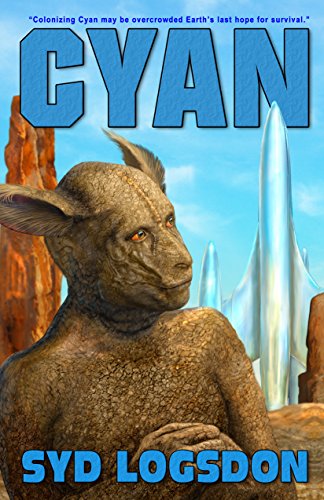
I have a lot of things to do in this rejuvenated version of A Writing Life, largely having to do with upcoming releases, but I won’t forget Cyan. I will return to talk about how it came to be, perhaps once a month. You can get a jump on all that by typing Syd Logsdon Cyan into Amazon and reading it now.

next week there will be Christmas posts on Tuesday and Thursday

701. Approaching Cyan

Approaching Cyan

Cyan is the name of a novel and the name of a planet.

I’ve been writing science fiction for fifty years, but I’ve been reading it even longer. When I began, NASA didn’t exist and the word astronaut hadn’t been coined. I was ten years old.

In the science fiction novels that filled my childhood, I rode on a thousand spaceships or starships to explore a thousand planets, but there was one novel I could never find. I never read of the discovery, exploration, and colonization of a planet — all the phases of what would actually occur — under one cover.

I really wanted to read that book. Eventually, I had to write it myself.

The kind of science fiction I prefer — and write — is based on reality, humanity, and scientific accuracy. The key question I continually ask myself is, what is likely to actually happen when the day comes. And the day that interests me most is something past tomorrow, but not too far past.

I can imagine 2050, but it really doesn’t interest me. It will look too much like today. I prefer to look forward a hundred years or so.

The novel Cyan opens in 2086, which seems a contradiction to what I just said, but I began writing it about 1980. It just took a long time to complete.

I also had to keep changing the year dates on what I was writing. Real world manned space exploration had slowed to a crawl. Who could have predicted in 1972 when the last astronaut left the moon, that fifty-three years later no more humans would have gone beyond low Earth orbit? Certainly no science fiction writer would choose to imagine that.

So what planet would I want to colonize? Mars? Of course not. Half the fun of science fiction is world building, and Mars is far too well known to be of interest. It would have to be a planet around another star, and if it was to be colonized in the next hundred years or so, it would have to be nearby, at least in stellar terms.

Actually, any extra-solar colonization in the next hundred years requires a major stretch of the imagination, but science fiction writers are in the imagination business.

So what are out near neighbors in the galaxy? Here is a list:

Sol, our sun, as a starting place.

Alpha Centauri, about 4.3 light years away.

Sirius, about 8.6 light years away.

Epsilon Eridani, about 10.5 light years away.

Procyon, about 11.4 light years away.

Epsilon Indi, about 11.8 light years away.

Tau Ceti, also about 11.8 light years away, in another direction.

Other than specks and oddballs, that is the full list of star systems within five parsecs of us. I will add two more, just beyond five parsecs, because they were part of Gordon Dickson’s writings in his Dorsai novels. You’ve read them, right?

Formalhaut, about 16.6 light years away.

Altair, about 16.7 light years away.

— << >> —

Click here (or type in https://en.wikipedia.org/wiki/List_of_nearest_stars ) for a Wikipedia article that will list 56 of the nearest stars, including some very small ones, and tell you more than you ever wanted to know about them.

— << >> —

Jandrax, my first published novel, was a lost colony story. The FTL ship Lydia malfunctioned during a jump, stranding colonists and crew so far out that they would never return.

The novel Cyan would be a prequel, taking  place hundreds of years earlier in the same imagined universe. It was intended from the first to be one of a group of novels, so I wasn’t just choosing a star and planet for a single story, but deciding what to do with the whole nearby neighborhood.

It seemed during my youth that every author of a novel about early extra-solar exploration landed on Alpha Centauri. I didn’t want that, so I made the planets of that star system barely habitable. Alpha Centauri lives in the backstory, but I don’t plan a novel about it.

Sirius, on the other hand, is 23 times as luminous as the sun. It struck me as a perfect place to put a colony of humans who were quite satisfied to live in space habitats, with no desire to take up planetary life. That became the setting for Dreamsinger, a novel which I have been sparring with for several years now. I offer no predictions about when it will be completed.

As the novel Cyan opens, limited colonization of the planet Cinder, around Alpha Centauri B, is underway. Explorers have not yet returned from Sirius. When they do, half way through Cyan, they will tell of a system unfit for colonization. Later, a group of dissidents will prove them wrong, leading to Dreamsinger.

There are three starships waiting to leave Earth. One is the Darwin, scheduled for Procyon and the as yet unknown planet Cyan. The other two will head out to Epsilon Eridani and Tau Ceti where they find prime, Earth-like planets.

Writing a story about the exploration and colonization of a prime planet would be a dead end for me. Something not related to the actual colonization would be needed to jazz up the story, and that was exactly what I was trying to avoid.

Cyan, on the other had, had plenty of challenges on its own. It was — and was designed to be — a place to tell a story about how exploration and colonization might actually take place.

I’ll tell you more about Cyan next week, but if you don’t feel like waiting, just go to Amazon and type in Syd Logsdon Cyan and you can buy the novel today, as an ebook or as print on demand.

more about Cyan next week

696. Then Life Happened

Then Life Happened . . .

Donald Maass, noted author and literary agent, said that there are many authors who have “both published and perished”, referencing the publish-or-perish dilemma facing young academics.

In 1984 I was one of those authors.

I had been writing full time for about eight years. Just looking at the dates you would say nine years, but I had taken a 15 month hiatus from writing to become Stanislaus County Red Cross Director, a job of massive satisfaction and hair-pulling frustration.

My third novel publication, Todesgesanga, came in 1984. It was a German translation and renaming of A Fond Farewell to Dying. Todesgesanga means Death Song, which I admit is a more accessible title.

Counting a cover novella in Galaxy in 1978, Todesgesanga was my fourth publication, all by major magazines or publishers. David Hartwell was my agent. If you don’t remember him, he was top notch. He was reading everything I sent him.

Life was good, on the surface, but my two ongoing novels were both fighting back.

Cyan was a bigger SF novel than I had yet attempted. The world building was huge, but by 1984 that part was finished and the novel was well underway. My ten explorers had made the near lightspeed journey to the eponymous planet and had completed their year of exploration. They had returned to a much changed Earth where I provided about 30,000 words of near disaster to disrupt their lives before they returned to Cyan with colonists. They were saved on Earth by the villain of the piece, Salomon Curran, but now that they were all back on Cyan, Curran’s presence had become a problem I couldn’t solve.

Curran was so huge to the story, and such a bastard that he would dominate the rest of the novel if I let him. Cyan would become about Curran instead of being about the colonization process, and I couldn’t have that. I finally killed him off, summarily, and submitted to novel to David Hartwell. He rejected it, and he should have. It wasn’t finished; Curran had to die a different way. But how?

I was alternately writing in Cyan and in The Menhir Series. That work was even bigger in concept. I could write scenes in that world all day long, but which scenes? I still have boxes of lovely, useless text that I wrote before I knew what it was that I needed to write.

I was in the middle of world building, and character building, and arms and armor building, and city building, and religion building, and magic building. Even horse-replacement building. I needed all that to write the right words, but writing words was the way to discover all of that. Some of one led to some of the other, which led to some of the first, which led to . . .

Looking back now, I see that I was doing it all correctly. I just didn’t have a clue how long it was going to take.

Basically, my problem was that I wasn’t making a living.

In those days novelists were given relatively small advances against earnings. If the author’s percentage of the publisher’s earnings exceeded his advance, he got paid more. If he had a best seller, he got paid a reasonable amount, and his next book got a larger advance. Several good sellers in a row, and an author could eat, sleep, and pay his rent. Several best sellers in a row and he would be well off.

That rarely happened. The norm was that a book by a non-best-selling author would never pay back the advance. The authors of those books had both published and perished.

For one cover novella, two novels, and a foreign reprint, I made about $10,000. That is for eight years work. Even in 1970s dollars, I could have made more digging ditches, or on welfare.

Something was going to have to change.

— << >> —

But not right now. Next week we have to talk about Trump again. (Sorry!) Then comes Thanksgiving, which will call out two special posts not related to writing. Our present conversation will continue on December third.

668. Century Ships

Joachim Boaz at Science Fiction and Other Suspect Ruminations has been running a series of reviews on century ship stories. He does a good job, even providing links so you can read the story itself before or after reading his review. I’ve read two of them, both story and review, picked out because they were by Brunner and Ballard.

Century ship stories are an extreme version of slow starship stories, that is, stories about exploration in ships which do not travel faster than light. Century ship stories assume that the people who start the journey will not live to complete it. It will be completed by their descendants who, when they arrive, will never have lived anywhere but on the ship.

That sounds like a recipe for disaster, and it typically is. A reversion to barbarism along with a superstitious belief that nothing outside the ship actually exists is a common trope. The original Star Trek used it in For the World is Hollow, and I Have Touched the Sky.

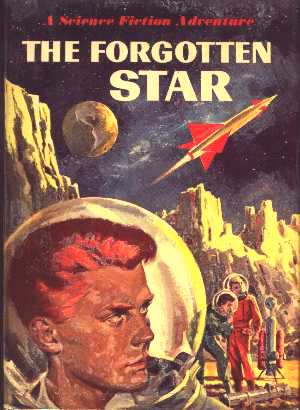
I first encountered century ships before I reached high school in The Forgotten Star, a top notch juvenile which has, ironically, been forgotten. It takes place in our solar system, before star flight; the young heroes discover that Ceres isn’t really an asteroid, but a century ship from elsewhere.

The first time I read a century ship story told from the occupants’ viewpoint was Heinlein’s Orphans of the Sky. It was such a dreary presentation of the “we forgot this is a starship” trope that I never returned to it, and it pretty much put me off century ship stories for a long time.

On the other hand, slow — but not that slow — starship stories are my bread and butter. They take relativity more or less seriously, and offer all kinds of complications through the slowing of time at the approach of lightspeed. Heinlein did it well in the juvenile Time for the Stars. Other authors had milked the concept for its considerable potential for weirdness.

At nearly the speed of light a trip to the stars will seem quick, no matter how many years pass back on Earth, but getting up to the speed of light is an issue is two senses.

First, it will require power on the order of what would come from the total annihilation of matter. This generally requires a MUD (magical unexplained dingus). Slipstick Libby invented one, but usually Heinlein got there by torch ship (what a wonderful name!), a MUD he never bothered to explain. When I needed that much power in Cyan, I invoked Lassiter’s Anomaly as an ersatz explanation. This gave my core ships a nice philosophical underpinning, like E. E. Smith’s Bergenholm which cancelled inertia, but core ships are still MUDs.

Given the power, however you get it, relativistic starflight still has the problem of acceleration time. True, time slows down at near lightspeed, but you have to get there first. If you are an honest writer who takes the time to look at Einstein’s simpler equations, you will realize that it takes a long time to approach lightspeed at an acceleration that wouldn’t squash a human flat.

I did the math for Cyan, and it turned out that a one-way trip to Procyon — accelerating at one gee, coasting, then decelerating at one gee — took three years subjective while twelve years passed on Earth and Cyan. That’s a six year round trip for the ten crewmen, which calls for a lot of games of chess and a lot of intimate human interactions. If you’ve read Cyan, you know what I mean.

As a side note for new writers looking for a useful tip, that coasting stage is a near-freebie. A ten light year or a hundred light year trip would take about the same subjective time, but the time differential between the crew and the folks back home would become immense.

Later in the book, sending colonists took a whole different set of calculations. Accelerating to half the speed of light takes a tiny fraction of the fuel needed to accelerate to near lightspeed, so the colony ships were even-slower-starships, though still not nearly as slow as century ships. Call it twenty years, one way.

How do you get tens of thousands of people into a small space and keep them from killing each other over twenty years? Freeze them. Given the technology of 2107, that meant a twenty percent loss of life among those who chose to go.

Cold blooded? (Forgive the pun.) Not when you consider the conditions they were fleeing.

While the colonist were on their way toward Cyan, a group of beltmen (denizens of the asteroid belt) were also planning an escape. They were already used to living in space; many of them were born there. A long slow trip in a small habitat did not deter them, but the eighty year voyage to Sirius had a lot of unintended consequences. Not quite a century ship perhaps, but close enough.

Of course if you have been following this blog during the last six months you realize that I am talking about Dreamsinger, the sequel I am working on now.

Further down the to-write list is a sequel to the sequel to A Fond Farewell to Dying which concerns a hyper-century ship built around memory taping and a few frozen stem cells. That one doesn’t turn out the way its originators planned either.

I guess the trauma of reading Orphans of the Sky at a tender age hasn’t completely put me off century ships after all.

667. My India

I am frequently blown away by what I am doing here. I came to the internet late, and the magic of it has not worn off. I know that most of you reading this don’t remember a world without the World Wide Web. Even the phrase has fallen out of use, if not out of memory, and has become a basically meaningless www at the start of urls.

Not me. I grew up in a house without a telephone, without plumbing, and didn’t have a flush toilet until I was seven. Still, I have had decades to get used to the changes so I am as blasé as anyone about most of them, but one thing still knocks me out.

Here is an example: On January 6th, I had visitors to this site from nine countries; Canada, India, Netherlands, New Zealand, Philippines, Russia, South Korea, the United Kingdom, and the United States. More than half of those visitors were from India.

That isn’t a typical day. There is no such thing as a typical day, actually. However, if I were to tally all my days, the US would come in first in number of readers and India would come in second.

I would never have anticipated that when I began this blog, but there is some logic to it. To start with, India is a big country, second in the world by population, with five times as many people as the US. China is bigger, but I get few hits from China. There is a reason for that too, beyond politics.

Although the official language of India is Hindi, English is widely used. That is a legacy of hundreds of years of British domination. When India achieved independence in 1947, there were dozens of major languages. If any one had achieved dominance, it would have given its speakers a major political advantage, so English became a “subsidiary official language”. There are vast number of English speakers in India, and a lot of them are on the internet. Of those whose sites I’ve seen, many are in one of the Indian languages plus English.

I get a kick out of all the hits I get from distant countries, but India is special. I have had a relationship with India since 1968. When I switched from Biology to Anthropology at the start of my Sophomore year in college I had just taken Introduction to India and had already found my area of specialization. During the last three years at MSU I was a member of the Indian studies group, researched overseas Indian colonization, and took a year of Hindi (of which I remember little, all these years later). I made friends among Indian students studying at MSU and among returned Peace Corps volunteers.

My wife and I signed up for and were accepted to the Peace Corps for assignment in India, but lost out when the deferment was cancelled. Then I spent four years in the Navy, before entering the University of Chicago for a masters degree. Again India was my area specialization, and my thesis was on Indian village economics.

All of that makes me an expert, right? Not on your life it doesn’t. I’ll give you an example. I once took a graduate level class in Indian history. The first day we were asked about our backgrounds. One young Indian woman said that she was only auditing the class. She was in America with her husband who was a student in another department, and she was just coming by to fill in a few details that she might have missed in her high school history class.

I was in my late twenties with a B.S., enrolled in a top graduate school, and right out of high school she knew ten times more about India than I ever would.

It’s enough to keep you humble.

When I started writing, I put that knowledge to use. My second published novel, A Fond Farewell to Dying takes place in a post nuclear war, post flood world where India is the only remaining modern technical civilization. My main character was an American scientist who had moved there because North America was so backward after being heavily nuked. Because of his research, he becomes embroiled in the rising conflict between India and a pan-Muslim neighbor.

A major sub-plot in Cyan concerns parallel colonization efforts by Indian and North American groups.

The Cost of Empire is primarily built around actual Indian history, somewhat modified since it is taking place in an alternate universe. The various durbars in which Britain announced its imperial claims on India are collapsed into one, watched over by a fleet of dirigibles flown there to overawe the Indians who are agitating for independence. David James, the main character, learns from overseas Indians in Trinidad and later in India itself that maybe his country shouldn’t be ruling the whole world after all.

I you are a writer, you use what you know.

658. Non-Political ?

Like 2020, 2016 was also the year of a Presidential election. I had a new blog designed to bring in readers for my upcoming novel Cyan and I had no intention of writing on politics. I was planning to share some of the things I had learned in decades of writing while drumming up customers. The last thing I wanted to do was make half of my readers mad at me.

Not that I had any readers yet, so early in my blogging career, but I hoped to soon.

Life has a way of changing our plans. My neutrality lasted about a month, from mid-August until mid-September. Then I had to interrupt my sequence of blogs between 10 and 11 to say:

This is not normally a political blog, but as I am a citizen, there are times to speak out. The post originally scheduled to be here will appear tomorrow.

Have you ever asked yourself, “How could Germany have been fooled into following Adolph Hitler?” The answer is on your television this morning, and it is Donald Trump.

I called him out for his fear-mongering, but added that I didn’t see him as evil, just foolish. I subsequently changed my mind about that.

Still I couldn’t see spending much time on someone who had no chance of winning. That was another error in judgment, both about how effective Trump would be and about how much time I would spend yelling at him.

On February 29th I celebrated the end of Black History Month with a bit of whimsy that would grow into a long series of posts about an imaginary Presidential candidate. I’ll remind you about that on Wednesday.

By Election Day things looked pretty well settled on a Hillary win. I had never been impressed by her either, so on September third I wrote a post to be placed election day, making these predictions:

By now you know who won this time around . . . As of today, Hillary’s win seems certain if she doesn’t stumble, but she stumbles a lot. It could still be Donald. You know the outcome. So do I, but I didn’t when I wrote this.

Here is what I do know, now, September third. Whoever was elected yesterday will be a one-term president.

You’ve heard every talking head for the last year say that no two candidates in history have been so hated and feared as Donald and Hillary. Almost everyone dislikes one or the other; a sad majority dislikes them both.

So the question arises:  who will win the Presidency in 2020? You can be sure it won’t be Donald or Hillary, no matter who won yesterday.

If your candidate lost yesterday, take heart. Whoever your party chooses in 2020 will win – barring another match-up of turkeys, and what are the chances of that happening again?

If your candidate won yesterday, tough luck.

Well, that is what it looked like in September of 2016. I’m not so sure that prediction was any better than the others I made during the campaign. I just hope I got that one right.

656. Angle of Repose

As a point of accuracy, angle of repose is a civil engineering term referring to how steep a slope is possible without slumping due to gravity. The angle varies according to the material under consideration.

I am completely misusing the term here in reference to axial tilt because it sounds so good. So sue me.

Today is December 30; the year is near it’s end. The solstice was December 22 this year, so the days have been getting longer for eight days now. What we call the first day of winter is actually winter’s mid-point, judged by the inclination of the Earth. The “incorrect” way we measure winter actually works pretty well though, because there is a delay effect between tilt and the weather that depends on it.

“The Earth tilts south in the winter and tilts back north in the summer.” Easy to say and easy to understand, just like saying that the Earth is flat, but of course it’s wrong. I remember teaching the matter to my school kids every year. I would designate a student sitting in the center of the room as the Sun and walk around the classroom with the globe tilted roughly 23 degrees toward the bank of windows to demonstrate that the angle of inclination doesn’t change, only the position of the Earth in relation to the Sun. I’m sure they all forgot it by the next day.

The seasons as we know them are due to the degree of tilt. Tilt further, and the seasons would be more extreme. Tilt less and they would be less extreme. I’ve made a career of writing about that.

My first novel, Jandrax, was set on a world circling a cool sun, with a tilt of something like 32 degrees. That made for seasons like those on Earth, but more extreme. It worked out well for my intentions, stranding a bunch of religious extremists and watching them adapt in two different ways, as a static civilization in changing weather, and as nomads who followed the good season.

The unharmonious planet Harmony was in the middle of an ice age, with the only livable real estate flanking the equator, and of course they had two summers and two winters each year.

No, I know it isn’t obvious, but it is real. I explained the phenomenon in 14. Axial Tilt. Check if you doubt me.

Cyan came later. I set it up as a planet with virtually no tilt, resulting in unlivable cold, miserable cold, too cold for comfort, Goldilocks perfect, too hot for comfort, miserably hot, and too hot to live, all depending on your latitude. That would have made for a perfect climate somewhere (a boring thought for a writer) except that I threw in a 40 hour day so even at the “perfect” latitude you could count on burning your brain and frosting your buns every overlong day of the seemingly endless year.

It also resulted in two virtually independent super-biomes, separated by a dead torrid zone, as Keir lamented when Tasmeen, Beryl, Debra, and Viki . . .; no, sorry, you’ll have to read that yourself.

Okay, what’s opposite of the unchanging, tilt-less Cyan? A planet of Uranian orientation, of course. Stormking becomes the third of the trilogy, lying on its back in orbit, presenting first one pole and then the other to its star. Such a planet would probably not be viable for a human civilization, but as a place for an orbiting civilization to dump its exiles, it’s perfect.

Dome cities could survive on a Uranian planet, but why would they want to? Any people, like our exiles, who actually interact with the environment would have to keep continually on the run. That’s a little like the nomads of Jandrax, but where those were a people whose march kept them on the leading edge of a moving paradise, the exiles of Stormking live in an endless hell-storm. All of the water of that planet spends half of the year locked up in north polar ice caps while the south pole is desert. Then all that water has to move from north pole to south to freeze again while the north pole becomes desert. All this will have to happen twice a year.

You can’t imagine the storms. Actually, you don’t have to. I do, and then I have to write them.

This is going to be fun.

645. Lassiter Triumphant

Sometime in the eighties as part of Cyan, I wrote the story of Lassiter, discoverer of Lassiter’s anomaly, destroyer of the final vestiges of Einstein’s version of the universe, and inventor of the space drive that powered all the starships in the novel. He was quite a character, and soooo not a hero that he was fun to write about.

Unfortunately Lassiter’s story took up too much space in a novel that was already verging on excessively complex, so I reduced the explanation of his space drive to 236 words on pages 64 and 65, and left the man himself out altogether.

I had already made this cut long before I retired from teaching and used OCR to get the half-completed paper Cyan manuscript into the computer. Somewhere in the dozens of boxes from the pre-computer half of my career, Lassiter remains. It would be nearly impossible to find him this late in the game.

There are a lot of paragraphs, pages, and chapters like that, irretrievable in the outer world, but still resident in the dust bin of my mind. I enjoy rummaging around there and experiencing them again, even though you can’t see them.

Now that I am writing Dreamsinger, I have a chance to resurrect Lassiter from memory, and this is the attempt. If things go well, I will finally be able to commit him to print within the novel. If not, at least you get to meet him here.

=================

Lassiter was a funny looking guy who loved women, and had more success with them than you would have thought possible. He had a big nose, big ears and a receding hairline. He was five feet eight and skinny, but he had a big personality.

His pursuit of women was not predatory, but he always wanted more. As soon as he had enticed one woman into his bed, he was ready to look for another.

Lassiter was also a fine engineer, and in his work he was as steady as he was unsteady with women.

If he had been less of an engineer, he would never have been able to develop a whole new way of looking at the universe. If he had been less horny, he would never have worked as hard at chasing fame.

#          #          #

Lassiter collaborated with an established ghost writer to produce his biography, which they called A Man of Gravity. It was not humility that kept him from writing it himself. Lassiter had no humility. It’s just easier to get away with bragging if you say “He did this . . .” instead of saying “I did this . . .”. For example:

Lassiter was fuming when he barged into Linda Volstone’s office. She was the vice-administrator of the Lunaire Pile, the Morris reactor which provided power for the entire Lunar colony. Lassiter was the senior engineer at the project, and he was a frustrated man.

“Lin,” he said, “you’ve got to do something about Dahlgreth.”

Volstone was slender with night-black hair. She had shared Lassiter’s bed two — no three — women ago, and she still had a weakness for him. She said, “What is Dogbreath up to now?”

Dahlgreth was not a popular administrator.

Lassiter said, “He still won’t let me publish.”

from A Man of Gravity, page 27

In fact, it is doubtful that this exchange ever took place. The real story was about a diligent engineer who discovered an overage in the power output of his reactor, and could not explain it. It was only a fraction of a percent, but it haunted him. It was real; it should not have been there; there were no errors in his instruments nor in his calculations. Something was happening that Einstein’s equations could not account for.

After a much research, he concluded that reduced gravity was the reason. Nothing in any theory supported him, and he was all but laughed out of physics, but the fact remained that no reactor on Earth showed the overage, but Lunaire did and the Chinese reactor on the back side of the moon did.

He published his findings and ran into a wall of opposition. Einstein had been under siege for more than three decades — but by theoretical physicists, not by some upstart engineer who had a few facts and a theory, but did not have fifty pages of unreadable mathematics to back him up.

A lesser man would have crumbled. So would a greater man, but Lassiter was motivated by something normal physicists would not have understood. He wanted fame. More than that, he wanted to be so rich and famous (and the rich part was extremely important) that women all over the world would throw themselves at his feet.

His biography did not say this, but everyone who really knew him understood.

He made himself famous by casting himself as the little guy that the establishment was afraid of. He built a brash persona, and then grew into it. He became the relentless voice of simple reason.

He gave interviews. He wrote op-eds. He was a favorite guest on talk shows. Everywhere he appeared he had the same message: the overage is there, lesser gravity is the only thing different, let’s outfit a probe and settle the matter.

The probe Dirac settled the matter. As it moved outward from the Sun, the output of its mini-pile grew. Measurements were made, conclusions were reached. It turned out that a larger portion of the reactor’s fuel was being turned into energy the further the probe moved outward from the Sun’s gravity. Somewhere beyond Uranus, the probe’s reactor could no longer handle the overage and it exploded. The nuclear fireball continued until every atom of the probe was consumed.

Once the metaphorical smoke cleared, it became apparent that anyone who could initiate a reaction beyond thirty-seven light minutes from the Sun would have a self-sustaining nuclear torch that would eat ice, asteroids, cosmic dust — anything.

Gravity was the only thing holding matter together. No one could explain why, but there it was. Start a hot enough fire, far enough from the sun, and Lassiter’s anomaly would bring about the total annihilation of matter.

It would provide a stardrive; not FTL, but good enough to allow starships to visit nearby stars. That brought enough fame to satisfy even Lassiter. And enough money. And enough women.

For the rest of his life, Lassiter basked in his accomplishment. Money poured in. Women adored him, or at least adored his money and fame. By the time he was ninety-seven, and still hanging on to life with apparent gusto, he was the second most famous man on Earth and the second richest, both following Saloman Curran.

When the nukes came down, his story ended with billions of other stories, but during his lifetime he lived driven by his gonads and never paid a price for it.

=================

When I was young, probably in high school, I ran across the following observation:

If a race of intelligent beings evolved at the bottom of a sea of mercury, they would be unable to discover electricity because every build-up of charge would be immediately dissipated.

I don’t remember who said that, or what book I found it in. Actually, I have mentioned this before, and asked if anyone knows where it came from. Do you know? I’m still listening.

That observation stuck with me and is the basis for Lassiter’s anomaly. What used to be called weightlessness and is now called micro-gravity is not the absence of gravity, but a balancing act within a gravity well. When we reach the empty spaces between the stars, what will we find there that has always been masked by the gravity that defines our perceptions?

Lassiter’s anomaly? I doubt it, but who knows?

641. The Synapse Emerges 2

This concludes the post begun Monday.

The Cyan sequel, unnamed, has remained in the upper left corner of my brain all the time that I’ve been writing Dreamsinger. Dreamsinger is not a sequel to Cyan; it is sideways, starting at the same point and diverging into an empty corner of the Cyan/Jandrax universe.

Today (I’m writing both parts of this post on October 5, 2019) everything fell together. Hang on, this get’s complicated.

Humans have colonized the space around Sirius. The main population center is Home Station, in orbit of Stormking, a basically uninhabitable planet. Directed dreaming is used to keep the population happy and easy to control. (See 621 and 622.)

Okay, good enough, but how does this directed dreaming work? How can you create and store a dream, then implant it into a living brain? What technologies are involved, and how much do I have to tell the reader? I will certainly tell less than I know, but I have to have it well in hand to tell the story effectively.

REM sleep was discovered in 1953 and sleep studies were in all the science magazines I was reading through high school. Consequently, I already know more than people who came onto the scene after it had faded from prominence. Still, research is a writer’s best friend so I went to the local library, sorted through the books on dreams and dreaming, and dumped the ones which were astrology, self-help and wishful thinking.

In one book there was reference to a researcher sending visual images to a dreaming colleague. (See Our Dreaming Mind by Robert Van de Castle, pp. xxii and xxiii.) It seemed legitimate, and not believing anything is as futile as believing everything. Besides, I don’t have a Ph.D. reputation to uphold, so I decided to go with it. Now I have to explain it. Here’s a bit from the (very) rough draft of Dreamsinger.

     In the misty olden days of the twentieth century, Van de Castle demonstrated that thought images could be projected into a dreaming mind. That tiny bit of knowledge did not fit into the world as it was then understood, and was forgotten for nearly a hundred years. When it was discovered again, it pointed toward revolutionary changes in our understanding of the brain.
     Basil Kendrick demonstrated that events similar to brain to brain transmission seemed to occur continuously within the brain. He theorized that transmissions of information took place not only by synapses, but also by means of what he called K-waves, which were so short as to be undetectable and, incidentally, travelled faster than light.

K-waves, are you kidding? That sounds like something E. E. Smith would have used. Hang with me a while. The idea of telepathy taking place at FTL speeds goes back to Heinlein, and I always liked it. I needed some entrée into FTL, and this seemed like a good way to get it. As for the term K-waves, Kendrick named them after himself in order to get his name into the history books.

The name Kendrick came out of the air, and I was prepared to keep changing names until I found one that didn’t have a (K or B or D or whatever)-wave connected with it in the real world. As it happened, I got lucky on the first try.

I Googled. There are real K-waves, but they refer to long cycles in economics. I could ignore them. However, there is also a K-complex, so I checked that out.

Without getting into things that are above my pay grade, the K-complex is an EEG waveform associated with memory consolidation, which occurs during a non-dreaming stage of sleep. K-waves (imaginary) and the K-complex (real) are unrelated, but they won’t be when I get through writing Dreamsinger.

Now picture an old writer jumping for joy, just not as high. Things are coming together, or at least close enough to use.

They used to say, “Close only counts in horseshoes and hand grenades”. I would add, “. . . and in writing science fiction”. It is fiction, after all, and you have to at least go beyond our present knowledge, probably in a direction future reality will not support. I work hard at world building, but I’m not obsessive about it. (Reading these two posts, you might disagree.)

My Kendrick, on Earth just before colonists departed for Cyan and for Sirius, stirred up controversy with his theories and then the nukes came down. All his studies were in the massive databanks of the computers that went to Sirius and to Cyan. Under Sirius, they led to directed dreaming. On Cyan . . .?

Suddenly, I have a way of connecting the unconnected all over the place.

I already know that Louis Dumezil, who will later write the Monomythos, and “Frank”, who will invent the FTL drive, have met while waiting to go on the new Darwin expedition. Now I simply add one conversation. In a bull session during training Dumezil will tell “Frank” about K-waves, and their purported FTL speed. He will know this because his father (the religious fanatic, remember?) was a nut on telepathy. Dumezil will also tell his life story, which includes the white powder on the blue berries that lead to a psychedelic experience. (I wrote all this a couple of months ago in a short piece called Children of the Hollow Hills, which you haven’t seen.)

When “Frank” gets washed out of the trip on the Darwin by Debra and Beryl’s new research, he sets out to study the supposed connection of telepathy with FTL, but there are no known telepaths on Cyan. However, he finds the remnant of the cult Dumezil escaped, who are still sucking fungus powdered berries and talking mind to mind.

“Frank’s” study of telepathy, using the cultists as subjects, proves the FTL nature of K-waves. He also discovers K-waves are the actual carriers of all information inside the brain, as Kendrick suggested. The previously measured energies of the synapses are only a side effect, a sort of down-cycle echo of the true energies. “Frank” renames the K-waves as Synapse waves, and goes on to invent the FTL drive I used in Jandrax, and which will allow him to go exploring after all, bad genes notwithstanding.

He names it The Synapse, which I knew he had to because that was what I called it back in 1976.

Don’t you  love it when everything falls together?

Was intuition at play here? Maybe. Foreknowledge? Don’t be ridiculous. I think it was pure, dumb luck, augmented by self-training in grabbing anything good as it floats by, and letting nothing escape that might further the cause.

640. The Synapse Emerges 1

Life is weird, and strange things happen. It is almost enough to make you believe in a master plan, although it remains questionable whether that would be divine or diabolical. In any case, if there is a plan, it’s a hoot.

I’m going to tell you a story that began in January of 1976 and came full circle on October fifth, about a month ago. I have to warn you though, only old writers, new writers, or wannabe writers are likely to be be interested.

But really, who among you hasn’t either built a world, or wanted to?

In the fall of 1975, I sat down to prove or disprove my ability to churn out 40,000 to 50,000 words and call it a novel. By Christmas I had succeeded, although it wasn’t good enough to publish. Right after New Years, I set out to write a “real” novel, science fiction, with world building and everything. It was to be a lost colony book, so I had to get my people stranded, and that meant inventing an FTL drive. I took all of five minutes to do it.

     A sphere floating in space, silver against a backdrop of stars.
     The stars shift their colors, doppler down, out. The sphere hangs alone in darkness where here and there are concepts yet unborn. Six antennae project; it is not so much moved as displaced. First it is here, then it is there, but it never crosses the space between here and there . . . Synapse drive can cross the galaxy in a heartbeat.

from Jandrax

All done. I blew things up and left my people who-knew-where, and I didn’t have to think about that star drive again.

Synapse? It was just a word that came to mind, with no real connection to brain cells except that it seemed to imply something, without specifying what.

Beware of what you create, Dr. Frankenstein.

I wrote the novel Jandrax, and it was published. Picture a young author leaping with joy.

A few years later I started Cyan and had to invent a non-FTL star drive. (For more, check out the post coming November 20.) This time I put some thought into it so that it had some reasonable underpinnings. Lots of years passed and eventually Cyan was published, but I wasn’t through. I now had a world full of people I really liked, and some of them were young enough to continue exploring on the decrepit old starship Darwin.

The trouble was, I’d blown up the Earth, and I couldn’t count on it to recover for a long while. Someone had to write the Monomythos which had driven/would drive the plot in Jandrax, and someone had to invent the Synapse. I had to find them hidden among the population of Cyan, and I had to find motivations for both of them to do what I knew they had to do.

Writing prequels is like doing a time travel paradox story. He invented this, because he had to, because he used it on page 92 of a previously published book, that takes place in the new book’s future. See, time travel.

There was no problem with the Monomythos. I decided to have its writer be a rational young man who had grown up under the influence of a religious fanatic, either his father or a father figure. That’s right up my alley and the writing of it has been dribbling along recently on days when other writing is stalled.

In fact, the whole sequel to Cyan has been dribbling along in lots of pages of notes-to-self. Darwin is too old to push to previous accelerations, so the next journey will need cold sleep. No problem, there are 60,000 cold sleep units left over from Cyan’s colonization.

But that brings up something else.

I don’t know about you, but loose ends keep rolling around in my head long after I’ve moved on to other books. In Cyan, between 10 and 20 percent of the cold sleepers never woke up. Their bodies were fine, there was just nobody home. I had created that as an unexplained fact, but ever since then I’ve been wondering why things should work out that way. I decided to let Debra and Beryl figure it out in the sequel.

If you don’t know who Debra and Beryl are, for God’s sake go buy a copy of Cyan and read it. (LINK)

Using the computer’s file of DNA patterns from the 60,000 who set out from Earth, Debra and Beryl discover that a certain cluster of seemingly unrelated genes is present in all who died, and absent from all who lived. Further research is indicated, but it provides an absolute predictor of who will die in cold sleep.

One of the people (still unnamed, let’s just call him Frank for now) who is ready to depart on the new exploration finds that he has the deadly gene cluster and can’t go. When the Darwin departs without him, he is motivated to find an answer to faster than light travel.

All of this was worked out during the last six months, well before yesterday’s epiphany.

I’m only half way through this odd tale, and this post is already long enough, so I’ll to finish on Wednesday.