Tag Archives: science fiction

127. Not a Frog, Not a Kangaroo

220px-Litoria_tyleri220px-RedRoo

Flashback: 1963, riding in a car, reading an article, probably by Arthur C. Clarke, on why humans should go into space. A little fish, swimming in shallow water, said to his father, “Why don’t we go up on the land and see what we can find?” The father fish responded, “Why would you want to do that?”

I read the passage out loud, but no one was interested, so I relapsed into nerdy silence.

Years later I found that the now accepted theory is that fish in shallow waters, accustomed to using their fins against the sea bottom, began to use them to navigate mud flats at low tide as mud skippers still do in mangrove swamps today. Legs evolved from fins.

It didn’t happen this way on Cyan. (This is a follow-on to yesterday’s post. If you missed it, we’ll wait for you to read it. Done? Good.)

On the planet Cyan, hundreds of millions of years ago, primitive chordates developed a split vertebral column, which resulted in twin tails. When they moved onto land, their tiny front steering fins were never used for locomotion and their twin tails (they had no back fins) became legs.

As Gus Lienhoff said when he dissected the first one Cyanian creature the explorers had collected:

Look, no pelvis. Look at this complex of bones. Some are fused, some flex, and these four are cantilevered. And look up here; no scapulae, just three extra thick, specialized vertebrae. Tiny front legs, powerful back legs with twice as many joints as you would expect, and absolutely no hint of a tail. Not even anything like a coccyx. A truly tailless, truly hopping biped. I wouldn’t have believed such a thing was possible.

Not a frog, not a kangaroo.

Frogs are quadrupeds with overdeveloped hind legs, like rabbits. They have a vestigial tail, like a human coccyx. If you look at a frog’s skeleton, it looks a bit like a massively deformed human. They can leap, but they also walk.

Kangaroos have a five-legged gait when walking. They lift up on a tripod made of small front legs and a powerful tail to shift their massive hind legs forward. Then they stand balanced on their hind legs while moving their forelegs and tail forward. 3 – 2 – 3 – 2, etc.

Cyanian bipeds, from the simplest to the most complex are hoppers. They all have short, grasping forelimbs; not quite T-rex hands, perhaps, but too weak to knuckle walk. They can move miles with grace and speed, but moving inches puts them into a condition of stumbling clumsiness. There are tree dwelling bipeds; how they navigate is a mystery I didn’t get around to investigating

When a trio of Cyl (intelligent Cyanian creatures created through recombinant DNA – its a long story) first enter a human habitat . . .

They were awkward inside the dome where the furnishings of the place made a maze for them to negotiate. As bounders, they were creatures of the unobstructed open plain. This human habitation was utterly foreign to them, not because of the steel from which it was made, or the interlocking triangles of its geodesic construction, but because it was cluttered. How could one hope to move about in it?

I don’t claim to be an artist, so I have made no effort to draw or paint these critters. I also haven’t seen the cover EDGE is putting on Cyan. If it has Cyanian hoppers, I sure hope they don’t look like frogs or kangaroos.
Jandrax 11

They had covered the body with a sleeping bag. Jan threw it back and grimaced. Jason was badly crushed and his clothing was matted with blood. There was no need to look closer, but habit made Jan do so. He found tiny bits of moss embedded in the wounds near the base of Jason’s skull, but nowhere else. Suspicion was mirrored in his expression, and he tried to suppress it. The colonists had levered the bole off Jason but had not moved him. The bole was bare of moss.

The old, down limbs scattered about on top of the snow were not. Happenstance? Or had Jason been clubbed into unconsciousness and left in the path of the tree?

“How the hell did this happen?”

Dumezil answered, “He was gathering down wood and apparently didn’t hear the warning.” Chambard and Dubois looked uneasy, but nodded their agreement.

“Who cut the tree?”

“I did,” Dumezil said.

***

Angi left her family to join Jan. Even now he kept vigil, never trusting the land around him. The line of mourners circled beneath the low hillock where he watched. Angi stopped beside him and laid her hand gently on his arm. “He was the first,” Jan said, “but he won’t be the last.”

There were two bundles and two graves. Tom Dennison’s body had been coated with polyfoam and irradiated to preserve it after the explosion in the computer bay. Caught up in the press of immediate needs, the colonists had not taken time to begin a cemetery until now.

A white, amorphous, anonymous bolus of plastic lay beside one grave; a hide-wrapped bundle lay beside the other. Both killed by the same mad act – and every other death this planet will witness attributable to the one who stranded us here. Jan grimaced and started down the hill.

Marcel Dumezil, the leader of the Monists, read the service. Jan doubted that Dennison would have appreciated it. He was a Pentecostal Baptist from NorAm, the only one aboard the Lydia who had actually been born on Earth.

As for Jason, he had been a Pertoskan Monist. He had argued into the night with Alex Chambard the day before he died, disputing the points of doctrine which separated his sect from the Benedictine Monism embraced by the colonists.

Coincidence?

Dumezil closed his Monomythos and stepped back.

Alex and Lucien lowered Jason into the earth; Nur and Valikili lowered Tom Dennison. Then Valikili took a shovel and gently broke away a portion of the polyfoam. “Once the man is gone,” he said, “it is wrong to preserve the body.”

Jan nodded, all the time knowing that the permafrost would preserve both bodies better than any work of man.

They shoveled in the cold, dry earth. Jan watched the colonists as the graves were filled, wondering who had thrown the bomb, and why. It had to be on everyone’s mind.

Tears flowed freely as Henri Staal saw his watchmate under. He had mostly recovered from his burns, though he would always bear scars. Jan touched his shoulder as they left the cemetery to say, “I’m sorry.”

Staal looked around at the bleak horizon and shuddered. “Why, Jan? Why would anyone do this?”

There was no answer he could give.

*****

I suppose every beginning writer chooses names that make him cringe later in his career. Clearly Benedictine is one of these. There is no hidden connection to the Order of St. Benedict. It was just a dumb mistake.

126. Let’s Build an Ecosystem – 2

Continuing our look at the creation of an ecology for Cyan. If you missed yesterday’s post, you might want to go there first.

We can take grasses and weeds for granted. Let’s give our trees multiple trunks bound together, like a strangler fig without its victim, and that should be enough. We need something like insects. We’ll call them Chitropods – chitro sounds like chitin, and pod means foot, so our reader will infer an exoskeleton without any further work on our part. Continuing the idea of inference, if we call the flying creatures who eat the chitropods pouchbats, the reader will draw a better picture in his mind that we could on paper.

The number of legs is important to Terrestrial arthropods, but lets bypass that by giving all our chitropods many legs, but with only one joint each where it meets the body. Now they have a rolling gait “like caterpillars on crutches”. Humor helps keep description from limping along. (Sorry, couldn’t resist!)

These are throw-away inventions. They could have been applied to any ecosystem and they are not systemically related to each other. They alone would be good enough for almost any SF novel, but not for one about scientists teasing out the essence of their planet.

Here we need a key differentiation, from early in evolution, from which a thousand lesser differences can be derived. Here it is: on Cyan, early in the development of chordate life, the vertebral column doubled at the posterior, giving the Cyanian version of fish twin tails. That changed everything. I’ll explain more fully tomorrow in a separate post.

On Cyan, the classes are Pseudo-pisces, Amphibia, and Inturbia. No reptiles, no birds, no mammals, no dinosaurs. The Amphibia are cold blooded. Inturbia are inefficiently warm blooded. The term Inturbia should imply “internal body temperature un-perturbed by external changes”. Not every reader will get that, but we need to reward our best readers by not spelling out everything.

There are a thousand other details, but for that, you will just have to download the book when it comes out. From EDGE. Soon.

***

I do have one more thing to share. I wouldn’t bother you, but since you’re reading a post about the backstage secrets of writing science fiction, I can assume that we are all nerds together here .

Inturbia have live birth. Cyanian amphibs have to return to water to lay their eggs, except for one group, the Sphaeralvids, who produce globewombs.

(Globewombs were) the closest thing to an amniote egg that Cyan’s fauna had developed – a transparent, leathery sac extruded by a Sphaeralvid mother and filled with a clear fluid like seawater. Into this she deposited fertile ova, then defecated. Then she separated from the globewomb and left it cached in the crotch of a tree, high up where it would receive full sunlight. On a bright day millions of these globewombs glinted in the treetops.

Algae from the Sphaeralvid mother’s bowels converted the feces into biomass and the Sphaeralvid nymphs fed off the algae.  When the feces were gone, the globewomb walls would break down, leaving the now sizeable nymphs free to face Cyan on their own.

Neat, huh?

Jandrax 10

“What do you know about sensory deprivation?”
“Enough to recognize my own problem,” she snapped.

Andrax smiled. “Then you know that drawing into yourself at this moment is the worst thing you can do. Would it help to know that almost all the colonists feel as you do?”

Her shrug said I don’t know.

“Talk to Helene about it. Odds are she’ll share your feelings and you’ll both be better for the conversation.”

Jan continued to circulate, looking for trouble. At this crucial point, the psychological state of his charges bore more potential for danger than the environment. Later, when the first groups had begun to adjust, they would form a stable core on which the remaining colonists could lean.

He let his eyes encompass the empty horizon.

Damn! It was easier in the green belt where the danger was constant, but where there was not the potential for mass madness a potential exacerbated by the religious temper of the colony.

Within half a local year, the melt and the herds would reach this spot. Before that time, they must erect fortifications. For that they would need timber, but as yet he could spare no timber-cutting parties.

That girl, Angi. She had shown more signs of vertigo than most, but he had had an ulterior motive in seeking her out. She was young, pretty, and very female. With sixty-two male and only thirty-six female colonists, only those who adapted most quickly and realized the permanence of their plight, would find wives.

Polyandry would come later. It was inevitable.

***

Every day the landing craft brought down new colonists. Nur Mohammet and Tennyson Risley of the crew were working on a ground-effect machine to be used for surface transportation. Relying only on the landing craft to transport their daily meat would be unwise.

A month passed. The skimmer took over the run to the green belt – a shorter run every day. Only Captain Childe remained in orbit, unwilling yet to give up on the Lydia.

Jan took time every day to spend at least a few minutes with Angi, not neglecting to give attention to the half-dozen other girls of appropriate age. In his estimation, none of the others matched Angi, but one never knew. Angi’s suitors were increasing in number and boldness.

Jan had just managed to catch Angi alone when Tenn Risley found him.

“Jan. Its Jason. He’s been killed.”

Jan felt himself stiffen up inside. Of all his companions, the only one he would have called a friend was Jason. Angi touched his arm, saying, “I’m sorry.

“How did it happen?”

“Tree fell on him.” Jason had piloted the skimmer with a crew of colonists up into the mountains on a cutting expedition. “Dubois just called in to tell us. Someone has to hike up there because none of the cutters can run the skimmer.”

“Was anyone else hurt?” Angi asked.

“They didn’t say, so I suppose not. Oh, one of your brothers was on the crew, wasn’t he?”

“Yes. Jean.

***

Jan and Tenn started at daybreak. The skimmer required a fairly flat roadway, so it had followed the river Lydia. Jan and Tenn would have had to follow it anyway to stay near water. The air was so dry that they required vast quantities of liquid.

The cutters met them and Jan offered each a brief nod. He knew everyone by now. It was his job to do so. Jean Dumezil, Angi’s younger brother, wore his usual flat expression, but Alexandre Chambard and Lucien Dubois were clearly moved.

They had covered the body with a sleeping bag.

*****

A couple of notes here on words I would change if I were rewriting.

Paragraph 6, exacerbate. It’s exactly the right word for meaning, but the wrong word for mood. Today I would say made worse.

Paragraph 9, polyandry. Again, the perfect word was the wrong word. I should have said polygamy and accepted the slight loss of accuracy. By the way, if you didn’t take Anthropology 101, polygamy is multiple spouses, polygyny is multiple wives, and polyandry is multiple husbands.

125. Let’s Build an Ecosystem – 1

Over in Backfile, you will find an eleven part document called How to Build a Culture, inspired by Poul Anderson’s How to Build a Planet.

I could also write a paper called How to Build an Ecosystem, but who needs to read all that. A couple of posts here should cover the subject, without boredom or overload.

The fact is, simply peppering your planet with a few well chosen and deeply odd critters is enough in most cases. Andre Norton did it all the time, and it worked for her. The frawns and yoris on Arzor are simply transmogrified bighorn sheep and alligators, but so what? They provide plot points and local color, and that is all that is asked of them. Marion Zimmer Bradley gave us a mammalian snake, a hyper-weasel, and an intelligent dinosaur who sent out pheromone soaked calling cards in Hunters of the Red Moon. What more could you want? In Jandrax, showing up now in Serial, my native animals were distinctive, but most were mammalian, as one would expect from ice age migrators.

When I wrote Cyan, I faced a different situation. My crew was set down on an alien planet for one year, with the task of coming to understand its weather, geology, and ecology in order to prepare for colonization. They were all scientists, so their actions and conversations called for a deeper understanding of their new world than any other kind of science fiction novel would have required. Actually, that challenge was half the fun.

When I began Cyan, I had been studying ecology for about twenty years, starting back when I had to explain what the word meant. I later came to understand the essence of Earth’s taxonomy in the most rigorous possible way – I had had to condense it to a level which middle school students could understand without dying of boredom.

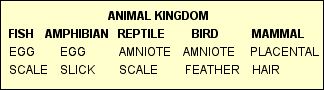
Scientists should forgive the following chart and paragraph.taxon

Drop a salmon egg on the gunwale of your canoe and it will dry out in minutes. A chicken or turtle egg would survive the same treatment. This is the meaning of amniote egg (although there are other, competing meanings). Creatures who lack them, must lay their eggs in water. The rest of the chart should be clear, although simplified. For example, birds have scales on their legs as well as feathers elsewhere, and I skipped Dinosauria altogether.

Now pull up a chair and lets build Cyanian ecology. It needs to be wierd but recognizable – that’s the key to all science fiction invention. We also need restraint. You can only explain so much to your reader without losing them, and beyond a certain point, your backstory is wasted effort.

Come back tomorrow and we’ll dive more deeply into Cyanian ecology.

Jandrax 9

Unbroken by vegetation, a land of gently rolling hills stretched to the horizon. To the east, ramparts of hills rose, similarly naked, and in the distance one could see the massed green and white above the melt line where trees grew through the perpetual snow. Near at hand the ground was tortured and broken with the fossil prints of last melt’s herd.

Angi Dumezil negotiated the ramp gingerly, bowed under the weight of her share of the supplies. Papa Marcel, leader of the colonists, and her brother Anton stayed near her; the others were strangers. Jan Andrax directed their egress and hurried them beyond the flash perimeter. When they were sheltered below a nearby hillock, he signaled to the landing craft and it leaped skyward, then rolled into the gentle arc that would carry it northward to the green belt to take on meat for the colonists remaining overhead.

Angi shaded her eyes against the cool sunlight until she could no longer see the departing speck.

Andrax had called them into a circle. He squatted negligently, scratching a map into the ground. “We are here, two kilometers above the camp. The river Lydia runs here, though it is little more than a stream this time of year. We’ve hardly begun with shelters. There is no wood nearby; until the melt comes and we can float it down from the hills, we are experimenting with rammed earth and adobe.”

Angi looked around, drawing. her jacket tighter about her. Now that the landing craft had gone, there was no work of man and no bit of vegetation to break the endless monotony of the rolling land. The whole of her vision was encompassed by gray-brown soil and red-brown rocks. (see below) She closed her eyes tightly against a feeling of vertigo and missed the rest of the instructions Andrax was giving.

They shouldered their burdens and walked to the base. Whenever they topped a rise, hundreds of square kilometers lay stretched out before them, but all so uniform that the eye refused to acknowledge the scale. No haze muted the distance.

Andrax did not move to aid the colonists with their burdens, but paced up one side of the column and down the other with his express pistol ready at hand. What creature could possibly inhabit that wilderness, Angi could not imagine.

By the time they reached camp, Angi was suffering from thirst. Though the day was cool, the air seemed utterly devoid of moisture and sucked away her body fluids with every breath. Rows of adobe bricks lay at the water’s edge, all split and crumbled in the cold, dry air.

A single building stood, a long, low dormitory framed with driftwood from the river and coated with dried mud. There was a fire built of the dung cakes that lay so abundantly on all the hills.

After they had eaten and drunk, Andrax set them to work. It was a kindness; once her hands were busy, Angi’s unease abated somewhat. She worked with a girl of her own age, Helene, unpacking and cataloging the crates they had brought. Jan drifted by from time to time, once stopping to ask, “Feeling better?”

“What do you mean?” Angi replied, turning away to mask her irritation.

“Don’t be evasive. I’m not much of a psychologist, but I’m the best we have. It’s part of my training. Tell me what you felt hiking in. Vertigo?”

She nodded.

“What do you know about sensory deprivation?”

“Enough to recognize my own problem,” she snapped.

*****

Oops. I goofed, and it took me forty years to catch it. All Angi would see is snow. This description is of what she would see a few months later after the melt has come and gone. When I wrote the first draft, the melt cycle wasn’t yet clear to me, and in all my revisions I missed this error. Oh, well! more tomorrow

124. We Are Not Alone

“The Blue Book say’s we’ve got to go out, and it doesn’t say a damn thing about having to come back.” Captain Patrick Etheridge, keeper of the Cape Hatteras Life Saving Station.

That could be the motto of space exploration. Not everyone will survive. That is why, in this excerpt from Cyan,  Ramananda Rao is making this report. You will note that I have suppressed a name to avoid a spoiler.

from the Logs of the  Darwin/Cyan Expedition
S.Y. 601, Day 239 (corrected)
entry by Ramananda Rao, acting geologist
at Venturi Station

Today, everything changed.  Our entire outlook on our work and on Cyan can never be the same again.

We have been at Venturi station for three weeks now, doing the work *** should have done.  The working conditions are miserable.  We are too far south and the land is too hot.  We arrange to work by the light of Procyon’s lesser companion, or early in Cyan’s morning, but still the heat is stifling.  Since I arrived here with Viki Johanssen, we have worked like dogs, taking core samples with our mole to map the extent of this ore field.

I can do the work; I have the training.  But I don’t have the inclination.  I would much rather be studying the weather.

When I first saw that Cyan stands straight up in orbit, I thought it would be meteorologically barren. How wrong I was. True, it has no seasons, but her slow rotation brings daily temperature variations of almost seasonal proportions.  Her storms are vast and powerful – and unpredictable.

Yet today, the weather and the ore fields became insignificant in a heartbeat when Viki leaned down to pick up a stone – and saw a row of flakes chipped away from one edge.

We are not alone here.

 When the exploration of Cyan moves into colonization, humans will face critical choices. Our knowledge of ecological consequences will always be incomplete, but we understand enough to know how badly we can screw things up.

Humans will go to the stars. But cattle? Horses? Wheat? Cockroaches and boll weevils? The chances for ecological disaster are huge.

And what will we do if we find a species evolving toward human level intelligence, but not there yet? The explorers of Cyan will have to face that dilemma.

Jandrax 8

If you have been following this blog, you may have seen the rest of chapter one excerpted here and there. This is the piece of writing that spawned Cyan.

“Something you said bothers me. You said that we would be here as long as we survive. What exactly did you mean by that?”

Jan did not answer at once. His restless eyes never stopped their circuit. “Jase, do you know what the mortality rate is for Scouts on a new planet? Trained men whose whole life is dedicated to survival?”

“No.”

“Ten percent for each new planet.” Jason greeted that with stunned silence.

“Jase, the first planet I explored, three of my twenty companions died; nor was it an exceptionally dangerous planet. On my second planet two of my friends were cut down before my eyes by an innocuous-looking flying mammal whose poison was deadly to humans.

“I came through my third planet with no particular difficulty, but on the last one I tangled with a large, horned herbivore during my first day planetside and left in a coma. I spent a total of two hours on her surface.

“Those were planets which had been properly scanned from orbit. I was working with trained and experienced Scouts and the latest of equipment. Here .  .  . ” 

Jan broke off as something caught his attention. What it was, Jason could not tell, but it apparently posed no danger because the Scout relaxed again and continued, hardly aware of the interruption.

“Here, I’d give odds that there won’t be a human alive inside ten years.”

Chapter 2

Computer printout found folded and
placed in the log of Jan Andrax

Monists. Full title, Universal Monists. A religious group founded by Louis Dumezil in S.Y. 767. The premise of this group is that all religions were founded by the same spirit (deity?) and that a true religion can be found by collating the elements common to all religions while rigorously discarding those elements confined to particular religions or families of religions. The text containing this distillate was published S.Y. 767, hence the founding date, and was called the Monomythos. Dumezil further refined his text through eleven revisions culminating in the Grand Monomythos in S. Y. 801. After his death, further revisions led to the splitting of the Universal Monists into denominations based on increasingly fine points of doctrine. Each sect publishes its own subtly different Monomythos. As of S.Y. 872 four hundred distinct Universal Monist sects were known. Several ecclesiastical wars have been fought among them, the most violent being on Hallam in S.Y. 851-859.

The story of where I got the idea of Universal Monists was told last week over in A Writing Life, in 118. Jandrax redux.

123. Trump on Cyan?

This blog is about writing, not politics, but sometimes you just have to speak out. I hadn’t planned to post this excerpt from Cyan, but today’s (March 20) Face the Nation, and an interview with Stephanopoulos on This Week, changed my mind.

For months, the media has become increasingly open in their bias against Donald Trump. Well, so am I, but I’m not sworn to neutrality. On today’s show, Stephanopoulos’s gotcha questioning actually made Trump look like the wiser man, and that’s hard to do. I fear that the media’s abandonment of neutrality will further inflame Trump’s supporters, and that protesters trying to silence him will harden his supporters’ resolve.

It made me think about Saloman Curran.

I created Curran as a villian, or adversary, or strong-man, or malign father-figure in my upcoming novel Cyan. My protagonist Keir finds himself working for Curran, much against his will, and trying to figure him out

*****

“What do you think of Saloman Curran?”

That was the question Keir asked a dozen times during the following days. The words varied with circumstances, and he was careful to ask it when his respondents would feel free to answer honestly. Keir had realized that his own opinion was colored by his needs, and by the power that Curran held over him, and he wanted to know what the other people who shared the Curran International building with him thought of their boss.

They loved him.

They thought he was the smartest, strongest man in the world. They thought he was one of the few men who could help pull mankind out of the mess it had gotten itself into.

Their feelings were close to worship, but it was not like a Christian’s love of Jesus. It was closer to the distant, worshipful fear of an angry Jehovah. Not one person had any faith that his position with Curran was secure. Any one of them could be fired at any time; they knew that; they accepted it.

“Nels got fired last week, but he was screwing up.” What do you expect?

The second sentence was never voiced, but always implied. If anyone was fired, demoted, or punished in any way, it was assumed that that person was at fault. No one ever thought of blaming Curran.

Keir had never seen an organization like Curran International, and at the end of a week he decided that it was not the organizational structure, or even Curran himself, that was different. These people loved Curran, not because he was loveable, but because they had set out to find someone to love.

*****

Jeeze, that sounds familiar, and it scares hell out of me.

Jandrax 7

The three men remained motionless until the trihorns had passed.

Adrian Dumezil wiped sweat from his face and grinned. “Now there goes a beast I wouldn’t like to tackle. I thought this was a desert planet.”

“It is,” Jan replied. Because of the cold, and because most of the planet’s water was tied up in the massive icecaps, it never rained. Much of the year the land was barren desert, but in the winter ice crystals formed in the upper atmosphere and fell as sleet, snow, and hail. Throughout the winter this accumulated and, with the coming of spring, melted to release water for the growth of plants. Within a few weeks of its coming, the melt would pass, leaving desert again.

This was the stationary view. From space the area of the melt was a broad band of green moving slowly southward. Along the route of the green belt moved massive herds of herbivores and attendant carnivores, caught up in a perpetual migration. .

The landing craft had set down on the forefront of the green belt three weeks earlier and already the herds had largely passed by. Within days it would be necessary to move the hunting base southward several hundred kilometers.

They marched in silence then, broken only when Jan or Jason showed Adrian how to recognize siskal, lal, and greenhorn bushes and the tracks of the three major herbivores and their corresponding carnivores: the leers – huge, toothed, flightless birds – and longnecks, whose sinous necks and compact musculature made them particularly dangerous, and the tiny, scavenger krats.

***

They were ruins. Despite the stats he had studied, Jan had not believed that they would be.

The ruins topped a butte that rose perhaps a hundred meters above the surrounding countryside and extended for about a square kilometer. It took a sharp scramble to reach them and, when they had, there was little to reward the climb. Few of the stone walls remained more than waist-high and most of the city/castle/fortification/whatever was reduced to rubble by time. There was little to show what manner of creature had inhabited the place until Jason found a mural on one of the plastered inner walls. Its faded pigment showed a potbellied, winged mammal with what appeared to be grasping hands. In a corner of the mural, isolated by fractured plaster, were the foot and ankle of another creature. Jan stared long at it, then rummaged without success for the lost pieces of plaster. Adrian joined him, asking “Why so intent?”

“Because,” Jan answered, “that foot looks uncannily human.” They did not find the missing plaster, nor anything else to identify the masters of the ruin.

It was well past noon when they left the site, intent on returning to the camp by nightfall. Jason seemed troubled and managed to fall back slightly to speak to Jan alone.

“Something you said to Dumezil bothers me. You said that we would be here as long as we survive. What exactly did you mean by that?”

*****

The precursors, as the makers of the ruins come to be called, are here because I felt that a survival story alone would be a bit dry and uninteresting without some hint of mystery. When I wrote these paragraphs, I had no idea how much this decision would influence the second half of the book.

Also, regarding the krats –  Wild Kratts, the PBS nature show, was years in the future when my krats were born.

more tomorrow