Tag Archives: writing

52. Anthropology 101

220px-Nehru_gandhiFirst I wanted to be a scientist, an inventor, and a spaceman. The word astronaut hadn’t been invented yet. By the time I reached high school John Storer, Peter Mathiessen, and Marston Bates had converted me to ecology. I entered college majoring in biology; following their rules, I took chemistry and math the first year and enrolled in Biology 201 at the beginning of year two. I lasted less than a week, because the whole department was DNA crazy. In the words of Marston Bates, they were only interested in “skin-in” biology, while I was only interested in “skin-out” biology. They were wearing white lab coats; I wanted to wear khaki.
rolling sched...Ten years later, everyone would have been studying ecology. My timing was a fortunate misfortune, because twenty years later the study of ecology had degenerated into fighting with government bureaucracy to save what little of the wild remained. Diplomacy is a skill I never had and never wanted, so it’s a good thing my life didn’t lead me down that path.

Anthropology was the closest thing to behavioral biology that MSU offered. I switched majors and it served me well. I spent two summers on archaeological digs which taught me I didn’t want to be an archaeologist. I did want to look like one. My roommate and I took our first archaeology class in 1967. Professor Cleland was tall and lean, with close cropped hair and a full red beard. We went back to the dorm and threw away our razors. I never went back to bareface, which came in handy a year later when the Summer of Love occurred and suddenly there were hippies everywhere.

All this, you understand, was years before Indiana Jones put on his hat and picked up his whip.

My interests within anthropology soon narrowed down to South Asia, that is from Pakistan, through India to Bhutan and from Nepal to Sri Lanka, including overseas populations in places like Trinidad and Fiji. I mined that knowledge heavily in A Fond Farewell to Dying and made two of the main characters in Cyan Dravidian Indians from Trinidad.

Although I spent a lot of energy studying Hinduism, Islam, and Buddhism, the religion around which I built Jandrax came from a more personal source – from growing up a fundamentalist and then bailing out.

The core concept of Anthropology is culture.

Putting it as simply as possible, we do not see with our eyes or hear with our ears, but every sensory perception is filtered through our cultural upbringing. We have an internalized vision of what the world is like, and every perception is censored by that view.

That is a quote from a paper I gave at Westercon 34 in Sacramento, California in 1981, in which I summarized what the study of anthropology and the writing of novels had taught me about creating alien cultures. Thirty-five years later, it stands up well to the test of time, so I am presenting it on this website. It starts today in Serial.

It’s called How to Build a Culture. Pop over and give it a look.

50. Change of Venue

If you googled here to find out how to get your trial changed to another county, sorry about that. This is an entirely different subject.

In point of fact, this is the fiftieth post in A Writing Life, with about sixty posts in Serials on this same website. It is time to revisit some of the things I said in post number one.

Once upon a time I wanted to be a folk singer. It was 1966, and I was a college freshman. I bought a guitar and was getting pretty good when the Summer of Love hit, everybody formed psychedelic rock bands, and the coffee houses went the way of the dinosaur.

rolling sched...I had lost my venue. I wasn’t a Christian, so I couldn’t sing in church; I wasn’t a drunk, so I couldn’t sing in bars. And U-tube wasn’t even dreamed of.

When I started writing, the venue was clear. Books were published by publishers and sold in bookstores, or in bookstands, or by dumps in grocery stores. (Dumps are fold-up cardboard bookstands designed for temporary placement.) Literary agents facilitated the process. Later, agents became virtual guardians of the gates to publication.

There were always other routes to publication. I have a friend who wrote a cookbook for children and self-published. She still has a garage full of unsold books. Twenty years ago there were always stories of authors who had self-published and become rich and famous. Probably a few of them were true; probably for every success there were a thousand garages full of unsold books.

Publicity and distribution are the key issues, and the internet provides new venues for both. You can self-publish e-books, or go e-book with a traditional publishers, as with my novel Cyan coming out from Edge next year. In either case, it is up to the author to publicize his own books.

One could, for example, set up a website and offer free reads on a Serial blog, along with tidbits from forty years of A Writer’s Life. That might build readership for one’s novels.

It has worked so far – you’re here. Stay tuned to find out how it goes in the future.

40. Names From the Past

Original_ouija_board

The boy in the tower, remember? From the last two posts? His name? I’ll take you there by way of a side trip.

In 1965 I was a Fleming Fellow. I can be reasonably sure you’ve never heard of that, but it is a wonderful program. Every year from four to seven juniors from Oklahoma high schools are chosen to spend the summer teamed up with doctors from the Oklahoma Medical Research Foundation, essentially as research interns.

We were housed boarding house style with a local family, where one of my young colleagues promptly found a girlfriend, Dixie Margaret Peacock-Van Tyle. I wouldn’t share her name after all these years, but it’s just too good to resist. She was pretty, vivacious, and a lot more worldly than we nerds were.

One night as we were all sitting around the living room, she brought out a ouija board and we had a seance. All our hands were on the planchette, but Dixie was the one who interpreted the results. The board told us of past lives, and when it came to my past, the board spelled out TIDAC. Tidac, Dixie said, was a fourteenth century prince of Normandy. Then it spelled out JAVERNAN. Javernan was a sixteenth century French sorcerer.

I was a kid from nowhere. At home, I had to keep my opinions ruthlessly suppressed. I worked constantly, on the farm and on science projects. I had no real interests except for getting-the-hell-out, and getting on with my life. I had no girlfriend, not because girls didn’t like me, but because I refused to let any entanglement interfere with my escape.

Considering my real life, being a prince and a sorcerer in previous lives was a big deal. I went to bed that night with a smile on my face that has really never faded.

Thank you, Dixie, wherever you are. You brought some romance and whimsy into my life.

The boy in the tower became Tidac, and when he grew to be a man, the first friend he made was named Javernan.

39. Into the Valley

220px-Langaa_egeskov_rimfrostIn 1972, I was working as head surgical technician in the dental service of a naval hospital. We did quite a bit of exciting work, but the day to day routine consisted of assisting in the extraction of impacted wisdom teeth.

The next day after the vision of the young boy in the tower (yesterday’s post), some unfilled appointments left me with a couple of hours to kill. I sat down and wrote the first chapter of what would become a fantasy series.

I typed the last period on the last polishing of that story in June of 2013.

Mark Twain said of a writer starting a novel, “. . . in the beginning he is only proposing to tell a little tale; a very little tale; a six-page tale.”

In 1972 I had no intention of writing a novel, much less becoming a novelist, but the boy’s story already had me by the throat.

In that first chapter, which I wrote there in the dental office, Marquart, the boy’s father, comes in on horseback (kakais came later), in midwinter, to take up his new lands in the Valley of the Menhir. His new wife is with him, pregnant with the boy. They are seen by Harthka, wife of a free forester and, as they pass on, we follow her to her crude, hidden dwelling. She is followed by a ‘shifter (only a simple werewolf in this first iteration) who attacks her. She is saved by her husband Amon (later Amyn, to avoid confusion with Amon Ra).

A simple story, and very medieval at first. Everything would grow, deepen, and morph as the fantasy elements crystalized, but I did not know that in 1972. I did realize, as I wrote that first chapter, that when Marquart was killed, the boy would flee to the hills, would be found and raised by the forester Amyn, and that those years would be the making of him.

I also knew the boy’s name, which I will share next post.

A young marine knocked on the door. I put the papers aside, called the oral surgeon, and went back to work. That night I took the chapter home and filed it away, where it would lie fallow for the next five years, then re-emerge to blow a hole in my career.

More next post.

38. Sidetracked by Mark Twain

200px-Beowulf.firstpageMark Twain said:     (see posts 18, 19, and 20)     “(In the beginning a writer) has no clear idea of his story; in fact he has no story. He . . . can only find out what it is by listening as it goes along telling itself . . .”      

Been there; done that. Spirit Deer and Jandrax presented themselves to my typewriter with reasonable speed and ease. My third work, Valley of the Menhir, was a kakai of a different color.

          (Kakai – the native riding beast of the World of the Menhir.)

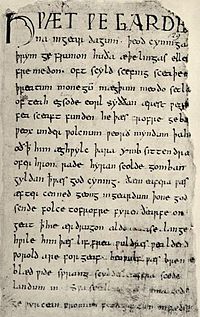
VOTM actually came to me about three years before I had any idea of becoming a novelist. I was stationed at a California naval base and my wife was with me. She was working at the base library and taking a reference librarian class at a local junior college. I took it with her, for company. One night in the college library, waiting for her to finish her work, bored, I took down a copy of Beowulf. I opened the book and the words “all that lonely winter . . .” jumped out at me.

I slammed the book shut and put it away. I didn’t know what part of the story I was in, or what the actual context was, and I didn’t care.

I had had a vision of a young boy in the open window of a stone tower, looking out across a leafless, snow bound landscape. He was newly an orphan. The master of the tower had saved him, but in doing so, the boy had become captive to his world’s expectations. He would now have to spend his childhood in preparation for gaining revenge on the slayer of his father. But he wanted no revenge. His only feelings for his cold and distant father was a vague fear, even now that he was dead.

I wasn’t a novelist yet, but I knew a story when I saw one. I didn’t know I would still be haunted by it forty-some years later.

More next post.

37. Fantasy, Whatever That Is

220px-Mårten_Eskil_Winge_-_Tor's_Fight_with_the_Giants_-_Google_Art_ProjectIt has been a grand ride.

Since I started reading science fiction in the late fifties, I have seen the rise of Amber, Witch World, the Dorsai, the Lensmen, LeGuin, Zelazny, Ellison, Varley, Ballard, and hundred of others. I was there for the Tolkien revival and the revival of other fantasy writers under Ballantine.

Through the years, avid readers waged war on one another over the most trivial of notions, just like any other family. If you called science fiction “sci fi” (never mind SyFy) you were beyond the pale. You had to call the genre science fiction, or maybe SF; but then you had to argue whether that stood for science fiction of speculative fiction or . . . I’ve forgotten what the lesser contenders were.

Mimeograph and USPS were the internet of the early sixties. Whole forests went to the pulp mills to make paper to support arguments about what was or was not science fiction, whether fantasy was worth considering, and where one ended and the other began. Then Heinlein published Glory Road and sent shock waves through the SF community by landing with one foot squarely in each camp.

I mention all this because, although my publications so far have been science fiction, I have spent more time and taken more satisfaction writing fantasy. I’ll spell that out in the next few posts. Most of those works remain unpublished, but you can see some short stories in Serials.

Today, everything goes, but you still have to declare your allegiance. I recently dealt with a publisher who required that you shoehorn your submission into one of about forty SF/fantasy sub-categories.

All of this is probably subsumed under Clarke’s Third Law, “any sufficiently advanced technology is indistinguishable from magic.” Put another way, the Creation as given in Genesis is fact, allegory, or fantasy depending on whether you are a fundamentalist, a religious liberal, or an atheist.

Put still another way, if it tastes like fantasy, it is (for you) and if it tastes like science fiction, it is (for you).

36. Halloween 1988

I wrote full time from 1975 to 1983, starved out, and took a day job that continued for the next twenty-seven years. I became a teacher in a small middle school in central California. In 1988 and 1989 I began writing again, using that experience in the novel Symphony in a Minor Key (see yesterday’s post). This is Neil McCrae’s Halloween from that book.

220px-Clarke-TellTaleHeart“What is Frankenstein’s favorite food?” Lisa Cobb asked.

Neil looked up from his desk to see that she was in tutu, tights, and dancing shoes. She was taller than the average sixth grader with more maturity in her face but still flat chested, so she looked the part of a ballerina. For the last several weeks she had been coming in to spend the time before school in Neil’s room, but she rarely approached him. She just hung around with her friends Sabrina and Elanor.

Neil said, “I don’t know, what is Frankenstein’s favorite food?”

“Hallo-weenies.”

Neil grinned and she ran off, pleased with herself.

Not since May, when Neil had first come onto the campus, had it seemed so different from a high school.

Neil found that he did not miss the feigned world-weariness of his high school students at all. He missed their conversations, and he missed the sense of camaraderie that came of teaching near-adults, but they were too staid. In their own way, following their own values, high school kids were as puritanical as any Pilgrim that ever rode on the Mayflower. Peer pressure was like the rule of the church patriarchs, looking over every shoulder, examining every action by the yardstick of current fashion. Everything not required was prohibited.

These children were in a different kind of transition. Their teachers encouraged them toward maturity, and most of the time they conformed. But on Halloween, they were all seven years old.

When the bell rang, the students came in reluctantly, and Neil chose to overlook their tardiness. He also raised his voice and spoke over their conversations while taking roll, rather than try to quiet them. Then Neil sent Greg and Rosa to close the drapes and a hush of expectancy came upon the classroom.

The drapes let in only a little light, certainly not enough to read by. Neil opened his desk drawer and took out a pair of candles on matching brass candlesticks that he had borrowed from Pearl. He lit them. He moved them so that they threw his face into harsh relief and projected his shadow, huge and menacing, on the wall behind him. He opened another book and read:

True! — nervous — very, very dreadfully nervous I had been and am; but why will you say that I am mad?  The disease had sharpened my senses — not destroyed — not dulled them. Above all was the sense of hearing acute.  I heard all things in the heaven and in the earth.  I heard many things in hell. How, then, am I mad?  Hearken!  and observe how healthily — how calmly I can tell you the whole story.

He read The Tell-Tale Heart through to its grisly conclusion, timing himself by the clock on the back wall so that he reached the denouncement when the narrator cried, “. . . tear up the planks! here, here — it is the beating of his hideous heart!”, just half a minute before the period ended. For those long seconds after he had finished, the classroom was tomb silent.

Then the bell rang.

Half the students leaped to their feet screaming, then broke into laughter, and went out for their break repeating juicy bits of the story to one another. Neil sat back with a feeling of satisfaction, mixed with amusement at his own self-indulgence.  There was a lot of theater in Neil McCrae, but he kept it on a tight leash. Once in a while, though! Just once in a while it felt good to cut loose.

35. Symphony in a Minor Key

Symp iamkNot every book is written to sell. Imagine a book about a year in the life of a person who just goes to work every day and does his best. No car chases, no drug lords, no shootouts, no steamy sex. Its chance of publication – pretty close to zero.

Nevertheless, some books have to be written.

1986-7 was my best year as a teacher. I had gotten through the rocky couple of years that every teacher experiences in the beginning, and I had a nearly perfect class of kids. The cute, the clever, the interested and interesting came in numbers well above average, and there were very few pain-in-the-pinfeathers turkeys.

I hadn’t written a novel since I started teaching because there had been no emotional energy left over. When summer came after that nearly perfect year, I was ready and I wanted to write about teaching.

I wanted to write honestly, so the first thing I had to face was the Big Lie of education fiction. The most unbelievable thing about Kotter and the Sweathogs was not the teacher’s complicity in their nonsense, but the fact that there were only fifteen students in the room. I was accustomed to teaching about 200 students a day – six periods of thirty to thirty-five students each.

The second barrier was that I had been teaching sixth grade. Education fiction always takes place in high school so the teacher and his students can have a semi-adult relationship. I didn’t want that. It wanted to write from my own experience, for practical reasons and because I find middle school children endlessly fascinating.

I also needed a hook and a theme, something to give unity and meaning to my protagonist’s efforts and provide a background against which his daily efforts could be measured.

There is a facet of teaching you probably haven’t thought about. Everyone is aware of teachers taking sexual advantage of their students, and rightly abhor it. However, not every accusation is honest; students do sometimes lie. I have no sympathy at all for offenders, but it remains true that every male teacher lives in fear of being falsely accused.

I decided to make my protagonist, Neil McCrae, a high school teacher who is falsely accused of sexual misconduct. He is acquitted, but parents do not believe the acquittal. He moves out of state and takes a job teaching sixth graders (made believable by details I won’t give here).

Neil’s personal rehabilitation makes half of the story; the other half is a complete and accurate picture of a year in the life of a sixth grade class.

From my real school, I ordered two full sets of the paperwork I normally use to run a class. One set was for fall, the other set was used to build a virtual school. I produced a calendar, complete with holidays, parent-teacher nights, school productions and all the things that would have been on a calendar for my actual school. I drew up a set of lesson plans for the year. I made a list of students, with thumbnail biographies. I drew a room plan, and a campus map.

I decided to make Neil an English teacher and give him two three-period blocks. That’s rare, but not unprecedented. It meant that he would have only about sixty-five students, which would be easier for him and me to manage. It gave him two groups to play off each other, and also portrayed, in reduced form, the boredom by repetition that plagues school teachers.

During my last year before retirement, I taught six identical science classes every day. No one is good enough to make that work in a novel.

I put Neil’s school at the north edge of Modesto, California, where an almond orchard existed in the real world, and only rewrote the rest of the area slightly. For example, an abandoned motel in the real world became migrant housing in the novel.

I did the setup work at the end of my school year. I spent most of the summer in Europe, then began writing in earnest, and continued through the 1988-9 school year, with the intention of finalizing and polishing Symphony in a Minor Key the following summer.

My conceit was to make every day in Neil’s world match my world. Every rainstorm in my world would also occur in Neil’s. That turned out tragically differently than I could have expected.

On January 17, 1989, in Stockton, Patrick Purdy opened fire on a school yard full of children, killing five and injuring thirty more. It was only thirty miles from Neil’s imaginary school, and fifty miles from my real one.

Symphony in a Minor Key was more than two thirds finished at the time of the tragedy, and I had to decide whether to abandon my plan to mirror reality. I didn’t; I went on with the plan. Neil’s world, like mine, skidded out of its normal path for a while. Neil was sharply reminded how precious his students were, and so were the rest of us.