

Tag Archives: writing

28. Acronyms

USELESS

As children, we all learned that the word STOP on stop signs is an acronym. It means it’s time to “Spin Tires On Pavement”. Or was that just an urban legend?

There are quite a few urban legends centering on acronyms. I received an e-mail from a friend purporting to prove that shit is an acronym. Sorry; variations on that word are spread all across the Germanic language family. There is also a supposed acronym derived from Fornication Under Carnal Knowledge, but that seems a bit far fetched as well.

For a long time I was taken in by the urban legend surrounding posh. I first saw it authoritatively stated in a museum display in Shetland that posh stands for Port Out, Starboard Home, meaning that passengers with posh tickets got staterooms on the shady side both ways when P & O steamships traveled from England to India and back. John Ciardi’s A Browser’s Dictionary debunked that one.

Of course everyone knows that NASA is National Aeronautics and Space Administration, scuba is Self Contained Underwater Breathing Apparatus, and laser is Light Amplification by Stimulated Emission of Radiation.

Jack Cover, inventor of the taser, named his device after the novel Tom Swift and his Electric Rifle (1911), with the “a” added to make it pronounceable. That sounds like an urban legend, but isn’t.

Heinlein didn’t invent tanstaafl (There Ain’t No Such Thing As A Free Lunch) but he made it popular in his novel The Moon is a Harsh Mistress.

Wysiwyg (What You See Is What You Get, pronounced a bit like the name of Ebenezer Scrooge’s old boss) is one of my all time favorite acronyms. My first computer, a Mac SE, was part of a wysiwyg system. The screen had 72 pixels per inch and the matching printer was 72 dpi. Whatever you wrote or drew on the screen transferred to the page with absolute fidelity. Unfortunately, that also meant it was pixelated. As soon as crude bit-mapped fonts went the way of cave paintings, wysiwyg went away as well and it never really came back. When people use the term today, they actually mean “what you see is pretty darn close to what you get”.

I shouldn’t have to point out the difference between an acronym and an abbreviation, but since TV anchor persons no longer seem to know the difference, I will. Acronyms are pronounced as words; abbreviations are pronounced as letters. NASA is pronounced NASA, not N-A-S-A, making it an acronym. The USDA is pronounced U-S-D-A not youse dah, making it an abbreviation. An individual retirement account can be either, depending on whether you pronounce it I-R-A or IRA, like Ira Flatow.

Making up new acronyms can be fun. If you want to join with others in that pursuit, e-mail the United States Emergent Language Expression Society of Schenectady. Or not.

Sometimes the bad joke fairy takes over my keyboard. Sorry.
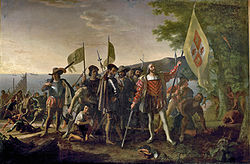
25. Columbus, King of Explorers

250px-Landing_of_Columbus_(2)Poor Columbus; he has taken a beating over the years. We don’t see him for what he was, with all his strengths and weaknesses, but through the lens of our own times.

This excerpt from my upcoming novel Cyan gives a picture of how we might view him a century from now, when we have to change our calendar to meet the demands of the rest of the world.

Anno Domini
A Latin phrase meaning the Year of our Lord.

Before sunrise on October 12, 1492, Anno Domini, a lookout for Columbus’ expedition sighted land. Columbus had found two new continents (although he did not know it), following his own powerful vision of how the Earth was constructed (a vision that was wrong), and began a five hundred year reign as king of explorers.

Half a millennium later, Columbus was dethroned. Even school children were now being taught that Columbus was not the only one who knew the world was round. Sailors and scholars had known that for hundreds of years before him.  Columbus’ great vision was that the Earth was small, and in that he was wrong. By the late twentieth century, it was certain that the Vikings got to America first, likely that St. Brendan beat Columbus there, and there were a dozen other putative explorers who had their champions.

Besides, American popular thought was in one of its Noble Savage stages, and it was politically correct to echo the Native Americans who complained that Columbus was a destroyer of races and cultures.

But even at the height of Columbus bashing, it was apparent that his voyage had differed in one significant detail from the other explorers who had preceded him. After Columbus, America was never lost again. After Columbus, and those other explorers who sailed close on his heels, the Earth became entirely known and entirely interconnected for the first time.

*****

In the year A. D. 2037 (as Christians measure time), at the Conclave of Mecca, the Islamic world announced that they would no longer recognize, speak with, acknowledge, or deal with any person, nation, or document which forced them to use a calendar based on Christianity.

At the International Bureau of Weights and Measures Convention in Buenos Aires two months later, a new calendar was established, based on a sidereal year. It would have neither weeks nor months since Islam and the rest of the world could not compromise on the issue of lunar months. It could not start at Jesus’ putative birth, nor at Mohammed’s, and it quickly became apparent that the new Standard Year should date from the midnight preceding the day the Earth became one planet for the first time.

This whole Standard Year business came about by accident. When I wrote Jandrax thirty plus years ago, I had no idea that I would write other stories in the same universe. After all, I stranded all those poor people so far out that no one would ever find them.

However, I began wondering what circumstances, beyond what I had already written, might cause Dumezil to invent his pan-Earth religion, and I wondered what Jan Andrax’s ancestors were like. That led me to make Stephan Andrax, Jan’s multi-great grandfather, spaceside commander of the Cyan expedition.

In Jandrax, I had pulled the date Standard Year 873 out of thin air. Now I had to backtrack and make it work for Cyan, which I did my making Standard Year Zero start with Columbus’ discovery of America.