Tag Archives: writing

175. 1776, the movie

Ah, June 29th. Its just about time to watch the movie 1776 again. It is a family tradition to watch it every year just before Independence Day.

My wife and I saw it first as a play on July 4, 1976, in an outdoor presentation. We had gone to the big city – locally that means San Francisco – to rub elbows with the crowds on the day of the Bicentennial. That afternoon, we were hooked. When it came out as a movie, we went to see it, then bought the VHS. Yes, this was before DVDs, or downloading, or streaming, or TiVo; actually, I think it was before we had bought a VCR, but we wanted to always have a copy.

1776 is a great patriotic rush of a movie but I wouldn’t recommend that you learn your history by watching it. The Columbia Companion to American History on Film says that “inaccuracies pervade 1776, though few are very troubling.” Maybe, but I’m not so sure. Some of the best parts of the movie just didn’t happen.

In fact, the wiki summary of historical accuracy praises the play while documenting error after error until you get the impression that nothing in it was true to life. See the movie first, then read the quibbles, because 1776 is not a historical movie, but an allegory, or better still, a retelling. It goes to the essence of the hesitation and worry, even fear, that attended the event, all wrapped in a story of arrogance, honest outrage, pride, and sacrifice. The writing is beautiful, the quips are side-splitting. Much of the dialog is taken from the words of people who were there, gleaned from works written by them years later.

In fact, there is no lack of historical material to work from in reconstructing the event, even though it was conducted in secrecy. These were literate men, with a clear picture of their own historical importance. Most of them told their own stories in later years.

Unfortunately, they tend to disagree on what actually happened. Years after I first saw the play, I went back to college for an MA in History, and thereafter set about trying to make my own knowledge of the event more accurate. It is surprisingly hard to do. Even the date July 4 is in partial doubt. The Declaration was approved on July 4. Jefferson, Adams, and Franklin claim that it was signed that day, but only a hand written copy then existed, and not all members were present. Those present may have signed the hand written copy – or not. We just don’t know. Certainly the printed version that we now view in the National Archives was not ready for some weeks. It was signed on August 2, but not by every member, as not all were present. Some signatures were apparently added piecemeal later on.

I care about historical accuracy, but when I am watching 1776, I let that go by and immerse myself in a moving theatrical experience. Now don’t bother me any further. I’ve got the DVD cued up.
Jandrax 59

When dusk came, the crooning resumed, alternating with an airy cry of, “Dilwildi, dilwildi, dilwildi.” I searched the trees for the sources of the noise and saw patches of deeper darkness sitting at intervals along the larger limbs. Occasionally one of these would move, but I could not make them out. Alpha rose, with her tiny red companion Gamma in train. Beta, our third moon, would not be up for hours yet, but these two gave a silvery sheen to the lake, highlighting the darker gouges of the long, sweeping rollers. One of the patches of darkness detached itself from a limb and sailed seaward. I tracked it with my rifle, an instinctive, defensive action, but there was no reason to fire. It flew, but somehow I did not think of it as a bird. I followed it with my eyes until it was lost in the distance.

I slept too soundly that night. I had seen no carnivores, true, but there must be such or life here would quickly overpopulate. In the morning I slipped the oars into their sockets, cast off, and worked my way out of the inlet. I was in a foul mood, for rowing cost me much pain in my leg, yet I dared not set the unpredictable sail.

I rowed out into the lake a half kilometer to better survey the island, then turned west to follow the shore. The wind was against me, making the task harder than it need have been. From this distance I could see how thin the fringe of jungle actually was and how rugged were the hills beyond. Except for the shore, it was a forbidding and utterly inhospitable place.

I rowed for several hours, searching for a proper anchorage. I also filled my waterskins for the first time and set the line out to catch some fish more palatable than rocod. I had given up the idea of finding large game, but if I could get ashore and build a fire, cooked fish would be a delicacy by comparison.

At one point a flat plain no more than five meters above water level extended several kilometers inland. Here the jungle too thrust inland. There was an inlet into which I rowed.

It was not a river, of course, for there was nothing to feed it, yet it no doubt carried snowmelt from the mountains during the melt. Now the inlet was merely a thin arm of the lake, first a halfkilometer wide but soon narrowing to a dozen meters. My passage was silent but for the cutting of my oars, and the birds were in full song. Trees soared overhead, their branches intertwining to make tunnels of the smaller channels off the main stream. Twice I saw the large flying creatures overhead, but they passed quickly from sight.

I paused to check the charges in my rifle, for with a section of jungle this large I would have to revise my earlier assumption that there would be no large animals. It was my seventy-sixth day of raw fish.

The inlet continued for several kilometers, growing gradually narrower until trees began to meet over the main channel. I tied up to a tree and worked my way across the steps that its roots provided onto dry land. I staggered and nearly fell, so unaccustomed was I to the firm, unswaying earth.

*****

As I prepare this for serialization, I am struck by how much 1979 me doesn’t sound like 2016 me. It sounds more like Andre Norton, or H. Ryder Haggard, or Edgar Rice Burroughs. I grew up reading old books which were trapped in the amber of underfunded libraries, and started out writing like their authors.  more tomorrow

174. Painfully United

The UK has a painfully long name – the United Kingdom of Great Britain and Northern Ireland. How it came to be united is also painful; it is a millennium long story full of warfare, with some significant sore losers.

Since BREXIT, every knowledgable news commentator is predicting at least a partial breakup of Great Britain. A full understanding of why would take a book. I am going to put it into shorthand, with all the inaccuracies that entails. None of what follows is wrong, but it’s a kindergarten primer.

Once upon a time the British Isles (that includes Ireland) were Celtic. During the first millennium AD, Germanic invaders began to raid and colonize. These invaders were speakers of Germanic languages, including the languages ancestral to English. That doesn’t mean they were Germans, as we use the word today. Germany came to nationhood only very recently.

Over centuries, these Germanic speaking invaders came to conquer a good deal of what is now England, and were essentially the native population by 1000 AD. One group, the Angles gave us the name England.

Meanwhile, a  bunch of Vikings (Northmen, Normans) conquered the part of western France which came to be called Normandy. They shed their Scandinavian branch of the Germanic language family and took up French, along with wine, clothing that wasn’t fur, and other aspects of a better life style. in 1066, William the Bastard crossed the channel and conquered England, becoming William the Conqueror. He brought top-down feudalism, displaced the local lords, handed out fiefdoms to his followers, and introduced French as the language of the court. Middle English became the language of the commoners; it would take centuries for English to supplant French as the language of the intelligentsia.

The Robin Hood legends with poor Saxon serfs under the hated Norman lords comes from this period.

Wales fell under English domination through simple conquest in 1284. Full union with England took place in 1536, at which time Welsh law was suppressed.

In what would become Scotland, ancestral languages similar to Middle English had already overtaken the lowlands by the time the followers of William moved in. Beyond the highland line, as in Ireland and Wales, Celtic languages remained. Over the centuries, Scotland became a nation, with its own kings, traditions, and court culture. As it did so, the ancestral languages evolved into Scots. Scots is not English with a bad accent; it is a similar but separate language with its own literature, used in the Scottish court.

Scotland and England fought intermittently throughout the centuries. Since England was larger and more fertile, and could field larger armies for longer times, England won more often than it lost. Scotland became sometimes a vassal state and at other times, nearly so.

When Queen Elizabeth died childless, her cousin James the Sixth of Scotland was given the English throne. His proper title became James the Sixth and First, but the English ignored his Scottish heritage. So did he. He was ill used as a child in Scotland, and he couldn’t get to London fast enough. Although a Scottish King on an English throne, his home country was only a bad memory to him. 1603 was called the Union of the Crowns, but Scotland still had its own parliament.

For four generations spanning most of a century, the Scottish/English kings had their hands full fighting against English protestants who disliked their Catholic leanings. Back in Scotland, rabid Protestants had increased their power. Mid-century brought about the Wars of the Three Kingdoms, sometimes called the English Civil War, although it was also fought well beyond the English border. It was a complex situation, with the English vs. the Scots, Royalists vs. those who opposed the Divine Rights of Kings, and Catholics vs. Protestants. Individuals found themselves torn between conflicting loyalties, and the changing of sides was common. The planting of American colonies was heavily influenced by these events.

1707 saw the Act of Union. The Scottish Parliament was subsumed by the English one, after English manipulations had nearly bankrupted Scotland. The Scots language was suppressed. At one point, maps labeled Scotland as North Britain.

Events in Ireland were even more harsh, with multiple invasions from England, annexation, the plantation of Scottish protestants in Northern Ireland during the War of the Three Kingdoms, the genocidal Irish Famine, rebellion, partition, and the Troubles. Since 1921 Northern Ireland has been part of Great Britain while the bulk of the island became the separate Republic of Ireland. Ironically, this was done by vote, during which Northern Ireland stayed with Great Britain basically because the mass plantation of Scottish (now Scots-Irish) Protestants three hundred years earlier had shifted demographics.

If this sounds like England bashing, I apologize. It’s a complex situation, but winners tend to be hated by losers, and those feelings can last a long time. Just ask anyone who lives on the route of General Sherman’s march to the sea. England, AKA Great Britain, was the most powerful country on Earth for a third of a millennium. Such a country makes enemies. Unfortunately, some of them live in England’s back yard.

Jandrax 58

In a band at the water’s edge were giant trees whose roots must burrow down to water and whose boles thrust skyward, and beneath them layer upon layer of vegetation – saprophytes, mosses, lichens, an abundance of fruits and flowers, vines, and birds of all colors flittering between the layers of green. Yet even from my position at water level I could see the unyielding rock rising up behind the jungle, at places seeming only a hundred meters wide.

Nowhere on the planet have we found anything like this. Perhaps it is the moderating effect of the surrounding lake that allows such to develop. I do not know; such knowledge as I have is sketchy on these things. Perhaps Jandrax would have understood.

I sailed west around the island, looking for a safe anchorage. Were I whole, I could have run ashore anywhere, leaping out and dragging the boat up on some rocky shingle; with my injury I needed a place where I could tie up without beaching my craft. Once I entered the mouth of an inlet, dropping the unpredictable sail and rowing in, but the inlet was surrounded by low and swampy ground that I could not negotiate.

I stayed in that inlet, tied up to the knobby root of a low-growing tree and slept poorly, mindful of the new sounds around me. I did not hear the coughing of longnecks or the squeal of krats – for which I was thankful – but I did hear many sounds that I could not identify, especially a soft, crooning call that echoed throughout the night.

I missed the sunrise the next morning, shaded by trees and tired out by an uneasy night. When I woke, soft light was filtering through the jungle and the birds were about their daily tasks. I saw several species new to me and familiar species that were somehow different, like the leatherbill that landed on my prow, his brilliant red underbelly at odds with his continental cousins.

I caught rocod from the murky waters and ate them raw, but I kept my rifle close at hand, hoping that some herbivore would come down to water. I was thoroughly sick of raw fish. Leatherbills came to watch me eat, so I set my line again and, dividing my new catch, spent an hour feeding them. They were very bold, one even venturing to eat from my finger.

No herbivores came, nor had I really expected them. This fringe of jungle would be the abode of small creatures only. I saw what I took to be huge birds circling the island as I approached it yesterday, but they were not in evidence today.

I realized, with a twinge of guilt, that I had not notched my calendar board yesterday.

I spent the afternoon lounging in the boat. I had not realized the depth of my loneliness at sea; now it fell in on me again. In the afternoon I stripped and went overside for a much needed bath. At sea I had not dared do this for fear of becoming separated from the gig.

I considered sailing out to fill my waterskins rather than drink this muddy shoreline water, but I could not bring myself to leave this haven even for an hour. The next day I would go, however, for I was determined to find a landing where I could actually go ashore. I cursed my leg in bitterness, knowing that I had passed a hundred landings, including this one, where an agile man could have gone ashore.

When dusk came, the crooning resumed, alternating with an airy cry of, “Dilwildi, dilwildi, dilwildi.” more tomorrow

Jandrax 57

Chloe’s child should be nine months old now; simple arithmetic makes him a good bet to be mine, but Anton claims him. Perhaps; no one will ever really know. I saw him only once and I burned with a hunger that was nine-tenths shame.

There is nothing for me at the colony. The men despise me and the women shun me. So be it. They have cast me out symbolically, so I have cast myself out physically.

When I was younger I would have dreamed of finding where the herds go and returning triumphant with the knowledge. No more. Youth is dead, and dreams. Still I am curious, and out here on the open water my loneliness is less poignant than it was where I had my fellows around me, showing me by daily example that I am less than a man.

My supplies are limited but I have fishhooks and line. Every fish I catch sacrifices his entrails to make more bait so the supply is endless, if monotonous. I never dreamed how tired a man could get of raw fish.

I learned much from the computer before I undertook this trip, but little of it made sense. Now I have begun to put it together into a coherent pattern; the strange sounding names and terms are no longer meaningless. Keel, tack, tiller, before the wind. They were meaningless before. Now I know them well. Tacking is what I do from dawn to dusk, a keel is what I lack to do it well, leeway is what I am making – that is, the wind is blowing me away from where I want to go. Our lake is huge, 200 by 750 kilometers and I had intended to cross it diagonally. It seems that I will be at it forever and I would have long since died from my ignorance if I were on a terrestrial ocean, but there are no storms on this planet and I have only to reach out my hand to have fresh water. Water, fish, wind, sky, water. I live, but I become unutterably weary.

Using my knife, I make a notch in the calendar board as the sun sets, and count. Seventy-two.

***

By taking sun sightings at dawn and sunset I have been able to establish my latitude, but I have no way to determine my longitude. Each day finds me further south. It is now the seventyfourth day of my journey and I have spotted land, but not the opposite shore of the lake. It is the great island which my map shows, or so I think.

I will stop here in hopes of finding the materials with which to improve my craft, especially with which to build some form of keel. Also, I may find some of the smaller life forms here to supplement my diet of fish.

***

The island rose from the sea like the top of some mountain with great rocky headlands upon which the waves broke. On a planet without storms or rain, the rocky faces are stark and unweathered.

The island rose up devoid of vegetation, locked in the grip of low winter, the season of desert before the snows come. Only immediately adjacent to the lake was there a band of dense vegetation, drawing moisture from the lake itself.

*****

At the second three asterisk break, the story changes from present to past tense. Present gave immediacy that could not be sustained, and past is the tense of story telling. At least, it used to be. When Jandrax was written, the modern, ubiquitous use of present for story telling had not yet swept over the globe in a noxious wave. more tomorrow

172. Flash Fiction Day

Today we have a short post on a short subject.

This Saturday, June 25, is Flash Fiction Day in Great Britain. The nice thing about the internet, is that even Americans can click on a British site, so you can check them out.

The term flash fiction is relatively new to me. I discovered it about a year ago while I was writing the blog entry A Very Short Story over on Serial. That entry has since been moved to Backfile.

The story in question was Koan; at 175 words, it would not be eligible for Saturday’s 100 word contest, but it’s short enough not to take itself too seriously, which seems to be important in flash fiction.

I remember, many years ago, one of the science fiction magazines ran a series of vignettes (think of vignette as an old word for flash fiction), then ran a contest for “The Shortest Science Fiction Story Ever Told.” The subject of the contest was, “The last man on Earth sat alone in his room. There was a knock on the door . . .”

Most of the entries were forgettable, but one stuck in my mind for its cleverness, brevity, and sheer laziness – yes, what else would you call adding only seven words. The entire story read:

The last man on Earth sat alone in his room. There was a knock on the door. It was the last woman on Earth.

Snicker!

I have to warn you about the British website. There isn’t any science fiction there. It’s all fuzzy and warm and about feelings and relationships. Very academic, very much “literature”, pretty much what you would expect from a site which announces Supported using public funding by ARTS COUNCIL ENGLAND on its masthead.

If you want another kind of flash fiction, just Google. There are all kinds. For example, National Flash Fiction Day in New Zealand is on June 22, because it’s the shortest day in the year – in the southern hemisphere. I like that.

So, how shall I end this bit? Of course — A flash essay about flash fiction. Eighteen words ought to do it.

Steak is good. Vegetables are good. A balanced diet is admirable. But there’s nothing wrong with potato chips.

Jandrax 56

Chapter 12
Isle of Myth
Excerpts from the journal of Jean Dubois

I

The gig moves easily to the motion of the waves. I stare out across the endless waters, thinking back.

It has been fifteen months since the trihorn ripped my leg and made me a cripple. By now the herds will have come and gone, and all the men will once again have distinguished themselves. The young men will have taken wives.

Thinking back. And burning with hungers I can never appease.

Where do the herds go? Every year they come from the north, running with the melt. It has been thus since the Lydia arrived. Every year they come from the north, go south, but they never return from south to north. Therefore, where do the herds go, and where do the herds come from again the next year? People say the beasts cross the polar cap and return by following the northward melt on the other side of the planet. This is pure nonsense as anyone can tell from the reports in the computer. Jandrax – Andrax – may have known but he never passed the information on.

(FYI, reader, Andrax knew and talked about it with his friends from the Lydia, but apparently none of the other colonists got the message – or knew but did not pass it on.)

What happened to Jandrax? No one will tell and I could not find the answer in the landing craft’s computer. Of course, I am no technician and the questions I can pose are quite elementary. I fear for our future. We have wrapped manhood up in hunting until no one who is not lame or blind will even smith the guns the hunters use. What madness. Only six of us still know how to run the computer.

Here is another mystery. The computer gave me the roll of the Lydia. Andrax was a supernumerary. There were eight crew members and one hundred colonists. None of the crew members still live. Why?

And what of the precursors? Who built the ruins that the elders sometimes mention? And who are those others whose existence the elders would like to deny?

The elders meet every such question with silence. They have fairly killed the curiosity of my whole generation.

I have with me a map of this region and another of the whole planet. I transcribed them painstakingly from the computer. It seems to me that the herds must follow the northward melt and that the only place they can do this is on the opposite side of the lake. That is a region as unknown to us as another planet. I am going there; again (and this question I must aim at myself), why?

*****

Three comments —-  

1. This is the other remnant of the first draft which I left in first person, like the Hallam story, because it clearly works that way.

2. This is a story within a story, and longer than a normal chapter, so it is divided into sub-chapters. I like that effect, and used it widely in Cyan. It probably contributed to T. A.’s impression that this was a bunch of shorter works glued together. No, it is a basically simple story, with enlivening elements treated discursively.

3. This section comes dangerously close to committing the young author’s besetting sin of whining. Thou shalt not whine. Write it down and tape it on your computer screen.

Jean doesn’t whine, quite. His character is saved by his fortitude after his maiming, by his work with Levi-Steur, and by the fact that this quest is his way of continuing to fight against his fate.

Structurally, it is important that this comes late in the novel. If thou must whine, don’t do it in Chapter 1 or your reader will never reach Chapter 2.

more tomorrow

171. Solstice Measured

so me

This is a follow on to Monday’s post. If you haven’t read it, you might want to give it a glance.

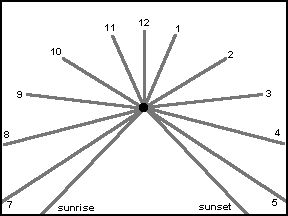
I’m going to show you how to construct a simple instrument to measure sun angles. It works especially well at the solstice, but a few days late won’t hurt if you are only out to amuse yourself and maybe learn something. I first used this when I was considering where to place windows in a building to get north light without afternoon glare. You could use it to pick out the optimum placement for solar panels, or decide how deep to make a south-facing porch.

FYI to my followers in Brazil, New Zealand, and Australia. I am going to write as if everybody lived in the north latitudes; I’m sure you are used to modifying that kind of writing to meet your own needs. Sorry, but it’s just too clumsy to qualify every statement.

All you need to measure sun angles is a board with a vertical dowel or wire set into it near the center. You could use a carpenter’s square for that. You will need a spirit level to level the board, and it wouldn’t hurt to then use the level to see if the dowel is still vertical (what carpenters call plumb). You will mark the shadows as they fall directly on the board.

This is what I used the second year. The first year i drove a rusty used pipe into the ground and drove stakes into the shadows. Same principle, but far too clumsy.

Next, you need your local sun time. Subtract daylight savings time, but that isn’t enough. Noon, by the sun, is when the sun is directly south of you. Clearly that is an hour earlier on the east side of your time zone than it it on the west side, so you need your longitude and some simple arithmetic.

There are twenty four time zones, each 15 degrees wide. The first time zone is at zero longitude in Greenwich, England but, again, it’s not that simple. Time zones center on their base longitude. The first zone lies from seven and a half degrees east longitude to seven and a half degrees west longitude, and the other zones follow suit. Then all is adjusted to match up with political boundaries, but we can ignore that.

Let’s choose Oklahoma City as a neutral site, so I can give  a shout out to their wonderful Fleming Fellowship, celebrating its sixtieth anniversary this month. OKC is at 97.5 west longitude. If you ignore political gerrymandering, OKC’s time zone centers on 90 degrees longitude, so OKC is on the western boundary of the theoretical time zone; the political time zone ends on the western border of the state. The sun is south of OKC when your watch says 1:30 PM, if your watch is accurate and you have it set for daylight savings time.

To find solar noon for the longitude where you live, add or subtract 3 minutes for every degree you are west or east of the theoretical center of you time zone.

I like to set my board up the day before and rotate it so that the (solar) noon shadow lies parallel to this sides of the board. That isn’t necessary, but it makes for a neater project. Then I’m ready to record the shadow that falls at sunrise.

Sunrise is problematical. You can look it up for your area, but it’s not that simple. (Have I said that before?) If you live on a mountaintop, sunrise will come earlier. If you live in a valley – or, in my case, on the west side of the Sierras – it will come later. How much can’t be calculated. It depends on how far west of that hill you are, and how high that hill is, and whether today’s sunrise happens to fall behind your neighbor’s house, or behind that big oak tree. It will come when it will come. Have a straight edge handy and draw a line from the dowel down the center of its shadow, then write down the time. Continue through the day. I try to make a mark every hour on the (solar) hour.

Early and late shadows will probably run off the board, but for the rest you can calculate the sun’s vertical angle because you will know the height of the dowel and the length of the shadow. Personally, I take the measurements, redraw the triangle on another piece of paper, and measure with a protractor; but then, I grew up before calculators.

You do realize that this is the year’s extreme for north tending sunrise and sunset and for high sun angles, and that every other day until December will be slightly different.

Even if you never design windows for north light without afternoon glare, or plan the placement of solar panels, or decide how deep to make a new porch, taking the sun’s angles throughout the day will give you a better feel for your personal environment, and a new appreciation for the complexities of astronomical observations.

Extreme astronomy geeks will repeat the process at the equinox and winter solstice, but good luck if you try. I’ve never been able to pull off any shadow measurements in December because of clouds.

Jandrax 55

Nightwind stepped to the door and rapped sharply. In his left hand he carried a strip of supple hide and two hide cords. Paulette Dumezil opened the door, then opened her mouth to scream. He hit her.

Nightwind closed the door behind him and worked swiftly, binding her hand and foot and tying on the leather gag. He peered out again and saw no one. Heaving her to his shoulder, he padded down the street to the wall.

He could not climb the wall with his burden, nor lower her over the palisade with the guard nearby, so he left her at the foot of the ladder. When the guard had passed overhead, he went noiselessly up to meet him.

The guard stiffened and turned, bringing up his bow.

Nightwind smiled, crouched before him.

For a moment the guard was startled into immobility, and that hesitation was his last mortal act.

Nightwind wiped his knife, sheathed it, and dropped back to recover his quarry. Paulette was regaining consciousness so he struck her again, carried her up the ladder, and lowered her to the ground outside.

At midnight, Adrian Renou went to relieve the guard at the river wall and found him dead, his blade undrawn. In the furor and confusion that followed, it was several hours before anyone realized that Paulette Dumezil was no longer behind the palisade.

*****

This is going to be one of those notes for writers that someone just reading Jandrax for enjoyment may want to skip. It’s not quite a spoiler, but it comes close.  Continue reading

170. Middle School Astronomy

We learn our astronomy from books, but that isn’t how the science started. The ancient Greeks learned about the stars by looking at the stars. Their understanding was a mixture of observation and myth, with myth sometimes predominating.

When we are young, we also learn astronomy from casual statements we hear from adults. I’ll give you an example. Mars has recently been at a close approach; every evening lately, when I step out my front door (miles from the nearest city) to look at the sky before bed, there it is, red and bright, about halfway to zenith in the south-eastern sky. Now imagine that I say to a child, “Mars is really getting close.” Just that, with no other comment. What images might pop into that child’s mind?

*****

“The seasons change because of changes in the Earth’s tilt.” You might find a statement like that in an old middle school science textbook along with an illustration like this:

ma1

Not true. Not a lie, but an oversimplification that may be fine for the average student, but does not do justice to the brightest kid in the room. A better statement would be, “The seasons change because of apparent I changes in the Earth’s tilt”, coupled with an illustration like this:

ma2

Now we are more accurate but we’ve confused 90% of the students.

It should be obvious by now that this is a bit of a how-to based on long experience. Even if you aren’t a teacher, you will probably someday have to explain this kind of thing to your own kids.

Let me suggest a third option. First explain things in your best lecture voice with reference to the textbook and with drawings on the board. Then pick a student sitting in the middle of the classroom; out of kindness, choose someone who likes attention. Say, “Helen, don’t move. For the next few minutes, your head is going to be the sun.” Then establish where Polaris lies, for the sake of the demonstration. Your classroom may not allow you to use real north. If some bright, smart-mouth kid catches you out, don’t get mad. Rejoice that someone is paying that much attention and make it a teachable moment.

Now walk around the classroom with the classroom globe tilted toward your Polaris and talk them through the seasons, pointing out that the tilt never changes in relationship to Polaris, but it appears to change in relationship to Helen, our sun. Pat your worst troublemaker on the shoulder as you pass him, wink at the shy girl in the back corner who never volunteers, and say, “Excuse me, Earth coming through,” when you have to dodge around desks.

There is a rule of thumb for teaching science (which probably doesn’t work for algebra). If you enjoy teaching, and you let your students enjoy learning, they probably will.

*****

That exercise was for letting students visualize things they can’t see for themselves. You can also help them see things that happen in their everyday world, but normally go unnoticed.

Observing the path of the sun through the seasons is an Earth’s-eye-view version of the tilted globe carried through the classroom. How do you compress a year’s worth of observation into one 40 minute session, using the real sun instead of charts and graphs? It can be done, but it takes nine observations on your part, spread over three days, with those three days spread over half a year. It also takes a small can of paint and a paintbrush.

When I set this up, I picked a solid, upright, eight foot steel pole which was set up away from the shadows of structures and which I knew would not be disturbed for years to come — a volleyball net pole out on the playground. At 10 AM, noon, and 2 PM (sun time, not daylight savings time) one summer solstice I painted three inch circles (same diameter as the pole) at the pole shadow’s tip.

I repeated those actions during the fall equinox, which was intriguing for my students. I had a paint can and small brush at the ready during my ten and two classes, and on the stroke of the hour, I ran out of the classroom, painted the circle, and ran back in while they watched from the windows. The noon painting had an even bigger audience because of noon recess. As you might guess, I told those who asked questions, “You’ll find out what this is all about — some day.” On Christmas break I painted the last three circles during the winter solstice.

That spring, and for years afterward, I arranged to teach solar motion as near as possible to the spring equinox. The solstices fall outside school days, and the fall equinox is often cloudy in California. I explained everything with lectures, and reading, and drawings on the board, but then we all went out to those nine circles on the playground. As I talked them through the lesson, we all watched the pole’s shadow move. It is fascinating in our mile-a-minute world to take the time to watch a shadow inch its way across the ground. Even if it wasn’t 10 or noon or 2, everyone could see that the shadow’s tip either had or would touch all three of the middle circles.

I explained how I had placed the circles and invited students to lie down with their head on a circle and look past the tip of the pole to see where the sun would be (or would have been) at noon or 10 or 2 on the first day of summer or the first day of winter.

They paid attention. On days they pay attention, learning happens. It isn’t easy, but it works.