Monthly Archives: March 2016

119. Brevity

The publication of Jandrax is underway over in Serial. This post looks back at the spirit of the times during which it was published.

Things have changed since 1979, but probably not in ways you are aware of. Several barriers were broken shortly thereafter, and five years later there was technological breakthrough that opened the floodgates.

The first barrier was not racial, nor of gender, nor moral, nor technological. At the time, it was called the two-dollar barrier. I first heard it discussed at Charlie Brown’s house (publisher of Locus) in the Oakland hills where I had been invited along with a batch of other newbie authors just after Jandrax was published. It was a firmly held belief among the publishers gathered there that readers would not pay more than two dollars for a paperback novel.

Like the sound barrier, the two-dollar barrier disappeared with a poof and was forgotten soon after, but until then it had a critical effect on what kinds of books could be published.

Short books.

You see, if you could only charge two dollars for a book, printing costs limited how long that book could be. Throughout the sixties and seventies, science fiction books were short. Jandrax, at 50,000 words, came in near the end of that era. I’ll say more about the full effect that had in a moment.

You don’t have to take my word for it, by the way. Go to any well stocked used book store and make a stack of science fiction novels from that era. Make another stack of recently published science fiction novels. Prepare to be amazed.

The second barrier was related to the first. It was the big-money barrier. It was the notion that advances for science fiction or fantasy novels were and always would be peanuts. David Harwell broke that barrier by offering a massive advance on the fantasy novel The Book of the Dun Cow, which was slated to shake up the world. It didn’t, but the massive advances remained and set us on the path to today when new authors get no advance and Stephen King could single-handedly retire the national debt.

Then, in the early to mid eighties, computers became readily available. They didn’t make writing easy, but they made typing – or rather, re-typing – easy. Every pro switched over and refused to go back. No wonder; I know that in the early days I spent much more time repairing mangled typescript than I did actually writing.

Suddenly, new writers were multiplying like fruit flies. Books were getting longer, and cost more. Advances to the elite were soaring. Advances to newbies were shrinking.

Welcome to now.

Before all this happened, books were different. Not better, not worse, just different. There was a premium on brevity and conciseness. Take a look at Dorsai! by Dickson, then look at his Final Encyclopedia for the maximum shock version of the contrast.

New books are not just longer; they are leisurely. Books of the seventies were frenetic. Newer, longer books have a little more story and a lot more words.

Jandrax is short and fast, but that was the norm. It could use fewer shock cuts and more phrases like “the next day …” or “they returned to the compound where they …” or “after the hunt was over, they …”. About another seven thousand words would smooth things out nicely.

It’s a good book and I recommend you slip on over to Serial and start reading. But finish your coffee first. You’ll need the caffeine to keep up.

Jandrax 3

51jbN0bvqRL._AA160_PART I
From the log of Jan Andrax,
Standard Year 873 and of the colony,
Year 1

These are the bare facts about the planet fate has chosen for our last landfall: diameter somewhat smaller than Earth, day 21 hours, year 312 Earth-standard days (a little over 356 planet days), axial tilt 32°, considerably more than Earth, resulting in greater seasonal variation. Orbital ellipticity considerably greater as well, reinforcing that effect.

Damn!

Chapter 1

The planet hung like a cold jewel in the viewport the last planet most of them would ever see from orbit. Great icecaps stretched north and south, coursing together to touch hands at the equator along the one major north-south-tending mountain range. Of course the world was uncharted. The stars hanging beyond it were arrayed in a manner utterly strange.

The planet’s oceans were gone – locked into the massive polar caps – and what remained as seas would be extremely saline. The air would be very dry; it was likely that rain never fell, only winter snows.

A cold, barren, forbidding world hanging close in to a cool sun.

*****

(Dear reader, If you just want to read Jandrax and enjoy the story, no one will force you to go beyond the five asterisk barriers. What lies below, on this and many other posts, is for the geeks and nerds and new writers and would-be writers who want to pull back the curtain and see the wizard exposed.)

*****

This is how we do it in science fiction. Log entries, printouts stuck into journals, and excerpts from contemporary writing are all ways of getting information to the reader as quickly and painlessly as possible. You have to be careful, of course. These cliches are part of the DNA of science fiction, but so is their overuse. Don’t do too much of it. Unexpected, humanizing touches like the Damn! at the end of the log entry can sometimes help. Don’t overdo that, either.

And don’t be so careful that you mess up the flow of narrative. Here is a painful example – painful to me, that is; I’m sure no reader ever noticed it. In the first sentence the words “most of them” should have been “they”. I knew there was going to be a one-character exception to the statement, but I didn’t have to be so tediously accurate. It comes from all those master’s theses and academic papers.

In fact, fighting back academic speech is an ongoing struggle. Natural speech doesn’t come naturally to me, and the problem was much worse back when I was writing Jandrax. If I could remove about fifty instances of the word “thus” and replace them with less pretentious words, Jandrax would read more smoothly.

Oh, well, it gives us something to talk about.

118. Jandrax redux

I originally wrote this when I had barely begun blogging, to introduce myself and one of my novels. I am presenting it again because no one was listening back then, and because Jandrax is now available to be read in its entirety, over in Serial.

Jandrax

Here is a story so old that I have no idea where it originated. A group of Irishmen were sitting in a bar, solving the world’s problems. One of them asked the rest, “If a cataclysm were to destroy all the poets in Ireland, how many generations would it take to replace them?” One of the others simply held up his hand with a single finger raised. (If you know the origin of this, let me know.)

You will note that this is not an ethnic joke, but a comment on how the Irish view themselves. It is also true – and not only about Irish poets, but about any of those human traits that lie latent in all of us until circumstances call them forth.

That includes the capacity for religious controversy.

Before Martin Luther made his opinions stick, there was a long history of dissent within the Catholic Church. Dissenters were called heretics, and they were usually burned at the stake. Look up Jan Hus (AKA John Huss). Once Luther opened the floodgates, here came Zwingli, Calvin, Knox, and good old Henry VIII with his political and personal agenda.

Quakers, Shakers, Anabaptists, Methodists – you get the picture. As someone once misquoted scripture, “Wherever two or three of ye are gathered together, there will be a fight.”

When I needed a religion for my first science fiction novel Jandrax – available battered and cheap in used bookstores everywhere – (And now available over in Serial.) I came upon Joseph Campbell’s Hero With a Thousand Faces. I read the introduction, saw the notion of the monomyth, and the entire religion I needed exploded in my mind, complete in a heartbeat. I closed the book and never went back to it, not wanting to dilute the purity of that flash of inspiration.

Some hundreds of years in the future, Louis Dumezil, a scholar with a self-imposed mission of peace, collates all the world’s religions, winnowing out the common core, and setting it down in his Monomythos. His hope is that a common religion for all men, carved out of mankind’s various faiths, will bring an end to sectarian fighting. Fat chance. In fact, Dumezil unwittingly sabotages his own work by coming out with later, updated editions of his Monomythos.

You can guess the result. His initial success at setting up a pan-human religion based on the Monomythos breaks down into warring sects killing each other over which Monomythos is the correct one.

In Jandrax, the title character is a disillusioned former zealot who lost his religion in the sectarian fighting on Hallam’s world, and now finds himself marooned on an unexplored planet with a shipload of purists.

Jandrax 2

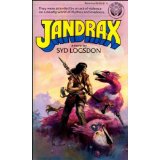
51jbN0bvqRL._AA160_Jandrax began with a one page prolog designed to set the scene.

A sphere floating in space, silver against a backdrop of stars.

The stars shift their colors, doppler down, out. The sphere hangs alone in darkness where here and there are concepts yet unborn. Six antennae project; it is not so much moved as displaced. First it is here, then it is there, but it never crosses the space between here and there.

Within the sphere, eight souls are busy taming the nether energies, the Synapse, so that they might emerge from otherwhere in the place of their choosing. One prowls restlessly in a place foreign to his nature, and one moves quietly in the darkness with certainty in his mind and death in his right hand.

The dark figure paused outside the room where the computer split seconds into their million component particles and prepared to extract them from netherwhere. He watched the stars fade out on the screen past Dennison’s sandy head. Only a moment would pass until the stars returned and New Harmony lay below. Synapse drive can cross the galaxy in a heartbeat.

He released the trigger and hurled the grenade.

The explosion echoed through the sphere; Jan Andrax ran toward it. The bomber was gone when he reached the computer bay. Flames roared in the confined space as Staal staggered out, his clothing afire. Jan beat out the flames and leaped in to rescue his partner.

In the control room, Captain Georg Childe heard the explosion and shouted into the com. There was no answer. He tried again, then aborted without further hesitation and the stars returned.

Strange stars.

Synapse drive can cross the galaxy in a heartbeat.

Four seconds had passed.

*****

A lost and stranded starship is not a new concept. MZB used it in Darkover Landfall, her prequel to the Darkover series. Heinlein used it in Starman Jones, although he managed to let his young hero save the day and bring back his ship.

For me it was just a concise way of setting up a situation I wanted to explore. I gave about twenty minutes thought to Synapse drive, whatever that is, because it doesn’t figure into the story after it fails. If I ever need to write another story in this universe and time period (Cyan shares the universe, but takes place before the Synapse is discovered or invented), I’ll have to actually work out how it functions.

Incidentally, did you catch the beginners goof? Between paragraphs three and four I switched from present to past tense for no good reason. Jandrax continues next post.

117. Seven and a Half Months

On September 2, 1975, I had a year to spare and an itch to see if I could write a novel. As is common with first novels, it never sold.

On September 2, 2015, forty years later, I wrote a blog entry about the experience. It was the third entry on a new blog, so nobody read it.

Today, things are better. This twin blog site has been in place for seven plus months, with a total of just under 300 posts. My new novel Cyan will be out soon from EDGE.

Today over in Serial, I am beginning the serialization of my novel Jandrax, which was published by Ballantine in 1978. It is still available in used bookstores, and I hope that a new generation of readers will discover it.

The rest of this week in A Writing Life will be taken up by talk about Jandrax, but first I would like to rerun the post that tells how I started writing, forty and a half years ago.

It Was Forty Years Ago Today
first posted Sep. 2. 2015

I feel guilty of bait and switch. This post isn’t about the Beatles, or Sgt. Pepper, or the Summer of Love. It actually was forty years ago today that I first sat down to see if I could write a novel.

Would-be writers should take note. This was a controlled experiment. I wasn’t writing from the depth of my soul, nor writing the books that had been burning a hole in my brain for years. That came later. This was simply to answer a single question – could I sit down every day and write, or would my well run dry after the first week.

September 2, 1975 was the day after Labor Day that year, and I was at loose ends. My wife and I were had just rented a tiny house in the poorest part of town; she had a new job as a picture framer. She proved to be very good at it, and ended up managing the gallery for most of the next decade. If my writing experiment hadn’t worked, I would have gone to graduate school the next fall.

Writing a science fiction novel or a fantasy novel would have called for a lot of time spent in world building. That wouldn’t tell me what I wanted to know. A historical novel would have called for even more research, and a detective novel would have called for crafting a complex puzzle. I wasn’t worried about any of those skills. I just wanted to know – could I write word after word after word, day after day, week after week.

I needed a no-research story, so I decided to send my protagonist on a deer hunt, where he would get lost. I would set it in autumn, in a part of the Sierras I could drive to in a day if I needed to be on the scene. I would roll in a storm, with low hanging clouds so he couldn’t find north and couldn’t send up smoke. I intended to let him get out on his own. Over the weeks I piled misery after misery on the poor guy’s head.

GPS? Cell phone? Don’t be silly; this was 1975, when lost meant lost.

That was the setup. Here is the payoff – I wrote the novel. There is nothing exciting to say about sitting down every day and pounding the keys of a typewriter. (1975, remember; no computers.)

There were no exciting stories to tell my wife at the end of the day, but inside my head I was having a ball. Getting lost in the woods and finding my own way out was infinitely exciting, and every night I could go to my comfortable bed while my protagonist tried to sleep on the frozen ground. I was hooked. I never went back for my Ph.D..

I did go back a few years later for a second BA and MA in History, while I was writing, but that’s only because I love learning almost as much as I love novels. It had nothing to do with career plans.

The novel, Spirit Deer, was only 141 pages, far too short to publish. It turned out better than I had expected, and its core story was not age specific. A few years ago I got rid of Tim’s wife, his best friend, the forest ranger, the old hunter, and even Tim’s last name, and turned Spirit Deer into a young adult novel. It’s looking for a home. If it finds one, I’ll let you know.

Jandrax 1

51jbN0bvqRL._AA160_We are just coming off Voices in the Walls, which, if you missed it, was a fragment of a novel presented with commentary. It was intended to provide young writers with a chance to look over my shoulder.

Like most experiments, I didn’t know if it would fly, but I think it worked out quite well. Now I intend to expand the idea by presenting Jandrax, my first published novel, as a serial, with commentary on world building, person, publishing, writing style (Be careful how you write, it will still be around to haunt you in your old age!), and changes in the world of fiction from then to now.

In August of 1978 I received this letter, which changed my life.

August 8, 1978

Mr. Syd Logsdon
(address)

Dear Mr. Logsdon:

I have just read Jandrax, the novel you sent to my  husband.  Lester handles the fantasy for the list, and I take care of the science fiction.

I like the book and would very much like to publish it–probably in the Spring.

I offer you (monetary and rights details, very modest)

If these terms are satisfactory, get back to me, and I will get a contact prepared.

Is this your first novel? It reads well, and I would hope to see many more from you.

Would you prepare a 200-word About The Author (in the 3rd person) to run in the book and send that along in the next few weeks.

I think readers like to know something about new authors.

I shall look forward to hearing from you.  Welcome to Ballantine.

Cordially,

Judy-Lynn del Rey
Editor-in-Chief
DEL REY Books

P.S. I’m not sure I love the title. Can you come up with something a little jazzier that captures the spirit of the book?

If you are a would-be writer – and why would you be reading this if you were not – you probably already know what a rejection letter looks like. I had certainly seen dozens by the time Jandrax was accepted. I’ve seen hundreds since.

Acceptance letters are a different breed of cat. This one hangs, framed, above my desk. I look at it from time to time to remind myself that I am a published author, when current events make that seem fantastic. I have had a few more acceptances, which are filed, not framed, because only the first one gives you that maximum heart thump.

Jandrax begins tomorrow

116. Spacecraft Threatened by Bears

200px-Voskhod_spacecraft_diagramYes, I agree; it’s a snarky title. It’s also accurate, believe it or not.

I had the great good fortune of living through the early days of manned space flight. I was nine years old when the Russians orbited the first satellite, and the early manned flights came when I was in high school. I watched every American launch with fascination and envy, but the Russian launches were shrouded in secrecy. I knew only the bare minimum that all Americans knew. I’m not sure the president knew much more.

During those early days, nothing was routine. Every mission was dangerous. They still are, of course, but not so much as then. American failures were there for all the world to see, while the Soviets kept their’s secret. After the breakup of the Soviet Union, information about the early Russian space program became generally available, but by then few people cared. I did, and I sought out the stories.

Today is the fifty-first anniversary of the first space walk – by the USSR. I would have brought it to you on the fiftieth anniversary, but I wasn’t blogging yet. Voskhod 2 was a triumph, and also a flight which went spectacularly awry.

Voskhod 2
March 18-19, 1965

The first six manned Soviet spaceflights were aboard Vostok craft. Gagarin became the first man in space on Vostok 1, Tereshkova became the first woman in space on Vostok 6. I plan to talk about them on their anniversaries, in April and June.

Vostok astronauts wore space suits throughout their flights and landed by personal parachute separate from the descent module. Before the second generation Soyuz spacecraft came on line, the Soviets launched two additional manned missions on modified Vostoks called Voskhod.

On Voskhod, a backup solid fuel retrorocket was added to the spherical descent module, another additional rocket softened the landing so that the cosmonauts could remain within the descent module, and the ejection seat was no longer used. This allowed Voskhod 1 to carry three astronauts where Vostok had carried only one.

Voskhod 1 cosmonauts flew without space suits, as did early Soyuz missions. Voskhod 2 cosmonauts Belyayev and Leonov wore space suits because they were scheduled for the first space walk. Their craft also carried an inflatable airlock.

American space walks first took place during the Gemini program (see post 87). That craft had two hatches but no airlock; both astronauts were in vacuum during the entire spacewalk.

On Voskhod 2, Leonov crawled into the airlock, sealed the inner door and opened the outer one. Belyayev remained in the pressurized descent module.

For ten minutes, Leonov remained within the airlock but exposed to the vacuum of space, then he slipped free and floated on a tether for another ten minutes. He was called back in to terminate his space walk, and his difficulties began.

(Or perhaps they had already begun. Some sources state that he “experienced a disorienting euphoria” during the space walk and other sources state that he suffered bends-like symptoms after the space walk was over; I haven’t been able to confirm these statements.)

It is certain that he had extreme difficulty reentering the airlock. His space suit had over inflated; the boots and gloves had slipped beyond his toes and fingertips, and his suit had increased in girth. He had to vent part of his rapidly depleting oxygen in order to bring his suit down in size, and even then had to enter the airlock head first, instead of feet first as planned. Once inside the airlock, he had extreme difficulty contorting his body to close the outer door. All the time, his body was heating up dangerously. Since he was surrounded by vacuum, there was nothing to carry away the heat his body was generating.

Once air pressure had been restored in the airlock, Belyayev opened the inner door and Leonov was safe. For the moment. As he said in an article for Smithsonian’s Air and Space magazine in 2005, “the difficulties I experienced reentering the spacecraft were just the start of a series of dire emergencies that almost cost us our lives.”

The mission had achieved it’s goal and it was time to return, but just before the scheduled time for firing retro rockets the cosmonauts discovered that their automatic guidance system was malfunctioning. It took time to prepare for manual entry, so they had to wait one orbit, which would make them miss their return point by a thousand miles. Most of that orbit they were out of radio communications. When communications were restored, ground control asked them where they had landed, not knowing of their difficulties.

Their orbit was set, but the time they would fire their retro rockets would determine where on that orbit they would land. They chose a target just past the Urals. Using the clumsy and difficult manual backup equipment, they achieved the correct attitude and fired the retro rockets in the conical rear portion of the craft called the orbital module. The orbital and landing modules were supposed to separate ten seconds after retrofire. They didn’t.

The two cosmonauts knew immediately that something was terribly wrong. Instead of the steady press of force against their backs as they decelerated, they found themselves whipped about by confused forces that exceeded ten gravities. A communication cable between the two modules had failed to release, and now both modules were spinning about each other, tethered by the cable.

Finally, about 60 miles up, the cable burned through and the cosmonauts were freed. The drogue chute deployed, and then the main chute. All was peaceful and in order – briefly. Then it became dark as they dropped below cloud cover, the final rocket fired to slow them to landing speed, and they landed in 6 feet of snow.

They were 1200 miles beyond their intended landing point.

They blew the explosive bolts to release the hatch. It didn’t open. They had landed in the middle of a forest and the hatch was held shut by a tree. By yanking violently they dislodged it and it fell away, lost in the snow.

They made their way out of the spacecraft and waded through snow to a small clearing. Bikonur had not heard their landing signal, but a passing cargo plane had. It circled, and was soon joined by other planes and helicopters, but none of them could land in the rough taiga. Pilots threw a bottle of cognac; it broke. They threw warm clothing which got caught in the trees, but at least two pairs of wolfskin boots made it to the ground.

The light was failing. The cosmonauts returned to their landing module for shelter. Leonov was walking in calf deep sweat still trapped in his space suit from his space walk. Both cosmonauts stripped, removed the liners from their space suits and wring them as dry as possible, then put the on again along with the wolf skin boots and abandoned the useless space suits. The crawled into the landing module for the night, well aware that the taiga was filled with bears and wolves, and that this was mating season, when they were most aggressive.

The hatch was out of reach. The lights failed, but the circulation fan ran all night. The temperature dropped to 22 below zero.

A rescue party arrived on skis the next morning; they chopped trees to build a small log cabin and a big fire. The cosmonauts spent a second night, then skied out to where a second, larger party had chopped down enough trees for a helicopter to land.

I guess they made ‘em tough in those days. i suspect they still do.

115. St. Patrick’s Day With Juan O’Malley

full title
Juan Angus Georg Angelo O’Malley celebrates St. Patrick’s Day
by drinking tequila and while wearing lederhosen under his kilt.

It is cliche to say that we are a nation of immigrants. We are also a nation of holidays celebrating our immigrant origins – Cinco de Mayo, Octoberfest, Tartan Day, Chinese New Year, and of course, St. Patrick’s Day.

The middle school where I taught for nearly three decades was not racially diverse. We had an occasional student of East Indian heritage, a very occasional black student, but the rest of the students were divided roughly equally between Mexicans (mostly Catholic) and Anglos (mostly Mormon).

I didn’t say Mexican-Americans. The phrase seems politically correct, but it lumps some very different groups together, and not all of them like the name. There were students of Mexican heritage whose ancestors had been in California longer than I had, students whose ancestors were here before the 49ers, students who were children of recent citizens, students who were children of field workers with visas, and students who had just come over the border illegally. Some were Mexican, some were Mexican-American, and some were more American than the DAR.

The newcomers had an understandably harder attitude. A few of my students wore a T-shirt with a message that said it all:

Not Mexican-American
Not Hispanic
Not Chicano
MEXICAN!

As you might guess, Cinco de Mayo was a tense holiday for the teaching staff, but St. Patrick’s Day was neutral. I took sneaky advantage of that to tell a double story.

Pardon an aside: I got away with a lot because I liked middle school kids and I was a good science teacher. Most good science teachers escape to High School at the first opportunity. My kids always scored high on the science portion of standardized tests because I taught what was in the book first, then added what else I thought was needed. One year our seventh grade science teacher was an incompetent who was invited not to return. The following year I shoehorned four weeks of biology into my physical science class so his students would not reach high school without basic knowledge. For a few insane years, math teachers were forbidden to remediate; I squeezed remedial math into my science class. In the physics of motion chapter, I always taught the space program, including a brief history of the cold war so they would know why we went to the moon.

And I always taught the Irish immigrant story on St. Patrick’s Day.

It is a moving story, which eighth graders are old enough to appreciate. Potatoes from the new world were perfect for Irish soil; where a crop of oats had supported four people, a crop of potatoes would support eight; when previously hungry people were no longer hungry, they had more babies. Then the potato blight struck, and there was no going back to oats because the population had grown.

The land was largely owned by the English. They continued to export grain throughout the famine. Vast numbers of Irish starved. Those who could raise the money took ship for America.

The passage was hard. Ten percent of those who left Ireland died on the way. Their quarters were cramped, filthy, and unhealthy. Eighth graders both love and hate this part of the story; they have a very human capacity to be simultaneously moved and grossed out. I would walk about the room, measuring out the cubicles with hand movements, mimicking the heaving of the ship in a storm, telling of the bilge seeping up from below, pointing out the sound and smell of vomiting from seasickness, and reminding them that the cedar bucket behind that blanket at the end of the central aisle-way would fill to overflowing with human waste on the bad days when the hatches had to remain battened down.

Then I would quote a passage from a letter sent back to Ireland by an immigrant, who described the passage then said, “But I would endure all that ten times over, rather than see my children hungry.”

Once in the United States, things were still hard. The Americans who were already here didn’t want them. They could only obtain the jobs no one else wanted. Many were Gaelic speakers and did not speak English. They were segregated into the poorest part of the cities. They were disrespected.

They bettered themselves, generation by generation. They learned American democracy, and elected their own kind to office. They learned American capitalism and many became rich. Eventually, they elected one of their own, John F. Kennedy, to be president.

Along the way, they began to celebrate themselves. St. Patrick Day parades are an American invention. They have only recently begun to be celebrated back in Ireland, but they have been important in America for more than a century.

*****

You have to talk fast to get all that into forty minutes and still have time for the payoff, because the story is a lead-in to a realization, which is elicited by questions.

Who else came to America from elsewhere? (Mexicans is the answer you get, but you have to point out that the same could be said about Italians or Jews or Viet Namese or almost any immigrant group.) Who else didn’t speak the language? Who else was treated badly by the one’s who came before?

St. Patrick’s Day isn’t about shamrocks and leprechauns. Its about Irish pride. Its about saying, “I’m as good as anyone.” It can even say, “I’m here – deal with it.” St. Patrick’s Day is American, not Irish, because America is where the Irish had to speak up for themselves.

Cinco de Mayo is an American holiday. It is not widely celebrated in Mexico. Just as St. Patrick’s Day is Irish Pride Day, Cinco de Mayo is Mexican Pride Day.

It is a message I got across most years, but no one would have listened if I had not first captured their emotions with the story of a politically neutral and sympathetic people with whom both Anglo and Mexican students could identify.

Voices in the Walls 34

6 of 6 of an outline of the remainder of Voices in the Walls.

One of the slaves is young, powerful, and pushy. He has always resented the whites above him; he is happy now to treat Matt as an underling. Matt is not about to buy that, and there is a lot of testosterone fueled head butting, complicated by black-white tensions.

Of course, this brings an image to mind – a white guy handcuffed to a black guy, running through the swamps ahead of the law. We’ve seen this show before, in any number of B movies. It will take careful writing to acknowledge that these emotions have to play out, without having the incidents take over the novel.

Eventually, Matt will have a climatic scene where he has to choose between the life of a white man and the freedom of a black man. The whole book points to this moment. It can’t come too soon, nor be delayed too long, but he finally has to take that pistol, given to him to protect his sister, and use it to protect one of the escaping blacks. Which white he shoots has to be carefully chosen. Not Meeker, that would be too pat. Not someone who is a complete innocent, nor a complete villain. The black he rescues is equally important. Probably not Alice – too easy and pat again, as well as being a sexual instead of a racial act. Not his black adversary among the runaways, that would be unbelievable. Probably Ben Sayre. Possibly one of the lesser characters among the runaways.

(Need I point out that this scene will be an obvious metaphor for the entire coming Civil War?)

This climax needs to come shortly before they all reach the Waterside area. There Matt will meet up with the old slave who taught him how to swing and axe and adz at his father’s shipyard. He has to experience again the servility that the old man offers him, and reject it.

Matt and his group steal a bugeye, an inshore vessel which Matt understands well. They work their way down to the Atlantic at night and out into a storm, then turn north and sail to freedom.

I’ve wanted to write this scene since I saw reference to an actual event years ago, long before I got the idea of Voices. A vessel designed for other purposes is exposed to a storm, and weathers it, to the surprise of those who thought they knew its capabilities. Like Matt. The storm is a massive threat from the outside, overshadowing white-black differences, and forcing them to work together or perish. And finally, the land is ripped apart by men in warlike contention, while the sea (aka nature) offers challenges men can overcome if they work together.

Yes, critics, writers are aware of the symbolism in their books. Readers, too. They don’t need you to point them out.

This also prefigures what Matt will do in the years to come. We find in the epilog, as he and Rachel and Sarah listen to Lincoln’s Gettysburg Address, that he will spend the war in the Northern navy and will be in command of a river steamer with a black crew which is lost at the siege of Vicksburg.

In the final scene Alice comes by with her child at her side and is embraced by Rachel. She and Matt face each other; he nods, she smiles, but they do not – cannot – embrace. Matt realizes, sadly and with feelings of personal inadequacy, that he still can’t treat Alice as he would a white woman, and he predicts in his thoughts – as Lincoln’s words echo in the background – that although the slaves are freed, it may take a hundred years before his kind can bring themselves to treat them as equals.

Filler

No post today. This week will have posts Mon., Tue., Thur., and Friday, because Friday is an anniversary. You’ll have do come back then to find out what it is an anniversary of.

Egregious auto grammar check!  Thou shouldst return upon the aforesaid Friday, to find out of what it is an anniversary.