Monthly Archives: June 2016

171. Solstice Measured

so me

This is a follow on to Monday’s post. If you haven’t read it, you might want to give it a glance.

I’m going to show you how to construct a simple instrument to measure sun angles. It works especially well at the solstice, but a few days late won’t hurt if you are only out to amuse yourself and maybe learn something. I first used this when I was considering where to place windows in a building to get north light without afternoon glare. You could use it to pick out the optimum placement for solar panels, or decide how deep to make a south-facing porch.

FYI to my followers in Brazil, New Zealand, and Australia. I am going to write as if everybody lived in the north latitudes; I’m sure you are used to modifying that kind of writing to meet your own needs. Sorry, but it’s just too clumsy to qualify every statement.

All you need to measure sun angles is a board with a vertical dowel or wire set into it near the center. You could use a carpenter’s square for that. You will need a spirit level to level the board, and it wouldn’t hurt to then use the level to see if the dowel is still vertical (what carpenters call plumb). You will mark the shadows as they fall directly on the board.

This is what I used the second year. The first year i drove a rusty used pipe into the ground and drove stakes into the shadows. Same principle, but far too clumsy.

Next, you need your local sun time. Subtract daylight savings time, but that isn’t enough. Noon, by the sun, is when the sun is directly south of you. Clearly that is an hour earlier on the east side of your time zone than it it on the west side, so you need your longitude and some simple arithmetic.

There are twenty four time zones, each 15 degrees wide. The first time zone is at zero longitude in Greenwich, England but, again, it’s not that simple. Time zones center on their base longitude. The first zone lies from seven and a half degrees east longitude to seven and a half degrees west longitude, and the other zones follow suit. Then all is adjusted to match up with political boundaries, but we can ignore that.

Let’s choose Oklahoma City as a neutral site, so I can give  a shout out to their wonderful Fleming Fellowship, celebrating its sixtieth anniversary this month. OKC is at 97.5 west longitude. If you ignore political gerrymandering, OKC’s time zone centers on 90 degrees longitude, so OKC is on the western boundary of the theoretical time zone; the political time zone ends on the western border of the state. The sun is south of OKC when your watch says 1:30 PM, if your watch is accurate and you have it set for daylight savings time.

To find solar noon for the longitude where you live, add or subtract 3 minutes for every degree you are west or east of the theoretical center of you time zone.

I like to set my board up the day before and rotate it so that the (solar) noon shadow lies parallel to this sides of the board. That isn’t necessary, but it makes for a neater project. Then I’m ready to record the shadow that falls at sunrise.

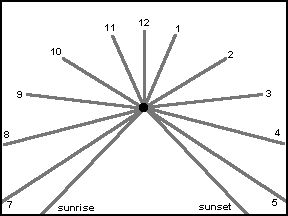
Sunrise is problematical. You can look it up for your area, but it’s not that simple. (Have I said that before?) If you live on a mountaintop, sunrise will come earlier. If you live in a valley – or, in my case, on the west side of the Sierras – it will come later. How much can’t be calculated. It depends on how far west of that hill you are, and how high that hill is, and whether today’s sunrise happens to fall behind your neighbor’s house, or behind that big oak tree. It will come when it will come. Have a straight edge handy and draw a line from the dowel down the center of its shadow, then write down the time. Continue through the day. I try to make a mark every hour on the (solar) hour.

Early and late shadows will probably run off the board, but for the rest you can calculate the sun’s vertical angle because you will know the height of the dowel and the length of the shadow. Personally, I take the measurements, redraw the triangle on another piece of paper, and measure with a protractor; but then, I grew up before calculators.

You do realize that this is the year’s extreme for north tending sunrise and sunset and for high sun angles, and that every other day until December will be slightly different.

Even if you never design windows for north light without afternoon glare, or plan the placement of solar panels, or decide how deep to make a new porch, taking the sun’s angles throughout the day will give you a better feel for your personal environment, and a new appreciation for the complexities of astronomical observations.

Extreme astronomy geeks will repeat the process at the equinox and winter solstice, but good luck if you try. I’ve never been able to pull off any shadow measurements in December because of clouds.

Jandrax 55

Nightwind stepped to the door and rapped sharply. In his left hand he carried a strip of supple hide and two hide cords. Paulette Dumezil opened the door, then opened her mouth to scream. He hit her.

Nightwind closed the door behind him and worked swiftly, binding her hand and foot and tying on the leather gag. He peered out again and saw no one. Heaving her to his shoulder, he padded down the street to the wall.

He could not climb the wall with his burden, nor lower her over the palisade with the guard nearby, so he left her at the foot of the ladder. When the guard had passed overhead, he went noiselessly up to meet him.

The guard stiffened and turned, bringing up his bow.

Nightwind smiled, crouched before him.

For a moment the guard was startled into immobility, and that hesitation was his last mortal act.

Nightwind wiped his knife, sheathed it, and dropped back to recover his quarry. Paulette was regaining consciousness so he struck her again, carried her up the ladder, and lowered her to the ground outside.

At midnight, Adrian Renou went to relieve the guard at the river wall and found him dead, his blade undrawn. In the furor and confusion that followed, it was several hours before anyone realized that Paulette Dumezil was no longer behind the palisade.

*****

This is going to be one of those notes for writers that someone just reading Jandrax for enjoyment may want to skip. It’s not quite a spoiler, but it comes close.  Continue reading

170. Middle School Astronomy

We learn our astronomy from books, but that isn’t how the science started. The ancient Greeks learned about the stars by looking at the stars. Their understanding was a mixture of observation and myth, with myth sometimes predominating.

When we are young, we also learn astronomy from casual statements we hear from adults. I’ll give you an example. Mars has recently been at a close approach; every evening lately, when I step out my front door (miles from the nearest city) to look at the sky before bed, there it is, red and bright, about halfway to zenith in the south-eastern sky. Now imagine that I say to a child, “Mars is really getting close.” Just that, with no other comment. What images might pop into that child’s mind?

*****

“The seasons change because of changes in the Earth’s tilt.” You might find a statement like that in an old middle school science textbook along with an illustration like this:

ma1

Not true. Not a lie, but an oversimplification that may be fine for the average student, but does not do justice to the brightest kid in the room. A better statement would be, “The seasons change because of apparent I changes in the Earth’s tilt”, coupled with an illustration like this:

ma2

Now we are more accurate but we’ve confused 90% of the students.

It should be obvious by now that this is a bit of a how-to based on long experience. Even if you aren’t a teacher, you will probably someday have to explain this kind of thing to your own kids.

Let me suggest a third option. First explain things in your best lecture voice with reference to the textbook and with drawings on the board. Then pick a student sitting in the middle of the classroom; out of kindness, choose someone who likes attention. Say, “Helen, don’t move. For the next few minutes, your head is going to be the sun.” Then establish where Polaris lies, for the sake of the demonstration. Your classroom may not allow you to use real north. If some bright, smart-mouth kid catches you out, don’t get mad. Rejoice that someone is paying that much attention and make it a teachable moment.

Now walk around the classroom with the classroom globe tilted toward your Polaris and talk them through the seasons, pointing out that the tilt never changes in relationship to Polaris, but it appears to change in relationship to Helen, our sun. Pat your worst troublemaker on the shoulder as you pass him, wink at the shy girl in the back corner who never volunteers, and say, “Excuse me, Earth coming through,” when you have to dodge around desks.

There is a rule of thumb for teaching science (which probably doesn’t work for algebra). If you enjoy teaching, and you let your students enjoy learning, they probably will.

*****

That exercise was for letting students visualize things they can’t see for themselves. You can also help them see things that happen in their everyday world, but normally go unnoticed.

Observing the path of the sun through the seasons is an Earth’s-eye-view version of the tilted globe carried through the classroom. How do you compress a year’s worth of observation into one 40 minute session, using the real sun instead of charts and graphs? It can be done, but it takes nine observations on your part, spread over three days, with those three days spread over half a year. It also takes a small can of paint and a paintbrush.

When I set this up, I picked a solid, upright, eight foot steel pole which was set up away from the shadows of structures and which I knew would not be disturbed for years to come — a volleyball net pole out on the playground. At 10 AM, noon, and 2 PM (sun time, not daylight savings time) one summer solstice I painted three inch circles (same diameter as the pole) at the pole shadow’s tip.

I repeated those actions during the fall equinox, which was intriguing for my students. I had a paint can and small brush at the ready during my ten and two classes, and on the stroke of the hour, I ran out of the classroom, painted the circle, and ran back in while they watched from the windows. The noon painting had an even bigger audience because of noon recess. As you might guess, I told those who asked questions, “You’ll find out what this is all about — some day.” On Christmas break I painted the last three circles during the winter solstice.

That spring, and for years afterward, I arranged to teach solar motion as near as possible to the spring equinox. The solstices fall outside school days, and the fall equinox is often cloudy in California. I explained everything with lectures, and reading, and drawings on the board, but then we all went out to those nine circles on the playground. As I talked them through the lesson, we all watched the pole’s shadow move. It is fascinating in our mile-a-minute world to take the time to watch a shadow inch its way across the ground. Even if it wasn’t 10 or noon or 2, everyone could see that the shadow’s tip either had or would touch all three of the middle circles.

I explained how I had placed the circles and invited students to lie down with their head on a circle and look past the tip of the pole to see where the sun would be (or would have been) at noon or 10 or 2 on the first day of summer or the first day of winter.

They paid attention. On days they pay attention, learning happens. It isn’t easy, but it works.

Jandrax 54

He wore no shirt, no jacket, and no cap.

The night was warm by the standards of Harmony, but none of the colonists would have dressed thus. Nor would Nightwind, had he been relaxing in his camp, but this was a mission where discomfort weighed second to mobility and he expected to remain active enough to make up for his lack of clothing.

The sun was down and Beta was up, shedding a silvery light. The fields were bloated with the excess snowmelt. He slipped from bush to bush, a shadow among shadows. Beneath the palisade wall he paused for a long time, listening. When his ears had confirmed what his eyes had seen from afar, he unwound the braided rawhide line from around his belly and made a loop, then flipped it effortlessly up to catch on the palisade wall.

He was over the wall in a moment, fading back into the shadows, coiling his line. Young Adrian Renou stood his guard, unaware that his perimeter of defense had been penetrated. Nightwind sneered.

He moved among the shadows all but ignoring the ineffectual guard and dropped to the ground. All of the doors in the town were bolted fast from the inside, so the Old Man said, but he knew where he could wait.

Slipping across the courtyard, Nightwind climbed to the second story of the town hall and the cubicle where Anton Dumezil made his home. He had personally watched Dumezil go out with the young men to hunt and knew that his wife was several years dead. It was a calculated risk that his apartment would be empty. It was.

Nightwind opened the shutters on the window overlooking the square and carefully carved out a notch. When he closed them again, they appeared unchanged, but he could watch the square unobserved. Satisfied, he dropped the bolt, wrapped himself in one of Dumezil’s robes and slept.

Nightwind woke late in the morning and that shamed him. He had lived in the open all his life and the dim light of indoors had lulled him into thinking that the night continued outside.

He went to the window and stood watching the square. People came and went. Most were women since the men were hunting and the boys were sleeping late after a night on guard. Some of the women were attractive and these Nightwind watched with sharp attention. One in particular caught his eye.

Paulette Dumezil came to the cistern for water, carrying twin wooden buckets at the ends of a staff. She moved with an almost unconscious swaying of her hips though there was no one to see her. The cistern water was days old and sour; it rankled that she could not go down to the river for fresh water, but the hunter’s council had declared that no woman should leave the palisade during the hunt. She could hardly remember the last abduction and discounted the danger. Taking the water, she returned to the cubicle where she lived alone now that her husband was on the hunt.

Nightwind tried to eat some of the supplies Dumezil had stored but found them unpalatable. He was used to fresh meat and fresh fruits. Ignoring the hunger in his belly, he lay down again in the afternoon to sleep. He had chosen his quarry and there would be no sleep tonight.

The moons moved in their complex patterns. Gamma was the first to rise, coming into view while the sun was still well up in the sky. Nightwind watched the sky for redness, though he could not see the sun from where he stood. Dusk came. Nightwind’s skin shone red in the afterglow as he left Dumezil’s apartment and slipped into the shadows. A few people were still on the street, but Nightwind had no difficulty avoiding them. more tomorrow

169. North Light at Solstice

Some years ago, I had an epiphany at solstice time, all about north light.

North light is one of those concepts we accept without thinking it through. Artists prefer north light for their studios – we learn this young if we are thinking about being painters. Most of us never become artists and never have a studio, so the notion falls into the category of unexamined concepts.

I learned to paint and draw, but my skill level never rose above adequate. I didn’t become an artist, or any of another double-dozen fleeting ambitions, but I did become a writer and later a teacher. As I was nearing retirement, I bought a three acre parcel with house in the foothills of the Sierras.

For the first time, I had the chance to build something bigger than furniture or musical instruments. I was wandering around the back yard on blistering summer afternoon, thinking about north light and about building a shop with big widows pulling in masses of lovely natural light, when I looked at the north wall of my new house and saw that it was in full, hot, withering sunlight.

That’s not supposed to happen. But it does.

I live at latitude 37, roughly in line with San Francisco, Tulsa, and Washington, D. C. Here the sun is so far north (apparently) by mid-summer that it rises well north of east and sets well north of west, traversing a curved path so that at noon it is still south of zenith. The result is that the north sides of structures receive cool morning sunlight, shade during most of the day, and blistering sunlight in late afternoon.

I should have known, but in the cities where I had spent my life there were always trees and the shadows of multiple buildings to hide the effect. I had studied astronomy, but that is about the big picture, not about what is happening in your own backyard. I should have known from a youth spent outdoors, but then I was always on a tractor and in motion, concentrating on the windrow of hay I was creating, not on how sunlight fell on structures.

As a childI was aware of the motion of sunsets across the western horizon as the seasons progress, because every evening I was in the dairy barn looking out its west facing windows. I still love that phenomenon. There is a place near my foothill home where my wife and I go to watch the sunset. The spot faces west, on the western side of the westernmost hill in our area, so the vista carries all the way across the San Joaquin Valley to the coast range, and to the the buildup of clouds beyond where the cold waters of the Pacific spill fog over San Francisco. Mount Diablo, the highest peak in this section of the coast range, lies directly west of our lookout. Every spring and autumn equinox, the sun sets directly behind it. As summer progresses, each sunset is further north until we reach the summer solstice. Then they drift back, pass Mount Diablo, and head south until the winter solstice turns them back north again.

This is how astronomy began, with observations of visible phenomena. There were no ideas of orbiting bodies; that came later. Today, however, we know too much. We learn our astronomy from textbooks, not from our own observations. And then the reality in our own back yard catches us by surprise. more tomorrow and Wednesday

*****

For the record, I scratched the itch to build a building. My wife and I rebuilt a sagging 11 x 24 tool shed, put in big windows and a fancy facade. It is our quilting studio, where I also write. I’m sitting in in it now, watching the sun rise through the east window.

Jandrax 53

It occurred to Dumezil that there could be only one destination for young Dubois. The gig could be sailed upriver even in the melt if the wind were as strong as it had been for the last two days. There he could hunt alone and perhaps recoup his status. It would be extremely dangerous; no, it would be suicide. He could never survive it.

Well, the damage was done. He would simply tell the hunter’s council what he had found and they would look for his body. Or, rather, for the rifle.

***

On his way back from the Dubois house, Dumezil walked out to the hillock south of town where old Marcel was buried. Old man, he thought, staring down at the bare earth, why did you do this to us? You were the snake in your own Eden.

The sun was warm on Anton’s neck, if only by comparison to high winter. He squinted as he looked around. Water everywhere, great sheets of it stretching from the lake to the base of the hills, the remnant of the winter’s accumulation of snow. Soon all would be green again for a season. He remembered Bordeaux where the grass and trees were both kind and everlasting. Why, Marcel, Papa, mentor? Why this false hegira?

***

Positions on the barges were chosen by lot, but the elder Anton Dumezil had conspired to be assigned to outpost one each of the last five years. It made the trek easier for a man past his prime. The younglings were eager as always, poised for the slaughter. He could see little glory in sowing the ground with bones and entrails, though the hunt was a necessary pursuit.

Two-thirds of the male population went on the hunt, leaving behind only the women, the young boys, and a few older men like Levi-Stuer and Lucien Dubois. Chloe Dumezil cradled her infant son against her as she watched the barges depart carrying the younger Anton and the others. Her face was drawn with worry and disgust. It was clear that the men thought poorly of Anton, more for his surrender of the antler than for his actions during the last hunt. She had married him thinking him heir apparent to his father’s power. It was clear now that he was no such person.

Night fell on a town that was nearly half empty.

Levi-Stuer assigned guard posts to the boys and old men who remained. For many of the youngsters it was their first manly responsibility, and they strutted to their posts with bows strung and arrows bouncing at their hips. It was a pitiful guard, really, but Levi-Stuer was not worried. The others had not struck in several years and many believed that they had finally died out. They raided only during the hunt. Everyone seemed to accept that they simply struck when the guard was at its ebb, though some had suggested that they actually followed the herds. That was ridiculous of course; to do so they would have to travel thousands of kilometers a year.

Two nights passed without incident.

***

His name was Nightwind. He was slender but powerfully built, with no excess flesh. He wore herby hide breeches cut off just above the knee and high moccasins of longneck hide. He carried a bow and quiver which he hung in a greenhorn bush to protect them from moisture. His twin knives were of steel which he had forged himself, fashioning them lovingly over long hours. They were carried in a single sheath which was suspended horizontally before him, the blades overlapping, the handles projecting outward over each hipbone. He could draw either or both in a heartbeat. He wore no shirt, no jacket, and no cap. more tomorrow

168. A Woman in Space

53 years ago today, the first woman flew in space. Her name was Valentina Tereshkova. The Soviets hailed her as a hero of the People (see131. Chasing Cosmonauts), and as proof that Russia was ahead of the US in social advancement as well as in space travel.

The US treated her as a joke.

Both assessment were wrong, although both contained kernels of truth. Even today, half a century after the event, it is difficult to come to a balanced appraisal of the flight of Vostok 6. Russian propaganda and American dismissal still cloud the picture.  I am taking a shot at accuracy here, but a workman is only as good as his tools, so keep a measure of skepticism in mind.

Tereshkova’s father was MIA during WWII, leaving her mother to raise Tereshkova alone. She left school early to join her mother working in a state textile mill. There she joined a parachute club, which was a military auxiliary, and became an expert parachutist as well as secretary of the local Komsomol.

Early in the Soviet space program, there was a movement to add female cosmonauts, mostly for propaganda purposes. Candidates did not need flight experience since the Vostok craft were fully automated, but the did need extensive parachute experience, since at that early stage cosmonauts finalized their landings by personal parachute (see130.  First Into Space). Tereshkova was one of fifty-four candidates interviewed, and one of five who made it through training.

Tereshkova was personable, doctrinally sound in communism, from the peasant and workers class, hard working, willing, and an expert parachutist. She was not well educated nor an experienced pilot. Ponomaryova and Solovyova, female cosmonaut trainees who had those additional qualifications, were scheduled for a later, more sophisticated flight, and Tereshkova was scheduled for the Vostok 5/6 dual flight.

Vostok 5, crewed by  Valery Bykovsky, was launched on June 14, scheduled for an eight day flight, but a low orbit forced it to be shortened to five. Vostok 6, crewed by Tereshkova, was launched on June 16 and remained in orbit for three days. They passed within five kilometers while in space.

During the flight, Tereshkova discovered that the automatic orientation system had her flying sideways in orbit, an error that would have been fatal during reentry. Ground control confirmed and corrected. Whether she activated her final reentry personally or not is still unclear.

In those early days, landing accuracy had not been perfected. When she ejected from her craft, she found herself coming down into a large lake, and was only saved from downing by a strong wind that carried her to a rough landing on shore.

American astronauts, all of whom were test pilots, had little respect for the skills of Soviet cosmonauts. They used Tereshkova’s flight to justify their ridicule, saying that the Russians had simply pulled a woman off the line in a factory and sent her up into space as a glorified passenger. There was a bit of justification in their assessment. It was a propaganda stunt, but that didn’t mitigate the dangers. Tereshkova was uneducated, but by six years later she had taken advantage of her situation to earn a degree in engineering. She was not a pilot when chosen for training, but by the time of Vostok 6 she had learned to fly jets and had made 120 additional jumps to hone her skills as a parachutist.

Alan Shepard was a superb test pilot when he flew his Mercury mission, but he had almost no control over his capsule and nobody called him spam-in-a-can. Well, actually, Chuck Yeager did, but that’s what too much testosterone will do to your thinking.

Tereshkova’s contribution to space flight was real, but the Soviet commitment to equality was not. Ponomaryova and Solovyova’s flight was cancelled, and it would be nineteen years before another Soviet woman flew in space. It would be twenty years before the first American woman, Sally Ride, entered space, even though thirteen American female astronauts had been chosen and trained during the early sixties. Like Ponomaryova and Solovyova, they never flew.

Jandrax 52

Everything was crazy now. The young men wanted to take authority, forgetting that they, too, would grow old someday. It could not be that way, but how was he to stop it; though there had been few women – and too many of them had been lost to the others – those remaining had been fertile, and the younglings outnumbered their elders two to one.

Everything was crazy, but that young Dubois was the craziest of all, he and his bastard rifle. The council of hunters had demanded that Anton retrieve that weapon to be used in the hunt, ignoring the fact that young Dubois had contributed five rifles to the council and had made ten of those Levi-Stuer was renting. Fools! They should be honoring Dubois, not angering him. He had proved himself a man in the hunts, and further in his confrontation with Anton’s eternally damned son. They counted him half a man because he was crippled, but such misjudgment always backfires. If they had treated him right, he would have made rifles for the next twenty years, becoming the single most important man in the community and vastly augmenting the colony’s tenuous hold on civilization.

But they had not honored him; they had reviled him.

Worse, their attitudes had so affected the impressionable young femmes that he was now without a mate. The asses! They should have banished young Anton and made Dubois a present of that slut Chloe.

Dumezil swung heavily away from the wall and worked his way down the ladder. Jean Dubois was his nephew, his sister Angi’s son; why could worthless young Anton not have been more like him?

***

Lucien Dubois answered the door personally. Anton could hear Lucien’s daughter working in the kitchen and could smell boiling meat. It was a sharp, rancid smell – year-old meat from the permafrost cellars. Soon there would be fresh meat to eat. Of all the things lost in coming here, Anton missed most the good French cooking of Bordeaux. Here there were not a dozen edible plants and a half-dozen edible species of animal. With such plain fare, eating had ceased to be a pleasure.

Lucien looked bad. Of course, Lucien always looked bad, thin to the point of emaciation, weak tuberculosis probably. He should leave the household before his sons and daughter caught it, Anton thought, but where would he go? Still, Lucien seemed more distressed than usual.

“Lucien, old friend, you look troubled. What is it?”

Dubois motioned him to the wood and leather chair that sat by the fire, taking a stool before his honored guest. “It is my son, Jean. He has gone.”

“Gone? Gone where? Where could he go?”

Lucien shrugged. “Who knows? He has been very bitter lately.”

Anton nodded. “Perhaps he is keeping liaison; he has no wife. Maybe some great hunter is all talk and no manhood?”

Lucien looked puzzled, then took his meaning. “No, Anton, he is really gone. He took the gig, the one with sails, and left two nights ago.”

Now this was news in a town where little ever happened. Anton was offended not to have heard. “Why was I not notified?”

“Why should you be? He committed no crime. If he wanted the gig, it was his. He was a man. He hunted so that we could have meat and he made rifles so that the colony would be stronger. Whatever I have is his if he wants it.

At mention of the rifle Dumezil was reminded of his mission. “The bastard rifle, did he take it with him?”

“Of course, he was never without it.”

This was bad. While the rifle was technically Jean’s, the hunter’s council wanted it and they would make things hard for Jean when he returned.

If he returned. more tomorrow

167. On the Brink of Glory

Not everyone who does the work endures the danger is there to reap the glory.

Take Eliot See and Charles Bassett for example. Both were chosen for the second group of astronauts, and were assigned as the crew of Gemini 9. They were flying together in a T-38 trainer en route to prepare for that mission when they went down on approach to Lambert field in bad weather. Both were killed, crashing into the building where their spacecraft had been built, not 500 feet from the Gemini 9 itself.

Gemini 9 would have been the first spaceflight for each man.

Everyone knows the names Grissom, White, and Chaffee, who died on the launchpad in the “Apollo One” fire. Grissom and White were veteran astronauts. Roger Chaffee was among the third group of astronauts chosen. He worked through the Gemini program without being given a mission, then was chosen to replace Donn Eisele, who had been injured during training, on the first scheduled Apollo mission. That flight ended in fire, on the ground during routine preparations; Chaffee never got to fly in space. Eisele recovered from his injuries and flew on the next (and first successful) Apollo mission.

Robert Henry Lawrence Jr. was the first African-American astronaut. (Ed Dwight had been an astronaut candidate earlier, but was forced out.) At Edwards Air Force Base, Lawrence investigated unpowered glide return characteristics using an F-104 Starfighter, contributing greatly to knowledge necessary to the Space Shuttle program. He was assigned to the Air Force’s Manned Orbiting Laboratory program, but before he flew in space, he was killed in a crash landing while acting as a pilot instructor to a trainee. When the MOL project was abandoned, many of it’s astronauts transferred to NASA, where they became the backbone of the early Space Shuttle missions. Lawrence would almost certainly have been among them.

Milburn Apt became the first man to reach Mach 3, and died in the same flight. It was his his first flight in the X-2 rocket plane. He achieved the mission objectives, but found that his flight had carried him unexpectedly far from Edwards. Because of the X-2’s noted instability, he was not scheduled to begin return maneuvers until his speed had dropped, but that would have carried him too far for a safe return glide. He began to turn back at above optimum speed, and lost control as turbulence knocked him unconscious. When he regained awareness, he ejected his safety capsule – the forward section of the craft – but did not survive.

Apt received unwanted posthumous fame. The cockpit camera recorded the final seconds of his flight, and that film became required viewing for all subsequent pilots preparing for hypersonic flight.

Apt’s daughter was two years old when he died. She later became a writer, and her Letter to My Father Concerning the State of the World is a moving exploration of what it meant to her to be the daughter of a test pilot who did not survive.

Jandrax 51

He was no longer cheerful. His sister Marie had been more than patient with him but he knew that she could not wait to be married and rid of him. His father steered clear of him and his brothers avoided him.

He sat alone in the evenings staring into the fire – alone but for the constant pain – and wondered what he had done to deserve such a burden. Once he had not thought thus; once he had not complained or railed against his fate. But, then, once he had been whole.

***

Pierre did not remark when Jean ordered the hundred soft iron bullets, the primers, and the powder. After all, who would have more use for such than a gunsmith. He did seem to think it strange when Jean bought a small quantity of scrap copper, but shrugged it off with a layman’s ignorance of the workings of a gun.

The copper was expensive, but necessary. Since the colonists had not found lead on Harmony, they cast their bullets from iron. These were all 10mm, for Andrax had designed the muzzleloaders to fire the same ammunition as the offworld rifles. Jean put twenty of these in a special mold and added molten copper to bring them up to 17mm. He filled a horn with powder, pocketed the deadly primers carefully shielded against shock in trihom-wool batting and pocketed the bullets.

Raoul brought the gig around just as Jean had requested. Jean was sure that his youngest brother found him a little insane; probably the boy was right. Three laborious, painful trips were necessary to carry down the provisions he wanted. Then Jean climbed aboard alone, rowed out from shore in the twilight, and set the sail.

Chapter 11

Anton Dumezil, the elder, paused on the catwalk that surrounded the palisade. Leaning against the truncated tree boles, he stared out across the fields. The melt had come. The fields between the palisade and the lake were sheets of snowmelt, broken here and there by the coming green. The intricate webwork of canals which would prolong the greening far into low winter was hidden beneath the sheet of natural water. A few prams moved about, poled by anxious farmers, all old men and boys.

Eventually the question would come – was he fit to lead the colony now that he was no longer a hunter? He would hunt this year, as he always did, but it had been some years since he had carried his own weight. Rightfully, he should turn his rifle over to a younger, stronger man.

It was wrong that the young men should have such power, even though the meat harvest was of paramount importance. LeviStuer had been preaching that for years, only ceasing when that Dubois boy went to work for him last year. Anton had not listened and now he wished he had.

His father, old Marcel, would have listened. He was crazy, but he listened.

Now his eldest son conspired against him, though he would stand no chance in a political contest. Young Anton had hurt himself badly by allowing Dubois to be gored the elder Anton had no doubt that it had been intentional and had proved himself indecisive in letting Dubois live when a clean knife thrust into the already gaping wound would have opened the femoral artery, yet have gone unnoticed. Further, he had had the gall and stupidity to marry that Chambard girl while Dubois lay bedfast.

Still, young Anton might have pulled it off, for Dubois was discredited as a man by his crippling injury. But then the boy had let Dubois take back that horn, a visible taunt and slur on his manhood. What a fool! What a coward! How could such a one have sprung from his loins? more tomorrow