
Monthly Archives: June 2016

166. Nonstop Before Lindberg

Nonstop over water is a big deal. In the early days of aviation, planes failed frequently, and forced landings were standard procedure. Landing in a cow pasture was problematical. Landing in the ocean would likely be fatal.

In 1909, Louis Bleriot flew nonstop (there wasn’t any other way to do it but nonstop) across the English Channel. He would certainly have set off a round of longer and longer first flights, but WW I got in the way.

After WW I, there was a surplus of newer, more sophisticated aircraft. Two British flyers, John Alcock and Arthur Whitten-Brown, along with several other competing teams, set out to cross the Atlantic nonstop, beginning their flights in Newfoundland. Hawker and Grieve took off first, crashed a thousand miles into the flight, and were picked up by a passing steamer. Raynham and Morgan tried an hour later, but crashed during takeoff.

Alcock and Brown left Newfoundland on June 14, 97 years ago today. Alcock, the pilot, had waited as long as he dared for better weather, but finally decided to chance the near gale force winds. The two aviators, in a single open cockpit, took off at 4:10 PM, barely clearing the trees at the end of the runway. They headed east toward Ireland, with the wind behind them to hurry them along.

Shortly after takeoff, Brown discovered that their wireless was not working. He crawled out of the cockpit onto the wing to get a look at the small propeller mounted under the fuselage which powered the radio. Three of four of the blades had sheered off. They would remain out of communication until their flight either succeeded or failed.

At 7 PM, the exhaust pipe on the starboard motor overheated, split, and burned away. This left the motor running erratically, but there was no way to fix it.

They were flying at 3000 feet; Brown was navigating by sextant. When they entered a fog bank. Alcock had to rise to 12,000 feet so they could see the stars again. About sunrise, they entered an even higher bank of fog. They could not tell left from right or up from down, but the instruments showed the plane listing and then entering a spin. They dropped down, blind, almost to the ocean itself. Fifty feet above the water they cleared the fog and clouds with wings vertical. Alcock pulled up just above the water.

For hours they flew in alternating clouds and clear air, until the storm turned the sky black in front of them. Then they entered snow, sleet, and freezing rain. Alcock tried unsuccessful to fly above the storm, but the only result was that a critical gauge, fixed to a strut outside the cockpit, iced over. Again Brown had to leave the cockpit to chip away the ice, but this time he had to remain, clinging to the cross wires, to repeat the process every time the gauge re-iced.

Eventually they had to drop down through the storm again to see the ocean below so they did not overfly their destination. At 8:15 AM, June 15th, they sighted the Irish coast.

Alcock and Brown were knighted for their efforts, and lionized in Britain.

In America, not so much. Eight years later, Lindbergh flew nonstop from New York to Paris, following the same route overwater as Alcock and Brown, and became famous throughout the world as the “first man to fly the Atlantic”.

***

These posts are necessarily short, so details get missed along the way. Like Bleriot before them, Alcock and Brown, and their competitors, were in pursuit of a monetary prize. This time it was for the first single plane to cross from North America to Britain in under 72 hours. The “single plane” rule was to avoid someone flying from Newfoundland to Iceland, jumping into a second, newly fueled and serviced plane, and completing the trip. Stops along the way were allowed, as long as the same plane was used.

A decade later, Lindbergh was also in a race with a bunch of other flyers to win a monetary prize for the first non-stop flight from New York to Paris. There was nothing in the prize about a solo flight. The other competitors were in larger planes, with crews. Lindbergh flew solo to save the weight of a second person, so he could carry more fuel.

Does this sound familiar? The X-prize, recently won by Burt Rutan’s Space Ship One, was modeled after these early aviation prizes. Even the moon landing was the result of competition, not for money, but for prestige and the military high ground.

If you want more information on early aviation feats, check out Famous First Flights That Changed History, by Lowell Thomas, junior and senior.

Jandrax 50

Andrax was a genius. We would never have made it without him.”

“You said ‘in your studies since.’ Do you mean that Jandrax Andrax designed the muzzleloader before you became a gunsmith?”

“Oh, yes, he taught me the trade. I used the computer but he made the subject come real in my mind. Quite a man.

“What happened to him?”

The older man froze. Jean had seen the elders do that so often and always in response to the same question. What was there in this person that was so special? Some special honor or some special horror?

***

Chloe was pregnant. Jean wondered if it was Anton’s child or his own, or if it belonged to a third party. Probably not even Chloe knew for sure.

***

By the melt, Jean had learned his trade. The off-world rifles were wonders of simplicity, as were the Jandrax muzzleloaders. The latter had only a barrel and a stock, a flash hole which was stuffed with a paper primer, a hammer and a trigger and the two bolts on which they revolved, and one spring. Only two moving parts. The offworld rifles were complex only by comparison.

During the winter Jean had built fifteen muzzleloaders in addition to his personal weapon. The latter was a standing joke; “Dubois’ Panic Pistol” the hunters called it. Jean didnt blame them, really. The true joke was that he had built himself a rifle at all since he was forever barred from hunting. He turned five of his weapons over to the council to be used on the hunt. That would buy him and his family meat for the winter, and well it should. Five rifles were worth more than five men, but the council drove a hard bargain. It was made up of hunters, naturally. The other weapons he gave to Herbert in exchange for his education. Levi-Stuer protested that the payment was too high, but Jean would have no man say that he was unable to carry his weight in the community.

If he seemed bitter, he was.

Paulette Dumezil had married. She was the last of Jean’s agemates. The oldest unmarried girl in the community was now four years his junior and she was being courted by all the fine young men who would soon go out on their first hunt. They would blast their way to glory and manhood with the rifles he had built.

Bitter? He damned well was.

***

Within the courtyard of his father’s house, Jean practiced walking without his cane, but he never went outside without it. It was not that he could not, but as long as he carried that horn, people would remember the man who was injured as well as what he had become.

This he also practiced. He had fashioned a metal hook and attached it a handsbreadth below the handle of his cane. With the cane in his left hand and his rifle in his right, he limped across the courtyard, then suddenly swung around on his good leg, going to a crouch, planting the cane like a tripod, and swinging the rifle up in one motion. The rifle barrels came to rest on the hook so that either barrel could be fired, his eye was at the sight, and his finger on the trigger. Not graceful, certainly, but quick enough. From the beginning of the maneuver until the hammer fell on an empty flashhole only four heartbeats elapsed. more tomorrow

165. Hopping Across the Atlantic

In False Fame on June 7, I gave Lindbergh a bit of a hard time. That was fair, but there is more to the story.  Lindbergh left New York, flew to Newfoundland, then crossed the Atlantic and landed in Paris, all in one unbroken flight and solo. No one had done that before and he deserved credit for his achievement.

During the New York to Newfoundland part of the flight, and crossing France at the other end, Lindbergh could have tried to set his plane down in a cow pasture if it had faltered. He would probably have lived to tell the tale. It is the over water part of his flight that scared those who followed his exploits and made him a hero.

However, eight other men had already crossed the Atlantic by air and two of them were on a non-stop flight.

***

A great deal of progress in aviation had taken place between the Wright brothers first flight and the end of WW I. By 1919, the U. S. Navy was ready to attempt a flight across the Atlantic, using Curtiss flying boats.

There was a generation of world wide flight, now largely forgotten, between world wars one and two, that used flying boats. The reason was simple – there were few airfields. If you wanted to fly to Cuba, for example, your only choice was to land in the water at Havana harbor. All that changed in the 40s when warring nations, especially the US and Britain, built military airfields across the globe. When peace returned, the day of the flying boat was over.

300px-Curtiss_NC-4_four_engine_configuration-detailIn 1919, that generation of flight was just beginning. The U. S. Navy had commissioned Glenn Curtis to build four flying boats before the end of WW I, and now planned to use them in an attempt to cross the Atlantic by air.

On May 8, the NC (Navy Curtiss) 1, 3, and 4 left New York on a three jump flight to Newfoundland, where they were repaired and readied for the longest over water part of the journey. They left Newfoundland on May 16, heading toward the Azores. A string of naval ships were set out along the way for navigation or rescue. The NC-4 arrived at the Azores after a 15 plus hour flight. The NC-1 and -3 didn’t make it. The NC-1 landed in the open ocean; it crew was rescued but the craft later sank. The NC-3 also landed in open water, then taxied the last 200 miles to the Azores.

The NC-4, now alone, left for Portugal on May 20, but didn’t get far. After repairs, it again departed on May 27 and arrived at Lisbon harbor ten hours later. From North America to Europe, the trip took just under 27 hours – or just under 11 days, depending on how you spin your figures. Subsequently, the NC-4 flew on to Portsmouth, England, making it the first flight from the United States to Great Britain.

All in all, three aircraft with six-man crews and 53 Naval support ships were involved in the journey. The crew of the NC-4 were Albert Cushing Read, Walter Hinton, Elmer Fowler Stone, James Breese, Eugene Rhodes, and Herbert Rodd.

Two weeks later two British aviators made the Atlantic crossing non-stop. We’ll look at their flight tomorrow.

Jandrax 49

Jean looked up from the lathe where he was turning a firing pin for one of the double rifles. Levi-Stuer was whistling a tune the young man had never heard before and, as Jean was a collector of tunes, he listened for a moment, memorizing. But it was only a fragment which LeviStuer kept repeating.

“Herbert,” he called, “what tune is that?”

“Um? Was I whistling?”

“Yes, but I don’t know the tune.”

The gunsmith looked puzzled. “I don’t know what I was whistling; I wasn’t paying any attention.”

Jean chuckled and whistled the fragment back to him. Herbert laughed. “I haven’t heard that in years. My wife would disown me if she knew I knew it.”

“That good, eh?”

“You bet! Listen.” He sang it in a broken baritone, all about a femme of unlikely appetites and proportions. They laughed together until tears came.

LeviStuer leaned weakly against the bench and wiped his face. “If you tell anyone where you learned that one, I’ll not forgive you.”

“Never!”

Herbert had mellowed in the months since Jean first came to him. His life had been unutterably lonely before and Jean had wondered why he chose to make rifles rather than wield them, much as his community needed the weapons. Now he knew, though LeviStuer would never admit it. It was written in his red eyes and the way he leaned forward to inspect his work with an eye almost to the metal. Herbert LeviStuer, master gunsmith before Jean’s coming, the only gunsmith was more than half blind. Jean didn’t mention it, not wanting to shame the older man.

Jean limped over to the desk where they took their lunch, cradling his bastard child. It was a weapon such as that world had never seen, a normal muzzleloader with a long, tapering 10mm barrel and a normal hammer mechanism and trigger, but with a very short second barrel mounted where the fore-stock should have been. This second barrel was calibered to 17mm and fired from a separate hammer and trigger set forward of and below the first. No one else was the least interested in it because it weighed several kilos more than the already heavy muzzleloaders; but then, no one else had had such a pointed reminder that single-shot weapons are not satisfactory for dangerous game.

Jean accepted a mug of chota and set to sanding the stock. He worked on his personal project only when no other task was pressing. Herbert watched for a moment, then chuckled, “Andrax would have liked that weapon. It would have appealed to his way of thinking.”

Jean was curious. “Andrax? You mean Jandrax?”

Jan Andrax was his name. It was only after he left that people bastardized his name.

Jean laid his pet aside. “People say that he designed the muzzleloader.”

“That he did, and a fine job, too. In all my studies since I have never seen a simpler design that would be workable with our limited technology. Take that thing of yours. No offense, but the effort you put into it could have produced two normal muzzleloaders.

I know. I would like to design a true double rifle like the offworld guns, but every time I try to get one off paper it turns out too heavy.”

“Exactly! Andrax was a genius. We would never have made it without him.” more tomorrow

164. Flight into Space

The golden age of (fill in item of your choice) is thirteen.

I first read that phrase in reference to science fiction, but it works for quite an array of things. Certainly the music of our youth is the music we will always prefer, although that may come to us a couple of years after thirteen. It certainly works for automobiles and aircraft.

For me that golden age revolves around the F-104 and the X-15.

***

The entire focus of Edwards AFB, including most of the X-craft, was to fly higher and faster. The higher part caused problems with loss of control as the atmosphere thinned. The faster part brought about heating problems from atmospheric friction. Both lines of research culminated in the X-15.

The X-15 was first contracted in 1954. Early in its development, a follow-up aircraft to be called X-15B was considered. It was to be launched atop a Navaho missile in order to reach into space. NASA dropped the idea in favor of the Mercury program. The Air Force followed up with the proposed X-20, but that too was cancelled after Mercury became successful. Actual flight into orbit by a winged craft would not occur until the first Space Shuttle launch.

The first X-15 flight took place in 1959 and it was still flying nine years later, less than a year before the first moon landing. Like the earlier X-planes, the X-15 was dropped from a larger plane, in this case a converted B-52 bomber. Rather like a two stage rocket, this piggybacking allowed the X-15 a head start. The first 8.5 miles of altitude and 500 mph of speed came out the the B-52’s fuel tank, leaving the X-15’s fuel supply intact for the final push.

During that near decade, there were almost 200 flights. Thirteen of those flights went above 50 miles. The maximum speed reached in level flight was 4,520 mph.

The Air Force awards astronaut wings for flights above 50 miles – international rules do not agree. Two of those thirteen flights went above 100 kilometers. The Federation Aeronautique Internationale counts 100 kilometers as the edge of space, making Joseph Walker officially the thirteenth man in space. (Also the fourteenth.) One of those who gained Air Force astronauts wings was Joe Engle who later flew the Space Shuttle. Neil Armstrong flew the X-15 seven times, but never above fifty miles. He had to settle for a consolation prize on July 20, 1969 when he landed on the moon.

To successfully fly at such altitudes requires a series of small rocket motors strategically placed around the spacecraft to control attitude when the rudder, elevator, and ailerons have nothing to work against.

On high speed flights by the rebuilt X-15A-2, an ablative coating was sprayed onto the surface of the aircraft to protect it from overheating due to atmospheric friction, an issue that the SR-71 and the Space Shuttle would also have to face.

For my generation, the X-15 was the ultimate, and it looked the part. It’s pilots flew to the edge of space; they were not blown there in a capsule on top of a converted ICBM. Mercury and Gemini were wonderful. I followed them religiously. But the X-20, proposed descendant of the X-15, riding on top of a Titan missile would have done it with more class. And it would have landed under the pilot’s control, not on the end of a parachute in the middle of the ocean.

Scott Crossfield, the X-15’s designer and first pilot said it was one of the few aircraft that caused grown men to cry upon its retirement.

Jandrax 48

Jean smiled and said sotto voce, “Not you, ma petite. You I can live without.”

Anger took her color and he wondered what he had ever seen in her. Walking past her, he took down a trihorn antler from the mantle.

“What are you doing,” Anton shouted. “That’s mine.”

“A trophy? These are as common as rocks. What makes this one so special?”

Anton said nothing.

Jean measured the antler against his cane, then tossed the cane into the fire.

“This is the horn that tore out my leg. You’ve said so many times, so it is reported to me. Very well, let the beast who crippled me provide my cane. I say that I own this antler, n’est-ce pas?

Slowly Anton nodded, looking as if Jean had cut the thing from his body.

Jean turned at the door. “It is fitting that I should have this. A payment of debts. I always pay my debts.

“And others always pay their debts to me.”

***

Perhaps it was the foolishness of youth that impelled Jean to do it, but he didn’t think so. Youth has no monopoly on foolishness. Jean never mentioned the incident to anyone, nor ever again mentioned his “accident”. Within the small community there was no one who didn’t know the story. He carved a bone handle at the base of the antler and never walked with any other cane.

He could have lived on his past work and on sympathy, but that was not his way. He could not say that he did not despair or that he was not bitter. He railed at his weakness, at the fates, and at the untrustworthiness of his friends. Yet he kept his feelings to himself.

Jean would never walk straight again; therefore he could not hunt, for he was in no condition to hunt alone and no one would trust his life to a crippled hunting partner. Not even his father or brothers would have been so foolish. So be it.

The colony was only twenty years removed from an advanced, mechanized civilization, and the colonists were farmers. Yet few native plants would grow on their irrigated farms, and the vast herds were their true livelihood. To be a hunter was to be a man.

To be unable to hunt was to be emasculated.

Putting it so crudely was unfair to a subtle state of affairs, but it was true.

This, too, Jean had to accept, or at least to find a way around. It was for that reason that he took back the antler. A highly symbolic act.

That Anton had allowed Jean to take it without challenging or killing him on the spot was an admission of guilt. Jean could have ruined him with the story, but did not. Yet he walked with the antler cane and speculation followed him. Several times someone asked if Anton had given him the antler, but Jean never answered and no one pressed him. The very question bordered on insult and no one risks a challenge unnecessarily.

Jean went to Levi-Stuer’s smithy, limping along the street in the dry, cold winter sun. The old man admitted him and closed the door against the cold. Levi-Stuer had been born and raised on Bordeaux; judging by his age, Jean felt that he must have been about forty when the Lydia arrived. He had taught himself the art of gunsmithing from the computer’s memory banks, aided, some say, by Jandrax. Jean had never known how much of the Jandrax legend to believe.

Jean leaned the antler against the wall, accepted the mug of chota, and told Levi-Stuer that he was ready to learn his trade. more tomorrow

163. X-craft

Jay Miller wrote a book called The X-planes: X-1 through X-31, and later revised it to include craft through X-45. (Presently, the number is up to X-56.) If you are any kind of a space aficionado, you need to look it up in your local library. The only thing wrong with the book is its title; not all X-craft were planes.

When I was growing up, I was in love with the F-104 Starfighter and the X-15 rocket plane, two aircraft with markedly similar outlines. The F-104 was designed, a few prototypes were built and tested, then it went on to become one of the most successful fighter jets in history. The X-15 was designed, three were built (and rebuilt after various incidents), and tested. There were never any more X-15s, nor had there ever been a plan to build more. The X-15 was never a prototype, because a prototype is a first iteration, built to be tested, perfected and turned into a series. That is true whether you are talking about fighter jets or can openers, but not true of X-craft.

X-craft were something different. They were flying laboratories – a much overused term, but still accurate, although technology demonstrator is preferred.

After World War II, advances in flight by Germans, British, and Americans, along with nascent cold war tensions, put us on the edge of an unknown frontier. The “sound barrier” loomed as the best known obstacle to further advances in aviation, but there were a hundred other unknowns that never made it into the popular press. Wind tunnels could only tell so much, computer modeling was decades in the future, and it made no sense to build a squadron of high-performance aircraft that might or might not fly.

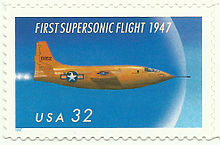
First_Supersonic_Flight_1997_Issue-32c

A glance at the first X-plane, the Bell X-1, gives clues to what was known and what was not known. We already knew that turbulence off the wing would foul up the tail controls at high speed, so the horizontal stabilizer was attached high up on the vertical stabilizer, not on the body. It was not known what negative effect the cockpit bubble would have, so the windscreen was faired into the shape of the fuselage. It was shaped like a 50 caliber bullet – everybody says that without explaining. It is a reference to the machine guns carried on fighter planes. Fired from a ground rest, those bullets would have been sub-sonic. The planes they were mounted on flew at subsonic speeds, but bullets fired from a plane in flight had been going supersonic for a long time.

An aside here for the non-nerd. Planes flying slower than the speed of sound are subsonic. That includes all commercial aviation except the Concorde. Planes flying faster than the speed of sound are supersonic. The X-1 and its follow-ons proved that supersonic flight is not problem. The problem is the transition zone, the trans-sonic region. Slower than sound, the accumulated shock wave is out in front of you. Faster than sound, it is behind you. At the speed of sound, it is right in your lap, trying to tear your plane apart. No modern, supersonic plane lingers at that speed.

The X-1 broke the sound barrier (i.e., passed through the transonic region into the supersonic region) on October 14, 1947, with Chuck Yeager at the controls.

Since this is A Writing Life, I’ll add that I was born about two months after the sound barrier was broken. I was present on the planet for almost all of the early X-craft explorations, although far too young to notice. When I became aware of the X-craft, I fell gloriously in love with them and the infatuation never passed.

The X-2 was a more normal looking aircraft, with swept wings and a pilot’s bubble. It carried supersonic speeds to new heights, but killed its pilot in the process. I will tell that story next Wednesday.

The X-3 was an extreme aircraft, stretched out and incredibly streamlined right down to the tip of its needle nose. It looked faster than any plane before or since, but it wasn’t. All that streamlining couldn’t make up for the fact that the engine slated for the plane wouldn’t fit, and the one that did fit was underpowered. The fastest (looking) plane in the sky flew slowly.

The X-4 was tailless and not successful. The X-5 tested variable sweep wing technology. The X-6 was an aborted project testing out the possibility of a nuclear powered aircraft. The X-8 was a small, unmanned rocket designed for upper atmospheric research. The X-7, and X-9 through X-12 were test beds for missile research. X-13 and X-14 were early attempts at Vertical TakeOff and Landing (VTOL).

Then came the coolest aircraft/spacecraft in the history of mankind, the X-15, which will be the subject of tomorrow’s post.

Jandrax 47

Chapter 10

The elders find low winter a gloomy time, though Jean could not imagine why. The sky is clear most days and when it is not, the high ice crystals which pass for clouds make beautiful patterns. Of course, there is no vegetation but there is never vegetation except during the melt or where there is liquid water – along the river, surrounding the lake, and, of course, in the irrigated fields. When high winter arrives and the snow comes, the elders seem better contented, saying that the snow covers the barrenness of soil and rock. Jean simply could not imagine what it might be like to live where vegetation was a yearround thing. He loved the melt as well as the next person, but he also treasured a return to the lean cleanness and the simplicity of rock and soil.

The streets were compacted earth again, now that the mud had gone. Jean leaned on his cane and started out again after resting against the side of a building. He was still very weak and his leg never stopped hurting. For a week he had been exercising near his father’s house and this was the first journey of any length he had tried. Across the settlement to the house that Anton and Chloe were occupying.

He knocked on the door and waited, his breath freezing in a circle against the rough wood. That was the curse of low winter; every breath sucked a man dry and he must drink water by the gallon. Chloe opened the door and stepped back in horror.

“Good day, Chloe,” he said.

From within the house all sounds ceased as Anton, unseen, froze at whatever he was doing. After a moment Jean heard his footsteps approaching and greeted him as he entered the room.

Anton’s reply was half-hearted at best. Jean tried to interpret the look in his eyes. Hatred? Fear? Mere uneasiness? It was more than Jean could manage.

“It is good to see you up and around,” Anton said.

Jean ignored him and turned to Chloe. “You didn’t come to see me during my convalescence.

She opened her mouth; closed it. Then she turned angrily and went to sit by the fire. Anton replied for her, “She has been busy. It’s not easy to start a household.

“I wouldn’t know.”

Now Anton was really angry, but holding it back.

Jean had him at a disadvantage for he made no accusations. He did not ask Anton what had happened – why he had not fired. Anton wanted Jean to ask so that he could defend himself against the unspoken accusation; or, better still, for Jean to deny Anton’s story so that Anton could attack. Jean said nothing except, “You have something of mine.”

Chloe stiffened.

“I have nothing that is yours,” Anton replied.

“Yes, you have something that is mine by right of pain and I have come to take it.”

Chloe stared her amazement. Jean was crippled, but he carried his blade. He smiled and said sotto voce, “Not you, ma petite. You I can live without.” more tomorrow

162. False Fame, reprise

In October, 2015, I wrote a post about the people who got fame they didn’t deserve, or failed to get the fame they did deserve, or who deserved fame, but for reasons other that what the public believed to be true. Since we are going to visit a bunch of forgotten heroes in the next two weeks, I am reprising that post here.

True or false: Charles Lindbergh was the first man to fly across the Atlantic.
False. He was the ninth.

True or false: Charles Lindbergh was the first man to fly nonstop across the Atlantic.
False. He was the third.

The first flight across the Atlantic was by the NC-4, a flying boat with a crew of six, which left New York on May 8, 1919 and arrived at Lisbon, Portugal on May 27, after several stops and numerous problems. (coming June 13)

Less than three weeks later, John Alcock and Arthur Whitten Brown flew nonstop from Newfoundland to Ireland in a converted WWI bomber. (coming June 14)

Lindbergh flew nonstop from New York, north to Newfoundland, then across the Atlantic ending up in Paris. His flight was longer, but the Atlantic crossing was identical to the one made by Alcock and Brown eight years earlier.

Ask anyone in America today who was the first to fly across the Atlantic, and they will either say nothing or name Lindbergh. Alcock, Brown, and the crew of the NC-4 have all been forgotten. It’s not enough to be first, or best, if you don’t also catch the public imagination, or fall under the anointing power of the press.

*****

John Glenn was the most famous astronaut until Neil Armstrong replaced him. If you asked anyone in America during the sixties who was the first man in space, they would have said John Glenn. Nope, he was fifth.

All right then, he was the first man in orbit. Nope, he was third.

First American in space? Nope, third.

Russian Yuri Gegarin was the first man in space and in orbit. (see 130. First in Space) Alan Shepard’s sub-orbital flight was next, followed by Gus Grissom, also in a sub-orbital flight. Russian Gherman Titov orbited next, then John Glenn. For the completist who is reaching for his reference materials, the first X-15 pilot to win his astronaut’s wings came in just after Glenn. (We’ll look at the X-15 tomorrow and Thursday)

John Glenn earned his fame, and he never asked to be better remembered than his fellow astronauts. But he was.

Gegarin is still remembered by a very few, but ask any American who Gherman Titov was and you will either get a blank stare or be told that he was the Communist dictator of Yugoslavia. (And if you’ve forgotten him, it was Josip Broz Tito.)

*****

Okay, let’s not be sexist. True or false: in 1928 Amelia Earhart became the first woman to fly a plane across the Atlantic.

False. She was only a passenger on that flight; the pilot was Wilmer Stultz and the copilot was Louis Gordon. The flight was a bit of a stunt, and a successful one. On arrival in England, Earhart became instantly famous. There was a ticker tape parade and a reception at the White House when she returned to America. The press called her Lady Lindy. She wrote a book, went on tour, designed luggage and clothing, and generally became rich and famous – essentially before she had done anything.

But that’s not the whole story. Earhart later came to deserve the fame she had already gained. She became the first woman to fly solo across the North American continent, participated in the Santa Monica to Cleveland Woman’s Air Derby, and in 1932 she became the first woman to fly nonstop alone across the Atlantic, finally earning the fame she had received four years earlier.

It is a final irony in the fame-for-the-wrong-reasons game that Earhart is best remembered today for the flight in which she died, while failing to finish.

Jandrax 46

Jean woke. It was a sudden thing; after weeks of madness, the fever broke in the night and he woke with his full faculties, but weak, incredibly weak. He was in his own bed in his parents’ house. The quilt which lay over him was the one his mother had sewn of krathide the year she died. Jean had slept under it for nearly a decade.

Outside the ground was bare and brown. The shutters were closed tight but he could see through a crack. Another crack near the ceiling let a ray of light fall across his hands. They were fearfully thin. The ground outside told him that the melt had passed and the single shutter told that full winter had not yet come. Later, double shutters would be hung with dry leaves as insulation between them. At least a month had passed, but not more than two.

Jean remembered everything up to the moment he was hurled to the ground. He wanted to see his leg, but it took a long time to get the energy to throw back the quilt. When he did, he found his leg was wrapped in bandages and he got a look at his body. White; skeleton thin. The bandages were not bloody, and Jean was determined to see what lay beneath them. He nearly passed out from the effort of removing them; then he wished that he had.

The scars were massive, ridged, and ugly. That he could live with. But the bone had been broken and Jean could see that it had not set properly.

He moaned when he passed out, and his sister found him uncovered and unbandaged when she came rushing in.

A week later broth and renewed appetite had restored some of his strength. He found that much had happened during his unconsciousness. He had lain at the edge of death from infection and that was why, despite Doctor Marcuse’s undeniable skill, his leg had healed crookedly. It was a wonder that it had healed at all.

And Anton had married Chloe.

Looking back and pondering – there was certainly time enough for that now – it all made sense. Chloe had never been what Jean would have termed faithful. That she had been seeing Anton at the same time she was seeing him was no great surprise – in retrospect. It also explained Anton’s late-blooming hatred.

Why had he not fired?

Jean had to have the story, but he had to get it carefully. If it were an obvious lie, he had to consider whether or not to refute it. What could Jean accuse him of attempted murder? Or failure under pressure, which carried as stiff a penalty and greater shame. Would such an accusation be fair?

Furthermore, Jean had to consider whether or not he wanted to make an enemy who might call him out to fight. Once that would not have bothered him, but now . . . .

Anton’s story, as Jean got it from Claude Delacroix, was that he had fired as the trihorn passed – that is, he had pulled the trigger but the primer failed. He then recocked the rifle and took new aim, but held his fire rather than hit his partner. When the trihorn tossed Jean away, Anton killed it.

The story could have been the truth. Or it could have been a lie, and no one but Anton would ever know. Primers do fail, though rarely.

Jean could make no accusation. more tomorrow