
Monthly Archives: October 2016

239. Morning of the Gods

Not counting fragments, dead ends, and works in progress, I have written nine novels. Three were science fiction; two were published and one is in the process of being published, so this blog had concentrated most heavily on that genre. Three others were more or less contemporary, a survival novel, a mystery adventure (now on display over in Serial), and a novel on teaching, a bit of which appeared in Serial last Christmas time.

You wouldn’t know it from this blog, but I have spent more time and effort, and more of my soul, on three novels of fantasy than on all my other efforts combined. It’s time to give them a moment in the sun. Here is the opening of Valley of the Menhir, a prolog called Morning of the Gods.

**       **       **

Other lands; other skies.  Not of earth. Lands of red sky and green sea; or gray sky and silver forests. Lands and peoples as endless as the sand, and as nameless. Realities shifting into one another, slipping by like images glimpsed in a nightride through chaos.

Out there in the night that stretches away from us all – there where consciousness ends; where experience missed sets an iron boundary on our lives – there is a land of red sky and green sea, Poinaith, and another land where the gray sky leans down to lock hands with the sliver elfin forest. 

And there is a land that has no name. We will call it the World of the Menhir. Although menhirs are found on many worlds – they are, in fact, the gateways between worlds – on no other world are the fates of its people so intertwined with their menhirs.

The World of the Menhir was temporarily Godless. Certainly, there were plenty of ways to worship. Piety was great among the people, but the last real Gods had departed a thousand years ago. All that was about to change.

In the land of red sky, two riders came, the one skirting the water’s edge and throwing up a spray of spindrift, the other riding some paces inland and throwing up a spray of creamy sand.

The foremost rider, Rem Ossilo, drew rein and his mount Margyr shook its head in rebellion at ending its run. Hea Santala’s mount closed the distance between them and they cantered inland to the cliff base and the path that wound upward. Switchbacking single file, Rem Ossilo in the lead, they ascended the cliff to a rounded, grassy hill. The sea was green beneath them, hurling itself against the headland beneath a rusty sky.

At the top Rem dismounted to look back. There was no pursuit – yet. Hea Santala’s gaze followed his. Though her face was lined with sadness and his with anger, there was no mistaking the commonality of that gaze. It was a last looking, drawing in memories for an uncertain future, hoarding a moment out of time to nourish them in exile.

Rem Ossilo gazed long at the distance, first assuring himself of their temporary safety, then taking in the panorama of his homeland. That was his way. Hea Santala took in all things at once, loving the land and fearing her enemies in the same unwavering gaze. Even hating her enemies somewhat, not for their animosity, but because she must leave this land. That was her way.

Rem looked then at his wife; that there was still some affection in his glance was a tribute to her, not to him. In the distance there was a hint of dust. She raised a finger to point, saying, “Our children are coming.”

For a moment every light emotion left his face, and it was as if someone had opened the gates of hell. Then hell turned icy and he turned away from the sea, remounting and urging Margyr toward the jumble of menhirs that surmounted the hillock. Hea Santala followed without comment. All her life she had followed without comment, and that had been her undoing.

**       **       **

That’s the last you’ll see of Poinaith as Rem and Hea pass into exile in another world, the world of the Menhir, where Valley of the Menhir will properly begin five generations later.
Raven’s Run 29

By four, Raven was asleep. I wanted to be away from the Wahini before the port authorities arrived, so I set the alarm for two hours sleep. When it went off, I would have thrown it overboard if I had had the strength.

We rag-bathed by lamplight, lavish with soap and water for the first time now that we were in port. Quarters were cramped, so I helped her and she helped me. Somehow, that made the process take longer.

By the time we reached the street, the fish market had been underway for an hour. The sounds and smells were comfortingly foreign. Notre-Dame de la Garde was lovely in the early morning sunshine as it looked down on Marseille. 

The embassy wouldn’t be open until later in the morning, so we took our time. Raven was lovely in her shore going clothes, but it was a testimony to her, not to them. She was a fair seamstress, and I had sewn up the Wahini’s sails. Between us we had managed to turn a spare piece of terylene sail cloth into a simple shift. It was a little crude to look at, but I could guarantee it wouldn’t blow out in a fifty knot wind. I bought her a pair of sandals at a street stall to complete her outfit. On the Wahini, she had gone barefooted.

Raven was preoccupied. She walked at my side, holding closer to me than was her habit, and smiled. But she should have been electrically alive. How many people get pulled out of the ocean and whisked off to Europe on a private yacht? By someone who becomes an enthusiastic lover? I may not be a fairy tale prince, but I am not Beauty’s beast either. So we sat on a bollard overlooking the fish market and I asked her what was wrong.

“How is it since you rescued me, Ian?”

“Fifty-two days.” I had all the facts ready so I could tell my story with accuracy at the embassy. “I picked you up on April thirteenth. My lucky day.”

“Not so lucky for me.”

“Depends on how you look at it.”

“I suppose.”

“You could be dead. Instead of walking around Europe with me, enjoying the sunshine and the smell of fish.”

She patted my leg and smiled, but the smile went away quickly. She said, “I was supposed to catch a plane back to San Francisco the night my ship got to New York. Someone was supposed to pick me up at the airport early that Tuesday morning.”

“And you weren’t there. It wasn’t your fault.”

“I’ve been speculating about what happened then. Daddy would notify the airline and they would check to see if I ever got a boarding pass. Then he might check on later flights. If I didn’t come back within twenty-four hours, he would probably call the cruise line.”

“And they would say you never got off the ship.”

“No, Ian. That’s what is bothering me. When we got off in Bermuda, the Bermudan customs people checked our passports, but the cruise line people didn’t make a head count. If they did the same thing in New York on the way back, they would have no way of knowing that I never left the ship.”

“Leaving your disappearance a complete mystery. Maybe Davis and his sidekick had that in mind?”

“Maybe. That isn’t what I was thinking of, either. If I never got home, Father would not think I had drowned in mid-ocean. He would think I had turned left at the terminal with some guy I had just met and gone off to raise hell without telling him.”

I didn’t like thinking of myself as one of a cast of thousands, but she looked so glum that I said, “If that is true, then he has just been spared unnecessary grief.”

She nodded. “True. And I’m happy for him, but I’m not feeling too good about myself.”

It must have been contagious. Suddenly, neither was I.

*****

As I have said elsewhere, this set of events couldn’t happen today, because of ubiquitous, instant, worldwide communication.

238. The Worst Story

The Worst Story Ever Told

The rest of this week and all of next are devoted to fantasy. It’s a fluid category. In one sense, everything is fantasy. Science fiction almost always has some outré element, and it usually deals with science or engineering which hasn’t been invented yet, and probably never will be in the “real” world. The Iliad and the Odyssey are predicated on believing that the Gods are real. So is Pilgrim’s Progress, The Scarlet Letter, and most American fiction written before 1950.

We just need is a simple definition which separates science fiction from fantasy, so we can compare apples with apples. It probably doesn’t exist, but I’m going to throw something into the pond just to stir up the water.

Science fiction stories tell us to ask for the stars.
Fantasy stories tell us to be careful what we ask for.

**       **       **

The Gods have always told us to be careful what we ask for, and most men, frightened, have complied. A few have had the courage to complain, at least in poetry and song. Leonard Cohen, in Bird on a Wire, said:

I saw a beggar leaning on his wooden crutch,
He said to me, “You must not ask for so much.”
And a pretty woman leaning in her darkened door,
She cried to me, “Hey, why not ask for more?”

Khayyam in the Rubiyat, using pots as metaphors for human beings, said:

After a momentary silence spake
Some vessel of a more ungainly make:
  “They sneer at me for leaning all awry;
What! did the hand, then, of the Potter shake?”

**       **       **

Of those who knuckled under and said, “Be careful what you ask for,” no one has written a more damnable story than W.W. Jacobs’ The Monkey’s Paw. Morally, that is. As a piece of fiction, it is superb. As an apology for the status quo, no one has done better. That is to say, no one has done worse.

Without, the night was cold and wet.” So the story begins. Mr. White and his son are playing chess when Sergeant-Major Morris, back from India, comes visiting and tells the tale of a talisman, enspelled by a fakir, which grants three wishes to three men. The holy man “wanted to show that fate ruled people’s lives, and those who interfered with it did so to their sorrow.”

The first man had his three wishes. Morris does not know what the first two were, but the third was for death. Morris then had his three wishes, but he won’t discuss them. He hurls the talisman into the fire, but Mr. White recovers it and . . .

No, I can’t tell you any more. It’s all too horrible.

(But you can click the link above and read for yourself.)

Of course not all fantasy fits my baiting definition, and much that is not fantasy, does. I’m just poking the beast with a stick, because every time I read something that says, “Be careful what you ask for,” I am once again infuriated by the propaganda of surrender.

Raven’s Run 28

Evening was approaching and the city lights had begun to come on. After sixty-eight days at sea, it looked good. It looked like food, showers, a bed that did not heave all night long, and other people’s voices. Our bowsprit was pointed straight toward the seaside Promenade de la Corniche where people were driving home from work, or out for a night’s entertainment. The houses of the city rose up in tiers on the highlands beyond.

A ninety degree turn to port put the promenade on our right hand and took us under the battlements of Tour Saint-Nicolas, past the breakwater and the entrance to la Grande Joliette, the new ship harbor. The stalk-legged silhouettes of unloading cranes were black against the sunset as we passed, turning sharply to starboard this time and passed beneath Tour Saint-Jean down the narrow entry into the Vieux-Port.

Marseille’s old harbor is famous throughout Europe, even though it is now mostly used by pleasure boats and fishermen. It is a half mile long rectangle of water thrusting itself right into the center of Marseille, and packed with boats of every description. Encircled by broad avenues which are backed by shops and restaurants, it is the heart of the city. As we looked for an empty berth, the cathedral of Notre-Dame de la Garde was etched black against the fading sky high above us.

We tied up next to a rugged but colorful fishing boat. One of the fishermen helped up put out our lines, gesturing and giving orders in flowing French. When I answered him out of my hundred word French vocabulary, his gestures simply became more animated. Between us we managed to get the Wahini secured.

He pointed to the Q flag flying and said something I didn’t understand. After several tries, he simply repeated, “Demain.  Demain!” and I got the picture that tomorrow would be soon enough to contact the port authorities. I hauled the flag down.

The other fishermen were lining the rail now. One of them gestured toward our stern and our helper trotted back to see the Wahini’s name and home port. He came back looking impressed and asked, “L’Amerique du Nord?  Le Etats-Unis?” I nodded. Then he asked if we had just made the Atlantic crossing. At least, I think that is what he said. I nodded again.

That made us instant friends, or at least minor celebrities. The other fishermen came down to join us and carried us away across the broad Quai du Port to a night on the town.

I never did decide if they were really impressed with our crossing, or just looking for an excuse to celebrate. Or maybe they were just impressed with Raven and looking for an excuse to spend an evening with her. She was in her element. Within minutes she had discovered that one of the fishermen spoke a rough sort of Spanish and the two of them became our translators. We were paraded from restaurant to bistro and presented to every waiter, shop keeper, and passer-by in Marseille. We ate bouillabaisse, which I was told a dozen times that night was invented in Marseille, and other things I could neither identify nor remember. I could not refuse the wine, and by two hours into our night my memory was getting hazy.

It was close to two AM when we got back to the Wahini. After our guides had gone to bed, Raven and I sat on deck looking up at the lights of the houses on the surrounding hills. My head felt like a half-full gallon pail. Raven was enjoying my discomfort. “For a person who doesn’t drink,” she said, “you certainly tied one on.”

I was too far gone to try to be clever. I just said, “That’s why I don’t drink.”

“You seemed to enjoy it.”

“Too much!”

She smiled sweetly, like a tigress surveying her prey. “I seem to remember some other things you used to enjoy. Do you feel up to them?”

I looked into her predatory eyes and said, “Would it matter?”

“No.”

“Then let the games begin.”

As it happened, I was up to them. Within seconds she had my full attention. The rest of the night was not hazy at all. more tomorrow

237. Rain

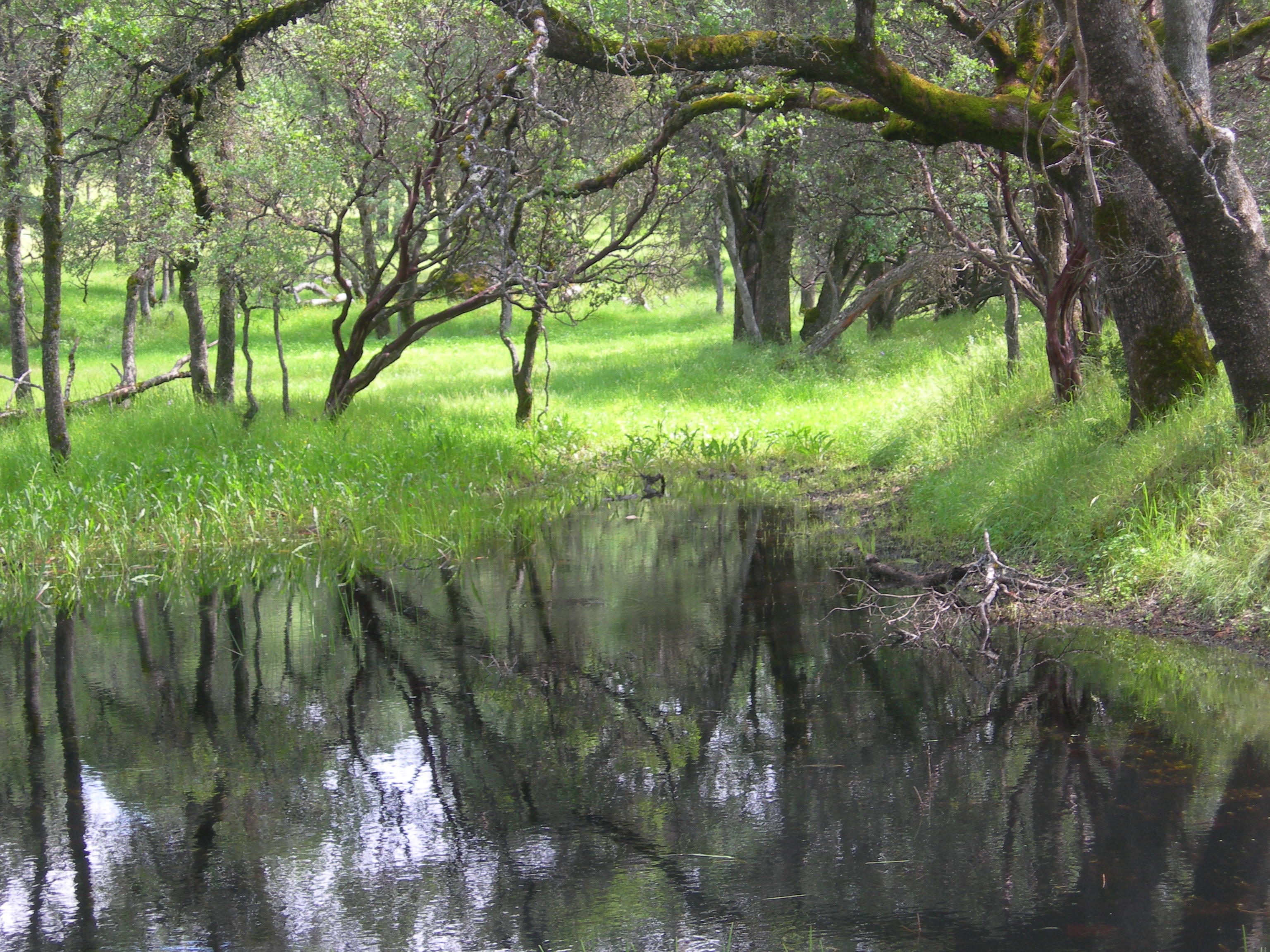
dscn4753This is a vernal pond, a few miles from my home. It will fill with water by Christmas and be dry again by Easter.

Let’s take a break from the world of politics and check into the latest meteorological phenomenon.

It rained last night.

That may not be a big deal to you, but here in the foothills of the Sierras it represents the change from one season to another in a climate that only has two seasons – dry and wet.

Our last rain came in mid-April. Six months without a drop. You may have heard that we are in a drought, but this is a different phenomenon. It is normal here for the last rain to come in mid-April, and normal for the first rain of the rainy (if that is the word) season to come in mid-October. Our drought is because we haven’t been getting enough rain between October and April.

So what does that have to do with my world of writing science fiction? Everything, really.

When I was young, my three favorite SF authors were Clarke, Heinlein, and Norton. Clarke’s stories always took place in artificial environments. Heinlein’s characters inhabited space ships, orbiting habitats, or frontier worlds; it didn’t matter, as long as they could talk incessantly, they were happy. Andre Norton characters, whether they were explorers, soldiers, spies, or interstellar traders, always spent their time outdoors, in wilderness or something like wilderness. The only cities you were likely to see in a Norton novel were in ruins, or the slums of the Dipple which any one of several young men were quick to flee from, usually into more trouble than they could imagine.

That suited me just fine. Her worlds were my world. In rural Oklahoma, I spent from May to September every year outside, usually driving a tractor, through rain, wind, dust, and heat. There were years when I watched the crops dry up and die under the relentless sun – and watched my Dad see six months work disappear before his eyes. There were other years when the rains came on time, the crops were good, and the pastures grew up heavy with grass; when the nights were a symphony of insect whirrings and the days were filled with bird songs and butterflies. Cliché? Paradise always sounds like a cliché.

It was the only life I knew, and I loved it, good years and bad, but I had to leave it, first for college, then to make a living. When I wrote my first book, I sent my protagonist into the mountains and lost him there, then let him find his way out. For my second book, Jandrax, I marooned a shipload of colonists on a barren, unexplored world, and watched them find a way to survive. In Cyan, coming out in a few months, I send a crew of ten to explore a rich new planet, then send them back to colonize.

I lived in a small city for most of my life. I could write about cities, but I don’t want to. My world is the world of nature –  even if it is nature on another planet.

So— it rained last night. About an inch, which isn’t much, even by Oklahoma standards, but the foothills only get thirteen inches in an average year. All the creekbeds remain empty and the hills remain covered with tall, dead grass in shades of brown, but within the soil, the change has begun. Seeds that have lain dormant since spring will be sprouting now, out of sight, and within a week there will be a faint haze of green, invisible beneath the long grass, but showing in the road ditches. This year’s grass will begin to flex its vegetive muscles, forcing its way upward through last year’s dead roots. Unnoticed, those roots will begin to loosen and be shoved aside until one day, a month from now, seemingly all at once, the old year’s grasses will tilt and fall, to disappear beneath the new green.

Suddenly all the brown will be gone and the new year’s grass will clothe every hillside. While the snows of winter cover the midwest, these Sierra foothills will be spring green, and the wildflowers will return.

Raven’s Run 27

Chapter Eight

Fifty-seven days out of Jamaica – forty-two days after I picked up Raven – we caught sight of the Rock. Gibraltar was originally called jebel al Tarik, Tarik’s Mountain, after the Moorish general who led his mixed Arab and Berber forces north across the Strait in 711 AD on their way to conquer Spain. Raven explained this to me; while studying her Hispanic heritage, she had become something of an expert on Spanish history.

The Nile, the Danube, the Rhone and thousands of lesser streams feed the Mediterranean, yet it is never filled. Surrounded by the land masses of Europe, Asia, and Africa, and sheltered from the cold currents of the North Atlantic, the warm basin of the Mediterranean becomes a great still, sending billions of tons of water into the air every day. So much so that a current of cold salty water from the Atlantic flows into the Mediterranean through the Straits of Gibraltar.

For us, the current wasn’t enough. We first gained, then lost, sight of Gibraltar. The levante was blowing in our faces and the current could not overcome it. For two days we tacked around outside the Strait until the wind shifted far enough to the north to give us a slant we could use. We crossed into the Mediterranean on the twenty-seventh of May.

#          #          #

Since our first night of passion, everything had changed between us. Raven had become easy in my presence. On days when the sun was warm, we rarely bothered with clothing. We turned brown. We made love when the mood took us, mostly on deck in the sunshine. We discovered that the cabin house was just the right height for certain interesting games.

It was an extended honeymoon for two strangers. I grew to know her body in every way, and her mind in some ways, but her soul remained beyond my grasp. I could see hints of it in her smiles and in her sudden brief angers, but she kept the innermost parts of her self barricaded behind her smooth manner, her sunny smile, and her supple body.

#          #          #

My original plan had included stops in the Azores, Lisbon, Gibraltar, Cartagena, and Barcelona before delivering Wahini to Will in Marseilles. After Raven came aboard so abruptly, all that had to change. There was nothing in my ship’s papers to account for her presence and she had no passport. I was, in essence, smuggling her in. Wherever I first landed, I would have to explain her presence to the port authorities. I wanted the backing of a friendly consulate when I tried to convince some foreign government that she had “fallen” off a cruise ship and I had picked her up. We were certainly not going to complicate our lives by saying that she was thrown off her ship.

It seemed a good idea to sail directly to Marseille, but the wind was not cooperative. The levante continued to blow in our faces. We could make a close reach most of the time, but Wahini didn’t like that point of sailing in her boomless condition. Our progress was slow.

Eleven days after Gibraltar, we passed the Chateau de If on its island outside Marseille harbor. Alexandre Dumas had placed both The Count of Monte Christo and The Man in the Iron Mask in that prison. It looked the part. The entrance to Marseille was difficult, so we brailed up the wounded sail and went in under power. more tomorrow

236. American Voices

If you are just discovering Leap Alan Hed, his story is getting rather long. Try the tag cloud under Leap.

Leap Alan Hed was going to Tulsa, to have it out with Billy Joe Barker. It had been eight weeks since he left his home in Dannebrog, running from the media circus that Barker had set in motion by calling on Americans to write in Leap’s name for President. Barker had started it all; Leap figured Barker owed it to him to at least try to stop it.

It was hard for Leap to travel. He could go by bus, slumped down, face covered by the brim of his hat, and take his chances on being recognized. That was how he got to Hays, Kansas. There he picked up a ride with a friend of a friend from Dannebrog who took him as far as northern Oklahoma. He found himself stranded in Ochelata on a Sunday morning.

By now Leap was hungry for normalcy, and on Sunday morning, that meant church. He couldn’t go in, of course. If you are from the city, or the north, you may not know this, but when you go into a small town southern church as a visitor, everyone in the congregation will come up and shake your hand, ask you your name, welcome you to their fellowship, and half of them will invite you for Sunday dinner. Leap would have loved that, but since his face had been in every newspaper in America . . .

The Ochelata Baptist Church was a long, low green roofed building, built around a courtyard. There was a park on the east, so that was the direction Leap used for his approach. He walked in, as bold as if he belonged there, across the park to the blind back of the sanctuary where he settled down hidden by a few trash cans and sat for two hours listening to the service taking place on the other side of the wall. From time to time, his eyes were awash with the moisture of homesickness.

He slept the day out in a wooded ravine, and walked southward on Highway 75 during the night. Morning found him somewhere, but he didn’t know where, hungry, cold, and discouraged. He was in front of a convenience store, on the outskirts of a small town, so he pulled up the hood of his sweatshirt and went in. He kept his eyes floorward as he picked out a couple of donuts and a cup of coffee, and didn’t look up at the checkout where the surveillance cameras are clustered. Outside again, he found a bench at the edge of the light.

He was on his second donut when a pickup rolled to a stop. A man of fifty got out and exchanged a few parting words with his driver before she u-turned and disappeared. Everything about their casual friendliness said man and wife. He was carrying a brown paper bag that said “lunch”. He crossed to Leap’s bench and sat down.

He glanced at Leap, looked away, then his head snapped back again. He studied Leap for about five seconds, then turned his head back toward the road and didn’t look again.

Discovered! This man knew exactly who Leap was, but he made no acknowledgment. With eyes averted, the man talked as casually as if he didn’t know Leap’s identity. Leap had seen that reaction several times in the farm country and small towns where he had been wandering these last weeks. People in rural America have a respect for privacy and a willingness to mind their own business which he found admirable

Leap’s benchmate said was waiting for a bus that would take him west to Sperry where he had a job as a school custodian. And, yes, there was another bus that went south to Tulsa. After twenty years as a skilled lathe operator in a small factory, the man had lost his job after 2008. He had been out of work, except for odd jobs, for seven years, and now he was pushing a broom at age fifty, and glad to get the work.

He had gone from Democrat, to Republican, then further with the rise of the Tea Party. He had no faith in government, no faith in politicians, but he still had faith in free enterprise. Where he had worked all his life, the owner had been just down the hall, working all day behind a second hand desk in a room with plywood walls. They had gone to the same church, and every decision the owner had made had included concern for his employees.

The factory made small parts, that went onto larger parts, that then went onto automobiles. In 2008, the system collapsed and the factory folded. Leap’s temporary friend blamed free trade and Hillary and Obama. He did not blame large corporations and their CEOs. His vision of free enterprise was a hard working owner in a dusty plywood room, with forty hard working employees out on the floor making things. Multi-national corporations were outside his experience and outside his imagination.

The bus rolled up with whoosh of air brakes. As the man got up, he added, shaking his head, “Donald Trump says he’s going to fix all that.”

“Do you believe him?”

“No, not really.”

“Are you going to vote for him?”

“I might. Probably not, though. It’s hard to vote for a man that full of hate.”

After a pause, he added, “I might just throw my vote away on this guy called Leap. That way I won’t be responsible for what happens later.”

Raven’s Run 26

“I don’t know what I would do, but I would not rape you. And I would not beg. Not ever!”

I released her throat, shaken by the anger I had felt. I don’t like to be out of control, and my show of force had nearly become real. I caught her arms and jerked her upright. I shifted my weight and, without rising, lifted her out at arm’s length and slammed her onto the other transom. Her eyes grew wide. I don’t look like I could do that.

“Raven, you had better get your story straight. You are sending too many messages, and none of them track. And don’t try to jerk me around. It won’t work.”

Her brows were drawn together. She looked angry, but I was learning that nothing is ever that simple with Raven. She met my gaze. Her face was flushed and her lip trembled. Her voice was flat and challenging as she said, “What kind of message am I sending now?”

I said the first thing that came into my mind. I said, “Lost and lonely.”

Raven choked. Tears welled in her eyes and traced the lines of her face. I had hit a little too close to home. I had reached past her defenses to the core of her anger and confusion. She bit her lip and controlled her voice. She could not control her tears. She pounded her knees with her fists, and muttered, “Bitch, bitch, bitch!” over and over.

Finally she stood up. We were close together in the confines of the Wahini’s cabin. Her waist was at the level of my face. She began to unbutton Will’s shirt. There was no showiness and no hesitation, just a simple twist of the fingers, one button after the other, until it fell open and she shrugged it off.

She was not wearing the string bikini, and she was magnificent.

Will’s jeans were bunched in folds around her waist and cinched in by his belt. She unbuckled it and the jeans slumped down until they caught on the flare of her hips. She reached forward and braced her hands on my shoulders. She was trembling and her voice was husky as she asked, “Is this message clear enough?”

I reached up to the silky skin under her arms and brought my rough hands down her sides. Like sandpaper on velvet. I could feel her take a deeper breath. I brought my hands past the narrowness of her waist and around the swelling of her hips, pushing the jeans ahead until they rounded the curve of her flank and fell away.

Magnificent!

She slipped her hands down the back of my collar as I leaned forward. Still gripping her hips in my hands, I kissed her gently, first just beneath the navel, then downward. I could hear hear moan above me. A long, long time down there, as she shivered to the touch of my tongue, then upward to take her breasts in my mouth while she fumbled with my clothing and took me in her small, strong hands. Then she was sprawled on her back across the transom, and I was plunging deep in, and for a while there was no doubt of what either of us wanted. more tomorrow

235. 1989 Revisited

This follows Tuesday’s post. 

In the early nineties, my wife and I were traveling on a train in Germany, where we found ourselves sharing a compartment with a young German college student. We congratulated her on Germany’s recent reunification. She became flustered and could not understand why we, as Americans, could be concerned with the reunification of her little country.

Germany is not a little country. It fought the British Empire to a standstill in WWI, then conquered essentially all of mainland Europe in WWII, and today is a leading state in a more-or-less united Europe. But this young woman would have been the granddaughter of people who were there at Germany’s defeat in 1945, and her parents would have grown up in the western half of a nation, whose eastern half had been gobbled up by the Soviets. Her humility made sense, at that moment in history.

Germany was divided in 1945 and reunified in 1990, but the real year of change for Germany and the rest of eastern Europe was 1989. That is why I slid Raven’s Run into that year when I began to post it in the twenty-first century.

**       **       **

On February 14, 1989, Ayatollah Khomeini declared a fatwa (death sentence) against Salman Rushdie. Even before a year of great progress in international relations had fully begun, the sound of the coming world challenges were echoing in from the Middle East. The next day, the Soviet Union announced that the last of its troops had left Afghanistan, ending a fruitless nine year war that some called Russia’s Viet Nam. Unfortunately, America didn’t get the message about the fruitlessness of trying to change Afghanistan.

The Warsaw Pact alliance was getting shaky. For forty five years Russian had maintained its dominance over eastern Europe by military might. It had cost them, in rubles, in the lost productivity involved in maintaining a huge standing army, and in the growing recalcitrance of the peoples under their domination.

There had been other risings during that near half century – in East Germany in 1953,  and in Hungary and Poland in 1956. But by 1989, conditions within Russia itself had deteriorated badly. Russia’s new leader Mikhail Gorbachev was ready for change. When mass protests occurred in Hungary in March, he allowed reforms to begin. It was a far cry from the Russian tanks and guns of 1956.

The Hungarian revolution of 1956 had been put down ruthlessly. Officially, it was not seen as a Hungarian uprising, but as something orchestrated by the West. Now the story was changed, and it was officially accepted as a popular movement. Soon the Hungarians began tearing down the fence that closed off the Austrian border, which eventually had major consequences for East Germany.

Germany was partitioned in 1945 and Berlin, inside the Russian sector, was also partitioned. The two Germanies were fenced apart, and between the two Berlins the East Germans, at Russian insistence, built a massive concrete barrier. The Berlin Wall became the visible symbol for the separation of Europe.

By stealth and guile, innumerable refugees fled from East Germany to the west, but no defections got as much attention as those that broke through, over, and under the Berlin Wall.

With loosening of restraints in Hungary, East Germans defections intensified. For decades, they had vacationed in Hungary. Now they went to Hungary by the thousands and crossed from there to Austria. By September, 30,000 had escaped. When the East German government closed that route, East Germans flocked to Czechoslovakia where they descended on the Hungarian and West German embassies. In October, the East German government closed the border with Czechoslovakia. Those East Germans who had not been able to escape, turned to protests, which grew weekly in size. A shoot to kill order was given, then retracted under pressure from Gorbachev. By late October, the crowds of demonstrators numbered in the hundreds of thousands.

The East German government relented and opened the Berlin wall. East German people then tore it down.

Throughout eastern Europe, variations on the theme played out. Dozens of countries were freed from Soviet domination, but there was one massive casualty. Yugoslavia, a conglomeration of smaller states since WWI, disintegrated shortly after the breakup of the Warsaw Pact nations, leading to wars throughout the nineties.

Germany reunified in 1990 and the Soviet Union dissolved into its component states in 1991.

Raven’s Run 25

“You never made a pass at me.”

“You were scared to death.”

“At first, I was. I didn’t stay scared.”

“Raven, you were sending out “Back off!” signals every waking minute. What did you expect me to do? Paw you like a drunk in a bar? You were trapped. We both knew that if I were a different kind of man, you would be in real trouble. I had to keep my distance to let you feel safe.”

She was silent and thoughtful. The pressure was building inside me. And inside her. I could feel it in her shoulders where she leaned slightly against me.

I took her mug and mine and set them aside. Then I put my arm around her and she slipped up against me without hesitation, leaning her face against my chest. There was a rich, clean smell about her.

She said, “I’m sorry.”

“For what?”

“Today. It was cruel.”

“I don’t know about cruel, but it was damned confusing.”

She reached over and took my hand in both of hers. “Ian,” she said, “sometimes I’m a real bitch. I was mad at you for not making a move on me. Dumb; really dumb. I knew why you hadn’t, but I was still hurt. It shook my confidence and it made me mad. I just wanted to show you what you were missing.”

“I had that much figured out,” I said. My throat felt like broken glass.

“I wanted you to make a pass so I could turn you down. I was that mad at you.”

“I had that part figured out, too. You wanted me on a leash. I don’t break to the leash worth a damn, Raven.” I heard my voice growing hard. “I give. I take what is offered. I share. But I don’t beg. Ever.”

She just shook her head. I could feel the motion against my chest. She asked, “Are you turned on now?”

“Don’t be stupid.”

She traced a line up my jeans from knee to crotch, stopping just short of the target. Her fingernail was like an electric probe. The air was getting thick; I couldn’t get enough of it.

She rolled around to lie on her back with her head in my lap, looking up at me. Her eyes were hollow and unreadable. She said, “What if I turned you off now? What would you do?”

I laid one hand on her breast – then slid it up to close around her throat. Her eyes went wide.

“What would I do? I don’t know. Maybe pick you up and drop you back in the ocean. Maybe I would jump in myself, too. Maybe I would just back off and not say one more word to you, or look at you, or admit you exist, until we reached Europe. I don’t know. Do you want to chance it?”

Now there was real fear in her eyes.

“I don’t know what I would do. But I can tell you exactly what I would not do. I would not rape you. And I would not beg. Not ever!” more tomorrow