Monthly Archives: December 2016

269. Old European Christmas

DSCN1839In Dickens’ A Christmas Carol, when confronted by the Ghost of Christmas Past, Scrooge says, “Long past?”, and the ghost replies, “No, your past.” We’re going to turn that on its head. You already know about your childhood; you don’t need me for that. During the next three posts, we are going to travel several hundred years into the past and watch Christmas evolve into what we enjoy today.

Last night I watched a DVD of Santa and Pete, in which Saint Nicholas leaves Amsterdam to visit the New World. There he finds his red hat and coat, learns to come down chimneys, trades his horse for reindeer, and they learn to fly after drinking an old African potion. It’s a sweet movie, but it has nothing to do with reality.

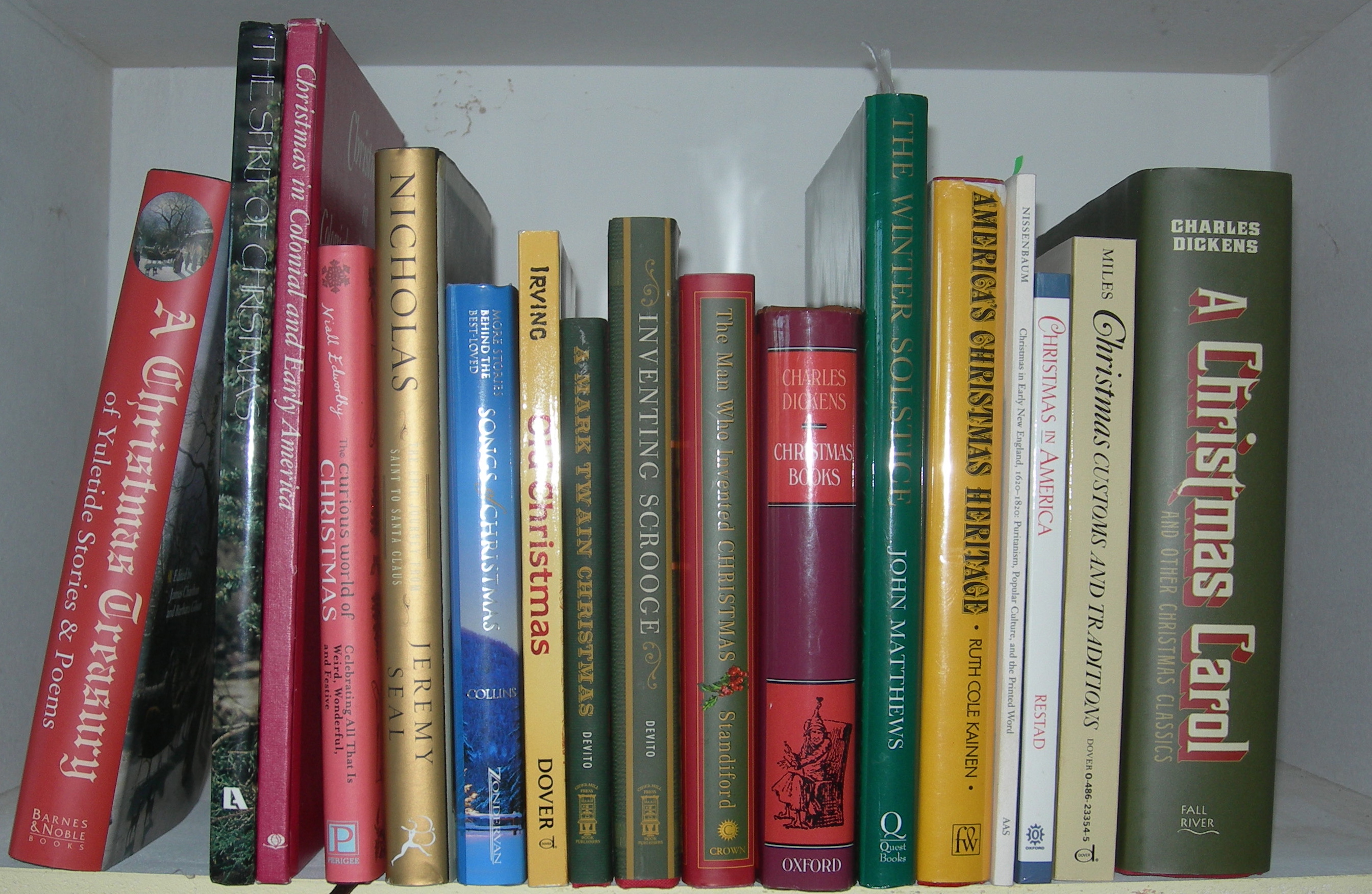
Christmas has a real history, which is not as sweet, but is absolutely fascinating. Our guide for this will be an academic history of Christmas called The Battle for Christmas, written by Stephen Nissenbaum, which I first mentioned last year in A Christmas Booklist.

Some historians are dry as dust: others have a novelists touch and bring history to life. Nissenbaum is one of the latter. If you like Christmas and you like history, you can look forward to a good time with him if you seek out the book for yourself. Of course, he is a historian, so the book is dense.

*             *              *

I imagine that everyone knows that many of the traditions of Christmas, like holly and the yule log, are pagan in origin. It is also widely known that the date of Jesus birth is not found in the Bible. Put those two ideas together, and it is no surprise that the Puritans did not celebrate Christmas in early New England. It’s all very logical, but it isn’t the whole reason – probably not even the major reason.

Puritans were little worried about Paganism itself. Odin and Balder did not enter into their thinking. Their world was strung between two poles – God on the right and the Devil on the left. They weren’t afraid of holly and evergreens, but they were afraid of disorder. And disorder was always waiting in the wings, locked into the agriultural cycle.

All across northern Europe, both before and after Christianity, fresh foods were available in spring and summer, and into autumn. Grains were planted in spring and harvested in fall. Some was kept to be ground into flour for winter bread. Some was preserved by fermentation to form a variety of beers. Cabbage was fermented into sauerkraut, which kept millions of German peasants alive through the winter.

In America, as late as the Revolution, apples were preserved as hard (fermented) cider which would store through the winter. Most of the excess grain grown anywhere west of the Appalacians went to market as the portable and storable product called whiskey. Alcohol may bring a tipsy smile, but it is also a food that does not spoil.

From peasants in the Middle Ages until the Industrial Revolution, the only leisure for the European lower classes was in winter, when farm work could not be done. Early in the winter, the season’s barley had become beer, the extra animals who could not be kept alive through the winter had been slaughtered, and the pantries were as full as they would ever be. It was time for a party.

*              *              *

When I first read The Battle for Christmas about ten years ago, finding this tie to seasonality was like meeting an old friend. I spent my youth tied to the Oklahoma-farmer version of agricultural seasonality, with planting times and harvest times, with putting up vegetables for the winter for the family and putting away grain and hay for winter feed for the animals. The season of cattle breeding was keyed to bring on late fall births, so there were new calves and new milk just in time to provide work and income during the winter when no grains were growing.

I had already based the entire Menhir series on a hero who grew up tied to the agricultural cycle in a land of peasants and lords, where drought and overpopulation made life a struggle for food. In such a place, early winter is a time of relative plenty and late winter is the starving time — a subject I will address here next month in an excerpt from those books.

*              *              *

So we have the onset of winter, enforced leisure, plenty of food and beer (at least for a while). The celebrations of this point in the year were raucous, with plenty of drunkenness and, no surprise, plenty of sex.

Along came Christianity — always the enemy of a good time — and tried to Christianize the holiday by tying it to Jesus birth. It didn’t work. click here to continue the story
Raven’s Run 59

Susyn sipped, put her cup neatly back into its saucer and continued. “Up to that point, Raven was in no danger. But then the P.I. tried to extort another payment from Brock, and Brock stepped on him. To save his life, the P.I. claimed to have arranged to have copies of his report sent to Raven if anything happened to him.”

Susyn made a gesture of distaste. “Things had gone too far for that. Brock had him killed anyway. Then he went after Raven.”

“But she didn’t have any knowledge of any of this,” I said. “If she had known, she would have told me.”

“It doesn’t matter, Ian. Brock can’t take any chances. That is why I’m here. Senator Cabral sent me to bring Raven back. He has arranged a place of safety until his FBI friends can build an airtight case against Brock and arrest him.”

So that was it. Everything that had happened made sense now. If only I had called Will one day earlier, Raven would be sitting here with us, and by tomorrow she would be safely home.

Briefly, without the details of our love life, I told Susyn what had happened since we left Marseille, including the fact that Raven had apparently taken up with Eric.

She shook her head and said, “No, Ian, this just won’t do.”

“I’m afraid it will have to do. Anyway, Raven will call home again sooner or later, and get the same message you came here to give her. Meanwhile, she is lost somewhere in Europe. If I can’t find her, neither can those two who have been after us.”

“No, Ian, no. It isn’t just two thugs anymore. It isn’t like the cocaine trade. Brock doesn’t import, he exports; and he has called on all his European distributors. There must be a hundred people looking for Raven now, all over Europe. Sooner or later, one of them will see her.”

I put my finger gently on Susyn’s lips and said, “Don’t talk for a couple of minutes, OK?” Then I stared out into the street, seeing nothing, and thought furiously. It could work exactly that way. Europe is huge, but there would be no need to cover it all. Forget Eastern Europe. Forget any area given extensively to industry. Likewise, forget the purely farming country. Forget the small cities; there are too many of them. Forget Paris and London, where the whole city is a museum of history and culture. Pick the cities like Munich where the old town survives or has been rebuilt. Concentrate on the places every tourist sees. Send agents around with a picture of her and some plausible story – a young man looking for his missing lover; an old man looking for his missing daughter. Get a standard guidebook to Europe and go to the tourist information centers in the major tourist cities. Go to the youth hostels and the campgrounds.

Europe is huge, but tourist Europe is small.

The Europe of student wanderers is smaller still. The typical medium sized city has hundreds of hotels, but only one youth hostel, and one or two campgrounds. It could be done. It was the way I would chose, if I were to search for her.

Susyn said, “Well?”

“They could find her, so I have to find her first.”

“Good! I knew you would.”

“I’ll need money. I can’t worry about pinching pennies now.”

“Done.” She opened her purse and gave me a fistful of francs.  I counted them out and she made a note of the transaction. “If you need more, just ask.”

“How will I contact you? Will you be staying in Paris?”

“I am going with you.”

That was a new thought. I considered it briefly, then said, “Okay, with reservations.”

“Such as?”

“There are certain skills involved in living close to the ground, and a great deal of discomfort. Raven was just beginning to learn them. If I am to be effective in tracking Raven, I can’t take time to worry about you.

“I know where she went and who she went with, so we might have her back by tomorrow. Or she may stay one step ahead of us, and it might take weeks. If you want to come along, that’s fine, but don’t get in my way. Better still, we’ll split up the work and stay out of each other’s way. You go to the consulates, and the police, and American Express, and I’ll go to the hostels, campgrounds, and hangouts.”

“That will be great. I really appreciate this, and so will the Senator.”

I nodded politely, but I was thinking about Raven, not about the gratitude of strangers. I said, “Let’s get on with it.” more tomorrow

268. Rick Brant Bibliography

Here is the list of the Rick Brant books I promised in last Thursday’s post. Numbers 1 through 18 were published by Grosset and Dunlap and widely distributed. They are hiding in thousands of dusty attics and can frequently be found in the children’s sections of used book stores, and used onlline through Amazon.

I have never seen books 19 through 24. although I’ve looked for them everywhere. According to Series Books numbers 19 through 23 were also published by G & D; I don’t dispute this, but clearly they were not well distributed. Also according to Series Books, number 24 was published by Manuscript Press. I have little to say about the last six books since I have not read them.

The list below is coded. KS (Kindle, single) means that the book is available for individual download to Kindle through Amazon. U (used) means the book is available used at reasonable prices, if you shop around or order through used bookstores carried by Amazon. $ (Egads!) means it is available used in the same way, but at ridiculous prices. I’ll buy these last six myself when I win the lottery.

GK (Gutenberg/Kindle) indicates an interesting phenomenon. These appear to be public domain works, and were made available for free through Project Gutenberg. Click to go to the Browse By Author:G page, then scroll down to Goodwin, Harold L.

I downloaded one novel into iBooks using EPUB format with images, and another into my desktop Kindle app using Kindle format with images. Both seem equally good. This was just a test for your sake; I still have treasured copies from my youth. While you are at Gutenberg, do yourself a favor and download the non-series SF novel Rip Foster —, under either variant title.

These Gutenberg books are also available from Amazon in the form of The Rick Brant Science-Adventure Series (Halcyon Classics). This Kindle download is a compendium of the eleven books available from Gutenberg. I had no reason to download it, but I have bought compendiums before and find them harder to navigate that individual titles. It’s your call.

KS  1.  The Rocket’s Shadow, 1947
KS  2.  The Lost City, 1947
KS  3.  Sea Gold, 1947
U    4.  100 Fathoms Under, 1947
U    5.  The Whispering Box Mystery, 1948
   6.  The Phantom Shark, 1949
GK  7.  Smugglers’ Reef, 1950
GK  8.  The Caves of Fear, 1951
U    9.   Stairway to Danger, 1952
GK 10. The Golden Skull, 1954
GK 11. The Wailing Octopus, 1956
GK 12. The Electronic Mind Reader, 1957
GK 13. The Scarlet Lake Mystery, 1958
GK 14. The Pirates of Shan, 1958
GK 15. The Blue Ghost Mystery, 1960
GK 16. The Egyptian Cat Mystery, 1961
GK 17. The Flaming Mountain, 1962
GK 18. The Flying Stingaree, 1963
$    19. The Ruby Ray Mystery, 1964
$    20. Veiled Raiders, 1965
$    21. Rocket Jumper, 1966
$    22. The Deadly Dutchman, 1967
$    23. Danger Below!, 1968
$    24. The Magic Talisman, 1990

I had considered doing a mini-review of each of the first 18, but I found a site that already has good mini-reviews of all 24. Go to http://tomswiftfanfiction.thehudsons.com/TS-Yahoo/author-TH-RickBrant.html . I’ve read these reviews and the eighteen I am familiar with are accurate, so I would trust the rest. This site also offers paperback (print on demand) versions of 19 – 24, but I can’t vouch for their legality regarding copyright issues.

*            *            *

I have been in contact with the people at Gutenberg. Most of that institution’s work is done by volunteers, including volunteer proofreaders. I would like to do that job myself, but only on a work I already love. Proofreading a novel is not like reading a novel. The experience is both long lasting and intense.

Gutenberg’s copyright research is also by volunteers, so the person I contacted could not tell me if more of the novels were copyright free, and therefore available to be proofread for release by Gutenberg. There are ways of finding out, and I am pursuing them. If anything comes of this, I’ll keep you updated.

Raven’s Run 58

Senator Cabral’s secretary was Susyn Fletcher. She pronounced it Susan. We had been together for several days before I realized that it had such an affected spelling. She was a tiny dynamo – not more than five feet one, certainly under a hundred pounds, with shoulder length bleached blonde hair in constant disarray. She was smiling when I met her; her personality was like a freshly uncorked bottle of champagne. She looked and acted like a much deflated Dolly Parton, minus the countrified accent.

She stuck out her hand. It was almost lost in mine. She laughed and said, “Well, didn’t Raven pick herself a big one.”

“She didn’t exactly pick me. She fell into my clutches.”

“Poor girl!” You could see that she didn’t think it was such a terrible fate. Susyn Fletcher was good for the ego. “Where is she?”

“Gone. She left this morning. No forwarding address.”

“Oh.” Susyn’s liquid violet eyes went from fun to personal concern with the speed of light. No doubt, she was an invaluable asset to Senator Cabral. In ten seconds she had me feeling like a lifelong friend. She asked,”What happened.”

“We had a personality conflict.”

“I’m sorry for the two of you, but what rotten timing! I really need to find her and take her home. She is in danger here.”

Susyn grabbed my hand and said briskly, “Lets go. I want to get out of here.” Sudden decision and brisk movement were the signature of her character. “Let’s eat. Where is a good restaurant?”

So, for the second time in two days, I found myself sitting in a streetside cafe with a lively young woman. This could become addictive. Susyn filled me in on what had been happening in the States. Senator Cabral had gone straight to the regional head of the FBI, who was an old friend from the Senator’s FBI days. They had launched an investigation and five days later it turned up paydirt.

Susyn placed her fork neatly across the rim of her plate and asked, “Ian, did Raven tell you that she had hired a private investigator?”

“Yes. While we were at sea we discussed her background, trying to find some reason for that first attack. She said she had once hired a private eye to look into someone on her father’s staff, but he had not reported back to her.”

“Did she tell whom she had had investigated?”

“No. I asked her, but she wouldn’t tell me.”

Susyn nodded and gave a brief, sparkling smile. “Good girl. Raven and the Senator don’t always get along too well. You knew that?”

“Of course.”

“Yes. Well, even though they fight a lot, she still respects him and tries not to be a political burden. Part of that role is learning never to say anything bad about anyone, if you can avoid it. Everyone in government needs to learn that lesson. If you engage in too much office gossip, it will stand in the way of advancement.”

I put my hand on her arm to interrupt the breathless dialog, and said, “Susyn, you’re losing me.”

“Oops, I’m getting ahead of myself. Raven did not engage in needless gossip; she didn’t give you the name of the person she was investigating. It was Guadalupe Rodriquez, one of Senator Cabral’s secretaries.”

She was watching my face as she said the name. Beneath the friendliness and the mischief, she was watching for signs. Of what, I could not tell. I’m sure my expression didn’t change, because the name was completely new to me. Susyn went on without a break, “The private eye followed her for a week and found out she was meeting with a fellow known to work for a local contractor and investor named Adrian Brock. This Brock’s construction company is not his main source of income. He is also deeply into agriculture. He owns plantations which produce hundreds of tons of California’s most lucrative crop.”

That would be marijuana, of course. I said, “Raven would have told me that.”

“Yes,” Susyn agreed vigorously, “if she had known. But the P.I. actually sent the results of his investigation to Brock for a hefty cash settlement. Raven never knew.”

Susyn paused while the waiter brought coffee. The rain had relented and pedestrians were moving about again. Raven and I had sat like this, just yesterday, talking, laughing, and watching Paris stride proudly past. I dragged my thoughts back and concentrated on what Susyn was saying. more tomorrow

267. Books Under the Christmas Tree

DSCN3974This is a slight reworking of post 60. Thank You, Harold Goodwin

I have a December birthday, which worked out well as a kid since books were my favorite gifts, and winter is a prime time for reading. The books I got were locally sourced and cheap, mostly published by Grosset and Dunlap, Whitman, or Golden. For anything by a normal publisher, I depended on libraries.

Nobody, not even Heinlein, wrote better juveniles than Harold Goodwin, although the comparison is apples to oranges. Heinlein’s juveniles were set in space and used future science reasonably extrapolated from the present. Goodwin’s stories, with one exception, were set in the present and built on extant science.

If you’ve never heard of Goodwin, its largely because he worked under the pseudonyms Blake Savage and John Blaine. If he gets no respect, it’s largely because he was published by Grosset and Dunlap. That meant Goodwin’s Rick Brant books shared bookstore space with Tom Swift, Jr and the Hardy Boys – series that were written to outline by anonymous authors.

I read all three G & D lines as a kid. They taught me to read and to love reading. But when I try to reread Hardy Boys books today, they come off dull and dumb. Tom Swift, Jr. – well, I can’t force myself through them.

Rick Brant holds up. A few years ago I reread the whole series from start to finish and they were as good as I remembered them. The same was true of Goodwin’s single outer space adventure, sometimes titled Rip Foster Rides the Gray Planet and sometimes Assignment in Space with Rip Foster. You won’t find Rip in a used bookstore, although he shows up occasionally in antique stores, right next to the BB guns and old, rusted roller skates. (See Monday’s post for a source.)

Rick Brant lived the perfect life. I would have traded with him in a heartbeat. He had adventures, twenty-six eventually, which he shared with Scotty (Don Scott) who was the ideal older brother figure. They appeared to be seventeen and eighteen in the first book and were still the same age forty-three years later. That’s good work if you can get it.

Rick lived with his family on Spindrift Island where his father was the head of a diverse group of scientists. Each had a different specialty, allowing for a wide range of stories, and they formed a dozen of the best uncle figures any boy could imagine.

Rick was bright and a bit precocious, but he wasn’t a wunderkind. Elsewhere he might have seemed nerdy, but on Spindrift he simply seemed a bright young scientist among brilliant experienced older scientists. He was always learning. He often saved the day, but he never had to save the world. In short, he seemed real.

The same timeliness that made the Rick Brant series perfect for its time makes it seem a bit dated today. A kid with a smart phone is not likely to be impressed when Rick invents a miniature walkie talkie, and that’s too bad. However, if you have a kid with an e-reader, and you can’t keep him supplied with enough good books, Rick Brant is available on the internet. For fifteen minutes of your time and no dollars, you can send him to Spindrift. The experience might surprise both of you.

Or maybe you remember reading one or two of these books yourself and want to indulge in a little nostalgia. Christmas is a good time for that. I’ll give you the details tomorrow.

Raven’s Run 57

“All right, so I dominate everybody. But that doesn’t make it hurt any less.”

“And it doesn’t make you a failure as a man. Chances are she will go running to some weakling. She also needs to dominate.”

Was Eric a weakling? He was tall, athletic, and ruggedly handsome. Yet there had been something passive about his approach to life. When he told us that Paris was a tough gig, there had been something essentially accepting in his voice. And his answer had been to move on.

Will hesitated before adding, “I learned about you two that day on the beach. It was pure competition. I was just a game piece; you two were the players. You won the battle that day, but you also lost the war.”

“Right!”

“Well?”

“Well what?”

“Are you going to let her go gracefully, or are you going to go chasing after her, mess up your life, and make an ass of yourself?”

I had to smile, and it was the first time that day. “Make an ass of myself, I guess,” I said.

“I thought so. Well, I have some news about Raven.”

“What?”

“Senator Cabral’s secretary is flying to Paris to pick her up. It seems that the Senator has some kind of line on her attackers.”

What? I hadn’t told Will where I was calling from. “Why Paris?” I snapped.

Will laughed. “If you remember,” he said, “when you got on the train, that’s where you said you were going. I know you were going to do some train shifting, but I couldn’t tell anyone else. So wherever you are, there is a young woman in Paris waiting to take Raven off your hands. Too bad you lost her.”

“What’s the matter with you!”

“The more I think about that day on the beach, the more I resent the way I was used. Not by Raven. She was a stranger, and she was fighting for her life. By you! My friend. Shit!”

I slammed the receiver down.

#          #          #

I walked to the American embassy. It was a good five miles. By the time I arrived, I had worked off some of my anger, and I knew that Will was right. He had a good eye for human motivations, and a good heart. If there was anyone whose opinion I could trust, it was his, and he knew me better than anyone else ever had.

It only made me more crazy. I had never wanted a woman to keep house and raise kids. I wanted a woman with fire and courage, one who would conspire with me to make life an adventure. Raven was that kind of woman, and she had run from me. Worse, she had not been driven away by insensitivity, or an ill-considered phrase, or anything I could change. She had been driven away by me, by what was the essential part of my soul. more tomorrow

266. The Other War

dscn5408

I was once interviewed, while in high school, for a summer internship in science. I had expected science questions, but they turned out to be philosophical. I suppose they wanted to see what kind of citizens we would be.

I was asked what I thought of the decision to drop the bomb on Hiroshima. I said that it shortened the war, saved American and Japanese lives (based on estimates of casualties incurred in taking Japan by conventional warfare), and was not essentially different from the firebombing of Dresden, which went mostly unquestioned because it was not nuclear.

I have become much more liberal since that faraway interview, but I still hold those same views. I mention that to point out that I am not a knee-jerk liberal who always assumes that America is wrong. I also don’t assume she is always right.

On December 7, 1941 – seventy-five years ago today – the Japanese attacked Pearl Harbor. You might expect me to write about that, but instead I intend to remind myself and my readers that, although war with Japan was necessary and right, the war waged against Japanese-American citizens at home was not.

On December 8, America declared war on Japan. On February 19, FDR signed executive order 9066, which led to the internment camps. I will say more about that in later posts, but today I want to show you some photos from a memorial on the Merced County Fairgrounds, near where I live.

dscn5410Between May and September of 1942, nearly five thousand Japanese-Americans were rounded up and sent to an assembly camp on the Merced County Fairgrounds, before being dispersed to relocation camps away from the West Coast. Today there is a memorial to that event. The photo above shows the top half of one of the plaques that were placed there. It takes six tall, bronze tablets, with closely spaced lettering, to hold all the names.

The first plaque is headed by the instructions given to the detainees. The last one contains the statement Never Again . . . May We, As A Democratic Society, Never Forget the Injustice.

dscn5406

The sculpture that stands before the wall of names tells the story in its own way.

The internment of the Japanese residents of America was a racial act, aimed at a group whose hard work and success had engendered jealousy among their neighbors. Citizens and non-citizens alike were caught up in the event. Older, non-citizen residents and their American born offspring were both at risk.

Families were not torn apart. Rather, they were moved intact out of their homes and their communities, both non-citizens and their citizen children.

Sounds a little familiar, doesn’t it? Even contemporary? What was it the last plaque said? Oh, yes — Never Again . . . May We, As A Democratic Society, Never Forget the Injustice.

Raven’s Run 56

Chapter Sixteen

It would be hard to recount the next few hours. I was not thinking; not really feeling. I wandered around Paris on the same streets we had walked together yesterday and relived my months with Raven. I was too far gone to analyze. I simply watched a rerun in my mind, feeling again everything I had ever felt for her.

I came to two conclusions:  she had never felt for me what I had felt for her, and I was not going to give up so easily. I also came to suspect that if I wanted to see her again, I should find Eric Sangøy.

I caught a bus to the hostel where Eric had been staying. The concierge remembered him. He had checked out three hours ago, accompanied by a beautiful, dark young woman. Her clothing? A tied off blouse and short pleated skirt. She was the kind one remembered clearly. He had no idea where they had been going.

The lounge of the hostel was nearly empty. It was almost time for the daily lockout; while the place was being cleaned, its occupants were not allowed inside. I asked around, and it seemed that everyone knew Eric. He had been friendly to everyone, and open about his plans. He would be going to Luisanne next. If I wanted to know more, there were two or three people he had been particularly close to. I should come back tonight, when everyone was here.

Before I left, I checked in for the night. Then I rode out to the campground. It was a tedious journey; a long walk to the station, a metro ride to the end of the line, a long wait and a longer bus ride to the edge of the city. I fidgeted in the seat and watched the rain slap at the bus window. The campground was a sea of mud, pebbled with soggy tents. Breaking camp in the rain was no fun. Packing Will’s sleeping bag was less fun. It still smelled of Raven.

I shouldered my pack and carried Will’s over my arm. I stood under the shelter, waiting for the bus back to the city. The rain came in slantwise with the wind and wet me to the knees. Half a dozen couples were waiting with me, holding close with soft, intimate voices cooing maddeningly behind me. I stared into the rain until the bus came.

Before I got on the Metro, I phoned Will at the consulate in Marseilles. He asked how Raven was.

“Gone,” I replied.

“Gone where?”

“I don’t know. She left me without warning. All I have is a note.”

“Did she say why she left or where she was going?”

“No. Not where she was going. She said why, but it didn’t make any sense to me.”

I could almost see his sad smile. He said, “Of course it wouldn’t make sense to you, Ian.”

“What does that mean?”

“Did you really think she would stay with you long? Come on, man. She was putting distance between you when you were here. It was only a matter of time.”

“You didn’t like her!” My voice sounded childish, even in my own ears.

“Actually, I liked her a lot. Besides being good looking, she was also a very interesting and independent person. Too independent for you.”

“That’s what she said in the note. I don’t understand; I never tried to dominate her.”

Will didn’t say anything. There is nothing like the hum of telephone silence to make you face the lies you are telling yourself. Finally, I said, “All right, so I dominate everybody. But that doesn’t make it hurt any less.” more tomorrow

265. The Last Day of Peace

Tomorrow is the seventy-fifth anniversary of the attack on Pearl Harbor. It was the last day of a peace which American’s had clung to even while war surged across Europe, North Africa, and Asia. The next day came war, and after the war was over America found herself to be a super-power engaged in a cold war with the USSR. Nothing would ever be the same.

I had intended to write a post giving a picture of that last day of peace, but when I began my research, I found that it had already been done, and done well. Here are two examples:

Roosevelt to Japanese emperor: “Prevent further death and destruction”

The day before infamy: December 6, 1941.

There have been other last days of peace. No one needs to be reminded of the day preceding 9/11. We probably ought to remember March 19, 2003, the day before we invaded Iraq in search of weapons of mass destruction that never existed. We might also consider Viet Nam, but there is no “day before” to a war we stumbled into one foolish step at a time.

The most poignant last day of peace in American history is November 6, 1860. That was the election day which gave us Abraham Lincoln. By December, South Carolina had seceded. By January, Mississippi, Florida, Alabama, Georgia, and Louisiana had followed suit. By May the rest of the South had also broken off, and the Civil War was already underway.

As I write this protesters are in the streets carrying signs that say “Trump is not my President”. They haven’t seceded yet, although there are many who would like to. Yesterday I saw a petition for California to withdraw from the Union.

I opposed Trump. I could write thousands of words telling you why, but that time has passed.

Some of what Trump said during the campaign made sense, if you stripped away the racism, the insensitivity, and the bombast. It was no accident that people voted for him. We were all faced with choosing the lesser of two evils.

The time has come to regroup and become what the Brits call “the loyal opposition”.

Loyal.

And opposed. Oh, yes, very much opposed to the part of his message which was racist, exclusionary, and backward looking. That was the bulk of his message, but it wasn’t all. Not quite.

Raven’s Run 55

She raised her arms and locked her hands behind her head. She said, “Untie me.”

I set her breasts free, touched them, tasted them, and stood back again. She said, “More.” I put my arms around her, kissed her mouth, her neck, her breasts, her belly, then slipped the zipper of her skirt and removed it.

She had remembered. More French cut panties, like the first time I had seen her, but these had been transparent even before they were wet. I slipped them off.

She said, “My turn.”

When I was also naked, we got towels from bureau and wiped each other dry. It became a game, and when we could stand the game no longer, we fell upon the bed, clinched, grasping, straining, and trembling toward climax.

Then again. And yet again. Raven was infinite in her variety and inexhaustible. She was frenzied, hungry, insatiable. It was as if she were trying to wrap up a lifetime of lovemaking in one night.

She was.

#          #          #

The morning sun was pale and watery, but it found its way through a crack in the blinds and straight into my eyes. The bedside clock said nine o’clock; late by my standards. I stretched, and found the bed beside me empty. I lay back, listening for sounds of her movement in the bathroom, but the silence came back to mock me.

My clothes were in a damp pile on the floor, but hers were gone. I pulled back the blinds. The sun was weak and rain was threatening. People were crossing the square, but she was not among them. I shook my head, not ready to admit to myself what I had begun to fear.

I found her note propped on the sink.

Ten minutes later I was still sitting on the bed with the unread note crumpled in my hands. I could not open it and admit that what I had feared for weeks had come to be. As long as it remained unread, I could think that it was harmless. She had gone out to cancel our tickets to Rouen, or to buy some little lover’s present.

Finally, I had to open it. She had written:

#          #          #

Ian,

I am not like most people. You surely know that by now. Every day with you has been an adventure, and I thank you for all of them. But love can be bondage, for a person like me. Lately, I have been afraid that I was falling in love with you, and last night I proved to myself that I was. For someone else, that would be cause for happiness. Not for me. It would spell the end of all I have tried to become. Maybe we will meet again some day, and we will no longer be enthralled to one another. Then I can explain. I can’t explain now. The explanation would also tie me to you. I’m sorry. More sorry than you can ever know. 

Raven

#          #          #

“More sorry . . . I doubt that,” I said it to the empty room.

I would be talking to a lot of empty rooms from now on. more tomorrow