Monthly Archives: May 2017

352. A Modern Maverick

The old TV show Maverick has been on local channels lately. It was one of my favorite programs when I was twelve years old, but I’ve pretty much outgrown it. I don’t watch the reruns, but they started me thinking about an American archetype — the lovable con man.

There are a lot of them in literature, and a lot more moving among us in our everyday lives. You know him, weird Uncle Bob who always has a beer in his hand but never buys drinks. Or Uncle Jim who thinks it is wonderful that you are planting trees in your mother’s yard, and drives home to get his favorite shovel, but never comes back.

What all these slick dealers have in common is that they are funny, charming, and it is almost impossible to stay mad at them. They’ll steal your beer, or steal your heart, or steal your money, and leave you laughing at how easy you were to take.

In the movie version of Maverick, he says, “There is no more deeply moving religious experience, than cheating on a cheater.” Cute, but in point of fact, Bret and Bart and Beau cheated everybody. It doesn’t matter though, because they were charming.

There were others before Maverick. Starbuck, in The Rain Maker, teaches Lizzie that she is beautiful, but she marries her home town swain. Good thing. If she had run off with Starbuck, it would not have ended well.

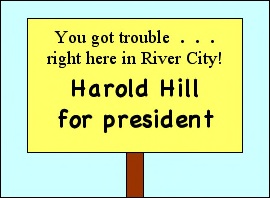
Harold Hill, in The Music Man, made a career of separating suckers from their money. He was charming and slick and thinks faster than the locals. When he falls in love with the librarian, it changes his attitude. She reforms him. Okay, fine, but for me that doesn’t saves the movie; the line that saves the movie is when he tells Winthrop, “I always think there’s a band.”

See, he didn’t mean it. He thinks he’s giving something back. He’s a good Joe at heart.

If a con man believes his own lies, does that make us forgive him? In the movies it frequently does. But what if a real Marian the librarian married a real Harold Hill. We would probably find her later with eight kids, hungry and living on skid row, after Harold Hill moved on. I like the movie version better.

Does our charming American con man believe his own lies? Does he even know himself where the truth is? Does it matter to him? Does it matter to us?

If he is slick enough, and fast enough, and plausible enough — if he can tell one lie to cover another until we get lost in the shell game — there is no limit to how far he can go.

He could even become President.

Raven’s Run 146

He was alert and ready, unhurried and unworried. If he had known that I only had one bullet left, he would have worried even less.

I bellied forward in the direction Raven had gone. The ground sloped away gently toward the valley below. Someone, probably the gunman, took a shot at the moving grass but I never heard the bullet sing. I crawled into moisture and turned with it, following an inch deep seep until it tumbled over a lip of rock, and I tumbled over with it. I sensed motion behind me, rolled over, and brought the Tokarev up. 

It was Raven.

She was crouched down behind the low bank, with her muddy knees driven deep into the loam. She wore loose, light pants and shirt, some kind of silk jogging outfit, with a windbreaker and a band to tie back her hair. She had muddy elbows and knees, and a dark smear of mud across her cheek. Her eyes were wide with fear.

Then puzzlement. Then the fear disappeared as she recognized me.

She gave a little yelp and fell forward into my arms. She was breathing heavily, perhaps crying a little. She buried her face in my neck, holding me tightly. I could feel her body trembling, and then she pressed her face upward and I had the sweet taste of her mouth on mine.

I pushed her off, although it was the last thing I wanted to do. She shook her head in wonder and said, “Where did you come from. Why . . . ; what . . .”

I grinned at her and shook my head. “Later. Now get down.”

Susyn and her dark companion were out there somewhere, and I had only one bullet. Things didn’t look good, but the electric charge that had passed between Raven and me was worth more than adrenaline. There was no way I was going to die now. I had more important things to do.

Before sticking my head up, I listened hard and heard a strange, penetrating sound. Susyn’s voice. Susyn’s death lament for her brother, the fourth and last, all dead by violence. Two of them dead at my hands.

I looked over the grassy rim. Susyn was kneeling with Alan’s lax and bloody head against her breast, rocking back and forth, crying out with a high and rhythmic keening. It set my hair on end. The dark man was crouched beside her, unmoved. If I had had two bullets, I would have spent one on him.

I slid back and motioned to Raven to follow. We went downslope on knees and elbows, but within three hundred meters, the seep tumbled over the verge of a grassy cliff. It was a steep, green and lovely drop, but the grass and mosses did not disguise the granite beneath. We could go no further in that direction.

I looked back. Susyn and her man were coming our way, walking fast and separating as they came. Susyn’s path was carrying her away to the left. The Levantine was coming directly toward us.

I eased down. He had been looking to his left. A quick movement on my part would have caught his eye. Raven put her hand on my ankle and I shook my head. I motioned her back upstream and whispered, “Get twenty feet away and draw his attention the moment you see him.”

She moved away without protest. I checked the Tokarev briefly. Seconds. I had only seconds to wait – seconds to live or die.

I heard Raven draw a sharp breath as the stranger came into sight. He turned toward her, raising his revolver, but in that same moment he had sensed the trap and begun to turn back downslope. I raised the Tokarev two handed, in classic Weaver stance, and brought the sights to bear on his face. more tomorrow

351. Who Is Listening?

When EDGE accepted Cyan for publication, I was less than enthused about publishing in eBook format. I’ve changed my mind.

It wasn’t the notion that science fiction authors should embrace technology that got to me. It was who responded to my website.

Building a website has been a learning experience, and I sometimes feel I’ve only begun. At first, no one was reading, but I expected that. Eventually, views began. Even later, likes began. I kept writing. I knew that gaining readership is a long-haul process.

I found it addictive to view the websites of the people who responded to me. One of the most surprising things I found was the number of respondents who were clearly from somewhere in the world other than America.

I regularly put out eight posts a week, many of which require research, and I have a life to live. That doesn’t leave me a lot of time to spend under the hood of WordPress, but I did find 

           https://wordpress.com/stats/day/(insert your own url here) 

which lets you click see how many views and visitors you had on any given day. More interesting, it shows a map that tells you which countries those views came from.

I was blown away.

To be specific, these are the results from this year, January 1 through April 21.

USA                    45%
Canada              28%
India                   8%
Australia            5%
U K                      4%
Switzerland       3%
South Africa       2%
Hong Kong       about 1%
Morocco           about 1%
Ukraine             about 1%
Romania          about 1%
Singapore        about 1%
Ireland             about 1%
Czech Rep.      less than 1%
Spain               less than 1%
Philippines      less than 1%
Japan               less than 1%
Kenya              less than 1%
Germany         less than 1%
Jordan             less than 1%
Israel               less than 1%

Global, indeed.

So, back to the initial statement — Yes, I would like to have Cyan on every bookstore shelf and in every library, not just available on line. However, no matter what happens from now on, I will insist that whatever I publish in the future will also be released as an eBook.

This goes back the the very beginning, to my childhood. Growing up on a farm, at first I had only G&D books (Tom Swift and the like) purchased from a local hobby store. Then I found the county library. I didn’t see a real bookstore until I was in college.

Those books were my window to the world.

Today, a book hungry young person with access to the internet can find — and afford — eBooks, even if her or she lives in India, South Africa, or Ukraine. I like that, and I’m proud to be part of it.

Raven’s Run 145

Chapter Thirty-eight

In that brief moment, Raven had not seen me, and she did not look back again. I stripped off my windbreaker and tossed it aside as I ran, pulled out the Tokarev and racked back the slide. 

The new man was faster than Susyn. He sprinted ahead, closing the gap on Raven as I closed on Susyn. Raven was moving well, and he was only marginally faster. Perhaps she would make it to Flam before he caught her. We could not be far above the village now.

Then Raven rounded a curve and pulled up, faltered, and headed off to her left across the grass. The stranger turned with her and then I saw why. Skinny Alan had come up from below to block her path.

The grass was knee deep in the fullness of it’s summer growth. Raven was having hard going. Her pursuer was gaining fast, and Skinny Alan was moving up at a diagonal to cut her off. He looked over his shoulder to call to Susyn and saw me. He almost fell over his own feet in his hurry to straighten up and change direction. Susyn looked over her shoulder and I was right there. I smashed into her as I passed, knocking her rolling across the meadow. Alan was pulling out a pistol. I raised the Tokarev, thought better of it, and took a forward roll. I had no bullets to waste on a moving target. Alan sprayed the air, triggering one of those double stacked wonder-nines as fast as he could pull the trigger. It was one step below a submachine gun. I went flat, hugging the earth and scuttling sideways.

Then silence. Alan would be reloading. The grass was half a meter high, and I could not see him without raising my head. I shoved the Tokarev in front of me and gently parted the grass, moving it from the roots with my left hand. I saw blue cloth, probably Alan’s shirt. He moved out of my sight to my left and I slid carefully to the right.

There was motion behind me and Alan fired again. I heard Susyn’s scream of fright and anger; then I jerked upright and fired once into Alan. He spun on me, raising his pistol and I had to fire again, taking an extra fraction of a second to line up the sights. He jerked mightily, firing again into the air, and fell back into the grass.

Susyn screamed in rage and I dove for the ground as she fired in my direction.

The long summer grass saved my life. Susyn’s bullets were like steel bees as I scuttled away, belly flat. The air smelled of decaying vegetation, that sweet mushroom smell of a wild, wet meadow. After a hundred feet of wild scrambling, I chanced a backward look. Susyn was kneeling beside Alan, and the stranger she had brought with her was watching impassively, waiting for orders. The revolver in his hand looked businesslike. He glanced up, then back to Susyn. He was alert and ready, unhurried and unworried. more tomorrow

350. Master Basho’s Dojo (2)

Regular readers will notice that these posts are coming later in the day.

Keir, back from Cyan, has found Uke Tomiki after his disappearance. You really should read yesterday’s post first, if you missed it.

They ate supper with the master of the dojo as the evening fog rolled in to mask the hillside and hide the view of the slum. The old man introduced himself as Basho. At Keir’s puzzled expression, he explained, “The name is familiar, perhaps? Basho was a seventeenth century poet, famed for his haiku. I took his name when I opened this dojo. I was born under another name.”

They sat on tatami and ate rice with scraps of vegetables and fish. It was not fancy, but there was plenty of it. Keir suspected Uke’s back salary assured that.

Keir had wanted privacy to talk to Uke, but the master of the dojo was soon engrossed in his meal, and ignored them so completely that it was as if they were alone.

Keir said, “Uke, I need you.”

“For what, Keir?”

“Will you come with us to Cyan?”

“Of course,” Uke smiled. “I was only waiting for you to ask.”

“Why did you wait? You knew that you would be welcome.”

Uke looked serene, but it was apparent that it was a hard won serenity. Much pain lay beneath it. He said, “Keir, my arrogance almost cost you your life. Or made your life a thing not worth living.”

“How so.”

“My testimony.”

“You were in pain, and you only told what you knew.”

Uke shook his head. “No. If I had acknowledged my pain, I would have never put you in danger. I hid my pain, hid my uncertainty, and attacked the court-martial board. Their whole lives were dedicated to the acquisition of power, and I threw in their faces the fact that they had no power over me. If I had gone in meekly, they would have treated me gently, and I would never have been badgered into giving them the testimony they used against you.”

“You can’t blame yourself for what they did. I don’t.”

“Blame is not the issue, Keir. I cannot control what they were and what they did. But I should be able to control what I am and what I do – and I didn’t. I attacked when I should have been silent. I would never jump a kavine with my bare hands, because I recognize its danger. I did not recognize the danger that panel represented. Worse, I did not realize that my attack would put you in danger. And I should have.”

“And so . . .?”

“And so, I compounded my failure. I went from stupidity to stupidity. For a while, after the trial, I spent my time drinking, taking drugs, and walking dark streets alone, as if I were searching for death so that I would not have to face my failure. Eventually, I came to my senses and returned here, to regain my balance.”

“Returned?”

Uke nodded. Keir pushed his empty rice bowl aside and said, “When Stephan told me you had come here, we agreed that it was unlike you. You never seemed to have much feeling for your Japanese heritage.”

“That is largely true. My father was a fifth generation citizen of USA. He and his elder brother were most unlike one another. His brother embraced zen, became a black belt in several disciplines and spent much of his adult life in Japan. My father, on the other hand, loved football, beer, and everything American. What he knew about Japan, he learned in college. When he became ambassador, he went to Japan as much a foreigner as if his name had been John Smith. And I am my father’s son.”

“But . . .?”

“But even as a boy, I loved my uncle and, odd as his ways seemed to me, I spent time with him when he returned to San Francisco to found a dojo.”

They were silent for a moment, and the old man raised his chopsticks in a kind of salute. Keir said, “How old are you, Uncle?”

With mock formality, Uke’s uncle replied, “I have had the privilege of seeing the year ’06 once before, although I was too young to remember it.”

“Uke, are you ready to take on the world again?” Keir asked.

Uke looked toward his uncle, who nodded and said, “It is time.”

This is your last freebie. What are you waiting for – go download Cyan.

Raven’s Run 144

Road and train were briefly parallel here and ahead on the footpath was a familiar figure. I leaned out to look closer and the train turned away so that I had to rush to the opposite window.

It was Raven, alone, walking slowly downhill.

I bolted for the door. The train was moving swiftly now, on this brief bit of level ground. The wind snatched at the door as I threw it open. Fence posts were snapping by thirty feet away and the train had taken another turn away from the footpath, bearing toward the opposite side of the valley. Stone rip rap clothed the slope of the railroad bed; jagged, bowling ball sized chunks of Norwegian granite. I could not land on those and survive. Ahead I could see a spot where the sward came right up to the tracks. Behind me were the excited voices of the other passengers as they realized what I was about to do.

A hand caught at my shoulder and I slammed it against the frame of the door with a violent sideways motion of my body. The hand withdrew and I dived forward, twisting to take the fall rolling.

The train receded into the distance, never slowing its stately pace. There were heads stuck out of the windows looking back. I waved to them as the train passed out of sight, spat out grass and mud, and stood up. Everything still seemed connected and working. The Tokarev was still in place.

The train had carried me a half mile from the footpath before I could jump. Susyn and her new man were just passing the place where the train track and path had diverged. They did not see me, which was good. With only three bullets, stealth was in order. 

By the time I got back to the path they were half a mile ahead of me and they had seen Raven. Susyn was gesturing ahead. Her new man nodded, then looked around and saw me, but gave no sign of recognition. There was no reason that he should know me. Yet.

They hurried ahead, and I hurried to follow. 

Could I get Susyn to back off? None of her original reasons for attacking still existed, but James had died. However ill and foolishly begun, this confrontation could not simply end. There had been too much fear, too much betrayal, and too much blood.

Raven turned around with her hands on her hips and her head cocked back, staring up at the moss green ascendancy of the fjord walls. And froze in that gesture as she saw Susyn and her man purposefully advancing on her. She spun on her heels and ran.

They ran after her. I ran after them. more tomorrow

349. Master Basho’s Dojo (1)

What! You haven’t downloaded Cyan yet? It’s been available for weeks.

OK, I understand. You want one last tease. Since you insist, here is Keir, on Earth, looking for his friend and crew mate Uke Tomiki after he has disappeared.

Keir took the jumper to the San Jose airport, and the Rapitrans to within ten blocks of Uke’s dojo. It was not actually in San Francisco, but south fifty kilometers in the hills overlooking Santa Cruz. Until fifty years ago, the hills had been covered with redwoods, but not even the most stringent conservation measures could stand against the urban guerrillas who slipped in at night to chop away at their half meter thick bark. In twenty years of nightly battering, the trees had died one by one, and as each one fell, shacks took its place. Now the forest of giants had given way to a forest of slum housing, growing like mushrooms on the bones of the ancient trees.

Keir found his way through the roadless maze of polyfoam, packing crates, cardboard, and stucco, with starving children staring like beasts from the darkened holes that passed for doorways.

The dojo was built of grey wood, laboriously split and sawed from the bodies of the downed giants. Three living redwoods remained, towering above the rubble, protecting the dojo from the sun, and in turn being protected by the ones who lived there. The dojo was a low, open building. Some of the inner parts were protected from sight by moveable screens. A stern young woman with a staff stood in the doorway, and made him wait while she sent word of his coming to those inside.

A young boy led him inside. Keir wondered if he was there to seek enlightenment, or food.

He was met by a wizened old man with sparse black hair and a wispy goatee, who was not quite the cliché Keir had expected, but close. They bowed slightly to each other, and Keir said, “I have come to see Uke Tomiki.”

“I have been expecting you.”

Keir raised an eyebrow and the old man’s face broke into a smile. “No,” he said, “it is not mysticism. I had not been expecting you, personally, but it was clear that eventually one of Uke’s friends would come for him. He is not the kind of man the world leaves in peace for long. A dojo such as this could never be his home; only a brief resting place. I will take you to him.”

The little man led Keir beyond the screens. There, a dozen men and women of various ages sat zazen, in two rows, facing an altar covered with flowers. Uke was third from the left in the back row, and he did not notice them when they came in. Keir looked at the old man, but got no help. He was simply waiting to see what Keir would do.

Uke had taught them all the pose of zen meditation, so Keir knelt quietly at the side of the room, mimicking their stance, but he did not attempt to meditate. He simply waited, watching the ones who were meditating. The old man considered him for a moment longer, then left quietly.

An hour passed. These people did not chant, so the only sound was the buzzing of flies and the distant, indecipherable sound of voices in the slum beyond the dojo. At first Keir considered Uke in his new surroundings, then he reviewed the work he had to do for the remainder of the week. It would take months of perseverance to achieve the no-mind state these people were searching for. You couldn’t just step in off the street and meditate successfully, so Keir did not attempt it.

Eventually, the old man came back and struck a gong. The meditators opened their eyes, shook their heads and began to swim back up to the world they had temporarily left. Keir was watching Uke when he stood and became aware of Keir. At first he seemed still off in that dreamy place, but suddenly his eyes cleared and a smile came to his face. He crossed the room, hand outstretched, and at the last moment, changed his mind and embraced Keir, saying, “My God, how I have missed you.”

To be completed in tomorrow’s post.

Raven’s Run 143

The scenery was glorious. Huge waterfalls tumbled down either side of the valley. Once we dropped away from Myrdal, the grass in the sheltered fjord was heavy and green. The train groaned and clattered against its brakes on the steep grade. There was a switchback trail that paralleled the tracks. Hikers coming up from below were moving slowly, sweating, and ignoring the train. Those strolling down from Myrdol waved as we passed them. The train passengers waved back.

I watched the hikers faces, looking for Raven, or Susyn, or Alan. The train plunged into a tunnel of willows and the footpath turned away from the track. There were no familiar faces on board the coach. Of course Susyn could have recruited more help, and I wouldn’t know them. With a sudden change of light, the train burst out from the willow screen. The sun was low in the western sky, just above the rim of the fjord, bathing the valley with warm, golden light. I could see the footpath again, but no one there was familiar. Path and train track converged and the train rumbled across a grade crossing, then rolled westward across the valley. The path continued eastward out of sight.

I moved into the next coach. Most of the windows were open. Tourists were hanging out, taking pictures. The wind tugged at my windbreaker. I put my hands in my pockets to keep it from riding up and revealing the Tokarev stuck in the waistband at the small of my back.

The train ground to a halt. Here, the melting snow pack had produced a powerful waterfall that fell almost onto the tracks. Everyone on board piled out and there was much posing and picture taking. I wandered around and got a look at the rest of the passengers. The train whistle blew and everyone got back on. The various waterfall fed streams had come together to form a narrow, rapid river. The train passed over it, and over the footpath. This happened several more times, and each time there were hikers to look at. Sometimes the footpath was on one side of the valley and the train was on the other, then the reverse. Sometimes the footpath and the train were side by side for a stretch.

We were over half way through the descent to the sea when I saw Susyn, walking down with someone I did not know. He had dark hair and skin. Latino or Levantine? I had only a glimpse before we were past and a turn cut them off, but I knew with an absolute certainty that it was her.

Should I stop them and reason with her? I should not. Even if Cameron Davis could call her off, I couldn’t. They would only look upon me as a target of opportunity, and I was in no position to win a fire fight. I didn’t have enough bullets, and I wasn’t sure that Senator Cabral had enough clout to keep me out of a Norwegian prison.

And even if I convinced her, where was Alan? more tomorrow

348. Spring

        Friday was Cinco de Mayo. Since I don’t post on Friday, I have placed this note here.
        Cinco de Mayo and St. Patrick’s Day are opposite sides of the same coin, as I explained in 115. St. Patrick’s Day with Juan O’Malley, last year. I also had something to say about racial identity in 144. Who Said You Were Mexican?, on Cinco de Mayo, a year ago today. I don’t want to repeat those posts, but you are welcome to click and visit.

Now, today’s post, beginning with a quote from Cyan:

For the colonists, the world that loomed beyond the perimeter fence was a fearsome enemy. Cyan’s climate aggravated the problem. The colony was situated in the region of spring — or autumn, depending on your psychological makeup. But it was neither spring nor autumn, and as the year wore on there grew up an unhealthy expectancy. Minds and bodies geared to seasonal change had a gene deep awareness that spring had been prolonged past its time — an awareness that slowly changed to a deep, unarticulated dread.

In Cyan, I made a great deal out of the lack of seasons, because seasons are so overwhelmingly important on Earth. Of course, people who were born and lived all their lives in Hawaii or Tahiti probably look at that claim and say, “What the heck is he talking about?” But most of us know.

Here in the foothills of the Sierras, half the year is harsh, brown and dry. The other half is green, and during that rainy seasons wild flowers not only come in profusion, but they also come in order.

First comes miner’s lettuce, with tiny flowers in the center of large, circular leaves. Not impressive as flowers, really, but a life saver for the the vitamin starved miners during the gold rush. Then comes Blue Dick. Now don’t blame me; I didn’t name it, and it is lovely despite its name.

The lupine come early middle and late, in a variety of colors. When my wife and I first came to the foothills, we learned most of the names, but now we mostly just look and enjoy.

What has this to do with writing? It’s the way I choose to live, and the places my characters go are mostly places I wouldn’t mind accompanying them.

Today (April 24) my wife and I drove to one of our many favorite spots. It’s late in the sequence of things, but the white lupine haven’t quite reached their peak.

In New York City today, there are writers inhabiting dim, smoky bars, gathering material for their next novel. More power to them. I couldn’t take it.

For me, I spend my green winter going out twice a week to see how the wildflowers are coming along, and gathering material for my next novel. That’s my story, and I’m sticking to it.

Raven’s Run 142

It was a flat, crude, and ugly automatic, with a five pointed star cast into the rubber handle. It looked like an early Browning, but the markings were not in English. I pulled the magazine and popped out a round. As I had suspected: 7.62 mm. – a metric way of saying .30 caliber. It was a Russian Tokarev. The fast little bullet would penetrate well but it didn’t have the stopping power of a .45, or even of a 9 mm. Back in West Berlin, when I was in the Army, I had shot one a few times and had not been impressed. It was clear that Susyn’s henchman had picked it up on the black market after arriving in Europe.

Worst of all, there were only three rounds. I emptied the magazine and dry fired it, then put it back together. I didn’t trust the safety, so I left the chamber empty. It would only take a second to rack the slide when I needed it.

If I got to Raven before Susyn or Alan.

I tried to put that out of my mind. I went back to my seat and stared at the barren lunar landscape of Norwegian mountains as the train strained its way upward. Soon Raven would be safe. There was no other way to look at it. Soon she would be safe. I set those lyrics to the silent music rattling around in my head, keeping time with the sound of the train. Safe. Soon. The alternative was unthinkable. 

*          *          *

The line from Oslo to Bergen runs over brutal, gray, granite mountains where heavy snow pack stays into July. Well toward the coast, Myrdal is a way station where a secondary line snakes its way precipitously down into a deep fjord to the village of Flam. The scenery on that descent is spectacular, and the run to the bottom is a favorite with knowledgeable tourists. Eric had said that Raven planned to take it, then go on to Bergen.

Myrdal itself was little more than a train station and restaurant. I showed Raven’s picture to the railway officials but hundreds of tourists pass through each day. They did not remember her. I checked my pack and picked up a map. The train down to Flam was powerful and short, with light excursion coaches. There was a trail down as well. Many tourists walked down, then rode the train back up. Few walked both ways.

If Raven had taken the train down and up, she was probably in Bergen already. Take the train down, walk down, go on to Bergen – hard choices. If Ed were here, or Will, or even if I had recruited Eric, then I could leave someone here to watch for her if we missed each other.

Then I cursed myself. I had money – Senator Cabral’s money – so there was no need to act alone. I scanned the faces on the platform and selected a likely looking couple. They were Danish, they spoke English, and they would be glad to earn a hundred American dollars for a couple of hours work. I peeled two fifty dollar traveler’s checks out of my stash and gave them one of the xerox pictures of Raven. I wrote a hurried note to Raven explaining the situation and telling her to stay in the station until I returned.

The little train was groaning and whistling as the conductor hurried the last passengers. It was already moving when I swung aboard. more tomorrow