Monthly Archives: July 2017

390. Pilgrim Son (2)

Continuing Pilgrim Son from yesterday —

Masters dictated an outline of Brutal . . . and sent that with the first two chapters. Dial Press, who had asked for Brutal . . .  in the first place, was impressed, but wanted another reading. Two weeks later, they passed on the book.

Masters was not like you and me; he had friends in high places, so he could find out what went wrong. It turned out that a famous publisher had advised them not to publish anything by an ex-British Indian officer, and they caved to pressure.

Nothing personal, but your book does not meet our current needs. Does that sound familiar?

Masters returned to what he had written, and found it different than any book of its type and better than most. He decided to finish it and send it on its rounds to publishers on spec.

He finished it. He sent it out. It came back. He sent it out again —

As is the manner of things in publishing, rejections began to pile up. A friend of Masters’ gave this advice: (page 127)

A writer’s time is always valuable. If you don’t write anything, I can’t sell anything.  While Brutal is going around the publishers, you should be starting something else. . . .  Why don’t you write a novel? You could, you know.

Master’s says, “The writing of Brutal . . . had given me confidence that the mere mass of works in a full-length book was nothing to be afraid of.”

I offer you that quote here for the express purpose of adding, “AMEN!” Spirit Deer did that for me.

As usual, Masters approached the question with deep thought. Write a novel, or become a novelist? It isn’t exactly the same thing. Masters was looking of interesting work to fill the rest of his life, and provide security for his family. Writing one novel would not further that end. Becoming a novelist — producing novel after novel — would.

He would become a novelist, but what kind. He wrestles with this for many pages, starting on 128, before he decides what we already know. He will write historical novels about India, from the viewpoint of Brits who are half inside and half outside the culture of India. By page 138, he is ready to say:

I listed thirty-five areas of conflict about which I felt I could write novels. They covered the whole period from 1600 to 1947. Taken as a whole, they would present a large canvas of the British period in India. The British would be in the foreground, as they had been in actuality, yet I thought the canvas would show how they were controlled by their environment — India — even while they were ostensibley directing it.

(to provide unity to the project) . . . I thought that the only course left open to me was to put into the foreground of each book some member of a single continuing family.

And that is exactly what he did, through more than twenty novels.

Through all this, and other chapters besides, he interrupts his memoir with short paragraphs like:

John Day rejected Brutal. They said they already had a writer on Oriental subjects. . . .  and  . . . Little, Brown rejected Brutal. It was very well written and eminently readable, they said, but the couldn’t think what category to publish it in, as it contained elements of travel, belles-lettres, adventure, and military history, as well as autobiography.

I also remember those days of frustration. Now rejection slips are kind, vague, and always contain something like, “not for us, but try elsewhere.”  They do not cause hurt feelings, but they also don’t give any useful feedback.

Back in the day, I was once turned down on an outline that my agent was excited about, because the novel, on the subject of Shah Jehan’s reign, was “too Indian”. Imagine that. A novel about historical India that was too Indian. Another novel was highly praised by a publisher, who ended by saying, “But I can’t take it because men’s adventure books are no longer selling.”

Maybe its better when we don’t know why.  Pilgrim Son review continues tomorrow.

Spirit Deer 27

If he had hit the deer, would it have died? Or had the deer’s spirit put the branch in the way? Tim’s father would not have approved of such speculation, but his grandfather would have understood.

A chill was growing under the hemlock as the fire died. There was little energy left in him now. He slipped into a fitful sleep.

* * *

Two miles away the black bear caught a faint scent, but he could not identify it. Without his sense of smell, he was nearly helpless. It was days since he had had meat, and his instinct to hibernate as well as his hunger told him how badly he needed to eat. He stood up on his hind legs and peered uselessly into the blinding screen of snow, but a bear’s eyes are weak, and he saw nothing.

A great rage was building within him.

* * *

Tim woke, shivering uncontrollably. The fire was out. He scattered the ashes and found a live ember. Working carefully, he took tinder from the supply in his canteen and rekindled the fire. When he had it going, he didn’t wait to warm himself, but stacked the remainder of his wood so that it would fall into the fire as it burned. Then he fell back into a half-conscious state.

* * *

The fire was out again when he woke and day was beginning to lighten the world. The snow had stopped. He ate a mouthful of snow, then dug around the roots of his shelter tree, hoping to find a squirrel’s cache of pine nuts. He found a pitiful few.

He did not bother to rebuild the fire. If he stayed here now, he would never leave.

The deer’s tracks had been covered by the fresh snow, but it made no difference. He was too weak to stalk it anyway. The tracks of birds and small rodents dotted the snow here and there, but there were by not many of them.

Tim wandered in a daze, looking for anything to eat. Once he blundered into a pine and looked longingly at the cones hanging high above his head. For the life of him, he could not figure out how to get them down. Not for the life of him.

Later, he realized that he was following a set of tracks, but he didn’t know what had made them. He followed them to the base of a lodgepole pine and, looking up, he could see a creature sitting in the lower branches staring down at him.

Porcupine!

The  porcupine is one of the few creatures slow enough to be caught and clubbed. The have no speed, only their quills for protection.

Shaking with excitement and need, Tim strung his bow and nocked an arrow. Shooting overhead was a skill he had never practiced. His first arrow buried itself in the limb on which the porcupine sat.

The porcupine was startled into action. As Tim nocked another arrow, almost sobbing, the porcupine waddled to the main trunk and started up. Tim took careful aim and shot again. The arrow skewered the porcupine and buried itself in the tree trunk.

The creature hung suspended by the shaft that had struck it, nailed to the tree and completely out of Tim’s reach.

“No, no, no, no, no!” Tim cried as tears ran down his cheeks. Then, making slow and graceful turns, the porcupine slid down the shaft, propelled by its own weight, and fell to the ground. The arrow remained embedded in the tree.

Tim approached the fallen creature and fell to his knees before it. It lay on its back with its rodent like mouth half open. Its eyes were flat and dull in death.

It was meat. More than meat, this was life itself. more tomorrow

389. Pilgrim Son (1)

Pilgrim Son by John Masters is the third in a trio of memoirs. The first two are about his life in the British Indian army, the last is about becoming a writer.

As I said earlier, I first read Pilgrim Son in the late 70s, about the time I was writing Spirit Deer. I was impressed by Masters professionalism. I expected professionalism from the publishing industry —  the phrase publishing industry suggests that it is run in a businesslike manner. Within a few years, I decided that was a myth.

I recently went back to Pilgrim Son and reread it, looking for the point at which he rails against the industry for not recognizing that his first novel would be successful. I spent many hours and did not find the quotation, so I will tell you that he said something like this: If Nightrunners was good enough to be chosen for book clubs, then why did every editor who read it fail to know this? Quote, more or less.

Pilgrim Son is 383 dense pages, much of which is dedicated to Masters observations on becoming an American in the late 40s and early 50s, while living in a colony of bohemian artists and writers. That world no longer exists.

I can’t recommend the book to everyone. Nevertheless, if you are a serious would-be or beginning writer, you could do worse. For you, I will drop approximate page numbers from time to time in order to help you find the parts of the book which will be most useful to you.

The book Masters was writing at the beginning of Pilgrim Son was Bugles and a Tiger; its original title was Brutal and Licentious, part of a then well known quotation. I will call it Bugles  . . . or Brutal . . . as he does, according to which part of Pilgrim Son I am referring to at the moment. Sorry if that confuses you.

#                             #                            #

Around the beginning of 1948, John Masters had settled down to write. This included discussing his prospects with several editors of his acquaintance, and receiving their advice.

Beginning writers will now be reaching for their favorite means of suicide or homicide at the notion that Masters got to talk to and receive advice from editors before he had written anything. It does help to have friends in high places — or so I am given to understand. I never had any myself.

Those editors suggested that he begin with a memoir of his life in India, somewhat following the pattern of Lives of a Bengal Lancer. (page 106, but also check out pp. 104-5) Masters disliked that book, but took what he could from it in planning his own. Planning was second nature to him, learned as a British Army officer, so he soon knew what every chapter of Brutal . . . was going to contain. Then it was time to write.

Masters says: I pulled myself together. The first chapter was only going to be twenty-five pages and I could manage that. The the next . . . and the next . . . One chapter at a time, I could do it. The book as a whole and each chapter had been shaped by the master plan. Now I must concentrate on each page, each line.     page 112

Masters finished the first draft and read it through. He didn’t like it. Lots of beginning writers have reached that stage. Masters had learned that an excellent plan does not always result in excellent execution.

It’s what he did next that makes him interesting. In his own words, somewhat shortened:

A more experienced author might have been able to avoid these errors, but for me there was no way but to replan in the light of what was there on paper. …. Find out how it happened, first, and then remedy it.

I divided several sheets of paper into lines and columns and went carefully through the MS, grading each sequence in three ways: by length, by type, and by merit of its type. It soon developed that almost every sequence could be classified as Action, Explanation, Color, Characterization or Thought. When the job was done, and it took several day’s hard work, my new charts revealed a very lumpy texture in the book. Page followed page of action, with no explanation and little color. Color was not used as a background to action or as a perimeter to characterization, but haphazardly, as the pictures had come to me. Although I could grade some sequences A, too many were B’s and C’s: not good enough for a professional.

 . . . Using my charts to correct the early faults, I rewrote the first two chapters.  . . . .  

I’ve never been quite that organized myself, but I have gutted and rebuilt many hundreds  of pages. Pilgrim Son review continues tomorrow.

Spirit Deer 26

There was too long a stretch of open ground to be covered before Tim could get within spear throwing range. He strung his bow instead, and laid aside his crutch. His ankle might give way, but he had to take the chance. Moving laterally, he got directly behind the deer, then began to advance. His ankle sent a shock of pain through him each time it hit the ground. He carried the bow in shooting position, ready to draw and release the moment the muley became alarmed.

To his amazement, the deer did not become aware of him. He advanced slowly, footfalls silenced by the thin layer of snow, to within fifty feet of the animal. It still sat quietly, looking down the slope.

Tim paused. If he did not shoot soon, his chance would be lost. Drawing back his bow, he sighted on the deer’s side just behind the shoulders and released.

The arrow flashed, flying true. There was a thuck on impact and the mule deer erupted from the ground. For a fraction of a second it stared at Tim; then it was gone, bounding away in great leaps, using all four feet in its haste.

Tim stood holding his empty bow, frozen in superstitious terror. For a moment the deer’s eyes had seemed to hold an almost human intelligence. Was this a spirit deer after all – one that could not be killed?

The deer was gone. Only his tracks remained.

Tim staggered forward to where the deer had lain. His arrow was buried head deep in a thumb sized branch of whitethorn, and its shaft had shattered on impact. It was a chance in a thousand with such a large target and such a skimpy bush, but Tim’s arrow had been stopped short.

Tim’s scream of frustration rebounded from the mountainside.

Chapter 10

Tim squatted before his fire. In this exposed position at the edge of a small meadow, the constant wind had stunted the growth of a mountain hemlock, twisting it into a whorling shrub that backed against a granite outcropping. Tim had built a fire against the rock so that it reflected heat into the space beneath the hemlock. He had made that space more snug by interweaving branches from nearby shrubs and banking snow against the outer branches.

It was snowing again. The scattered flakes had given way to a steady fall of snow with the coming of night. They did not dance as they had the night before. Now there was no wind and they floated purposefully downward, filling the night with a curtain of white and steadily building up a layer on the trees and ground.

Tim paid little attention to his surroundings. He sat silently, caught up in the rumblings of his empty stomach and the throbbing of his ankle. Today had nearly defeated him. The long stalk in the cold and wind had been bad enough, but it was the waiting, not moving while he searched the brush with his eyes, that had left him chilled through and exhausted.

The fire was dying, but it seemed just too much trouble to put on more wood. Tim’s head dropped to his chest. He really should have saved that arrow, but instead he had taken the already shattered shaft and had broken it again and again, then ground it underfoot in his rage.

If he had hit the deer, would it have died? Or had the deer’s spirit put the branch in the way? more tomorrow

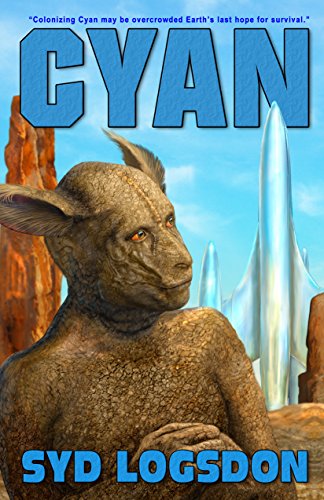
388. Cyan Released Everywhere

Cyan was released in a sequence. First it was available in March for pre-order from Amazon.

On April 17, it was released, but exclusively from Amazon.

Today, it becomes available everywhere.

If you do your reading on another tablet, in EPUB or another format, you can finally download.

I thought the only hard copies available would be the fifty print-on-demand copies I took with me to Westercon, however once I made the POD order, they became available to everyone. I didn’t see that coming.

Enjoy.

Spirit Deer 25

The muley’s trail switchbacked up the valley as he browsed. Tim remained under cover as he followed so he could not be seen from above. He knew that a mule deer will browse for an hour or so as the day begins, then lie down looking downslope. This gives the deer the advantage of rising winds moving up the canyons in the morning. Tim could do nothing to disguise his scent, but he could stay out of sight.

From time to time, Tim could see freshly nipped branches of serviceberry and manzanita. Then he came upon a peculiar sign. The deer had torn up a large patch of snow and it was visibly yellow from his urine. A nearby willow was bruised and its bark was torn loose near the ground.

The deer was going into rut despite his wound! Tim would never have believed it. Perhaps this would make him careless.  Certainly it would make him dangerous. A muley in rut with freshly sharpened antlers will not hesitate to attack

* * *

In another part of the mountains, the black bear was leaving the foothills. His nose had begun to heal, but his sense of smell was mostly gone. His eye where the buckshot had lodged was swelling and the infection was spreading. He could not hunt properly with only his weak eyes to guide him. He was hungry and angry, and he was heading for the section of the mountains where Tim was lost.

* * *

Eventually, Tim decided that he had followed the deer’s tracks far enough. By now, it should have gone to earth, so he worked his way up the side of the valley and continued upslope parallel to the muley’s trail. After half a mile he dropped down into the valley again to check and, sure enough, the tracks were gone.

If his reasoning was correct, the deer was below him now, so he began a slow downslope stalk into the wind. The trees grew closer together here, and that made it hard for him to see.

The clouds were a boiling sea of gray and charcoal hanging just above the treetops. It was nearing noon, but the day just grew colder. Tim leaned against the bole of a mountain hemlock to rest his aching ankle and consider his next move. As long as he stayed still and upright, he would probably remain unseen against the trees, but he would have to look carefully before he made each move.

He moved diagonally to the right and stopped again against the bole of a lodgepole pine. He stood there with only his eyes moving for a long time, looking particularly at a likely clump of bitter cherry. Then he moved again, going about twenty feet and stopping.

He worked his way along for two hours, moving briefly and standing long to search with his eyes. The cold was getting to him, but he tried to ignore it. Eventually, he came to an opening in the trees, almost a meadow, but with a scattering of Jeffrey pines and low bushes of manzanita and whitethorn – just the kind of resting spot his father had taught him to look for.

Tim settled back against a pine and slid down so that he was hidden by a light screen of gooseberry. He scanned the area. It took almost ten minutes before Tim’s eyes could separate the deer from its cover. The deer had chosen a spot commanding a view of his trail. If Tim had blundered along following his tracks, the deer would have been long gone. more tomorrow

387. Buchan the Racist

Getting ready for Westercon, I prepared a set of notes, placed as posts, for the panel What made the golden age golden? I was under the impression that it would be history and homage, and made notes appropriate for that. I was wrong, and it isn’t the first time I have spent time off track by starting before I had full information. When i’m ready to start a project, I’m ready, and sometimes I pay the price.

After I had posted my notes-to-self, but long before Westercon, I received this description of the panel:

Heinlein and Asimov are two pillars of the Golden Age of Sci-Fi. But reading those works with modern eyes can reveal attitudes that would be unacceptable in modern times. What can we learn from the classics when we look past the sexist and racist attitudes that pervaded the works of that time? Can we still appreciate works that present unacceptable ideologies?

Well, that’s a bit of a different story. No problem. I am always ready to fight the forces of political correctness.

I’ve been to this rodeo before. Once, several years ago, I was looking at on-line reviews of John Buchan’s The 39 Steps. I don’t remember why, but I do remember a review that ripped Buchan as a racist for seemingly anti-Semitic statements in that novel. I wrote a counter-review; both have since disappeared.

For those who don’t know him, John Buchan was a popular British novelist of the early twentieth century. He is very much a pro-British patriot, with the prejudices that implies. Think Kipling light. And he was a racist, but not an anti-Semite. I say that not as a scholar, but as a fan, who has read and re-read his works.

If you read him at length, his distaste for African blacks comes through loud and clear. His Jews, on the other hand, show up as both heroes and villains, just like his Germans and his Englishmen. But if you only read a little, you can be fooled.

#                #                #

To follow through on this, I used one of my favorite techniques. I recommend that you put this into your bag of tricks. I went to Project Gutenberg, downloaded The 39 Steps in Rich Text format, then cut and pasted that into my word processor. Now I had all 41,264 words in a searchable form.

One more hint. RTF will be hard to read because its wide line-length makes it look like bad modern poetry. Just switch your word processor to horizontal format and it will be much easier to work with.

The reviewer who started this controversy had complained about Buchan because of the words of one of his characters, Scudder. If you don’t know the book, Scudder is a kind of amateur spy who finds out that bad people are about to start World War I, and catch England off guard. This is what Hannay, the main character, says, quoting Scudder:

The Jew is everywhere, but you have to go far down the backstairs to find him. Take any big Teutonic business concern.  If you have dealings with it the first man you meet is Prince von und Zu Something, an elegant young man who talks Eton-and-Harrow English.  But he cuts no ice.  If your business is big, you get behind him and find a prognathous Westphalian with a retreating brow and the manners of a hog.  He is the German business man that gives your English papers the shakes.  But if you’re on the biggest kind of job and are bound to get to the real boss, ten to one you are brought up against a little white-faced Jew in a bath-chair with an eye like a rattlesnake.  Yes, Sir, he is the man who is ruling the world just now, and he has his knife in the Empire of the Tzar, because his aunt was outraged and his father flogged in some one-horse location on the Volga.

Wow! That sounds pretty anti-Semitic, and the reviewer who started this conversation took it as proof positive. But let’s wait a minute. Assume that the character Scudder is the worst anti-Semite since Hitler — does it follow that Buchan hated Jews? I wrote a mass murderer into Cyan — does that mean I approve of mass murder?

You can’t read the words of a fictional character as the opinion of the author, especially if you are looking at a minor character of questionable honesty.

Scudder dies in chapter one and his quest is taken over by Richard Hannay, the actual main character in this and several other novels. If you look closely at the character of Hannay and a dozen other lead characters in two dozen other novels, then you will come closer to having a fair and defensible picture of Buchan’s attitude.

In point of fact, not only was Scudder a minor character, he was also a liar. The reviewer who cried bigot never found this out because he quit the novel early. I knew that he was, but I needed a quote as proof. To find this, I searched for the word Scudder in my Find and Replace function. His name appears 65 times in the book because Hannay keeps thinking about him. Click and read. Click and read. Click and read. I found the passage I remembered at the beginning of chapter four.

The little man had told me a pack of lies.  All his yarns about the Balkans and the Jew-Anarchists and the Foreign Office Conference were eyewash . . .

Hannay worries at Scudder’s diary, taken off his body, because it seems odd, almost as if it were a cypher, and Hannay is good at cyphers. Sure enough, the Jew-Anarchist plot is just a cover for a much deeper plot (not by Jews), which Hannay foils by the end of the book.

So, everybody was a nice, unbigoted person and it was all a misunderstanding? If it were only that simple.

Reread the first quote, if you can stomach it. How would that passage play in a book published in 2017? When it was published in 1915, the book was a hit. Nobody minded that passage at all.

After Hitler and the holocaust, anti-Semitism fell out of favor. Before that, it was everywhere, in Europe and America. An actually anti-Semitic book in England in 1915 would have raised no eyebrows.

Was Buchan a bigot? Yes and no. He was not anti-German, he was not anti-Semitic, but he was anti-African. How do I know? I have read more than a dozen of his books, some multiple times. You can’t know from assumptions, and you can’t know from reading one book.

Bringing this back to the Golden Age of science fiction, we should be able to read and appreciate authors like Heinlein when he depicts mannerisms that are foreign to us. (Or to be fair, foreign to you; I grew up in the same era and it all seems normal to me, even when I disagree with it.) The fact, for example, that Joan Freeman in Lost Legacy is the object of mild sexist teasing should not mask the fact that she is a full participant in the action.

Nevertheless, understanding is one thing, enjoyment is another. There is a limit, and it varies with each of us. For me, Heinlein sometimes seems silly, but I still read and enjoy everything but Farnham’s Freehold. That one goes on my never-again list, along with John Buchan’s anti-Black tirade Prester John.

POSTSCRIPT: As it turned out, everyone on the panel ignored the description and we just talked about how great the golden age was. The forces of political correctness never raised their heads.

Spirit Deer 24

Since the chase, the deer had laid up and had eaten heavily. His wound was mostly healed now and much of his strength had returned, but the bone of his foreleg was chipped and he could not put weight on it without pain.

Now something out of the ordinary was happening in the night. There was a suggestion of light low in the valley where there should be no light. The deer had watched it for nearly two hours, not alarmed because it was at a distance. Then, just after the snow began to fall, the human that had hurt him so badly and chased him so relentlessly appeared in the faint light. The deer froze, watching. After a while the human disappeared and the deer slipped away, moving as rapidly a his damaged foreleg would allow.

* * *

The snow had left its mark lightly on the land, with a few drifts beneath the trees and about an inch on the ground. When he smothered his fire with snow and started out, Tim found that his ankle had not stiffened with use. He felt better than he had since his adventure began.

The sky had cleared briefly about sunrise, and Tim had taken advantage of his opportunity to look for landmarks. He could see far across the slopes, but there was nothing in sight that he recognized. That puzzled him. He could not imagine being so far from the place he had set out to hunt.

He would have built up a signal fire in hopes of being seen by some ranger on fire watch, but the clouds closed in tight again within a few minutes.

Tim studied the high valley with care and wished for a pair of binoculars. Or a rifle. Or a helicopter. Or just a cell phone. He circled the valley, staying in the cover of the stunted trees, but all he found of his deer was a single frozen track, pointing upslope.

Why? Why, at the obvious beginning of winter, with snow already on the ground, was the muley going further into the mountains and away from its winter feeding grounds in the valley below? Had it seen him? If it had, it must have been last night when he walked out into the snow storm.

Tim stood irresolute, staring at the single track and feeling really scared for the first time. He had seen far enough down the mountain to know that it would take him days to walk out in his crippled condition. Hunger was already grinding at him. He could concentrate on the task at hand only by a major effort of will. His bare forearms were chapped and reddened by exposure, and corded with loss of weight. He was in real trouble.

He really had no choice. Without any hope of rescue, he had to save himself, and he could not hope to walk out without food. He was already weak and he would only become weaker.

He turned upslope, in the direction that single track pointed.

From time to time Tim found tracks. He did not need many, because the deer kept to the valley of the creek. About mid-morning, Tim came across a complete row of tracks that stood out clear in the fresh snow. These had been laid down since the storm. The deer’s injured foreleg had never touched the ground. That injury was Tim’s only advantage.

His disadvantage was his own ankle. This morning he was putting more weight on it and ignoring the ache. He hoped that he would be able to manage a hobbling run if it came to that, but he wasn’t sure. more next week

386. Chief Seattle

Beware, I occasionally rant. Like today.

If this post had a descriptive sub-title in the nineteenth century style, the full spread would be:

Chief Seattle: White Man’s Indian
or, how a movie took a fine old man and turned him
into a puppet and a joke

How’s that for laying out a political agenda for all to see?

Yesterday and today I presented an ersatz Miwuk legend. Ersatz is a fancy word for “I just made it up”. I don’t apologize for that. Spirit Deer is a work of fiction, and I used Miwuk Indians as the basis for Tim’s knowledge because they were the resident Native American’s in the places he finds himself. (When I wrote the book in 1975, it wasn’t yet a crime to say Indian instead of Native American.) Later, I will also have a “family story” about his grandfather’s grandfather. That is also made up, to meet the needs of the novel. Again, no apologies. Fiction is fiction. Historical fiction has some responsibility for maintaining accuracy, but Spirit Deer isn’t even subject to that.

I wrote this novel, all of it, including the legends and family stories. It’s fiction, okay. If it were ever to be published, I would make sure that those facts were clearly stated.

Actually, that’s what I’m doing here.

There is a point to all this, beyond simply taking responsibility for what I have written. When I was a teacher, I came across a book called Brother Eagle, Sister Sky: A Message From Chief Seattle and also the supposed text of Chief Seattle’s speech. This took place decades ago, and I can’t remember which I saw first, but my Hemingway style “writer’s shit detector” went off like a siren. I was sure that this was another white guy putting words in an Indian’s (excuse me, Native American’s) mouth, after he was long dead and couldn’t set the record straight.

It turns out, I was right. The version of Chief Seattle’s speech in question, which comes complete with the statement, “I have seen a thousand rotting buffaloes on the prairies left by the white man who shot them from a passing train,” was written by screenwriter Ted Perry for the 1971 film Home. Those buffaloes were killed and rotted decades after Chief Seattle made his speech, and half a continent away. To be fair to Perry, he tried for years to claim credit for the speech and counter its false historicity, to no avail.

Actually, as fiction, or as a soupy environmental statement, it is a powerful piece of writing. But it has nothing to do with Chief Seattle.

The publication of Brother Eagle, Sister Sky led to a 1992 Newsweek article that named Perry as the author of the speech. In researching for this post, I also found a more complete article from the New York Times. You can check them out for yourself.

All this slapped me in the face four ways.

As a writer, I work hard to keep my fiction from telling lies, either morally or factually. I am a long time student of ecology, and I abhor the way a hard-edged science gets turned into a set of slogans. As an anthropologist (B.S., M.A., and two summers on archaeology digs), I hate the way Native Americans are rarely seen for themselves, but as savages or saints, according to whatever is the current fashion. I am a student of history as well, and . . . you get the picture.

You might have guessed by now that I can be irritated by lies, and seeing a screenwriter’s version of “Chief Seattle’s” speech accepted as history grinds all my gears.

Spirit Deer 23

The Deer saw all this from his place concealed at the edge of the forest. The First Man was becoming weaker as he hunted. He could not make a kill while his arms had not the strength to draw his bow properly, and while his legs did not have the strength to stalk properly. The Deer saw that the First Men would soon perish. Then the Deer changed his form so the man would not know him.

The First Man saw a dark animal at the edge of the forest, bigger than the Squirrel or the Towhee, and standing still and close. It took the last of his strength to pull back his bow and shoot. The animal fell, and only when the First Man came close did he see that it was his friend and teacher the Deer.

The First Man was terribly frightened and sad, but the Deer was a Spirit Deer and he answered the Man’s fear and sadness by saying, “As long as you eat my meat with reverence and kill only for need, my children and your children will inhabit these hills in peace forever.”

Tim felt much like a First Man as his memories slipped away into sleep. But this deer was unlikely to give himself up so that he could eat.

* * *

Like the puffy down of cottonwood they came, rolling on invisible currents of air, settling on Tim’s clothing and instantly disappearing into the fabric. He had awakened to feed the dying fire only to find the ground already white with snow. Tim had known that it was coming, but still he was not ready for it.

He left the shelter of the cutbank and stepped out into the swirling mass. A slight wind funnelled down the creek, sucking warmth from his exposed arms and finding its way through the many rips in his clothing.

He threw back his head in wonder at the delicate beauty of the snowfall. The flakes fell harmlessly into his eyes and mouth and collected on his clothing. He knew that he should be scared; it surprised him that he wasn’t.

He stood out far longer than he should have, and when he returned to the fire it took a long time to stop shivering.

Chapter 9

Animals are more predictable than people. Very little of their behavior is learned; most of it is born in them.

Mule deer are not the intellectuals of the animal world, nor are they cursed with an excess of curiosity. Their first reaction to any new object or event is to walk wide around it, then study it from afar. They are creatures of the open forest and plains, thriving best where underbrush is scarce and visibility is high; they place faith in distance. This is often the death of them. They will sometimes stare openly at a hunter while he knocks them down from 300 yards away with a high powered rifle.

Tim’s deer was more cautious than normal because he had been wounded and because the area he was in was entirely new to him. And there was more. 

When Tim had fallen into the stream and hit his head, he had not been knocked unconscious. He had been swept downstream only a few hundred yards and had come out dazed and maddened by pain. He had run after the wounded deer, bleeding from his head wound, dripping water, and screaming. The chase lasted for hours, and when Tim finally collapsed, he remembered none of it.

That was why he was so badly lost, and why the deer feared him with an almost human fear. more tomorrow