Monthly Archives: December 2017

Symphony 57

Interlude

Carmen had not been in San Francisco in nearly three months, and Neil had not been there for several years. It was early Friday evening; they had no school tomorrow and no deadlines tonight, and apparently Carmen had finally decided that she liked Neil. So they headed in.

It was rush hour and the commuters coming back from San Francisco were choking the lower level of the Bay Bridge, but the upper level was reasonably clear. Carmen slid skillfully through traffic, found the right lane and made the wide southward loop that would put them on Van Ness. The city lights were just beginning to come on, as the lowering sun turned the skyscrapers to brass.

They parked in the lot beside the Maritime Museum and walked out to look at the boat basin. Since Neil had been there last, the three master Balclutha had been acquired and moved in. She was silhouetted against the lights of Richmond. The Thayer was gone, but when he inquired of a passer-by, Neil found out that it was just in dry-dock for repairs.

Neil said, “I was worried there for a minute.”

“Why? What is the Thayer?”

“Haven’t you see her? She’s been tied up here for years.”

Carmen laughed. “If it has been here for years, then I have seen it, but one ship looks just like another to me.”

“How can you say that? That’s like saying when you’ve seen one woman, you’ve seen them all. Balclutha is all right; she’s pretty enough, but she has no real historical significance. The Thayer was a west coast lumber schooner. She was built on Humbolt Bay and sailed the coast of California bringing down the lumber that built this city. I think she is the only one of her kind left.”

“I think you may be the only one of your kind left,” Carmen laughed. “How did you get to be such an expert on ships?”

“My grandfather was in the herring fisheries out of Aberdeen in the twenties. When they went bust, he came to America with my grandmother, and my father in nappies. That’s diapers in American.”

“I know what nappies are. I watch PBS.”

“Anyway, my grandfather settled in Astoria, at the mouth of the Colombia, and took up salmon fishing. He was still working at it when he was seventy-five. My father grew up with the sea and hated it. He got a job as a carpenter, worked his way up to being a contractor, put me through college, and dropped dead of a heart attack at age fifty. My grandfather went to his funeral. He’s still alive, and tough as leather.”

Neil stopped talking and stared at the ships. He had said too much, too fast, and his voice had lost its lightness. He had not intended to talk about his father. It was too soon after his death to speak lightly of it and the flippancy he had tried to assume had turned to bile in his mouth.

Carmen put her hand on his and said, “I’m sorry.”

“I shouldn’t have brought it up. It just slipped out. I meant to just tell you about my grandfather.”

“When did your father die?”

“Two years ago.”

“It has been ten years since my father died,” Carmen said. “I can talk about him now, but I still have the pain. I suppose I always will.”

” ‘If it is cured by anything less than death, the chances are that it was not true sorrow.’ “

“Is that a quote?”

“Hemingway.”

“I’d rather hear McCrae.”

“I didn’t mean to be pretentious.”

“I never thought you were.”

They went up the sidewalk and around the museum to look at the shops in Ghirardelli Square. They did not hold hands because they were not lovers; but they were becoming friends. The old black guitarist with the raspy voice and the pictures of himself with the stars was playing his ragged blues as they passed by. They admired the paintings in the galleries on Beach Street. Neil like the semi-nude self portraits by Ruby Lee. Carmen thought they were self-indulgent. Neil agreed, and liked them anyway. Carmen wanted to know if he liked the art or the subject. Neil said, “Both.”

They took a cable car from the Hyde Street station and played tourist, riding the hills as the city turned on her multi-colored night face. Downtown they counted the couples, categorizing them him-her, him-him, and her-her, and found out that San Francisco was still basically a heterosexual city.

They went to Chinatown, side by side, hands in pockets; but where Neil walked, Carmen strode, heels clicking, soles twisting under the back thrust of her lean legs, with a motion that turned heads wherever they went. Neil had never seen her this way, free, relaxed, laughing, full of tasteless jokes and outrageous puns. She had shed her teacher persona. It was her night to howl.

They ended the night at the Plow and Stars, listening to Golden Bough, and caught the last cable car back to Fishermen’s Wharf. They made the long drive home in a companionable silence, broken by the sound of soft music on the radio and only occasionally by talk. Neil watched her profile in the light from the instrument panel and thought her beautiful. more tomorrow

445. Bait the Crazies

This post will be bitter, so I will also make it short.

Much of Symphony in a Minor Key is based closely on personal experience. The conference that Neil and Carmen attended is of that species. I attended the real conference on which this fictional one was based. Call it a close paraphrase, complete with the same opening exercise, although they used an excerpt from A Clockwork Orange instead of a Burns poem.

I have endured hundreds of these meetings. Some were after school, on our own campus. Some were away and multi-day. All of them cost the district money which was not well spent, and cost me time that could have been better spent shooting pool. Or sleeping. Or — I often thought at the end of a long day — shooting myself.

Some of the presenters were prophets of some new panacea. Some were just trying to do something they thought was useful. Some were shysters, plain and simple. Some were just trying to make a living. Some — I am convinced — had no training for anything but education, but had discovered they couldn’t stand kids, and had to do something else to make a living that justified the years they spent in college.

A few were competent. Very, very few.

A friend and fellow teacher told me, when I was just beginning, that the only job in education worth doing is teaching in the classroom. If you are thinking, “What else is there?”, you clearly have not experienced the phalanx of bureaucrats who make up a large part of the education community.

I thought she was right at the time, and thirty-plus years later, I am convinced of it.

Teaching, like any other profession, has its moments. Sometimes it is wonderful. Sometimes it is terrible, and never more so than at conferences where those who know little try to teach those who know better.

And yes, like Neil, when I couldn’t take it any more, I would raise my hand, smile innocently, and bait the crazies.

Truth be told, I did that a lot.

Symphony 56


Over in A Writing Life today, there is a post that gives the background for this part of Symphony.

==============

That uncorked the bottle. Neil leaned back with a bland look of false interest as Anne Marie Chang proceeded to pounce on his words and destroy his arguments to her own satisfaction. And, to judge from the sycophantic mutterings around the table, to the satisfaction of her friends. Her discomfort and anger paid him back a little for the morning he had had to endure, and he learned a great deal about Anne Marie and the shock troops for change that she represented. 

She had, as she herself said, unfinished business with the school system. She had been leveled when she was in elementary school and she had never quite forgiven her teachers for doing that to her. She felt that they had been saying to her that she was unworthy, and she was determined that no child would ever have to go through that again.

“But you did learn to read under that system,” Neil pointed out, baiting her further.

Yes, she had, but it had been boring and repetitious, and while she had been rote learning vocabulary, the children in the advanced classes had been reading stories that were meaningful and enjoyable.

Neil pointed out, “But if you had not done the hard, rote work, you would never have made it to and through college, would never have become a teacher, and would not be in a position to push your theories now.”

That was not the point. She could have learned just as well — better — some other way.

Maybe.

They were late returning from lunch, and Anne Marie had to hurry her afternoon presentation. Carmen remained very quiet through it, and Neil knew that she was angry with him. That could not be helped. He had come here to learn, and the argument at noon had taught him a lot about the hard reality behind the slick presentation.

# # #

After the meeting was over, Neil and Carmen walked quietly out to the car together. Before she started the motor, Carmen turned to him and said, “Why did you take on Anne Marie at lunch?”

“That’s a hard question, Carmen,” he said. “There were several reasons I was aware of and maybe some subconscious reasons as well. The simplest answer is that I couldn’t take it any more.”

“Couldn’t take what? Her?”

“Sort of. Her pretentiousness was irritating, but what I really couldn’t stand was the way her followers ate up every word without thinking about any of it. I can’t stand stupidity — particularly among the well educated.”

Carmen digested this for a moment, then said, “What did you think of Anne Marie herself?”

“Before lunch, I thought she was a monstrous, walking ego without a sense of perspective. Afterwards — I still didn’t have much respect for her, but at least it was clear that she really believed in what she said. And that she really cares for kids and wants what’s best for them. Knowing that, I couldn’t quite dislike her. But if she is going to set out to be a reformer, she have an obligation to be intelligent about it.”

“You didn’t find her intelligent?”

“No. A good politician, yes; within the limited scope of selling a product, she was very skillful. But her arguments were full of holes. Why did everyone buy them?”

Neil fell to musing and missed the laughter on Carmen’s face. She said, “Maybe the smart teachers don’t go to conferences?”

“We were here, weren’t we?” he said. Then he saw the grin on her face and suddenly the world was a better place to live in. more tomorrow

444. Last Men on the Moon

left to right: Schmitt, Cernan (seated), and Evens

The last Apollo mission occurred forty-five years ago this week, with final departure from the moon on December 14th..

The three men who went to the moon on Apollo 17 were not the original choice. Astronaut crews during Apollo were selected well in advance, with primary and backup crews for each mission. The backup crew, as a unit, was supposed to fly on a subsequent mission, but not the very next one. That plan was frequently disrupted by events. Everyone probably remembers from the movie Apollo 13 that Mattingly was originally part of the Apollo 13 crew, but was bumped at the last minute in favor of Swigert because Mattingly had been exposed to rubella. The actual shuffling that took place was far more complicated than that.

As Apollo wound down and missions 18, 19, and 20 were cancelled, (see 441. The Last Apollo) nine astronauts were going to lose their chance at the moon. One of these men was Harrison Schmitt who had been slated for Apollo 18. He was one of the scientist astronauts recruited by NASA. Given the schedule at the time Apollo 18 was cancelled, none of these scientists would have flown. This was unacceptable to the scientific community; they lobbied for and got Schmitt moved up to Apollo 17, which cost Joe Engle his mission.

What happened to the men who got the Apollo axe? Obviously that is worth at least one post, possibly more, but my rotation pushes that into January or later.

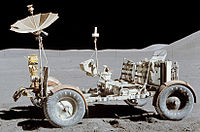
Eugene Cernan and Harrison Schmitt landed on the moon December 11. Their mission was J type, as were Apollo 15 and 16, which meant these missions were designed for a three day stay and included a Lunar Rover. This dune buggy looking vehicle allowed one or two astronauts to move further away from the Lunar Lander and greatly increased the usefulness of the mission.

Apollo 17 landed in the Taurus-Littrow region of the moon. This site allowed sampling a wide range of types of rock, as it consisted of an ancient lava flow, with surface broken by subsequent meteor strikes, and included secondary strikes. This means that ejecta from the nearby Tycho crater came to earth (came to Moon?) causing secondary, smaller craters at the Taurus-Littrow site. This allowed Schmitt to sample Tycho material even though an Apollo landing at Tycho never happened.

A few minutes before eleven PM, Greenwich Time, December 14, 1972, the last manned mission to the moon lifted off, to later rendezvous with the CSM and return to Earth. Gene Cernan was the last to enter the lunar Lander before take off. We’ll give him the final words:

“Too many years have passed for me to still be the last man to have left his footprints on the Moon. I believe with all my heart that somewhere out there is a young boy or girl with indomitable will and courage who will lift that dubious distinction from my shoulders and take us back where we belong. Let us give that dream a chance.”

==========

I’ve read a large number of memoirs by astronauts and others involved in space exploration. The Last Man on the Moon by Eugene Cernan and Don Davis is one of the best. If you want more of this story, that is the place to go for it.

Symphony 55

Anne Marie reached over to shake his hand and said, “If you have been teaching literature in high school, then you should be right at home with what we will be doing in the elementary schools from now on. We are learning from you.”

Neil smiled and thought, “If I bag some of this, I can fertilize my garden with it.”

Anne Marie shifted her attention elsewhere, for which Neil was grateful. All of the others at the table were either her old friends or, like Carmen, were old acquaintances pretending to be friends. Since he had heard all he wanted to hear from Anne Marie already, Neil soon lost himself in his food, offering only an occasional “Oh” for politeness sake. Gradually, his attention was dragged back. The air of sycophantic attention to Anne Marie was ruining his appetite.

A heavy-set teacher named Dana was saying, “What was that poem, Anne Marie, and why was it so strange?” Anne Marie explained, and Dana went on, “That was brilliant! Now I know how my kids must feel sometimes!”

Neil winced inwardly.

The pale, skinny woman at Dana’s side said, “Can you give me some copies of that poem? I want to try that same exercise on the teachers at my school.”

Neil stopped chewing. This was just too much to take in silence.  He said, “I wasn’t impressed.”

Eight heads swiveled toward him, and Anne Marie said in a silky, poisonous voice, “Oh? Why not?”

“It was too fake. It might have impressed laymen, but not teachers who have had any experience.”

Dana gave him a look that made him wonder if he had suddenly sprouted horns and a forked tail. She said, “That is exactly what our children face. Maybe you don’t realize it because you have spent your time teaching high school, but it isn’t easy for younger kids.”

“I have noticed that,” he replied dryly. “I didn’t mean that the exercise of putting yourself in the students place was false, just unnecessary. Anyone with any imagination could do that without setting up such an artificial situation. My complaint is that your conclusions do not follow from your set-up. In fact, that exercise would make a better argument for leveling than for heterogeneous grouping.”

He felt Carmen kicking him under the table, but he didn’t care.

“Would you care to explain what you mean by that?” Anne Marie said. Her voice was level, but there was fire in her eyes. She did not like being disagreed with.

“Certainly,” Neil answered, unabashed, and pulled a folded copy of Address to the Deil out of his pocket. “Here, take a look at the first verse. There are ten words that the average English speaker of today might not know and six of them sound like modern English. The structure, allowing for the fact that it is poetry rather than prose, is the same as modern English. What a reader has to overcome here is simply vocabulary. For that all he had to do is read at a level where he does not become frustrated by guessing the meanings of too many words in one passage. That does not represent what a non-English speaker faces. That represents what an English speaking child faces as he learns new vocabulary. The answer to that particular problem is simply to give him new vocabulary at a rate he can absorb, by letting him read things that are a little hard, but not too hard. That is easily accomplished by leveling.”

That uncorked the bottle. Neil leaned back with a bland look of false interest as Anne Marie Chang proceeded to pounce on his words and destroy his arguments to her own satisfaction. But not his. more Monday

Symphony 54

“I can not only read it, I had to memorize it once. That is one tricky lady up there.”

The passage wasn’t in English, quite. It was tantalizingly familiar yet basically unreadable. It went:

Hear me, Auld Hangie, for a wee,
An’ let poor damned bodies be;
I’m sure sma’ pleasure it can gie,
               Ev’n to a deil,
To skelp an’ scaud poor dogs like me,
               An’ hear us squeel.

The piece consisted of the ten most difficult of the poem’s twenty-one verses.

Anne Marie announced, “You have only one minute left. Are you half finished?” The audience laughed uneasily.

Carmen said, “What is this?”

Neil whispered, “It’s a poem by Robert Burns, Address to the Deil.” When he pronounced deil correctly with a slight stop between syllables that told of the missing letter, Carmen recognized that it meant devil. “It’s half in Scots and half in antiquated English. Burns sometimes wrote in English, sometimes in his native tongue, and sometimes he mixed them up. My grandfather is a real fan of Burns. When I was growing up, he said that any Scotsman, even an expatriate, had to learn his Rabbie Burns. So I did.

“Hang on to your wallet, Carmen, this gal is going to start selling snake oil any minute.”

And, indeed, she did. After most of the teachers had confessed that they could make little out of the passage, she arranged them in groups and let them discuss the material. In that way, they were able to tease much of the sense out of it, though they were still wide of the mark on those words which were simply outside their experience. They could figure out from context that gie was give and hame was home, but no amount of reasoning could tell them that douce meant sweet. They took skelp to mean scalp, when it really meant to strike.

This, Anne Marie went on to say, was what was wrong with the teaching of reading in California by the old methods. The teachers had now experienced just the kind of frustration a Chicano, or Viet Namese, or Maung child feels when trying to read English. It was one thing to read when you knew most of the words, but when you know half or less than half, the frustration is immense. Her solution was group reading and discussion so that the strong readers could help the weak ones to understand.

By this time, Neil was drumming his fingers on the table and twitching in his seat. Carmen put her hand over his and said, “Shh. What’s wrong?”

“Can this woman be that stupid?” Neil whispered. “Can she really believe that she has proved anything?”

Carmen tried to hide a smile. Strangely, it was a breakthrough for them that she could laugh at him. She said, “Anne Marie’s a hard-sell artist, but listen to her. She has a lot of valuable things to say.”

“Maybe,” Neil thought, “but I doubt it.”

Eventually the morning wore away. Lunch was being provided and they all adjourned to a nearby banquet room. Carmen stopped half a dozen times on the way there to speak to friends from other schools. When they entered the banquet room and looked around for a place to sit, Anne Marie Chang motioned across the room to them. Carmen said something unladylike under her breath, added, “Now were stuck!”. She waved back brightly.

Carmen introduced Neil to Anne Marie and explained that he was taking Gina Wyatt’s place. “Neil has been teaching high school literature classes. This is his first time with sixth graders, so the framework is all new to him.” more tomorrow

443. Booklist Reboot

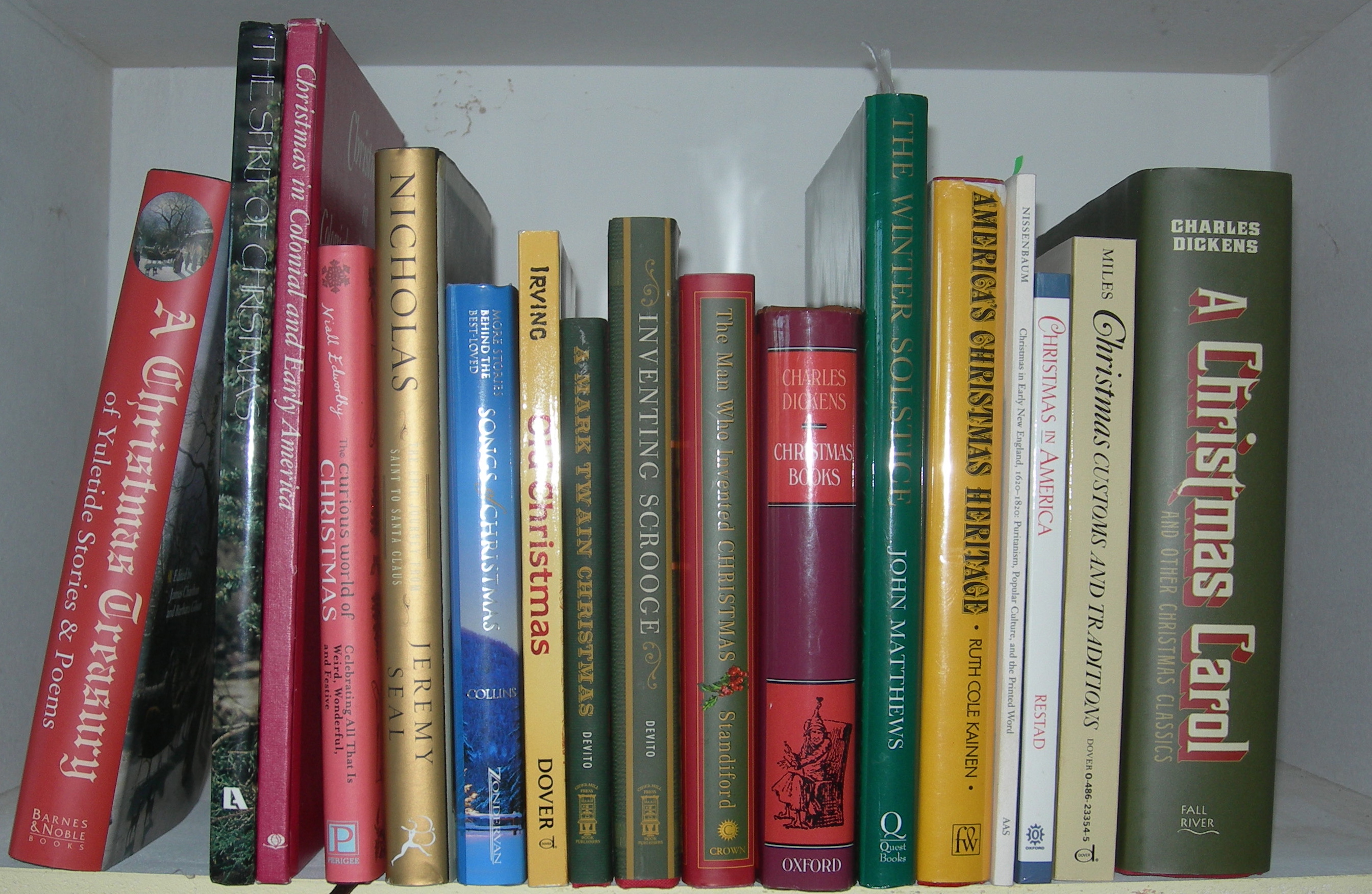
On December 15, 2015 I posted this list of Christmas books. 

Here is the annotated booklist I promised you yesterday. You could also Google Christmas or old Christmas, or search either of those subjects on Amazon. I suggest you do. This is not a best list because there are too many books on Christmas for anyone to have read them all. This is simply a list of what I’ve discovered over the years, minus the clinkers. Some of these are easy to find, others will lead you through the back stacks of used bookstores, but there’s no harm in that.

A Christmas Carol by Dickens has to head any list. He also wrote many other Christmas works and gets his own post next Wednesday, the 23rd.

Washington Irving had a powerful influence on Christmas, which is largely forgotten today. Among his followers was Clement Moore of Night Before Christmas fame. They also get their own post, on Christmas Eve.

The rest of this list is in order from decorator froth to historical complexity.

Go to any bookstore and you will find dozens of Christmas cookbooks and books on Christmas decor, sometimes with historical tidbits. You’re on you own here, with one exception. The Spirit of Christmas series by Leisure Arts is classy, has been around since about 1990, and fills up ten pages of Amazon with choices.

Christmas in Colonial and Early America, 1975, by World Book, is an early, sepia toned version of this kind of book with a little more meat in it’s history.

For almost two decades, Ace Collins has been writing books titled Stories Behind . . . , beginning with Stories Behind the Best-loved Songs of Christmas. The title tells the tale; the individual stories are interesting and heart felt.

The Curious World of Christmas is lightweight and breezy, a book of short entries which can be digested one little bite at a time.

The only recent Christmas book I can’t recommend is Nicholas, by Jeremy Seal. I found it dark and tedious, and couldn’t get past page 42, but if you want a detailed look at how St. Nicholas became Santa, it’s the only work I know completely devoted to that subject.

The Man Who Invented Christmas by Les Standiford and Inventing Scrooge by Carlo De Vito each tell the story of the genesis of Charles Dickens’ most famous story. As a writer and a lover of Christmas, I couldn’t choose between them. Read the one that is easier for you to find. Then read the other one next Christmas.

A Mark Twain Christmas has been sitting on my next shelf for a couple of weeks. I will give it a tentative approval based on a thumb-through, and the fact that it is also by Carlo De Vito.

A Christmas Treasury of Yuletide Stories and Poems by Charlton and Gilson has works by every famous author you’ve ever heard of, from St. Matthew through The Adventure of the Blue Carbuncle.

Ruth Kainen’s America’s Christmas Heritage contains well written regional histories of Christmas at a level of detail that is satisfying without being overwhelming.

John Matthews’ The Winter Solstice has a look similar to the decorator/cookbook works above, but with a unique twist. It concentrates on the Roman, Celtic, and Germanic contribution to Christmas. It feels like the Middle Ages, without falling into the trap of New Age Gaia worship.

Christmas Customs and Traditions by Clement Miles is a Dover reprint of a 1912 work. It is an old fashioned history of the evolution of Christmas from Roman times to what was then the present.

Christmas in America by Penne Restad is a scholarly telling of the history of American Christmas. 172 pages of text, 36 pages of notes. You get the picture; a book for the overeducated Christmas nerd, but it is still a good read.

The remaining “recommendations” are probably over the top.

I have in front of me Christmas in Early New England, 1620-1820: Puritanism, Popular Culture, and the Printed Word by Stephen Nissenbaum, published by the American Antiquarian Society. I have already confessed to having two masters degrees, one in Social Science and one in History. This is the kind of thing I used to read for a living. I still read them, but only if they are on a subject that really interests me. Nissenbaum taught at Amhurst; you will find his original research referenced in many of the less scholarly books above. His book The Battle for Christmas was a Pulitzer Prize finalist, but a scholarly work of 400 pages is not something to take on casually. I confess to not owning it; I read it on interlibrary loan years ago. If, however, you are a Christmas nerd and a history buff, it is available in paperback. Go for it; what have you got to lose?

===================

BY THE FOLLOWING YEAR I had purchased and re-read Nissenbaum, and wrote three posts summarizing The Battle for Christmas. If, like me, you are a complete Christmas nerd, click here to read them.

Symphony 53

They parked at an underground garage at the hotel where the conference was being held.

Since Carmen had shown him only coldness from the first, Neil had tried to avoid thinking about her. He hadn’t had much success. She figured prominently in his erotic fantasies, and in spite of himself he always noticed what she was wearing and how she was wearing her hair. Now he studied her covertly while she took time to fluff up her shoulder length curls. Her eyes were deep brown in a cafe-au-lait face. Her nose was thin, her features were finely modeled, and her skin was smooth.

In the elevator, her perfume surrounded him. He felt sixteen years old. He felt foolish and elated at the same time.

The elevator door opened and Carmen stepped out. Neil came a bit behind, enjoying her trim figure. She wore a short, close fitting black skirt and a patterned silk blouse of many blues, with her hair loose on her shoulders and a yellow scarf at her throat. The high heels she wore exaggerated the motion of her hips. She had the look of a hot, chic, young Chicana on the prowl; and the fact that she seemed unaware of the effect she was having on Neil — and all of the other men she passed — only made her more desirable.

It was going to be hard to keep his mind on business.

# # #

The conference was titled Literature Based Learning: a New Approach to the Teaching of Reading. The hotel had set aside a long conference room with a speaker’s table at one end and rows of tables facing the front of the room. They had shoehorned nearly a hundred teachers into a space that would have comfortably held half that number. Neil and Carmen appropriated a spot near the front, then Carmen left to run some errands of her own. Neil stayed behind to listen in on the conversations around the room.

Neil liked to circulate before things started and get a feel for the crowd. That way he could pick out the dull and the pompous, and zero in on the interesting ones who remained in case he had to get into a group.

The conference was advertised for grades K through eight. All the conferences Neil had attended before had been only for high school teachers. The difference between this conference and those was striking. Those conferences had been seventy-five percent male; this one was ninety percent female. As Neil circulated, he found that most of the conversations were about other people. He heard, “He said . . .”, and “She did . . .”,  and “They went . . .”.  At the high school conferences he had mostly heard, “I said . . .”, and “I did . . .”, and “I went . . .”.

Carmen returned and they took their seats. The superintendent of a local district spoke briefly and then introduced the main speaker, Anne Marie Chang. Carmen whispered, “That is the woman who gave us a bad rating last year. Whatever you do, don’t tell her you’ve grouped your kids!”

The speaker did not look that formidable, but when she began talking it was clear that she had an axe to grind, and that she had had a lot of practice in grinding it. After a brief introduction to the new language arts framework, and a hint that she had had more than a small role in shaping it, Ms. Chang passed out xeroxed copies of something she wanted the participants to read. Once they were distributed, face down, she told everyone that they had two minutes to read the passage and then they should be prepared to discuss it. Neil and Carmen turned theirs over, and Neil chuckled. Carmen said, “What is this?” She sounded irritated. “Can you read this?” more tomorrow

442. Life is a Tunnel

Every once in a while, a phrase appears, demanding to be used. Sometimes it fits into whatever is being written at the time. Sometimes it hangs around for years before it fits. Sometimes, it just hangs around.

The phrase at the top came to me when I was considering a sequel to Raven’s Run. There were several stories on audition, and none were chosen. I don’t even remember which sequel this was supposed to go with. I do remember the scene it was to be part of.

Iain Gunn was looking out a second story window at an urban street. South San Francisco, I think. It was just beginning to rain. A girl with long black hair had just gotten out of a car. She was wearing a tight, short dress, and she was, of course, lovely. Gunn was waiting for someone to come along who was connected with the business he was just getting involved in, and this girl certainly was not that person, but she caught his attention.

She hunched her shoulders when the rain first hit her, but then she straightened her back and looked up. She raised her hands to the rain and smiled. No dancing around — she was a serious and sophisticated person — but she accepted the rain and appreciated the moment. She stood for a few more moments, facing Gunn but unaware of his presence. Her hair began to flatten against her head and Gunn could see beads of moisture trickling down her face. Then she turned and walked purposefully away. For her the moment was over, but it would remain with Gunn.

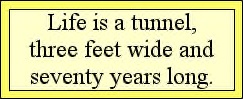
Life is a tunnel, three feet wide and seventy years long. The phrase hits Gunn (as it had hit me). She is just another of the million people he will nearly meet, nearly have some kind of relation with, one whom he could perhaps come to hate, or perhaps fall in love with. But he will never know.

If this were cliche #472 in the detective story handbook, he would meet her again and this would just be a foreshadowing of things to come. Meeting her again would be expected by the reader.

It is not meeting her that will make the incident meaningful. She will now become a symbol for all the things we miss as we live our random lives.

It’s not a new idea, and not the first time I’ve used it. These words in the opening paragraphs of Valley of the Menhir set the stage for what is to come:

Out there in the night that stretches away from us all — there where consciousness ends; where experience missed sets an iron boundary on our lives — there is a land of red sky and green sea, Poinaith, and another land where the gray sky leans down to lock hands with the sliver elfin forest.

Experience missed sets an iron boundary on our lives. Another phrase that jumped into my head, but in this case, just as I needed it.

We all live lives of found and missed opportunities. Our lives are a path from birth to death, as wide as our shoulders and as long as we last. We see so much, but if we were to turn three feet to either side, there are a thousand other lives we could live instead.

I’m satisfied with my life so far and I’m glad I was wrong about its length. I have more things to do, and more books to write. These last seventy years have been great, but I‘m not done.

Symphony 52

They rolled past Tracy and onto highway 580. For as far as the eye could see in every direction were windmills. Most of them were tall, slender, high-tech monstrosities. Seen in isolation, they might have a functional beauty, but here on these hills they were starkly out of place. Neil said, “I had read about these windmills, but I never guessed they could be so ugly.  How could they do this to the landscape?”

“I know,” Carmen replied bitterly, “and notice how few are turning.”

“Almost none of them.”

“Right. I’ve been watching this take place for a couple of years now. Every time I come through here there are more windmills, but I never see them turning. If we need wind energy so badly, why aren’t they making electricity instead of just standing there? If they don’t work, why are they building more of them? It makes you wonder if someone lining his pockets on government money?” see below

For a few minutes, the conversation lagged; then she said, “How do you like teaching sixth graders?” It was almost the same question she had asked thirty miles before, but this time it sounded real. Neil answered, telling her some of the feelings he had for his students, and explaining how different they were from high school students. Carmen warmed to him as he spoke. He could feel her relaxing.

Then he told her of his conversation with Pearl, and how he had grouped his readers. Carmen laughed and said, “Don’t let Bill Campbell hear about that.”

“Why?”

“Last year he caught hell during our Program Quality Review. They said we were tracking. We weren’t really, but one of the inspectors had an attitude problem. She was one of the new guard, and gung ho for literature based reading. Her report was so unfavorable that Bill had to do away with leveling even before we had anything to take its place.”

“I had wondered about that. You seemed to be out of synch with yourselves. You’re all set up for literature based reading, but the books aren’t literature — they’re horrible.”

“Yes, they are. We have some new materials ordered, but they haven’t come in yet.”

“Good.”

“No, I’m sorry. I didn’t mean to get your hopes up. Bill only had so much money, so he only ordered for Pearl and me. He said he would order literature for sixth grade next year when Gina was ready to come back.”

After a long silence, Neil asked, “Did he come to that decision before or after he knew who was going to replace her for the year?”

“Before,” Carmen said, but he was not sure he believed her.

Paranoid! Don’t let them make you paranoid, he told himself sternly. Then he had to laugh. Don’t let them make you paranoid? Them?

“What are you laughing at,” Carmen asked, but he couldn’t answer and she looked miffed. He thought, “Serves you right.”

The rest of the trip was friendly. Neil traded stories with Carmen, telling of his boyhood and youth in Oregon, and finding out more about what it was like to grow up as the daughter of a field worker. They dealt with surfaces and first insights, speaking as if their lives had been without pain. It was not intimacy, but it was a beginning.

It had been several years since Neil had been to the Bay Area, and he was shocked at its growth. It had spilled over the first range of the foothills to fill up the Livermore Valley. All the lovely hills and pasture lands were giving way to stucco and concrete. “People are even moving as far as Modesto to find affordable homes, and commuting to the Bay Area,” Carmen said. Neil could not imagine a seventy mile commute.

==================

Out of fairness, I have to add that the windmills did look like a big government hoax in 1988 when this was written, but today they provide much of the state’s energy. more tomorrow