
Monthly Archives: February 2018

Symphony 92

Since the American Navy had accidentally shot down an Iranian airliner the previous summer there had been talk of terrorist reprisals, and American schools were one of the targets being threatened. If that was the case, and the school which had already been struck was so close . . .

Neil found himself searching the playground with his eyes, and at the time it did not seem melodramatic. He said, “What do you want me to do?”

“Don’t say anything to your students, but be on the alert. Join Tom and me out front when the busses come to pick them up. It’s late enough in the afternoon that we probably won’t have any parents coming in to pick up their children because they heard it. If some parent comes in, get their child out of the classroom without a fuss. If we can manage it, I want to get these kids home with their parents before they hear about it.”

Bill went on to pass the word and Neil returned to his classroom. Bill’s words “a bunch of dead and wounded” rang in his head as he sat down and looked at his kids. Little Randi Nguyen with her boundless energy; Rabindranath who was calm and bright and utterly without a sense of humor; Lisa Cobb with her erratic behavior and terrible puns; even Jesse Herrera. Dead or wounded . . .; he had to shake his head to drive the vision away.

The bell for the last break of the day caught him by surprise and he jumped. Somebody laughed, then hid his laughter. The students all rushed for the door. Neil was on his feet in an instant and out the door to pace the playground in paranoid fear. All of the other teachers were out, exchanging worried glances and saying nothing.

When the busses came, a phalanx of teachers was there to protect their students from an enemy who never appeared.

# # #

Neil drove to the mall after school and went to a department store where he had seen racks of televisions on display. He had no TV himself and he did not want to watch this with Carmen. He could either watch it alone, or in the anonymity of a public place, but not with someone he loved. He arrived at the store just in time to see the whole bloody scene on the news. All normal business had stopped in the store as clerks and customers stood riveted by the horror of it.

A second channel picked it up and Neil watched again. His fascination was like a private shame. He hated the newsman for the way he shoved his microphone into a child’s face to ask her how she had felt, but he could not turn away.

The next morning the Modesto Bee devoted five full pages to the tragedy. Neil, who did not subscribe, went out early to buy a copy and read it all. Five dead. Thirty wounded. That would be half of the kids he taught. And all the rest, the other three hundred students, would never feel safe again. Like a rape, it would tear them out of their childhoods and plunge them into a mad, adult world long before their time.

What would he say to his own students today? more tomorrow
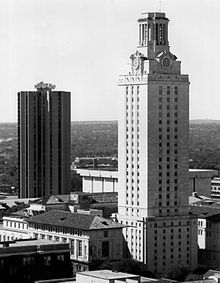
463. Shooters

The University of Texas Tower
photo by Larry D. Moore

===============

Today in Serial, a school shooting occurs in the novel Symphony in a Minor Key. Here in A Writing Life I have explained why it was there.

Yesterday in the world we all inhabit, another school shooting took place in Florida. Since the post below was written a week or so ago, this makes an unexpected and jarring contrast.

I could say, “What are the chances of such a coincidence?”, but the chances of a school shooting on any given day have increased dramatically since I was forced to include one in my novel thirty years ago. As always, I feel for the victims and the survivors, and like everyone else, I have no answers.

I am adding this note of explanation about an hour after the original post appeared.

===============

The original post.

Most American’s alive today have grown up in an era of mass shootings. We had not yet reached that point in 1966.

I was working on the home farm that summer. I had graduated from high school and was waiting to enter college in the fall.

On August first, Charles Whitman shot his wife and mother, then took weapons to the observation deck of the main tower at the University of Texas. Over the course of the next hour and a half, he shot and killed thirteen people on the ground below and wounded another thirty-one; two of his victims died later. He was eventually killed by police.

Like the rest of America, I heard about it on the news. It was a shock. It was something that had not happened before.

Whitman’s position on top of the tower made it hard for the police to get to him. That was not an accident; Whitman was a former Marine sharpshooter. He knew his business.

There are several talking points in this incident for people on both sides of the gun control controversy. None of his weapons would be called an assault rifle by modern use of that term. Several civilians joined the police in returning fire. They probably helped, but did not prevent the tragedy.

It was the deadliest mass shooting in American history, at the time. Today it ranks eighth.

Twenty-three years later, the Texas Tower shooting still ranked seventh. I was teaching school and writing Symphony in a Minor Key in the evenings. I had set myself the task of writing events in my imaginary middle school in exact correspondence to what was happening in the real world.

I didn’t know what I was getting myself into.

On January 17, 1989, Patrick Purdy shot and killed five students at a school in a nearby town, and wounded thirty others, including a teacher. I was faced with the decision of whether or not to include this tragedy in the novel I was writing.

I chose to write it in. That is why today’s post in Serial appears as it does.

Symphony 91

There is an explanation of how this piece of Symphony came about in today’s post over in A Writing Life.

Terror

Life is not a well told tale. Things come out of nowhere, and in their wake, everything is changed. There is frequently no warning, and even afterward, those events may make no sense.

In Stockton, thirty miles north of Kiernan School, at about eleven thirty in the morning, a distracted young loner named Patrick Purdy parked his car outside Cleveland Elementary School. As he left his car, he used a fourth-of-July sparkler to light a pipe bomb in the front seat, and entered the school yard through an unlocked gate in the fence. He crossed a grassy field, rounded a classroom building and waited there watching the playground where the students were at recess. He was wearing a 9mm automatic pistol and carrying an assault rifle.

Purdy had attended that school for four years when he was a child. At that time it had been a white, middle class neighborhood. Now the community was filled with southeast Asian refugees. Most of the children in the playground were Asian. Purdy had told acquaintances how much he hated Asians.

Two things happened almost at once. The bomb Purdy had left in his car exploded, and the bell ending the recess period rang. The children turned from their play and ran back toward their classrooms. Purdy raised his AK-47 and calmly, matter-of-factly, fired a burst of thirty rounds into the mass of students. They fell, screaming and bleeding, or silent and already dead.

He replaced the ammunition clip and fired again. A teacher herding her children toward safety was shot down, and more students fell. Teachers inside the building at Purdy’s back huddled on the floor with their students, but he did not turn in their direction. He walked to his right, crossing in front of them, still firing into a school yard now littered with huddled heaps of the dead and wounded.

He rounded the far corner of the building just as the first sirens began to sound in the distance. Laying aside his assault rifle, he pulled out his pistol, put the barrel of it to his chin, and fired once.

He was dead when the first officers arrived at the scene. Five students lay dead. Twenty-nine students and a teacher lay wounded.

# # #

Neil had not had a good day. He had obtained a video of Martin Luther King’s “I have a dream” speech to show to his students in connection with the holiday. His morning class had responded with very little enthusiasm when he tried to get them to discuss what it meant. There were no black children at Kiernan, and Neil had not been able to convince them that the civil rights Dr. King had fought for were for all of them. To these children the events of the fifties and sixties were another world, as foreign as ancient Athens. They were indifferent to it all.

His afternoon class was even worse. He had almost reached the point of giving up in disgust and trying some other tactic, when Bill Campbell came to the door of his classroom and motioned for Neil to join him outside. The look on Bill’s face alerted Neil that something serious had happened.

“I just got a phone call from Elaine Sanders. There has been a shooting at one of the elementary schools in Stockton. Apparently, there were a bunch of dead and wounded. Elaine wanted us to be on the alert.”

Bill’s words were just words. The reality of them did not hit Neil at once. He said, “On the alert for what?”

“I don’t know. Strangers on campus; anything like that.” more Monday

Symphony 90

Oscar took the sheet and hesitated. Laura leaned over and whispered, “You can do it.”

Oscar stood up and tried the first sentence. Those who spoke Spanish looked puzzled, then amused. He stumbled on, his voice breaking, and once he had to stop to wipe his face with the back of his hand. But he kept his jaw set firmly and forged ahead, mispronouncing every other word, and understanding nothing of what went before his eyes.

Neil hurt for him, and wondered if he had pushed him too far. Oscar cast him an angry glance from his set face.

Brandy Runyon snickered. Neil’s snapped, “Brandy!” She stopped instantly. 

Oscar finished, and sat down, looking at the desk to in front of him, humiliated. Neil said, “Thank you, Oscar.”

Flavio looked at his teammate, feeling his embarrassment, but unsure of what had happened out on the playground. He looked at Neil and asked, “What grade do we get?”

“You get the very best grade I have to give,” Neil replied. “I am very proud of Oscar.”

He heard Tony whisper, “But he read it all wrong.” And he heard Lauren silence him fiercely, saying, “Shut up! Don’t you understand anything?”

# # #

Jesse Herrera had returned to Neil’s afternoon class with the rest of the children after Christmas vacation was over. He was very subdued. He was surly, angry, and withdrawn, but he didn’t get into trouble. Neil remained friendly to him, but carefully kept a certain distance between them. The boy was in serious trouble, and there was no point in fawning on him and pretending that he was not.

Neil had a meeting with Mrs. Herrera on the first Friday they were back. It was the first time he had met with her since Jesse’s hearing, and she was full of thanks because Neil had championed her son.

Neil said, “How are things going in counseling?”

“Really well. I think Jesus is doing much better.”

“He had been quiet in school and hasn’t bothered anybody,” Neil replied. He was skeptical of Jesse’s sudden change, but he didn’t say so to his mother.”Can you tell me anything you’ve found out that might be helpful to me?”

“No, not really.”

“Mrs. Herrera, I don’t mean to pry into your personal business. I just want to help Jesse — Jesus. I’m only asking for information so I know best how to handle him.” 

Mrs. Herrera looked trapped and uncomfortable. She said, “Well, the counselor said that I had to set limits and strictly enforce them. I have to say what I am going to do and then do it.”

“And have you been able to do that?”

“I’ve been trying. Just last night, Jesus was bugging me about wanting to watch a program on TV that I didn’t want him to watch. I told him he couldn’t watch it, and when he kept bugging me I made him go to bed an hour early.”

This was apparently her idea of stricter discipline. Neil said, “What would you normally have done?”

“Oh, I don’t know. Maybe I would have given in and let him watch it.”

“Well, that’s progress,” Neil said. Privately, it made him wonder if the boy had any chance at all.

# # #

Neil’s meeting with Mrs. Herrera was followed by the three day weekend of Martin Luther King Day. The Tuesday afterward was like any other day at Kiernan, but thirty miles north events were taking place which would shake their school, and other schools across the nation, to their foundations. more tomorrow

Symphony 89

Eventually, the sobs died to hiccups and Neil moved away again. He found a clean handkerchief and handed it over. Oscar wiped his face and handed it back. Neil said, “Look at me.”

Oscar was still miserable, but he had regained some composure.

“Oscar,” Neil said, “I want you to think about something that isn’t very pleasant. I want you to think about Pedro. Imagine how he feels when I call on him to read some passage in English and he can’t.”

Neil waited until Oscar had nodded his understanding.

“How do you think he feels?”

“Bad.”

“Bad like what?”

“Bad like I felt when I couldn’t read the Spanish.”

“And what does Pedro do when I call on him?”

“He tries.”

“Even though he can’t read it?”

Oscar nodded.

“Does anyone ever laugh at him?”

Oscar shrugged. “Maybe. Sometimes.”

“Do you suppose they laugh behind his back when he isn’t listening?”

“I suppose.”

Neil sighed and screwed up his own courage. It is no fun to browbeat an eleven year old boy. He asked, “Did you ever laugh at him?”

Oscar only shrugged.

“Do you think he would have laughed at you if you had tried to read that Spanish and been unable to?”

Oscar snapped, “I don’t know! How would I know?”

For a long time then, neither of them said anything. The wind whistled through he short grass and chilled them both. January in Modesto is a good time to play active outdoor sports, not to sit motionless and beaten in the open air. After a while, Neil said, “When Pedro, or Sabrina, or Carlos reads something too hard for them, and takes a chance on being laughed at, would you say that they have courage?”

Oscar took his time and really thought about it. He said, “Yes.”

“Do you think they have more courage than you do?”

Oscar spun angrily to face Neil. Full grown or eleven years old, you don’t call a Chicano’s courage into question. And it was clear now that Oscar wanted to be a Chicano more than anything. He wanted to be one as badly as his father wanted to be something else.

Oscar said with quiet dignity, “I have courage.”

Neil nodded. He said, “Do you have enough courage to go back into that classroom and try a piece of Spanish you can’t read?”

That was hard. Desperately hard. Oscar’s face filled up with fear, and with his fierce fighting against that fear. How unfair, Neil thought, to batter an eleven year old. But courage has its price. And if you don’t learn it at eleven, will it come any easier at twelve? Or thirty?

He waited again while Oscar wrestled with the challenge. Oscar said, “They’ll laugh at me.”

“They might.”

“You want me to go in there and let them laugh at me?”

“I want you to go in there and show them you have the courage to do one time what they have to do every day. If they laugh, it is their weakness, not yours. It is no concern of yours.”

“That’s easy for you to say!”

Neil smiled suddenly and ruffled Oscar’s hair. “I’ve been laughed at before,” he said, “and I’ll be laughed at again.”

They walked back together, side by side but not touching. At the door, Neil said, “Thank you, Evelyn. I’ll take it from here.”

“I let the children free read.”

“Fine. Thank you.” Neil sat down and Oscar took his seat. The other students had all watched them return, but none of them made a sound. Neil took up a copy of the Spanish story and held it out to Oscar. He said, “It’s up to you, Oscar. Make your own decision, and I won’t hold it against you.” more tomorrow

462. The N Word

Another version of this post, with the same poem, appeared as 86. N —-

The N—– word. Everybody in America is afraid of it. Including me.

I could write it out plainly. In fact, I feel a little foolish writing a letter followed by dashes, especially since I used it in a post just a week ago, and will again in the poem below. But if I spelled it out, I would feel like a little kid cussing in front of his parents, then pretending he didn’t know they were there.

I grew up white in a community which had no blacks. So how do you learn to hate or fear someone you never see? Easy. You listen to your parents and their friends, and absorb their attitudes.

I didn’t come to hate, in part because my parents didn’t hate. But they did fear. If you study black-white relations in America, it is amazing how much fear there is on both sides. I certainly had my share, and I hated having it. But I couldn’t shake it, until I wrote and published this poem. It didn’t cure me, but it helped.

          Mother Tongue

               I saw a calf born.
His mother, in her need to clean him,
Knocked him over on his first rising,
And on his second rising.

In her need to make him safe,
she drove him to his knees.

               Words are like that –
A mother tongue that overwhelms us,
That makes us what we are,
and sometimes, what we should not be.

*****

When I see a black man, I hear “nigger”
Spoken sharply in my father’s voice.
I step back, my eyes grow tight,
Suspicion fires my blood,
And for one moment he is my enemy.

Then reason returns,
And I am shamed.

It is my father’s fear.
I would leave it in my father’s grave,
If I could . . .,  but I cannot!

I can only drive it down;
And bury it deep in shameful, hollow places.

Symphony 88

Neil sat back in his seat, faced their disbelief with a bland smile, and said, “Begin.”

Tanya Michelson looked disgusted. Casey Kruger looked over her shoulder and grinned at the humor of the situation. Tanya shoved the paper in front of Pedro and said, “You read it!” But Pedro was illiterate in both languages. Olivia Pinero led them through it.

Duarte Zavala’s group did well under his guidance. He could not read Spanish well enough to go to a Mexican sixth grade, but he could read a first grade book with ease and he took great pleasure in showing his teammates how it went.

All over the room, kids who had never been the best at anything were suddenly their group’s only hope.

Neil gave them the rest of the hour to work. When they came back from break, he called on Delores Perez and she read without error. He wrote an A on the board. He called on Lydia Ruiz; she won her group an A. Dixie Margaret Trujillo, Rafael, Richard Lujan, Olivia, and Elanor all earned As. Then he called on Oscar Teixeira.

Oscar looked stricken. He shook his head. Neil said, “Come on.”

Oscar said, “I can’t.”

“Sure you can.”

“No.”

“Come on, Oscar.”

Oscar slammed the story down on the desk and screamed, “No!” Tears streamed down his face. “I told you, I can’t!”

He shoved his chair back and bolted to his feet, then ran out the back door of the room.

# # #

Neil went straight to the office and borrowed Evelyn, the secretary, to sit with his class while he went looking for Oscar. It didn’t take long. Aside from the main building and the quad of portables, nothing broke the emptiness of the playground but a half dozen walnut trees. Oscar was sitting under one of them, still crying.

Neil squatted down beside him and waited for him to speak, but Oscar was too far gone in his misery to talk. Neil put his hand on the boy’s shoulder and said, “Tell me about it.”

“Why did you do that to me?”

“Do what?”

“Make me look like a fool.”

“Do you think that was what I was trying to do? I wasn’t. You took me completely by surprise.”

Oscar wiped his face with the back of his hand and said, “What did you expect?”

“I expected you to read the story.”

Oscar looked at him for the first time. It was a quick, furtive  movement, as if to assure himself that Neil was not making fun of him.

“Oscar, who did I call on to read?”

“What do you mean?”

“Name them. Give me their last names.”

Oscar sobbed, “Just go away and leave me alone.”

Gently, Neil repeated, “Name them.”

Oscar looked away from Neil, out across the playground to the trees beyond. Neil tightened his grip on the boy’s shoulder and said in his softest voice, “Name them.”

“Ruiz, Lujan, Ortiz, . . .”  He named them all.

“Yes. And Teixeira. Do you hear any Anglo names in that group?”

“No.”

“Oscar, I set that whole thing up so that those Spanish speaking kids could have a moment of glory.”

“I don’t speak Spanish!” It was an admission torn from the center of his being, and in that moment Neil gained a great insight into Oscar Teixeira.

“You father never taught you? He never let you learn?”

Oscar tried to answer, but sobs rolled up from his chest and cut off his voice. He shook his head.

Neil sat beside him and caught the boy’s head in his hand, drew it to his chest, and held him while he cried. He said, “I’m sorry, Oscar. I didn’t know.” more tomorrow

Symphony 87

Before the day began, Neil cautioned his students again, “I was serious about taking a grade for your group no matter who reads. So it is your job to see that everyone in your group is good enough to read for your grade.”

The bright students thought Neil was being cruel to them. In fact, it was the Pedro Velasquezes and Martin Christoffersens who suffered. They had to face the impact of three other students who were determined that they learn today’s lesson perfectly, or else! Oscar Teixeira had Rita Morales in tears, but when the time to read came, Pedro had never read so well in his life.

And he had never hated reading so much.

# # #

Neil had anticipated parent resistance, but he had expected it to come from the Teixeiras, the Hagstroms, or the Kumars. Instead, he got the chance to meet Toni Boyd for the first time. She was a petite brunette who was trying to raise Lee without benefit of a husband, and that left her little time to visit the school. She had to take time off from work to come in. Neil did his best to explain to her what he was trying to do. She left, unconvinced, which was only to be expected. Neil had huge doubts himself.

The next day, he took his case to the kids.

“Today,” he began, “we are going to set cooperative learning aside for once. I want to hear from each of you individually. Yesterday you got a grade for what your group did. I want you to take five minutes to think of how that made you feel, and then we’ll talk about it.”

They didn’t need five minutes. They already knew how they felt. They hadn’t liked it a bit. The top students didn’t like their grades riding on what their weaker companions could do, and the low performers did not like being singled out and made to carry the burden. They told him so vehemently and in great detail.

“It wasn’t fair!” That summed up their feelings.

“Why wasn’t it fair?”  Neil asked.

For most of them, the unfairness was self-evident. It could not be explained. It was Rafael who put it into words. “We didn’t get a grade for what we did. We got a grade for what somebody else did.”

“Actually, you got a grade for how well you had prepared somebody else. So you were getting a grade for what you did.”

“Yeah,” Oscar said, “but some of the ones who read were smart and some of them were stu–; some of them weren’t as smart.”

“Thank you, Oscar, for not finishing that word,” Neil said dryly. “What you say is true, not everyone can read equally well. Is that fair?”

“That’s just the way it is,” Oscar replied.

Neil thought, Remember you said that. Then he went on, “Well, we should have no problem today. I have a bunch of copies of a very simple story. In fact, it is from a first grade book.”

Half of the class groaned and the other half laughed.

As Neil stood up to distribute the photocopies, he said, “Remember, I am going to pick someone from your group and everyone in the group will get a grade from how that person reads.”

He dropped copies as he went, and spread a rising tide of disbelief behind him. 

“What!”

“I can’t read this!”

“You’ve got to be kidding.”

“Mr. McCrae . . . !”

The children’s story encompassed only two hundred words. Transcribed from the picture book that Carmen had loaned him, it only took up two pages.

It was in Spanish. more Monday

461. Undesirables

Emigrants statue, Helmsdale, Scotland, commemorating the eviction of Highlanders from their land. A father and child and, hard to see in this photo, the mother looking back at her home which she will never see again.

Black History Month is human history month. I’ll have plenty to say about the position of blacks in America, but today they are not the most threatened group. As I write this, Congress is fighting over DACA.

Two Christmases ago I wrote a fictional story about a little girl who was going underground with her parents because Donald Trump had become president. One of my readers replied with a short fictional addition in which one of my characters said, “If only our parents had followed the law, we would be all right.” That reader had a right to his opinion, and I published his reply. I’m not here to disrespect him. I am here to disagree with him. Strongly.

Deportation is a kind of eviction. Eviction is the act saying, “You can’t stay in this place any more, because the rights to this place belong to someone else.” That someone is usually a person or a corporation. Deportation makes the same statement, except that the someone else is you and me.

Eviction is old. It has been around since Og the caveman kicked his mate’s brother out of the hut. It wasn’t long after that before force of boot was traded for force of law.

Between 1710 and 1850 in northern Scotland, Scots who had lived on their lands for hundreds of years were forced off, their houses burned, and their livelihoods destroyed. It was all quite legal. Scotland had become an adjunct nation to England, de facto. Ancient laws had been misrepresented and changed to match an English model. Clan chiefs, whose existence was traditionally enmeshed in reciprocal obligations with their clan, were now seen as landowners.

It equivalent to Donald Trump shifting his legal position from President of the United States to owner of the United States, but on a smaller scale.

These “landowners” forced their clansmen off the land, sometimes with great violence. In early clearances, they were moved to undesirable lands within Scotland. When this failed, later clearances moved them off to the Americas.

In Ireland, during the Famine, undesirable Irishmen were moved out by eviction or allowed to starve in place. Most of them went to the Americas.

It was a pretty practical solution. If you don’t want undesirables around, send them to America. Ironic, isn’t it, that those undesirables’ descendants are now about to evict a new set of undesirables from America.

Meanwhile in America, the American Indians . . . but you know that story. If you don’t, check out 247. The People’s President.

You may not realize that in 1941, all those undesirable Japanese with their rich farms in California were moved into relocation camps. It was supposed to be for our protection, because they might attack from within. Maybe; but if so, why did they never get their farms back. (266. The Other War)

So let’s get back to DACA. This is an act protecting persons brought to the United States illegally as children. They are American in every way but a technicality. They may well not speak any language other than English. They may never have stepped foot outside the United States.

Now we are going to send them home. Home? They are home.

Let’s consider a pair of hypothetical children. Jose was born in Mexico, an hour before his parents crossed the border illegally into the United States. Ramon’s parents were on the same trip north, looking for work. Ramon’s mother gave birth just an hour after they crossed the border, illegally, into the United States.

We’ll let Ramon stay. He is a citizen. We’ll deport Jose. That’s fair, isn’t it.

Maybe, but . . .

What about (hypothetical) Barta Kovacs? He was brought over in 1956 by his parents, who were refugees from the Hungarian Revolution. Today he is 64 years old. He never married, but he spent thirty years as a school teacher, rising to be principal of a local high school before running for office. He has been a State Senator in one of those northern states for eleven years, and now he’s ready to retire.

However, as he applied for Social Security it was discovered that there had been an irregularity in his application for citizenship years before. Technically, he has never been a citizen, even though he has spent 62 of his 64 years here, and has no memory of Hungary.

Will the present administration deport him back to Hungary? I don’t think so.

Good thing our hypothetical Barta Kovacs wasn’t Mexican.

Symphony 86

When they had run out of suggestions, Tanya said, “Now let’s choose the best ten words;” and she listed her choices. Olivia and Casey liked smelly and wanted to add it. Tanya agreed, took out one of her choices, then said, “Who’s going to write them down?” Olivia undertook that task. Then Tanya’s hand went up and she said, “We’re ready, Mr. McCrae. We made our choices.”

We? Neil thought.

# # #

Neil did no more cooperative exercises until the next day. Then he had them list as many names for characters as they could think of and choose the ten they would like best if they were writing a book. Things went pretty much as the first day until Tanya’s hand went up. Then Neil said, “Today Pedro will read your list.”

Pedro sat up, woke up, and shook his head decisively. Neil said, “Come on, you chose the names. Surely you can read them.”

Pedro didn’t think so. Neil was firm. It was sad and embarrassing to hear him stumble through the list, and throughout the room there was a hushed shuffling as previously disinterested students suddenly began reviewing the lists that they had “chosen”.

Neil learned another interesting thing. In every group but one, the names were a mixture of Mexican and Anglo. In the group that Oscar Teixeira dominated, there were nothing but Mexican names.

# # #

On the third day they read together from Fog Magic.  One advantage of cooperative learning was cost.  Neil could afford to buy nine copies of the paperback out of his own pocket, where he could not have afforded a double classroom set. The children had one copy for each group and they clustered around it as each student read in turn. Neil did not tell them that they all had to read equally, simply that everyone had to have a chance to read, so in most groups the slow readers read only a sentence or two while the better readers took over.

When they had finished, Neil chose a student from each group to read to the whole class from the part they had just finished. Sometimes he chose a good reader; sometimes he did not. Tasmeen zipped through her paragraph, but Martin Christoffersen had a terrible time. When they had finished, Neil announced that tomorrow he would take grades on their oral reading.

“You mean everybody will have to read?” Rafael wanted to know.

“Everybody will read in their group at the start. Afterward I will choose one person from each group just like I did today, and take grades from that.”

“In other words,” Oscar said, “only one-fourth of us will be graded tomorrow.”

“No, everybody will get a grade. The person who reads will earn a grade for the whole group.”

He might as well have told them that tomorrow he would teach the positive values of communism. They exploded into lamentations, but he did not respond to them and they were still complaining when the bell rang.

# # #

Bill Campbell stopped Neil as he came in from the parking lot the next morning and motioned him into his office. He said, “Is it true that you are giving grades to groups of kids based on what the lowest member can do?”

“Not exactly, but that is close enough to the truth.”

“Are you trying to get us all fired?” Bill asked, only half joking.

“Bill, I’m using techniques they taught me in that seminar you sent me to. I don’t like them, either, but I am willing to try them. Give me a week before you lynch me. Okay?”

Bill shook his head and said, “It’s okay by me, but if the parents get you before then, don’t say I didn’t warn you.” more tomorrow