
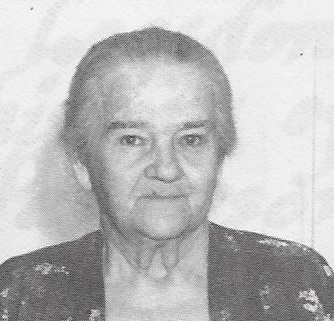
Here is my redneck Granny, who died long before the original of this was posted. I’m sure she would hate everything I have said here, but I love her anyway.
Redneck Granny
I started this blog late in 2015. When Black History Month rolled around in 2016, I had a lot to say — enough to fill the month with posts. This, somewhat modified, was one of them.
— << >> —
The first African slaves arrived in America about 400 years ago. If we count twenty-five years as a generation, that’s 16 generations.
Let’s look at the typical American today. He or she had two parents and they had four parents between them, and their parents had eight parents between them. And so forth. Up the line sixteen generations, that’s 32,768 direct ancestors. If you don’t believe me, do the math.
All those ancestors sent DNA down the line to make our average American. What are the chances that not one packet of DNA was out of Africa? What are the chances that there weren’t a lot more than one out of Africa in his/her lineage?
You might think whites didn’t mix with blacks in the olden days, but are you sure? Are you counting all the times when a white man was in charge, and a black woman didn’t have any say in the matter? They wouldn’t even have called it rape in 1619. Nor 1719. Nor 1819. In a lot of places they wouldn’t have called it rape in 1919. 2019 — maybe.
So much for black purity, but that isn’t any big secret. What about white purity?
How white do you have to look to pass for white? Three quarters? Seven eighths? How many generations does that take? Not many.
Now what are the chances that a whitish, black female would claim to be white if she could? Or a whitish, black male? Forget the twenty-first century when African-Americans are proud of what they are. Project your thinking back to when being white meant being free, and being black meant being a slave. Wouldn’t you pass for white, if you could get away with it?
I would. Some of my (and your) ancestors probably did.
More math. Lets say that by 1700 (eighty years into the era of American slavery, thirteen generations ago), one hundred partially negro girls could and did pass for white. That’s not a big number to surmise. In fact, it’s ridiculously small.
Let’s give doubters no excuse for their doubts. Let’s say that these passing girls only averaged two children who went on to have children. That’s certainly a minimal estimation. Their descendants are boys and girls who would disappear into the white gene pool.
That’s 408,000 offspring after 13 generations. Which is to say, in 2025.
Wow. And after a couple of generations, if Mom kept her mouth shut, none of them would know they were passing. They would believe they were white.
That doesn’t cover all the other blacks, male and female, who passed in the last four hundred years. That is only one hundred, starting in 1700. But there weren’t just a hundred, they didn’t start in 1700, and they haven’t stopped to this day.
There is one big change in the twenty-first century. People who are light skinned and could call themselves white, now often identify as black. It’s probably confusing for “white” folks who haven’t thought it through.
I don’t think it confuses “black” folks at all.
If math doesn’t impress you, if you think numbers lie, then let’s make it personal.
Rhett Butler was partly black. Scarlet O’Hara was partly black. Simon Legree was partly black.
You’re partly black. I’m partly black. And my Oklahoma relatives just disowned me.
That’s mighty white of them.
— << >> —
This was a modified version of a post from February 3, 2016. If you are wondering why this old “white” guy is so concerned with black identity, it is all a matter of upbringing. In my case, that means being raised on the edge of the South in the fifties in a culture that didn’t exactly hate blacks, but didn’t much like them either. My people fully believed in the separation of the races; the only good black was somebody who lived someplace else.
The problem with the community viewpoint was television. On the six o’clock news I saw black people being washed down the sidewalk by firehoses because they were marching for the right to be human.
They were right. We were wrong. Hardly anybody in my town got that message, but I did.
I escaped to college, where I studied Anthropology and got an extended view of what British imperialism had done to the black and brown people of the world.
Then I studied History, where I found out that English imperialism had been just as harmful to the ruddy-faced and red-haired poor in Scotland and Ireland. I also found out what white America had done to the Native Americans, the Chinese and Japanese immigrants, and even the Irish.
In California, where I now live, white incomers from the east now discriminate against the Latinos, who owned California after they took it away from the California Indians, and before the white east-coast Americans took it away from them.
Over the years I wrote about all of those displaced and disadvantage peoples in my blog and now that has all been gathered together for publication.
Originally I planned to call the book . . .
Your Redneck Granny is a Black Woman, and she doesn’t even know it
I had kept that provocative phrase in my back pocket for years, but when it came to reality, the title . . .
Your Redneck Granny has a secret
. . . seemed more likely to make a prospective reader curious enough to pick up the book.
I originally wanted to publish it early in 2026, but the five novels of the Menhir Series will take the whole year to release. Instead Redneck Granny is planned for release on January 20, 2027, just about a year from today. Keep it in mind and tell your friends.
 A Writing Life