
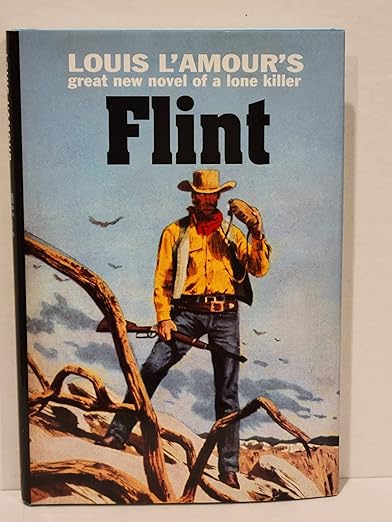
Last week I said you should buy a copy of Flint, by Lous L’Amour, and have it in hand as I take you through the first five pages. I have left out more than I have provided, so you need the original. Don’t read this and think you have read L’Amour. Now let’s begin —
Flint, Chapter 1, Paragraph 1-3 => It is given to few people in this world to disappear twice but, as he had succeeded once, the man known as James T. Kettleman was about to make his second attempt.
If he did not succeed this time he would never know it, for he would be dead.
When a man has but a few months to live, he can, if he so wills, choose the manner of his going, and Kettleman had made such a choice. He was now on his way to a place of which he alone knew, and there he would die. He would die as he had lived — alone.
If that doesn’t grab you by the lapels, I don’t know what it would take.
Be sure to read the paragraphs I don’t provide. The ones I am giving you are just landmarks.
Paragraph 6 => There were five people in the car. The lights were dim, the passengers lay sprawled in uncomfortable sleep. The train rushed westward through the cold, clear night, carrying the man steadily toward his final destination.
First who he is, now where he is. Next we will get a glimpse of his love interest and his antagonist, both of who will appear later in the novel. Read on . . .
Paragraph 10-14 => The country outside was invisible. The windows had steamed over, and the train moved as if through an endless tunnel. (I am trying to maintain the letter and spirit of the copyright laws, which allow short excerpts, so you will have to have a copy of Flint to read the longer sections.)
Now we know where he is going, and that the place is intimately familiar to him. If you are a fan of the genre, you also know that it is a place you want to spend the next few hours. In a different genre, it would be different place.
Paragraph 15-23 => Next in your copy, but too long to reproduce in this post, is the essential flashback that establishes Flint’s deep background. This gunfight is a classic of the genre, but it is told briefly since it exists to establish character and motivation. There will be other gunfights to bring the book to its necessary conclusion. This is a Western, after all.
In another genre, say a romance, this might be be an early or failed romance to set up THE ONE in the closing pages.
Paragraph 24 => In the instant of silence that followed the shooting they heard the click of a drawn-back gun hammer, and every head turned. “He was my friend,” the youngster said, and he started shooting.
This is a triple set-up. First it establishes Flint’s relationship to the man who is killed. This will be fleshed out later in the novel. It also shows Flint’s gun skills, and finally it sets-up an essential mistake of identity, when “Kettleman” is later thought to be the legendary hired killer Flint.
Paragraph 27-28 => The train whistled, the lonely sound trailing off across the wind-swept plains. Kettleman got out his pipe and lighted it. His two bags and haversack were at the back of the car. When he opened that door there would be a moment when the cold air might awaken the others, but he would be gone.
Up to a point he had planned every move, but once arrived at Flint’s old hideout there would be nothing to do but wait. Some time ago his doctor had told him he would not live a year, and most of that year had passed.
The next five paragraphs are skipped just to speed the process. Of course you will read them in that novel in your other hand.
Paragraph 33-34 => There had been more than fifteen hundred dollars in Flint’s pockets when he died on that rain soaked Kansas hillside, following the shooting at The Crossing. The boy who was to become James T. Kettleman had sixty dollars of his own, which he used to buy an outfit of store clothes in Kansas City.
He travelled to New York City and sold his four horses for an additional four hundred dollars. With this stake he started in business. It was more money than either Jay Gould or Russel Sage had started with.
Again, some paragraphs are skipped.
Paragraph 41 => In the fifteen years following that night at The Crossing he had built his small stake into many millions, making many enemies and no friends in the process. He married a wife who tried to have him killed, and had no children.
That last sentence is a masterpiece of brevity. It tells a little, but leaves volumes unsaid. It leaves us dying to know more about this woman. When she shows up more than half-way through the book, we will find that she has been worth waiting for.
Paragraph 43 => Thirty years earlier, when he was two years old, he had been picked from the brush near a burned wagon train, where he had been overlooked by raiding Comanches. There were no other survivors. Nothing remained to tell who he was, and those who found him had no interest in learning. During the next four years he was handed around from family to family and finally abandoned on a cold night in a one-street Western town.
Having established Flint as a youth and as a grown man, L’Amour finally tells us about the very early life which set him on his path.
Paragraph 47-49 => The dry grass bent before the wind, and seed pods rattled in the brush along the right of way.
James T. Kettleman was ended, and the man who had borne that name, making it feared and respected, stood now where he had stood so many years before, without a name. He was now a man without a past as he had been a boy without one.
“Good-by,” he said, but there was nobody to say the word to, and nothing to remember.
<< == >>
So now we are five pages into the novel. I dare you — or any reader — to stop now.
There is a lot to be learned in these few pages about grabbing your readers, whether you like Westerns or not. And if you didn’t get a copy of Flint to read, causing you to miss 90% of what the rest of us learned, aren’t you sorry now?
Of course you can still go get a copy. This post will still be here. Just type Syd Logsdon 716. Don’t Start at the Beginning, Part 2 into your browser.
 A Writing Life