
Author Archives: sydlogsdon

Symphony 29

Neil’s eyes were blazing and both boys drew back. He knew how this kind of wrong-headedness could destroy the good feelings in a whole class, and he felt helpless to stop it. Helplessness always made him angry.

Neil sent Sean to sit against the building a hundred feet away, but in full view, then talked with Duarte for five minutes. Then he sent Duarte away and talked with Sean. It did not take long for him to find the pattern behind their actions. It had exactly the same significance as two bull elk vying for dominance in a herd. It had nothing to do with Anglo and Mexican, but both boys were seeing it in those terms. That made it dangerous.

Neil called Duarte back and tried to get the two of them to talk. He got nowhere; at eleven years old they were simply to self-involved to understand what Neil was trying to do. Finally, as the class bell rang at the end of noon recess, he warned them both strenuously and sent them on to their next class.

# # #

Rumor travels fast. When the last student had gotten on the bus that night, everyone in the teacher’s lounge knew what had happened. Fiona came to Neil and said, “I hear my son Sean gave you some trouble today.”

“Not much.”

“That isn’t the way I heard it,” Fiona said. “I saw him in science five minutes after you finished chewing him out. He was steamed. So was Duarte. There is no love lost between those two.”

“Tell me about it!” Neil laughed.

“They have been going at it off and on for at least three years. What you saw today was nothing new, and no surprise to the rest of us. Did you write them up?”

“No.”

“Well, thanks for that, anyway.”

The remark irritated him. “Fiona,” he said, “I’m half-way insulted. The fact is, I was so angry that I completely forgot he was your son. Personal loyalty had nothing to do with it. The fact that he was your son wouldn’t have mattered if I had thought he needed to be written up.”

A flash of protective anger crossed her face, but she was a rational person and a professional. Her good sense rode down her mother’s instincts, and she said, “Of course not. And I didn’t mean to insult you.”

Fiona moved away and Carmen took her place. She asked him to tell her what happened and he did.

Carmen shook her head when he had finished and said, “I had those two in a self-contained classroom in the third grade, before we were reorganized. They were separated at my request when they went to fourth grade, but apparently somebody forgot and put them together again. I should have caught that when I looked at your class lists before school started.”

“Do you mean this school bases its class lists on who can and can’t get along?”

“Of course not, but we do try to separate poison combinations. It makes life easier.”

“Does it make life better?”

“I don’t follow.”

“They have to learn how to get along with their enemies someday. Life won’t put them in compartments where they don’t have to rub up against people they don’t like. When are they going to learn to deal with that?”

Carmen snapped, “Soon enough!  They’ll learn about life soon enough.” 

She slammed her chair back as she got up, and everyone in the room turned to look. That embarrassed her. Momentary vulnerability came into her expression and transformed her. Then she spun and stalked out of the room. more tomorrow
426. The Five Plots of Time

It is a dubious tradition to produce articles like The Three Basic Plots of Fiction, or The Four Kinds of Traditional Hero. I’ll add my bit, even though I’m dubious myself.

The Five Master Plots of Time Travel Stories

This grouping came out as I was thinking about The Map of Time. Time travel has a long and tortured history as a set of concepts hung uncomfortably between science fiction and fantasy. None of it makes much scientific sense, although I do read a lot of actual (?) scientific theory which demonstrates that even scientists can waste their lives reading too much SF. It would make more sense to simply call all time travel stories fantasy, but they always require a time machine, so they must be science fiction — more or less.

Then again, Einstein would hate FTL stories. They violate relativity, but that doesn’t keep me from reading and writing them.

Let’s just tackle this mess in the spirit of fun.

Master plot #1.     A man tries to change history and fails. He is doomed to failure, no matter what, because the past can’t be changed. The entertainment in this kind of story is in making the reader think the hero will succeed, and fouling him up at the last minute in some clever way.

Master plot #2.     A man tries to change the past in some logically forbidden way. The classic form would be that our hero goes back to kill his father before our hero is born. The stars go out; the universe ends.

I am not fond of this form. It’s too much too simple. Perhaps a good writer could make it work if we know that the victim-to-be is the hero’s father, but the hero does not. (Shades of Oedipus!) Then we would anticipate that this is a type one story, and be taken by surprise when the hero succeeds and the stars go out. That might work, but I doubt it.

Master plot #3.     This is a variation on 1 and 2. A man tries to fix a tragedy by going back in time, but instead makes things worse. This is just a variation on the notion that, “You can’t make the world better, and you shouldn’t try. Just accept your fate.” Literature is filled with this Christianity based defeatism, epitomized by The Monkey’s Fist.

The Greeks called it hubris. I don’t buy it. For me, a man without hubris isn’t much of a man.

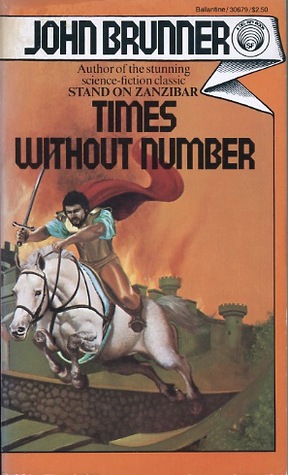
Master plot #4.     A man is in a world different from ours. He tries to change the past, succeeds, and his world morphs into the “real” world, i. e. ours. If the reader accepts that he is reading an alternate timeline story, and is taken by surprise by the ending, it can work. Brunner used this bit in Times Without Number, but that novel had enough quality to succeed even with a different ending. Zelazny did a beautiful variation in the short story The Game of Blood and Dust.

Master plot #5.     A man tries to change history, but instead creates a new timeline, or crosses over into an existing alternate timeline. This isn’t a trope; it’s a genre. Alternate timelines can be wonderful, but they are often cheap knock-offs, based on the notion that you don’t have to create anything, you just rearrange what already exists.

They aren’t even time travel stories, unless someone moves from one timeline to another. Pavane is an alternate timeline novel, but not a time travel story, since every actor in the novel remains tied to his own timeline throughout, and is never even aware of the existence of any other.

Okay, I will admit that any bright twelve year old could invent more plots, or could knock holes in these. I present them merely as a mental exercise — a fourth dimensional Rubik’s cube — for your amusement.

Have fun arguing.

Symphony 28

The physical and emotionally difference between the sixth graders and the older children was strikingly apparent to students and teachers alike, and the sixth graders segregated themselves. They shared a common playground with the older ones, but they staked out those areas that the older kids did not use.

As Neil watched, a baseball game was getting under way. Duarte and Sean were the captains; they called the rest of the class one by one to make up sides. To Neil’s dismay, Duarte was choosing only Chicanos and Sean was taking only Anglos.

Neil moved closer, thinking he was getting a sad insight into racial tension at Kiernan school. Instead he heard Tim Galloway hanging on Sean’s arm whispering urgently, “Choose Rafael!” When Sean chose Bob Thorkelson instead, Tim gasped in dismay, “He can’t even hit the ball!”

Sabrina Palmer jerked at Sean’s other arm and said, “What’s the matter with you? Choose the good ball players. It doesn’t matter if they are Mexican.” To her it was not a weighty matter of prejudice; she just wanted to win the ball game.

On the other team, Oscar Teixeira threw his glove down and snapped at Duarte, “Why didn’t you get Greg? He’s the best pitcher.”

Before the teams had even been chosen, some of the players on each side had begun to wander off in disgust. Neil heard, “That’s a lousy way to choose a team,” and “What’s the matter with Duarte anyway?” and “That was cheap!”

Neil whistled and waved the kids over to him. They came reluctantly; they didn’t know him well yet and being called in from the playground usually meant that someone was mad at them.

Neil asked them, “Do you want to play baseball?”

“We did,” Sabrina said, “until Sean and Duarte screwed it up.”

“Let’s try again,” Neil said. He pointed to two of the most athletic looking boys and said, “Ramon and Carlos, you choose teams this time. And make it fair. Duarte and Sean, you two stay with me.”

Neil had chosen two Hispanics as captains — he could as well have chosen two Anglos — so this time the children were chosen by ability and there was a fair racial mixture.

Neil led Sean and Duarte away from the ball diamond and asked them, “What are you two doing, trying to start a race riot?”

Duarte shot him a black look and said, “I don’t know what you are talking about.”

“Oh, you don’t? Well, you must be the only kid in sixth grade who doesn’t know. Your teammates knew; they were complaining and walking off before I ever got there. What’s up?”

“Well, Sean started it.”

“I did not! I was choosing fair yesterday when you took all Mexicans.”

“That’s ’cause Mexicans are better,” Duarte muttered.

“Duarte!” Neil snapped, putting boundaries on the confrontation. He continued in a softer voice, “Duarte, do you really think Mexicans are better than Anglos?”

“No. But Sean thinks Mexicans are no good.”

“I do not!” Sean replied, then muttered under his breath, “I just think you are no good.”

Duarte lunged for Sean and Sean’s reaction was only a heartbeat behind. Neil caught them each by the back of his shirt and jerked them apart, none too gently. “Stop it!” Neil’s shout echoed across the playground, and the ball players all looked up. “That will be enough out of both of you. I pulled you aside to talk to you — to help you solve your problems. If you want to fight, that’s a whole different story.” more tomorrow


Symphony 27

September 1988

Neil’s relationship with his fellow teachers was strained for the first couple of weeks. He was naturally friendly and under normal circumstances he would have quickly fitted in, but there was one question each teacher had to ask him, for which he had no answer.

It was clear that he was not used to teaching sixth graders, and if he had any particular aptitude for the younger children, it did not show during those first weeks. So why was he here?

Neil said that he had wanted to try his hand at teaching younger children. That was not entirely a lie, since he used to think about it in that dreamy state of considering unlikely alternatives. But he would never have done anything about it, so he had a hard time putting conviction into his voice when he replied.

That answer only led to the next logical question. Why didn’t he get a job in his home town? Why move away and leave all his friends behind to make the experiment? There was really no way to answer that question.

By the second week, the other teachers knew that Neil would not talk about his reasons for being at Kiernan and his reluctance to share such basic personal information made them all pull back from him. They were unfailingly polite, but that initial friendliness had faded.

That was the situation when circumstances threw him in with Fiona Kelly.

# # #

In any school, some of the students are the sons and daughters of the teachers. Teaching some other teacher’s child can be a little unsettling; under the best of conditions there is a flavor of conflict of interest.

The children of teachers are angels or hellions or something in between, just like the children of bums and businessmen. Sean Kelly was something in between. He was not quite a top student, but close.  He made mostly As and Bs. He loved baseball and he was good at the game. He was open and friendly, and if anyone had accused him of unkindness to any of his fellow students he would have been shocked and angry at the accusation. Yet, he had a weakness; a nemesis; his own personal Dr. Moriarity.

He could not stand Duarte Zavala.

Duarte Zavala was one of the Chicano children who broke the stereotype. Duarte was not quite a top student, but close. He made mostly As and Bs. He loved baseball and he was good at the game. He was open and friendly to anyone, as long as that person observed certain conventions. If someone disliked Hispanics because they were Hispanics, then that person became Duarte’s mortal enemy.

Duarte conceived the idea that Sean didn’t like Hispanics and began a campaign against him.

Sean Kelly liked Sean Kelly a great deal, and generally thought of others as adjuncts to himself. In this, he was almost identical to Duarte but, at eleven years old, neither could see the similarity. Sean’s self-infatuation made him condescending to the other children around him, male or female, Anglo or Hispanic. Duarte saw only that Sean condescended to his Hispanic friends; he could not see that it was an equal-opportunity egotism. Nor did Duarte realize that he also condescended to the same Hispanic children that Sean did.

Eleven year olds are not particularly good at self-analysis.

A prelude to the final confrontation came during the second week of school. Neil was on noon playground duty, wandering about to see to it that none of the larger children took unfair advantage of the new sixth graders. more Monday

425. Goodreads as Textbook

I bought The Key of Time several years ago from E. R. Hamilton’s, my favorite purveyor of remaindered books. It looked and sounded good, but so did the half dozen others that came in the same order. I put Key aside and it stayed in my to-read pile until I became immersed in Steampunk. It seemed to ooze Steampunk, so I dove in.

I planned to review it in this blog. You saw the results on Monday in post 423. 85 Pages: a review, so named because I couldn’t get past page 85.

That got me thinking about Goodreads. I’ve only been involved with Goodreads for about a year and a half, but I am impressed by the intelligence of most of the reviews. Since I discovered it, I have treated Goodreads almost like a textbook on what intelligent readers want.

Here are Goodreads’ stats on The Key of Time by Felix J. Palma, translated by Nick Caisto:

10289 ratings                2127 reviews                rating 3.37 out of  5

That’s a lot of ratings and reviews. Many Goodreads books have almost none. The 3.37 rating is fairly normal. It’s hard to find a book on Goodreads that doesn’t garner mixed reactions.

I decided to pick a few Goodreads reviewers who agreed and disagreed with my take. Here are some examples — or rather excerpts, for the sake of space and so I don’t step on anybody’s copyright.

Traci said, It was amazing.

. . . Do you enjoy magic tricks even though it’s all sleight of hand? . . . I loved every moment I spent with this new and talented author.  . . . one of my favorites, of the year. Beautifully written.

Did Palma get his act together after page 86? Were the last 524 pages better than what I read?Did I miss something?

Frances seemed to think so, with some reservations.

Frances said, (I) really liked it.

. . . I was beginning to wonder if I wanted to continue. At times I groaned (but it). . . . soon became compelling enough to finish. When I finally read the last page . . . I (was) . . .  pleased to have read such a creative and unique book.

I have to admit that I also felt compelled to continue as well, despite the insipid “hero” and glacial pace. It reminded me of all the times I’ve tried to read Dickens’ longer books. But this isn’t Dickens. It’s more like pretend-Dickens. For me it was finally more irritating than intriguing.

Velma said, (I) did not like it. and recommended the book for “someone willing to edit it, heavily.”

Time travel! Jack the Ripper! Automatons! What’s not to love?!? Well, as it turns out, almost everything. . . . it took every ounce of stick-to-it-iveness I could muster to get through this convoluted, interminable literary maze. WHERE, I ask you, was the EDITOR in this hot mess? . . . (Palma is) a decent, if grandiose, storyteller and he mimics to perfection the florid style of the period he set this novel in . . . But come on, Félix, enough with the meandering, the inconsistencies, the convenient last-minute reprieves . . . I was all set to love this book, what with it being about the re-writing of the history of the earliest science fiction and all, but it wasn’t to be . . .

Velma pretty much sums up my reaction. If you look at her whole review on Goodreads, she is even angrier than this excerpt shows.

What is the takeaway? About Goodreads, that is. I’ve had my say on Palma.

Goodreads won’t tell you if a book is good. It will tell you all the different things readers think about it. And that is its value — many looks from many directions. I will continue to check it out, after I read something. Whether I love a book or hate it, I always learn something from Goodreads reviews, even it is is just public taste.

Symphony 26

Finally, he circled back. The sun was hanging low above the mountains when he came back into town, but the heat had not relented. He stopped at a mini-mart, bought a liter of Seven-Up and a pint of Seagrams, and returned to his apartment.

Still, he would not face the source of his feelings. He mixed a stiff drink and turned the air conditioning on high. He wandered into his bedroom to the rickety bookcase and made a selection, went to his casette collection and made another. While Eric Clapton sang and played on the stereo, Neil drank and lay back on his couch.  He opened the book and read:

Napoleon I., whose career had the quality of a duel against the whole of Europe, disliked duelling between the officers of his army. The great military emperor was not a swashbuckler, and had little respect for tradition.

Two songs later his drink was empty, so he laid the book aside and made another. Last year he had introduced The Duel into his class for the first time. What would a sixth grader make of Joseph Conrad? Nothing! From Conrad to the insipidity of a sixth grade reader. The thought was bitter gall in his mind.

His drink was empty again and he smiled at that, almost as if he were cherishing his weakness. He had not gotten drunk one time since the whole affair began. He would feel wretched in the morning. Good enough; he was in the mood to feel wretched.

In the months since this all began, he had not allowed himself the luxury of self-pity, but he was ready for it now.

The tempo of the music had changed. Clapton was singing softly about his shy, sweet lady, and how she looked “Wonderful Tonight”. The song brought Carmen to mind. He remembered the liveliness in her face when she was with her students, and the dead stillness when she was with him. He wondered again what Campbell had told her.

Back beyond Carmen’s image was another face, and that face was the source of all his melancholy. For it was not Alice Hamilton who had betrayed him the most. She was just a foolish young woman who had owed him nothing.

But there had been betrayal. When the accusations had come, there had been one he should have been able to turn to. Lynn; a tall girl with wild hair and soulful brown eyes, who had shared his dreams, shared his bed, and who had planned to share his life.

She would share those things, but she would not share his troubles. She was a teacher, too, and she could not afford to be associated with someone accused of sexual misconduct. That was what she said, but it was a thin excuse. Now that alcohol had loosened the iron fist of his self-control, he remembered once again the look in her eyes when he had told her about Alice Hamilton. She had hesitated. She had doubted.

How could she have doubted? Was it some fault in her that prevented belief. Or was there some secret weakness in him that only she had seen.

How could he be the man he wanted to be — the man he had thought he was — if his lover could look at him in the moment of his accusation and have such doubts? more tomorrow

424. Arthur C. Clarke and Russia

(Written last Thursday) This morning’s news brings new revelations about what Russia is doing to America through the internet. Or are they new? Didn’t Arthur C. Clarke warn us all that this was coming back in 1960 in his short story I Remember Babylon? Of course he did; Arthur has always been ahead of the curve.

I Remember Babylon? is actually dated and struck me as a bit naive when I first read it, but you might want to check out Arthur’s prescience as he gives you today’s headlines 57 years before they happened. After its original appearance in Playboy, the story was reprinted in Tales of Ten Worlds, available in your local used bookstore or on Amazon.

Symphony 25

“On a day like this,” Neil went on, “it would be easy to think that anything is better than heat . . .”

“Right,” Jason Parmalee chimed in.

“. . . but in fact people who live where it is cold dream about heat just like you are dreaming about cold now.”

“Impossible!” was Lee Boyd’s opinion.

“True, though. Take the miners in the Klondike gold rush, for instance. Do you know what that was?” They didn’t, of course, so he told them a bit of that tale, then said, “One of the men who went to the gold rush was a poet named Robert Service, and he wrote about a man who couldn’t stand the cold. This man wanted so much to get warm that when he died he wouldn’t let his partner bury him. His name was Sam McGee.” And Neil began to read:

There are strange things done in the midnight sun
     By the men who moil for gold;
The Arctic trails have their secret tales
     That would make you blood run cold . . .

He had them for a solid eleven minutes, and the discussion that followed lasted until the final bell rang.

# # #

Neil gathered up the student’s papers and stuffed them into his briefcase. As he locked the door and headed for his car, he ran into Glen Ulrich. Glen was looking pale and ill, but he was polite enough to say, “How was your first day?”

“Hot! How do you stand these classrooms?”

Glen looked sour. “Well, we don’t have much choice, do we? Not everyone can get an air conditioned room. It all depends on who you are.”

Neil was taken aback. He made a conventional reply and broke off the conversation. In the parking lot he saw Carmen but she paid no attention to him. Pearl Richardson was getting into her station wagon. She waved, smiled, and said, “How was it?”

“Okay.”

“How did it feel, having little hooligans instead of big hooligans?”

Neil was in no mood for banter, but he managed to say, “A hooligan is a hooligan, I guess.” Then he waved and got into his car.

He was low. Rock bottom depressed, and it had sneaked up on him. When he had been reading to the children he had felt some of the old excitement of teaching for the first time since Alice Hamilton had made her false accusation. When the children left for the evening, two of them had said good-bye and at least a half dozen had looked friendly. It was all any strange teacher could hope for on the first day. He had done very well, really.

So why did he feel like dog droppings?

He drove east on Kiernan, but he couldn’t face his apartment, so he turned right on McHenry and drove down between the filling stations, the department stores, and the tire stores. It was like prodding a wound. He hated the tabletop flatness, the heat, the traffic, and the enervating blandness of Modesto. To Neil, it was a town without character. He drove downtown, past the modern ugliness of the new civic center and headed aimlessly southwestward. Down Crows Landing Road he found Modesto’s equivalent of a slum, rolled past the boiled meat stench of the rendering plant, and southward past a tractor dealer with a showroom so big and grand that it was like a temple of agriculture. Still further south he went, out of the city and across the flat valley. The heat wrapped itself around him, carried in by a wind that did not cool. Off to his right, the coast range stretched north and south, burned to pale gold by the pitiless sun. He passed palm trees and farm houses, drove through the butter thick smell of feed lots. He no longer knew where he was, and he did not care. As long as he could just drive, he did not have to think. more tomorrow

423. 85 Pages: a review

This was supposed to be a review of The Map of Time, by Felix J.  Palma, a book of 609 pages. Instead, it is a review of the first 85 pages because I am going to bail, give up, leave; because life is short and Time is precious.

Mind you, there is some quality in this book. If it were irremediably terrible, I wouldn’t waste a post on it.

Heinlein did time travel, often and occasionally well. Let me retrodict (retrodict: neologism, the opposite of predict) how Heinlein would have written the first 85 pages of this story in, say, 1955.

A___ stood over the torn body of his lover, heartbroken, feeling that his life was over. Then C___, his cousin said, “You can fix this. Just go back in time and kill her killer before he can kill her.

That, folks, is the entire thrust of the fist 85 pages of The Map of Time.

And that’s not all. We already knew exactly what was going to happen by the second or third page. How? Because Palma spends most of his pages foreshadowing events. And, since he calls in every cliché known to Victorian England — Jack the Ripper, ruthless rich father, cowardly wimp of an heir, H. G . Wells and his Time Machine, a hero who thinks he is sensitive but is actually just a clod chasing whores in Whitechapel — we know from the start where this story is going.

The only surprise along the way is that there wasn’t one single surprise along the way.

The writing style is Victorian appropriate. The “hero” never becomes quite so bad that we don’t think he might be salvaged. The “Dear Reader” asides are cleverly handled. The description of London carries the story well. These are all the reasons I stayed around as long as I did. I thought it might get better. I thought something would eventually reward me for my perseverance.

No luck. I’m out of here.

Did I leave just before the story got good? I’ll never know.

If you stuck with The Map of Time all the way through, and you think I’m wrong, tell me. But, spoiler alert, I’ll be hard to convince.

Symphony 24

After lunch, Neil’s second class arrived. The temperature had passed eighty-five outside; it was hotter still in the classroom. The children were tired and cranky from a long first day at school. The bloom was off, and they were not half so eager and mild as his morning class.

This group had P. E. first hour, so Tom Wright had done all the housekeeping chores that the district required. Neil only had to explain his own rules, pass out books, and they were ready to work a full hour sooner than his morning class had been.

They read the same story the morning class had read, but this time Neil listened more carefully to their performance. The ones he had chosen by watching for readers-by-choice were quite good for their age. He dreaded finding out how the others read. When he assigned them the same writing exercise, there was a perceptible psychic flinch. They had probably done that assignment or one just like it the first day of every school year since they had been able to write. Neil realized that he would have to be more imaginative in his assignments or sheer boredom would stop their voices.

He tried to study them as they wrote, but it was hard to concentrate with sweat running down his face. The children were suffering and whining. He didn’t blame them, but it irritated him nonetheless. What they think he could do about the heat?

Aaron Garcia snarled at Mickey Kerr, and Neil snarled at both of them.

When the last break bell rang at 2:15, the children did not run out. They walked out slowly and threw themselves down on the grass in the shade of the trees.

Neil watched them. Most of them were too hot and miserable to even play. He sighed and said, “The hell with it.” He had no desire to take his class outside before they were housebroken, but in this heat anything else would be cruel. He tucked a book under his arm, followed them out, and locked the door behind him. That got him some curious stares.

The bell rang to return to class, but Neil waved the other students over and sat among them with his back against a tree trunk. He said, “Who’s hot?”

They all were and they were vehement in saying so.

“Me, too. You know, we live on a funny planet. Even though people have been on Earth for three or four million years, we still can’t find a place that suits us. Every place on Earth is either too hot or too cold, at least part of the year.”

“What about Hawaii?”

“Or Tahiti?”

“Well, most of the planet is either too hot or too cold most of the time. Right now, I would like to be back home in Oregon, surf fishing in the ocean, in the fog. Where would you rather be?”

That question opened the floodgates. Everyone had someplace they wanted to be, and all of them were cold places. In Alaska, in the refrigerator at home, in a boxcar full of chocolate ice cream, or at the North Pole with Santa Claus; everyone had a preference. It took twenty minutes to hear them all. Lorraine Dixon had written two sentences about who she was, but she spent five minutes and a hundred sentences describing how much she liked ice skating. more tomorrow