Author Archives: sydlogsdon

384. How to Sign an Ebook

I was involved in a book signing years ago, and had/will have two at Westercon. [Two weeks from now as I write this, one week ago as you read it.] Which begs the question — how do you sign an eBook? I’ll answer that below, but first . . .

Jandrax came out in 1978, and the Stacey’s book store in the local mall invited me to do a signing.

READERS PLEASE NOTE: THIS POST HAS BEEN HIJACKED BY REALITY.

After writing that last sentence, I did a quick internet search to see what happened to Stacey’s. I knew it disappeared later, but I couldn’t remember what year. I discovered that my Stacey’s was a spin-off of the well known San Francisco store and I had to work my way through obituaries to that great institution. I finally found someone who knew the fate of my local store. It closed in 1994. To quote my source

 . . . in 1994, Borders and Waldenbooks joined forces – and like a tidal wave of orcs, they swept across the land, mercilessly engulfing independent bookstores. Ashes to ashes, Stacey’s.  RIP, The Bookstore in Modesto.

Waldenbooks? I had completely forgotten them. They used to be at the other end of the mall, but they too are gone with the wind. I liked that store. I also liked both of the Borders stores that were within driving distance. Barnes and Nobel wiped them out years ago.

The upside is that Barnes and Nobel is also a fine bookstore with two local outlets. Today it is beleaguered by Amazon. If they go I’ll miss them, too.

I also miss The Bookstore, a true independent in another location across town. It was replaced by a Christian bookstore. The Christian bookstore went out of business later. Apparently, not even God can fight The Big Book Monopoly.

Because I like old books, and because I am usually short of cash, I shop at used bookstores. There are half a dozen in my five county area, but I also know of another ten, all of which have gone bankrupt in the last two decades. Ironically, when I want an old book that isn’t available locally, I buy from used bookstores on the internet — brokered by Amazon.

If you want to buy my latest novel, Cyan, you have to go to Amazon for now, where you can download it or order it in paperback. On July 17 it will become available everywhere. That is, everywhere on the internet.

The internet giveth, and the internet taketh away. That’s not a battle cry, just a recognition of the reality of change.

So back to what I was saying:  Jandrax came out in 1978, and the Stacey’s book store in the local mall invited me to do a signing. It was great fun, although most people stopped, smiled, looked, and left without buying a copy.

When things got slow, the manager explained some of the financial realities of his life. He said that when books came in, and didn’t sell, it would cost too much to send them back. They simply ripped the covers off and sent them back instead, for full credit against their account. Then they threw the coverless books into the dumpster.

He pulled a copy of Silmarillion, just published, off the shelf, tore off the cover, and gave it to me. He said he would return the cover and it wouldn’t cost him a dime.

I took it. I didn’t want to insult my host, but I felt guilty at the time, and I still do. It sits on a shelf in my library, an odd souvenir of my book signing. I still haven’t been able to force myself through it, so it remains unread. Tolkien without hobbits is a hard go.

I thought of that event three years later when A Fond Farewell to Dying came out with a cover that was — not beautiful. It didn’t sell. I had a vision of book store managers everywhere taking one look at the cover, deciding it wouldn’t sell, ripping it off for credit, and tossing FFTD into the dumpster, as unread as my copy of Silmarillion. Maybe that is just me making excuses.

Maybe not.

So here we are, back in the present. I have two book signings coming at Westercon, and Cyan is primarily an eBook. What to do? EDGE, my publisher, allows me to buy print-on-demand copies, so I ordered 50. I’ll keep some for myself and take the others along.

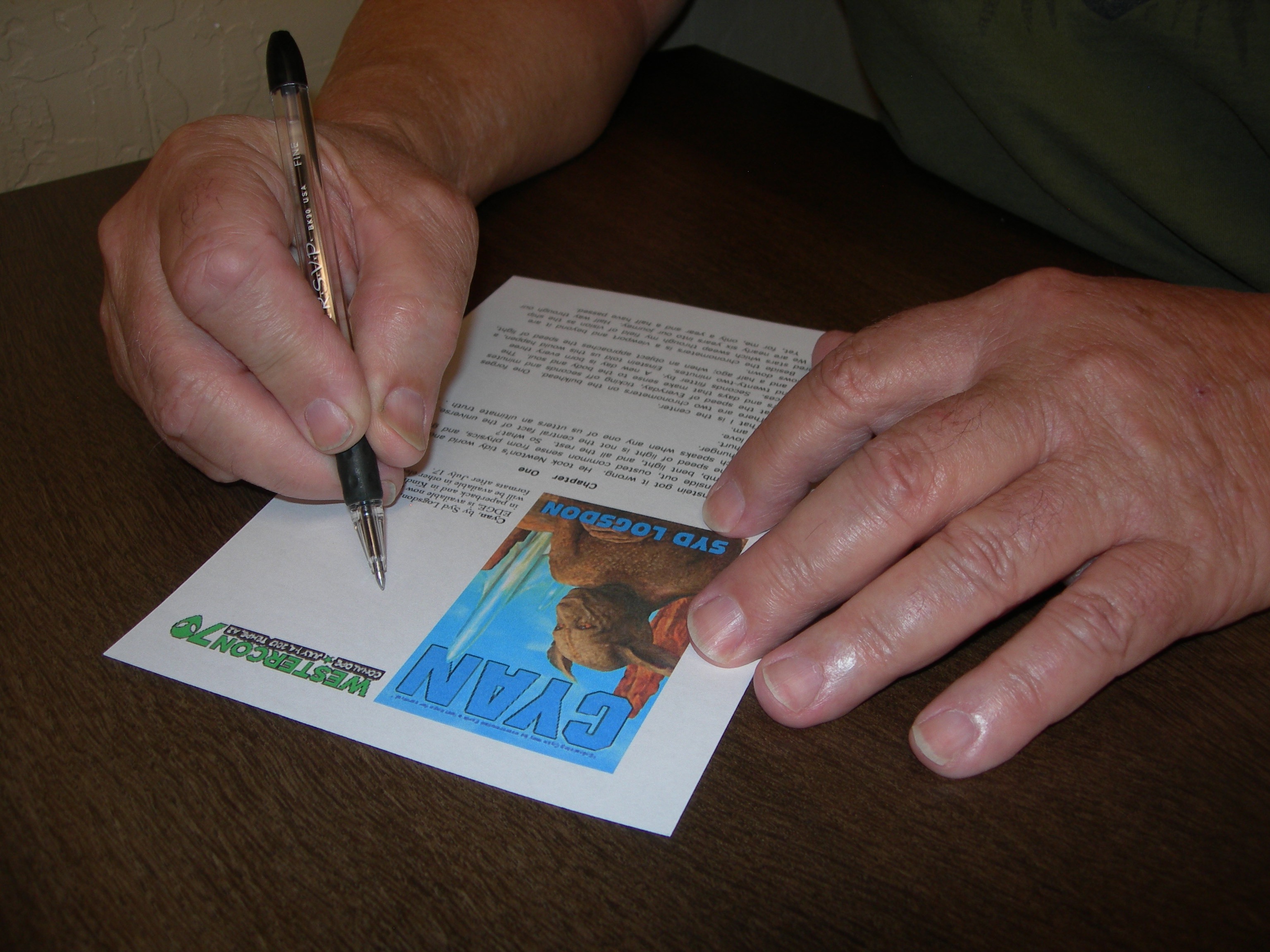
For the other thousand people at Westercon, I am making up a half-page, double-sided sheet with a thumbnail of Cyan’s cover, the Westercon logo, and a sample of text from chapter one. It amounts to a come-on for the eBook and a weird souvenir for those who attend Westercon. At least it gives me something to sign at the “book” signing.

Still, it was more fun signing a physical book.

Spirit Deer 21

The tracks led to a cut where some shift in the landscape was starting a new stream. It was dry now, but Tim could see that water had come rushing in a muddy torrent down the bank of the ravine, cutting and gouging among the rocks, uprooting one stunted juniper and carving a channel. Everything was knife edged in its newness. Obviously this waterfall had only seen one or two major rains. The deer’s tracks stood out clearly where it had gone up.

Tim gave a low whistle of admiration. Despite his injury, the deer still had stamina. And guts, for it had certainly fallen at least twice during the ascent. Tim tossed both spears over the lip of the bank above, then tossed up his unstrung bow the same way. Bracing his feet, he grasped his crutch-club by its tip and spun it up over the lip. The atlatl went into his quiver. It was a rough climb with only one good leg, but there were handholds.

A recent slide had dammed a small stream, shoving the waters sideways to spill over the bank of the ravine. Some water from the recent rain remained trapped there. The deer had apparently smelled it. Restraining his distaste, Tim drank from the muddy pool. The tracks led up slope away from the ravine.

Chapter 8

Tim squatted in the dimness and checked the tracks again. They continued toward the top of the hill, and Tim was sure that the deer was bedded down somewhere above him.

The deer had been browsing through this tiny, high valley. Tim could read this from his tracks, though he had not seen him. His father had taught him a lot about mule deer and their habits, and his grandfather had taught him Miwuk tales about them. Tim was sure that this deer would be up there somewhere watching the valley and trying the air for a foreign scent. In just a few minutes there would be no more light and Tim had to decide what to do. He could not make it back to his shelter now, even if he wanted to abandon the hunt. If he stayed where he was, he would be no better off in the morning than he was now. But if he could work to the ridge above under the cover of darkness, he would be in position when the muley came out from his cover tomorrow morning.

The wind decided matters for him. He simply could not stand the cold any longer.

He settled in against a cutbank, beneath a screen of firs and built a fire against a downed log. There were no aspens nearby to form a bark basket, so he skewered the squirrel he had shot that afternoon and roasted it whole. The dry, stringy meat was not nearly as satisfying as the squirrel and pine nut stew had been.

He drank from a trickle of water in the stream bed and wished for a bark basket and juniper berries to make tea. Even a pint of unflavored hot water in his stomach would have warmed him. He stretched out in the narrow space between the fire and the bank and thought of the down jacket tied to the back of his bike, hidden all too well at the campsite where he had started this hunt.

Tim did not sleep at once. He lay awake for a long time staring into the fire before the warmth finally began to soak into him, and thought about all the times he had sat beside his father or grandfather staring into other campfires. His father hunted only once a year to get a deer for the freezer, but they had spent many nights camping out for the pleasure of being outdoors. Sometimes he had gone with his father alone; other times his grandfather had come along. more tomorrow

Welcome to Summer

Hi, just a personal note, here; not one of my usual mini-essays.

I went to Tempe, Arizona to Westercon over the Fourth of July weekend. It was from 109 to 111 or thereabouts, but I felt no pain because the Mission Palms was well air conditioned. I have a report on that scheduled for the 11th.

I came home to find things weren’t much cooler. Yesterday was 109 here in the foothills of the Sierras, so my wife and I cut out for the coast and spent a few hours walking along the beach at Carmel. Today I’m home, hiding under the air conditioner, working out the details of a new novel that was sparked at Westercon.

I am also watering our non-native trees. When I just went out to change the sprinkler, I saw two mother wild turkeys with twenty-one gawky, half-grown chicks in our yard. They were panting, and looking miserable.

They and I are both asking — is it fall yet?

Spirit Deer 20

Tim was pleased, especially when his second spear struck the same target. Gathering his weapons, he decided that his bow might not be very good, but at least the spear thrower felt natural in his hands.

He had no idea how far he had wandered, or in what direction, after his fall into the river. He could be sure that he had wandered away from civilization because he had seen no one, and had heard no deer hunter’s gunshots. It was not reasonable to believe that he could simply walk a few miles now and be out of danger.

He was considerably better off than he had been a few days ago, but he was weak and terribly hungry. He could not survive on pine nuts alone. Game was scarce, and soon it would snow. Normally, it was best to stay in one place if you were lost, but he had been in one place for days already.

The simple fact was that no one was coming to rescue him. He had put himself beyond help by not telling anyone where he was going.

While he thought it out, Tim had continued to hunt and an unexpectedly lucky shot had skewered a squirrel. As Tim bled it and tied it at his waist, he decided to check and disarm his deadfalls, and start walking out.

Then he saw the tracks of a mule deer – walking on three legs.

It gave him a strange feeling. It could not be coincidence, that this particular deer was here now.

His first shot, so many days ago, had seemed clear and true, but the deer had not fallen. When he continued the hunt, it had brought him to disaster. Had his fall into the river been clumsiness, or something more? The thought made his hair stand up along his neck as he thought of some of his grandfather’s tales. Last night the deer had haunted his dreams and now it was back with him once more.

Was it a spirit deer?

Still, he was hungry, and that deer might mean life or death for him. He had no desire to chase him further, but it was an opportunity he could not pass up.

“I’m sorry, Deer,” he whispered aloud. “I don’t want to kill you any more, but now I have to.” 

He knelt to examine the spoor. The ridge of dirt between the halves of the hooves had collapsed and the edges of the track didn’t seem fresh. He worked along the ground, closely examining a whole series of tracks. The deer was favoring his right foreleg, carrying it mostly, but stepping gingerly on it from time to time. Where the right foreleg made prints, they hardly bruised the dry ground, while the left foreleg’s prints were deep. The left forehoof was fraying under the strain. Its tracks were a bit less smooth in outline than the rear leg tracks. The good foreleg would be tender from doing more than its share.

The tracks were several hours old. They came out of the maze of brush that extended from his camp to the edge of the ravine. The deer had apparently used that cover to sneak through the ravine without coming in sight of the camp.

The tracks went straight down the ravine and into the brush. Tim followed them slowly, not wanting to overtake the deer too soon. It might be a long stalk, and he would have to be cautious and study the deer’s habits in order to get close enough for a kill.

The tracks led to a cut where some shift in the landscape was starting a new stream. more next week

Spirit Deer 19

Chapter 7

Tim made quite a sight.

A quiver of aspen bark sewn with strips of willow bark hung from his belt. It held eight arrows, all feathered with aspen bark and tipped with obsidian arrowheads attached with pine pitch. Opposite the quiver hung his knife, the canvas case containing his firestone, and his canteen, now filled with dried tinder. His shirt sleeves were hacked off just below the elbow. His pant leg was split from waist to cuff and laced with strips cut from a dirty handkerchief. His boots were scuffed and battered; one of them was heavily splinted and both were laced with willow bark. His hair was still matted with dirt and dried blood.

He leaned on a crude crutch. He had replaced the original crosspiece with a stone from the creek bed set in pitch and lashed with squirrel hide so that it could double as a club. In his left hand he carried a bow strung with bootlaces and two slim spears tipped with deadly obsidian points. Through his belt, he had thrust an atlatl.

His Miwuk ancestors would have recognized all of his weapons as crude versions of their own, except for the atlatl. That was a spear throwing stick that Tim had read about. Because of his interest in his own ancestors, he had done a lot of reading about primitive men, and now he was about to put that reading to use.

It was his seventh day on the mountain and he had had nothing but pine nuts and one squirrel to eat. If he came upon any game, from squirrel to deer, he intended kill it – if he could.

On the opposite side of the creek, squirrels and Stellar jays had congregated in a lodgepole pine. They disappeared when Tim approached, so he seated himself on a fallen log and waited until they returned. He nocked an arrow and shot at a squirrel. It was a bad miss and every animal disappeared. Soon they returned. This time he aimed at a jay, and missed again. Tim had to wait nearly twenty minutes before they returned, and then they managed to keep to the far side of the tree. Finally, one cocky jay set himself up as a perfect target. Tim’s arrow clipped his tailfeathers, but did no harm.

After another half hour, Tim decided that he wouldn’t be getting any more shots, so he retrieved his arrows. One had lost its bark fletching, but that could be repaired.

Stopping in a clearing, he let his crutch fall and fired his seven good arrows at various targets while balancing on his good foot and letting his injured foot take some of his weight. There was no doubt that his ankle was getting better, and no doubt that his archery was lousy.

Pulling out his atlatl, he nocked the butt of a spear into its hook and raised them together until the spear came to a horizontal position above his shoulder. Holding the handle of the atlatl, he hooked his forefinger around the middle of the spear. The obsidian point glinted thirty inches in front of his face while the atlatl and the rest of the spear stuck out behind him. He cast the spear with an easy overhand motion, releasing his forefinger and keeping his grip on the atlatl. The light spear was fetched with bark like his arrows, and it described a flat arc ending in the bush he had chosen as his target.

Tim was pleased, especially when his second spear struck the same target. more tomorrow

Spirit Deer 18

The old man had seen the blot of darkness moving against the lesser darkness of the forest. He shifted the rifle carefully up as the bear came into the light, and fired.

A fiery lance of pain shot through the bear’s leg.  He squalled and charged back toward the forest.

* * *

It had been six days since Tim had eaten anything but a handful of pine nuts, and now the squirrel stew was playing havoc with his stomach. He squirmed uncomfortably through the night in his pine needle bed. And he dreamed.

It was morning in his dream – a clear, Sierra morning with the great pines standing bold against the blue of the sky. Once again he had his rifle in his hands. He and his companion were crossing a meadow with the sun at their backs. The grass was wet with dew and the morning sun fell slantwise, casting their shadows before them.

From time to time he would glance at his companion. Sometimes it would be his father in jeans and cowboy boots, striding along with his quick eyes darting about. Then it would be his grandfather, whose brown eyes were nearly buried in a mass of wrinkles. Since it was a dream, Tim did not think it was strange that his companion could change from one to the other.

Across the meadow, a deer emerged from the forest. Tim raised his rifle and his companion – he wasn’t sure which one – whispered, “Steady!” Tim let the rifle settle into place for the fraction of a second it took for the barrel to become still. The deer was pinned on the rifle sight. He squeezed the trigger gently and the rifle leaped in his hands.

The deer stumbled, fell, and rose again to run. But he did not run toward safety. He ran straight toward Tim. Tim reached for the lever to jack up another cartridge, but his hands felt numb and useless. The deer’s forequarters were soaked with bright, red blood. The deer’s eyes were bright with anger; his antlers looked sharp and deadly. The skin of the deer’s chest shivered from the interplay of muscles beneath and each drop of blood stood clear and individual, carried like bright jewels on the tips of the deer’s coarse hair.

The deer’s great brown eyes held no human intelligence, yet Tim felt as if it were shouting a reproach at him for his clumsy shot. A watery weakness swept through him and he had to turn away from that calm, accusing face. And as he did, the weakness settled in his stomach and became genuine pain. He woke, chilled and sweating in his shelter.

* * *

Tim lay awake for an hour. Then he slept, and dreamed again.

This time he was in his parent’s house, and once again his father was there. It was a brief dream, almost a simple touch of memory. His father and mother sat reading and talking while Tim played on the floor. Tim slid from sleep into wakefulness and lay awake again, staring at the rough underside of his shelter roof and missing his home. more tomorrow