Author Archives: sydlogsdon

Spirit Deer 2

Last year, Tim had been allowed for the first time to go with his father on his yearly deer hunt. Then his father had given him a rifle for Christmas, and this year they would have hunted together for the first time. There had never been any open agreement between them – that would have spoiled the whole thing – and his father would never have admitted that these were rewards for good behavior. Good behavior was simply expected. But if Tim hadn’t gotten control of his temper, the rifle and the hunt would not have been his.

Tim picked up an axe and took his anger out on the wood.

* * *

Tim was standing beside the pickup when his parents left the next morning. His dad tossed a worn leather satchel into the back and squeezed his shoulder. “Your mother is going to drop me off on her way to work,” he said. “Maybe I’ll be able to get a day between runs before deer season is over.”

“Now don’t you go driving crazy!” Tim’s mother said.

“You know me, Helen.”

“Yes, I do.” She turned and kissed Tim, and said, “There are leftovers in the refrigerator. You’ll have to make your own supper. I’m taking another double shift while Susan is having her baby. Maybe you ought to bike over to see your Granddad.”

“All right, Mom,” Tim said, but inside he was shouting, Not you too! He knew he shouldn’t be angry at either of them, but he was. After the pickup pulled out of sight, he wandered around the yard, feeling abandoned and feeling sorry for himself.

Eventually, he went to his bedroom and sat down on the bed with his new rifle across his knees. It had never been fired, except on the practice range. He took the shells from the box on his desk and loaded it, then unloaded it again. Finally he dropped a half dozen cartridges into his pocket and picked up his pack. As long as both parents were gone for the night, he figured he might as well spend the time with his grandfather. Maybe he could get in some target practice, or maybe he could get his grandfather to tell some of the family tales about the old Miwuk Indian days.

He left a note for his mother and strapped his rifle across the handlebars of his bike. He turned up the main highway into the mountains, standing on his pedals to make the initial grade. When he got to the turnoff to his grandfather’s place, he hesitated. Up the road, only seven miles further into the mountains, was the campground where he and his father had parked last year when they went hunting. At least he could go there. He had all day.

The road rose sharply for those seven miles, and Tim was thoroughly winded when he arrived at the campground. Half a dozen empty campers were parked there, but there was no one in the campground. Everyone was out hunting.

Tim stood astraddle of his bike for a long time, running his hands across the smooth steel and wood of his rifle. He was sorely tempted to have his hunt anyway, alone. Finally he decided to just walk in the woods for an hour before he went down to his grandfather’s place. He reached for his cell phone to tell his grandfather, then remembered that it was at home.  The one girl he liked least had begun to call him twice a day, so he had stopped carrying it. more tomorrow

364. The Core Story

photo by David Mayer

For the last month, these posts have been coming later in the day, in hopes of finding new readership in other time zones. I haven’t been happy with the results, so today I am reverting to the old posting schedule.

Over in Serial today, I begin presenting the novel Spirit Deer. I had some hesitation about this.

As it stands, Spirit Deer is a juvenile, not a YA. It would be suitable for most of the kids I taught in middle school, but too young for teenagers. It would stand with Island of the Blue Dolphins, not with Twilight.

It didn’t start out that way. When I originally wrote it, as an experiment to see if I could I write a complete novel, Spirit Deer was a book for adults. Tim had a last name, a wife, a job, a backstory, and other adult considerations. When he got lost in the woods and had to find his own way out, it was a catalyst for changing his life.

It was only 45,000 words however. That was too short for a western or a science fiction novel, even in the seventies, and way too short for a regular novel. And while the lost-and-found part of the story was fine, the relationships part wasn’t ready for prime time. It didn’t deserve to be published, and it wasn’t.

I moved on and my second novel,  Jandrax, and it was published. Fair trade; Spirit Deer had done its job by teaching me to write. It could be put away with no regrets.

But it wouldn’t die. The problem was, once you strip away the wife and the job and the friend and the adult concerns, the core story of how to keep alive when nature is trying to kill you was still powerful.

After a lot of years, and several other novels, I went back to Spirit Deer and stripped it down to it’s essence. At that level, Spirit Deer could have been about any male above the age of thirteen, all the way up to senility. To be fair, a woman could have endured what Tim endured, but I don’t think a woman would want to read a book about it. At least not in the eighties and nineties when the core story was tapping me on the shoulder and saying, “Don’t give up on me.”

Spirit Deer became a juvenile because of its length. When the wife and friend and backstory went away, there were only about 25,000 words left.

Consider this:

Man against nature, other men, or himself, is a story.
Man against nature, other men, or himself, plus gunfights, is a western.
Man against nature, other men, or himself, plus thugs, is a thriller.
Man against nature, other men, or himself, plus spies, is James Bond.
Man against nature, other men, or himself, plus sweet sex, is a romance.
Man against nature, other men, or himself, plus rough sex, is men’s action — a genre which has all but disappeared.
Man against nature, other men, or himself, plus sex, catching a big fish, and death on the last page, is Hemingway.

I didn’t want to add any of those plusses, and I didn’t want to make Spirit Deer artificially longer, so it became a juvenile. It’s still a good story, it taught me a lot, and it provides a lot for us to talk about as writers.

That is, I assume you are or want to be a writer, or I would have lost you in the second paragraph.

Spirit Deer will be presented in forty posts over in Serial, and there will be posts over here on A Writing Life expanding on the story, on being a beginning writer, and on how many ways a writer can present a core story.

Spirit Deer 1

Spirit Deer
by Syd Logsdon

Chapter 1

Tim was packing for their hunting trip when his father came to his room. When he hesitated in the doorway, Tim knew that something was up, and that it wasn’t something good. He shoved another pair of jeans into the pack and said, “What’s the matter, Dad?”

“I just got a call from Mike Conway,” Tim’s father replied.  “He’s come down with the flu.”

Tim stood still with his hands resting quietly on the half filled pack, waiting for the rest.

“I have to drive his rig for him.”

“How far?” Tim asked.

Tim’s father came up and put his hand on Tim’s shoulder. “All the way to Chicago. I’m sorry, Tim”

Tim wished he was twelve years old again, so he could throw a screaming fit. He had been working on his temper these last two years, trying to be fair to his family, trying to be responsible – trying to be more like his dad. If he acted childish now, if he even whined, his father would be terribly disappointed in him. He didn’t want that, so he gritted his teeth and asked, “How soon will you be back?”

“That’s the rest of the bad news. I can’t pick up his load until tomorrow morning. Figure two days each way, and at least a day to unload and load at the other end. Five days; I’ll barely be back in time to make my own next run.”

Tim couldn’t believe it. It wasn’t fair. He had waited all year for this hunting trip and now it was going to be snatched away from him. He said, “I wish we had left two hours ago.”

Tim’s father shook his shoulder in a friendly way. “Then Mike would have driven sick. I’m glad I was here for him. He has been a good friend to all of us.”

It was true. Tim knew that; but inside, the selfish twelve year old he had been was screaming, “I hate it, I hate it, I hate it!” Tim was tired of being fair. His fingers tightened on the pack. He wanted to grab it up and throw it – preferably through a window, or at his dad.

But Tim saw his father’s eyes on him. He knew the look of disappointment that would come into those eyes if he gave in to childishness, and he never wanted to see that look again. His dad said, “Tim, I’m proud of you for taking this like a man.”

Tim couldn’t reply, and he couldn’t stand those eyes on him any longer. He nodded with set lips and left the room. He headed for the woodpile.

Two years ago, the last time he had thrown a tantrum, his father had taken him out to that woodpile. He had given the axe to Tim and had told him to chop wood. After ten minutes, when some of his anger had been drained away by smashing the heavy logs into firewood, his father had said, “Everyone gets angry. Everyone wants to have things go just right, and things never do. Now you’ve got a choice to make. You can cry like a baby when you don’t get your way, or you can act like a man. The next time you find yourself losing control, I want you to get up from whatever you are doing and come out here. Work it out, then come back.”

Tim had spent a lot of time at the woodpile that year. Gradually he had gained control of himself, and as his father grew proud of him, he had grown proud of himself.

It had been nearly a year since he had gone to the woodpile to take out his frustrations, but this was no ordinary disappointment. more tomorrow

363. Masters: Coming to America

What sort of country would (the United States) have now if the Indians had had an Immigration Service when the Pilgrims set out in 1620?
John Masters

When I first read John Masters, something he said stuck with me. Before going to Westercon this year, I wanted to run down that quotation, and in doing so I found much more worth sharing. What he said about writing will appear here later, but today I want to give his insights on immigration, or, as he called it, his Seven Year’s War with the U. S. Immigration authorities.

For reasons detailed in his book, John Masters decided that, though he was an Englishman, there was no life for him in England, and that America should become his home. He applied for an immigrant visa, knowing that the British yearly quota of 65,000 was never filled. His reactions to the questions asked on the application form were humorous, but too long to place here. Apparently the questions were as inane then as they are now. (see 329. Green Card Blues and 361. Take This Test)

A week or so later, he was told that he would have to wait about four and a half years. He had been placed on the Indian quota. He went back to inquire and was told that American law only recognized the place of his birth, not his actual citizenship. Never mind that he was born in a British military hospital. Never mind that he was born of a British mother and a British father, stationed in the British army in a British controlled area. Never mind that a child born of an American parent (and it only takes one) anywhere in the world is an American citizen. Never mind that he was born in 1914, and India didn’t become a country until 1947. He was born in India, so he was on the India quota.

It was a good thing he hadn’t been born while his father was stationed in Greece. The Greek quota was eighty-one years. (Yes, that is not a misprint. 81 years.)

Masters decided to withdraw his application for an Immigrant visa, get a visitor’s visa, and work things out later. That was not allowed. Since he had applied for an immigrant visa, he was no longer eligible for a visitor’s visa. Too many others when facing impossible waits had made that same move, then disappeared once they were in America.

As you might guess, as a British Army officer with plenty of friends, he was eventually allowed a visitor’s visa, came to America, and managed to stay permanently, although with many additional bureaucratic battles.

Good thing he wasn’t actually Indian.

More to the point in 2017, good thing he wasn’t Mexican, or poor, or not a native English speaker.

Master’s comments on writing will come in later posts.

Alien Autopsy (4)

In Jandrax, I was happy to use modified mammals and birds. That was all the story needed. When I wrote Cyan, I faced a different situation. My crew was set down on an alien planet for one year, with the task of coming to understand its weather, geology, and ecology in order to prepare for colonization. They were all scientists, so their actions and conversations called for a deeper understanding of their new world than any other kind of science fiction novel would have required. That challenge was half the fun.

When I began Cyan, I had been studying ecology for about twenty years, starting back when I had to explain what the word meant. I later came to understand the essence of Earth’s taxonomy in the most rigorous possible way — I had had to condense it to a level which middle school students could understand without dying of boredom.

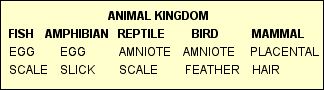
Terrestrial taxonomy looks something like this:taxon

Drop a salmon egg on the gunwale of your canoe and it will dry out in minutes. A chicken or turtle egg would survive the same treatment. This is the meaning of amniote egg (although there are other, competing meanings). Creatures who lack them, must lay their eggs in water. The rest of the chart should be clear, although simplified. For example, birds have scales on their legs as well as feathers elsewhere, and I skipped Dinosauria altogether.

I built up Cyan from the taxonomic level. If I had hadn’t been showing the planet through the eyes of a team of scientists, I would never have started out there.

It had to be weird but recognizable — that’s the key to all science fiction invention. It also required restraint. You can only explain so much to your reader without losing them, and beyond a certain point, your backstory is wasted effort.

I took grasses and weeds for granted. I gave my trees multiple trunks bound together, like a strangler fig without its victim. For something like insects, I made Chitropods – chitro sounds like chitin, and pod means foot, so the reader can be expected to infer an exoskeleton. Continuing the idea of inference, if we call the flying creatures who eat the chitropods pouchbats, the reader will draw a better picture in his mind that we could on paper.

The number of legs is important to Terrestrial arthropods, but I bypassed that by giving all chitropods many legs, but with only one joint each where each meets the body. This gave them a rolling gait “like caterpillars on crutches”.

These are throw-away inventions. They could have been applied to any ecosystem and they are not systemically related to each other. They alone would be good enough for most science fiction novels, but not for one about scientists teasing out the essence of their planet.

Here we need a key differentiation, from early in evolution, from which a thousand lesser differences can be derived. I decided that on Cyan, early in the development of chordate life, the vertebral column doubled at the posterior, giving Cyanian sea life twin tails. That changed everything. Earth fishes evolved legs from their fins. Cyanian “fishes” evolved legs from their split tails, so every Cyanian land creature is a tail-less hopper, fundamentally different from anything on Earth.

On Cyan, the classes are Pseudo-pisces, Amphibia, and Inturbia. No reptiles, no birds, no mammals, no dinosaurs. The Amphibia are cold blooded. Inturbia are inefficiently warm blooded. The term Inturbia should imply “internal body temperature un-perturbed by external changes”. Not every reader will get that, but writers should reward their best readers by not spelling everything out.

There are a thousand other details, but for that, you will just have to download Cyan.

All this is not to say that I didn’t invent interesting alien creatures. Kavines are incredibly fierce. Dropels, especially after they became domesticated, are cute and tasty. In the southern part of the upper continent, the Cyl developed something close to sapience, leading Viki to . . . nope, sorry, that’s a spoiler. I just started with taxonomy so they would all fit together.

Of course, too much consistency without outliers would be boring, so I added the globe wombs. The explorers see them shining in the treetops from their first minutes on the planet, and it takes a while for them to figure out what they mean.

Inturbia have live birth. Cyanian amphibs have to return to water to lay their eggs, except for one group, the Sphaeralvids, who produce globewombs. When a Sphaeralvid mother comes to term, she moves to a sunny spot in the treetops and exudes a transparent, leathery sac filled with a clear fluid like seawater. Into this she deposits fertile ova, then defecates. Algae from the Sphaeralvid mother’s bowels convert the feces into biomass and the Sphaeralvid nymphs fed off the algae.  When the feces are gone, the globewomb walls break down, leaving the now sizable nymphs free to face Cyan on their own.

Neat, huh? That is entirely too much detail for most books, but Cyan was written to show, realistically, what exploration of a new world might be like. This is just the kind of detail a crew of scientists would be recording.

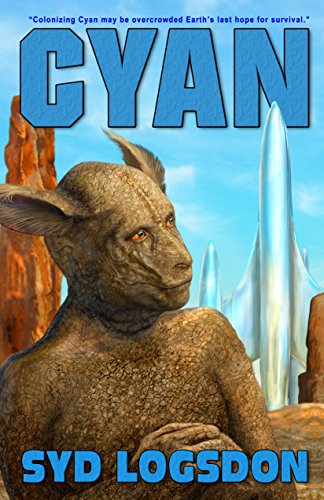
Aside:      Shortly after posting this, I received a digital copy of the print-on-demand version of Cyan to proof. I spent May 29 and 30 in close reading of all 315 pages. The taxonomy and ecology of Cyan are backstory, dribbled out in bits here and there, but what the reader sees up front and in their faces are the individual alien beings. I realized that I need a fifth Alien Autopsy post to devote to the Cyl (the cover critter), but there is no space for it here. You will find it next Thursday over on the A Writing Life side of this website.

#               #               #

I began Cyan a few years after I wrote Jandrax, and set it in the same universe but hundreds of years earlier.

I also have in mind a third novel set in the same universe, but very different. It will take place on Stormking, a prison planet with a Uranian inclination to the ecliptic. The people who make up its population are not scientists, but outcasts. They have no interest in taxonomy. They meet the creatures native to their world one by one, and all they care about are which ones can they eat and which ones want to eat them. This time I’ll stop worrying about how these alien creatures make up a logical system, and just weird them up big time. That ought to be fun, too.

362. Masters of India

     Wasn’t it barely a week since I had thrilled to learn what was inscribed on the base of the Statue of LIberty:
          Give me you tired, your poor,
          Your huddled masses yearning to breathe free . . .
     What generosity, I had thought, what a marvel of welcome!
                         John Masters

We’ll let that quotation hang there, and return to it later. This post, and several more, are connected to John Masters’ third installment of autobiography, Pilgrim Son.

I read the first installment of his autobiography, Bugles and a Tiger, during the 1970s. Normally a military biography would be the last thing to interest me. Furthermore, I was in the Navy against my will at the time, it that made it even more unlikely. However, Masters was a famous novelist specializing in India, so I read Bugles . . ., and I was impressed.

I had just finished four years studying South Asia and was about to return to another year of the same. My experience had shown me that there is wisdom (and stupidity) in writing on all sides of any issue. Wiser’s The Hindu Jajmani System (anthropologist), Nehru’s The Discovery of India (nationalist agitator, then national leader) and Masters’ various works (officer in the British Army in India) all showed accurate views from different perspectives.

I skipped Masters’ second autobiography, The Road Past Mandalay because I had no interest in sharing the horrors of WW II’s Burmese campaign, but Pilgrim Son was about the start of his life as a writer. I was beginning to write, so I ate it up.

That was nearly four decades ago. One particular story from that book stayed with me, and sent me back to seek it out again. I found that the whole book was a gem, far better than I remembered, and with more than one brief bit worth sharing.

For one thing, Masters had a lot to say about immigrants. That had not stuck in my memory because it was not an issue in the early eighties when I first read Pilgrim Son.

I have to set the stage by reminding American readers, whose world historical knowledge is typically shallow, that India is an ancient culture, but is new as a nation. Until mid-last century, it was controlled by Britain. In 1947, what was then India was partitioned into India and Pakistan, and each part became a self-governing nation. Decades later, Pakistan also split, into Pakistan and Bangladesh. What had once been a more-or-less uniform culture divided into hundreds of petty kingdoms, was first unified under British rule, then split into three modern nations.

After several hundred years, members of the British Army and of the British governing class, many of whom had lived in India for generations, had to take ship for England. John Masters was one of those Englishmen who was born in India, had lived his life there, and now found himself an immigrant to his other homeland. He soon found that there was nothing for him in England, and became an immigrant to America, where he began his writing career. more tomorrow

Alien Autopsy (3)

Imagined alien life forms can range from nearly human to outrageously strange. They can be imagined to meet story needs, or imagined first, with stories arising from their peculiarities.

Actually we can do even more. We can imagine whole ecologies. And again, we can go from minimalist to extreme. Arzor from Norton’s Beast Master is suspiciously like the American southwest, but Dune is a desert with an ecology quite a bit developed beyond any desert on Earth.

My first science fiction novel Jandrax [see note at the bottom of the page] is set on a deeply frozen planet, with only the equatorial region ice free. The only area I developed was a plain roughly a thousand miles across, centering on a massive freshwater lake. I stranded a starship with a load of fundamentalist passengers and a relatively unreligious crew, and watched the fireworks as they found two quite different ways of coping with the local ecology.

The area in question never sees rain, but during the cold season, snow and sleet falls, then melts during the (slightly) warm season. Viewed locally, this results in a dead season of snow, a brief season of wild plant growth during which massive migratory herds move through, and then a long season of dry, warm aftermath until the churned and destroyed vegetation is covered with new snow, where it and its seeds will wait for the next melt.

Viewed from the starship stranded in orbit, there is a moving line of green, eating up a mass of white, and followed by a growing gray, brown temporary desert.

I won’t tell you what happens to the people. That would be a spoiler to a book I’m hoping you will still read. Instead, let’s look at the alien creatures, starting with the herbivores.

Herbies are burrow bodied, tapir headed, fleet and harmless. Humpox don’t get much description, but don’t need it, with that name. Trihorns are as deadly as they sound. All are mammals, as are the carnivorous longnecks and krats. There are also huge carnivorous toothed birds called leers. They ended up on the cover.

These are the deliberately realistic creatures, all mammals and birds, devised in an era when warm blooded dinosaurs had not yet reached public awareness. In another part of the book, there is an interlude on an island which may be a hallucination or perhaps an encounter with the local version of God. Here the rules of realism don’t fully apply, and we find winged people who would never stand up to the laws of aerodynamics, and an insufferably cute, seal-faced, plump flying mammal called a dilwildi.

The example of Jandrax goes straight to the notion of purpose. Weird critters for the sake of weird critters is entirely valid. I love a weird critter novel. But Jandrax was my first full fledged novel, designed to show human interaction in a harsh, ice-age environment. It contains an entire religion, devised for the purpose of providing conflict. The ecology of the world was central to the story, and it was developed, but the individual alien creatures just needed to look right in an ice age environment. Nortonian minimalism is at work here.

#               #               #

I was in high school when I  first read Richard McKenna ’s novella Hunter, Come Home. It was a deeply moving, human story of manhood, honor, and love. It also had a second dimension, the description of an entire sentient ecosystem in peril and fighting back.

Here is a brief summary. Mordinmen were descendants of a lost Earth colony which had fought a generations long war against the dinosaur-like creatures which inhabited their planet. Manhood had become symbolized by the killing of a dino, but now the dinos were scarce and poor families, like Roy Craig’s, could no longer afford a hunt.

Mordinmen had now claimed another planet and were setting about to destroy its native ecosystem, in order to rebuild it in the image of their home planet. Red dots (successful hunters) were running the show, assisted by blankies like Roy who was working toward the time he could make his kill on the new planet. Hired as specialists, the Belconti biologists were providing the virus-like Thanasis used to destroy the native life.

When the story begins, the fight to transform this new planet has been going on for decades, and it is failing. Now the Mordinmen, against warnings by the Belacaonti, are about to unleash newer, harsher, more dangerous plague on the planet.

That’s about as far as I can summarize without a spoiler alert. Roy Craig wants more than anything to be a full fledged member of his machismo society, but his blanky status leaves him marginalized and frustrated. At the same time, he is drawn to the relatively gentle society of the Belaconti with whom is is working, symbolized for him by the woman Midori Blake.

Other than the dinosaur like creatures imported by the Mordinmen, there is only one other alien species — the entire planet they are all on. The native life of the planet is totally interconnected, essentially a one-world-tree (shades of Gaia).

There is a three way contrast in Hunter, Come Home. The Mordinmen, from a macho society built on killing are placed in contrast to the Belaconti, scientists who understand and treasure the ecosystem they are trying to destroy, and they in turn are contrasted to the interlocked, semi-sentient native life of the planet. Roy and Midori are each caught in conflicting loyalties as the planned apocalypse moves forward.

This is one of those cases where world building, culture building, and alien species building work together seamlessly. more tomorrow

Click here for next post.

[You can find Jandrax in used book stores. It is also available on this website, in an annotated form. Eventually it will be placed in Backfile, but I’ve been busy. I you want to read it here and now, your best bet for navigation is to begin by clicking the March 2016 archive and find Jandrax 2, then read and slide up, skipping every other post — archives alternates posts from the two blogs on this site. It is a bit of a pain. You can get Jandrax most days through Amazon’s cadre of used book stores. If you want the annotated version, in which I explain the various foibles of a young author, I plan to put it into an easily accessed form in Backfile, as soon after Westercon as I can find the time.]

361. Take This Test

Berlin WallMexican Wall

TAKE THIS TEST TO SEE IF YOU ARE FIT TO BE AN AMERICAN

Have you ever knowingly committed any crime for which you have not been arrested? [Never mind the fifth amendment. It does not apply here.
Have you ever been arrested? [Whether convicted or acquitted.]
Have you ever received public assistance?
Are you likely to receive public assistance in the future? [As if you could know that.]
Have you ever gambled illegally? [Yes, the Super Bowl counts.]
Have you ever encouraged an act of illegal immigration? [Yes, that includes hiring the maid who cleans you toilet, cooks your meals, and babysits your kids.]
Did you smoke pot before it was legal?
Have you ever been a member of the Communist Party? [Yes, Joe McCarthy is dead, and yes, the question can still be asked, and no, you can’t refuse to answer.]
Did you, in support of the Nazi party, aide in the persecution of any person because of race, religion, national origin, or political opinion. [If such aid was to the KKK, answer no.]
Have you ever assisted any organization engaged in kidnapping, political assassination, or any other form of terrorist activity. [If that organization was the CIA, answer no.]
Have you ever left the U.S. to avoid the draft?
Have you ever served in the armed forces?
Have you ever been a police officer?
Have you ever been a prison guard?
Have you ever been been a Boy Scout?

If you answered yes to any question above, you may not be eligible to enter the United States.

If you could not read any question above, you may not be eligible to enter the United States.

If you could not afford a lawyer to help you answer any question above, you may not be eligible to enter the United States.

If you were too repulsed to finish the test, you may not be eligible to enter the United States.

Finally: List your present and past membership in or affiliation with every organization, association, fund, foundation, party, club, society, or similar group in the United States or in other places since your 16th birthday. Include any military service in this part. If none, write “None.” Include the name of each organization, location, nature, and dates of membership. If additional space is needed, attach a separate sheet of paper. If you are unable to remember and list these affiliations, you may not be eligible to enter the United States.

—————-

All of these questions were drawn, with snide but accurate rewording, from Form I-485, Application to Register Permanent Residence. If you think this is a joke, click here to read the actual form.

Aren’t you glad you are an American citizen? If you weren’t, we probably wouldn’t let you in.

Alien Autopsy (2)

This material is the second post of four for the panel “Alien Autopsy: the biology of ET” Posts for the rest of the panels will be published in A Writing Life.

You can write a story and make up aliens – sentient or otherwise –  to fit. Or, you can make up aliens, and write a story about some peculiarity of their makeup. Decades of stories were about human mutants (not technically alien, but close enough) with psi powers. if you didn’t live through the fifties, you probably don’t realize how many ESP wielding mutants there were in science fiction, long before Professor X and his X-men made it to the comic books.

Sometimes a single biological factor, with its secondary ramifications, may suggest a whole species and their culture, as in Gardner Dozois novel Strangers.

It is the bittersweet story of a love affair between an Earth man and an alien woman of a people called the Cian. Throughout the novel, Dozois drops hints about the central paradox of Cianian culture, but Farber, his hero – if that is the right word – doesn’t pick up on them. Because he doesn’t understand his wife’s culture, he chooses to have children by her, thinking that is what she wants, and in the closing chapters Dozois drops a house on all of us when Farber – and we – discover that Cianian culture is all built around the fact that, because of a biological defect, its women always die in childbirth.

Technically, this is a gimmick story, but it is so well done that it doesn’t feel like one. Strangers is build around Cianian culture, but Cianian culture is built around the structure of its aliens’ reproductive biology.

There have also been a lot of less salutary books written about aliens with odd reproductive structures, but lets not go down that road.

(Aside: My novel Cyan, named after the planet which was named after the color, has no relationship to Dozois Cian, or the thousand other Cians — characters, book titles, and authors names — to be found if you type cian into Goodreads.)

Those of us that grew up with the original Star Trek knew aliens as humans with big masks and padded clothing. CGI made quite a bit of progress in removing that limitation in movies and subsequent TV programs, but the wildest aliens aren’t products of technology. They have been around for more than a century in novels. Remember War of the Worlds? Great monster. Even better radio broadcast.

Larry Niven’s Puppeteers might be hard to reproduce in a movie, but that doesn’t stop readers of Ringworld from enjoying them. In fact, that may be part of the appeal. We science fiction readers enjoy having a cadre of writers producing phalanxes of weird critters that would leave lesser readers shaking their heads.

No one has read all of science fiction, but I’ve read a lot. And in my slice of the SF universe, I have never found a writer who created more or weirder creatures than E. E. Smith, PhD; aka Doc Smith.

Smith was not available in either of the two libraries that were the centers of my childhood universe, but when I got to college, one of my roommates was a fan. He wisely started me on Galactic Patrol, and I read through to the end, then circled back. Take my word for it — keep the same order. If you start on the putative book one, Triplanetary, you’ll probably never make it past page five.

(Another aside: books four through six were written from 1937 through 1948, all appearing in Astounding. Smith wrote “book one” in 1934, unconnected to the rest. When he got a chance to see the complete series published, he rewrote Triplanetary to fit the others, wrote an entire new “book two”, First Lensman, and tweaked the rest. They fit together, and the first two have moments of excellence, but the last four are the essence of the tale. If you find the style too old fashioned after two chapters of Galactic Patrol, move on; you were born too late.)

You will, however,  miss a menagerie of strange aliens, both sentient and otherwise. I’ll describe just two; first Worsel:

. . . there was hurtling downward toward them a veritable dragon: a nightmare’s horror of hideously reptilian head, of leathern wings, of viciously fanged jaws, of frightfully taloned feet,  of multiple knotty arms, of long, sinuous heavily-scaled serpent’s body.

This is the creature who will become the second most formidable Lensman, and Kennison’ s best friend. The third second-stage Lensman was Tregonsee:

This . . .apparition was at least erect, which was something. His body was the size and shape of an oil-drum. Beneath this massive cylinder of a body were four short, blocky legs upon which he waddled about with surprising speed. Midway up the body, above each leg, there sprouted out a ten-foot-long, writhing, boneless, tentacular arm, which toward the extremity branched out into dozens of lesser tentacles, ranging in size from hair-like tendrils up to mighty fingers two inches or more in diameter. Tregonsee’s head was merely a neckless, immobile, bulging dome in the center of the flat upper surface of his body — a dome bearing neither eyes nor ears, but only four equally-spaced toothless mouths and four single, flaring nostrils.

These are the minions of civilization; the baddies look worse.

Part of the power of these descriptions comes from E. E. Smith’s writing style. In flipping through the internet while writing this, I ran across a comment that if the Lensmen series were to be offered for publication today, it would not be accepted. That is absolutely true, but it is also true that without the Lensmen series, there would be no Star Wars, nor any other space opera. The Lensman series set the pattern that all others would follow, and nothing that came after was as good as the original.

Heinlein was Smith’s friend, and our best picture of him, from RAH, shows Smith as the original of the Gray Lensman, and shows his wife as the original of Clarissa MacDougal. Much of the charm of the series lies in Kennison’s Boy Scout incorruptibility. Those who say he has no personality are wrong. He simply has a personality that is out of the modern norm. Like Jesus. Which is exactly what he should be, as the end product of thousands of years of Arisan work in perfecting human DNA.

All this works, and the hundreds of weird aliens work, because E. E. Smith’s writing style is essentially naive. His rolling cascades of description could only come from someone who is so sure of himself that he is incapable of embarrassment.

It’s been a long time since that kind of writer has been in vogue. more tomorrow

Click here for next post.

360. Eternal Ballads

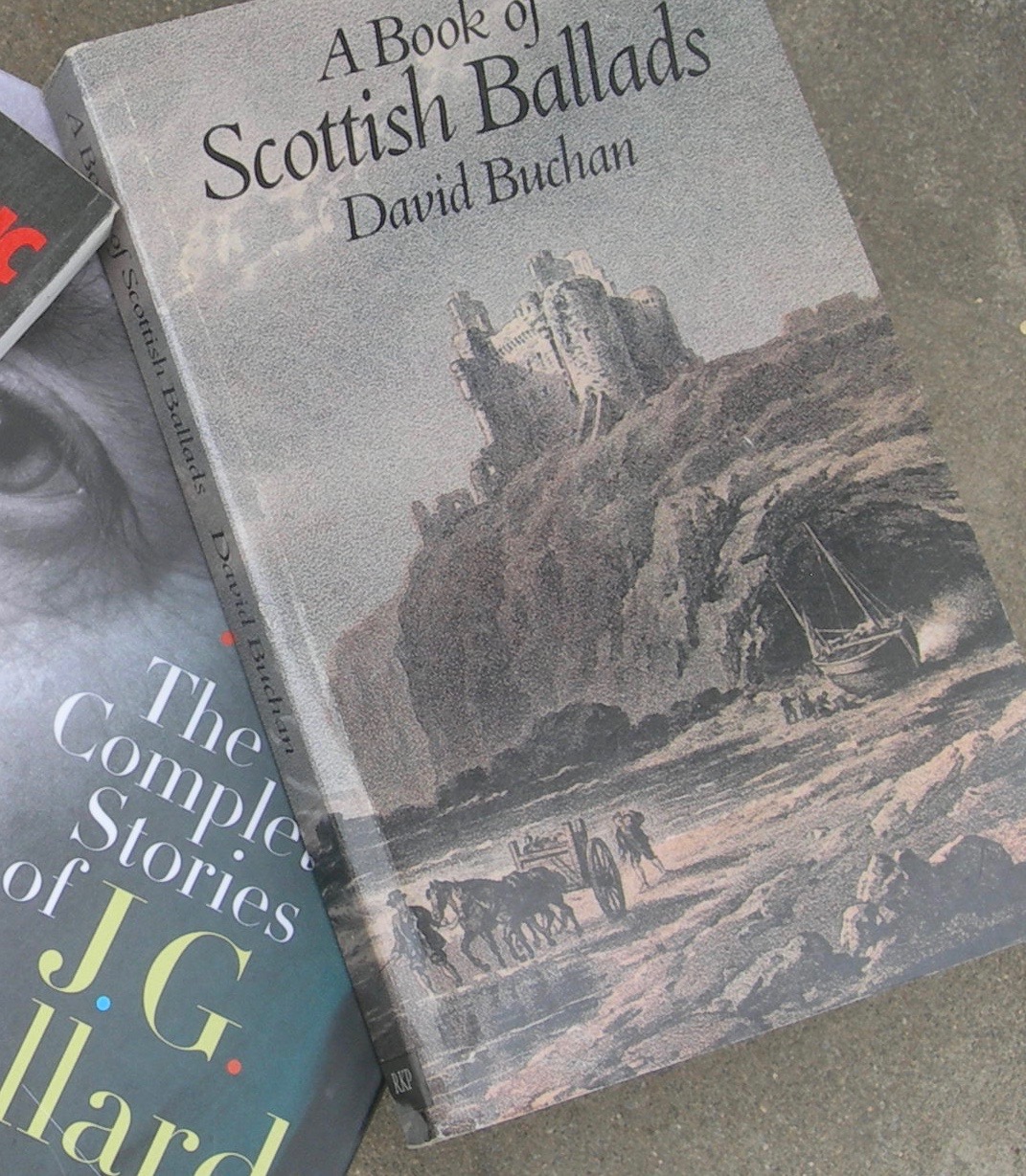
Just before noon on May 22, I was writing the posts leading up to the Golden Age panel I will be doing at Westercon. I wanted to know the name of a particular J. G. Ballard short story for the post. I remembered the story, not its name, so I pulled out my compilation of his work. It is massive, and by the time I had found the story in question (Deep End) I was approaching a state of depression. Ballard can do that. I suggest taking him in small doses; one story a week maximum.

That was when this story occurred to me. I wrote it in about an hour. Once it was finished, I realized that it might seem a very strange story — if you don’t know Ballard, and particularly Deep End.

=================

He was an old man already when they caught him. The crime, if it was a crime, and if he had done the deed, occurred so long ago that there were few witnesses left. Three, to be exact. One placed him on the scene. One testified that he had seemed to know too much about the crime, in conversation, a week after it was done. One said he saw it happen, and saw the old man, when he was a young man, and testified that they were the same person. None of the witnesses told exactly the same story two days running, but they were all old, so you could expect that.

The accused was found guilty and sentenced to ten years. It was a lenient sentence for the crime, but no one thought he would live long enough to serve it.

They placed him in a cell of the new type. For decades solitary confinement had been deemed cruel and unusual, so only the most dangerous endured it. The old man was not dangerous. He swayed when he walked and he was always short of breath.

But there were new rules now, designed to protect prisoners from each other. The old man was so clearly frail and helpless, that they applied to him. They put him in a cell, four meters by three, with a toilet and shower in an alcove, an opening that presented food three times a day, and a steel door that was closed once and forever, not to be opened for ten years, or until the old man died. This would keep him safe from the other prisoners who might have tormented him.

There was a camera at the ceiling, through which he could be observed.

Before he was incarcerated, they asked him what book he wanted with him. He would only get one. Most prisoners asked for the Bible. A few asked for the Koran. Buddhists never asked, as they carried their god within themselves.

The old man was not religious, but he loved the sound of human voices. It was the thing he anticipated missing the most, so he said, “Ballads,” thinking he could sing them and ease the eternal silence of the cell.

They gave him his book, pushed him through the doorway, and the last human sound he heard was the clanging of the door, and the oiled sliding of the lock. He sat on the bed. It was made of plastic, semi-soft, vastly durable, designed to outlast him. He was naked because once a prisoner had stuffed his mouth and nostrils with torn clothing, and slipped his hands into pre-tied manacles of denim, and had escaped into death.

After an hour of silence, eyes downcast to avoid the gray walls, the old man took up his book, but they must have misunderstood him. It was the complete short stories of J. G. Ballard. The old man had never heard of Ballard. With a sigh, he opened to the first page and read, “I first met Jane Ciraclides during the recess . . .”

#              #              #

When the proctors came to let him out at the end of ten years, they went first to the observation station. There were one hundred screens on the wall, ten rows of ten, all tied to the cameras in the cells for which this observer was responsible. The observer quickly darkened all but one screen, as protocol demanded. He had spent thirty hours a week in this room for eighteen years, viewing a hundred prisoners who could not look back. His outlook had become narrow, but his body had grown large.

The proctors were hardened to viewing the results of solitude, but even they were startled by the old man’s appearance. His head was shaggy in parts, bare and raw in other parts where he had torn out his hair by the handful. His body was a skeleton wrapped in wrinkled skin. The walls of his cell were covered with graffiti made with excrement. It must had smelled terrible.

Following protocol, they watched him for two hours, waiting for the moment his sentence would be up. He lay most of the first hour, foetal on the bed. Then he staggered up. There was no sound from the room, except the sliding of bare feet on concrete. The old man had uttered his last curse eight years before, and every day since then had been wordless. But not utterly without sound.

Now he approached the book, and opened it. He let pages flutter past, until he found a starting place, and then he read. After a moment, there was a faint groaning. After five minutes, that gave way to an ululation on two notes that grew in volume as his body began to shake. Eventually he leaped up and hurled himself against a wall, beating it with his fists until blood flowed, and sinking to the ground in whimpers.

The observer remained unmoved, sitting in his place like a fat Buddha who no longer saw the world’s pain. He leaned forward and rotated the camera, and said, “I thought so. Deep End. That always upsets him the most.”

One of the proctors said, “How can he have survived like this?”

The observed replied, “Everybody lives forever in Hell.”