Category Archives: A Writing Life

437. Steampunk Clockwork

A great deal of the charm of typical (if such a thing exists) steampunk is that it replicates the sense of wonder of early science fiction, something that is missing 147 years after its beginnings. My math refers to the publication of Twenty Thousand Leagues Under the Sea in 1870. There have been a lot of stories in that century and a half, so it is just a little hard to come up with something new.

Fortunately for science fiction, there is a new crop of readers every generation. Things that seem old and overdone to long-time readers, seem new to them. When I first saw Weir’s The Martian I thought, “Again?”, but a half million readers on Goodreads rated it highly.

In old fashioned science fiction, the hero could do anything. And therefore, so could the reader.

Among that “anything” was a world of inventions that any boy genius could whip up in his basement. When I first read Tom Swift and his Electric Rifle (published 1911; it was left behind by my grandfather and I found it in the early fifties), Tom was just putting the finishing touches on his electric rifle, but before he headed for Africa with it, he whipped up a new flyer which was half aeroplane and half dirigible to use on the trip. Easy; any boy wonder could do it.

I haven’t seen that schtick since I was a kid in the fifties, and then it was usually in books from the thirties. I think we can blame Apollo. We all saw an entire nation spend a decade of time and billions of dollars to get to the moon. Thousands of workmen (and women) in all parts of the nation made the billion parts it took to undertake a moonshot. It no longer seems possible, even in science fiction, for Sheldon to build a moon rocket in a shed out back of the house.

When I was a kid, if I wanted to build a robot, it would have been made from tin cans, old sewing machines parts, and imagination. Now kids can build real ones (if their parents have enough money) out of plug and play components. Is that better? Is it worse? Decide for yourself, but it is different in a fundamental way.

It is all part of the digitalization of the world. And no, I’m not complaining. I’m writing this while sitting in front of a computer that makes my present life not only better, but possible.

Let’s hop into our time machine and watch it all happen. Let’s make it an even century.

In 1917, if you wanted to listen to the radio, the first thing you would do was build one, out of wire, a variable resistor, a capacitor, an appropriate piece of crystal, and a set of earphones. If you were really ambitious (or more likely, really poor) you could build the variable resistor and the capacitor as well. Everything would be in plain sight there on a pine board in front of you.

The next step was tube radios (that’s valve radios in the land of Britain). Tubes were an offshoot of incandescent light bulbs with more parts inside. Like light bulbs, you could see everything through the glass casing. Things had become more complicated, but you could still see the parts and follow their wiring.

Televisions worked like this as well, and as late as my childhood, hardware stores had a device with hundreds of sockets on top where you could plug in a tube from your TV or radio and check to see if it was burned out. They burned out frequently. If it was bad you could buy a replacement right there and fix the radio or TV yourself.

Then came printed circuits. You could still follow the wiring, but you had to turn the board over and look at the back side.

Then came transistors. They took the place of tubes, but they were tiny, anonymous nuggets with three wires and you could no longer see what their guts looked like. It was the beginning of major progress, and the beginning of the end of understanding.

Finally, integrated circuits arrived, and now you could no longer see the parts or the wires that connected them.

Now if something breaks, you throw it away. That isn’t really a problem, because things are cheaper, and the replacement is usually better than the thing discarded. In terms of practicality, things are better than ever.

In terms of understanding how our machines work, much has been lost.

But steampunk brings it all back. (more Wednesday)

436. Thank You

This is for Thanksgiving, but posted a day early. After all, who looks at their computer while the Macy’s Parade is happening?

If you grow up Christian, God never leaves your bones, even if you lose your faith.

Thank You

Thank you.
Even if you aren’t there, thank you.

We need you so badly,
That it almost makes you real.

Thank you for peace.
We have precious little of it;
Help us appreciate the days we have.

Thank you for bodies that are often without pain;
Help us remember those days, when the pain comes.

But most of all —

For the days when our lovers sit beside us,
Close enough for a reached-out hand,
Thank you.

435. Looking for Louis L’Amour

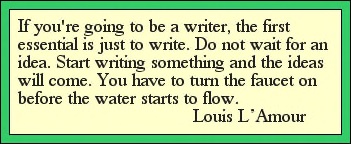
To revise or not to revise, that is the question. Actually, the question is how much to revise.

There are legendary writers who write rapidly, never revise, and turn out books like Hershey’s turns out chocolate bars. I recently read a third hand account of a writer who churned out a (very bad) science fiction novel over a long weekend. It was published, although probably it should not have been.

And then there’s Walt Whitman who was still changing parts of Leaves of Grass long after it was published. I guess I must be in the latter camp, since I’ve written three paragraphs of this post so far, and I have already changed three dozen words.

All this makes me remember the words of Luther Perkins, guitarist for Johnny Cash. He was famous for playing essentially the same riff on every song, and it always sounded great. Other guitarist were flying all over the fretboard at blinding speed, and being as quickly forgotten. Perkins said, “They’re looking for it. I’ve found it.”

I guess once you’ve found it, it gets easier. After four decades, I’m still searching. And rewriting. And revising, And polishing. It’s actually very soothing, but it is slow.

Louis L’Amour found it relatively early in his career. I became something of an expert on him during the seventies and eighties by reading and rereading his novels while taking breaks from my own writing. As a young writer, I could write a few paragraphs or even a half page, then I had to look at the ceiling for a while, waiting for the next thought to come.

Take heart, new writers; after four decades, things come a lot faster.

There were times, lots of times, when I had to do something to get my conscious mind off what I was writing so my subconscious could do its work. And not science fiction or fantasy; that is what I was trying to get away from. I needed something soothing and predictable, but written with a professional touch.

That’s a definition of the works of Louis L’Amour.

If my taste for L’Amour seems out of character for a science fiction and fantasy writer, remember I grew up on an Oklahoma farm in the fifties when every hero on TV rode a horse. I worked cattle every day, myself — but they were dairy cows and I was on foot. Everybody wore Stetsons and cowboy boots, and every farmer out on his John Deere tractor was a cowboy on a horse in his secret heart.

Go listen to some country western music; you’ll get the idea.

A single word description of L’Amour’s westerns would be consistent. A few were weak, a few were superb, most were strong examples of a type. His excellence was within a limited canvas. His historicals were weak and his one fantasy was a total dog.

Over a couple of decades, I read all his novels multiple times while waiting to find out what I was going to say next. (Except for The Haunted Mesa (1987); I could never get through that one a second time.) The same characteristic phrases appear at frequent intervals.

If you have written a long chunk of text, novel or not, finished or not, try this test. Choose a phrase that seems characteristic of you. Use the find function. If that phrase shows up fifty-seven times, you might want to think about that.

L’Amour’s moral and political positions are simple, firm, and unvarying — much like Heinlein, actually. An unsympathetic critic would say he wrote the same book fifty times. I think that pushes criticism of consistency too far. It would be better to say that he had a consistent moral position that channeled him into a certain type of story.

Personally, I tend to see both sides of every argument, whether in life or in my writing. Given a certain fictional situation, L’Amour would solve it in a certain characteristic way. I would see a hundred ways to solve it, and then go searching for solution number one hundred and one. It makes for slow writing.

L’Amour did not revise. I discovered that the first time I read Reilly’s Luck (1970). Early in the book the hero meets Wild Bill Hickok; when they part, L’Amour says that he never saw Hickok again. Forty pages later, Hickok and the hero meet up a second time, and Hickok loans him a gun.

You couldn’t make that kind of an error if you did even the most cursory revising. But that isn’t really surprising, considering how many books L’Amour’ wrote. He knocked them out like a chicken laying eggs. He couldn’t have done that if he had agonized over every book.

The two different styles of writing lead to two different approaches to revising. As writers, I don’t think we get to choose which camp we fall into. It’s a blessing or curse you are just born with.

434. S. L. in Occupation

Last post was about my father in the closing days of WWII. After his wounds had healed, he was returned to his unit, now in occupied Bavaria.

How he felt about the German soldiers he fought, he never did say. In his stories, he never shot them — just scared them a bit. Somewhere along the line he had ditched his M1 Garand for a Thompson sub-machine gun with a broken stock. He carried it (he said) one handed by the pistol grip; in combat he pulled the trigger and recoil sent the muzzle swinging up and to the left, with a spray of bullets that sent the enemy sprinting for cover.

It was a good, clean story for the wife and kid, but once he almost slipped in the middle of telling it. Comfort and humor almost got swamped by blood and truth. He changed the subject. There is no doubt in my mind that, like a million other WWII veterans, he only told what his audience could bear to hear.

His feelings about German civilians were quite clear; these were his kind of people. Bavaria was a long way from the seats of power, and these were farmers and poor shopkeepers. He hated Nazis, and German generals, and politicians, but he liked the local people and they liked him. So did their daughters.

My father was handsome young man, full of life, full of fun, and he had money. The young German men were gone. They had gone to war and were now dead or in Allied POW camps. The German civilians were hungry. As I read between the lines of his stories, my father kept several families fed, in exactly the same way my grandfather kept several families of out of work townsmen fed with produce from his farm during the depression.

My father’s feelings for his Bavarian Germans were conditioned by his childhood. These were working people, like his own family and friends, and like the German settlers that lived around Owasso, Oklahoma where he was raised.

He fell in love with a German girl and they planned marriage, but he discovered that to marry her, he would have to reenlist and remain in Germany two more years. He was a homesick farm boy, ready to feel the Oklahoma dirt beneath his feet again, so he left his German girlfriend and came home. A year later he married. A year after that, I was born.

433. S. L. Goes to War

I served but did not see combat. The Syd Logsdon in this title is my father.

World War Two was a presence in our home when I was young. My dad served, was wounded, and returned. It was the biggest and most concentrated experience of his life.

My dad was a storyteller, but all his war stores were humorous tales of incidents along the way, or descriptions of enduring exhaustion and cold, or brief, dry, cool descriptions of the techniques used to clear a town or take a pillbox. He went through some of the worst fighting in the war, but his stories were essentially bloodless.

These were not the kind of gung-ho stories that would lead to hero worship. He didn’t consider himself a hero, anyway. He was just one of millions who went where he was sent and did what he was given to do; that was enough.

I can see him in memory, telling his stories. Even as a child, I could see the pain in his face. He had to tell the stories — he couldn’t keep them in — but he kept the horrors shut up behind his eyes. I don’t know how much he told my mother when they were alone, but I do know how often her nights were disrupted by the terrors that came to my father in his dreams. PTSD they would call it now. Then, it was just the way men were, when they came back from war.

He joined the First Infantry Division as a replacement after D-day and fought his way across northern France. His view was a soldier’s view — a road here, a village there, this particular house, that particular pillbox. I don’t think he ever had a global picture of where he was. He left combat in an ambulance before the assault on the Rhine. He always said that wound kept him alive. He had an almost superstitious belief that he would have died on the Rhine.

He was there for the entire Battle of the Bulge. Roughly two hundred thousand American and German troops died in a small corner of the Ardennes forest. You can see windrows of the dead, in history books, in grainy black and white photographs. He never talked about that, although he was eloquent about the cold and the exhaustion.

The wound that sent him out of combat came under incongruous circumstances. After the Battle of the Bulge was over, his group had captured a stash of German weapons. The lieutenant in charge wanted to try them, so he, my father, and some other privates took a panzerfaust — a German antitank weapon — out to an open field. My father put it on his shoulder and pulled the trigger.

My father always speculated that some Jewish prisoner in a munitions factory had sabotaged the weapon, in hopes of taking out a German soldier. No one will ever know. The weapon exploded an inch from his head, and he spent the remaining months of the war in a hospital in Paris. more tomorrow

432. The Making of a Navyman

I am writing a steampunk novel called The Cost of Empire. Here is a quote:

        He was a patriot. Unit A should have seen that. Patriots are not to be trusted; they act by their own lights, and they don’t always follow orders.
        Too bad for Unit A. Too bad for Daniel.

Actually, I’ve said that before, a year and a half ago. Here is a repost:

====================

The military has no use for patriots, because patriots think for themselves. In combat, a soldier who shouts, “We must not do this,” is likely to get himself and his teammates killed. He has to go on, following orders.

So how do we turn patriots into yes-men? Boot camp. That’s what it’s there for.

Boot camp is not seen as something important, or morally debilitating. And, I suppose, compared the things that happen later in the field, it isn’t that important. But . . . without boot camp to turn patriots into soldiers, those later events could never happen.

This isn’t about me. I went through boot camp in neutral mode, observing, remembering, and trying not to feel. I wan’t always successful, but I was successful enough to survive intact. I was changed, of course, but by my own experiences, not by pre-programmed manipulations.

This also isn’t about the eighteen year old children who made up most of the recruits, who were eager to follow the path their elders had set, and ready to go over and kick some commie ass. (It was 1971) This is about one young man, and those he represents. He came into boot camp a patriot, ready to serve his country, full of love and compassion, but ready to do his duty. They broke him. I can still see him standing in the barracks before lights out, talking to his friends, saying, “This isn’t right. I joined up to fight for my country. Why are they treating us like this?” His friends laughed at him and told him that this was nothing, it was just getting him ready for what was to come.

It wasn’t nothing, but it was getting ready for his life to come. That was the point.

I never talked to him. There was nothing I could say. He was learning in front of my eyes what I had learned years before, at other hands, under other circumstances. But I never forgot him.

Boot camp is what in Anthropology we call a liminal experience, one that tears down an old identity in order to build a new one. The folks at boot camp are really good at this, even in mild boot camps like the one I experienced at the San Diego Naval Training Center. We could see the real thing across the fence at the Marine boot camp, and we thanked God every day that we weren’t Marines. While I was there, a Marine recruit who could no longer take the daily abuse, ran off and stowed away on a jet liner at the civilian airport just over the fence. Hours later the jet landed at his home town on the east coast and he fell out of the wheel well, frozen, asphyxiated, and dead. The Marines said good riddance. We worms (as Navy recruits are called) laughed. Learning to laugh at the death of others is part of the boot camp experience.

It was all choreographed indignation, play-acting inflicted onto a captive audience. They said that if we didn’t keep our barracks clean enough or our socks rolled tightly enough, the Trouble Shooters would come.

“You worms have been given socks to roll! That’s all we trust you with now! How can we trust you with nuclear bombs once you’re on an aircraft carrier if you can’t roll socks now!”  Every word was delivered at a shout.

Of course, the Trouble Shooters came. They always do. They came in the night, screaming in manufactured rage and tearing the barracks apart while we stood at attention in our shorts at the foot of each bed.

Near-naked, helpless, frightened into immobility, knowing that the only way to survive was to  let the insanity happen. Civilian identities dying; new, military identities growing.

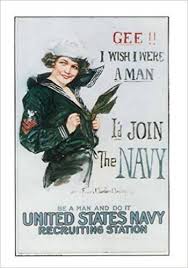
The making of a Navyman. You could put it on a poster.

431. The Other Veterans

This is an update of a post I wrote for Veteran’s Day 2015. Not many were reading yet, so I could simply repost, but a lot of things have changed since then. The new writing is indented.

I am an American; I vote. During my nearly thirty year career as a school teacher, I always went to the polls early and wore my ”I have voted, have you?” sticker throughout the day. Children would ask me, “Who did you vote for?” I never told them. Sometimes they would ask me, “Are you a Democrat or a Republican?” I never told them.

Teachers have a responsibility to be involved and have political opinions, because they are citizens. But they also have a responsibility to avoid shoving those opinions down the throats of their captive audience.

You are not a captive audience. You get both barrels.

I am one of the other veterans, the ones who went, did their job, and moved on. I don’t march in parades. I love America, but I still have a love/hate relationship with the flag. It stands for aspirations toward universal freedom, and when I think of it like that, I love it. But it also stands for the darkest of horrors.

For twenty-seven years, I had to endure the flag salute five days a week in my classroom. Understand, there were days when I said it with my whole heart. There were also days when I could only remember the dead on both sides in that useless war in Viet Nam; on those days, I said the words through clenched teeth.

But I said them. I could have refused. I might have been fired, or I might have won my case on first amendment grounds. Either way, the children I was there to teach would have had their education disrupted. It was my problem, not theirs, so I gritted my teeth and said the words.

Even the words “under God”, notwithstanding that I stopped believing in God when I was fifteen. But every time I said them, I thought of the children who have to pray five times a day facing Mecca.

NFL players, I get it. I support your right to protest. I agree that the situation you are protesting is unacceptable. Nevertheless, I think you are making a mistake. The people who see you kneeling can’t get past the flag. You are alienating the people you need to convince.

My draft number was 41.

Heinlein said slavery is not made more appealing by calling it Selective Service. I agree, mostly; however conscription levels the field. Without conscription, the white and the rich would not have protested so loudly as they (we) did, and the Viet Nam war would have gone on much longer.

When I got to boot camp, I was surrounded by whites, blacks and variations. There were only two who stood out — me, and one other guy. I was 24, mature, married, and with enough life experience to resist brainwashing. The others were all malleable, except for one recruit. I’ll tell you his story on Monday.

During my last year in college I signed up for a term in the Peace Corps. Then Nixon did away with the Peace Corps deferment. The Marines were drafting, so I joined the Navy.

I wasn’t trying to avoid death; I was young enough to foolishly assume I wouldn’t get killed. I just didn’t want to shoot anyone who was defending his homeland.

Four years later I was a civilian again, the Viet Nam war was over, and the general opinion had shifted. Most Americans had come to believe that the war was a mistake.

Thirty years later Bush Two sent troops in to find weapons of mass destruction that never existed, as if we had learned nothing.

I am a veteran; I believe in defending my country against real enemies. But I’m also a retired teacher. When I see starry eyed children who can’t wait for their chance to plunge into battle –- well, pardon my lack of enthusiasm.

There will be three more veterans’ posts next week.

430. The Rocket’s Red Glare

from Congreve’s original work.

“Oh, say can you see . . .”

No, this is not going to be about the NFL. It’s going to be about the rockets which figure into the anthem, into history, and into the steampunk novel The Cost of Empire, which I am now writing.

Rockets got their start in China, where they were used as fireworks and as military weapons. Just keep that in the back of your mind. We are going to start in the present and move backward in time, but not all the way to China.

When the average American sings the Star Spangled Banner — or mouths it, since it is a hard song to sing — it is unlikely that the image in his mind looks anything like the rockets which actually burst in air over Fort McHenry. My generation has V-2 rockets in our DNA, largely because early SF films used actual films of V-2 rockets as stand-ins before special effects were perfected. A later generation has Saturn-V rockets imprinted on their brain. To both, rockets are pointy ended cylinders with the flames coming out of the bottom.

Not so in 1814. The rockets that rained down on Fort McHenry looked more like fireworks rockets. They were called Congreves and a page of drawings of them is given at the top of the post. Some were explosive tipped. Some were parachute flares, which “gave proof through the night that our flag was still there.” All were guided, more or less, by a long stick that acted like a rudder, similar in function to the fins on a V-2.

They were nothing like accurate. That was the way of things before modern times. If you recall the battle of Agincourt in the movie version of Henry V, the English longbow men drew back together and fired hundreds of arrows simultaneously at a high trajectory, which rained down en masse on the French. The battle of Hastings was lost when King Harold Godwinson looked up at a bad moment and caught such an incoming arrow in the eye. Muskets in that era were also nothing like accurate, so lines of musket men firing together in the same direction managed to hit somebody, but probably not the targets they were aiming at.

William Congreve (not the playwrite and poet) gets credit and naming rights for the Congreve rocket, and he did make improvements, but his work was based on rockets captured in India.  Which brings me to why I’m writing this post. Here is a quote from The Cost of Empire. An Englishman who has gone native in India is speaking:

“About a hundred years ago this whole region was called Mysore and Hyder Ali was in charge. He fought the British and all the Indian princes around that kept shifting from the British side to his and back again. After he was killed, his son Tipu Sultan took over and formed an alliance with the French.

“It’s an old story. The same pattern happened all over India, as we British took over one region at a time. But this story has a kicker. Rockets.

“Rockets came from China. Everybody knows that, but they were widely used in India as well. Hyder Ali and Tipu Sultan used them extensively; some of their rocket brigades had over a thousand men. Rockets were made that exploded, that set fires, and even that had sword blades attached so when they came down spinning, they made a bloody mess of British ground troops.

“When the Mysore wars were over, the winners sent hundreds of captured rockets back to England. Congreve studied them and replicated them. The Congreve rockets we used all throughout the Napoleonic wars were just English versions of what Hyder Ali had used against us.”

The old guy is telling this story because a group calling themselves the Sons of Hyder Ali have built an arsenal full of rockets. They have bad feelings toward the British and a plan concerning the flotilla of dirigibles our hero is serving on.

I would tell you more, but that would be a spoiler.

429. Scales, digital and ridiculous

Ah, the good old days. They really sucked.

Even the phrase sucked falls into that category. I know that most of those who read this will not remember, but there was a time when nobody said sucked. It ranked up there with the “F” word. I remember when it arrived on the scene in my middle school students’ vocabularies, how it was an issue for a short time, and how two years later teachers were saying it. That’s what happens when a perfectly good forbidden word becomes common; it loses its flavor.

============

I have a great respect for Science Olympiad, but I never liked coaching, so I always volunteered to judge events instead. I enjoyed taking on new events that needed to be shepherded through their first year of implementation, and that led me to build a lot of gadgets to use in judging the contestants’ gadgets.

The people who think up new events in Science Olympiad often show an Olympian detachment (pun intended) from reality. Case in point — and forgive me if my numbers are off, I’m writing from memory — in two events students had to build light structures and test them to destruction. First it was a bridge, and a few years later, a tower. The lightest bridge or tower that held the most weight before failing won the event. There was a formula for weight vs. load, and specifications for what constituted failure.

The students applied the weight by pouring sand into a suspended bucket and there was a set maximum. If the structure held the maximum, the lightest structure won. If the structure failed, the weight vs. load formula was invoked. All in all, it was a well thought out event.

Except for one thing. The load was in pounds — up to ten, as I remember — and the weight of the structure was in grams. Let’s do the conversion.

1 pound equals 16 ounces
1 ounce equals 28.35 grams
Therefore, 10 pounds equals 4536 grams
And 9 pounds equals 4082.4 grams
That is a difference of 453.6 grams

Did I lose you? Just look at the cartoon at the top for a moment, regain your equilibrium, and come back to me. There is no final exam on this. This is just memoir about how much fun teaching science can be on a small budget.

To measure mass in grams, you could use a triple beam balance available in any science class. To measure ten pounds, you have your bathroom scale. But wait a minute, that ten pound maximum-weight bucket of sand has to be measured in grams! How do you do that?

You do it with levers, using the gizmo pictured at the top of the page. I actually built it, and used it all the years I was associated with that event. The lever makes the scale read about 160 pounds when there are 10 pounds in the bucket. That spreads out the difference between two similar weights. The box the adult is staring at is my old Mac SE, with a preprogrammed formula in a database. The formula is:

Scale reading in pounds after the sand has been added (times) conversion factor to grams (minus) weight of bucket in grams ——- all this fed into the formula for comparing load in grams to weight of the bridge or tower in grams, a formula provided by Science Olympiad.

At the event, all I had to do was watch the contestant, and stop her/him at the moment the structure failed. He/she was only given ten pounds of sand to work with, so overfilling could not happen. I typed in the reading from the bathroom scale and the computer gave me the score — after I had built and tested the device, programmed the database, and provided ten pounds of sand, calculated to the nearest gram on the same device.

Fun? Of course it was fun. I volunteered to do this, remember?

Was it accurate? No and yes. No, there was too much friction for the gram readings to be accurate, but the friction was the same for every trial, so yes, the ranking of the contestants was completely reliable.

About three years after Science Olympiad retired the event, digital scales which would measure that much sand to the nearest gram became available for under five bucks at every-guy’s-public-man-cave, Harbor Freight. Thank goodness it didn’t come earlier and ruin my fun.

428. Ve Speak Goot English

This is from today’s post in Serial:

(Language), Neil knew, was a real problem for those families who went back and forth between Mexico and the United States. The brightest children leaned to speak, read, and write English, but they were illiterate in Spanish. They could speak the lower class Spanish used in their homes, but they usually could not read or write it. Worse, their dialect was no more suitable for a good Mexican school than an American hillbilly dialect would have been suitable for a high school in Boston.

Fiction has its place. It can make us think and care, but plain old non-fiction can sometimes get things across more quickly. To wit:

We are a nation of immigrants. Everyone knows that.

Spanish is an immigrant language. Yep. Everyone knows that, too. However, so is English. If we we spoke a language that isn’t an immigrant language, we would all be speaking Cherokee, or one of several hundred other native tongues. Aztec, anyone?

English got here first. No, actually it didn’t. Of European languages, Old Norse got here first with the Vikings, but it didn’t last. Spanish got here second. English, French, Portuguese, German, Swedish — the list could get tedious if we let it — are all late comers.

English won.

Now we are zeroing in on the truth. The French gave up the right to provide the language of choice for about half of the USA when Napoleon sold Jefferson the Louisiana Purchase. Spanish lost out as the language of choice in Florida, Texas, New Mexico, Utah, Nevada, Arizona, part of Colorado and Louisiana, tiny corners of Wyoming, Mississippi, Alabama, Kansas, and Oklahoma, and all of California at the point of a gun. Or, a bunch of guns. That’s roughly a third of the lower forty-eight.

Like it or not, it happened, and it is irreversible. English is the language of the US, despite the innumerable other languages spoken by our immigrants. They came here, procreated, the original speakers died, and their offspring now speak English.

So why are the Spanish speakers different? It is certainly not because of anything wrong with them. It’s quite simple. When Germans immigrated, they didn’t go back. Modern immigrant Spanish speakers, primarily Mexican, documented or undocumented, go back and forth.

Migrant labor is typically seasonal. Besides, wouldn’t you rather spend winter in Mazatlan than Minnesota if you could? Hordes of Anglos do it, and they don’t even speak the language.

Not all people of Spanish background move back and forth. Many of them came to the US and stayed. Tens of thousands of them were already here to greet the Anglo pioneers when they arrived. See map above! Millions of them don’t speak any Spanish, just as Nils Hansen of Kenosha, Wisconsin (hypothetical person) doesn’t speak Danish. There is a word for these people — Americans — and they don’t pose any language problem in the schools.

Those who do go back and forth are not going to stop doing so. It works for them. Summer labor in the US, then back to Mexico for its mild winters and lower costs is not just logical, it’s capitalism. It’s entrepreneurship. It’s survival for the Mexican families and cheap food for you. Drive by any field in California at harvest time and count the Anglos bending their backs in the sun. Your total will be zero.

A wall won’t change it. A path to citizenship won’t change it, either. The idea of a hermetically sealed border is a Trumpean delusion.

So where does that leave the children of migrants? In a tough spot, to be sure. They often don’t spend the whole school year in schools in America, and they often don’t enroll while they are in Mexico. Many don’t learn to speak, read, and write English as well as their Anglo or permanent Mexican American classmates. Some barely speak, read, or write English at all. They speak Spanish, but they often don’t read or write it.

Solutions? That would take a shelf of books, not a post.