Category Archives: A Writing Life

Blatant Commercialism

Greetings, new friends.

Recently, a number of new people have found their way to my website, and I am glad to see you. All my old friends have already heard this.

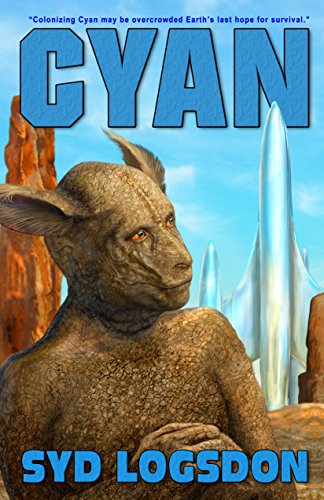
I began this website two years ago, shortly after finding out that my novel Cyan had been picked up by EDGE publishers of Canada. The original idea was to make myself and my writing known in order to find new readers for my novel. The website has grown well beyond that since.

Cyan came out in April as an ebook, and later became available in paperback as well. If you just found this website, you missed all the build up.

Cyan is a realistic, near-future science fiction novel about the exploration and colonization of a planet around a nearby star. With complications, of course.

If you click here, it will take you to the Amazon page where you can read reviews, see the blurb, and even use the Look Inside function to read a chapter or two. You can also click and buy.

If you do buy and like what you read, please take time to write a review. That way publishers will buy my next book. And then so can you.

End of commercial. Thanks for listening. SL

408. Behind the Curtain

Most of the time, I assume that the people who read this are writers or would-be writers. I also know that most of you are bloggers, but I don’t get the idea that you are blog nerds.

Before I started this blog, I did a lot of research and started studying HTML and CSS. Then I discovered WordPress and found out that I could blog without learning them. I already spend more hours than I can afford just writing, so I was happy to let WordPress take care of what’s going on under the hood.

I get the very strong impression that most of you have made the same decision.

My Dashboard tells me that I have made 799 posts in the two years I have been blogging. If it weren’t for WordPress that would never have happened. Still I find myself frustrated when I can’t do everything I want, or when my results aren’t all I would like, so I am going to a WordPress convention in about a week to see what else I can learn.

Meanwhile, a week ago I screwed up. I had to drop in an extra post titled OOPS because post #406 was eaten by the machine. We always say that, but it’s always our fault. In this case, it reminded me that I do something I have not seen any other blog do — I run twin, independent blogs on one site. That’s where the screwup occurred and it reminded me that some of you might want to know how to run multiple blogs.

So it’s nerd time. Minimally.

It is typical for blogs to appear on a website’s home page. That’s the first thing that usually comes up and it works fine. If you want two separate blogs, you have to put them elsewhere. This requires you to do two things.

First, change your home page to a front page. Go to manage site pages and use page templates under page attributes. Afterward, whatever is on your front page remains unchanged, no matter what posts you write. If you go to the top of the page you are now reading and click on Welcome to my Worlds you will see my front page. It pops up whenever you come in via sydlogsdon.com,  but if you get to me by another route, you may never have seen it. This page has only changed two or three times in the last year, when I felt a change was necessary.

Second, you need to set up a category and category page for each blog. Uncategorized already exists and is the default. If you look down on the right column of this page, you will find CATEGORIES and under that, A Writing Life, Into the Storm, Serial, and uncategorized.

Into the Storm is simply a relic from when I was learning, which I never bothered to remove. Ignore it.

A Writing Life is the name of the blog you are reading. It also appears in the menu across the top of the page. Serial is my other blog, also in the menu at the top. If you have never explored Serial, click there now and it will take you to today’s post on that blog, which happens to be Symphony 2.

Every time I write a post I have to choose a category — either A Writing Life or Serial — so the computer will know where to put it. If I don’t make a choice, the computer puts it into uncategorized. That is what happened to post #406. My dashboard said it had been published, but it didn’t show up where it belonged. The computer didn’t know where to put it, so it didn’t put it anywhere. Hence, the extra post called OOPS.

As I said, I am as little nerdy as possible on WordPress because computers will eat up your life if you let them. If you want to know more about all this, go where I went two years ago, https://dailypost.wordpress.com/2015/05/07/using-category-pages-to-organize-content/. You can use Further Reading on the upper left side of that page to backtrack to category and to creating category pages.

Most people don’t do any of this. Then the software places their posts into uncategorized and puts them on their homepage.

That’s all I remember from when I set things up two years ago. If you know more, or want to comment, make a reply.

407. Where Life Is

This is a repost from very early in the history of this blog.  SL

I was in the shower getting ready for a day at school when my wife called to me. A plane had hit the World Trade Center. By the time I dried and dressed, the second plane had hit.

Twenty minutes later, driving to work, I listened to the radio as the towers fell.

All day long I taught science, keeping to the lesson plan. I didn’t want to teach, and no one wanted to listen, but it was necessary to keep a semblance of normalcy. Every break we teachers watched the television, but we didn’t take any news back to the classroom. Our students needed to be in their own homes, with their parents, before they began to deal with the details of America’s disaster.

At the end of the day, I drove home. I had upon me the need to write, but not of the tragedy. Others wrote that day of what had happened, and wrote well. I needed to write of love and joy and beauty – and of my wife who is all those things to me.

Poems come slowly to me; usually they take years to complete. This one rolled freely about in my head as I drove, and when I arrived at home, I only had to write it down.

                    There Am I

Where there is water, there am I.
In sweet, soft rain and in hard rain,
driving and howling,
or filling the air with luminescent mist.
Water is life, and there am I.

Where there is sun, there am I.
In the soft heat of morning or in the harsh afternoon,
or heavy with moisture, forcing its way through clouds,
or dry as a lizard’s back.
Where the Sun is, is life, and there am I.

Where Earth is, there am I.
Whether dark loam, freshly plowed
or webbed with fissures, hard as stone,
or sandy, or soft as moss.
Where Earth is, is life, and there am I.

Where life is, there am I.
rainforest or desert,
broad plains of grass, or brooding jungle,
Where life is, there am I.

Where She is, there is life,
and sun and rain and earth, and all good things.
Where She is, is life,
And there am I.

The “I” was supposed to be me, of course, speaking of my own love for wilderness, and “She” was, of course, my wife.

However, when it was done it felt more like a religious poem. Strike the last verse, let the “I” be God and it sounds like something written by someone with a great deal more faith than I have. Odd.

OOPS

I goofed. I won’t give the details, but post # 406 was lost, temporarily, in the innards of my website. If you follow regularly, and saw Into the Storm 2, then went away, look just below this and find the post that was scheduled for two hours ago. Sorry. SL

406. Arthur C. Clarke Invents the Modern World

If you hang a satellite over the equator, 22,300 miles up, it will appear to remain stationary. Everybody knows that, or should, since global communications is based on the fact. A generation ago, everyone in the science fiction world also knew that this cornerstone of modern society was “invented” or discovered by Arthur C. Clarke.

I’m not sure that Clarke is still generally remembered for this. The origins of everyday things tend to be forgotten.

Clarke’s observation first appeared  February 1945, in a letter written to the periodical Wireless World.

When Wireless World began in 1913, wireless had a completely different meaning than it has today. It referred to wireless telegraphy, invented by Marconi, which used radio waves, interrupted by a telegraph key, to send messages. That allowed ships at sea to send and receive messages.

Wireless World remained on the cutting edge of electronic technology. so it was the right place for Clarke to write his February 1945 letter, which included these words:

An “artificial satellite” at the correct distance from the earth would make one revolution every 24 hours; i.e, it would remain stationary above the same spot . . . Three repeater stations, 120 degrees apart in the correct orbit, could give . . . coverage to the entire planet.

In October of that same year, Clarke was back in print in Wireless World with his article Extra-Terrestrial Relays, in which he fleshed out his idea.


Fig 3. Three satellite stations would ensure complete coverage of the globe.
Illustration from the 1945 Wireless World article.

Clarke discussed the difficulties of early radio and television transmission. Radio, particularly the lower frequency AM radios in use then, were erratic. Sometimes they only carried a short distance from the transmitter; at other times, they would bounce off the ionosphere and travel for a thousand miles. Television signals, being higher frequency, did not bounce off the ionosphere and so were limited to line of sight.

Relaying through orbital repeaters was the answer to both range and reliability. An orbit of 42,000 kilometers above the center of the Earth would provide a geosynchronous station.

The figure given at the top of this post –23,300 miles — appeared in every early popularization of space travel. It is not only a switch to miles, but also that distance is above the surface of the Earth, not the center.

To power his satellite, Clarke suggests mirrors concentrating the sun’s rays to heat water in boilers for turbines to run generators. He also suggests that “photoelectric developments may make it possible to utilize the solar energy more directly”. That is exactly what happened; only thirteen years later, Vanguard became the first satellite to use solar cells.

Clarke then went on to specify what kind of rockets would be needed to place these geosynchronous satellites into orbit and predicted, correctly, that such rockets would soon be available.

He also said:

The advent of atomic power has at one bound brought space travel half a century nearer. It seems unlikely that we will have to wait as much as twenty years (i.e. 1965) before atomic-powered rockets could reach even the remoter planets with a fantastically small fuel/mass ration — only  a few per cent. The equations developed in the appendix still hold, but v(elocity) will be increased by a factor of about — a thousand.

Oh, if he had only been right about that, too. Then our world might come closer to resembling the world envisioned by Harold Goodwin in his Rip Foster novel.

405. Blondel’s Future

You really should go to Serial and finish Blondel of Arden before you read this post.

#                    #                    #

I enjoyed writing Blondel of Arden. I like formal language, and I don’t get to use it often. I also rarely get the chance to write something completely light.

Blondel was pure fun, with every possible cliché in place. Quite sexist, actually. Somewhat like John Wayne and Maureen O’Hara in McClintock or in The Quiet Man. She gives him hell in both movies, and he paddles her at the end. (Pun unintended, but noted.) That is actually more than I can tolerate and I usually turn the TV off somewhere short of the end.

I understand the bondage symbolism in this kind of fiction. The climax of McClintock when O’Hara is running from her husband with all the town cheering him on is too much like a rape scene with spectators for my taste. I stopped well short of that in Blondel of Arden.

Blondel is a cynic, Grat is an innocent, and Sylvia is a twit. That’s thin characterization, but adequate for a short semi-comic piece. I enjoyed this brief encounter with more-or-less cardboard characters.

However, I’m a sucker for people, even people on paper. I thought Sylvia had some quality hidden beneath her flirtatious exterior. I liked her. I thought she had potential.

You have to understand that I wrote this many years ago. I thought of turning it into a novel, but I never will. I have four or five novels waiting in the wings now, and by the time I finish them, I’ll have a half-dozen more tugging at my sleeve.

But when I was considering a novel, this is what I had in mind —

#                    #                    #

Sylvia returns home, sans broach, to a pointless round of “women stuff”. She hates it. She misses the one great adventure of her life. She also reviews he own behavior, and finds it wanting. Grat and Blondel served her well and she served them with contempt. She broods about her behavior, and works to make herself better in her everyday round.

This is not enough. She owes a debt. (See, I told you she had quality.) If she can’t pay it, she can at least acknowledge it.

Something – I don’t know what – happens which frees her from her obligations at home. She sets out to find Blondel and Grat, to do something for them if she can, or at least to say thank you and I’m sorry I was such a twit.

Blondel and Grat have become companions. Grat is beginning to lose his innocence. Blondel fears that it is from associating too closely with him. Grat is also lovesick; Sylvia was his first romance and he can’t forget her. Blondel finds this alternatively endearing and irritating.

Blondel’s crust is thinning, and that is dangerous. He is a smart, little guy in a world of ignorant, thundering clods. His ability to “do unto them” quietly and unnoticed is his only defense. Every time he does something self-serving – which is basically how he survives – Grat looks on, once again disappointed in his friend.

Sylvia eventually finds them and joins them. Nobody is really happy with the arrangement. Any pair of the three could find a way to coexist, but the three-way relationship cuts too close to each of their hidden weaknesses.

Each person finds him/herself in peril and escapes that peril only through the aid of the other two. Grat and Sylvia grow in romantic love, while Grat has to wrestle with the understanding that Sylvia is no longer a damsel in distress. Blondel, to his external disgust and his disguised satisfaction, find himself in an avuncular relationship with these two innocents.

What perils? How do they overcome them? Beats me. Writing peril and escape are the easiest parts of writing a novel. They will present themselves as needed, if you know your characters and where they are going to end up.

I was also planning to use this as an excuse to build a story around a fantasy version of the Field of the Cloth of Gold, a real event in 1520 when Henry VIII of England and Francis I of France held an extravagant series of jousts in the fading days of classical knighthood. Think kings in golden plate armor whacking each other for sport and bragging rights, in a world where cannon balls could blow fist sized holes through either of them if the battle were real.

This gives us three real and relatable people trying to survive on the fringes of empty magnificence. Now the kings are cardboard — which is their normal state of being.

I don’t have time to take six months to write this novel, but I would love to spend two days reading it.

404. Various Anniversaries

I was really busy two years ago, and forty-two years ago.

On September 2, 1975 – the day after Labor Day that year – I sat down to see if I could write a novel. By Christmas, the first iteration of Spirit Deer was a reality, and I had become a writer.

Two years ago, six months after learning that Cyan had been accepted for publication, after several months of learning about blogging, after learning how to use Word Press, after pre-writing a few dozen posts — on August 29, 2015 I posted the first introduction to A Writing Life and Serial.

I seems like yesterday, and also like a lifetime ago.

403. Steampunk Dirigibles

Warning: this post gets nerdy.

If it has dirigibles, it’s steampunk. No, that doesn’t quite work.

If it doesn’t have dirigibles, it isn’t steampunk. No, that doesn’t work, either.

If it is steampunk, then chances are, there’s a dirigible in it somewhere. OK, now there’s a pronouncement I feel comfortable with. Even Brisco County, Jr. had a dirigible eventually.

The variety of airships (a more generic term) in steampunk is huge, especially if you look at the vast number of illustrations on line. The Aurora in Oppel’s Airborn is entirely realistic. The Predator in Butcher’s Aeronaut’s Windlass if essentially an air-floating wooden sailing ship. Some are essentially floating cities. Some run on diesels. Some run on magic, or crystal power.

Back here on Earth, everybody knows at least one dirigible, the Hindenburg, just like everybody knows at least one steam ship, the Titanic, and for essentially the same reasons. Beyond that, real knowledge of actual airships is spotty.

It might be helpful, before embracing the infinite variety of steampunk airships, to have a go at definitions for those which actually existed.

First up, why dirigible instead of Zeppelin? Answer: for the same reason that we use the word automobile instead of calling all automobiles, Fords. Ferdinand von Zeppelin meant more to the development of dirigibles than Henry Ford did to the development of autos, so if you want to say Zeppelin instead of dirigible, I won’t argue with you. After all, I used to say, “Gimme a Coke,” when I really wanted a Pepsi.

However, in the world of my upcoming steampunk novel, you wouldn’t dare say Zeppelin. It would be unpatriotic. A Brit with more ambition than morals stole Zeppelin’s plans, sabotaged his work, and built a British fleet of airships before the German war, while Zeppelin’s war efforts came to nothing. The result was a sweeping British victory, an overwhelmingly powerful Britain, and a very interesting world to write about. But no one calls dirigibles Zeppelins.

In our (real) world, airships are often divided into three classes, blimps, semi-rigids, and dirigibles. Blimps are bags of lifting gas which hold their shape entirely due to internal pressure. Pull the plug, and they collapse. Semi-rigids have a keel structure which helps to keep them from distorting due to localized weights, such as engines, but they still don’t have a solid skin. Dirigibles have a skeleton and a skin, and individual gas bags for the lifting gas. Dirigibles are sometimes called rigids; that is the most accurate term, but it is rarely used.

You will find this three part division in dozens of books on airships, and it fits pretty well. But the word dirigible was used far earlier, and at that time it meant “capable of self-movement and control”. There were dirigible torpedoes in the water, long before Zeppelin put dirigible airships into the air.

Which drags us back to another recycling of an old word — torpedo. During the American Civil War there were two types of torpedoes, stationary and spar. A stationary torpedo was a mine. When Admiral Farragut sailed into Mobile Bay, shouting, “Damn the torpedoes, full speed ahead,” that would translate into modern English as, “Damn the mines, full speed ahead.” A spar torpedo, on the other hand, was an explosive device attached to a long wooden pole and rammed into an enemy ship by a steam boat, often sinking both. Neither kind of torpedo had self propulsion or self steering.

Torpedoes with that capability were initially called dirigible torpedoes. The adjective dirigible was later dropped. E. E. Smith, in Triplanetary, recycled that old term for use in galactic warfare:

In furious haste the Secret Service men had been altering the controls of the radio-dirigible torpedoes, so that they would respond to ultra-wave control; and, few in number though they were, each was highly effective.

The original hot air balloons were (and still are) unable to steer or move on their own. The quest for dirigibilty (controlled self- movement) led to blimps, semi-rigids, and “dirigibles”.

So, there is plenty of confusion even before we get to the use of airships in steampunk. Call them dirigibles, if you want. Call them Zeppelins, if you want. I don’t see how anyone has a right to complain about your choice.

402. Nuclear Spacecraft

I taught middle school science for twenty-seven years, and always, whether I was supposed to or not, I taught the space program.

I grew up with space travel, first in fiction, then in fact. I loved it, and the kids I taught loved it, too. How much of that rubbed off from me, I’ll never know.

By the time I started teaching, the big show was over. When Gene Cernan stepped back into his LEM in 1972, it was the high water mark of manned space exploration. It’s been downhill since.

In the classic science fiction novel I had planned to serialize, Rip Foster is heading out toward the asteroid belt on the nuclear powered spacecraft Scorpius. That’s how we all thought the future would look. That’s how the future should have looked. Chemically powered rockets are simply not sufficient for exploring the solar system.

We have have nuclear power plants for electricity, nuclear submarines, nuclear aircraft carriers, even a nuclear cargo ship. Why not nuclear spacecraft? Weight? Do you really think we couldn’t have overcome that problem? Maybe it was the danger, but . . .

Here is a quiz for you. How many nuclear submarines are lying on the bottom of the ocean, tombs for sailors and ecological time bombs for the rest of us? Two from America and six from Russia. An additional Russian nuclear sub sank twice, but was raised both times.

How many nuclear and thermonuclear bombs have gone missing? The U.S. admits to eight. How many more are hidden under the umbrella of security? Your guess is as good as mine. How many have the Soviet’s lost? You ask them, I’m keeping my head down.

Did I mention Chernobyl and Fukushima?

Let me put it another way. When the Soviets launched Sputnik and initiated the space race, then followed up with a man in orbit before we could even launch a sub-orbital flight, we did an end-around and went to the moon.

If the Soviets had launched a nuclear powered space craft, we would have launched a nuclear powered space craft. Technology would not have stopped us. Fear of radiation would not have stopped us.

That was then, this is now. The best thing for manned space exploration today – though not for American interests or world peace – would be for the Chinese to launch a nuclear powered space craft. It wouldn’t even have to be a good one. Just the threat would be enough, and in a few decades ships like the Scorpius would be filling the solar system.