Category Archives: A Writing Life

342. Dyna-soar

Regular readers will notice that posts are now coming later in the day.

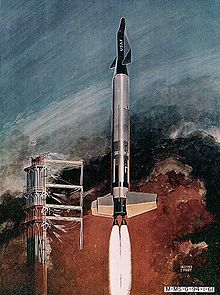
MISS, Man in Space Soonest, was a USAF project to put a man into a capsule and boost him into space on top of a converted ICBM. It was cancelled, resurrected, and passed on to the new organization NASA, where it became Project Mercury.

Times were tense. The Soviets had launched a satellite into orbit in 1957, beating America into space by a few months. They added to the humiliation by beating the US again in 1961, this time with a man in space. Worse than either accomplishment, was they booster that was used. It was far more powerful than anything America had in service, or in development. A booster that powerful presented all kinds of doomsday scenarios.

Eisenhower had plenty of problems at the time. He was using U-2 spy planes to illegally overfly the Soviet Union, and recognized that it was only a matter of time before that blew up in his face — which it did in 1960 when one of the U-2s was shot down while spying. MISS being transferred to NASA made it a civilian project, and less objectionable. The same logic led the Navy originated Project Vanguard to be passed on to NASA, and also to the use of underpowered rockets to launch it because they were not military hardware.

Sputnik and the Soviet manned missions were on top of a military booster, rendering that concern moot.

NASA went on to success in manned space flight, but in the fifties and early sixties, that was not a foregone conclusion. The Air Force moved on to the Dyna-soar.

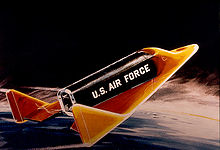
Project Dyna-soar (from the phrase dynamic soaring) had begun in 1957, when it was to be the next step after MISS. It was based on the theories of Eugen Sänger, who had a suborbital bomber on the drawing board for the Germans during WWII.

The basic idea was to send a winged vehicle above the atmosphere on top of a rocket, whether in a sub-orbital flight or returning from orbital flight. That craft would skip repeatedly off the upper atmosphere on returning, dissipating the heat of reentry, and ultimately land as a glider.

This sounds a lot like the Space Shuttle, but there are two main differences. STS was designed as a single stage to orbit vehicle, and it dissipated heat by shock waves while being protected by insulated tiles, much like the Mercury through Apollo missions had used shock waves off ablative heat shields. Dyna-soar was designed to ride into orbit on top of a military rocket and to lose its heat by skipping — that is, by dipping into the atmosphere, then bouncing back into space to radiate away the heat it had built up, followed by repeat, repeat, repeat, until cool enough to finally land as a glider.

That would make for a long, hard, bumpy ride. If you are simply thinking of reentry, it would be a unnecessarily tough way to go. To understand why the skip-glide method was so inviting, you have to project yourself back to dawn of the 1960s when rockets were small and space exploration was new. With skip-glide, a relatively small and not particularly powerful rocket could send the Dyna-soar anywhere on Earth.

When Alan Shepard made his sub-orbital flight, he traveled 116 miles above the Earth but landed only about 300 miles downrange. With that initial altitude, Dyna-soar could probably have circled the Earth before landing.

Dyna-soar was developed as a reconnaissance and bombing vehicle. It was, after all, an Air Force project.

Had it gone to completion, the Dyna-soar (also called the X-20 later in its development) would have been the most sophisticated space craft of its era. Unfortunately, money was scarce, and while in orbit, the Gemini could do anything the Dyna-soar could do.

Gemini was a monumentally successful project (see Gemini) that sucked up all of America’s attention. In December of 1963, the Dyna-soar project was cancelled.

Again, the Air Force had lost out to its civilian counterpart. It didn’t give up. The next time around, the Air Force co-opted the Gemini. That third chapter in the Air Force’s bid for space was told here last November as The Space Station That Never Was. We’ll cover the rest of the story – so far –  tomorrow.

341. Air Force in Space, Almost

Regular readers will note that posts now come later in the day.

See if you can find anything wrong with this sentence:

Throughout 1943, U. S. Air Force  B-17 bombers carried out raids over Germany.

Give up? The place is right, the time is right, the B-17s are right, but the United States Air Force did not exist yet. The service in question was the United States Army Air Force, previously called the United States Army Air Corps. From the beginning of American military aviation, planes flying from ships belonged to the Navy and planes flying from air fields belonged to the Army.

That changed with post-war reorganization. The War Department became the Department of the Army, which then joined the Department of the Navy and the newly created Department of the Air Force to become the Department of Defense.

The Air Force was new and hungry, and it soon found plenty to feed on.

By dropping atomic bombs on Japan, the United States had changed the face of warfare. A bombs, and soon H bombs, became our first line of defense against expected Soviet aggression, and it was the Air Force’s job to deliver them if needed. Within a decade, missiles were ousting planes as the primary means of delivery, and the Air Force became the proprietor of such missiles as the Atlas, Titan, and Minuteman.

But not of all missiles. The United States Army developed the Redstone IRBM which launched the first two American astronauts into space, if not orbit. The Redstone was later succeeded by the Pershing which was a cornerstone of the defense of Europe until the eighties. The Navy developed the Polaris and then the Poseidon submarine launched missiles, which were probably, due to their stealthy deployment, a greater deterrent than the missiles developed by the Air Force.

Meanwhile, the Army continued to maintain some aircraft for support missions, and with the onset of war in Korea and later Viet Nam, Army helicopters became a major force in the air. Naval jets launched form aircraft carriers were the equal of Air Force planes. Soon the Marine Corps came to maintain what amounts to a mini-air force all its own.

It looked like everybody has aircraft and everybody had missiles.

The Air Force had additional, more ambitious plans. They intended to launch manned Air Force vehicles into space, first on top of a Thor, then atop an Atlas. The project was called MISS, Man in Space Soonest. The Air Force announced its nine astronauts on June 25, 1958. They included X-15 pilots Scott Crossfield, Joe Walker, John McKay, Robert Rushworth, Robert White — and Neil Armstrong.

A month later, MISS was cancelled.

Two months later a new government organization called NASA was formed and took up the concepts pioneered by the Air Force. MISS became Project Mercury.

The Air Force, however, was not through trying for space. More on that tomorrow.

340. Federated Space Service

Regular readers will note that posts now come later in the day.

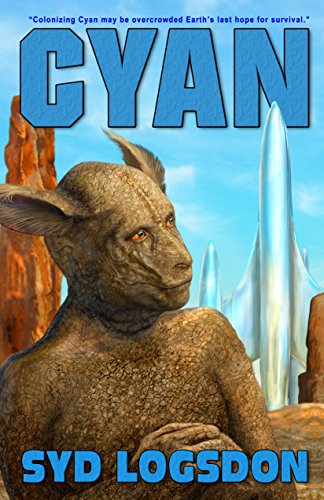
A week ago today, Cyan was delivered to those who preordered from Amazon, and went on regular sale. If you’ve read past the opening segment, you know that the explorers who returned to Earth found it greatly changed.

From Cyan: All seemed well, on the surface, but something profound was happening to the people of Earth. They were waking up to reality. When interstellar exploration had begun, few had taken it seriously. Now the process was flushed with success, and that success carried the seeds of its own downfall.

Suddenly, all over Earth, people who had been indifferent to space travel, except to mutter about a waste of resources, became truly aware of what was happening. And they didn’t like it. In the vague common mind of the beast, numbers began to move in slow, painful calculations.

A few thousand colonists; billions of the rest of us.

They — the rich, the powerful, the smart, the educated, the lucky — they will go to the stars and walk the green valleys of paradise. We — the downtrodden, the ordinary, the workers, the plodders, the ones who really make things happen, the ones who always get screwed — in short, you and me. We will stay behind.

In the general elections of 2103, and in a hundred scattered elections and revolutions in 2104, the people of Earth turned on their leaders and said with a loud voice that the spacers who brought in the ore from the belt, and the workers of L-5, and especially those who were finding new worlds, were no longer heroic friends but dangerous enemies. They would no longer be given freedom to do as they pleased, but would be harnessed to the common good.

This was the Earth Darwin returned to in 2105. When Tasmeen signaled Ganymede Station, she received a taped reply.

“Welcome home, Darwin. You will find the language of this year somewhat different from when you left. When the Dog Star returned in 2088, we found that it would be best to train comtechs in the jargon of your departure year, and that is the reason for this tape.

“The biggest change you will have to be ready for is that NASA no longer exists … because after the general elections of 2103 the people of North America decided to combine all space efforts into one military organization. You are all now members of the Federated Space Service.”

Tasmeen said, “I have a bad feeling about this.”

– – – – – – – – – – –

In point of fact, on our world, the war between NASA and the Air Force began on October 1. 1958, the day NASA came into existence and began to encroach on Air Force prerogatives. We’ll look at some of those early battles this week.

339. Teaching Space

I taught middle school science for twenty-seven years. It was often fun, but not always. Helping the kids make projects to demonstrate simple machines was a blast, but chemistry was no fun at all. It was a challenge to make astronomy appeal to my kids, but I think I managed.

Teaching space had its ups and downs.

The space race had everything, exploration, political intrigue, danger – both in space and in the Cold War which was the real reason for going to space – technology and a chance to participate. When I taught Gemini IV, I would put two chairs on their backs on a table and have two students lie back in them to represent McDivitt and White. Then I would take “Ed White” for a  space walk.

I was big and they were small. I would pick “Ed” up by the waist and take him spinning and “floating” around the classroom before he returned to the capsule. Great fun for both of us. I always chose the smallest student to play Ed White and, of course, always a boy. Sorry feminists, but if you think about it for a moment, you’ll see why.

I could use the movies Apollo 13 and parts of The Right Stuff, and that was a big help. But the space race was teaching history. What was happening in the world outside the classroom during my teaching career was less fun.

The Space Shuttles were practical. Five craft made 135 trips into space, expanded our knowledge, launched the Hubble, and built the ISS. They called the shuttle NASA’s pick-up truck. It was a good analogy, but what twelve year old wants to go to space in a pick-up truck?

Nothing was really new, just more and better of the same old stuff. Nobody was going beyond low Earth orbit.

(“When are we going to the moon again, Teacher? When are we going to Mars?”
“Damned if I know kid. It’s beginning to look like never.)

There were promising new programs. I watched several of them as they were announced, begun, and then cancelled. I’ll recap them later.

I taught the space shuttle with more enthusiasm than I actually felt. We followed its progress, and there was a lot of it during my teaching career. There was also tragedy.

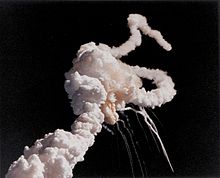
When the Challenger blew up, my class wasn’t watching. Our school got TV’s for the classrooms a couple of years later, so I didn’t know what had happened until recess when I went to the teacher’s lounge and saw faces suitable for a wake on my fellow teachers. It was a long afternoon, first explaining to the students what had occurred, and then going on with our work as if nothing had happened.

I didn’t face another day like that until 9/11.

I remember sitting with my friends in the teacher’s lounge after Challenger blew up, listening to the radio. When the announcer said that the mission commander had flown fighter jets during Viet Nam, I knew that he had found a more honorable death than that war could have given him.

When Columbia returned from orbit the last time, I was excited to see it. By that time I had moved to the foothills. Columbia’s flight path was to pass north of my new house, and I was up before daylight to watch its fire trail across the sky from my balcony. Instead, I only saw dense fog. I waited around until the projected time and at least heard it’s sonic boom. Five minutes later and a thousand miles to the east, it broke up and fell to earth.

It was Saturday morning. I had two days before it would be time to talk to my students about what had happened.

338. The Benson Murder Case

I just read The Benson Murder Case for the second time. It was an accident. All of the Philo Vance mysteries are titled The (whatever) Murder Case, and they are mostly indistinguishable on the library shelf. I didn’t recognize Benson as one I had already read.

The setting is New York City in the twenties, among the upper class and the demi-monde. Since I’m an ex-Okie farm boy, these people would look down on me as white trash. That places the novel somewhat outside my comfort zone, but it also gives a kind of anthropological interest to the proceedings.

Anyway, there aren’t that many non-bloody and non-cozy mysteries to choose from, and Philo Vance is good fun.

The author is Willard Huntington Wright. The putative author is S. S. Van Dine, who also appears in the novel as the narrator. We are told that Philo Vance, the main character, is a pseudonym for a famous real person who will never be named, so we start out with layers of misdirection. I like that touch. It is as if Conan Doyle had used John Watson, M.D. as a pseudonym. We already know that Holmes was real; just ask any genuine fan.

Vance is an aesthete, immaculate in dress, loquacious, self-centered, quite convinced of his own superiority, and independently wealthy. If an actor were to play him on television today, enunciating all the words that Wright put into his mouth, he would be seen as gay as hell.

I need to explain that. In a sex-ed class I was teaching, during a question and answer period, a student asked me if I had any gay friends. It was a teachable moment. I said, “I don’t know,” then pointed out that a gay person could pass for straight, and a straight person could pass for gay, if either wanted to. We control how we present ourselves. It is a form of communication.

That exchange took place back in the era of Will and Grace, when LGBT portrayals were rare and relatively unsophisticated, but even then the behaviors we associate with gayness were mostly learned from television.

So I repeat, if Vance were portrayed today as he appears in the books, he would not look straight. That’s probably our prejudice. I see no evidence that he was perceived that way in the twenties when the novels were published, except, perhaps, when the villain at the climax calls him “you damned sissy.”

I don’t really care if the author was presenting Vance as gay, or just snooty with a British education, but it does cause a bit of disconnect. Like reading a book in translation, the sub-text can get a bit muddied. This is especially true since this first novel is less about solving a crime than it is about the friendship between Vance, the layabout, and Markham, the hard working District Attorney.

Alvin Benson is shot. Vance tags along with his friend Markham to the scene of the crime, and Van Dine, Vance’s shadow, tags along as well to narrate the story. Vance instantly knows who did the deed, working from his understanding of psychology. Markham is confused by clues. For the next 348 pages, Markham suspects a half dozen people, and Vance follows along showing him the error of his ways, finally leading him to find the murderer.

It sound dumb in précis, but it works. Even the first time I read the story, when I was distracted by Vance’s irritating personality, it worked. The second time through the book, I realized that the real story, hidden behind the unfolding of the mystery, was Vance at work keeping his good friend from making a fool of himself, or worse, enduring the guilt of sending an innocent person to execution.

C. J. Verburg, in a one star Goodreads review, calls Vance a more smug and racist version of Lord Peter Wimsey. She really doesn’t like him, and I can’t say I blame her. She probably speaks for the typical modern reader.

Those who do like him, like him a lot. I’m rather in that camp — I think. Most Goodreads reviews are stellar or stinking, with very few in the middle.

337. The Year Without a summer

The Little Ice Age (yesterday’s post) was vague and questionable in its outlines and origin. The Year Without a Summer was precisely delineated, and there is no question of how it came about. It was the result of volcanic activity.

There is, however, a smaller mystery. In 1808, a very large eruption took place, but no westerner saw it. It is memorialized in ice samples from Greenland and Antarctica, and scientific detective work places the eruption somewhere between Tonga and Indonesia. It began a period of northern hemispheric cooling.

Then in 1815, the largest and most destructive volcanic eruption in human history took place at Mount Tambora in what is now Indonesia. The explosion was heard 1600 miles away. (Krakatoa, a better known eruption in the same region in 1883, was less intense.) Between the mystery eruption of 1808 and the Mount Tambora eruption of 1815, the second decade of the 1800s became the coldest on record. 1816 became known as The Year Without a Summer.

(As always seems the case with science, nothing is simple. 1816 fell within the Little Ice Age and was also associated with a low in the cycle of sunspots. If you really want to understand, I suggest a Ph.D. and a lifetime of study. That will give you some answers and a cartload of more sophisticated questions.)

The Year Without a Summer was disastrous. Crops, which had already been bad, probably because of the 1808 eruption, failed. Famine was everywhere in Europe, followed by typhus. There were massive storms and floods; an estimated 200,000 died in Europe.

In America, the northeast was hit hardest. Frosts continued through the summer. In August ice floated on Pennsylvania rivers. Snow fell in June in Massachusetts. Food was scarce and in 1816 there was no way to move it from less affected regions to those hardest hit. That year and shortly after, masses of northeasterners moved to the midwest, swelling the populations of Indiana and Illinois.

The event left echoes in literature. In 1816 Mary Shelley, Lord Byron, J. W. Polidori and others were storm bound together in a villa overlooking Lake Geneva. A contest of writing ghost stories ensued. Byron wrote a fragment, which Polidori later turned into the first vampire story (The Vampyre), Mary Shelley began what later evolved into Frankenstein, and Byron also wrote Darkness, a long poem inspired by the lightless days.

Here is a bit of that poem, which brings back memories of those old science fiction stories from my youth when the glaciers moved in to destroy humanity.

The crowd was famish’d by degrees; but two
Of an enormous city did survive,
And they were enemies: they met beside
The dying embers of an altar-place
Where had been heap’d a mass of holy things
For an unholy usage; they rak’d up,
And shivering scrap’d with their cold skeleton hands
The feeble ashes, and their feeble breath
Blew for a little life, and made a flame

336. The Little Ice Age

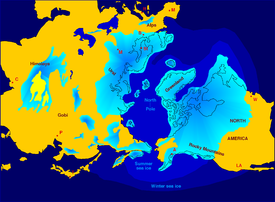
Hannes Grobe/AWI – own work – redrawn, supplemented and modified graphic from John S. Schlee (2000) Our changing continent, United States Geological Survey.

The writing of this blog is a pleasure, but it is like a fireplace on a deep winter’s day — it takes a lot of fuel. Sometimes topics fall into short supply. Sometimes I don’t know where my next blog is coming from.

Sometimes I get on the internet and put my conscious mind on cruise control. I let my fingers on the keyboard seek out half remembered images, phrases I have heard, interesting titles from catalogs of books I’ve never read, and half understood events I always meant to research and write about.

Today was that kind of day. I chased down, among other things, two similar phrases I had run across: The Year Without a Summer and The Little Ice Age.

They aren’t the same thing, it turns out. The Little Ice Age was a cool period that purportedly lasted about half a millennium, but its cause, degree, beginning, and ending are frustratingly difficult to pin down. NASA suggests three separate cooling periods in the 1600s, 1700s, and 1800s but the UN panel !PCC suggests that it is only a series of local events, not a unified world-wide phenomenon.

Locally, the increased cold brought famines, ice blockage of harbors, and shifts in agriculture. Some have suggested that the prevalence of winter scenes in Dutch paintings of the era, and even denser wood leading to better violins by Stradivarius, are byproducts of the Little Ice Age. Yeah, right. Scientists can be frivolously imaginative when pushing their theories, especially if proofs aren’t easily measured.

The Little Ice Age is a really cool name though, no pun intended, and it caught my attention because death by ice age was a common theme in the science fiction stories I read when I was young. Visions of glaciers coming down from the north to obliterate civilization lived in my head for years. They still do, sometimes.

Fifty years ago people — science fiction writers, anyway —  were afraid of global cooling. Now we are all afraid of global warming. That doesn’t set aside what we now know about retreating glaciers, but it does cause a slight pause on the way to full acceptance.

I was late coming to the table where global warming is concerned, for reasons that were entirely sensible twenty years ago, but no longer suffice today. I’m still not convinced that the warming is entirely man made, but it doesn’t matter. That the glaciers are retreating and the polar caps are disappearing is beyond question. That fossil fuel emissions are part of the picture is reason enough for action, even if we don’t know the whole story.

Science never knows the whole story, but people have to take action based on the preponderance of the evidence.

___________________

While I was cruising the web, I also found these estimates of human population.

     1804, Earth’s population, 1 billion.
     1927, Earth’s population, 2 billion.
     1960, Earth’s population, 3 billion.
     1974, Earth’s population, 4 billion.
     1987, Earth’s population, 5 billion.
     1999, Earth’s population, 6 billion.
      2011, Earth’s population, 7 billion.

I think there’s a pattern here, don’t you?

The answer to global warming isn’t an end to the use of fossil fuels — not exactly. It is an end to the need for fossil fuels. It is fewer people.

Oh, and that other thing, The Year Without a Summer, we’ll take a look at it tomorrow.

335. To Save a Life

I once saved a little girl’s life. True, but not as exciting as it sounds. I’ll tell you about it further down in the post.

In 1975, a whole bunch of things came together. I came back to California with a master’s degree and started writing novels. My wife’s parents lived in the same small city. Her father was a life long Red Cross volunteer, so when help was needed in the Swine Flu clinics, we all three volunteered. I had spent four years as a surgical tech in a Naval Hospital, so it was natural that I continued to volunteer after everybody had had their shots and the Swine Flue had not appeared.

(Cynics called the Swine Flu the cure for which there was no disease, but no one knew that at the time. Hindsight is always accurate, but sometimes cruel.)

About that time, the Red Cross was given the responsibility of teaching the then-new technique of cardiopulmonary resuscitation. My wife, my father-in-law, and i took the county’s first CPR class one week, then took the first CPR teacher training the following week. After that we taught as a team.

At that time there were no EMTs. We taught the local ambulance drivers to do CPR, then my father-in-law taught the park rangers at the local lake. We taught civilian classes every week or so and after a few years, we had trained hundreds.

In those days CPR training included the Heimlich maneuver and many other things I won’t even tell you about. Year by year, the training contained less and less. Dumbed down, in my non-medical opinion. To be fair, we weren’t teaching doctors and nurses. The amount that you can expect a civilian to learn in a short class, and remember in an emergency a year later, has to be fairly well restricted.

When I wrote my second published novel, I had the hero save a life using CPR, and in the front pages, placed a statement about CPR with a call for the reader to get training.

I never had to actually use CPR. That just means that nobody ever dropped temporarily dead in my presence, and I’m glad they didn’t.

However . . .

About twenty years later I was teaching middle school. It was the end of the day. The bell had just rung and my students had started getting into their back packs to file out, when one of them yelled, “Suzy’s in trouble!” and another student yelled, “She’s choking.”

The girl (not named Suzy) had slipped a hard candy about the size and shape of a marble into her mouth. She wasn’t supposed to do that until she was outside the classroom, so she was being sneaky instead of careful, and it lodged in her windpipe.

I slipped into the mode teachers use for bleeding, fainting, and fist fights. I went to her at a walk that resembled a run. Her face was desperate. I spun her around and stripped off her backpack while calmly saying, “Let’s get this off you. Let’s get you turned around so I can get that out, so you can breathe.” I put my hands in the right position and jerked up sharply — but carefully, since I was three times her size. The candy shot across the room.

That was it. It was over. She was shaken, but unhurt.

Humility would have me say that she would probably have been all right anyway, but I don’t think so. I really don’t think so.

So, what is the takeaway — that I’m a hero? Not likely. People’s lives are saved every day by the Heimlich maneuver. I have a friend, a teacher, who used it successfully twice during her career.

The takeaway is that CPR, rescue breathing, and the Heimlich maneuver are easy to learn, and if you ever have the chance to same the life of a loved one, or even a stranger, and you don’t know how, it will haunt you for the rest of your life.

End of sermon.

334. Making Videos for Cyan

I know from visiting your websites, that a lot, maybe most, of you either are or want to be writers. I’ve talked about some of the mechanics of that, especially in posts 133 and 134. During the last month, I’ve learned some more about how books are marketed in the age of the internet. I’ve had to make videos.

That proved harder than I thought it would, partly because of technology. Don’t think I’m a Luddite – I’ve been a computer nut since 1986 – but I don’t own a video camera. i don’t have kids to record as they grow, and I have no interest is seeing myself moving about on the computer screen.

Most of those who make videos to promote their books do so on their smart phones. I don’t have a smart phone. It is my firm belief that Alexander Graham Bell was an emissary of the Devil. I communicate the way God intended, by email, where I can correct my mistakes before I push send.

I finally used the camera built into my Mac. It makes a shaky, Skype-like picture, but that works well enough if you hold still and go into talking-head mode.

I didn’t want to ramble, so I wrote a script and tried out some videos. They stank (that’s the grammatically correct word that morphed into stunk about twenty years ago). It turns out that a glib, casual, conversational tone takes a hell of a lot of rewrites. I should have remembered that. I had to learn it two years ago when I wrote my first posts. I don’t mean numbers 1, 2, 3 . . .. I mean the ones you never saw because I trash-canned them.

Writing two masters theses and a bunch of novels did not prepare me to write posts. I had to learn a whole new, casual style. This month I learned that written-casual is not the same as spoken-casual — even if it is written as a script before it is spoken. It took quite a few tries to make the transition.

Eventually I made three videos for Brian at EDGE and he will put them on Youtube. They are an introduction to Cyan, the story of why I wrote Cyan, and a reading from Cyan. The first is already up; click here.

I’ve also tacked on the script I used in the Introduction to Cyan.

____________________

Hi. Welcome to my world, or at least to one of them. I’ve always been a fan of near future novels of exploration. There are so many things about traveling at sub-light speed that make for a great story.

Besides, it won’t be long until scientists have charted the actual planets around all the nearby stars. Then we won’t be able to make up our own planets.

Put those ideas together and you have Cyan, which is the name of me newest novel and the name of the planet that it takes place on.

In the year 2080 a crew of five men and five women, scientists all, set out for Procyon where they find a planet that stands straight up in orbit, with bands of unvarying climates. About 45 degrees north, is paradise.

But paradise with teeth — virgin, wild, beautiful, but very dangerous. Keir, our crewleader’s task is to keep his fellow explorers alive. He’s good at his job, but on a planet crowded with predators, that may not be enough.

For these scientists from vastly overcrowded earth, after years confined within the starship, the beauty and emptiness of Cyan is intoxicating.

They have one year to decide if Cyan is suitable for colonists, and it turns out to be perfect. But then one of the scientists picks up a flaked stone. This is not a natural occurrence. Someone, or some thing, has made it.

The explorers have discovered the Cyl.

The Cyl are a stone age group. They look nothing like man and their intelligence is low, but they are about to become much more. Evolution moves quickly under Procyon’s intense radiation, and the Cyl are poised to make the leap to full intelligence.

Earth needs Cyan to ease its massive population, and the Cyl need to be left alone to find their own destiny. Lines are drawn among the explorers and the resolution of the problem threatens to tear them apart.

____________________

When you get your copy of Cyan, you will see that this introduction actually only covers the first fifth of the novel. Giving a full summary would have made the video far too long.

333. Arthur C. Clarke: The Big Re-write

This is a follow-on to yesterday’s post.

There is an intellectual challenge in comparing Clarke’s Against the Fall of Night to his The City and the Stars. I could easily see someone writing a thesis in an English Literature program comparing the two in great detail. That would certainly make more sense that a thousandth thesis on Joyce’s Ulysses.

Clarke’s first version of the work, written, published, and praised, just wouldn’t let go of his mind. I get that; it happen to me twice. (The won’t let go part, not the published and praised part.) My second serious novel, Valley of the Menhir, came to me as a fragment and grew piecemeal over four decades. Cyan rolled along smoothly, and was almost finished (at about half it’s present length) when I ran into a problem I couldn’t solve without destroying the basic structure of the book. It sat in manuscript for years before I realized a way out of my dilemma.

Of course Against the Fall of Night was already out there, but the idea that a book could nag at a writer for years and finally cause a rewrite — even after it was published — makes perfect sense to me.

Truthfully, however, these two novels are the same story. Clarke would not agree, but I think he stood too close to both his works to judge. There are differences between the two, of course, and Clarke considered them significant. They don’t seem so to me.

In the introduction to Against the Fall of Night, Clarke said:

Between 1937 and 1946, at least five versions, of ever increasing length, were developed.

He also said this, which we already noted yesterday:

. . . undoubtedly, much of the emotional basis came from my transplantation from the country (Somerset) to the city (London), when I joined the British Civil Service in 1936. The conflict between a pastoral and an urban way of life has haunted me ever since.

Many people before Clarke had written to that theme without creating anything as lasting as the city Diaspar. Many people after Clarke recycled Diaspar, under many names in many novels. The movie Logan’s Run comes to mind. Yesterday I spent an hour in a local used bookstore and saw several forgettable (and actually forgotten) novels where the hero escapes from or is exiled from a sealed city and finds himself in a sylvan, or at least archaic, world.

I am glad to have reread The City and the Stars, and to have read Against the Fall of Night for the first time, but I don’t think I could recommend either to a modern audience. The writing style is not stilted, but it doesn’t sing. The premise is good, but a modern reader will have seen it already in a hundred novels published since mid-last-century. Finally, Clarke fails in his stated prime intention. He does not give a sense of deep time. When he says that some aspect of Diaspar has lasted a billion years, he could have said a thousand years instead, and the feeling would have been the same. I don’t fault him for this; I think the task was an impossible one. A thousand years or a billion years are both the same size when measured against the only yardstick that matters — “Longer than I will live.”

Diaspar, glorious as it is in Clarke’s description, had stood for billions of years and then was utterly changed by one young man is what appears to be about a year. Such an effortless transition has neither resonance nor believability. What Alvin does is powerful and meaningful, and Clarke’s creation of Diaspar, Lys, the Seven Suns, and Vanamonde is worthy of praise. But the changes that happen come too easily for full satisfaction as a novel.

Both versions of the story of Diaspar were great books for their time. Nevertheless, a modern reader encountering them today might shrug and say, “This is all old stuff. I’ve seen all this before.” He would not realize that these two novels, through their many imitators, are the reason the ideas seem familiar.

This all reminds me of Jekyll and Hyde. Almost no one has read the original, unless forced to in a literature class, but everyone knows the story. So which is great — the imitators everyone has seen, or the original everyone has forgotten?