Category Archives: A Writing Life

263. Andre Norton’s Beast Master

Not every draft post actually gets posted. I started one a year ago in which I asked “What science fiction or fantasy world would you most like to live in?” That’s not the same as which one do you like to read about. I love the Dorsai books, but I wouldn’t be caught dead in any of them. Or, if I were caught in one, I probably would end up dead.

The question never reached the website, but in the draft I answered, “Arzor”, which is the planet in Andre Norton’s Beast Master novels.

In many ways, The Beast Master is the ultimate early Norton. Many of her protagonists are orphans, and Hosteen Storm is a hyper-orphan. He has lost not only his family, but his whole world. He is haunted not only by painful memories, but by an oath sworn during his childhood. He has to choose between the angers of the past and the promise of the future, and in choosing, eventually finds a new family.

Hosteen begins the novel as a man apart, loyal only to his team of mutated animals, with whom he communicates telepathically. This kind of communication is a trope that Norton has used liberally, at least since 1952 with Star Man’s Son. (Incidentally, the first novel I checked out on my first visit to a library.)

Hosteen, half Navaho, half Sioux, chose to enter the Beast Master Corps, where he was teamed with a dune cat, an African eagle, and a pair of meerkats,. This was decades before Timon brought meerkats to everyone’s attention. They trained together, then spent the Xix war engaged in reconnaissance and sabotage missions. Now Earth has been destroyed, and the team is all that Hosteen has left.

He musters out on Arzor, a frontier planet much like his native Arizona. It is exactly what he would have chosen, but in fact he is impelled to go there in pursuit of revenge on a man he has never met. Hosteen will wrestle with himself throughout the book, torn between his oath and his growing respect and liking for the would-be victim and his son Logan.

Arzor is a transmogrified Arizona, with modernized cowboys on variform horses. Frawns look a lot like bighorn sheep; the yoris is clearly a distant relative of a kimodo dragon; the norbies are really, really tall Indians with horns. If you are inclined to cynicism (as I normally am) this could come across as a crude mashup. I have to fall back on my favorite phrase, “Somehow, Norton makes it work.”

For my taste, the trick is to come just close enough to the familiar, while keeping just the right admixture of the outré. It’s a tricky, narrow path, and nobody does it better than Norton.

When Hosteen first meets the man he has sworn to kill, he turns aside from the confrontation for reasons he does not understand himself. He subsequently becomes involved in an expedition to the Arzorean back country, which postpones his confrontation, but becomes a deadly adventure in itself. He and his team, with the aid of his would-be victim’s son, overcome an old and deadly enemy.

Finally, Hosteen’s oath can no longer ignored . . . but, even though the novel is nearing sixty years old, I won’t spoil the ending for anyone who hasn’t read it yet.

Three years later, Norton wrote Lord of Thunder, a beast master sequel. which was quite good, though not up to the original. Four decades later, she wrote three more in the series in conjunction with Lyn McConchie: Beast Master’s Ark, Beast Master’s Circus, and Beast Master’s Quest. It seems that Norton liked Arzor as well.

The Beastmaster films are unrelated to the original, although the title is ripped off and the animal characters (two ferrets, an eagle and a panther vs. Norton’s two meerkats, an eagle and a dune cat) certainly looks suspicious. Caveat view-or.

262. Andre Norton’s Star Gate

When I say Star Gate, I don’t mean the TV series. I also don’t mean the movie it was based on. I mean the original, from decades earlier, a novel by Andre Norton.

Andre Norton’s Star Gate came out in 1958 but It didn’t make it to any library I frequented. It didn’t enter my life until a decade later when cheap SF and fantasy paperbacks became generally available. Someone has an original edition for sale on the internet for $299, but at that price, I’ll never see the hardback.

Kincar s’Rud is called to the deathbed of the chief and kinsman he expects to succeed, only to find that it is not to be. He is told that he is only half Gorthian. His father was one of the Star Lords from Earth. To avoid bringing a bloody division to his clan, Kincar must leave succession to a hated cousin.

After generations on Gorth, the people of Earth have departed, but Kincar is told that a few remain, preparing to work out a separate destiny. Among these are his half-kinsmen, whom he must join. On his way he examines the few things given him as heritage and finds a Tie, a green stone amulet that is a tie to the three gods who rule his world.

Kincar is awed to be in the presence of Star Lords, and it takes him some time to adapt to their presence. This remnant consists of those who have formed so deep a bond with Gorth that they cannot bear to leave, even though all other Earth men have gone. Despite the good that Earth men have done on Gorth over the years, they eventually became convinced that their presence was warping the culture of the native Gorthians, and that they must, from conscience, depart. The few who did not take the ships out are also planning to leave, but by a different route.

They are pursued by native Gorthians as they try to find a place of temporary refuge, where they can construct a gate which will take them to an alternate Gorth where the native population never evolved; a place where they can remain in the land they love without doing harm. The gate is constructed hurriedly while under attack. All pass through, but Kincar is struck down harshly. The Tie he wears has reacted badly with the off world technology of the gate.

Here is classic Norton, with a medieval culture in conflict with an advanced technological one, and with real magic residing uneasily alongside real science. Star Gate is truly science fiction, but the fantasy touches that made the Witch World novels so appealing are already in place. (Aside: in the first Witch World novel, Simon Tregarth enters that world through a gate, which may be magical or alien technology. Norton never says which, but it’s probably magical, considering where he ends up.)

Kincar and his kinsmen emerge from the gate in a Gorth, but which Gorth? They have to explore to find out, and it quickly becomes obvious that they are not in the one they wanted. In this new Gorth, the Star Lords never departed. Worse, these Star Lords are cruel tyrants who have enslaved the native population.

Kincar’s group decides to delay building another gate to pursue their dream world. Since Star Lords have so tainted this Gorth, they feel obligated to set things right. This brings Kincar into conflict with his evil alternate father and into an alliance with his hunted alternate self.

*****

A decade after I first read Star Gate, I ripped Norton off for one useful bit. On our Earth, if you had an ancestor named David who’s father was named John, he would be David Johnson or David Johnsen or David Jensen or David Johns. On Gorth, he would be David s’John. I liked that so well that I made it the basis for kinship terminology on the World of the Menhir. Thanks, Andre.

261. Andre Nortonʼs Sword Trilogy

This post and yesterday’s are about the Sword Trilogy, Andre Norton’s first multi-book story. You can read the posts in either order.

Some of Andre Nortonʼs earliest work came during and just after World War II, and today is called the Sword Trilogy. I reviewed the last and best of the three books yesterday. A few are available today in paperback reprints, but the original hardbacks mostly ended up in libraries and command high prices today. Fortunately, all three are available as e-books, if you can tolerate a boat load of typos.

The Sword is Drawn came first in 1944, and was one of Norton’s earliest books; the fifth, if bibliographies can be trusted. My library rescue copy was printed by Oxford University Press, London, 1946, presumably under wartime austerities. It is a slender, ragged volume that needs to be read with a delicate touch.

In a forward to the book, Norton praises the World Friends’ Club for their work in establishing “pen friend” relations between youths of various countries before 1939, and adds:

Now again letters are finding their way by sea and air all round the world. It is possible that in these friendships lies the hope of lasting peace and the vision of a new world.

The four sections of the novel are set off by letters from the young protagonist Lorens van Norries to his American friend Lawrence Kane. Lorens is the grandson of Joris van Norries, head of the House of Norries, renowned jewelers and bankers, but he has been raised as an outcast. In the opening paragraphs, Lorens visits his grandfather’s deathbed and finds that he has been raised away from the family for a reason. His grandfather has foreseen the coming of the Nazis and now entrusts Lorens with the location of the family treasure which he is to dedicate to regaining the Netherland’s freedom. Unfortunately, the Nazi’s are not fooled, and Lorens has to run for his life. He is transported to England by Dutch smugglers, turned underground fighters.

Lorens ends up in Java, still a Dutch possession with a House of Norries presence, and there the war catches up to him again as the Japanese invade. He fights his way through the jungle and ends up fleeing by air toward Australia, where his plane is shot down and he is crippled. Heroes who are physically or emotionally crippled, and fight through anyway seems to be a Norton specialty.

Healed, but unable to fight in the traditional manner, Lorens has an interlude in America where he enlists an underground organization to transport him back into occupied Holland. There he recovers the treasure entrusted to him and uses it to advance the Allied cause.

The Sword is Drawn is a disjointed book, a round-the-world stumble back to where it started. This may be a problem for some readers; I find it a strength, as it mimics the chaos of war. The Sword is Drawn is a moody book, informed by the vision of a people who have been ground down and are still fighting back.

And then the war was over. The second book of the Sword Trilogy, Sword in Sheath,  came out in 1949 and has a mood in stark contrast to the first. Lawrence Kane – sometimes called Kane, sometimes Dutch, but never Larry – and Sam Marusaki, are back from service in WWII which included OSS work. They are called in unofficially, ostensibly to find a missing airman but actually to look for Naziʼs who had gone to earth in the East Indies after the war. Kane is the pen-pal to whom Lorens van Norreys sent all those letters and, sure enough, van Norreys shows up by chapter three, where he and Kane meet face-to-face for the first time. At this meeting we find out that, after the close of the first book, van Norreys spent the remainder of the war in the Dutch underground.

Every verbal exchange between Kane and Sam is couched in light banter, which somehow, unbelievably, still sounds like Norton. Lorens, Kane, and Sam set out on a Dutch tramp steamer to explore the area around the Celebes, where they fall in with Abdul Hakroun, a pirate who is willing to fight Nazis if there is a profit in it for him. Several mysteries entangle them until they find a lost civilization, a missing treasure, and a stranded Nazi sub. All this sounds very predictable for an espionage novel, but Norton’s touch saves it. Still, it is the weakest of the three books.

260. Early Andre Norton: At Sword’s Point

This is not bait and switch. This week will be devoted to early Nortons, but the news of Fidel Castro’s death makes a few timely words necessary.

This morning I watched some of Castro’s victims being interviewed, people of middle age who were forced to flee their homes as children. Many were still mourning the loss of parents as their families were separated when they fled to America. It begs the question: how can the expulsion of Cubans from Cuba be wrong, and the mass deportation of undocumented American residents be right?

*          *          *          *          *

This post and tomorrow’s are about the Sword Trilogy, Andre Norton’s first multi-book story. The other posts this week are also devoted to very early Nortons.

In my library (spare bedroom) there is a shelf of books on languages, and prominent there is my collection of books on how to teach yourself Dutch or, more properly, Nederlandish. Why Dutch? Why not German which I sort of learned in high school, or Hindi which I kind of learned in college? I could give you logical reasons, but they wouldn’t be honest. The truth is, I fell in love with the Netherlands, and a Norton novel was the cause.

The book was At Sword’ Point. I read it in high school and I re-read it every few years after that until the last library discarded their last copy. Then I bought it used through mail-order. Naturally, it turned out to be a discarded library book. I have it on the desk as I type.

Quinn Anders shivered as he limped up a moss-greened walk to the square New England house and raised his hand to the polished brass eagle doing bored duty as a knocker.

In the first sentence we know that Quinn is not a fire breathing super hero. He shivers. He is also not a perfect physical specimen. He limped. We learn later that he has suffered from polio, a disease common in the era, and that his scholarly nature comes from time spent bedridden as a child. By the time Norton tells us this, we want to know. It is not a narrative intrusion, but an answer to questions she has already teased into our minds.

She also informs us that she is an old fashioned writer, not afraid to use more words than are necessary (the polished brass eagle doing bored duty as a knocker, for God’s sake) and that her writing will be circuitous. That’s Norton. If you don’t like that first sentence, you had better go read someone else.

It worked for that era (and for the multitude of Norton fans). When the novel was published in 1954, the Soviets were consolidating their hold on Eastern Europe and had just detonated their first H bomb. The missile race and the space race were in the near future and escaped Nazis filled popular literature.

Quinn Anders is seeking help in finding out what happened to his older brother, killed in an auto “accident” in the Netherlands. In fact, his brother was part of an unofficial underground, headed by Lorens van Norries, whom you will meet tomorrow; the group came together in resistance to the Nazis, and has changed enemies to resist the Soviets. Quinn goes to  the Netherlands to finish the book his late father began on an obscure order of knights from the Middle Ages. At the same time he is looking for clues to his brother’s death, and to the ancient, gem encrusted porcelain knight that was his brother’s last gift.

He succeeds, of course. No spoiler alert needed for that statement. He also finds himself accepted by a band of like minded adventurers. That is, he finds a family, which is a familiar pattern in Norton, and in young adult literature as a whole.

At Sword’ Point is well plotted and satisfying, but what lifts it above other Norton works is the brooding atmosphere of the Netherlands, half medieval and half modern. I fell in love with the place. It didn’t hurt that Lorens and Kane had had lives of their own in earlier books, which I discovered afterward. You’ll hear about them tomorrow.

259. Turkeys Under the Oak Tree


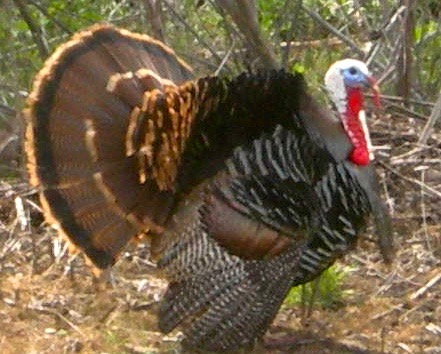
dscn0719dscn0693These birds were photographed on a spring drive through the foothills, about twenty miles from my house. The puffed up, greeting card version is what the males look like in season, when they are strutting their stuff and looking for love. The other bird is what most turkeys look like, most of the time.

You are reading this on Thanksgiving, but I am writing on September 27, about something that happened yesterday. My wife came to the door of the little building out back where I work and said, “Come here. Quietly.” There were ten wild turkeys eating bugs and acorns along the east side of the house.

We don’t get turkeys very often right up to the house, although seeing them in the neighborhood is a common occurrence. We stood for twenty minutes watching in the hundred degree heat of the tag end of summer before they casually wandered off.

Turkeys are the symbol of Thanksgiving, but I was thankful to see them because wild things fill my life with joy.

I grew up on a farm in Oklahoma in another century. I worked long hours when I was growing up, but I worked outdoors, so it might have well have been play. The music that filled my life was the churr of cicadas on summer evenings and the howl of coyotes echoing through the frosty night air in winter.

I left the farm for college, then spent my adult life in a small city, and moved to the foothills when I retired. Now my human neighbors are near enough for help in emergencies, but far enough away that I don’t hear them when they fight. I don’t even know if they fight.

Several times I have seen packs of coyotes running through my yard. Once a mother duck with nine ducklings following single file paraded through. Deer come in from time to time. They mostly prefer the low ground, and we live on a hill, but they come for water as the long days of summer dry out the last of their water holes. I keep water in bird baths for the birds, and water basins on the ground for everybody else.

The deer also have an uncanny knack of knowing when the tomatoes are ripe. Oh, well.

I see a bobcat about once a year, somewhere nearby. Twice they have come into our yard. Once I looked out the window to see a bobcat in the fenced back yard where stray cats stay out of reach of coyotes. My wife and I watched out the window as he sauntered along, unaware of us, then casually jumped the six foot fence without touching it.

We were even visited one holiday by the Christmas Pig. It was a three hundred pound porker who had obviously escaped from some farmer. I saw him several times after, so I’m maintaining hope that he was never found, and escaped becoming bacon and sausage.

So, happy Thanksgiving to you. And also to the turkeys and ducks and bobcats and raccoons and possums and the one lone pig.

In my house, Thanksgiving means turkey (from the supermarket, of course), stuffing, cranberries and pumpkin pie. Being thankful means looking out my window and never knowing what kind of critter might be looking back.

258. George Mackay Brown’s Seven Poets

Most of the people who read this blog are writers, or want to be writers. I know from visiting your websites that you range from beginner to professional, and many of your writings have impressed me.

Friends, I have something for you. I’ll give you details below, after the set-up.

I discovered George Mackay Brown in 1987 when my wife and I went to Europe for the first time. We started in England, then went to Scotland to see the land of my wife’s ancestors. Along the way, I visited bookstores to pick up reading material that I wouldn’t find at home and discovered Neil Gunn and George Mackay Brown, two Scottish authors who deeply enriched my life. Both write elegantly about their own experiences in Scotland and the Orkneys (technically part of Scotland but very different). I’m sure I’ll talk about them both from time to time in this blog, but today I just want to shill for one short piece by George Mackay Brown.

I recently had reason to flip through my George Mackay Brown collection, looking for a story I read years ago, and stumbled onto The Seven Poets, the final story in his collection The Sun’s Net. It is a post-apocalyptic story, but it is a fable, not science fiction.

    *     *

The world has reverted. After machines and cities swallowed up the earth, there was a revolution. Machines were banished. Cities were destroyed. Now there is a world wide agreement that no settlement can have more than 250 members. When a village grows beyond that, some are chosen to leave and form a new village.

(Now don’t tell me this wouldn’t work. I know it and GMB knew it. It’s a fable; a set-up to make a point about writing.)

The world is calm, serene, and boring; some men can’t abide that. They become wanderers, without a village, without a community, welcome everywhere for a brief stay, but welcome nowhere as permanent residents. Our narrator is such a man. He has wandered the whole world, through a long lifetime, staying with men of every occupation, but most usually, staying with poets.

Every village has a poet, who spends his year writing a masque for the midwinter festival. In Spain, such a poet told our narrator, “The world was created by one Word. Every poet makes, in his lifetime, a tiny fraction of one letter of that Word.” Another poet’s voice had deserted him. Another was a heretic to the new order who wrote of machines, but when his villagers performed his masque, their mocking turned the performance into a parody of his thoughts. In Siberia, a poet wrote in the inhuman language of roots and salmon and blizzards . . .

    *     *

I can’t begin to convey the depth of sensible weirdness of The Seven Poets. That would require exactly a many words as GMB took, exactly the same words, and in the same order. Prose written by poets can do that to people who try to paraphrase it. I can only say that his fable has captured beautifully the strangeness of trying to nail life to the page with words.

There doesn’t seem to be an online source for The Seven Poets, but it’s probably only fair that you’ll have to seek it out in print. I guarantee you a singular experience if you do.

257. Who Knows?

Who knows? Probably the internet.

The internet is science fiction at its best. Back in 1986, when I bought my first Mac, it came with a program called HyperCard. It was a crude, early version of what has now grown to be the internet. It allowed you to create mini-documents called cards and connect them via buttons so you could jump freely from one to another. I dreamed of creating a database of everything I wanted to keep at my fingertips. Then Newton came out – Newton was a proto-tablet that didn’t work very well – and I saw the pair of them as my own personal Tricorder.

Just dreams. Both hardware and software were too crude to be more than a tease, and even a tiny database takes a vast amount of time to create.

Today, the internet does what I dreamed of doing in the days of HyperCard and Newton. I use it to do research for this website. Sometimes I’m looking for things I don’t know, and it works fine for that. Primarily, however, I use it to check details on things I already know.

Here is an example. Years ago I wanted to look again at the Sherlock Holmes quote about furnishing your brain. If you don’t know what I’m talking about, here it is:

“You see,” (Holmes) explained, “I consider that a man’s brain originally is like a little empty attic, and you have to stock it with such furniture as you choose. A fool takes in all the lumber of every sort that he comes across, so that the knowledge which might be useful to him gets crowded out, or at best is jumbled up with a lot of other things, so that he has difficulty laying his hands upon it. Now the skillful workman is very careful indeed as to what he takes into his brain-attic. He will have nothing but the tools which may help him in doing his work, but of these he has a large assortment, and all in the most perfect order. It is a mistake to think that that little room has elastic walls and can distend to any extent. Depend upon it there comes a time when for every addition of knowledge you forget something that you knew before. It is of the highest importance, therefore, not to have useless facts elbowing out the useful ones.”

I thought this was in one of his middle stories. It wasn’t; it was in the first, A Study in Scarlet. To find it, I pulled down my complete Holmes in two volumes and spent an hour looking, but I couldn’t find it. I stumbled across it by accident months later.

So today I did an experiment. I went to my search engine and typed in “brain attic”. It returned a page with ten responses. Six of them referred to the Holmes quote. I opened one, copied and pasted into this post, and you just read it.

Here is another example of finding things I already knew. In my post on The Monkey’s Paw, I wanted to use a quatrain from the Rubaiyat. I knew it well, but not well enough to quote for publication. I didn’t want to spend time getting out my copy and reading through its pages, so I typed a fragment – “dId the hand of the potter shake” – into the search engine and up popped:

After a momentary silence spake
Some Vessel of a more ungainly Make;
“They sneer at me for leaning all awry:
What! did the Hand then of the Potter shake?

Notice that I scored a hit even though I had left out “then”.

Earlier today, I was writing about the Lord Darcy stories. I didn’t want to misspell Randall Garrett’s name (How many Ls, how many Rs, how many Ts?) so I typed it into the search engine and got my correct spelling along with a great deal of additional material that I didn’t need.

That I didn’t need at the moment, that is, but information that will be there when I do need it. Like I said at the top, the internet is science fiction at its best.

256. The Space Station That Never Was

 275px-mol_usafI love conspiracy theories. I don’t believe them, but they’re fun.

We do know that much is hidden from us. The SR-71 Blackbird was a myth, sworn not to exist, for most of it’s operational life, so why not believe in the Aurora, or at least wish it were real and dream up stories that use it.

The problem with actually believing in conspiracies is that most conspirators are too dumb to pull them off. Still, occasionally . . .

In 2005 two spacesuits of unknown origin were found in a locked room in a NASA museum. They were not connected with any known program, and presented a mystery to be solved. The story of chasing that mystery was well told by NOVA in its 2008 episode Astrospies. A decade after the discovery, and seven years after the NOVA program, files and photos were declassified and the secrets of the Manned Orbiting Laboratory were fully revealed.

The Air Force has long had a hand in spaceflight. As early as 1957, it funded development of a spaceplane, the X-20 Dyna-Soar. Ultimately that project was scrapped because of the success of the Mercury and Gemini programs, but USAF shifted goals to the Manned Orbiting Laboratory and continued.

The existence Manned Orbiting Laboratory project was not secret. It was announced in 1963 but most of what went on was not revealed to the public. Essentially, it was an orbiting spy station designed to take pictures of military interest. MOL was a single use vehicle. It was designed to be launched, used for a forty day mission, then abandoned. At that time the crew would return via a Gemini B capsule which was launched with the MOL.

MOL was designed for a stacked launch. The launch vehicle was to carry the MOL with the manned Gemini B in place at the top. Once in polar orbit, the Gemini B would be powered down and the two astronauts would move into the MOL where they would spend their mission taking pictures of the Earth through advanced camera system called KH-10. At the end of the mission, the astronauts would reactivate the Gemini B and return to Earth in it, abandoning the MOL.220px-titan-3c_mol-gemini-b-test_3

The Gemini B was virtually identical to the Gemini used by NASA, except for a hatch through the heat shield that allowed astronauts to move between it and the MOL.

The initial launch took place on Nov. 3, 1966 from Cape Canaveral. The MOL launched was a boilerplate mockup made from a Titan propellant tank, and the Gemini B was the prototype, and unmanned. The capsule returned to Earth safely, proving the modified heat shield, and is on display today at the Air Force Space and Missile Museum.

In June 1969, the project was cancelled. No manned and functioning flight was made. By the time of its cancellation, progress had outrun the program, and unmanned reconnaissance satellites had proved that they could do the job more cheaply than the MOL.

In all seventeen astronauts trained to fly MOL missions. One was Robert Lawrence, the first black astronaut, who died in training in 1967. (see 167. On the Brink of Glory) When the program was cancelled, all the astronauts who were under 35 years old were offered jobs at NASA. The seven who were eligible all accepted and became NASA Astronaut Group 7. All flew on the space shuttle.

255. Fire

dscn2539For writers – or anyone who is leading a thoughtful life – every day brings experiences that add to our understanding of the world around us. For the last half decade, my tutor has been fire.

I took the photo at the top of this post a few years ago, while standing in my front yard. The smoke was only about three miles away and my first thought was, this is finally it. Fortunately, it was on the other side of a lake that lies in the valley between my house and its location. We drove to a vantage point and spent an hour watching a scoop-equipped helicopter dropping down to the lake for loads of water, and dropping them on the fire. It took several days to put it out, so for a week we could not open any windows because of the smell of burning.

There have been weeks in late summer almost every year recently, when the smell of burning kept us indoors. You could blame our long-running drought, but that isn’t it. When there is little winter rain, things become unnaturally dry, and there is fire. When there is abundant winter rain, the grass and weeds grow tall and lush, and there is more fuel for the fires that still come.

Arthur Clarke wrote a story called Report on Planet Three, in which Martians, observing Earth through telescopes, concluded that life could not survive here because the atmosphere was so rich in oxygen that Earth might have open fires as a natural phenomenon! When I first read the story as a youth in Oklahoma, I found it humorous. Now that I live in the foothills of California, I say, “Yep, Arthur, you got another one dead right.”

A few years ago, a target shooter started a fire that burned into Yosemite. Three years ago, north of here, an illegal campfire was the spark. Two years ago, east of a foothill town I visit frequently, it was untrimmed trees rubbing against a power line. This year, someone pulled off the road into dry grass and his hot muffler started a thousand acre burn just a few miles from my home. That was the fire that caused me to write this post.

dscn4753Here is one of my favorite places. It is a vernal pond; man made, but fleeting. Right now it is probably filling with water, as it does every fall. It will look this beautiful until spring – maybe.

In the coverage of the fire this year, a newscast showed a reporter standing on a black top road. One side was untouched; the other was fire blackened. It was the point at which the fire had started, and I recognized it as the place I park when I go to the pond. I couldn’t tell whether the reporter was facing north or south, so I don’t know if my favorite place was saved, or destroyed. I haven’t yet had the heart to drive up and find out.

In my writing, I have brought nuclear war to Earth in two different fictional universes. It’s easy. I don’t see many movies, but everyone sees their trailers on TV. Massive, ubiquitous destruction prevails. A kid with his own camera and computer could illegally produce his own apocalyptic vision, using FX stolen from Blue-ray. Washington and New York have each gone up a dozen times in the last few years. He would have an abundance of destruction to call upon.

Bringing massive destruction over there is easy and cathartic. Dealing with even small destructions right here is another matter. I had no problem blowing up the Earth, twice, but I dread driving up to see if my favorite pond is still there.

254. Legal at Last

Roughly a week ago, California legalized recreational marijuana, having legalized medical marijuana twenty years previously.

It was so much of a no brainer, that (time-travel-spoiler-alert) I am writing this post a week before it happens, with reasonable certainty that I would-will-did not have to eat my words before post date.

So why even bother to talk about it? For one thing, it is a tie in with Raven’s Run, now being presented over in Serial. In my fictional 1989, California State Senator Cabral has been trying for years to bring about legalization because he thinks prosecution itself is what has made marijuana profitable. Oddly enough, that is also my opinion; I came to that belief back in the sixties.

Ah, the sixties. There is a smoky haze of nostalgia about the era, and the smoke smells like pot. I remember it well, and one reason I remember so well is that I wasn’t partaking. It wasn’t a moral stance. I was going to college on a scholarship, and I was determined that nothing was going to stand between me and graduation. Most of the people I knew were smoking weed and popping various multicolored pills which promised multicolored results. Those were the early days when the law hadn’t caught up to the pharmacopeia. In Michigan, where I was going to school, possession of marijuana was a felony, but possession of LSD was still a misdemeanor.

My friends were reading Castaneda’s The Teachings of Don Juan as enlightenment and popping peyote. I read Don Juan as fantasy – second rate fantasy, by the way – and skipped the medicine.

They were also taking LSD. At least their supplier said it was LSD, but on the black market, who knows. I wasn’t interested. I already knew about LSD from my time as a Fleming Fellow, during high school. One of the doctors I encountered at the OMRF that summer had used LSD in an attempt to induce musth (a frenzied sexual state – think pon farr) in an elephant. It didn’t go well for the elephant, and I was in no mood to engage in unsupervised medical research in a college apartment.

I came away from the sixties disliking the idea of mind altering substances. Then someone very close to me, with a debilitating ailment, became hooked on prescription pain killers. That reinforced my feelings. Now I try to hold my intake to coffee and aspirin.

This does not give me reason to tell anyone else what to do, and the idea of a whiskey fueled police force jailing ragged people for smoking pot is beyond my comprehension. I have voted for legalization every chance I’ve had, even though I wouldn’t touch the stuff myself. It has taken the rest of society fifty years to catch up to that position.

To be fair, a lot of people have been part way there for some time. As one of my kindest, gentlest, most Christian and conservative friends said two decades ago, when the question of medical marijuana was on the ballot, “Doctors can prescribe codeine, cocaine, and heroin, but not marijuana. That’s just dumb.” I would have said it more forcefully, but I couldn’t have said it more accurately.

So, when it came time to write Raven’s Run, I made the mastermind in the background (not yet revealed in Serial, so you’ll just have to keep reading) a purveyor of pot with interests in keeping up the anti-pot laws that make his enterprise profitable. And waiting in the wings, also related to Raven’s Run, is another novel, not yet written, about the sixties drug culture and the role played by the CIA in making LSD America’s favorite abbreviation.