Category Archives: A Writing Life

653. Eve Learns to Sing

If you want to put this excerpt from Like Clockwork into context, read Monday’s post. It takes place in the deserted shell of St Matthews Church, London, in the recurring year 1850.

The pocket London of the novel hangs uncomfortably between utopia and dystopia — pretty much like real life. It is a place where everyone lives forever in a peaceful world, but where alternative thinking is strictly avoided.

It is also a place where no one sings.

=================

Eve asked, “What are songs?”

The question hit him like a blow to the heart. Balfour said, “Didn’t your mother sing to you?”

“My mother was so desperate to live forever that she hardly lived at all. She held me and comforted me, but she lived for her work.”

“So she never sang?”

“Not to me. And I have never heard anyone singing here in Luddie London. Do they sing in the outer city?”

Balfour shook his head.

“Thank you for the book of songs, but these are just words on a page to me.”

“May I sing for you?” he asked.

For a moment her youth shone through her eyes and she nodded.

Balfour did not apologize, or say, “I’m not much of a singer.” This was not about quality, but about sharing. He found a familiar song and sang in a scratchy tenor:

Amazing Grace, How sweet the sound
That saved a wretch like me
I once was lost, but now am found
T’was blind but now I see

Eve said, “I don’t like that song. I’m not a wretch. Don’t sing me a song about self-loathing. Sing to me about a garden.”

Balfour ruffled the pages. He said, “I don’t know this one. Give me a moment to work out the notes.” She watched him, head bobbing slightly, lips moving as he read the staff twice through, then sang:

I come to the garden alone,
While the dew is still on the roses;
And the voice I hear, falling on my ear,
The Son of God discloses.

And He walks with me, and He talks with me,
And He tells me I am His own,
And the joy we share as we tarry there,
None other has ever known.

“Thank you. Oh, thank you,” Eve cried. “But that last line is wrong. If God gives the joy, then everybody would know it. Please go on.”

Balfour continued:

He speaks, and the sound of His voice
Is so sweet the birds hush their singing;
And the melody that He gave to me
Within my heart is ringing.

I’d stay in the garden with Him
Tho’ the night around me be falling;
But He bids me go; thro’ the voice of woe,
His voice to me is calling.

Eve said, “Don’t sing that last verse any more. I don’t want to leave the garden. I’ve never seen a garden, and I so much want to.”

“Could you sing it?” Balfour asked.

“I don’t know. Repeat it a time or two more and I’ll try.”

So Balfour repeated, dropping the last verse, and changing the last line of the chorus to All others shall ever know. Eve squeezed her eyes tight and her head moved to the music. After he had sung the song twice more, he said, “Now you.”

She sang. There was neither hesitation nor shyness in her manner, and her voice was pure and light. Balfour knew she was not singing for him, nor for herself, but for God. It was so beautiful that it almost made him believe again.

Eve shook her head at the end; there were tears in her eyes as she said, “How can I have lived my life, and never have heard a song?”

She remained silent for a time, then said, “I do thank you, but I don’t think you brought these songs just to please me.”

“No, although I would have if I had known how much you needed them. I have been trying to talk to my friends about Before, but they won’t listen. The direct approach to changing their minds is not going to work.”

Eve smiled and said, “So?”

“So we’re going to be sneaky. I’m are going to entertain them with excerpts from A Christmas Carol and you are going to sing sad love songs to them.”

“What good will that do?”

“Everything. It’s an formula that storytellers have used since the beginning of time. Tell them a story, and hide the message. They’ll listen to the surface, and then spend days trying to figure out what you really meant.”

Balfour and Eve do that thing with little visible results until other events intervene. Then Balfour says to Eve:

“The people are milling about and angry today. I don’t know if it is safe to go out.”

“We must. You need to read the third stave where Scrooge embraces a new life and I need to sing songs of change.”

“They are in no mood to listen.”

“They always hear, even when they don’t listen.”

=================

Obviously, since this is a blog by a writer on the subject of writing, Eve’s criticism of the two hymns is my criticism, which I hoarded for a lifetime until I found a place to express them.

There is one more song in Like Clockwork, the only song remaining in this London. Everybody sings it at Midwinter Midnight. That song turns out to be new lyrics to an old melody, and when Eve decodes it, she uses it to drive the last nail into the coffin of that pocket London.

Meanwhile, even an ex-Christian can feel the joy of carols and can miss hymns like In the Garden. Right or wrong, they express human longing for goodness.

652. Hymns vs. Carols

A note at the start: this may seem to be about religion, but it is also about the manner in which a writer presents his ideas.

During the last two days (November 10 and 11 in this time warp called writing posts ahead of time) I have reread Like Clockwork, putting on a final polish. I find that I have to give a finished piece a few months to lie fallow before I can see things like they when I meant to write the, or a perfectly fine sentence which leads the reader’s understanding in the wrong direction because it doesn’t match the lead-in from a previous sentence.

Songs, particularly their lyrics, play a late but vital role in the novel Like Clockwork, and polishing the parts of the book where Balfour teaches Eve to sing took me back to an earlier time in my life.

The first music I remember was in church, which was probably different from the church, synagogue, temple, ashram, or gurdwara you attended. It was the (town deleted) Southern Baptist Church, a white clapboard building that housed about fifty people each Sunday during the decade of the fifties. My father was song leader, although he couldn’t read a note of music, my mother played the piano, and everybody sang. Not well, mostly, but vigorously. That’s where I learned to sing without apologizing for my five note range.

We were fundamentalists, believing that God was all powerful, all knowing, and willing to forgive, but only if you accepted him as your personal savior. Otherwise, you would burn in Hell forever. I believed that myself at the time.

The hymns we sang echoed the sermons, particularly this one:

There is a fountain filled with blood
Drawn from Immanuel’s veins;
And sinners, plunged beneath that flood,
Lose all their guilty stains

This isn’t like the kind of fancy, up-town hymns most Christians were singing, but it suited our congregation. No one questioned the lyrics. Well, I did, but I never said so out loud. Even if you accept the underlying theology, this is a harsh way to present it.

There was also a sub-category of hymns called invitationals, which were the backbone of the service. At the end of the sermon, without exception, the last hymn sung was a call to repentance. It went on verse after verse in hopes that some sinner would come down to give himself to Jesus.

I know how often I speak tongue-in-cheek, but that’s not what I’m doing now. I myself went down when I was twelve years old, convinced that I would be Hell-bound if I did not. Loss of belief came a few years later, but the sound of those sweet invitationals still lives in my memory.

Just as I am, without one plea,
But that Thy blood was shed for me,
And that Thou bid’st me come to Thee,
O Lamb of God, I come! I come!

There’s that blood again, but you shouldn’t make too much of it. The sacrifice of a God or a parent for their children is hardwired into human DNA, from Jesus to Bambi’s mother. The presentation makes the difference, including the melody and the place. That “fountain filled with blood” never set well with me; today it makes me cringe and it makes me angry. But “just as I am” still rings in my memory as a sweet call to come to a God who would accept you, no matter what you had done.

Writers, it’s not just what you say, it’s how you say it.

Sometimes, however, it is what you say. There was only one hymn out of the hundreds I knew, In the Garden, that always spoke sweetly. I featured it late in Like Clockwork. Eve tweaks it a bit, but I was too young when I sang it to have that much nerve. It will show up in the next post.

Although I didn’t know it when I was a child, this hymn is supposed to be the thoughts of Mary Magdalene in the Garden of Gethsemane. I like it better as anybody, in any garden. The second verse says:

He speaks, and the sound of his voice
Is so sweet the birds hush their singing;
And the melody that He gave to me
Within my heart is ringing.

The sacrifice is always there, but you don’t always have to talk about it. People know.

Every Christmas we sang carols, which were that oxymoron, happy hymns. That was the only time we were singing the same thing more PC Christians were singing, and I loved them most of all.

If you are a Christian, you can look toward the manger, or you can look toward the cross. We looked toward the cross, but if I were still a Christian today, I would be kneeling before the Baby Jesus.

I suspect that all religions contain both those aspects. If you look past jihadis to the precepts of Islam, you will find a vast fund of good will. If you look at the history of “peaceful” Buddhism, you will find a war fought between followers of the Amida Buddha and the Buddha of the Pure Land. Everybody, everywhere, has the same choice to make.

In our Church, the sermon on the Sunday closest to Christmas started out with the Babe in the manger but quickly morphed into hellfire. The preacher never forgot that his primary duty was scaring the Hell out of sinners — or scaring sinners out of Hell.

That’s legitimate, but personally, I reject it.

There will be more on this in Eve Learns to Sing, on Wednesday.

651. Beyond the Toyshop Window

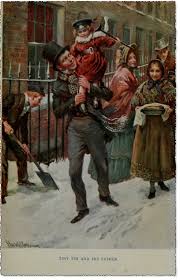
It’s classic, the scene of Tiny Tim and his sister looking through the toy shop window while waiting for Bob Cratchit. The world is cold behind them, but inside it a wonderland for children.

You’ll find this in most movie versions of A Christmas Carol. There is even a scene early in Tim Allen’s Santa Clause which is quick homage, with elves hidden among the children. I don’t think that scene ever appeared in the book. I’m not going to swear to it. I’ve read the book many times, and I don’t have time now to prove it to myself, but I’m pretty sure.

The first time I saw that scene in the 1970 movie musical Scrooge, it hit me hard. I wanted to know what else was going on in that toy shop. I wanted to know who ran it, and who made the toys. They couldn’t have been made by the silly proprietor in the movie. Their maker had to have a story to tell — or a story for me to tell.

I was particularly taken by the toy strong man, who eventually appears in critical scenes in Like Clockwork.

So . . . I wanted the builder to be highly intelligent and troubled. I named him Snap early on, with no idea why; then I had to scramble for a reason later in the process. I decided he should be a clock maker; now, why was he making toys instead? He had been cast out, of course, but from where and by whom? I had no idea when I started writing.

I wrote the first chapter and it fell out like water from a tap, including the name of the toy shop, which became the name of the book. Like Clockwork would start out as the story of a toymaker in a clockwork world. It smelled like steampunk, but I found out later that it was a pure time travel story.

At the end of the first chapter Snap turned around and there stood Balfour.

Robert Louis Balfour Stevenson is one of my favorite authors, and Kidnapped, the story of David Balfour, ranks right up there with A Wizard of Earthsea and The Old Man and the Sea as one of my three favorite books. As soon as my Balfour appeared unexpectedly on that London street, I knew that he was an avatar of RLS, but I made sure Balfour himself didn’t know it for quite a while.

Do you want to know where Like Clockwork came from? Other than from an image out of the movie Scrooge, and a lifetime of living, imaginatively, in Dickensian London, the answer is — out of left field. It has been a long time since a book has so completely written itself, chapter by chapter, line by line, with little foreknowledge on my part.

There is an exception to that. The ending came early and largely complete, but filling in the parts between was largely sans outline, sans planning, and sans any kind of reason. That may be part of why I like it so well.

Then Chapter 26, titled 62 – 54 = 9, which was the seventh chapter in my screwed up table of contents, fell out onto the screen. The opening sentence read, “Hemmings was a computer.” I didn’t see him coming at all. I just thought I needed a Babbage to balance the Great Clock. I had no idea how much it and Hemmings were going to take over.

It’s been fun. Throughout the novel there are little pieces of cultural reference and homages, sometimes humorous and almost always hidden. Scrooge himself is almost completely absent, except in feel, until near the end of the novel when he appears briefly in a cameo under an assumed name.

=============

Now that Snap had taken Pakrat with him, and Eve had sent a message that she would be gone today, Pilar was left alone with Lithbeth. She bundled her into a jacket, locked the toy store behind them, and set out to shop. They wandered the streets as if on holiday, talking with the cart vendors, and occasionally buying potatoes or onions. Lithbeth’s eyes were everywhere; she was almost never on the streets in the middle of the day, and things looked different in the strong, filtered light.

Through the grimy windows of an ancient building, Lithbeth saw a small man on a high stool, pen in hand, marking something in a thick ledger. His quick, bright eyes caught her as she passed, and he sent her a smile. She waved back, but then the Ogre came.

He was no larger than the other man, but powerful in his anger. He began to berate the clerk, and Lithbeth turned her face away.

Pilar put a hand on Lithbeth’s shoulder and said, “It’s best not to look into that window. It only makes old Countinghouse treat his clerk even worse than usual.”

“Why does he do that?”

Pilar shook her head. “Some men are like that,” she said. “A master can make his servant’s life a joy or a misery even in small things.”

“Snap would never do that.”

“No, he would not,” Pilar said, and felt a brief moment of peace. Snap would never do that.

=============

Of course, like Scrooge, Countinghouse has to have his come-to-Jesus moment. It comes on almost the last page of the novel.

=============

Dickens stopped dead in the street. The old scarecrow Countinghouse stopped likewise, and cringed at the sight of him, feeling a premonition of things to come.

“Who are you?” Dickens asked, in a voice firm with purpose.

“Countinghouse, not that it’s any of your business.”

“It is my business. Mankind is my business, but you in particular are my business. And you only call yourself Countinghouse because you have forgotten your name.”

“If I have forgotten it, let it remain forgotten.”

“There has been enough of forgetting. It is time to remember. You and I have much business together.”

=============

Poor old codger, people just won’t leave him alone.

650. My Friend Charles

When I was a junior in high school, I was force-fed Great Expectations and it was the most excruciatingly boring experience of my young life. It put me off Dickens for years.

Then I started seeing adaptations of A Christmas Carol on television every Christmas. That led me to read the book itself, and it was even better than the movies. That led me to his other four Christmas books and they were also wonderful.

Maybe this Dickens fellow could write after all.

Somewhere in there, fully a decade before I became a writer, I started to want to write a Christmas book. That’s hard in a world where every other writer has the same idea. You see them on every book rack, paperback equivalents of made-for-TV movies, all asking, “will the girl get the guy by Christmas”? Really, they have nothing to do with Christmas, but that doesn’t keep them from being competition.

No one is every going to match A Christmas Carol, but to sit on the same shelf any book would have to meet a certain level of gravitas. And it can’t be a grumpy old guy who finds redemption; once Dickens got through with his version of that story, every other one would be pastiche.

Ultimately, I found my story, although I have not yet written it. In Philadelphia, in 1790, during the brief period that it was the American capital, Ethan Gunn, a merchant seaman, returns from a year’s long journey to find that his wife has died in his absence. His children were taken in by his brother, living inland, where they died in a house fire. (Or so he is told.)

It is Christmas time and the poor of Philadelphia are in great need. Gunn has money from his voyage, but he counts it as nothing compared to the loss of his family. Through a friend he contributes to those in need, giving us access to a series of brief views of the lives of a series of minor characters.

Gunn himself gains nothing from his charity, because he is not giving of himself. His only ties to humanity are his friend, and a seemingly orphaned girl he has rescued from a shipwreck and taken under his wing. She is of about the same age as his lost children; in trying to ease her grief at losing her parents he comes to love her.

Every scene of a poor family rescued from the brink by Gunn’s aid only drives him closer to despair. The seemingly final blow comes when the parents of the girl he has befriended turn out to have also been saved, and are looking for her. He faces his demons when he considers hiding her away to keep her for himself, then relents, and finally gives away the only thing that has real meaning for him.

Whereupon his own children turn out to have been living with a Moravian family after escaping from the house fire, and are reunited with him.

It’s the unwritten books that will haunt you.

Incidentally, Gunn’s daughter becomes the mother of Titus Young. See 636. Half Breeds, Various.

*            *            *

Like Clockwork, which I finished about nine months ago, also owes a lot to A Christmas Carol. It isn’t a Christmas book, but it is Dickensian, and it owes it’s origin to a scene in Scrooge, the musical adaptation. I’ll tell you more about it on Wednesday.

Like Clockwork isn’t really my Christmas book but it is as close as I have come so far. It’s out looking for a publisher right now. Maybe by next Christmas you can see for yourselves.

649. Sorta Lost, Sorta Not

I started this as a note to myself on November 25, but it morphed into something else.

I have been writing Dreamsinger since July, following my usual foolish technique of jumping in with both feet and stomping around until things start to take shape. I knew the basic outline of the novel, but finding secondary characters to carry it on and portraying the culture without narrative dumps has been a bit difficult.

At this point, Dreamsinger is something of a tangle. There are about 25-30 thousand words of good writing, but things are misarranged (deranged?). It doesn’t properly hang together yet.

Richeal is part of the problem. I know you don’t know who she is, but let that stand; explaining her would force this into two posts, and I’m not ready for that yet.

I have avoided Richeal and pushed her into the background, despite the fact that she is a main character. She could be the big time villain; better still she could be the well-meaning and ruthless seeker after the wrong star, somewhat like Curran. I have finally chosen the latter, and that means I need much more of her, much earlier.

Dreamsinger now begins with the prolog and Antrim’s initial response to a suicide. That much works well. We still need to see and come to value Antrim before anybody else takes the stage, because we will see the story primarily through his eyes. However, Richeal is his primary adversary and should be present and a major force by the very next scene. I will do that, but it will require rearranging the sequence of a dozen smaller scenes.

My underlying error is the failed idea that the culture of the spacebounds is of small interest, and the culture of the planetbounds should be the novel’s main focus. I have been trying to present the spacebounds in as few words as possible in order to get on to the meat of the story. It turns out, that is the wrong way to go about it.

The reason Dreamsinger has gone adrift is the same reason that I’m living in the foothills today.  I hate crowding and I hate cities. I want to get down onto the planet Stormking where I will feel comfortable as quickly as I can. That would make the act of writing more pleasant for me, but the story would suffer.

The hyper-city, Home Station, is the culmination of an escape from Earth and the starting point for everything else. If I want to write this novel, instead of an Andre Norton style struggle in the wilderness, I have to follow its internal reality and suppress my distaste. Otherwise I need to write a different novel.

I have to write about a place I would hate, from the viewpoint of a character who finds it quite normal, and who has no real idea of how artificial it is.

Antrim needs to eventually be able to see the plight of the exiles on Stormking from an understanding and sympathetic viewpoint. To build that character, I have to build the history, culture, and physical layout of Home Station, along with the personalities of those who formed him and those who are trying to turn him into something else. Thirty thousand words hasn’t done it yet, because they aren’t quite the right words. Yet.

Close, but not close enough. Yet.

This all comes down to the author’s experiences and values. I say the author’s experiences instead of my experiences because it is also true of you, you authors and would-be authors out there in the blogosphere reading these words.

Home Station, like the overcrowded Earth in the middle section of Cyan, comes from the nine months I spent on the south side of Chicago. You may live there and love it for all I know, but for me it was a hell of claustrophobic fear, trapped inside a tiny apartment, cut off from the nature that I love, and surrounded by a place where bodies showed up on the streets every night. The University of Chicago itself was a joy; everything else was horrid. I got the MA I went for and couldn’t leave fast enough.

On the other hand I find Stormking relatively easy for me to portray. I grew up in a land of powerful winds, extended droughts, dust, heat, cold, and tornadoes. I worked outside every winter in sub-zero cold and every summer in sweltering, humid heat, all before anyone had air conditioning and central furnaces. I loved it, except sometimes in the worst of winter, and it all seemed perfectly natural.

Now I have to live inside the mind of Antrim, for whom the claustrophobic Home Station seems right and natural, and for whom Stormking will be a near-killing shock to mind and body. I have to create, then live with, someone whose reactions are the complete opposite of my own.

Weird how things work out. Oh well, no one ever said writing would be easy.

648. Limits of Accuracy

The Limits of Accuracy
in World Building

I’m sitting here on October 15th with half a dozen files open on my computer, calculator at the ready, and a page of scratched calculations. I’ve been world building again.

In full disclosure, my last math class was college calculus and I don’t remember much of that. I’m no astrophysicist. I know that because I bought a book on orbital mechanics in hopes of cribbing a few formulas to use in my writing. It didn’t take long to realize that I was out of my element.

My primary source of world building math has always been How to Build a Planet by Poul Anderson. I have kept a xerox copy on hand since I first used it while writing Jandrax back in the seventies of last century/millenium.

Don’t bother to google it. There are so many resources available for world building on the internet today that it gets pushed to a back page. I don’t use the new stuff myself; it looks like a black hole you could fall into and never escape. World building can easily eat up all the time available for writing. Besides, there is a limit to the accuracy we need.

When I set up the solar system around Sirius, a long time ago, I popped in a few inner planets, more or less following Bode’s discredited law, and set their distances after calculating i, luminosity, for the most important planet.

Sirius A, for the record, has about twice Sol’s mass and produces about 23 times its radiation. I calculated the distances from it to where there would be a luminosity of 75% of Earth’s, 100% of Earth’s, and 125% of Earth’s, then dropped Stormking into the middle of that range. That gave me an orbit roughly the equivalent of Jupiter’s, so I took the length of Jupiter’s year and called that the length of Stormking’s year.

That was good enough for then, but not now that I’m actually writing. I have political exiles on Stormking (which has a Uranian tilt) who have to walk for their lives, continuously, to stay in the middle of that planet’s temperature extremes. I have to know the real length of the year on a planet that distance from Sirius, to see how far I have to make them walk.

The exiles have to proceed southward for most of a half a year, rest for a few weeks, then turn north again, forever. It provides all kinds of plot possibilities, but I owe it to the reader to get my figures straight.

Sirius is a double star, and that other star provides complications I can only approximate. Since I began seriously contemplating returning to Dreamsinger, I came to realize that the perihelion of Sirius B would, on some orbits, coincide with Stormking’s position on its orbit in a way that would cause a superheated event. Big trouble for the exiles; great opportunities for the puppet master. (That would be me.) I can’t calculate how often this will happen or how severe it will be, given my skills, so that will be a hole in my accuracy.

I moved the orbit of Stormking out to the 75% luminosity distance of 828 million kilometers to make my exiles slightly more likely to survive, and calculated the year length (in Earth days) from that, using formulae I don’t totally understand, and came up with 4493 Earth days. That is fairly close to my ballpark estimate of 4335, which is Jupiter’s year in Earth days.

Why do all this? Partly it is because you have to consider your audience. If you try to write hard science fiction, set around known stars, a few of your readers will be scientists, and a much larger number will be people who wanted to be scientists, or at least love science. You have an obligation to them not to do something dumb.

Actually, a lot of science fiction writers are scientists or engineers, and can easily do the math I struggle with. I admire them, but I don’t feel inferior to them. I got here by a different route and I know things they don’t know. In all likelihood, you know things I don’t know. It all comes out even in the end, or at least even enough that we can all share the same fraternity of people who enjoy science fiction.

Careful world building is a rule of the game. You wouldn’t play chess with two white queens. You wouldn’t write a western where Wyatt Earp carries a luger instead of a Buntline special. You might, however, give Earp a luger if you were writing steampunk. Different games, different rules. If you take the science out of hard science fiction, all you have left is . . . basically nothing.

Nevertheless, there are limits. I am not good enough at calculating orbits to know for certain what Sirius B would do to my scenario, but I know what has to happen in the story, and by God that’s what is going to happen, no matter what physics says. You have to draw the line somewhere.

Now it you will excuse me, I have three other planets to calculate, so my people can follow reasonable orbits traveling between them. I wouldn’t want to embarrass myself.

You know, sometimes I do miss warp drive. Punch a button, and there you are at Vulcan. It would be so easy.

647. A Prayer For Those Who Need it

A Prayer for Those Who Need It

Dear God,

We thank you for the food before us
We thank you for those who grew the food
We thank you for those who keep us safe
We thank you for our freedom,
         and for our Constitution.

Forgive us for the ways in which we have failed you
          by failing our fellow man.

Help us reunite the families we have separated
Help us succor the allies we have abandoned
Help us accept our own children,
          born beyond the border,
          but ours since childhood
Help us to accept the refugees,
          crying out just beyond the wall
Help us to free those incarcerated
          guilty of believing
          that we would give them
          the refuge we had promised.

Help us to see clearly,
          all the ways that we have failed you
          by failing our fellow men.

And forgive this nation.
          God knows we need it.

646. Stinky Boy and his Cousin

Attribution of pictures is below.

I’ve met a couple of new friends lately.

(Actually this post is a month out of date. It was originally scheduled for October 16, but was displaced by a tribute to Alexi Leonov.)

This has nothing to do with writing, just with the life of a writer up here in the foothills. Over the years I’ve had plenty of wild visitors. By visitors I don’t mean the nuthatches, jays, and woodpeckers who live here all the time; nor the northern flickers (we call them 747 birds because of their size) and rufous-sided towhees who winter over. I also don’t include the turkey vultures who are always overhead.

I do count the great blue heron who came walking by one day. There’s nothing like a six foot blue bird slurping down a gopher to get your attention.

We’ve had coyotes running through our property many times. On two occasions they crawled under bushes in the yard to die. One was a youngster, probably hit by a car. The other was a ragged oldster at the end of his days. Those are the events that bring a settling of dozens of the vultures.

I don’t blame the oldster for picking our place as his last rest. We don’t have dogs to harass, we have lots of shade, and we keep basins of water available through the yearly seven month drought. We can’t stand the thought of a thirsty animal.

We have raccoons, although we rarely see them. Some mornings one of the water basins will be solid mud, and we know they’ve been by to drink and wash their food. Three times we’ve been visited by the neighborhood bobcat, but our elevation is a bit low for mountain lions. I’m all right with that. Bobcats don’t eat people; mountain lions occasionally do.

We have ducks and geese flying by and small hawks and owls living in our trees. Big red-tailed hawks and an occasional bald eagle cruise overhead with the ubiquitous vultures. And of course, bats come out by night.

Deer come by from time to time and eat our tomato crop. We were even visited once by the Christmas Pig. That was a 300 pound escaped porker who passed by one December 25th.

We have a flock of turkeys who come by two or three times a week in winter. I haven’t seen them for months, but they are about due to return. (And here they are, a week after I wrote that.)

I’ve mentioned most of our normal visitors before. Recently we’ve had two new ones. The first announced his presence several nights a week for a month or so, sending us an odoriferous wake-up call through the open window. We knew we had him before we saw him. I was walking back to the house at dusk one evening when I almost stepped on him. He looked up quizzically and I retreated.

Then for a few weeks, he showed up in the daytime. Who knew that a skunk is one of nature’s most beautiful creatures? I haven’t seen him for a while now and I miss him, odor notwithstanding.

Then, on the last day of September, Stinky Boy’s cousin showed up.

Now I know a badger is not a biological cousin of a skunk, but they share a striped face and that’s close enough for me.

In the interest of full disclosure, my wife saw him for full-faced positive identification. By the time I got there, all I saw was wide brown, furry butt disappearing at high speed into the distance.

So close, and yet so far.

The skunk photo is in public domain, the badger photo is via GNU. Both critters avoided my camera when they came to visit. Actually the skunk was in plain sight, but I didn’t dare get close enough for a good shot. You know, friendly fire.

645. Lassiter Triumphant

Sometime in the eighties as part of Cyan, I wrote the story of Lassiter, discoverer of Lassiter’s anomaly, destroyer of the final vestiges of Einstein’s version of the universe, and inventor of the space drive that powered all the starships in the novel. He was quite a character, and soooo not a hero that he was fun to write about.

Unfortunately Lassiter’s story took up too much space in a novel that was already verging on excessively complex, so I reduced the explanation of his space drive to 236 words on pages 64 and 65, and left the man himself out altogether.

I had already made this cut long before I retired from teaching and used OCR to get the half-completed paper Cyan manuscript into the computer. Somewhere in the dozens of boxes from the pre-computer half of my career, Lassiter remains. It would be nearly impossible to find him this late in the game.

There are a lot of paragraphs, pages, and chapters like that, irretrievable in the outer world, but still resident in the dust bin of my mind. I enjoy rummaging around there and experiencing them again, even though you can’t see them.

Now that I am writing Dreamsinger, I have a chance to resurrect Lassiter from memory, and this is the attempt. If things go well, I will finally be able to commit him to print within the novel. If not, at least you get to meet him here.

=================

Lassiter was a funny looking guy who loved women, and had more success with them than you would have thought possible. He had a big nose, big ears and a receding hairline. He was five feet eight and skinny, but he had a big personality.

His pursuit of women was not predatory, but he always wanted more. As soon as he had enticed one woman into his bed, he was ready to look for another.

Lassiter was also a fine engineer, and in his work he was as steady as he was unsteady with women.

If he had been less of an engineer, he would never have been able to develop a whole new way of looking at the universe. If he had been less horny, he would never have worked as hard at chasing fame.

#          #          #

Lassiter collaborated with an established ghost writer to produce his biography, which they called A Man of Gravity. It was not humility that kept him from writing it himself. Lassiter had no humility. It’s just easier to get away with bragging if you say “He did this . . .” instead of saying “I did this . . .”. For example:

Lassiter was fuming when he barged into Linda Volstone’s office. She was the vice-administrator of the Lunaire Pile, the Morris reactor which provided power for the entire Lunar colony. Lassiter was the senior engineer at the project, and he was a frustrated man.

“Lin,” he said, “you’ve got to do something about Dahlgreth.”

Volstone was slender with night-black hair. She had shared Lassiter’s bed two — no three — women ago, and she still had a weakness for him. She said, “What is Dogbreath up to now?”

Dahlgreth was not a popular administrator.

Lassiter said, “He still won’t let me publish.”

from A Man of Gravity, page 27

In fact, it is doubtful that this exchange ever took place. The real story was about a diligent engineer who discovered an overage in the power output of his reactor, and could not explain it. It was only a fraction of a percent, but it haunted him. It was real; it should not have been there; there were no errors in his instruments nor in his calculations. Something was happening that Einstein’s equations could not account for.

After a much research, he concluded that reduced gravity was the reason. Nothing in any theory supported him, and he was all but laughed out of physics, but the fact remained that no reactor on Earth showed the overage, but Lunaire did and the Chinese reactor on the back side of the moon did.

He published his findings and ran into a wall of opposition. Einstein had been under siege for more than three decades — but by theoretical physicists, not by some upstart engineer who had a few facts and a theory, but did not have fifty pages of unreadable mathematics to back him up.

A lesser man would have crumbled. So would a greater man, but Lassiter was motivated by something normal physicists would not have understood. He wanted fame. More than that, he wanted to be so rich and famous (and the rich part was extremely important) that women all over the world would throw themselves at his feet.

His biography did not say this, but everyone who really knew him understood.

He made himself famous by casting himself as the little guy that the establishment was afraid of. He built a brash persona, and then grew into it. He became the relentless voice of simple reason.

He gave interviews. He wrote op-eds. He was a favorite guest on talk shows. Everywhere he appeared he had the same message: the overage is there, lesser gravity is the only thing different, let’s outfit a probe and settle the matter.

The probe Dirac settled the matter. As it moved outward from the Sun, the output of its mini-pile grew. Measurements were made, conclusions were reached. It turned out that a larger portion of the reactor’s fuel was being turned into energy the further the probe moved outward from the Sun’s gravity. Somewhere beyond Uranus, the probe’s reactor could no longer handle the overage and it exploded. The nuclear fireball continued until every atom of the probe was consumed.

Once the metaphorical smoke cleared, it became apparent that anyone who could initiate a reaction beyond thirty-seven light minutes from the Sun would have a self-sustaining nuclear torch that would eat ice, asteroids, cosmic dust — anything.

Gravity was the only thing holding matter together. No one could explain why, but there it was. Start a hot enough fire, far enough from the sun, and Lassiter’s anomaly would bring about the total annihilation of matter.

It would provide a stardrive; not FTL, but good enough to allow starships to visit nearby stars. That brought enough fame to satisfy even Lassiter. And enough money. And enough women.

For the rest of his life, Lassiter basked in his accomplishment. Money poured in. Women adored him, or at least adored his money and fame. By the time he was ninety-seven, and still hanging on to life with apparent gusto, he was the second most famous man on Earth and the second richest, both following Saloman Curran.

When the nukes came down, his story ended with billions of other stories, but during his lifetime he lived driven by his gonads and never paid a price for it.

=================

When I was young, probably in high school, I ran across the following observation:

If a race of intelligent beings evolved at the bottom of a sea of mercury, they would be unable to discover electricity because every build-up of charge would be immediately dissipated.

I don’t remember who said that, or what book I found it in. Actually, I have mentioned this before, and asked if anyone knows where it came from. Do you know? I’m still listening.

That observation stuck with me and is the basis for Lassiter’s anomaly. What used to be called weightlessness and is now called micro-gravity is not the absence of gravity, but a balancing act within a gravity well. When we reach the empty spaces between the stars, what will we find there that has always been masked by the gravity that defines our perceptions?

Lassiter’s anomaly? I doubt it, but who knows?

644. Annotated Nostalgia

A few mementos from a well
misspent childhood.

Here is your Christmas list for any young people in your life, assuming that you want to help them to move beyond Star Wars. This also assumes that they can get past the anachronisms that are inevitable in books which are about the future, but were written decades ago.

Some of these are great; others are painful to read if you have adult literary sensibilities, but won’t necessarily be painful for kids.

It is nearly certain that some modern kids will find these intolerably restricted to reality. It’s your call. I’m just providing the list I promised in post 642. And since a simple list would be useless, I am adding annotations.

Tom Swift — Various characters named Tom Swift have been around in multiple incarnations, so let’s sort out their checkered history.

From 1910 through 1941, TS the original made inventions and had adventures that are basically unreadable today. If you want to see for yourself, try kindle.

From 1954 through 1971, Tom Swift Jr., the original TS’s son, did the same thing. These are the ones you are most likely to see. They were my bread and butter before I discovered libraries, but now I find them painful to read, although the inventions themselves are still great.

From 1981 onward, there were fourth, fifth and sixth series, about which I know almost nothing.

Tom Corbett — Tom Corbett Space Cadet never came to the hobby shop where I bought my early books, but I got a copy just a few years ago to give it a try. I couldn’t summon the energy to get very far without the added impetus of nostalgia, but it seemed better written than TS, and the protagonists actually got out into space. You see them occasionally in used book stores. There is an additional tidbit below.

Rip Foster — This is a single book with multiple names and is a forgotten gem. None of the other books on this list come close to its quality. See A Forgotten Classic, which also has details on where to get it.

The Heinlein Juveniles — Between 1947 and 1958 Heinlein wrote a dozen novels which were marketed as juveniles. I read the last ten. They are almost universally praised as the best in SF juveniles; I concur in that judgement. See 311. Boys at Work: Starman Jones.

Here is a double tidbit of trivia. The success of Heinlein’s juvenile Space Cadet helped Joseph Greene turn an unpublished radio script into the Tom Corbett Space Cadet series. Greene also later wrote the Dig Allen series, below.

Bullard of the Space Patrol — Copies of this book have been rare. I bought mine during the fifties at a stationary store that also sold a few odd books, but lost it over the years. Once I was an adult, I tried to find a replacement. After ten years I saw one copy in an antique store for a price I couldn’t afford, and ten years after that I found the copy I have now. In terms of quality, BotSP is second only to Rip Foster and ranks above the Heinleins. Although you are unlikely to see a copy in your local used bookstore, you can buy it used or on Kindle at Amazon. Finding lost treasures is much easier in the age of internet.

It isn’t technically a juvenile because of its adult protagonist, but I thought of it as one when I was young. I plan to write a full post on Bullard some time in the future.

Dig Allen — This series of six novels was published between 1959 and 1962. They are well written and well thought out, and I loved them as a kid. However you have to be prepared to accept that the heroes are going to find intelligent life everywhere in our solar system. Check at the very bottom of this post for more information.

Mike Mars — File these under blatant exploitation, but they were still a lot of fun. Published between 1961 and 1964, these books parallel the early manned space program. The premise is that there was a program called Quicksilver, using very young pilots, which did what Mercury did, but sooner and in secret. Anyone who thinks Area 51 houses dead aliens would have to love that.

Veteran SF writer Donald A. Wollheim was hired to knock these out (the first four came out in one year). They have something in common with Tom Swift Jr. in that half of each book is about the mission at hand and half is about chasing saboteurs and other baddies. Book five was my favorite because Mike got to fly the Dyna-Soar just before the real craft was cancelled.

Rocket Man and Starship through Space — If you find either of these, count yourself lucky. I read them in my high school library and have never seen another copy, despite decades of looking. They were written by G. Harry Stein under the pseudonym Lee Correy. They count as two of my all time favorites, despite the brainless ending of STS. See 194. Boys at Work: Lee Correy.

Rick Brant — I lived on Rick Brant when I was young, but it was a series based on then-contemporary cutting edge science, not SF of the future. As a consequence, it is extremely dated. As much as I would love to, I can’t recommend it for most modern kids, and their granddads already know about it. The Rick Brant series and the Rip Foster book were both written by Harold Goodwin under different pseudonyms.

==========

If you are looking at this post for your own nostalgic reasons, I suggest that you drop in on this Tom Swift info site and wander around. There you will also find a link to a sub-site on Dig Allen. I would go there at once as it may disappear. It doesn’t seem to be current and parts of it are already inaccessible, but it is a treasure trove.