
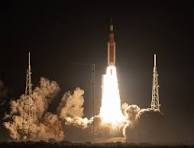
I never thought it would happen, but NASA proved me wrong. Good for them.
I was a space enthusiast from age 10, when space was impossible. I never lost my fervor. Coming home from our honeymoon a decade later, my wife and I went to her old college dorm to find a television and watched the Apollo 11 landing, surrounded by a crowd of enthusiasts.
Three and half years later, the glory was over. Manned exploration was over. We flew space shuttles, but only in low Earth orbit. We built a space station — two actually, and the Russians built many. Still, manned exploration was over. We were not-so-boldly going where Mercury and Gemini had gone before, but nobody was going where Apollo had so recently gone.
Then came NASP, Venturestar, and Project Constellation, phantom programs that promised new explorations, but died stillborn. By the time Constellation morphed into Artemis, I had given up — not on space exploration, but on the politicians who make it happen. Or don’t make it happen.
<< — >>
The rest is part of a post I wrote 45 years after the liftoff of the last Saturn. These were Gene Cernan’s words on leaving the moon at the end of Apollo 17.
“We leave as we came, and, God willing, we shall return, with peace and hope for all mankind.”
<< — >>
On December 7, 1972, at 12:33 AM Eastern Time, the last manned moon flight took off from Cape Canaveral.
Apollo was a stunt from the get-go. Kennedy’s speech set a goal of landing a man on the moon and returning him safely to the Earth within the decade. If we had failed, it would be laughed at today as just another empty promise made by a politician.
One man laid down the challenge and thousands of men and women carried out the promise.
But it was still a stunt. When Kennedy made his speech on May 25, 1961, Russia had put a man into orbit. We had not, although we had managed a sub-orbital flight. NASA had only been in existence for three years. By any real or imagined yardstick, the Russians were far ahead in space.
By herculean efforts, NASA forged ahead through Mercury and Gemini. The fire aboard “Apollo One” set American efforts back significantly, and when launches began again, it looked like the Russians were going to land on the moon first.
Something had to be done. That something was the Apollo 8 journey to and around the moon, without a lander, for the Christmas season of 1968. We could claim to have been to the moon first (by an ad-man’s stretch of the truth), even if the Soviets became the first to land.
The Russian program faltered. Apollo 11 landed a man safely on the moon, and returned him safely to the Earth.
Now what?
For the Soviets, the answer was to turn away from the moon. Their N-1 mega-rocket had failed, and their manned modules and lander were stored away. The Soviets began a series of long flights and space stations, studying space from low Earth orbit.
For NASA there were nine more Saturn V rockets waiting to launch Apollo 12 through 20. It didn’t turn out that way. Even before Apollo 13 failed, Apollo 20 had been cancelled so its Saturn V could be used to launch Skylab. Even before Apollo 14 landed, Apollo 18 and 19 were cancelled. Why? Because it was a stunt from the get-go. Apollo 11 had met the deadline. To coin-counting bureaucrats, that was enough.
For those of us who see space exploration as the future of humanity, Apollo 11 was only the beginning. Lunar exploration, a moon base, Mars, Venus — there should have been no end.
Bureaucrats did not agree. The program was cut short.
<< — >>
Eugene Cernan and Harrison Schmitt landed on the moon December 11, 1972, in the Taurus-Littrow region of the moon. This site allowed sampling a wide range of types of rock, as it consisted of an ancient lava flow, with surface broken by subsequent meteor strikes, and included secondary strikes. This means that ejecta from the nearby Tycho crater had come to earth (come to Moon?) causing secondary, smaller craters at the Taurus-Littrow site. This allowed Schmitt to sample Tycho material even though an Apollo landing at Tycho never happened.
A few minutes before eleven PM, Greenwich Time, December 14, 1972, the last manned mission to the moon lifted off, to later rendezvous with the CSM and return to Earth. Gene Cernan was the last to enter the lunar lander before take off.
We’ll give him the final words, spoken years later:
“Too many years have passed for me to still be the last man to have left his footprints on the Moon. I believe with all my heart that somewhere out there is a young boy or girl with indomitable will and courage who will lift that dubious distinction from my shoulders and take us back where we belong. Let us give that dream a chance.”
And now, we’re going back. It’s about time. Thank you to all who did not lose faith.
 A Writing Life