Tag Archives: Cyan

136. A Groaning in the Earth

There is a groaning in the Earth. In every corner of the globe, we hear the daily rumble of seven billion footsteps, raising dust in the desert, and pounding the concrete of city streets back into the rubble from which they came.

Earth Day is Saturday. It’s a beautiful idea, and ecological consciousness is long overdue, but all our good deeds matter little in the face of seven billion hungry souls. The band plays, but the Titanic still sinks.

Still, it is not in our nature to lose hope. We do what we can here at home, and dream of new frontiers. Like Cyan, where a minor character is about to bring a small dream to fulfillment.

***

As he walked down toward the fence that kept predators out of the settlement, Mitchell was torn between feeling excited and feeling foolish. He had been raised in a midwestern town on the Kansas-Nebraska border. It should have been an outdoor life, but every field was owned, and every farmer was ready to shoot on sight anyone entering his land. The crops of wheat that grew around the little town gave broad vistas, but there was nowhere to walk.

The town had been Mitchell’s prison and the wheat fields his prison walls.  Within the town were only a few tired locust trees, and across one corner an ancient creek bed cut a path. It had never held much water, and now it had only a sluggish flow of muddy outwash from field irrigation. When he was very young, Mitchell had tried to fish there, but the water was empty.

Mitchell’s body had lived in the town, but his imagination lived in the fishing books he checked out from the local library. Funds were low, so there were few modern books, but that suited Mitchell. His interest was in books from the last century; books about fishing in clear mountain streams for trout, grayling, or small mouth bass. 

Eventually, Mitchell grew up, moved away, went to college, got a job, and had as good a life as anyone could hope to find on overcrowded Earth. When Cyan opened up for colonization, his childhood dreams led him to apply. Now he worked as a chemist, stared through the fence that protected this new town from the wilderness beyond, and still dreamed. Until today.

Mitchell passed through the fence and closed the gate behind him. He walked down to the bridge over the Crowley and paused to admire the glint of globewombs far overhead. Then he crossed over and moved downstream. He had picked his place already, a sand bar just within sight of the bridge. Delacroix had told him that the pharagals could leap upward and shoreward, but that if he stayed at least three meters back from the water, he should be safe. But no guarantees; about Cyan, Delacroix never gave guarantees.

Now Mitchell opened a plastic jar and took out a fly. The hook had come from Earth as part of the precious ten kilograms of personal equipment each colonist had been allotted. He had tied it using cloth frayed from his jeans. He attached it to a Cyan-spun kevlar leader and tied that to his precious only fly line, just removed from its original package last night. The reel was also from Earth. It was an antique he had bought before he ever heard of Cyan because it was from a twentieth century company called Mitchell. Like him.

Carefully but unskillfully, he began to cast. He had never used a fly rod before, but he had read and re-read every book on technique. Eventually, he was able to get the fly out over the water and let it drop. It floated in the sluggish current, a wad of cloth trailing a snarl of frayed cloth legs. Probably no more pitiful excuse for a fly had been tied in a hundred years.

But on Cyan, no fly had ever been used. A dimple appeared in the water and the fly was gone. Mitchell pulled back on the rod, and something exploded into motion.

Five minutes later, Mitchell dragged his catch across the sand bar to a point where he could safely examine it. It was slim and bright blue, with a blunt head and twin tails that reminded him of pictures he had seen of seals. Down each side of the Pseudopisces was a row of interlocking cream and maroon triangles. It was gaudy and ungainly, but to Mitchell, it was the most beautiful thing he had ever seen.

He unhooked the fly and put it away carefully, reverently rewound the line onto his reel, and picked up the . . .

Trout! The Cyanian blue trout. It didn’t matter what this species had been called by the scientists. To Mitchell it was a trout, and to the tens of thousands who would read his fishing books over the next four generations, a trout it would remain.

134. The Long Road to Cyan (2)

This is a continuation of yesterday’s post. The writing of Cyan began about the time Jandrax was published. Why it took so long is a tale for another time, or maybe never, but the mechanics of bringing it into the twenty-first century will be of interest.

I followed the rise of OCR (optical character recognition) technology as it became available, but didn’t have a functioning system until about 2008. By that time I had two novels in published form, a novella in Galaxy, and five novels in typescript. I also had two other novels which were born on the computer. About half of Cyan was still in typescript and half was digital.

OCR is wonderful. It scans in text, flyspecks, pencil corrections, stray pencil marks,  coffee stains, the shadows from clumps of white-out, the shadows of paper creases, and an assortment of self-generated fantasy marks. Afterward, you have to read the result side by side with the original and make lots of changes.

Actually, scanning dismembered paperback books and magazines is relatively accurate. When I scanned To Go Not Gently before including it in Serial, OCR only made about a dozen mistakes per page. But when it scanned old typescripts . . . well, it took months to undo the curse of the typewriter. Then I was ready for final correction and polishing before Cyan could go out into the world.

Publication in the age of Cyan (2016)

Writer’s Digest and all its daughter publications used to be the bible for authors. Now they are only a place to begin generating lists. You have to go to the publishers’ and agents’ websites for details, or you’ll be lost from the outset.

The digital age has empowered publishers and agents – to be picky. They used to be happy if you typed double-space in pica instead of elite. Now they specify, and nobody specifies the same thing. Some want Times, some want Verdana, some want Courier – or was that Courier New. Some want .rtf, some want .doc, and some want .pdf.  Some still want paper, believe it or not. If they want paper, they don’t want return postage. It’s cheaper to shred at their end and print fresh at yours.

So, let’s say magic happens. Your novel is accepted. Now things really become different from the old ways.

Early in your search for an agent or publisher you were not allowed to send attachments to your emails. That will probably change now, and you will send your ms. formatted in the manner they prefer, as an email attachment. Just like the bad old days, you can pretty much count on months of no contact. Email makes it easier for them to contact you, if they need to, but it also makes it easier for everyone else to contact them. For agents and publishers, being too busy never seems to go away.

In the old days, you would spend this time writing your next novel. That is still true, but it is also the time in which you start preparing to promote your novel when it comes out. Once upon a time you didn’t promote your own novel because you couldn’t. Now you can, so you have to.

How? I can’t fully tell you because I’m still learning, but you can find a thousand people on the internet who think they know. Be careful; some of them charge money. For me, the main thing was to start this website. It has been going for eight months now. You are reading post 134 on this blog, with even more on the sister blog Serial. That’s a day job in itself.

You can get a business page for your Facebook account. I did, but it didn’t work for me. I was already saying everything I needed to say here, so Facebook was redundant. I am getting ready to tweak my author pages on Goodreads and Amazon. I may even try Twitter, but I’m not sure. I don’t think I could clear my throat in 140 characters.

Cyan is coming out from EDGE, a Canadian publisher specializing in science fiction and fantasy, as an e-book. It has been sixteen months since it was accepted, which I understand is not a particularly long wait. Since I’m writing at the end of March, I will probably know the release date by the time this goes online.

In mid-March I got the proofread manuscript back from EDGE and had to learn a whole new set of skills. Change tracking is a function shared by Pages (the word processor I use on my Mac) and Microsoft Word (used by the business world, including publishers) which allows an editor to make changes which are tracked and identified as hers in a sidebar, and allows her to make boxed entries in which she can ask questions, make suggestions, and share concerns. As author, I can then either accept or reject her changes. I can also recognize good criticism, but rewrite a segment in my style instead of accepting her changes. I can make notes in the sidebar for her attention, especially since format changes are better made by her than me. I can even explain the reasoning behind some decisions that might seem arbitrary.

Change tracking is one more reason why these are the good old days. Thanks, Michelle at EDGE, for a great job of proofreading.

About the first of March, I received a questionnaire for the publicity department which asked for such things as an imaginary interview with me, and imaginary interview with one of the characters in the book, three blog-entry style pieces, and the story behind Cyan. They also asked for a one paragraph, a two paragraph, and a four paragraph excerpt from the book, and for a 10 word, a 25 word, and a 75 word statement that might be used for cover blurb. I also received a questionnaire on cover design which asked for a physical description of the main characters, and gave me a chance to suggest a scene for the front cover.

They are still free to make any decisions they choose, but I am hopeful. EDGE seems to want to do things right.

133. The Long Road to Cyan (1)

Keir and his friends travelled eleven light years to get to Cyan. I sometimes feel as if my journey has been longer. I first wrote down the names of the ten explorers, carefully chosen to represent ten different countries, in 1978. That was about the time my first novel, Jandrax, was accepted by Del Rey.

Cyan will be released in e-book form from Edge, probably in the next month or two. As of today (Mar 30) I don’t know the exact date.

A lot has changed between the two releases. Since many of you are here primarily to find out how to get your own novels published, I’ll give you a rundown on the old and the new of it.

Publication in the age of Jandrax (1979)
(You can skip this until part 2, tomorrow,
or you can stick around and laugh at the bad old days.)

When I sent Jandrax around, most publishers accepted queries, then often asked for samples or full novels. You never sent the original. Once a typed and corrected manuscript was complete, it was precious. A coffee spill could destroy weeks of work and you couldn’t just push print to get another one. You sent a photocopy, and you included postage for its return. After a few publishers had seen your novel, the ms. copy started looking pretty ratty.

All this was expensive for a would-be writer, since photocopying cost a dime per page, coin fed, one page at a time, at the local library. There were hard learned tricks to this process, as well. Without computers, there was no headers function. Typing your name, address, phone number,  book title, page count, and page number on each page was out of the question. I typed all this once (with the word page, but no number), trimmed the copy close, and taped it face down on the platen of the xerox machine when no one was looking. After copying all the pages, I filled in each page number by hand.

I’m sure Heinlein had people for this.

In August of 1978, Del Rey bought Jandrax. It was published in April of 1979, which is a pretty quick turnaround. I didn’t have much to do with the process, and certainly had no say in decisions made. I didn’t see the cover until I got my 20 free copies in the mail. It’s a great cover, even though the “reviewer” at Locus mocked it instead of reading the book.  The back blurb was another story:

JAN ANDRAX
As a scout he’d tamed
four planets — and more women than
most men ever see . . .

Well, not really. I wasn’t too embarrassed though, because every reader knows that back blurbs are made up by sex crazed maniacs who haven’t read the book.

My only input between purchase and publication was to review the galley proofs. Galleys don’t exist anymore, but before computers, the typeset version of the book was run off in long sheets, about four inches wide and eighteen inches long, and sent back to the author for approval.

From the obsolete word file — stet. Not stat, that’s doctor talk for right away. Stet means “No, no, no. Put back that sentence you red-lined out. That was exactly what I meant to say, and I don’t want it changed!”

Truthfully, despite horror stories you might have heard, all the proofreaders I’ve encountered have been good at their job.

Jandrax came out and sold some copies, but never paid back its modest advance. That was normal for a first novel, back when first novels got any advance at all. There was an article in the local newspaper, I had a book signing at a local bookstore, and my wife bought me a T-shirt with Jandrax printed on it. That was the publicity campaign.

Things are different today, as I will explain tomorrow.

129. Poetry on Cyan

What do you do at the end of a long day of exploring a new planet like Cyan? Watch TV? Read a book? Maybe a western shoot-em-up, since science fiction wouldn’t be much of a change of pace.

If Uke Tomiki were one of your colleagues, you might write poetry.

It was late.  Beyond the meadow, the jungle was predominantly blue-green with spots of color where flowers of innumerable variety grew, and where tiny, flower-winged amphibians fluttered.  Globewombs glittered in the tree tops like a scattering of jewels in the dying light.  Procyon was setting as they watched, and night flying amphibians were coming out to catch the chitropods.  A small herd of dropels grazed just beyond the fence.

Tasmeen said:

Sunlight pearls,
Treetop caught.
Wombs of glass wherein
Tomorrow waits.

“Nice,” Keir said.  “Did you just compose it?”

“Oh, no.  I’ve been working on it for days, but it won’t come right.  What do you think?”

“Maybe a bit too clever at the end.”

“Too sweet?”

“Something like that.”

“Any suggestions?”

Keir smiled.  “You’ve heard my poetry.  You know I’m not the one to ask.  What would Uke tell you?”

Tasmeen made a face.  “Less is more.”

“So I humbly submit – bearing in mind the humility that Uke’s poetry has forced upon me . . .”  Tasmeen hit him in the arm, and he grinned, “that you take an axe to it.”

She sighed and said, “I knew you were going to say that.”  She repeated the poem, now abbreviated:

Sunlight pearls,
Treetop caught.
Wombs of glass.

Keir spread his hands.  “That’s it.”

“It will require a more knowledgeable audience than the first version.”

“Hey,” Ramananda demanded, “ain’t we sophisticated enough for you?”

Sometimes Keir thought that Tasmeen and Uke’s poetry caught more of Cyan than their scientific findings.  After sex and discussing their research – probably in the other order – making poetry had become their primary form of recreation.  

Tasmeen recited several of her newer poems, then teased Keir, “Do you have any new bordello rhymes for us?”

Keir knew that Tasmeen would only badger him until he relented, so he recited his latest.

Call me Gomorrah, she said.
Nothing more —
Unless you count her straining
          breasts as speech.
Call me Gomorrah —
          It told me all I had to know.

Ramananda shook his head in mock distaste.  “Always the dirty mind.”

“I like it!”  Tasmeen protested, then took Keir’s hand and said, “You can call me Gomorrah any time you want to.

127. Not a Frog, Not a Kangaroo

220px-Litoria_tyleri220px-RedRoo

Flashback: 1963, riding in a car, reading an article, probably by Arthur C. Clarke, on why humans should go into space. A little fish, swimming in shallow water, said to his father, “Why don’t we go up on the land and see what we can find?” The father fish responded, “Why would you want to do that?”

I read the passage out loud, but no one was interested, so I relapsed into nerdy silence.

Years later I found that the now accepted theory is that fish in shallow waters, accustomed to using their fins against the sea bottom, began to use them to navigate mud flats at low tide as mud skippers still do in mangrove swamps today. Legs evolved from fins.

It didn’t happen this way on Cyan. (This is a follow-on to yesterday’s post. If you missed it, we’ll wait for you to read it. Done? Good.)

On the planet Cyan, hundreds of millions of years ago, primitive chordates developed a split vertebral column, which resulted in twin tails. When they moved onto land, their tiny front steering fins were never used for locomotion and their twin tails (they had no back fins) became legs.

As Gus Lienhoff said when he dissected the first one Cyanian creature the explorers had collected:

Look, no pelvis. Look at this complex of bones. Some are fused, some flex, and these four are cantilevered. And look up here; no scapulae, just three extra thick, specialized vertebrae. Tiny front legs, powerful back legs with twice as many joints as you would expect, and absolutely no hint of a tail. Not even anything like a coccyx. A truly tailless, truly hopping biped. I wouldn’t have believed such a thing was possible.

Not a frog, not a kangaroo.

Frogs are quadrupeds with overdeveloped hind legs, like rabbits. They have a vestigial tail, like a human coccyx. If you look at a frog’s skeleton, it looks a bit like a massively deformed human. They can leap, but they also walk.

Kangaroos have a five-legged gait when walking. They lift up on a tripod made of small front legs and a powerful tail to shift their massive hind legs forward. Then they stand balanced on their hind legs while moving their forelegs and tail forward. 3 – 2 – 3 – 2, etc.

Cyanian bipeds, from the simplest to the most complex are hoppers. They all have short, grasping forelimbs; not quite T-rex hands, perhaps, but too weak to knuckle walk. They can move miles with grace and speed, but moving inches puts them into a condition of stumbling clumsiness. There are tree dwelling bipeds; how they navigate is a mystery I didn’t get around to investigating

When a trio of Cyl (intelligent Cyanian creatures created through recombinant DNA – its a long story) first enter a human habitat . . .

They were awkward inside the dome where the furnishings of the place made a maze for them to negotiate. As bounders, they were creatures of the unobstructed open plain. This human habitation was utterly foreign to them, not because of the steel from which it was made, or the interlocking triangles of its geodesic construction, but because it was cluttered. How could one hope to move about in it?

I don’t claim to be an artist, so I have made no effort to draw or paint these critters. I also haven’t seen the cover EDGE is putting on Cyan. If it has Cyanian hoppers, I sure hope they don’t look like frogs or kangaroos.

126. Let’s Build an Ecosystem – 2

Continuing our look at the creation of an ecology for Cyan. If you missed yesterday’s post, you might want to go there first.

We can take grasses and weeds for granted. Let’s give our trees multiple trunks bound together, like a strangler fig without its victim, and that should be enough. We need something like insects. We’ll call them Chitropods – chitro sounds like chitin, and pod means foot, so our reader will infer an exoskeleton without any further work on our part. Continuing the idea of inference, if we call the flying creatures who eat the chitropods pouchbats, the reader will draw a better picture in his mind that we could on paper.

The number of legs is important to Terrestrial arthropods, but lets bypass that by giving all our chitropods many legs, but with only one joint each where it meets the body. Now they have a rolling gait “like caterpillars on crutches”. Humor helps keep description from limping along. (Sorry, couldn’t resist!)

These are throw-away inventions. They could have been applied to any ecosystem and they are not systemically related to each other. They alone would be good enough for almost any SF novel, but not for one about scientists teasing out the essence of their planet.

Here we need a key differentiation, from early in evolution, from which a thousand lesser differences can be derived. Here it is: on Cyan, early in the development of chordate life, the vertebral column doubled at the posterior, giving the Cyanian version of fish twin tails. That changed everything. I’ll explain more fully tomorrow in a separate post.

On Cyan, the classes are Pseudo-pisces, Amphibia, and Inturbia. No reptiles, no birds, no mammals, no dinosaurs. The Amphibia are cold blooded. Inturbia are inefficiently warm blooded. The term Inturbia should imply “internal body temperature un-perturbed by external changes”. Not every reader will get that, but we need to reward our best readers by not spelling out everything.

There are a thousand other details, but for that, you will just have to download the book when it comes out. From EDGE. Soon.

***

I do have one more thing to share. I wouldn’t bother you, but since you’re reading a post about the backstage secrets of writing science fiction, I can assume that we are all nerds together here .

Inturbia have live birth. Cyanian amphibs have to return to water to lay their eggs, except for one group, the Sphaeralvids, who produce globewombs.

(Globewombs were) the closest thing to an amniote egg that Cyan’s fauna had developed – a transparent, leathery sac extruded by a Sphaeralvid mother and filled with a clear fluid like seawater. Into this she deposited fertile ova, then defecated. Then she separated from the globewomb and left it cached in the crotch of a tree, high up where it would receive full sunlight. On a bright day millions of these globewombs glinted in the treetops.

Algae from the Sphaeralvid mother’s bowels converted the feces into biomass and the Sphaeralvid nymphs fed off the algae.  When the feces were gone, the globewomb walls would break down, leaving the now sizeable nymphs free to face Cyan on their own.

Neat, huh?

125. Let’s Build an Ecosystem – 1

Over in Backfile, you will find an eleven part document called How to Build a Culture, inspired by Poul Anderson’s How to Build a Planet.

I could also write a paper called How to Build an Ecosystem, but who needs to read all that. A couple of posts here should cover the subject, without boredom or overload.

The fact is, simply peppering your planet with a few well chosen and deeply odd critters is enough in most cases. Andre Norton did it all the time, and it worked for her. The frawns and yoris on Arzor are simply transmogrified bighorn sheep and alligators, but so what? They provide plot points and local color, and that is all that is asked of them. Marion Zimmer Bradley gave us a mammalian snake, a hyper-weasel, and an intelligent dinosaur who sent out pheromone soaked calling cards in Hunters of the Red Moon. What more could you want? In Jandrax, showing up now in Serial, my native animals were distinctive, but most were mammalian, as one would expect from ice age migrators.

When I wrote Cyan, I faced a different situation. My crew was set down on an alien planet for one year, with the task of coming to understand its weather, geology, and ecology in order to prepare for colonization. They were all scientists, so their actions and conversations called for a deeper understanding of their new world than any other kind of science fiction novel would have required. Actually, that challenge was half the fun.

When I began Cyan, I had been studying ecology for about twenty years, starting back when I had to explain what the word meant. I later came to understand the essence of Earth’s taxonomy in the most rigorous possible way – I had had to condense it to a level which middle school students could understand without dying of boredom.

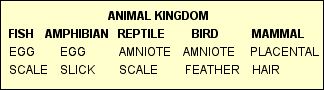
Scientists should forgive the following chart and paragraph.taxon

Drop a salmon egg on the gunwale of your canoe and it will dry out in minutes. A chicken or turtle egg would survive the same treatment. This is the meaning of amniote egg (although there are other, competing meanings). Creatures who lack them, must lay their eggs in water. The rest of the chart should be clear, although simplified. For example, birds have scales on their legs as well as feathers elsewhere, and I skipped Dinosauria altogether.

Now pull up a chair and lets build Cyanian ecology. It needs to be wierd but recognizable – that’s the key to all science fiction invention. We also need restraint. You can only explain so much to your reader without losing them, and beyond a certain point, your backstory is wasted effort.

Come back tomorrow and we’ll dive more deeply into Cyanian ecology.

114. Einstein Got It Wrong

As I said in the first post of this blog, way back in August, we are the last generation of writers who will have the privilege of putting the planets which suit our stories around nearby stars. It’s already too late for our solar system. Heinlein could not write Stranger In a Strange Land today; in fact, he eventually had to shift it to another timeline where Martians with their canals and cities still exist.

Answer this: if you read stories from the 60s and 70s, how many of them were set on planets around Alpha Centauri? Dozens, at least. Soon scientists will know what Alpha Centauri’s actual planets look like, and that party will be over.

The slowing of time at relativistic speeds – Heinlein got a lot of mileage out of that in Time For the Stars, as have many other authors. But not so much lately; these days, everything seems to move at warp speed.

The next real-world century will be exciting, but science fiction has largely moved on to the far future. Cyan, due out soon as an e-book from EDGE, explores that near future.

*****

Standard Year 594
Anno Domini 2086
from the Log of the Starship Darwin,
en route to Procyon system,
S.Y. 594, Day 167 (corrected),
entry by Stephan Andrax, Captain

Einstein got it wrong.  He took Newton’s tidy world and turned it inside out, ousted common sense from physics, and gave us the bomb, bent light, and all the rest.  So what?

The speed of light is not the central fact of the universe.  I am.  Not, “I, Stephan Andrax, am the center of the universe.”  The I which speaks when any one of us utters an ultimate truth . . .

I hunger.

I hurt.

I love.

I am.

That I is the center. Everything else is fantasy.

There are two chronometers on the bulkhead. One forges forward at the speed of Everyday, ticking off seconds and minutes and hours and days that make sense to the body and soul. The other races. Seconds flitter by. A new day is born every three hours and twenty-two minutes. Einstein told us this would happen, a century and a half ago; when an object approaches the speed of light, time slows down.

Beside the chronometers is a viewport and beyond it are dopplered stars which sweep through my field of vision as the ship spins. We are nearly six years into our journey. Half way through our journey. Yet, for me, only a year and a half have passed.

And through all the years and hours of our journey, the smaller, fleeter chronometer will rush ahead at Earthtime while our time is slowed. All those I knew and loved, except my companions here on the Darwin, are aging seven times faster than I am. When we return, my agemates could be my parents, and my parents will be dead.

The mind perceives what the heart cannot comprehend.