Tag Archives: ecology

348. Spring

        Friday was Cinco de Mayo. Since I don’t post on Friday, I have placed this note here.
        Cinco de Mayo and St. Patrick’s Day are opposite sides of the same coin, as I explained in 115. St. Patrick’s Day with Juan O’Malley, last year. I also had something to say about racial identity in 144. Who Said You Were Mexican?, on Cinco de Mayo, a year ago today. I don’t want to repeat those posts, but you are welcome to click and visit.

Now, today’s post, beginning with a quote from Cyan:

For the colonists, the world that loomed beyond the perimeter fence was a fearsome enemy. Cyan’s climate aggravated the problem. The colony was situated in the region of spring — or autumn, depending on your psychological makeup. But it was neither spring nor autumn, and as the year wore on there grew up an unhealthy expectancy. Minds and bodies geared to seasonal change had a gene deep awareness that spring had been prolonged past its time — an awareness that slowly changed to a deep, unarticulated dread.

In Cyan, I made a great deal out of the lack of seasons, because seasons are so overwhelmingly important on Earth. Of course, people who were born and lived all their lives in Hawaii or Tahiti probably look at that claim and say, “What the heck is he talking about?” But most of us know.

Here in the foothills of the Sierras, half the year is harsh, brown and dry. The other half is green, and during that rainy seasons wild flowers not only come in profusion, but they also come in order.
First comes miner’s lettuce, with tiny flowers in the center of large, circular leaves. Not impressive as flowers, really, but a life saver for the the vitamin starved miners during the gold rush. Then comes Blue Dick. Now don’t blame me; I didn’t name it, and it is lovely despite its name.

The lupine come early middle and late, in a variety of colors. When my wife and I first came to the foothills, we learned most of the names, but now we mostly just look and enjoy.

What has this to do with writing? It’s the way I choose to live, and the places my characters go are mostly places I wouldn’t mind accompanying them.

Today (April 24) my wife and I drove to one of our many favorite spots. It’s late in the sequence of things, but the white lupine haven’t quite reached their peak.

In New York City today, there are writers inhabiting dim, smoky bars, gathering material for their next novel. More power to them. I couldn’t take it.

For me, I spend my green winter going out twice a week to see how the wildflowers are coming along, and gathering material for my next novel. That’s my story, and I’m sticking to it.

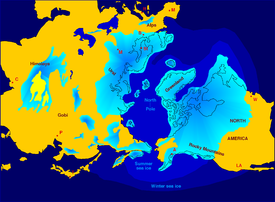
337. The Year Without a summer

The Little Ice Age (yesterday’s post) was vague and questionable in its outlines and origin. The Year Without a Summer was precisely delineated, and there is no question of how it came about. It was the result of volcanic activity.

There is, however, a smaller mystery. In 1808, a very large eruption took place, but no westerner saw it. It is memorialized in ice samples from Greenland and Antarctica, and scientific detective work places the eruption somewhere between Tonga and Indonesia. It began a period of northern hemispheric cooling.

Then in 1815, the largest and most destructive volcanic eruption in human history took place at Mount Tambora in what is now Indonesia. The explosion was heard 1600 miles away. (Krakatoa, a better known eruption in the same region in 1883, was less intense.) Between the mystery eruption of 1808 and the Mount Tambora eruption of 1815, the second decade of the 1800s became the coldest on record. 1816 became known as The Year Without a Summer.

(As always seems the case with science, nothing is simple. 1816 fell within the Little Ice Age and was also associated with a low in the cycle of sunspots. If you really want to understand, I suggest a Ph.D. and a lifetime of study. That will give you some answers and a cartload of more sophisticated questions.)

The Year Without a Summer was disastrous. Crops, which had already been bad, probably because of the 1808 eruption, failed. Famine was everywhere in Europe, followed by typhus. There were massive storms and floods; an estimated 200,000 died in Europe.

In America, the northeast was hit hardest. Frosts continued through the summer. In August ice floated on Pennsylvania rivers. Snow fell in June in Massachusetts. Food was scarce and in 1816 there was no way to move it from less affected regions to those hardest hit. That year and shortly after, masses of northeasterners moved to the midwest, swelling the populations of Indiana and Illinois.

The event left echoes in literature. In 1816 Mary Shelley, Lord Byron, J. W. Polidori and others were storm bound together in a villa overlooking Lake Geneva. A contest of writing ghost stories ensued. Byron wrote a fragment, which Polidori later turned into the first vampire story (The Vampyre), Mary Shelley began what later evolved into Frankenstein, and Byron also wrote Darkness, a long poem inspired by the lightless days.

Here is a bit of that poem, which brings back memories of those old science fiction stories from my youth when the glaciers moved in to destroy humanity.

The crowd was famish’d by degrees; but two
Of an enormous city did survive,
And they were enemies: they met beside
The dying embers of an altar-place
Where had been heap’d a mass of holy things
For an unholy usage; they rak’d up,
And shivering scrap’d with their cold skeleton hands
The feeble ashes, and their feeble breath
Blew for a little life, and made a flame

336. The Little Ice Age

Hannes Grobe/AWI – own work – redrawn, supplemented and modified graphic from John S. Schlee (2000) Our changing continent, United States Geological Survey.

The writing of this blog is a pleasure, but it is like a fireplace on a deep winter’s day — it takes a lot of fuel. Sometimes topics fall into short supply. Sometimes I don’t know where my next blog is coming from.

Sometimes I get on the internet and put my conscious mind on cruise control. I let my fingers on the keyboard seek out half remembered images, phrases I have heard, interesting titles from catalogs of books I’ve never read, and half understood events I always meant to research and write about.

Today was that kind of day. I chased down, among other things, two similar phrases I had run across: The Year Without a Summer and The Little Ice Age.

They aren’t the same thing, it turns out. The Little Ice Age was a cool period that purportedly lasted about half a millennium, but its cause, degree, beginning, and ending are frustratingly difficult to pin down. NASA suggests three separate cooling periods in the 1600s, 1700s, and 1800s but the UN panel !PCC suggests that it is only a series of local events, not a unified world-wide phenomenon.

Locally, the increased cold brought famines, ice blockage of harbors, and shifts in agriculture. Some have suggested that the prevalence of winter scenes in Dutch paintings of the era, and even denser wood leading to better violins by Stradivarius, are byproducts of the Little Ice Age. Yeah, right. Scientists can be frivolously imaginative when pushing their theories, especially if proofs aren’t easily measured.

The Little Ice Age is a really cool name though, no pun intended, and it caught my attention because death by ice age was a common theme in the science fiction stories I read when I was young. Visions of glaciers coming down from the north to obliterate civilization lived in my head for years. They still do, sometimes.

Fifty years ago people — science fiction writers, anyway —  were afraid of global cooling. Now we are all afraid of global warming. That doesn’t set aside what we now know about retreating glaciers, but it does cause a slight pause on the way to full acceptance.

I was late coming to the table where global warming is concerned, for reasons that were entirely sensible twenty years ago, but no longer suffice today. I’m still not convinced that the warming is entirely man made, but it doesn’t matter. That the glaciers are retreating and the polar caps are disappearing is beyond question. That fossil fuel emissions are part of the picture is reason enough for action, even if we don’t know the whole story.

Science never knows the whole story, but people have to take action based on the preponderance of the evidence.

___________________

While I was cruising the web, I also found these estimates of human population.

     1804, Earth’s population, 1 billion.
     1927, Earth’s population, 2 billion.
     1960, Earth’s population, 3 billion.
     1974, Earth’s population, 4 billion.
     1987, Earth’s population, 5 billion.
     1999, Earth’s population, 6 billion.
      2011, Earth’s population, 7 billion.

I think there’s a pattern here, don’t you?

The answer to global warming isn’t an end to the use of fossil fuels — not exactly. It is an end to the need for fossil fuels. It is fewer people.

Oh, and that other thing, The Year Without a Summer, we’ll take a look at it tomorrow.

331. Solitaire for Ten

Cyan is now available for pre-order through Amazon, with the eBook arriving April 17th. Meanwhile, I plan to repeat a few year old-posts that were designed to stir the blood of would-be readers just before an earlier release date that didn’t happen. This is one of them.

————————————-

In the novel Cyan, the starship Darwin carries ten explorers at relativistic speeds to explore the Procyon system.

Ten explorers, eleven light years from Earth. As the only humans on the entire planet Cyan, the death of any one is sure to send shock waves reverberating through the group.

Keir Delacroix, groundside leader of the explorers tried to put this into perspective upon the death of one of his colleagues. You will note a deleted name, to avoid a spoiler.

It seems to me that funerals are for the living, for saying things that we already know, to put life and death in perspective and find some comfort.

“We are alone here. We are more alone than any other humans have ever been. When one of us hurts, we all hurt. When one of us dies, a piece of the whole dies. We must be very careful with one another, because we are all we have.

“We come from an Earth that is overflowing with people. One death there is nothing. Had **** stayed behind, and died, no one would have noticed. Here, that death puts our whole world out of balance. And that is why we are on Cyan — to find a world where individual lives can be valuable again. At least, that is why I am here. Not as a scientist; not even as an explorer; but as a man searching for a place where humanity can find its soul again.

Death is a hungry beast, seldom satisfied with just one victim. And exploring a new planet is no safe endeavor.

—————————————

When pioneers arrived on the east coast of North America, the forest they faced was vast. It was later said that a squirrel could travel from the Atlantic to the Mississippi without ever having to touch the ground. That forest is no more.

When Heinlein’s pioneers reached the stars, flaming laser axes in hand, they wrought similar destruction. Today’s reader would not accept that.

I wrote Cyan as an exercise in seeing, not what could happen, but what probably would happen, in near-term stellar exploration. That includes both the pressures for colonization from an overcrowded Earth, and a knowledge of the ecological disasters which need to be avoided.

The explorers on Cyan are careful in their daily actions and in planning for future colonization, but they are not prepared to find a truly half-human species. Viki Johanssen, crew anthropologist, demands that Cyan be placed off limits to colonization, for their sake. Keir disagrees, and colonization plans go forward.

Viki is faced with a decision. What if she stayed behind when the Darwin returned, to study these creatures while they were still pristine, before human colonists come in? What would you do, if you knew that mankind’s only chance to study this half-human species was now, even at the expense of becoming the only person on an entire planet, certainly for decades, perhaps forever?

Would you choose to stay behind?

328. Still not a Frog or a Kangaroo

220px-Litoria_tyleri    220px-RedRoo

Cyan is now available for pre-order through Amazon, with the eBook arriving April 17th. Meanwhile, I plan to repeat a few year old-posts that were designed to stir the blood of would-be readers just before an earlier release date that didn’t happen. This is one of them.

——————————————-

Flashback: 1963, riding in a car, reading an article, probably by Arthur C. Clarke, on why humans should go into space. A little fish, swimming in shallow water, said to his father, “Why don’t we go up on the land and see what we can find?” The father fish responded, “Why would you want to do that?”

I read the passage out loud, but no one was interested, so I relapsed into nerdy silence.

Years later I found that the now accepted theory is that fish in shallow waters, accustomed to using their fins against the sea bottom, began to use them to navigate mud flats at low tide as mud skippers still do in mangrove swamps today. Legs evolved from fins.

It didn’t happen this way on Cyan. (This is a follow-on to posts 320 and 321. If you missed them, we’ll wait for you to read them. Done? Good.)

On the planet Cyan, hundreds of millions of years ago, primitive chordates developed a split vertebral column, which resulted in twin tails. When they moved onto land, their tiny front steering fins were never used for locomotion and their twin tails (they had no back fins) became legs.

As Gus Lienhoff said when he dissected the first one Cyanian creature the explorers had collected:

Look, no pelvis. Look at this complex of bones. Some are fused, some flex, and these four are cantilevered. And look up here; no scapulae, just three extra thick, specialized vertebrae. Tiny front legs, powerful back legs with twice as many joints as you would expect, and absolutely no hint of a tail. Not even anything like a coccyx. A truly tailless, truly hopping biped. I wouldn’t have believed such a thing was possible.

Not a frog, not a kangaroo.

Frogs are quadrupeds with overdeveloped hind legs, like rabbits. They have a vestigial tail, like a human coccyx. If you look at a frog’s skeleton, it looks a bit like a massively deformed human. They can leap, but they also walk.

Kangaroos have a five-legged gait when walking. They lift up on a tripod made of small front legs and a powerful tail to shift their massive hind legs forward. Then they stand balanced on their hind legs while moving their forelegs and tail forward. 3 – 2 – 3 – 2, etc. When they run, they depend on their tail for balance, just as some dinosaurs used a massive tail to keep their foreparts from tipping forward.

Cyanian bipeds, from the simplest to the most complex are hoppers. They all have short, grasping forelimbs; not quite T-rex hands, perhaps, but too weak to knuckle walk, as apes do. They can move miles with grace and speed, but moving inches puts them into a condition of stumbling clumsiness. There are tree dwelling tailless bipeds on Cyan; how they navigate is a mystery I didn’t get around to investigating.

When a trio of Cyl (intelligent Cyanian creatures created through recombinant DNA – its a long story) first enter a human habitat . . .

They were awkward inside the dome where the furnishings of the place made a maze for them to negotiate. As bounders, they were creatures of the unobstructed open plain. This human habitation was utterly foreign to them, not because of the steel from which it was made, or the interlocking triangles of its geodesic construction, but because it was cluttered. How could one hope to move about in it?

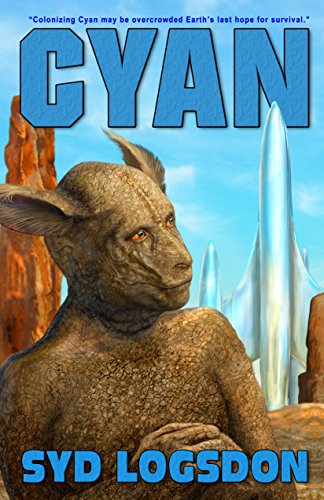
I explained all this to the artist who did the cover for Cyan. I also sent a crude sketch of what I had in mind, with many disclaimers about my (non)skills as an artist. The resulting cover shows a Cyl slightly different from my vision, but better. That’s what good SF cover artists do. However, it is an upper body portrait, so the secret of bipedal tailless hopping remains unresolved.

If I really want to know how it works – and I do – I would have to construct a skeletal robot and see how he moves. But there is no way I’m going to have that much free time anywhere in my near future. I have too many other books to write.

326. Dogwood Spring

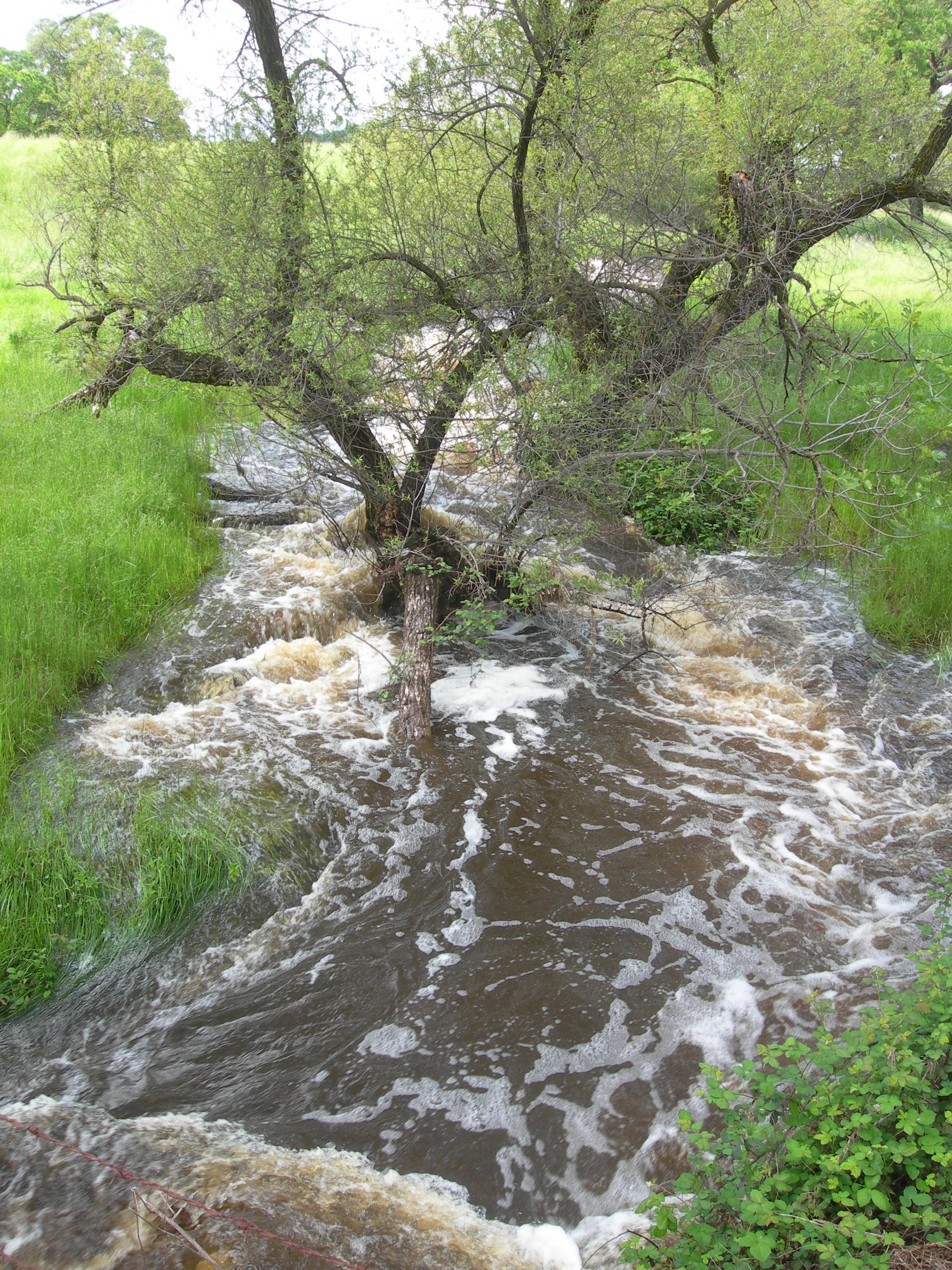
The California dogwoods are in bloom. Today (March 20) my wife and I took a drive along our favorite semi-secret road to see them. The road isn’t really secret, nor even secluded, but it is off the beaten track. People who don’t live on it, rarely use it. We wound through twists and turns, admiring the green fields and placid cattle, down a steep trail to a hairpin curve at the bottom where a vernal creek rushes through a culvert.

In summer, this is a pool and a trickle, but it has been an exceptionally wet spring and the steep hill behind the pool now provides a double waterfall. We stopped. I admired the bounty of water while my wife took pictures of the dogwoods.

Just at the point where the pool empties into the culvert, there was a clump of grass, rooted in a crack in the rock, partially submerged in the rushing stream. You could see that it had only been growing a few weeks, and shortly the water will fall. When that happens, there will not be soil enough to support the clump, and it will die. But for now, the clump of grass was wiggling and tossing in the water, happy as a hummingbird.

This quatrain occurred to me as I watched.

Though the bee did not come,
And the fruit did not form,
            It does not follow
That the blossom lived in vain.

Like any natural poem, you could apply it to a number of situations. Any un- or under-published author will know what I mean.

321. Home Grown Ecosystems (2)

Cyan is now available for pre-order through Amazon, with the eBook arriving April 17th. Meanwhile, I plan to repeat a few year old-posts that were designed to stir the blood of would-be readers just before an earlier release date that didn’t happen.

 —————————————-

Continuing our look at the creation of an ecology for Cyan. If you missed yesterday’s post, you might want to go there first.

We can take grasses and weeds for granted. Let’s give our trees multiple trunks bound together, like a strangler fig without its victim, and that should be enough. We need something like insects. We’ll call them Chitropods – chitro sounds like chitin, and pod means foot, so our reader will infer an exoskeleton without any further work on our part. Continuing the idea of inference, if we call the flying creatures who eat the chitropods pouchbats, the reader will draw a better picture in his mind that we could on paper.

The number of legs is important to Terrestrial arthropods, but lets bypass that by giving all our chitropods many legs, but with only one joint each where it meets the body. Now they have a rolling gait “like caterpillars on crutches”. Humor helps keep description from limping along. (Sorry, couldn’t resist!)

These are throw-away inventions. They could have been applied to any ecosystem and they are not systemically related to each other. They alone would be good enough for almost any SF novel, but not for one about scientists teasing out the essence of their planet.

Here we need a key differentiation, from early in evolution, from which a thousand lesser differences can be derived. Here it is for Cyan. Early in the development of chordate life, the vertebral column doubled at the posterior, giving the Cyanian version of fish twin tails. That changed everything. I’ll explain more fully later in a separate post.

On Cyan, the classes are Pseudo-pisces, Amphibia, and Inturbia. No reptiles, no birds, no mammals, no dinosaurs. The Amphibia are cold blooded. Inturbia are inefficiently warm blooded. The term Inturbia should imply “internal body temperature un-perturbed by external changes”. Not every reader will get that, but we need to reward our best readers by not spelling out everything.

There are a thousand other details, but for that, you will just have to download the book when it comes out July 5th.

***

I do have one more thing to share. I wouldn’t bother you, but since you’re reading a post about the backstage secrets of writing science fiction, I can assume that we are all nerds together here .

Inturbia have live birth. Cyanian amphibs have to return to water to lay their eggs, except for one group, the Sphaeralvids, who produce globewombs.

(Globewombs were) the closest thing to an amniote egg that Cyan’s fauna had developed – a transparent, leathery sac extruded by a Sphaeralvid mother and filled with a clear fluid like seawater. Into this she deposited fertile ova, then defecated. Then she separated from the globewomb and left it cached in the crotch of a tree, high up where it would receive full sunlight. On a bright day millions of these globewombs glinted in the treetops.

Algae from the Sphaeralvid mother’s bowels converted the feces into biomass and the Sphaeralvid nymphs fed off the algae.  When the feces were gone, the globewomb walls would break down, leaving the now sizeable nymphs free to face Cyan on their own.

Neat, huh? The globewombs are glinting in the treetops from the first day planetside. By the time the explorers understand what they are, the reader will have been wondering for some time. Globewombs don’t contribute anything to the plot, but since these are scientists trying to tease out the ecology of Cyan, we need some concrete examples of their work. Globewombs provide that.

They make me want to be there when they make the discovery – but that’s why I wrote the book.

320. Home Grown Ecosystems (1)

Cyan is now available for pre-order through Amazon, with the eBook arriving April 17th. Meanwhile, I plan to repeat a few year old-posts that were designed to stir the blood of would-be readers just before an earlier release date that didn’t happen.

——————————-

Over in Backfile, you will find an eleven part document called How to Build a Culture, inspired by Poul Anderson’s How to Build a Planet.

I could also write a paper called How to Build an Ecosystem, but who needs to read all that. A couple of posts here should cover the subject, without boredom or overload.

The fact is, simply peppering your planet with a few well chosen and deeply odd critters is enough in most cases. Andre Norton did it all the time, and it worked for her. The frawns and yoris on Arzor are simply transmogrified bighorn sheep and alligators, but so what? They provide plot points and local color, and that is all that is asked of them. Marion Zimmer Bradley gave us a mammalian snake, a hyper-weasel, and an intelligent dinosaur who sent out pheromone soaked calling cards in Hunters of the Red Moon. What more could you want?

When I wrote Cyan, I faced a different situation. My crew was set down on an alien planet for one year, with the task of coming to understand its weather, geology, and ecology in order to prepare for colonization. They were all scientists, so their actions and conversations called for a deeper understanding of their new world than any other kind of science fiction novel would have required. That challenge was half the fun.

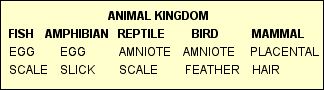
When I began Cyan, I had been studying ecology for about twenty years, starting back when I had to explain what the word meant. I later came to understand the essence of Earth’s taxonomy in the most rigorous possible way – I had had to condense it to a level which middle school students could understand without dying of boredom.

Scientists should forgive the following chart and paragraph.taxon

Drop a salmon egg on the gunwale of your canoe and it will dry out in minutes. A chicken or turtle egg would survive the same treatment. This is the meaning of amniote egg (although there are other, competing meanings). Creatures who lack them, must lay their eggs in water. The rest of the chart should be clear, although simplified. For example, birds have scales on their legs as well as feathers elsewhere, and I skipped Dinosauria altogether.

Now pull up a chair and lets build Cyanian ecology. It needs to be wierd but recognizable – that’s the key to all science fiction invention. We also need restraint. You can only explain so much to your reader without losing them, and beyond a certain point, your backstory is wasted effort.

Come back tomorrow and we’ll dive more deeply into Cyanian ecology.

315. Apprentice in Science

fleming-schola-rs-1966For eight weeks in 1965, I was a Fleming Fellow (see yesterday’s post).

The gist of the program was that a Fellow was assigned to a research scientist as something like an apprentice. My personal research had been a hybrid of ecology and space science (see Tuesday’s post) Nothing like that was available in a medical research facility; instead, I was assigned to Dr. Gunnar Sevelius who was doing research on determining renal flow through use of radioisotopes. He had just finished editing Radioisotopes and Circulation the preceding year.

Dr. Sevelius gave me a small lab room and access to a supply of radioactive iodine, along with sensors for radioactivity and a strip chart recorder. He sat me down to talk about his work and tell me what he expected from me. He treated me as if I could figure things out for myself – which I could. I didn’t see him often after that, although I hung out with his young lab assistants.

I don’t need to give a lot of detail here. It has all been superseded.

Everything sophisticated in science was crude when it was being developed. Any kid in a high school metal shop today could reproduce one of Goddard’s original rockets — but only because Goddard taught them how. Any trained technician can slide you into a machine and look at images of the inside of your head — but only because to the work done by people like Dr. Sevelius. Everything at OMRF was cutting edge for 1965, and probably none of those machines are even stored in dusty basements any more. Science moves on, and quickly.

Computers? Video monitors? Forget it. A strip chart recorder had a moving roll of paper, a moving head with roll of typewriter ribbon and a striker that made a dash on the paper every time the sensor detected radioactivity. An image of a pair of kidneys looked something like this:

renal

You can see a strip chart recorder at the top of this post. That’s me in 1965, with a haircut that was already going out of fashion.

I learned a lot that summer, not least that I would never again spend eight weeks in a windowless room doing repetitive research. I love the results of science, but the doing of it can be damned boring. I also got to test myself against other smart kids, and be satisfied with the result. Every other Fleming fellow had done more sophisticated work than I had, but they were the products of sophisticated high school science programs, or the children of scientists.

There were lectures and activities for us. I met a scientist who had done research on the reaction of elephants to LSD — two years before I chose to avoid it when it became mind candy.

I learned about Michigan State, and was encouraged to apply there. I got a tour of the basement where research was being done using a sensory deprivation tank. Fifteen years later that became the basis for my second published novel.

I learned about the infamous Dr. Sexauer. From a former fellow, I got the names of two of my former incarnations, in a late night seance. Tidac and Javernan became characters in my three fantasy novels. I wrote about that incident, and it led to an odd occurrence. The OMRF was trying to find all its Fleming Fellows to prepare for the 60th anniversary of the program. I had mentioned the name of the girl who seemed to be running the ouija board. The OMRF had googled her name, found my post, and connected with me. It was good to hear from them again.

When I returned to my tiny high school that fall, I had touched the larger world and I would never turn back.

314. Fleming Fellows

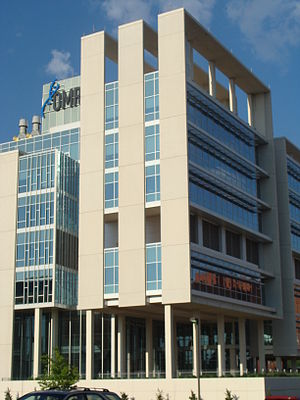
300px-oklahoma_medical_research_foundation_nimaphoto by Nima Kasraie

The Oklahoma Medical Research Foundation is a major research institution, but not a household word. Let me explain its importance in my life.

Everything that happens to a writer passes into his memory, sinks to the bottom, and grinds around there, knocking sparks off every other experience. Years later, it emerges, transmogrified, as stories or parts of stories.

My soul as a writer and as a human being was forged on a small farm, working essentially full time in addition to going to school. I was an only child. School and home were kept strictly separated. Except for one treasured cousin, none of my school friends ever entered my house.

I was a very smart child in a very small place. I worked hard, got strong, and loved the outdoor life, but my mind lived in other worlds, brought to me by books of science fiction. I decided to become a scientist. In that pursuit, I was torn between space science and ecology. When I was a high school junior, I put those two together (yesterday’s post).

That same year, among the many standardized tests we took, was the test to become a Fleming Fellow. There was also an application to be filled out in which I was to explain my aspirations and offer any personal projects to prove my capacity. I wrote up my ecosystem in space project.

I was notified that I was a finalist, and scheduled for an interview in Oklahoma City. At that time, I knew almost nothing about the fellowship or the OMRF.

Incorporated in 1946, the Oklahoma Medical Research Foundation was dedicated in 1949 by Nobel Laureate Sir Alexander Fleming. In 1957, OMRF started a summer program for students, which was quickly named the Fleming Scholar Program. It has evolved over the years, but in that era, from four to seven Oklahoma High School juniors were recruited, and spent eight weeks at the OMRF the following summer.

In the spring of 1965, I sat before a panel of scientists for my interview. I had expected questions on science. Instead, they asked questions on meaning and morality. What did I think of the bombing of Hiroshima? What did I think of capital punishment? Behind the questioning, they were clearly trying to find out my level of self-confidence, as the interview became quite adversarial at times. After I said that I was still uncertain about my stance on executions, one of the scientists asked, rather sharply, “Don’t you think it is our duty to think about such things?” I remember being irritated at his high-handedness. I snapped back, “I didn’t say I hadn’t thought about it. I said I hadn’t decided yet.”

I said to the panel that I intended to pursue a Ph.D. The whole panel tried to convince me that I should be getting an M.D. instead. I held my ground, and when the interview was over, one of the panelists admitted that most of them had Ph.D.s, not M.D.s.

Fortunately, self-confidence – or arrogance, if you prefer – is something I have never lacked. I received a Fellowship. I’ll tell you about it tomorrow.