Tag Archives: ecology

313. Weightless Ecology

ecoopwegt-lessI’ve been putting off this post since I started the blog. It’s embarrassing. I’m proud of what I did, but telling it makes me feel a little like one of those old guys who never stops talking about the night his forward pass won the big game.

Still, if I hadn’t done what I’m going to tell you about today, I would never have done what I did the summer after (tomorrow’s post), and if not for that, I would still be driving a tractor in Oklahoma. So here goes.

1964-5 was my junior year in high school. That was the year I took both junior and senior English because I was running out of classes to take, and that was the year I discovered science fairs. We didn’t have one in our tiny school, but their was a regional competition one county over. I had recently discovered Shirley Moore’s Science Projects Handbook, which was the bible for the science nuts (nerd wasn’t a word yet) of my generation.

America was in space; the Mercury project was completed and Gemini was waiting in the wings. I was enthralled with space, but also with ecology. Rachel Carson’s Silent Spring was about to make ecology a household word, but no one in my world had heard of it yet. I decided to put the two together and build an “Ecosystem Operable in Weightlessness”.

Lets get real. Boy scientist builds spaceship and flies to Arcturus only happens in the very old pulp stories. I wasn’t going to build something that would actually fly in space. It was an exercise in design, with as much building as I could pull off with limited resources.

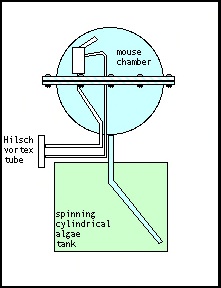
The idea was that at that time NASA needed to keep to keep some creature in weightlessness long enough to see what it would do to its body. Laika the Russian space dog hadn’t lasted long, and the longest Mercury flight had been 34 hours. I proposed a design that would put two mice in a closed ecosystem with algae. It was set up so that the algae tank would spin to provide just enough gravity to keep the water separate from the air, but the mice would be weightless in a separate chamber.

The fun was in the details. The mice would be housed in a two part plexiglas bubble, with a wire mesh floor at its equator. Waste would pass through he mesh, carried by the airstream and drop down into the algae tank.

That part actually got built. I made the algae tank of plexiglas, heated and formed around two round pieces of wood. I blew two half domes with a plywood form, an air compressor dragged up from shop class, and an oven borrowed from the home-ec teacher.

As I’ve said before, most of my education came outside of the classroom, thanks to indulgent teachers. They did the right thing, but it would get them fired if they did it today.

I bolted the half domes together through flanges formed during the blowing process. With two mice, Hing and Ho (named after the meerkats in Andre Norton’s Beast Master) in the upper chamber of the dome and a mass of Ankistrodesmus from a local stream in the algae chamber, connected by an aquarium pump, the ecosystem was as far finished as I could manage by the time of the science fair.

The physical result was limited by my resources, but the design went much further. To transfer the food to the mice, I had designed a pump, patterned after a Wankel engine (all the rage in Popular Mechanics that year). It was to send algae laden water up through a tube where it would be flushed over a fine mesh screen. The water would return to the tank on the airstream, leaving the algae for the mice to eat.

I did actually experiment with feeding them Ankistrodesmus. I strained it out of the water, dried it over a light bulb and passed the algae wafer into the mice’s cage. They went wild. You would have thought it was ice cream.

The design called for a small tube to carry a continuous airstream from above the algae water to strike the inside center of the upper dome, bringing the mice fresh air and carrying away waste as it returned. There a larger tube would carry the waste to the bottom of the algae tank.

To get water to the mice under weightlessness, the design called for the airstream from the algae tank to first pass through a Hilsch vortex tube, which split the airstream into hot and cold halves. The cold half was to pass between two thin metal plates. The warm (and moist) half of the air was to play onto the outside of these plates, leading to condensation and a continuous source of water for the mice to drink.

So why am I telling you this? Because this was the first step toward my future.

I didn’t know that at the time. I just did it because it was a challenge and more fun than I had ever had, but it led to a Fleming Fellowship, and that changed my life. more tomorrow.
259. Turkeys Under the Oak Tree


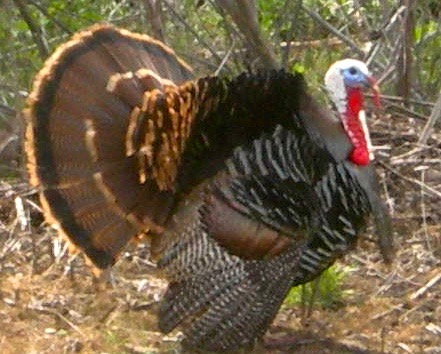
dscn0719dscn0693These birds were photographed on a spring drive through the foothills, about twenty miles from my house. The puffed up, greeting card version is what the males look like in season, when they are strutting their stuff and looking for love. The other bird is what most turkeys look like, most of the time.

You are reading this on Thanksgiving, but I am writing on September 27, about something that happened yesterday. My wife came to the door of the little building out back where I work and said, “Come here. Quietly.” There were ten wild turkeys eating bugs and acorns along the east side of the house.

We don’t get turkeys very often right up to the house, although seeing them in the neighborhood is a common occurrence. We stood for twenty minutes watching in the hundred degree heat of the tag end of summer before they casually wandered off.

Turkeys are the symbol of Thanksgiving, but I was thankful to see them because wild things fill my life with joy.

I grew up on a farm in Oklahoma in another century. I worked long hours when I was growing up, but I worked outdoors, so it might have well have been play. The music that filled my life was the churr of cicadas on summer evenings and the howl of coyotes echoing through the frosty night air in winter.

I left the farm for college, then spent my adult life in a small city, and moved to the foothills when I retired. Now my human neighbors are near enough for help in emergencies, but far enough away that I don’t hear them when they fight. I don’t even know if they fight.

Several times I have seen packs of coyotes running through my yard. Once a mother duck with nine ducklings following single file paraded through. Deer come in from time to time. They mostly prefer the low ground, and we live on a hill, but they come for water as the long days of summer dry out the last of their water holes. I keep water in bird baths for the birds, and water basins on the ground for everybody else.

The deer also have an uncanny knack of knowing when the tomatoes are ripe. Oh, well.

I see a bobcat about once a year, somewhere nearby. Twice they have come into our yard. Once I looked out the window to see a bobcat in the fenced back yard where stray cats stay out of reach of coyotes. My wife and I watched out the window as he sauntered along, unaware of us, then casually jumped the six foot fence without touching it.

We were even visited one holiday by the Christmas Pig. It was a three hundred pound porker who had obviously escaped from some farmer. I saw him several times after, so I’m maintaining hope that he was never found, and escaped becoming bacon and sausage.

So, happy Thanksgiving to you. And also to the turkeys and ducks and bobcats and raccoons and possums and the one lone pig.

In my house, Thanksgiving means turkey (from the supermarket, of course), stuffing, cranberries and pumpkin pie. Being thankful means looking out my window and never knowing what kind of critter might be looking back.

237. Rain

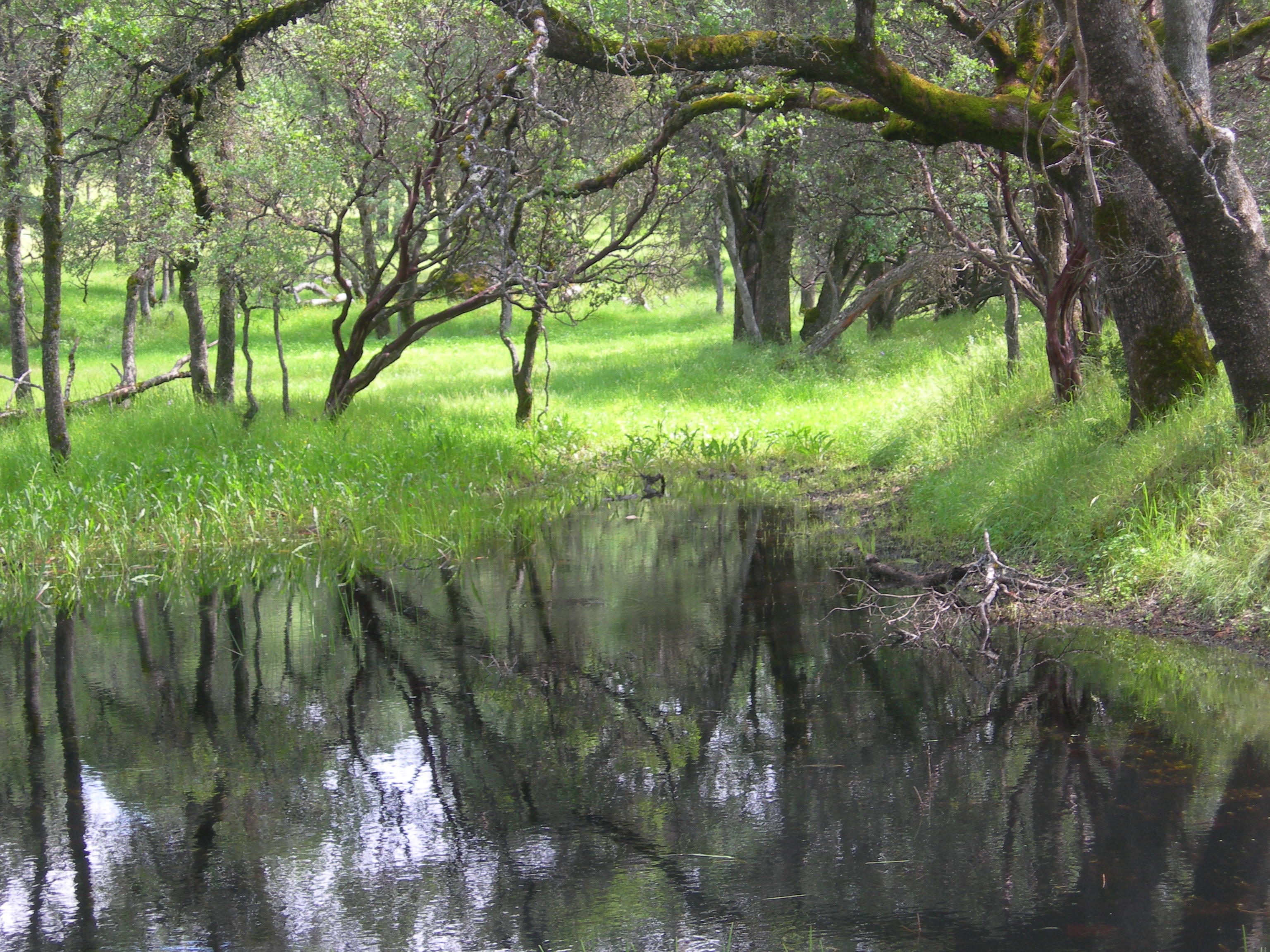
dscn4753This is a vernal pond, a few miles from my home. It will fill with water by Christmas and be dry again by Easter.

Let’s take a break from the world of politics and check into the latest meteorological phenomenon.

It rained last night.

That may not be a big deal to you, but here in the foothills of the Sierras it represents the change from one season to another in a climate that only has two seasons – dry and wet.

Our last rain came in mid-April. Six months without a drop. You may have heard that we are in a drought, but this is a different phenomenon. It is normal here for the last rain to come in mid-April, and normal for the first rain of the rainy (if that is the word) season to come in mid-October. Our drought is because we haven’t been getting enough rain between October and April.

So what does that have to do with my world of writing science fiction? Everything, really.

When I was young, my three favorite SF authors were Clarke, Heinlein, and Norton. Clarke’s stories always took place in artificial environments. Heinlein’s characters inhabited space ships, orbiting habitats, or frontier worlds; it didn’t matter, as long as they could talk incessantly, they were happy. Andre Norton characters, whether they were explorers, soldiers, spies, or interstellar traders, always spent their time outdoors, in wilderness or something like wilderness. The only cities you were likely to see in a Norton novel were in ruins, or the slums of the Dipple which any one of several young men were quick to flee from, usually into more trouble than they could imagine.

That suited me just fine. Her worlds were my world. In rural Oklahoma, I spent from May to September every year outside, usually driving a tractor, through rain, wind, dust, and heat. There were years when I watched the crops dry up and die under the relentless sun – and watched my Dad see six months work disappear before his eyes. There were other years when the rains came on time, the crops were good, and the pastures grew up heavy with grass; when the nights were a symphony of insect whirrings and the days were filled with bird songs and butterflies. Cliché? Paradise always sounds like a cliché.

It was the only life I knew, and I loved it, good years and bad, but I had to leave it, first for college, then to make a living. When I wrote my first book, I sent my protagonist into the mountains and lost him there, then let him find his way out. For my second book, Jandrax, I marooned a shipload of colonists on a barren, unexplored world, and watched them find a way to survive. In Cyan, coming out in a few months, I send a crew of ten to explore a rich new planet, then send them back to colonize.

I lived in a small city for most of my life. I could write about cities, but I don’t want to. My world is the world of nature –  even if it is nature on another planet.

So— it rained last night. About an inch, which isn’t much, even by Oklahoma standards, but the foothills only get thirteen inches in an average year. All the creekbeds remain empty and the hills remain covered with tall, dead grass in shades of brown, but within the soil, the change has begun. Seeds that have lain dormant since spring will be sprouting now, out of sight, and within a week there will be a faint haze of green, invisible beneath the long grass, but showing in the road ditches. This year’s grass will begin to flex its vegetive muscles, forcing its way upward through last year’s dead roots. Unnoticed, those roots will begin to loosen and be shoved aside until one day, a month from now, seemingly all at once, the old year’s grasses will tilt and fall, to disappear beneath the new green.

Suddenly all the brown will be gone and the new year’s grass will clothe every hillside. While the snows of winter cover the midwest, these Sierra foothills will be spring green, and the wildflowers will return.

222. Too Many Mouths

This continues from yesterday’s post The Wall.

When I was a kid in Oklahoma, we had tornadoes just like now, but with less destruction. About the time I was born, a local town was hit, and people were still talking about it when I left for college. It was that unusual.

When I was in my early teens, we watched a tornado drop down and march across the prairie. It was five miles west of us and in plain sight. Every ten minutes or so there was an explosion of wood and tin as another barn got hit, and it collapsed one house just before it lifted up again. It walked six miles across the landscape, destroyed three or four barns, and one house. No one was killed. One woman was slightly injured and scared half to death when her house fell in on her.

If that same storm were to hit today we would see hundreds of homes destroyed, numerous injuries, and probably deaths. The difference — more targets.

**     **     **

I would give you a reference on this next bit of information if I knew it. It came from a classroom lecture during college in the late sixties, and if I ever knew its source, I don’t know it any more. Call it an honest memory, with figures subject to further verification.

When Europeans conquered Africa, according to earliest census information the birth rate and the death rate were both about 4% per year. Medical missionaries saw the massive losses to disease and set about rectifying things. Slowly, the death rate dropped to about 2% per year.

The birth rate never changed.

You can do the math. Kindness, sacrifice, and the eradication of disease took a stable population level and started it on its way toward overpopulation and famine.

**     **     **

Yesterday’s poem Hungry paints a bleak picture of the future. It could be co-oped by conservatives as a call for borders. I reject that interpretation. Walls won’t help. No country is strong enough to survive without a fundamental change throughout the globe.

This world is straining at its limits with five times the population that should exist. The reason is clear – too many births for the number of deaths.

It would be facetious – and heartless – to say we need more deaths. We need fewer births, and the change needs to be world wide. We fight against terrorism, pray for peace, and try to tamp down bigotry, but all of that will get us nowhere if we don’t solve the problem of overpopulation.

Science continues to produce wonders. We may be able to feed the world, even with a population expanded beyond today’s. We may; but where will we house them? And what will be the psychological effects of inhuman crowding?

**     **     **

Let’s get back to the small picture: I used to keep an aquarium in my classroom. Every fall my students would bring me some crawdads. In spring, we let them go. One year the crawdads died unexpectedly in mid-year. I left the aquarium in place and we watched what happened.

Once the crawdads were gone, we just had algae (only visible by a greening of the water) and a few water snails. They multiplied. And they shrank. Every week there were more snails and each snail was smaller. Eventually there were thousands of tiny snails inhabiting the tank, filling the water with veils of snail mucus, covering the bottom, and the sides, and clinging to the surface tension, and filling the mid-waters.

I am afraid that my students and I saw our future. Not a cataclysm. Not a nuclear war sending us all back to barbarism as the science fiction cliche would have it. Just more and more people living smaller and smaller lives, relentlessly moving into a future horrible beyond conception.

Hungry.

138. Alone, and more alone

In the novel Cyan, due out shortly from EDGE, the starship Darwin carries ten explorers at relativistic speeds to explore the Procyon system.

Ten explorers working eleven light years from Earth. As the only humans on the entire planet Cyan, the death of any one is sure to send shock waves reverberating through the group.

Keir Delacroix, groundside leader of the explorers tried to put this into perspective upon the death of one of his colleagues. You will note a deleted name, to avoid a spoiler.

It seems to me that funerals are for the living, for saying things that we already know, to put life and death in perspective and find some comfort.

“We are alone here. We are more alone than any other humans have ever been. When one of us hurts, we all hurt. When one of us dies, a piece of the whole dies. We must be very careful with one another, because we are all we have.

“We come from an Earth that is overflowing with people. One death there is nothing. Had (***) stayed behind, and died, no one would have noticed. Here, her death puts our whole world out of balance. And that is why we are on Cyan — to find a world where individual lives can be valuable again. At least, that is why I am here. Not as a scientist; not even as an explorer; but as a man searching for a place where humanity can find its soul again.

Death is a hungry beast, seldom satisfied with just one victim. And exploring a new planet is no safe endeavor.

***

When pioneers arrived on the east coast of North America, the forest they faced was vast. It was later said that a squirrel could travel from the Atlantic to the Mississippi without ever having to touch the ground. That forest is no more.

When Heinlein’s pioneers reached the stars, flaming laser axes in hand, they wrought similar destruction. Today’s reader knows better.

I wrote Cyan as an exercise in seeing, not what could happen, but what probably would happen, in near-term stellar exploration. That includes both the pressures for colonization from an overcrowded Earth, and a knowledge of the ecological disasters which need to be avoided.

The explorers on Cyan are careful in their daily actions and in planning for future colonization, but they are not prepared to find a truly half-human species. Viki Johanssen, crew anthropologist, demands that Cyan be placed off limits to colonization for their sake. Keir disagrees, and colonization plans go forward.

Viki is faced with a decision. Being one of so few is a lonely thought, but could she survive being truly alone? What if she stayed behind when the Darwin returned, to study these creatures while they were still pristine, before human colonists came in.

What would you do, if you knew that mankind’s only chance to study this half-human species was at hand, but you would have to become the sole inhabitant of an entire planet, certainly for decades, perhaps forever?

Would you choose to stay behind?

127. Not a Frog, Not a Kangaroo

220px-Litoria_tyleri220px-RedRoo

Flashback: 1963, riding in a car, reading an article, probably by Arthur C. Clarke, on why humans should go into space. A little fish, swimming in shallow water, said to his father, “Why don’t we go up on the land and see what we can find?” The father fish responded, “Why would you want to do that?”

I read the passage out loud, but no one was interested, so I relapsed into nerdy silence.

Years later I found that the now accepted theory is that fish in shallow waters, accustomed to using their fins against the sea bottom, began to use them to navigate mud flats at low tide as mud skippers still do in mangrove swamps today. Legs evolved from fins.

It didn’t happen this way on Cyan. (This is a follow-on to yesterday’s post. If you missed it, we’ll wait for you to read it. Done? Good.)

On the planet Cyan, hundreds of millions of years ago, primitive chordates developed a split vertebral column, which resulted in twin tails. When they moved onto land, their tiny front steering fins were never used for locomotion and their twin tails (they had no back fins) became legs.

As Gus Lienhoff said when he dissected the first one Cyanian creature the explorers had collected:

Look, no pelvis. Look at this complex of bones. Some are fused, some flex, and these four are cantilevered. And look up here; no scapulae, just three extra thick, specialized vertebrae. Tiny front legs, powerful back legs with twice as many joints as you would expect, and absolutely no hint of a tail. Not even anything like a coccyx. A truly tailless, truly hopping biped. I wouldn’t have believed such a thing was possible.

Not a frog, not a kangaroo.

Frogs are quadrupeds with overdeveloped hind legs, like rabbits. They have a vestigial tail, like a human coccyx. If you look at a frog’s skeleton, it looks a bit like a massively deformed human. They can leap, but they also walk.

Kangaroos have a five-legged gait when walking. They lift up on a tripod made of small front legs and a powerful tail to shift their massive hind legs forward. Then they stand balanced on their hind legs while moving their forelegs and tail forward. 3 – 2 – 3 – 2, etc.

Cyanian bipeds, from the simplest to the most complex are hoppers. They all have short, grasping forelimbs; not quite T-rex hands, perhaps, but too weak to knuckle walk. They can move miles with grace and speed, but moving inches puts them into a condition of stumbling clumsiness. There are tree dwelling bipeds; how they navigate is a mystery I didn’t get around to investigating

When a trio of Cyl (intelligent Cyanian creatures created through recombinant DNA – its a long story) first enter a human habitat . . .

They were awkward inside the dome where the furnishings of the place made a maze for them to negotiate. As bounders, they were creatures of the unobstructed open plain. This human habitation was utterly foreign to them, not because of the steel from which it was made, or the interlocking triangles of its geodesic construction, but because it was cluttered. How could one hope to move about in it?

I don’t claim to be an artist, so I have made no effort to draw or paint these critters. I also haven’t seen the cover EDGE is putting on Cyan. If it has Cyanian hoppers, I sure hope they don’t look like frogs or kangaroos.

126. Let’s Build an Ecosystem – 2

Continuing our look at the creation of an ecology for Cyan. If you missed yesterday’s post, you might want to go there first.

We can take grasses and weeds for granted. Let’s give our trees multiple trunks bound together, like a strangler fig without its victim, and that should be enough. We need something like insects. We’ll call them Chitropods – chitro sounds like chitin, and pod means foot, so our reader will infer an exoskeleton without any further work on our part. Continuing the idea of inference, if we call the flying creatures who eat the chitropods pouchbats, the reader will draw a better picture in his mind that we could on paper.

The number of legs is important to Terrestrial arthropods, but lets bypass that by giving all our chitropods many legs, but with only one joint each where it meets the body. Now they have a rolling gait “like caterpillars on crutches”. Humor helps keep description from limping along. (Sorry, couldn’t resist!)

These are throw-away inventions. They could have been applied to any ecosystem and they are not systemically related to each other. They alone would be good enough for almost any SF novel, but not for one about scientists teasing out the essence of their planet.

Here we need a key differentiation, from early in evolution, from which a thousand lesser differences can be derived. Here it is: on Cyan, early in the development of chordate life, the vertebral column doubled at the posterior, giving the Cyanian version of fish twin tails. That changed everything. I’ll explain more fully tomorrow in a separate post.

On Cyan, the classes are Pseudo-pisces, Amphibia, and Inturbia. No reptiles, no birds, no mammals, no dinosaurs. The Amphibia are cold blooded. Inturbia are inefficiently warm blooded. The term Inturbia should imply “internal body temperature un-perturbed by external changes”. Not every reader will get that, but we need to reward our best readers by not spelling out everything.

There are a thousand other details, but for that, you will just have to download the book when it comes out. From EDGE. Soon.

***

I do have one more thing to share. I wouldn’t bother you, but since you’re reading a post about the backstage secrets of writing science fiction, I can assume that we are all nerds together here .

Inturbia have live birth. Cyanian amphibs have to return to water to lay their eggs, except for one group, the Sphaeralvids, who produce globewombs.

(Globewombs were) the closest thing to an amniote egg that Cyan’s fauna had developed – a transparent, leathery sac extruded by a Sphaeralvid mother and filled with a clear fluid like seawater. Into this she deposited fertile ova, then defecated. Then she separated from the globewomb and left it cached in the crotch of a tree, high up where it would receive full sunlight. On a bright day millions of these globewombs glinted in the treetops.

Algae from the Sphaeralvid mother’s bowels converted the feces into biomass and the Sphaeralvid nymphs fed off the algae.  When the feces were gone, the globewomb walls would break down, leaving the now sizeable nymphs free to face Cyan on their own.

Neat, huh?

125. Let’s Build an Ecosystem – 1

Over in Backfile, you will find an eleven part document called How to Build a Culture, inspired by Poul Anderson’s How to Build a Planet.

I could also write a paper called How to Build an Ecosystem, but who needs to read all that. A couple of posts here should cover the subject, without boredom or overload.

The fact is, simply peppering your planet with a few well chosen and deeply odd critters is enough in most cases. Andre Norton did it all the time, and it worked for her. The frawns and yoris on Arzor are simply transmogrified bighorn sheep and alligators, but so what? They provide plot points and local color, and that is all that is asked of them. Marion Zimmer Bradley gave us a mammalian snake, a hyper-weasel, and an intelligent dinosaur who sent out pheromone soaked calling cards in Hunters of the Red Moon. What more could you want? In Jandrax, showing up now in Serial, my native animals were distinctive, but most were mammalian, as one would expect from ice age migrators.

When I wrote Cyan, I faced a different situation. My crew was set down on an alien planet for one year, with the task of coming to understand its weather, geology, and ecology in order to prepare for colonization. They were all scientists, so their actions and conversations called for a deeper understanding of their new world than any other kind of science fiction novel would have required. Actually, that challenge was half the fun.

When I began Cyan, I had been studying ecology for about twenty years, starting back when I had to explain what the word meant. I later came to understand the essence of Earth’s taxonomy in the most rigorous possible way – I had had to condense it to a level which middle school students could understand without dying of boredom.

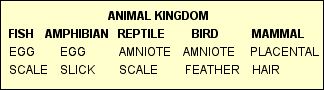
Scientists should forgive the following chart and paragraph.taxon

Drop a salmon egg on the gunwale of your canoe and it will dry out in minutes. A chicken or turtle egg would survive the same treatment. This is the meaning of amniote egg (although there are other, competing meanings). Creatures who lack them, must lay their eggs in water. The rest of the chart should be clear, although simplified. For example, birds have scales on their legs as well as feathers elsewhere, and I skipped Dinosauria altogether.

Now pull up a chair and lets build Cyanian ecology. It needs to be wierd but recognizable – that’s the key to all science fiction invention. We also need restraint. You can only explain so much to your reader without losing them, and beyond a certain point, your backstory is wasted effort.

Come back tomorrow and we’ll dive more deeply into Cyanian ecology.