Tag Archives: history

Golden Age of Science Fiction (2)

Raven’s Run concluded Monday, May 22. A new novel will begin soon.  Meanwhile, this is the second of three posts of material for the panel “What Makes the Golden Age Golden?”, to be presented at Westercon.

Yesterday, we looked at Jules Verne. Meanwhile, over in England, there was a fellow named H. G. Wells, but I place him with all the other unreadable Victorians. In my opinion, if he had been a German or a Spaniard or — God forbid — a Hindu, we would never have heard of him. Actually, that is probably true of most of the denizens of British Literature 101. Others differ on this opinion.

Science fiction, as we know it, got its start in France and England. The next major event in science fiction history, possibly not a golden age, but at least an efflorescence, was the era of the magazines, starting with Hugo Gernsback’s Amazing Stories in 1926 and extending, much attenuated, until today.

The era of John Campbell’s Astounding from 1939 is probably the most cited period in the search for a golden age, and a list of stories from that venue is compelling. The list of authors from the Campbell era is of almost unbelievable quality.

At that time, science fiction was mostly a literature of short stories. Novels existed, but were typically presented serially — a technique that has been in play at least since Charles Dickens. All that changed around the time of the end of World War II, with the rise of mass market paperbacks. It is a complicated story with dozens of players, but no one was more influential than Donald A. Wollheim.

Wollheim began as a fan, went on to write novels and short fiction, and eventually found his métier as an editor. He began with fanzines, moved to the editing of anthologies, then became an editor at Avon books. In 1952 he moved to Ace, where he introduced Ace Doubles. These were twin novels, published together back to back, head to foot. Two for the price of one was a real selling point in the era when paperbacks were introducing cheap literature to the masses. That’s me; I was part of the masses.

Was this a Golden Age? In terms of the availability of new writers like Delany, Le Guin. Zelazny and Brunner, certainly. And Andre Norton’s works finally got to shed their tattered cloth library look and to sport bright, new multicolored covers, sometime two on one double. But technically, this might not be a true golden age, since large numbers of the titles were recycled from the John Campbell era magazines.

It sure felt like a golden age to those of us who were reading the hundreds of titles that were suddenly available to us.

Here lies one of the answers to what makes a golden age. Any time you publish material, some of it will be golden. If your output is large enough, there will be enough gold to make an age, notwithstanding all the rest of the sludge-flow that carries it along. The influx brought about by Ace doubles and the rest of the paperback revolution made huge numbers of new works, and equally large numbers of lost classics from the past, available on every street corner for prices that everyone could afford. If that isn’t a golden age, I don’t know what it takes.

With no intention to disparage the genius of Le Guin, Zelazny, or any other, I am reminded of an old Irish story:

A group of men in an Irish bar were solving the world’s problems one by one. Deep into the night, one of them asked the group, “If every poet in Ireland were all killed tonight, how many years would it take before a new generation of poets rose up?” Another of the group raised his hand with one finger showing, and the rest nodded in agreement.

It is my opinion that for every literary genius who arises, there are a hundred like her or him that we will never know. For every award winning novel, there are many more as good moldering away in typescript, awaiting their author’s death and their final trip to the trash bin.

Literary genius is a part of the whole human race. A golden age comes when opportunity arises for the distribution of genius. Change the venue, change the world.

Today there is a mass of unread eBooks, self published through Amazon. You wanna get rich? Invent the algorithm that winnows through this crop of eBooks, and separates genius from the rest. Of course, if you do, would-be authors everywhere will hate you.

Why? Let’s consider traditional editors as Valkyries. (I didn’t say vultures, I said Valkyries.) They cruise above the field of battle and choose those worthy of Valhalla, or at least publication. Self-publication bypasses this process. An algorithm to decide on quality would be an AI-editor. Now there’s a scary science fiction concept.

The onslaught of paperbacks was not the last golden age. Beginning with the original Star Trek, there was a golden age of television science fiction, although its quality was never very pronounced. CGI, starting with Star Wars, brought a golden age of movies, at least visually. I watch them occasionally, but I have yet to see one which rises to the quality of a good novel. That may be just a personal prejudice.

I watched the Wild Wild West in its original run, and had no idea I was there for the birth of steampunk. I’m still trying to figure out what steampunk is, as something more than a sales tag. Jules Verne, plus sex? That’s puzzlement, not disparagement. I have liked the steampunk I’ve read and watched, but it won’t come into focus for me as a movement. more tomorrow

Click here for next post.

357. Mike Mars and Project Quicksilver

If you Google Mike Mars, you’ll get Mick Mars, lead guitarist for Mötley Crüe. In fact, if that is how you got here, sorry about that. The only connection, besides spelling similarity, is that Mick Mars is of the right age to have read Mike Mars when he was a kid.

Our Mike Mars is a fictional astronaut from a fictional project called Quicksilver. The series was written by Donald A. Wollheim.

The eight Mike Mars books were unique in science fiction. They were so tied to the moment that they became outmoded on publication. They were both strikingly accurate and completely false. They were less of an alternative reality than a conspiracy theory version of the early 60s.

Here’s the setup. Project Mercury has selected seven astronauts, who will conquer space for America – ostensibly. They are all military test pilots of great experience. At the same time, a second, secret space program is being formed to duplicate their work, using hot young (read: expendable) pilots just out of fighter training, but no one will know of their flights. And they will do their thing just a hair sooner than the old guys. The project is called Quicksilver.

I look at that paragraph today with awe at how dumb the notion was. When I found Mike Mars, Astronaut on the shelf at the hobby store where I bought my books, I flipped at how cool it all was. It was 1961; I was 13 years old.

Thirteen is the golden age of science fiction. (I didn’t make that up; it’s a well known cliché.) Thirteen is also the age when you like things you wouldn’t even look at a few years later.

Mike Mars is the nickname of Michael Alfred Robert Samson, one of the young pilots chosen to participate in Project Quicksilver. The first novel takes him through selection and early training until he is chosen as one of the young astronauts. It also includes a murderous saboteur and makes the reader aware that one of the seven, Rod Harger, is a traitor. After all, this is a book for boys, designed to sit on the shelf beside the Hardy Boys and Tom Swift, Jr.. Just being an astronaut isn’t exciting enough to give a climax every fifth page.

In Mike Mars Flies the X-15, the seven Quicksilver astronauts get glide flights in the X-15, and one of them will get to make a powered flight into space. (Guess who gets the powered flight.) We become more aware that six of the young astronauts are patriotic team players, but Rod Harger is in it for the power and the fame, and his father has thugs at the ready to tip the scales his way. This sets the pattern for the books — about half an accurate portrayal of training and flights and about half Hardy Boys style chasing crooks through empty hangers.

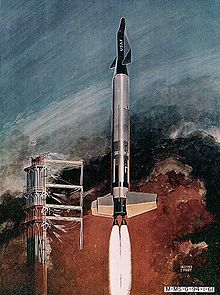
In Mike Mars at Cape Canaveral, Mike rides a Redstone rocket in a sub-orbital flight, after spending half the book fighting off more saboteurs.

In 1961 Yuri Gagarin became the first man in orbit, followed shortly by John Glenn. The Russian’s had won — except that those of us reading the Mike Mars series knew that Mike beat both of them in Mike Mars in Orbit. But, of course, he could never tell.

(True believers like me knew that Rick Brant had beaten all of them into space, back in 1958 aboard the Pegasus in The Scarlet Lake Mystery, but that was an accident and, of course, he could never tell either.)

In Mike Mars Flies the Dyna-Soar (see 342. Dyna-soar) Wollheim finally ran out of reality. The first four books had involved real hardware, but the real-life Dyna-soar was never finished. Space kids all over America forgave him however, as we flew with Mike to rescue a fellow astronaut in the coolest spacecraft that was never built.

There were three additional books, Mike Mars, South Pole Spaceman, Mike Mars and the Mystery Satellite, and Mike Mars Around the Moon. They never came to my hobby shop bookshelf, so I never saw them. It would be pointless to seek them out now. Within five years, alternative versions of early space travel had gone from unthinkable to not worth thinking about. NASA and the Russians made the conquest of space real, and I had grown beyond kiddy books.

But God the ride was fun while it lasted.

_____________________

Meanwhile, back in the real world, the secret military space drone, X-37b, recently landed at Kennedy Space Center after it’s longest flight to date. We will see how the Air Force is still trying for a Mike Mars reality in tomorrow’s post.

Golden Age of Science Fiction (1)

I am scheduled to participate in several panels at Westercon this year, July forth weekend in Tempe, Arizona. I intend to research the topics of each panel, and place posts outlining the ideas I will be carrying with me to the convention. Unlike normal posts, I will continue revising these right up to the moment I leave, including after they are published.

This material is for the panel “What Makes the Golden Age Golden?” Material for the other four panels will be published between now and the July 4th weekend, probably some in A Writing Life and some in Serial.

Now for the change-up. After I had written and posted all this, I finally got a proper description of the panel. 

Heinlein and Asimov are two pillars of the Golden Age of Sci-Fi. But reading those works with modern eyes can reveal attitudes that would be unacceptable in modern times. What can we learn from the classics when we look past the sexist and racist attitudes that pervaded the works of that time? Can we still appreciate works that present unacceptable ideologies?

What I had thought would be a panel on SF history is clearly going to be something different. I don’t mind. I am always ready to take up arms in the fight against political correctness, and this looks like it’s going to be a grand brawl!

#                    #                   #

The golden age of science fiction is thirteen. Some say twelve. Yes, that’s an old chestnut, but it’s still around, and people are still repeating it, because it’s true. (The golden age of fantasy would be a whole other panel, which I won’t talk about here.)

You can see it at work in Goodreads, where it can be encapsulated in this theory: The number of stars a novel will get is inversely proportional to the age at which the reviewer first read it.

That doesn’t always work of course, but it goes a long way toward understanding all those low star ratings of Harry Potter by grumpy old people who cut their teeth on Lord of the Rings, and all the five star reviews by people who were young when they first read him.

What makes thirteen a golden age? Duh! Youth, newness, our first realization of our personal uniqueness, and our first real sense of making our own choices. It also makes thirteen the golden age of baseball, science, making money, sexuality, and every other thing that makes life fun.

As for a list of books from my personal version of that golden age — sorry, can’t do it. Most of the science fiction books that gave me joy in the fifties are too dated to be enjoyed by moderns, with the exception of the early Nortons. Since Andre set her stories outdoors and stated her technological wonders without explaining them, they are largely immune to changes in the “real world”. They work when you are thirteen, and still work as long as you can see the words on the page.

We science fiction types always like to invoke Sturgeon’s Law — 90% of everything is #%*%#.” Turn that on its head, and we can say that every era has produced at least some good science fiction. In other words, there is not one golden age, but several, if you ignore the dreck. Let’s look at some of them

The first golden age of imagination was the ancient world. Thor lived then, and he still does. Gilgamesh lived then, and he lives again today, after a long hiatus. Zelazny’s works keep ancient Egypt alive. An odyssey is an odyssey, whether it is carried out by Odysseus or Dave Bowman.

Half-men half-animals, from Ra to the Centaur, abounded in the ancient world and they never really went away. Witness the were-critters inhabiting today’s bookstores. Demigods were everywhere, and they still are. Hercules is still among us and Tarzan is his modern cousin.

The trouble with starting in the ancient world is that it is ancestral to everything in heroic myth, from James Bond to Wyatt Earp to Luke Skywalker to Spiderman. Science fiction proper is not so old.

The first golden age of science fiction is found in the works of Jules Verne. Verne had the advantage of being so far back in science fiction history that he was respected. His works, in France at least, were viewed as literature, not as novelties. Now some modern science fiction writers are now being taken seriously again, but personally, I think this has more to do with sales figures than genuine acceptance.

Between Verne and today stretches the Valley of Critical Disdain, which takes up 99% of the history of science fiction.

Jules Verne invented science fiction, but he didn’t invent all his inventions. His technique was very much the same as the one science fiction writers use today. He took contemporary events and technology, and extrapolated them. That, not his “inventions”, makes him the father of science fiction.

Verne’s Nautilus was not the first submarine. As early as the 1500s there were diving bells and plans for sealed, submerged rowboats. There were numerous unbuilt plans before Drebbel’s first successful submarine in 1620. Every good American knows about Bushnell’s Turtle of 1776.

Kroehl’s relatively modern submarine made its maiden voyage in 1866. Twenty Thousand Leagues Under the Sea was serialized in 1869-70. Verne’s Nautilus was not the first submarine but it was infinitely advanced over the real submarines of the day. That is the manner in which science fiction still operates. 

Americans know Twenty Thousand Leagues Under the Sea, mostly from movies, comic books and juvenile editions, and some Americans know a half dozen other Verne titles. But Verne published from 60 to 80 novels, depending on which list you read. (The difference lies in whether you count French editions or English editions, and how you count the ones that were published in parts and later placed under one cover.) He was a force in French literature, and for at time was studied in French schools as an exemplar of excellence in the French language.

In the English speaking world, we have fewer titles. They are are often indifferently translated, and frequently abridged for the juvenile trade. One of my fantasies-that-will-never-happen is to learn French in order to read Verne in the original. more tomorrow

Click here for next post.

343. Black Shuttles

Atlantis, first launch, DOD mission.

Regular readers will notice that these posts are coming later in the day.

During the planning stage of the Space Shuttle, some changes were called for by the National Reconnaissance Office. That is an organization which, at that time, was not acknowledged to exist, but which is the home of sophisticated space hardware and a big budget. Specifically, NRO wanted the cargo bay on the shuttles to be bigger, presumably to accommodate their oversized spy satellites. They got their way, and the money they provided helped keep the struggling shuttle program afloat during the hard early days.

We’ve been looking at the Air Force in space this week and NRO isn’t the Air Force — quite. However, the head of NRO has traditionally been an undersecretary or Assistant Secretary of the Air Force. So, close enough.

It would not be unreasonable to think of the Air Force as an organization run by pilots and ex-pilots. MISS was a program designed to put men into space; so were the Dyna-soar and the MOL. But none of them ever succeeded in putting Air Force astronauts into space.

During this period of public failure, there were secret successes in the form of more and more military satellites. One of the earliest class of mission was reconnaissance, and the Air Force/NRO success with unmanned satellites was the primary reason MOL was abandoned. Through the sixties and into the seventies, these satellites used sophisticated film cameras, and their findings came back to earth via film canisters dropped from satellites and snagged out of the air by military aircraft. After digital imaging came to maturity, that was no longer necessary.

Sidebar.      Just how successful those satellites were, and how rich the NRO is, became embarrassingly obvious in 2012. The NRO gave NASA two Hubble-quality space telescopes that they had ordered, but weren’t using. One of these is slated to become the Wide Field Infrared Survey Telescope, due for launch in 2024.

At the same time that the Air Force, through NRO, arranged to have the shuttle’s cargo bay expanded, it began to build a shuttle launching facility at Vandenberg Air Base in California. To understand what this means requires knowledge that every space nerd had in the sixties, but which is never talked about these days.

Why do we launch space missions from Florida? Because it is the only place in the US which is both far south and on the eastern seaboard. Rockets are typically launched as close the the equator as practical so that the rotation of the Earth is added to the rocket’s speed — something vitally important when crude, early craft were being launched. They are launched from the eastern seaboard to provide thousands of miles of open ocean for first stages — or fiery, falling failures — to land in.

Vandenberg is situated on the western edge of the nation, ideally located for launching rockets north or south into polar orbit — that orange-peel path spy satellites need. Advanced Titans and Atlases launch from there as needed, without fanfare. But not with complete secrecy. It is a California cliché for a UFO scare to be debunked as “just another night launch from Vandenberg”.

The Johnson Space Center is in Huston because Texan LBJ was President when it was built. Orbital physics had nothing to do with it.

No shuttle was ever launched from Vandenberg. Shortly after the second classified Department of Defense shuttle mission, the Challenger was lost. Important secret launches were delayed by the hearings that followed.

The relationship between NASA and the Air Force had never been a happy one, and the Air Force shifted as quickly as possible back to its own resources. They used the shuttle to take up satellites too large to be launched by other means, and otherwise returned to using their own missiles, typically out of Vandenberg.

The Luke Skywalker picture of Air Force pilots in their space fighters has never come about. The closest to that idea is the robot X-37b, which we will look at in some future post.

——————————

The Smithsonian Air & Space magazine carried an article in 2009 on the eleven black shuttle missions. Since most details are still classified, the article is frustrating, but will provide about as much as you will find anywhere outside of alien-influence websites.

342. Dyna-soar

Regular readers will notice that posts are now coming later in the day.

MISS, Man in Space Soonest, was a USAF project to put a man into a capsule and boost him into space on top of a converted ICBM. It was cancelled, resurrected, and passed on to the new organization NASA, where it became Project Mercury.

Times were tense. The Soviets had launched a satellite into orbit in 1957, beating America into space by a few months. They added to the humiliation by beating the US again in 1961, this time with a man in space. Worse than either accomplishment, was they booster that was used. It was far more powerful than anything America had in service, or in development. A booster that powerful presented all kinds of doomsday scenarios.

Eisenhower had plenty of problems at the time. He was using U-2 spy planes to illegally overfly the Soviet Union, and recognized that it was only a matter of time before that blew up in his face — which it did in 1960 when one of the U-2s was shot down while spying. MISS being transferred to NASA made it a civilian project, and less objectionable. The same logic led the Navy originated Project Vanguard to be passed on to NASA, and also to the use of underpowered rockets to launch it because they were not military hardware.

Sputnik and the Soviet manned missions were on top of a military booster, rendering that concern moot.

NASA went on to success in manned space flight, but in the fifties and early sixties, that was not a foregone conclusion. The Air Force moved on to the Dyna-soar.

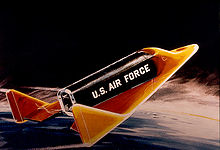
Project Dyna-soar (from the phrase dynamic soaring) had begun in 1957, when it was to be the next step after MISS. It was based on the theories of Eugen Sänger, who had a suborbital bomber on the drawing board for the Germans during WWII.

The basic idea was to send a winged vehicle above the atmosphere on top of a rocket, whether in a sub-orbital flight or returning from orbital flight. That craft would skip repeatedly off the upper atmosphere on returning, dissipating the heat of reentry, and ultimately land as a glider.

This sounds a lot like the Space Shuttle, but there are two main differences. STS was designed as a single stage to orbit vehicle, and it dissipated heat by shock waves while being protected by insulated tiles, much like the Mercury through Apollo missions had used shock waves off ablative heat shields. Dyna-soar was designed to ride into orbit on top of a military rocket and to lose its heat by skipping — that is, by dipping into the atmosphere, then bouncing back into space to radiate away the heat it had built up, followed by repeat, repeat, repeat, until cool enough to finally land as a glider.

That would make for a long, hard, bumpy ride. If you are simply thinking of reentry, it would be a unnecessarily tough way to go. To understand why the skip-glide method was so inviting, you have to project yourself back to dawn of the 1960s when rockets were small and space exploration was new. With skip-glide, a relatively small and not particularly powerful rocket could send the Dyna-soar anywhere on Earth.

When Alan Shepard made his sub-orbital flight, he traveled 116 miles above the Earth but landed only about 300 miles downrange. With that initial altitude, Dyna-soar could probably have circled the Earth before landing.

Dyna-soar was developed as a reconnaissance and bombing vehicle. It was, after all, an Air Force project.

Had it gone to completion, the Dyna-soar (also called the X-20 later in its development) would have been the most sophisticated space craft of its era. Unfortunately, money was scarce, and while in orbit, the Gemini could do anything the Dyna-soar could do.

Gemini was a monumentally successful project (see Gemini) that sucked up all of America’s attention. In December of 1963, the Dyna-soar project was cancelled.

Again, the Air Force had lost out to its civilian counterpart. It didn’t give up. The next time around, the Air Force co-opted the Gemini. That third chapter in the Air Force’s bid for space was told here last November as The Space Station That Never Was. We’ll cover the rest of the story – so far –  tomorrow.

338. The Benson Murder Case

I just read The Benson Murder Case for the second time. It was an accident. All of the Philo Vance mysteries are titled The (whatever) Murder Case, and they are mostly indistinguishable on the library shelf. I didn’t recognize Benson as one I had already read.

The setting is New York City in the twenties, among the upper class and the demi-monde. Since I’m an ex-Okie farm boy, these people would look down on me as white trash. That places the novel somewhat outside my comfort zone, but it also gives a kind of anthropological interest to the proceedings.

Anyway, there aren’t that many non-bloody and non-cozy mysteries to choose from, and Philo Vance is good fun.

The author is Willard Huntington Wright. The putative author is S. S. Van Dine, who also appears in the novel as the narrator. We are told that Philo Vance, the main character, is a pseudonym for a famous real person who will never be named, so we start out with layers of misdirection. I like that touch. It is as if Conan Doyle had used John Watson, M.D. as a pseudonym. We already know that Holmes was real; just ask any genuine fan.

Vance is an aesthete, immaculate in dress, loquacious, self-centered, quite convinced of his own superiority, and independently wealthy. If an actor were to play him on television today, enunciating all the words that Wright put into his mouth, he would be seen as gay as hell.

I need to explain that. In a sex-ed class I was teaching, during a question and answer period, a student asked me if I had any gay friends. It was a teachable moment. I said, “I don’t know,” then pointed out that a gay person could pass for straight, and a straight person could pass for gay, if either wanted to. We control how we present ourselves. It is a form of communication.

That exchange took place back in the era of Will and Grace, when LGBT portrayals were rare and relatively unsophisticated, but even then the behaviors we associate with gayness were mostly learned from television.

So I repeat, if Vance were portrayed today as he appears in the books, he would not look straight. That’s probably our prejudice. I see no evidence that he was perceived that way in the twenties when the novels were published, except, perhaps, when the villain at the climax calls him “you damned sissy.”

I don’t really care if the author was presenting Vance as gay, or just snooty with a British education, but it does cause a bit of disconnect. Like reading a book in translation, the sub-text can get a bit muddied. This is especially true since this first novel is less about solving a crime than it is about the friendship between Vance, the layabout, and Markham, the hard working District Attorney.

Alvin Benson is shot. Vance tags along with his friend Markham to the scene of the crime, and Van Dine, Vance’s shadow, tags along as well to narrate the story. Vance instantly knows who did the deed, working from his understanding of psychology. Markham is confused by clues. For the next 348 pages, Markham suspects a half dozen people, and Vance follows along showing him the error of his ways, finally leading him to find the murderer.

It sound dumb in précis, but it works. Even the first time I read the story, when I was distracted by Vance’s irritating personality, it worked. The second time through the book, I realized that the real story, hidden behind the unfolding of the mystery, was Vance at work keeping his good friend from making a fool of himself, or worse, enduring the guilt of sending an innocent person to execution.

C. J. Verburg, in a one star Goodreads review, calls Vance a more smug and racist version of Lord Peter Wimsey. She really doesn’t like him, and I can’t say I blame her. She probably speaks for the typical modern reader.

Those who do like him, like him a lot. I’m rather in that camp — I think. Most Goodreads reviews are stellar or stinking, with very few in the middle.

337. The Year Without a summer

The Little Ice Age (yesterday’s post) was vague and questionable in its outlines and origin. The Year Without a Summer was precisely delineated, and there is no question of how it came about. It was the result of volcanic activity.

There is, however, a smaller mystery. In 1808, a very large eruption took place, but no westerner saw it. It is memorialized in ice samples from Greenland and Antarctica, and scientific detective work places the eruption somewhere between Tonga and Indonesia. It began a period of northern hemispheric cooling.

Then in 1815, the largest and most destructive volcanic eruption in human history took place at Mount Tambora in what is now Indonesia. The explosion was heard 1600 miles away. (Krakatoa, a better known eruption in the same region in 1883, was less intense.) Between the mystery eruption of 1808 and the Mount Tambora eruption of 1815, the second decade of the 1800s became the coldest on record. 1816 became known as The Year Without a Summer.

(As always seems the case with science, nothing is simple. 1816 fell within the Little Ice Age and was also associated with a low in the cycle of sunspots. If you really want to understand, I suggest a Ph.D. and a lifetime of study. That will give you some answers and a cartload of more sophisticated questions.)

The Year Without a Summer was disastrous. Crops, which had already been bad, probably because of the 1808 eruption, failed. Famine was everywhere in Europe, followed by typhus. There were massive storms and floods; an estimated 200,000 died in Europe.

In America, the northeast was hit hardest. Frosts continued through the summer. In August ice floated on Pennsylvania rivers. Snow fell in June in Massachusetts. Food was scarce and in 1816 there was no way to move it from less affected regions to those hardest hit. That year and shortly after, masses of northeasterners moved to the midwest, swelling the populations of Indiana and Illinois.

The event left echoes in literature. In 1816 Mary Shelley, Lord Byron, J. W. Polidori and others were storm bound together in a villa overlooking Lake Geneva. A contest of writing ghost stories ensued. Byron wrote a fragment, which Polidori later turned into the first vampire story (The Vampyre), Mary Shelley began what later evolved into Frankenstein, and Byron also wrote Darkness, a long poem inspired by the lightless days.

Here is a bit of that poem, which brings back memories of those old science fiction stories from my youth when the glaciers moved in to destroy humanity.

The crowd was famish’d by degrees; but two
Of an enormous city did survive,
And they were enemies: they met beside
The dying embers of an altar-place
Where had been heap’d a mass of holy things
For an unholy usage; they rak’d up,
And shivering scrap’d with their cold skeleton hands
The feeble ashes, and their feeble breath
Blew for a little life, and made a flame

336. The Little Ice Age

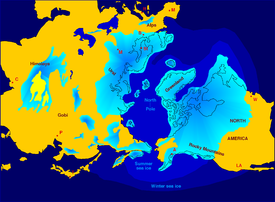
Hannes Grobe/AWI – own work – redrawn, supplemented and modified graphic from John S. Schlee (2000) Our changing continent, United States Geological Survey.

The writing of this blog is a pleasure, but it is like a fireplace on a deep winter’s day — it takes a lot of fuel. Sometimes topics fall into short supply. Sometimes I don’t know where my next blog is coming from.

Sometimes I get on the internet and put my conscious mind on cruise control. I let my fingers on the keyboard seek out half remembered images, phrases I have heard, interesting titles from catalogs of books I’ve never read, and half understood events I always meant to research and write about.

Today was that kind of day. I chased down, among other things, two similar phrases I had run across: The Year Without a Summer and The Little Ice Age.

They aren’t the same thing, it turns out. The Little Ice Age was a cool period that purportedly lasted about half a millennium, but its cause, degree, beginning, and ending are frustratingly difficult to pin down. NASA suggests three separate cooling periods in the 1600s, 1700s, and 1800s but the UN panel !PCC suggests that it is only a series of local events, not a unified world-wide phenomenon.

Locally, the increased cold brought famines, ice blockage of harbors, and shifts in agriculture. Some have suggested that the prevalence of winter scenes in Dutch paintings of the era, and even denser wood leading to better violins by Stradivarius, are byproducts of the Little Ice Age. Yeah, right. Scientists can be frivolously imaginative when pushing their theories, especially if proofs aren’t easily measured.

The Little Ice Age is a really cool name though, no pun intended, and it caught my attention because death by ice age was a common theme in the science fiction stories I read when I was young. Visions of glaciers coming down from the north to obliterate civilization lived in my head for years. They still do, sometimes.

Fifty years ago people — science fiction writers, anyway —  were afraid of global cooling. Now we are all afraid of global warming. That doesn’t set aside what we now know about retreating glaciers, but it does cause a slight pause on the way to full acceptance.

I was late coming to the table where global warming is concerned, for reasons that were entirely sensible twenty years ago, but no longer suffice today. I’m still not convinced that the warming is entirely man made, but it doesn’t matter. That the glaciers are retreating and the polar caps are disappearing is beyond question. That fossil fuel emissions are part of the picture is reason enough for action, even if we don’t know the whole story.

Science never knows the whole story, but people have to take action based on the preponderance of the evidence.

___________________

While I was cruising the web, I also found these estimates of human population.

     1804, Earth’s population, 1 billion.
     1927, Earth’s population, 2 billion.
     1960, Earth’s population, 3 billion.
     1974, Earth’s population, 4 billion.
     1987, Earth’s population, 5 billion.
     1999, Earth’s population, 6 billion.
      2011, Earth’s population, 7 billion.

I think there’s a pattern here, don’t you?

The answer to global warming isn’t an end to the use of fossil fuels — not exactly. It is an end to the need for fossil fuels. It is fewer people.

Oh, and that other thing, The Year Without a Summer, we’ll take a look at it tomorrow.

327. The Lone Hero

bks275-1

                         A note before we start  ——

     Yesterday, someone searched on the sub-title of this blog (be not ashamed . . .) but my software doesn’t tell me who. For your information, unknown and curious person, I explained my relationship to this poem on the last day of 2015, and included a copy of the poem the same day.

     And now to our regularly scheduled business ——

===============

In my youth, before Star Trek and Star Wars and computer generated effects, the typical movie hero was a cowboy, riding into town alone, beholden to no one, ready to stand or fall on his own.

Even the word “beholden” seems old fashioned. Ancient. Outmoded — like the western hero himself. And to be fair, he never really existed. If you spend any time at all reading histories of the old west, you’ll find out that things were done by groups, not by lone heroes. When the Dalton gang tried to hold up two banks at once in Coffeyville, Kansas, it wasn’t a John Wayne figure standing tall in the street that stopped them. It was a dozen or so armed citizens that blew them out of the saddle from windows and doorways. Same story in Northfield, Minnesota when the James gang bit the dust.

I called them armed citizens. That sounds pretty good. Put them up on horses with Winchesters and send them as a posse after the bad guys. It still works — unless you are the one they are after. Call them vigilantes, and some people will start to feel uncomfortable, but not everyone. Call them a gang and people will start thinking about locking their doors.

Put them in white hoods. What do you think of them now?

It’s all a matter of perspective, isn’t it?

The lone, self-sufficient individual or small family did exist. There were soddies on the Kansas prairie miles from the next settler. Or log cabins in the deep woods of Ohio and Indiana — back when Ohio and Indiana had deep woods. And there were the mountain men. You can’t get more independent than that — except that they moved across the prairie in companies, and only dispersed once they were in the mountains.

One thing is certain. The idea of the loner was always there.

I wrote my first book, a young adult novel called Spirit Deer, with the idea of the loner front and center. The young man Tim — he didn’t need a last name — got lost in the Sierras while deer hunting and found his way out without help despite innumerable trials and tribulations. You can still sell that kind of book (see Two Hands and a Knife), but they are becoming rare. Today’s YA novels seem to be about how to get along in the world.

There’s nothing wrong with that. It better fits the world today’s youth live in. The — ask a friend, seek companionship, don’t rock the boat, politically correct, do no harm, love yourself, make no judgments, everything is morally right as long as you don’t hurt someone’s feelings — world.

Granted, there is much good in these “civilized” changes, but whatever happened to standing up on your hind feet and saying, “I don’t agree. That’s not for me.” There’s nothing wrong with having an opinion different from the crowd.

No wonder Trump won.

He’s as fake as Rooster Cogburn, but he represents something Americans have come to miss. The cowboy hero, riding into town alone, beholden to no one, ready to stand or fall on his own.

There is one thing to remember though. When the smoke cleared and the sound of six guns faded at the end of that movie, half the town was dead in the street. That may work when you can leave the theatre and drive home to your secure suburban house. It doesn’t work so well when you have to pick up a shovel and go bury your dead.

The self-certain loner and the soft spoken conformer. As Kirk said to Spock, “The truth probably lies somewhere in between.”

325. Exploring Challenger Deep

300px-challenger   300px-bathyscaphe_trieste

HMS Challenger 1874 and bathyschaphe Trieste 1960

Challenger Deep is located in the western Pacific about 2000 kilometers east of the Philippines. It is the deepest part of the Mariana’s Trench, which makes it the deepest part of any ocean.

March 23, 1875, the British research ship H.M.S. Challenger rolled out a line with a weight on the end to measure the oceans depth, something it had been doing throughout its four year journey. It was quite a line. When the weight hit bottom, Challenger’s crew had paid out five miles of hemp — a depth of 4475 fathoms in the measurements of the day.

Although cruises like the Beagle and the Endeavour had set the stage for such exploration, the Challenger expedition was rigged out specifically to study the world’s oceans beneath their surface. It essentially initiated of the science of oceanography. Our space shuttle Challenger was named after H.M.S. Challenger, as was the ship H.M.S. Challenger II which returned to the spot in 1951 and remeasured the depth using an echo-sounder. This time the figure was seven miles, not five.

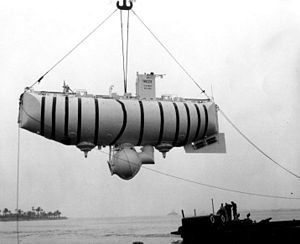
Reaching the bottom of Challenger Deep remained impossible until two world wars, submarines, frogmen, sonar, and the invention of the Aqualung wedded modern technology to oceanographic exploration. A new invention by Auguste Piccard, the bathyscaphe, finally made very deep dives possible.

In its essential function, a bathyscaphe is more like a dirigible than a submarine. The crew is suspended beneath the vessel in a steel sphere designed to withstand great pressure. The skin of this pressure sphere is so thick, five inches in the case of the Trieste, that it would sink immediately. To prevent this, it is suspended beneath a large, thin skinned, self-propelled float filled with gasoline. This provides buoyancy and, since gasoline is a liquid, is not affected by pressure. Air tanks allow the bathyscaphe to float on the surface as it is being prepared for use. Once the air tanks are emptied, the negatively buoyant bathyscaphe sinks to the bottom — seven miles down in the case of Challenger Deep. The pressures there are so great that it is impossible to refill the air tanks, so the bathyscaphe also carries several tons of steel shot in open bottom containers, held in place by powerful electromagnets. When it is time to return to the surface, the electromagnets are shut off, the steel shot is released, and the now positively buoyant craft returns to the surface. In case of a power failure, the shot would automatically fall away.

The bathyscaphe Trieste was built in Italy to a modification of a Belgian design by Swiss inventor Piccard for the French navy, who subsequently sold it to the American Navy, who rebuilt it with a new and stronger pressure sphere made in Germany. Globalization, anyone?

On the twenty-third of January, 1960, the Trieste was ready to plumb Challenger Deep. The crew consisted of Jacques Piccard, son of the designer, and Navy Lt. Don Walsh. They boarded the vessel, moved down to the seven foot diameter pressure sphere and sealed the hatch. The air tanks were allowed to fill with water and the descent began. It took nearly five hours to sink to the bottom of the Deep. Three quarters of the way down, one of the plexiglas windows cracked, but not enough to cause disaster.

As they cruised above the deep ocean floor, Piccard and Walsh reported a bottom of smooth ooze and saw bottom fish swimming, proving that vertebrate life could survive such high pressure and eternal darkness. They spent only twenty minutes at the bottom, in part because of the cracked viewport, and hours more returning to the surface.

No one would return to those depths for another half century.

Trivia for the faithful: Jean-Luc Picard of Star Trek: TNG seems to have been named after the Jacques Piccard, or after his father Auguste Piccard and his twin brother Jean Felix Piccard. Different sources credit different family members with the name origin. Also, in TNG episode “11001001” a small, slow starship named Trieste is mentioned.