Tag Archives: history

167. On the Brink of Glory

Not everyone who does the work endures the danger is there to reap the glory.

Take Eliot See and Charles Bassett for example. Both were chosen for the second group of astronauts, and were assigned as the crew of Gemini 9. They were flying together in a T-38 trainer en route to prepare for that mission when they went down on approach to Lambert field in bad weather. Both were killed, crashing into the building where their spacecraft had been built, not 500 feet from the Gemini 9 itself.

Gemini 9 would have been the first spaceflight for each man.

Everyone knows the names Grissom, White, and Chaffee, who died on the launchpad in the “Apollo One” fire. Grissom and White were veteran astronauts. Roger Chaffee was among the third group of astronauts chosen. He worked through the Gemini program without being given a mission, then was chosen to replace Donn Eisele, who had been injured during training, on the first scheduled Apollo mission. That flight ended in fire, on the ground during routine preparations; Chaffee never got to fly in space. Eisele recovered from his injuries and flew on the next (and first successful) Apollo mission.

Robert Henry Lawrence Jr. was the first African-American astronaut. (Ed Dwight had been an astronaut candidate earlier, but was forced out.) At Edwards Air Force Base, Lawrence investigated unpowered glide return characteristics using an F-104 Starfighter, contributing greatly to knowledge necessary to the Space Shuttle program. He was assigned to the Air Force’s Manned Orbiting Laboratory program, but before he flew in space, he was killed in a crash landing while acting as a pilot instructor to a trainee. When the MOL project was abandoned, many of it’s astronauts transferred to NASA, where they became the backbone of the early Space Shuttle missions. Lawrence would almost certainly have been among them.

Milburn Apt became the first man to reach Mach 3, and died in the same flight. It was his his first flight in the X-2 rocket plane. He achieved the mission objectives, but found that his flight had carried him unexpectedly far from Edwards. Because of the X-2’s noted instability, he was not scheduled to begin return maneuvers until his speed had dropped, but that would have carried him too far for a safe return glide. He began to turn back at above optimum speed, and lost control as turbulence knocked him unconscious. When he regained awareness, he ejected his safety capsule – the forward section of the craft – but did not survive.

Apt received unwanted posthumous fame. The cockpit camera recorded the final seconds of his flight, and that film became required viewing for all subsequent pilots preparing for hypersonic flight.

Apt’s daughter was two years old when he died. She later became a writer, and her Letter to My Father Concerning the State of the World is a moving exploration of what it meant to her to be the daughter of a test pilot who did not survive.

166. Nonstop Before Lindberg

Nonstop over water is a big deal. In the early days of aviation, planes failed frequently, and forced landings were standard procedure. Landing in a cow pasture was problematical. Landing in the ocean would likely be fatal.

In 1909, Louis Bleriot flew nonstop (there wasn’t any other way to do it but nonstop) across the English Channel. He would certainly have set off a round of longer and longer first flights, but WW I got in the way.

After WW I, there was a surplus of newer, more sophisticated aircraft. Two British flyers, John Alcock and Arthur Whitten-Brown, along with several other competing teams, set out to cross the Atlantic nonstop, beginning their flights in Newfoundland. Hawker and Grieve took off first, crashed a thousand miles into the flight, and were picked up by a passing steamer. Raynham and Morgan tried an hour later, but crashed during takeoff.

Alcock and Brown left Newfoundland on June 14, 97 years ago today. Alcock, the pilot, had waited as long as he dared for better weather, but finally decided to chance the near gale force winds. The two aviators, in a single open cockpit, took off at 4:10 PM, barely clearing the trees at the end of the runway. They headed east toward Ireland, with the wind behind them to hurry them along.

Shortly after takeoff, Brown discovered that their wireless was not working. He crawled out of the cockpit onto the wing to get a look at the small propeller mounted under the fuselage which powered the radio. Three of four of the blades had sheered off. They would remain out of communication until their flight either succeeded or failed.

At 7 PM, the exhaust pipe on the starboard motor overheated, split, and burned away. This left the motor running erratically, but there was no way to fix it.

They were flying at 3000 feet; Brown was navigating by sextant. When they entered a fog bank. Alcock had to rise to 12,000 feet so they could see the stars again. About sunrise, they entered an even higher bank of fog. They could not tell left from right or up from down, but the instruments showed the plane listing and then entering a spin. They dropped down, blind, almost to the ocean itself. Fifty feet above the water they cleared the fog and clouds with wings vertical. Alcock pulled up just above the water.

For hours they flew in alternating clouds and clear air, until the storm turned the sky black in front of them. Then they entered snow, sleet, and freezing rain. Alcock tried unsuccessful to fly above the storm, but the only result was that a critical gauge, fixed to a strut outside the cockpit, iced over. Again Brown had to leave the cockpit to chip away the ice, but this time he had to remain, clinging to the cross wires, to repeat the process every time the gauge re-iced.

Eventually they had to drop down through the storm again to see the ocean below so they did not overfly their destination. At 8:15 AM, June 15th, they sighted the Irish coast.

Alcock and Brown were knighted for their efforts, and lionized in Britain.

In America, not so much. Eight years later, Lindbergh flew nonstop from New York to Paris, following the same route overwater as Alcock and Brown, and became famous throughout the world as the “first man to fly the Atlantic”.

***

These posts are necessarily short, so details get missed along the way. Like Bleriot before them, Alcock and Brown, and their competitors, were in pursuit of a monetary prize. This time it was for the first single plane to cross from North America to Britain in under 72 hours. The “single plane” rule was to avoid someone flying from Newfoundland to Iceland, jumping into a second, newly fueled and serviced plane, and completing the trip. Stops along the way were allowed, as long as the same plane was used.

A decade later, Lindbergh was also in a race with a bunch of other flyers to win a monetary prize for the first non-stop flight from New York to Paris. There was nothing in the prize about a solo flight. The other competitors were in larger planes, with crews. Lindbergh flew solo to save the weight of a second person, so he could carry more fuel.

Does this sound familiar? The X-prize, recently won by Burt Rutan’s Space Ship One, was modeled after these early aviation prizes. Even the moon landing was the result of competition, not for money, but for prestige and the military high ground.

If you want more information on early aviation feats, check out Famous First Flights That Changed History, by Lowell Thomas, junior and senior.

165. Hopping Across the Atlantic

In False Fame on June 7, I gave Lindbergh a bit of a hard time. That was fair, but there is more to the story.  Lindbergh left New York, flew to Newfoundland, then crossed the Atlantic and landed in Paris, all in one unbroken flight and solo. No one had done that before and he deserved credit for his achievement.

During the New York to Newfoundland part of the flight, and crossing France at the other end, Lindbergh could have tried to set his plane down in a cow pasture if it had faltered. He would probably have lived to tell the tale. It is the over water part of his flight that scared those who followed his exploits and made him a hero.

However, eight other men had already crossed the Atlantic by air and two of them were on a non-stop flight.

***

A great deal of progress in aviation had taken place between the Wright brothers first flight and the end of WW I. By 1919, the U. S. Navy was ready to attempt a flight across the Atlantic, using Curtiss flying boats.

There was a generation of world wide flight, now largely forgotten, between world wars one and two, that used flying boats. The reason was simple – there were few airfields. If you wanted to fly to Cuba, for example, your only choice was to land in the water at Havana harbor. All that changed in the 40s when warring nations, especially the US and Britain, built military airfields across the globe. When peace returned, the day of the flying boat was over.

300px-Curtiss_NC-4_four_engine_configuration-detailIn 1919, that generation of flight was just beginning. The U. S. Navy had commissioned Glenn Curtis to build four flying boats before the end of WW I, and now planned to use them in an attempt to cross the Atlantic by air.

On May 8, the NC (Navy Curtiss) 1, 3, and 4 left New York on a three jump flight to Newfoundland, where they were repaired and readied for the longest over water part of the journey. They left Newfoundland on May 16, heading toward the Azores. A string of naval ships were set out along the way for navigation or rescue. The NC-4 arrived at the Azores after a 15 plus hour flight. The NC-1 and -3 didn’t make it. The NC-1 landed in the open ocean; it crew was rescued but the craft later sank. The NC-3 also landed in open water, then taxied the last 200 miles to the Azores.

The NC-4, now alone, left for Portugal on May 20, but didn’t get far. After repairs, it again departed on May 27 and arrived at Lisbon harbor ten hours later. From North America to Europe, the trip took just under 27 hours – or just under 11 days, depending on how you spin your figures. Subsequently, the NC-4 flew on to Portsmouth, England, making it the first flight from the United States to Great Britain.

All in all, three aircraft with six-man crews and 53 Naval support ships were involved in the journey. The crew of the NC-4 were Albert Cushing Read, Walter Hinton, Elmer Fowler Stone, James Breese, Eugene Rhodes, and Herbert Rodd.

Two weeks later two British aviators made the Atlantic crossing non-stop. We’ll look at their flight tomorrow.

164. Flight into Space

The golden age of (fill in item of your choice) is thirteen.

I first read that phrase in reference to science fiction, but it works for quite an array of things. Certainly the music of our youth is the music we will always prefer, although that may come to us a couple of years after thirteen. It certainly works for automobiles and aircraft.

For me that golden age revolves around the F-104 and the X-15.

***

The entire focus of Edwards AFB, including most of the X-craft, was to fly higher and faster. The higher part caused problems with loss of control as the atmosphere thinned. The faster part brought about heating problems from atmospheric friction. Both lines of research culminated in the X-15.

The X-15 was first contracted in 1954. Early in its development, a follow-up aircraft to be called X-15B was considered. It was to be launched atop a Navaho missile in order to reach into space. NASA dropped the idea in favor of the Mercury program. The Air Force followed up with the proposed X-20, but that too was cancelled after Mercury became successful. Actual flight into orbit by a winged craft would not occur until the first Space Shuttle launch.

The first X-15 flight took place in 1959 and it was still flying nine years later, less than a year before the first moon landing. Like the earlier X-planes, the X-15 was dropped from a larger plane, in this case a converted B-52 bomber. Rather like a two stage rocket, this piggybacking allowed the X-15 a head start. The first 8.5 miles of altitude and 500 mph of speed came out the the B-52’s fuel tank, leaving the X-15’s fuel supply intact for the final push.

During that near decade, there were almost 200 flights. Thirteen of those flights went above 50 miles. The maximum speed reached in level flight was 4,520 mph.

The Air Force awards astronaut wings for flights above 50 miles – international rules do not agree. Two of those thirteen flights went above 100 kilometers. The Federation Aeronautique Internationale counts 100 kilometers as the edge of space, making Joseph Walker officially the thirteenth man in space. (Also the fourteenth.) One of those who gained Air Force astronauts wings was Joe Engle who later flew the Space Shuttle. Neil Armstrong flew the X-15 seven times, but never above fifty miles. He had to settle for a consolation prize on July 20, 1969 when he landed on the moon.

To successfully fly at such altitudes requires a series of small rocket motors strategically placed around the spacecraft to control attitude when the rudder, elevator, and ailerons have nothing to work against.

On high speed flights by the rebuilt X-15A-2, an ablative coating was sprayed onto the surface of the aircraft to protect it from overheating due to atmospheric friction, an issue that the SR-71 and the Space Shuttle would also have to face.

For my generation, the X-15 was the ultimate, and it looked the part. It’s pilots flew to the edge of space; they were not blown there in a capsule on top of a converted ICBM. Mercury and Gemini were wonderful. I followed them religiously. But the X-20, proposed descendant of the X-15, riding on top of a Titan missile would have done it with more class. And it would have landed under the pilot’s control, not on the end of a parachute in the middle of the ocean.

Scott Crossfield, the X-15’s designer and first pilot said it was one of the few aircraft that caused grown men to cry upon its retirement.

163. X-craft

Jay Miller wrote a book called The X-planes: X-1 through X-31, and later revised it to include craft through X-45. (Presently, the number is up to X-56.) If you are any kind of a space aficionado, you need to look it up in your local library. The only thing wrong with the book is its title; not all X-craft were planes.

When I was growing up, I was in love with the F-104 Starfighter and the X-15 rocket plane, two aircraft with markedly similar outlines. The F-104 was designed, a few prototypes were built and tested, then it went on to become one of the most successful fighter jets in history. The X-15 was designed, three were built (and rebuilt after various incidents), and tested. There were never any more X-15s, nor had there ever been a plan to build more. The X-15 was never a prototype, because a prototype is a first iteration, built to be tested, perfected and turned into a series. That is true whether you are talking about fighter jets or can openers, but not true of X-craft.

X-craft were something different. They were flying laboratories – a much overused term, but still accurate, although technology demonstrator is preferred.

After World War II, advances in flight by Germans, British, and Americans, along with nascent cold war tensions, put us on the edge of an unknown frontier. The “sound barrier” loomed as the best known obstacle to further advances in aviation, but there were a hundred other unknowns that never made it into the popular press. Wind tunnels could only tell so much, computer modeling was decades in the future, and it made no sense to build a squadron of high-performance aircraft that might or might not fly.

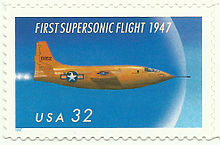
First_Supersonic_Flight_1997_Issue-32c

A glance at the first X-plane, the Bell X-1, gives clues to what was known and what was not known. We already knew that turbulence off the wing would foul up the tail controls at high speed, so the horizontal stabilizer was attached high up on the vertical stabilizer, not on the body. It was not known what negative effect the cockpit bubble would have, so the windscreen was faired into the shape of the fuselage. It was shaped like a 50 caliber bullet – everybody says that without explaining. It is a reference to the machine guns carried on fighter planes. Fired from a ground rest, those bullets would have been sub-sonic. The planes they were mounted on flew at subsonic speeds, but bullets fired from a plane in flight had been going supersonic for a long time.

An aside here for the non-nerd. Planes flying slower than the speed of sound are subsonic. That includes all commercial aviation except the Concorde. Planes flying faster than the speed of sound are supersonic. The X-1 and its follow-ons proved that supersonic flight is not problem. The problem is the transition zone, the trans-sonic region. Slower than sound, the accumulated shock wave is out in front of you. Faster than sound, it is behind you. At the speed of sound, it is right in your lap, trying to tear your plane apart. No modern, supersonic plane lingers at that speed.

The X-1 broke the sound barrier (i.e., passed through the transonic region into the supersonic region) on October 14, 1947, with Chuck Yeager at the controls.

Since this is A Writing Life, I’ll add that I was born about two months after the sound barrier was broken. I was present on the planet for almost all of the early X-craft explorations, although far too young to notice. When I became aware of the X-craft, I fell gloriously in love with them and the infatuation never passed.

The X-2 was a more normal looking aircraft, with swept wings and a pilot’s bubble. It carried supersonic speeds to new heights, but killed its pilot in the process. I will tell that story next Wednesday.

The X-3 was an extreme aircraft, stretched out and incredibly streamlined right down to the tip of its needle nose. It looked faster than any plane before or since, but it wasn’t. All that streamlining couldn’t make up for the fact that the engine slated for the plane wouldn’t fit, and the one that did fit was underpowered. The fastest (looking) plane in the sky flew slowly.

The X-4 was tailless and not successful. The X-5 tested variable sweep wing technology. The X-6 was an aborted project testing out the possibility of a nuclear powered aircraft. The X-8 was a small, unmanned rocket designed for upper atmospheric research. The X-7, and X-9 through X-12 were test beds for missile research. X-13 and X-14 were early attempts at Vertical TakeOff and Landing (VTOL).

Then came the coolest aircraft/spacecraft in the history of mankind, the X-15, which will be the subject of tomorrow’s post.

162. False Fame, reprise

In October, 2015, I wrote a post about the people who got fame they didn’t deserve, or failed to get the fame they did deserve, or who deserved fame, but for reasons other that what the public believed to be true. Since we are going to visit a bunch of forgotten heroes in the next two weeks, I am reprising that post here.

True or false: Charles Lindbergh was the first man to fly across the Atlantic.
False. He was the ninth.

True or false: Charles Lindbergh was the first man to fly nonstop across the Atlantic.
False. He was the third.

The first flight across the Atlantic was by the NC-4, a flying boat with a crew of six, which left New York on May 8, 1919 and arrived at Lisbon, Portugal on May 27, after several stops and numerous problems. (coming June 13)

Less than three weeks later, John Alcock and Arthur Whitten Brown flew nonstop from Newfoundland to Ireland in a converted WWI bomber. (coming June 14)

Lindbergh flew nonstop from New York, north to Newfoundland, then across the Atlantic ending up in Paris. His flight was longer, but the Atlantic crossing was identical to the one made by Alcock and Brown eight years earlier.

Ask anyone in America today who was the first to fly across the Atlantic, and they will either say nothing or name Lindbergh. Alcock, Brown, and the crew of the NC-4 have all been forgotten. It’s not enough to be first, or best, if you don’t also catch the public imagination, or fall under the anointing power of the press.

*****

John Glenn was the most famous astronaut until Neil Armstrong replaced him. If you asked anyone in America during the sixties who was the first man in space, they would have said John Glenn. Nope, he was fifth.

All right then, he was the first man in orbit. Nope, he was third.

First American in space? Nope, third.

Russian Yuri Gegarin was the first man in space and in orbit. (see 130. First in Space) Alan Shepard’s sub-orbital flight was next, followed by Gus Grissom, also in a sub-orbital flight. Russian Gherman Titov orbited next, then John Glenn. For the completist who is reaching for his reference materials, the first X-15 pilot to win his astronaut’s wings came in just after Glenn. (We’ll look at the X-15 tomorrow and Thursday)

John Glenn earned his fame, and he never asked to be better remembered than his fellow astronauts. But he was.

Gegarin is still remembered by a very few, but ask any American who Gherman Titov was and you will either get a blank stare or be told that he was the Communist dictator of Yugoslavia. (And if you’ve forgotten him, it was Josip Broz Tito.)

*****

Okay, let’s not be sexist. True or false: in 1928 Amelia Earhart became the first woman to fly a plane across the Atlantic.

False. She was only a passenger on that flight; the pilot was Wilmer Stultz and the copilot was Louis Gordon. The flight was a bit of a stunt, and a successful one. On arrival in England, Earhart became instantly famous. There was a ticker tape parade and a reception at the White House when she returned to America. The press called her Lady Lindy. She wrote a book, went on tour, designed luggage and clothing, and generally became rich and famous – essentially before she had done anything.

But that’s not the whole story. Earhart later came to deserve the fame she had already gained. She became the first woman to fly solo across the North American continent, participated in the Santa Monica to Cleveland Woman’s Air Derby, and in 1932 she became the first woman to fly nonstop alone across the Atlantic, finally earning the fame she had received four years earlier.

It is a final irony in the fame-for-the-wrong-reasons game that Earhart is best remembered today for the flight in which she died, while failing to finish.

152. Montrose and Argyil

Here is a poem based in an era when having the wrong religious belief would get you killed very quickly and very cruelly.

The English Civil War was fought while America was being born, between fierce sects of Protestant Christians, over points of doctrine so small that no one remembers them but historians. It was a time of multiple and conflicting loyalties, when opportunists and men of conscience alike changed sides, then repented and changed back again. Much of the freedom of religion we cherish in America today came as a reaction to the excesses visited on the people when armies decided what God had intended.

It was not unlike Shia and Sunni today. I understand them both, and fear them both when they march, because I remember how recently our Christian ancestors were killing each other for the same kinds of reasons.

To explain the obscure points in this poem, it takes place in Scotland which was under English rule. The tolbooth is Edinburgh city hall and the heads of executed prisoners were hung there. Corbies are crows in the Scots language. Montrose and Argyll were sometime enemies, depending on shifting fortunes. Both fought long and eventually lost – then lost their heads. I have bent history enough to put them on the spikes at the same time, so they could have a final conversation.

Montrose and Argyll

There is a spike by the Tolbooth side
Where famous heads are hung to dry;
There came the Marquise of Argyil,
Bereft of body, to reside.

In sun and rain, by weeks and days,
‘Til bare of flesh, by corbies pared,
Above the commons in the street
Who gibed and jeered, and milled and stared.

Montrose later joined him there,
Come newly from the scaffold head,
With fresh and bloody countenance,
Unwelcome, save that he was dead.

Then Montrose said to Argyil’s skull,
Staring eyeless at his side,
“A martyr’s death ye sought and found;
I see your flesh is mortified.”

The skull spoke back, “My Lord Montrose,
Ascent has brought you to my side;
And yet the rose upon your cheek
Comes newly leaking from your eye.”

They bickered harshly through the day
Of who was right when King Charles fell,
And who the Lord most dearly loved,
And who would spend his days in hell.

Then said the Marquise of Argyil,
“That ye died was no one’s fault but yours.
Ye had the chance to do the right,
But ye woudna’ heed the Lord.”

Replied the Marquise of Montrose,
“Full many died, whose deaths are yours.
Ye had the chance to let them live,
But ye woudna’ heed the Lord.”

They both paused, their voices spent,
Reflecting on the weary years,
The twists, the turns, the changing sides,
Betrayals, deaths, and bitter tears.

To overthrow an upstart King,
Then, repentant, bring him back again.
For Scotland, God, or Covenant
‘Til Cromwell’s axe cut short his reign.

Now all is done; the King is dead,
The Scottish church no stronger stands;
Both Marquises have lost their heads,
And Cromwell strides upon the land.

  * * *

          Myself, I am a sinful man,
          My kindness an indifferent sort.
          Temptation is my truest friend,
          And prayer remains a last resort.

          Yet when I stood beneath those spikes
          To hear the dead and mighty speak
          With undiminished passion still,
          Though hung in shame before the weak.

          I wondered then, as I ask now,
          What further deeds they might begin,
          In Jesus’ name, on Jesus’ flock,
          If they were not such Christian men.

151. Not So New Enemies

Part two of a comparison of Christianity and Islam.

Bush Two called those who strap on bombs to kill their enemies, cowards. That was the most monumentally stupid statement to ever come out of the mouth of a man not noted for his wisdom. People who die for their beliefs are not cowards. If we are to defeat them, we have to understand them. Mislabeling them is not useful. And if we call them fanatics, we had better understand what fanaticism is.

We made a start yesterday by looking at Christian fanatics. Now it’s time to make the comparison to Islam.

*****

Muhammad did not claim to be God or his son. He claimed to be God’s messenger, a prophet, making him closer to Moses or Isaiah than to Jesus. Muslims believe that Jesus was also a prophet, but not the Son of God. Christianity grew out of Judaism, fulfilling it and therefore removing its validity, at least according to Christians. Islam grew out of both and recognizes both as sister religions which have been rendered obsolete by the Koran. Christians and Jews get preferential tax treatment in Islamic law as People of the Book.

That doesn’t keep wars from happening.

Christians claim to be a religion of peace, but history does not bear that out. Actual wars of religion occurred throughout the Reformation period, and wars of politics and commerce often had a strong religious component. Think of the conquest of Mexico, with priests marching beside the conquistadores and building their missions in the shadow of the presidio.

Islam was born in conflict and has never hidden its belief that the Koran should be spread by military conquest.

Before the Reformation, Christianity had about a thousand years of supremacy, full of internal strife, but well able to keep that strife in check. When Jan Hus rebelled against the Church, they burned him at the stake; problem solved.

Islam, on the other hand, split into two parts almost from the beginning. Upon Muhammad’s death, two lines of succession emerged. Those who favored Abu Bakr became Sunni; those who favored Ali ibn Abi Talib became the Shia. Both sects follow the five pillars of Islam and both believe in the absolute authority of the Koran. They differ on their interpretations of the Koran, and those disagreements have been passed on by sectarian schools. Each sect would say that the other might think they follow the Koran, but they are following false doctrine, and have abandoned Allah. All of this sounds a lot like my Baptist father arguing with my Catholic uncle.

Each of the two sects of Islam remained unified. This was very different from the Catholic and Protestant split. The Catholic church remained unified, but Protestants exploded into hundreds of different denominations, mostly at verbal war with one another, and occasionally at real war.

Throughout the history of Islam, church and government have interacted closely. Islam was spread by conquest, which isn’t necessarily as bloody as it seems. Wherever Islam conquered, the old underdogs often rode the elevator of change to high position in the new order. Sometimes they were very helpful in easing the road to conquest.

By a century after Muhammad’s death, much of the Holy Land was in Muslim hands, which did not please the Catholic church. When Tariq ibn Ziyad led his armies across the Straits of Gibraltar and conquered Spain in 711, the Catholic church fought back, but it took seven hundred years to expel the conquerors. In 1492, the Catholic rulers of Spain finally drove out the last Muslims, expelled the Jews, sent Columbus exploring, and began the Spanish Inquisition. Lovely year.

Also during that period, the Catholic church decided to take back the Holy Land, and set the Crusades in motion. Everybody knows that. What is not so well known is that for most of the second millennium, Eastern Europe was a battleground where vast areas were conquered by Muslim leaders, then reconquered by Christian leaders a few decades later, then Muslim, then Christian, for a very long and depressing time.

So we come to today, in a section of the world where two warring sects of Islam are filled with fourteen hundred years of hatred for each other; where religious, ethnic, and dynastic differences abound; and where those who would prefer prosperity at any reasonable cost, clash with those who are entirely dedicated to following the word of Allah, as their particular leaders understand that word. Many would love to kill westerners, but satisfy themselves instead by killing members of the opposite sect who are so near at hand, and such an easy target.

Above all, Islam is a religion which never exploded into a hundred sects. When there are only two sects, victory and the destruction of the other seems possible for both.

In Britain during the War of the Three Kingdoms (see tomorrow’s post) even pious men kept switching sides because they were enmeshed in conflicting loyalties to King or Parliament, to home region, to religion, to friends, and to their own particular bottom line. All of these loyalties were absolute, but as the situations changed, one loyalty would override another and a man would find himself fighting along side the ones he was fighting against only months earlier.

That should sound familiar. Change the names and the dates, and it could be the Middle East today.

150. Old Enemies

There are times when a man has to stand up and defend his country. That is the flip side to yesterday’s post criticizing boot camps.

Today we face Islamic extremists who would destroy us. We can bemoan the our mistakes in Iraq, but we have to move forward from where we are. Wishful thinking is of no value in this issue. We call them fanatics. That’s an accurate description, but it is not useful. It’s just another word like evil, enemy, or barbarian – just another word that means THEM, as opposed to US.

If we are going to understand Islamic terrorists in order to defeat them, we have to find the inner fanatic in our own culture, so we can start to see the world through their eyes. Today we will revisit a time when Christians were killing each other over doctrine. Tomorrow, we’ll compare that to Islam.

*****

Trying to compress two thousand years of Christian history into a few hundred words borders on the burlesque, but let’s try. Christianity began with Jesus, who did not write the Bible. Fundamentalists like my people believe that it was written by his immediate followers under the infallible inspiration of God, but textual evidence suggests that it was actually written hundreds of years later.

In any case, by the third century there were hundreds of “books” to chose from. The Church chose some and discarded many in order to create the Bible. This gives some validity to the Catholic notion that the word of the Church is more important than the Bible, or at least others’ interpretations of the Bible.

Within the Roman empire, Christianity went from persecuted, to allowed, to the official religion of the state. Then along came Martin Luther. He was not the first to question the Church, but he was the first one to live through the encounter, because of changes in world politics which pitted proto-German rulers against Rome and provided him with a sanctuary.

The dam broke and here came a vast flood of new denominations, each anti-Catholic and each disputing with its fellow Protestants. For protection, many of these denominations sought the protection of secular leaders. Protection from outside enemies soon moved toward forced conversions within an area. The Dutch and Swiss became largely Calvinist, many Germanic states became Lutheran, Ireland remained Catholic at the core, although under increasing pressure from their English conquerors, France and Spain remained Catholic, England became the realm of the Church of England, and Scotland fell under a particularly Knox-ious form of Calvinism.

From 1618 through 1648 the Thirty Years War decimated Europe as country after country fought to see which form of Christianity would prevail, cementing the notion of one realm, one ruler, one religion. The notion of individual choice in religion was crushed under the boots of Kings and generals. This era provided every denomination with myths of how THEY were trying to destroy OUR beliefs. That WE were also trying to destroy THEIR beliefs tends to be forgotten.

The English Civil War, also called the War of the Three Kingdoms, came hard on the heels of the Thirty Years War. American notions of religious freedom were born out of the horrors of a conflict where various interpretations of God’s Truth were enforced at sword point, and partisan armies swept the land. The American answer to all this was the separation of church and state, found in the First Amendment:

Congress shall make no law respecting an establishment of religion, or prohibiting the free exercise thereof . . .

There is a bit of cynicism in this. Instead of insisting that God’s will be done, Americans have learned that the man in power rarely understands God’s will.

149. Boot Camp

It’s Armed Forces Week again, that time of year when any questioning of the military is taken as a slap at servicemen or veterans. Citizens who have the temerity to say, “Wait a minute, let’s talk this over,” are seen as unpatriotic. When I was in the military, those people were called commie-pinko wimps. I was one of them, but they drafted me anyway. I’ve told that story in 42. The Other Veterans. I also told the flip side of the story in 43. S. L. goes to War and 44. S. L. in Occupation, which detail my father’s WW II experiences. There are times when a man has to stand up and defend his country. There are also times when a man has to stand up and tell his country to back off.

The military has no use for patriots, because patriots think for themselves. In combat, a soldier who shouts, “We must not do this,” is likely to get himself and his teammates killed. He has to go on, following orders.

So how do we turn patriots into yes-men? Boot camp. That’s what it’s there for.

Boot camp is not seen as something important, or morally debilitating. And, I suppose, compared the things that happen later in the field, it isn’t that important. But . . . without boot camp to turn patriots into soldiers, those later events could never happen.

This isn’t about me. I went through boot camp in neutral mode, observing, remembering, and trying not to feel. I wan’t always successful, but I was successful enough to survive intact. I was changed, of course, but by my own experiences, not by pre-programmed manipulations.

This also isn’t about the eighteen year old children who made up most of the recruits, who were eager to follow the path their elders had set, and ready to go over and kick some commie ass. This is about one young man, and those he represents. He came into boot camp a patriot, ready to serve his country, full of love and compassion, but ready to do his duty. They broke him. I can still see him standing in the barracks before lights out, talking to his friends, saying, “This isn’t right. I joined up to fight for my country. Why are they treating us like this?” His friends laughed at him and told him that this was nothing, it was just getting him ready for what was to come.

It wasn’t nothing, but it was getting ready for his life to come. That was the point.

I never talked to him. There was nothing I could say. He was learning in front of my eyes what I had learned years before, at other hands, under other circumstances. But I never forgot him.

Boot camp is what in Anthropology we call a liminal experience, one that tears down an old identity in order to build a new one. The folks at boot camp are really good at this, even in mild boot camps like the one I experienced at the San Diego Naval Training Center. We could see the real thing across the fence at the Marine boot camp, and we thanked God every day that we weren’t Marines. While I was there, a Marine recruit who could no longer take the daily abuse ran off and stowed away on a jet liner at the civilian airport just over the fence. Hours later the jet landed at his home town on the east coast and he fell out of the wheel well, frozen, asphyxiated and dead. The Marines said good riddance. We worms (as Navy recruits are called) laughed. Learning to laugh at the death of others is part of the boot camp experience.

It was all choreographed indignation, play-acting inflicted onto a captive audience. They said that if we didn’t keep our barracks clean enough or our socks rolled tightly enough, the Trouble Shooters would come.

“You worms have been given socks to roll! That’s all we trust you with now! How can we trust you with nuclear bombs once you’re on an aircraft carrier if you can’t roll socks now!”  Every word was delivered at a shout.

Of course, the Trouble Shooters came. They always do. They came in the night, screaming in manufactured rage and tearing the barracks apart while we stood at attention in our shorts at the foot of each bed.

Near-naked, helpless, frightened into immobility, knowing that the only way to survive was to  let the insanity happen. Civilian identities dying; new, military identities growing.

The making of a Navyman. You could put it on a poster.