Tag Archives: history

671. Old Lascar

Early in January I was taking a break from writing Dreamsinger to write posts for the blog. At the same time, I decided to re-read Cost of Empire. It has been floating from publisher to publisher for a couple of years now, longer than reason would expect but not longer than reality dictates. I wanted to become reacquainted with it.

As I read, I was reminded again how much India lives in my writing. That led to my February fifth post. I had particularly enjoyed writing David James’s encounter with an old Sikh man in London. Indians in British literature are so often spear carriers, villains, or Gunga Dins that it was a pleasure to present a character who was just a nice old fellow worth knowing.

This takes place just before the launch of the dirigible Henry V and it’s subsequent journey to India.

*                     *                     *

There was an old man who sat in the sun every day in a nook against the south side of a rooming house. David had seen him since he first took a room in the city, as he was on his way to where he slept. There were plenty of street sitters, mostly beggars, so at first David paid him no mind. 

Once he became aware of the man, David realized that he never begged or harangued any passers by, but sat with quiet dignity, enjoying the sun and minding his own business. He seemed as isolated as David felt, so David nodded to him in passing, and the old man smiled.

The old man was never there when David walked to work, but he was always there as he returned. The evening after the nod, David touched his palms together as he passed and said, “Namaskar.” Startled, the old man did not reply.

The next evening, David again saluted the old man with namaskar, and received a head bob, palms together, and a reply of, “Namaste.” And a smile.

The following evening, the old man was not alone. A scrawny, dark skinned youngster sat beside him. This time the old man saluted him first, and the boy said, in passable English, “My grandfather greets you. He asks why you take time to notice an old man?”

David stopped. He didn’t want to stand over the old man, but there was no way he could contort his legs into the position the fellow favored. He compromised by sitting down on the lowest of the steps leading to the boarding house and replied, “Why shouldn’t I notice you? Will you tell me why you said namaste after I had said namaskar?”

The boy translated, then replied, “Grandfather says that only the people of eastern India say namaskar. Grandfather is from Maharashtra where they say namaste. It is the same greeting. He asks how you know to say either?”

“I learned namaskar from a friend in Trinidad. His grandfather came to Trinidad to work, after the African slaves were freed. His grandfather was from Bengal.”

They began an intermittent relationship. Sometimes the boy would be there when David came by, and he and the old man would talk through him. But the child was restless, and most evenings he was absent. Sometimes David would salute with namaste (now that he knew the difference) in passing, and sometimes, especially when he was particularly weary, he would simply sit quietly with the old Sikh and watch the people passing by.

It felt natural. David normally shied away from crowds or strangers; to have to say something when he had nothing to say was hard for him. Sitting with the old man and saying nothing, even when he had much to say, was a quiet comfort.

Piece by piece he learned the old man’s story. He was a lascar, as Indian sailors were called. He had first sailed out of Bombay as a young man, forty years ago. He had reached London, and had been paid off. He had no English to seek work or a berth on a ship, so it took him two years to find his way back home to his wife.

He made more journeys, and spent far too much time starving in port between them. His wife had a son during one absence, and died during another absence. Finally his son, now the age he had been on his first trip, shipped with him.

The docks of London were full of lascars looking for a berth, or just existing; a few worked in Britain, although it was illegal. His son gave up on finding a berth, found work with a ships’ chandler, and eventually saved enough money to buy the boarding house where his father took the sun. He married a half-Indian girl, the daughter of another lascar, and his son was now his grandfather’s translator.

The old man longed for his home. His son worked day to night, and hoarded his pennies like an Englishman. His grandson had never seen India, and lived the life of the despised, in the land which had conquered his homeland.

670. A House Still Divided

A house divided against itself, cannot stand. I believe this government cannot endure, permanently, half slave and half free. I do not expect the Union to be dissolved — I do not expect the house to fall — but I do expect it will cease to be divided.
                          Abraham Lincoln, June 16, 1858

In 1858, the house (America) was certainly divided. Three years later it was split asunder. That wound was not healed. The South was dragged back by bitter force, and for another hundred years black people bore the brunt of Southern hostility — and Northern hostility as well.

Ending an armed rebellion does not quell a rebellious spirit.

During WWII America moved with concerted effort to end Fascism. Twenty years later, our house was divided once again, with vast numbers supporting war in Viet Nam and vast numbers opposing it. Very few minds were changed, and the bitterness did not die. Only bitter people died, and not all of them. I should says, not all of us. Fifty years later and I’m still pissed at what we did in Southeast Asia.

We are frequently divided by the wars we have fought, and we are always divided by race — never mind the fact that the whole concept of race is an illusion. For four hundred years, whites and blacks have mixed their DNA, frequently by white force on black women. Light colored “blacks” have passed and become “white”.

Personally, I like the result (though not the means). If you lined up every American by skin tone there would be an unbroken continuum from dark to light, but the end points would still be very different. Would you prefer having everybody a dull beige? How boring would that be?

The “black race” has whitened and the “white race” has darkened. If that second statement seems wrong, it is only because when there is a question of whether an individual is white or black, if he/she isn’t completely white, he/she is “demoted” to black. Witness a certain duchess in Britain who is only slightly south of pale.

If you have any sense of mathematics you can see that this process will eventually make “whites” cease to exist. The “one drop of blood” gang will have won — and disappeared.

There is only one race, but there are still a thousand variations of that race, whatever we call them. There are also a thousand ethnicities, by which I mean groups with a common history and culture. There are ten thousand sects and religions.

Jesus said, “Wherever there are two or three gathered together, there will be a fight and the next day we will have two denominations where yesterday there was one.” Or something like that. Matthew 18:20, snarky translation.

Some things can be compromised. Some can’t. Some things are so basic to personal world views that all we can do is let the majority decide, and let the minority continue to try to change the law.

When Martin Luther King and thousands of others were fighting for civil rights, the house (America) was divided. At first, all we could do was pass legislation. A strong minority, not just in the south, hated the Civil Rights act. It was put in place by force, not agreement.

Things got better. It is sometimes hard to remember that, but they did. Yet we remain a house divided to a greater degree than in any recent decade. Democrats and Republicans alike are forted up, with cannons protruding from the parapets. That isn’t healthy for either side, since nobody is ever completely right.

I have a solution.

(I can hear you saying, “Yeah, right, sure you do!”) Okay, I have a suggestion.

I grew up Republican and rebellious, but when it came time to register to vote, I didn’t register as a Democrat out of spite. I registered Independent.

Or tried to. In California, they make you register “No Preference”, and I hate that. Independent sounds like a true American who makes up his own mind on issues. No Preference sounds like a wimp who doesn’t care.

I care. I look at every issue with both eyes open, and I usually find sense on both sides. I also usually find stupidity on both sides. A little compromise would make both liberal and conservative proposals more sensible, but it happens all too seldom.

Moderates in Washington are disappearing from both parties. That leaves a vacuum.  Perhaps it is time for people to say “a plague o’ both your houses” and register as independents.

I’m not referring to an Independent Party. If the movement became a party, it’s members would no longer be independent.

We could also use more people running as independents. We all know that no independent is ever going to become President. But a member of a local school board already could be. A mayor could be. State legislators could be, at least in some states. The time is right. Social media makes running without party backing a real possibility, especially in local races

Such a movement away from monolithic parties would be healthy for America. At the very least, if might scare both parties back from the brinks of extremism. Think what ten independent Senators would mean in Washington today. They would wield immense power toward moderation.

Ten years ago there were moderate Democrats and moderate Republicans. They are becoming increasingly rare, and moderate voters have no one to represent their interests.

No one is listening to me, of course, and that’s all right. A movement toward independent candidates doesn’t need someone to tell everybody to go out and be independent. That is a decision to be made one citizen at a time.

I won’t be running for office myself. Every time I get in an argument with someone, they end up mad at me and I don’t change their mind at all. Compromise and conciliation are wonderful things, but they are not in my skill set. That’s why I write.

But you . . .? Maybe you could change the world.

669. Lots of Love

Sorry about the title of this post. It is a bad pun I just couldn’t resist.
You’ll get it as we move on.

I was in the library a week ago getting some books, one each on trains, canoes, guns, and tools — kind of a guy’s smorgasbord. While I was there I checked the catalog for books on Moravian Christians. Two of the books on my to-write list have connections with them, first in 1790s Pennsylvania and later in 1830s Georgia. There was only one book in the catalog, titled Love Finds you in Nazareth, Pennsylvania. I thought, “Yeah, right!”, but I went to look anyway.

The book was by Melanie Dobson, a committed Christian and writer of Christian romances. If you have ever read this blog before you know that this is not in my wheelhouse, but it looked competent, and it was set only forty years earlier than the first of my planned novels. When you are looking for information on an obscure subject, you grab anything you can get, so I checked it out.

This is probably the first romance I’ve read, not counting all those westerns where the hero gets the rancher’s daughter after he shoots up the town. I am about fifty pages in, and I’m impressed.

There was a quirk in Moravian marriage customs called the Lot. The book made me aware of it. It’s just the kind of thing you are apt to find right up front in fiction, but only hidden deeply in books on history. That is one reason for reading historical fiction, and make no mistake, quality westerns and quality period romances are historical fiction.

The small amount of research I have done in addition to  Dobson’s book paints this picture. In the early 1700s, a Moravian man who wished to be married would submit a girl’s name to the elders, or accept a name off the list of eligibles. After much prayer by all concerned, he would blindly select a lot from a pile. It would say yes, no, or maybe later. Once he got a yes, the girl would be notified and given the chance to accept or reject him as a husband.

All of which explains the bad pun in the post title, and why this is a near-Valentines Day presentation.

This use of the Lot is not a matter of coercion, but of faith. It is a way to get the wife or husband that God wants you to have.  It couldn’t be further from my way of thinking, but I was once a Christian and matters of faith still fascinate me.

In Dobson’s novel, Susanna, while still in Germany, has accepted a proposal by a man she does not know so that they can go together as missionaries to the New World. They marry in the opening chapter and immediately leave for Nazareth, Pennsylvania. They arrive with the marriage still unconsummated, and she doesn’t understand why.

The mechanics of this are handled believably, and the reader is also puzzled until the viewpoint switches to Christian, her husband, and we learn that he had previously chosen another woman, but the Lot said no, so he took Susanna on faith, married her, and now is deeply troubled about what he has done.

In every novel about love, there has to be conflict and misunderstanding to be resolved. In every novel about faith, there has to be a seed of doubt and rebellion. This novel has them both, and they are handled extremely well.

As I said, this isn’t my kind of novel. I only picked it up for atmosphere and background, and to use Dobson’s research as a jumping off place for my own. I never planned to finish it, but as good as it is, I just might.

In either case, if you find all this even half as interesting as I do, you should check out the back story of Dobson’s research in her blog.

At first the Lot seemed as if it would be just a side issue in my proposed novel, but then I discovered that the custom continued past the date about which I plan to write. Had I not known about the Lot, it would have been a major failure on my part.

Then things got worse when I discovered that sixteenth century married Moravians usually lived separately in men’s and women’s dormitories, and only met for cuddling and sex at times appointed by the elders. Yikes! That won’t work for me. (As an author, and it damned sure wouldn’t work for me as a husband.)

The girl in my novel, as I visualized her, wouldn’t be bound by the Lot one way or the other, and if her husband-to-be hesitated to carry through because of a bad reply on a piece of paper, she would kick him in the slats and reeducate him. She certainly wouldn’t put up with the sixteenth century equivalent of separate bedrooms.

My characters were destined to remain in the faith and become missionaries to the Cherokee in a later novel, but their personalities and Moravian mores no longer seem to fit. More research and much more thought are indicated.

Science fiction is easier. You just make up the culture to satisfy the needs of the story. If things stop working, you can rewrite. But if you are an honest writer, you can’t rewrite history.

662. Slavery

I am not a professional historian, but as a student of history, with an MA in that field, I consider myself bound by some of the same rules of accuracy. What follows is based on long study, but it is also very much an overview. Any expert could shoot a few holes into this, but they would be very small and local holes in a basically correct summary.

Slavery has been around forever and everywhere. The Romans had it. Native American’s had it. The long centuries when Eastern Europe went back and forth between the Christian world and the Muslim world produced slaves in vast numbers. We Americans can’t really understand the institution unless we see more than just the Southern plantation.

The America which gave us today’s race relations was British America. In Spanish America and French America the story took different turns. To understand slavery in what was to become the U.S.A., we need to look first at a couple of examples of what was happening before blacks arrived.

The British Navy was mostly a slave institution, though never called that. The officers chose to be there; the men, especially in wartime, did not. A few volunteered, and mostly regretted it, but the bulk of naval crews were impressed. That means picked up by armed bands and forced into service. Kidnapped, in other words, but legally since the government was doing the kidnapping.

(Not unlike Selective Service, come to think of it.)

Once on board, they were subject to punishment without trial, given inadequate food, and brutally flogged at the whim of their officers. They were taken away from their families for long periods and frequently killed or maimed in combat. If they lived long enough they would be released back into civilian life, so it was not true slavery.

At first this system lacked a racial component, but as time went on British merchant ships came to be manned primarily by sailors from India. If you read Sherlock Holmes you will find Lascars (Indian sailors in the British fleet) everywhere in Victorian England. This allowed conditions on board to remain so vile that only the destitute would sail. The same thing happened in America, where American officers and crews gave way to American officers with foreign sailors, for the same economic reasons.

Back on land, during the early days of the British American colonies, the rich took passage, but the poor had to bind themselves to pay for transportation. They became semi-slaves for a set period of years, but a bound person could look forward to eventual release. The system had a class component, but not a racial one, and was not permanent, so it wasn’t true slavery.

A system existed in south-western India which is worth looking for because of what it lacks. I will be a little vague here since this is from a treatise I read while getting my first MA in the mid-seventies. I’m presenting it from memory. In that area of India, low caste people were bound into a complex relationship with upper castes. The upper caste owned the land; the lower castes worked it. Sometimes when a family fell into debt and was on the verge of starvation, the father would sell himself into slavery to save his family. This was called lifetime indenture, because the man became a slave, but his family did not.

That is a huge difference, and is the reason I offer it in contrast to what happened in America.

When the first Africans arrived as slaves in 1684, forced labor had already existed for a long time in Britain and British America. With the arrival of blacks from Africa, we finally reached the full-fledged American system. It consisted of involuntary servitude for life, followed by the same for a slave’s children, all defined by race, with few (none, in a practical sense) rights to reasonable treatment. A corollary of the system was the treatment of slave women as brooders, and their children as a crop to be sold.

Ugly. All the forms of near slavery were ugly, but this was particularly foul. The full system had all the ills of previous systems with none of the restraint, and it lasted until the Civil War.

And then all the problems were over — we wish.

Lifetime indenture was ended but the ones who had built the country with the sweat of their unpaid faces were not compensated. Racial disdain became worse. The KKK was invented. Jim Crow laws were passed.

One aspect of this which has only recently come to the attention of the general public is re-enslavement through the judicial system.

Immediately after the Civil War, white southerners found a way to get back some of their power and some of their slaves. They simply arrested and imprisoned newly freed blacks, then rented them out. They invented the chain gang. If you are trying to find historical reasons why blacks fill our prisons and why our police are so often corrupt, chances are pretty good your research will lead you to those events.

That is a quote from the post 88. John Henry which examines the claim that the folk-hero was really such a prisoner.

Eventually came the Civil Rights movement which finally brought a legal end to discrimination. That’s why this post is coming on Martin Luther King Day. But the Civil Rights Act, like emancipation, was a start, not a completion.

Are things better than they were? Of course. Are they good enough? Not on your soul, or the nation’s soul. There is still much work to do.

659. Leap Boy’s Last Word

On February 29th, 2016, I wrote Leap Boy For President about a kid, born on Leap Day of 1952 and named Leap Alan Hed. Take a moment to say that with a middle initial. Childhood taunts about his name made him a rebel, some joker put him up as a write-in candidate for President in 2016, and he won.

It was a pretty good joke at a time when there were more Republican candidates for the nomination than there are in that flock of turkeys which shows up in my yard every week or so.

The piece wasn’t anti-Trump. I wasn’t worried about The Donald in the least. No one at the end of February of 2016 had any idea he would make a showing in the race.

At that time I was worried about Hillary, hoping she wouldn’t win the Democratic nomination, and scanning the available Republicans in hopes of finding one I could vote for.

Did I mention that I’m registered as an independent?

By July of 2016, Trump was looking likely and so was Clinton. Reasonable candidates were falling to the wayside in droves and Election Day was looking more and more like a no-win situation. Looking back after all this time with Trump, it is hard to remember how unappealing Hillary was.

So I resurrected Leap Alan Hed, and provided a series of posts through the summer and fall about the poor schmuck who was railroaded into standing as a write-in candidate against his will, hounded by the press, and beloved by those who wouldn’t take his “No!” for an answer. He eventually went underground, hid from the world, and won anyway — then ran for the border to keep from being inaugurated.

On the night before the election, I gave Leap the last word. We found him sitting around a fire with a bunch of homeless guys, wondering about what would happen the next day. He was still in hiding, but his companions had recognized him from seeing his picture in the papers. One of them asked his opinion.

Leap said, “They won’t vote for me. They aren’t that stupid, no matter how frustrated they have become. They will vote for Hillary and God knows what that will mean. Or they will vote for Donald, and everybody knows what that will mean.

“In a few days, or maybe a few weeks, I’ll be able to surface again and get back something like a life of my own. I just hope there’s a country for me to go back to.”

Leap’s companion said, “I don’t have a life to go back to. I can’t vote for you, or anybody else. You have to have an address to vote and I haven’t had an address in years. But I would vote for you if I could.”

“Why, for God’s sake? Why?”

“Because you aren’t him and you aren’t her, and anybody else is better. Somebody has to do the job. At least you don’t want it, and that means something.”

“If nominated, I won’t run. If elected, I won’t serve.”

“I don’t think so. I think you would come out of hiding and do your duty.”

Leap shook his head, and just said, “No.”

“Its going to be Donald or Hillary or you,” the other said.

Leap sighed. He said, “No good can come of this.”

Truer words were never spoken.

643. Apollo 12

Everybody knows about Apollo 11, especially since its fiftieth anniversary last July. And then there’s Apollo 13 which was crewed by Tom Hanks, Bill Paxton, and Kevin Bacon, with Gary Sinise working hard in the simulator. Or so America remembers it.

Quiz: match the actual Apollo 13 astronauts with the actors who played them.

Answers: Jim Lovell (commander), Fred Haise (lunar module pilot), and Jack Sweigert (command module pilot). Ken Matingly was the astronaut who got bumped for a disease he didn’t have.

That’s it. The average American knows one flight, one movie, and may vaguely remember something about the Bible being read from the moon. It was lunar orbit, actually, on Apollo 8.

There were six moon landings; five of them are essentially forgotten. Apollo 12 was the second landing, and today it has reached its fiftieth anniversary with none of the mega-hype we saw in July. If Apollo 11 had aborted at some point, and Apollo 12 has succeeded exactly as it did, all the hype would be today, and no one would remember Neil Armstrong.

Query: who was the next person to fly the Atlantic solo non-stop after Lindbergh. Answer: I have no idea, either.

For the record, the crew of Apollo 12 consisted of Pete Conrad (commander), Alan Bean (lunar module pilot), and Dick Gordon (command module pilot).

The countdown for Apollo 12 started at midnight Nov. 9th, 98 hours before scheduled launch. Zero and liftoff, was reached after several holds, some planned, some not, at 16:22 GMT (22 minutes after noon, local time) fifty years ago today.

36 seconds into the fight, Apollo 12 was struck by lightning. 52 seconds into the flight, it was struck again.

Every light on the boards went on at once. No one had seen such a display of dismay on any flight or in any simulation. Conrad said, “I don’t know what happened here; we had everything in the world drop out.”

NASA had made the launch despite a thunderstorm, for reasons no one seems to be able to nail down. The surge of power from the two strikes caused most of the electrical system to shut down, rather like a home surge protector shutting down power to save a computer. The crew rode out the emergency until they reached a stable orbit, then got to work reestablishing their connection to the fuel cells.

As if that weren’t enough, the automated navigation system was no longer working. They had to use a sextant (a high tech one, of course) to establish their position by shooting a pair of stars.

Two hours and fifty three minutes after liftoff, the final stage of the Saturn V fired again and put them on a trajectory for the moon.

*          *          *

The moon landing was routine — which is to say, very much like Apollo 11 — which is to say, scary as hell.

They did not have a computer data overload like the one in Apollo 11 that made it look like they were going to crash. They had already had their electrical overload on liftoff.

They came down precisely where they were supposed to. What made it a scary-same-as was that the immediate area where they had planned to land was covered with small craters and boulders, and they had to search around for an area that wasn’t. Conrad flew the LEM while Bean kept his eyes on the instruments. As he swung them around toward his left, the LEM tilted crazily. Then Conrad found a clear spot and came down to land.

Landing on the moon throws up a storm of dust and small particles that obscure the ground and can damage the spacecraft. In the low gravity, it all takes a while to settle. One of the probes on the four feet of the lander touched the moon, a light came up on Bean’s board and he relayed the message. Conrad cut the rocket and the LEM fell, slowly due to the low gravity, to the moon’s surface.

As planned, not counting having to search for an alternate landing site.

Here’s a side note on what it is like to want to know things. I have been aware since the sixties that the LEM balances on the thrust of its rocket engine, and moves sideways to find a place to land. But how did it move sideways? Were there side thrusters like the ones which move big ships away from the dock? Was the main engine gimbaled? No, it turns out, the whole craft is tilted, so the main engine can move them sideways, operating like a helicopter.

So how do they tilt the LEM? Do they use the same attitude thrusters that change its orientation in space? That seems likely, but I’m not sure. Learning one thing just makes me curious to learn another.

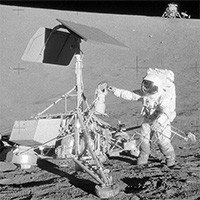
Once they were down, there was work to do. In addition to the exploring and sample collecting like Apollo 11, they also set up the ALSEP (Apollo Lunar Surface Experiments Package) which would continue gathering and relaying information long after their moon walks were over. Conrad and Bean did two moon walks, and on the second one walked to the nearby Surveyor III spacecraft, the unmanned soft landing vehicle which had surveyed their landing site two years earlier. They removed a few parts for analysis back on Earth.

Once their time on the lunar surface was over and the LEM upper stage had rejoined the CSM, the LEM descent stage was given a controlled burn by remote control, then allowed to crash back to the lunar surface. This gave a test “seismic” event to calibrate the ALSEP. So if anyone mentions those six LEM descent stages still sitting on the moon, you can tell them no, there are five.

Apollo 12 splashed down late on November 24th. By the time it was launched, politicians were already dismantling Apollo, and America was yawning. We set out to beat the Russkies and we did it, so why were we still going to the moon?

Politics and public opinion work that way; science doesn’t. No one ever did one experiment and said he had the answer to any problem. No geologist ever looked at one tiny patch of ground and said he understood the whole Earth. Fifty missions would not have been too many to settle scientific questions about the moon, especially since each mission would have likely generated new and deeper questions.

Nevertheless, after November of 1969, only four more missions would land on the moon. Apollo 13 would fail to land, and Apollos 18, 19, and 20 would be cancelled.

Pete Conrad went on to command the first manned mission to Skylab. He died in 1999. (For information on Skylab, see posts 297, 298, and 299.)

Dick Gordon was backup Commander to Apollo 15 and was scheduled to finally land on the moon as Commander of Apollo 18, until it was cancelled. He died in 2017.

Alan Bean Commanded the second manned mission to Skylab and was backup Commander for the Apollo-Soyuz mission. He died in 2018.

After leaving NASA, Bean studied art and became a painter of lunar subjects. He said, “I’m the only man who can paint the moon, because I’m the only one who knows whether that’s right or not.”

There are about a million books on Apollos 11 and 13, but locally I could only find one book on Apollo 12. Fortunately, that one was full of Bean’s own recollections and paintings. See Apollo: an eyewitness account.

639. In The Canebrake 3

“Cotton, how come you’re so pale?”

The older man said, “Shit!”, and grinned. He wouldn’t have answered anyone else, but he had known Titus all the boy’s life, and had known his parents before that.

“It’s a long story, passed down,” he said. “My mother’s mother’s mother was a pale, good lookin’ woman. I suppose she had some white in her, I don’t know how much. Her master caught her one day in the fields and that’s how my granny came about. She was half white plus whatever her mother already was.

“My granny got sold to her master’s cousin, and he caught her out when she was washin’ clothes in the creek. That’s how my mother got to be three-quarters white, and then some.

“She got sold too, when she was still young. She grew up to be a rare, beautiful woman, so they made her a house slave and she had six of us. She never got married, but the boss’s son spent a lot of time in her room, so we all came out pale as cotton. That’s how I got my name.

“He kept my sisters and sold me to Bullfrog.”

Titus said, “I always wondered.”

Cotton shook his head, not so much angry as bemused. He said, “Hell, I’m whiter than half the so-called white people in Tennessee, for all the good it does me.”

Titus was quiet for a while, then he asked, “So you’re going north to freedom. How far are you going to go?”

“How far would you go?”

Titus chuckled. “Cotton, if you want my advice, keep walking north ’til your feet freeze to the ground. Then thaw them out and go further.”

“Sounds right.”

“You going to stay black, or pass for white?”

“What do you think? If I say I’m a free negro, what’ll that get me? If I say I’m white, they’ll treat me like a man.

“I’m going to find me a poor, good-lookin’ white woman, and we’re going to have a batch of pale colored kids. And I’m never going to tell her. And I’m never going to let my kids know that their daddy started out life as a nigger.”

=================

The night wore on. There were worse things than bogles in the night around the two of them.

For Titus, there were soldiers; men, true enough, but full of evil intent. They were of his own people, his own race, his own nation, but they had come for the Cherokees that his parents had devoted their lives to, and that he had lived his life among. They had come for them and had carried them away, out of a country which had been theirs since before the white men ever came, and toward a land none of them had ever seen.

And for Cotton, there were men who looked like Titus — looked like Cotton, near enough, though they would ever acknowledge it — men who would take him into captivity and sell his body as if it had no soul. As if he were not almost entirely white. As if some of those soldiers were not at least as black as he was, but don’t say it! They would kill you if you said it.

And what if Cotton had been all black, not mostly white. And what if Titus were a Cherokee, instead of Scots and German. And what if those soldiers were as white as they claimed to be. What then? Would it matter? Really matter?

So the wind made its noises in the canebrake, and the trees moaned. So Titus’s eyes were wide in a white face and Cotton’s eyes were wide in an almost-white face. So the waterhorses frolicked in the swamp, and the moccasins slithered through the stagnant water, and the frogs croaked like the toads of Armageddon.

So the darkness was filled with all the fearful creatures out of Scotland — and out of Africa as well, for that matter. Cotton too would have his own demons, brought with his people from their old home across the ocean, and now hiding in the canebrake with the bogles, and the soldiers, and the rattlesnakes.

Even if it weren’t All Hallow’s Eve — even if the barriers between Earth and Hell had not thinned and broken — they might as well have.

Cotton raised his cup and drank the tea made of herbs he had found in the swamp. He handed it across the fire, and Titus’s lips touched the same cup as he drank the same liquid. Cotton said, “In the morning I go north.”

Titus replied, “In the morning I go west.”

They would not meet again. They both knew it, but neither said so.

Fire and death and the hangman. The slave catchers and the block. They are all real, but a man goes on.

Still, it had been good to see Cotton one more time.

======================

Not a Halloween story, you say? No ghosts? I disagree.

These wraiths of fiction never lived, and the men of that era who did live are long gone to wherever souls go. But they still haunt us today, and they will probably haunt our children as well.

638. In The Canebrake 2

A voice out of the darkness called, “Titus?” It shook him; he had expected almost anything except someone who knew his name. “Is that you, Titus Young?” the soft voice repeated.

In answer, he kneed his horse and rode further into the light of the fire. The hidden voice said, “You scared hell out of me.”

“You didn’t do my heart any good either, Cotton.”

A man of middle age came out of the canebrake and Titus swung down to walk up to the fire. Even though they had known each other most of Titus’s life, they didn’t shake hands, because Cotton was a slave.

Or had been. The fact that he was alone in the dark, not far from the Ohio border suggested he had run away. That left a lot of questions. Titus had been told that the Cherokees were allowed to take their slaves with them, and Cotton had been with Bullfrog since he was a boy.

Cotton was the one who taught Titus most of what he knew about hunting, fishing, and tracking, and just keeping alive in the hills and the swamps. That counted for a lot, but Bullfrog and Salali were the Cherokee couple who had adopted Titus when his parents died. Even if Chief Ross had told them to do it, and even if Bullfrog hadn’t paid much attention to him afterward, Titus still owed them both a debt of loyalty.

Titus asked, “Why are you here? What happened to Bullfrog and Salali?”

“I’m sorry to tell you, Titus,” the older man said. “I stayed with them as long as they were alive.”

“Go on.”

“Salali was sick all summer. By the time we left, she had no business traveling, but the soldiers didn’t give us any choice. She died two days along the trail.”

“And Bullfrog?”

“He was hurt bad inside when Salali died. He rode all day, he ate, he laid under his blanket at night, but I don’t think he ever slept. After about two weeks, he died too.

“The soldiers didn’t want to give us time to bury him, so I carried him out of camp in the middle of the night. Those soldiers weren’t much. It wasn’t hard to avoid them. I found a nice place under a pecan tree and buried him, same as I had buried Salali. When I finished, I stuck the shovel in the ground like a gravestone and started walking north. I was already out of the camp and there was no reason to go back.”

So. Bullfrog and Salali hadn’t been the best pair of substitute parents, but Titus missed them. To be fair, he had been no prize either when they got him. Headstrong; too young to be independent, but determined to be independent anyway. He had spent most of his time with Cotton, learning Cherokee ways from the slave, the same way Cotton had learned when he came to Bullfrog as a boy.

“Was Francesca in your group?” Titus asked.

“Your wife? Why would she be with us? She wasn’t Cherokee.”

“The soldiers took her anyway.”

“That’s why you’re following?” Titus nodded. Cotton said, “I never saw her, but there were several groups that moved out at different times. She might have been in a different group.”

“Okay,” Titus said, swallowing his disappointment. “Don’t matter, I’ll still find her.”

Cotton bustled about the fire, pulling something out of the ashes. It was meat, long, slender, cylindrical. Snake. Titus didn’t mind snakes, as long as they were dead. And if they were dead, you might as well cook them. When Cotton started to tear it with his fingers, Titus said, “Don’t you have a knife?”

“Got nothing. I should have kept the shovel, but it seemed too much trouble.”

Titus went to his horse and took a knife out of his saddlebag. “Keep it,” he said as he handed it over. “I’ve got another one.” Cotton grunted his thanks and split the snake. It tasted like squirrel, and it was as welcome as a feast.

Except for munching, they ate in silence. Titus hadn’t seen Cotton in a couple of years, and the time showed in extra wrinkles. It was good to see him again.

Titus had been born to a German father who had died too soon, adopted by a Cherokee father who had not been able to handle him, and had learned most of what he knew from this black slave. Only he wasn’t really that black.

“Cotton,” he said, “how come you’re so pale?”

This story will conclude tomorrow. After all, that will be Halloween.

637. In The Canebrake 1

The background for this story is told in 636. Half Breeds, Various.

In the Canebrake

It was a long, cold afternoon, with spits of snow that were slow melting. There wasn’t any green left in the grass; it was all the crackly brown of late fall. The year was 1838; the month was somewhere in that no-man’s land where October slides into November on a path slippery with sleet.

Titus’s mare was holding out, but he was treating her with extra care since she had lamed up a week earlier. Somewhere ahead of him the main body of the displaced Cherokees was moving west, but he didn’t know how far behind them he was. He had been riding after rumors, picked up at wood cutters’ camps and isolated cabins since he left eastern Tennessee. Now he was tangled up in a canebrake, following a narrow, muddy trail that paralleled one of the many tributaries of the Tennessee River. It wouldn’t be long now until he reached the Ohio — he thought. He hadn’t been really sure of his location for days, and the low overcast sky didn’t help any.

He pulled up at a familiar churring sound, followed by a slithering in the leaves. Canebrake rattler, probably. Titus had lived around snakes all his life, but he had never gotten to like them. Even worse were cottonmouths. They didn’t even have the decency to warn a man before they struck.

It was getting on dark, and the fog was rising from the stagnant waters beyond the trail. He was two days hungry and there wasn’t a scrap of food in his saddlebags. Pretty soon his horse would not be able to find her way ahead, but there was no place big enough or dry enough to spread a blanket. The tall canes around him seemed to close in as the light failed.

He could smell the swamp. He thought of waterhorses and the sluagh, and all the other fairy creatures his Scottish mother had told him about. Those weren’t comfortable thoughts for a night this dark and cold, on a trail this uncertain, at the approach of All Hallow’s Eve.

Something erupted from the brush at his side and hurled itself scrawking into the air. An egret probably, or maybe a heron, but when he saw it for a moment silhouetted against the moon, it became a boobrie, come all the way from the lochs of the highlands to haunt the Scottish half of his soul.

Then he saw the light, faint, almost luminescent in the distance. Perhaps the light of . . .

Titus took hold of his imagination and put it firmly away. What he needed to worry about tonight were not creatures designed to frighten children, but men with guns and knives, and the intent to do a traveller harm.

He eased forward; the sound of his horse’s hooves was swallowed up by the soft ground. There was a spot wide enough for a simple camp, and somebody had managed to find enough dry wood for a fire.

Then the mare stepped into a puddle. It was a small sound, but the figure by the fire vanished. First he was there and then he wasn’t, and he didn’t leave even a hint of movement in the canes.

Titus froze in place. His rifle was in a scabbard at his knee, but pulling it out now might cause the trouble he was trying to avoid. He hallooed the fire in a low voice, but got no answer.

Titus kicked his mare in the ribs and started forward, pausing at the edge of the firelight. He called out, “How about welcoming some company. I’ve been riding all day and this is the first wide spot in the trail I’ve seen in hours.”

No answer.

“I’m not going on in the dark. You might as well come out, unless you plan to stay squatting in the mud ’til morning.”

Still nothing, and a shiver ran up his spine. He wished he hadn’t been thinking of bogles. Then a voice out of the darkness softly called his name.

This story will continue on Wednesday and conclude on Thursday.

636. Half Breeds, Various

A couple of days ago, in late September, I was beginning to search around for an idea for this year’s Halloween post. I’m not into things that go bump in the night, but if there were ever a holiday that calls for the telling of stories, it would be All Hallows Eve. Then I remembered a scene in an unwritten novel.

Of all the novels I’ve written in my head only, not on paper, Titus Young is the most complete. I know who my protagonist is, I know his antecedents and I know his offspring. Titus Young is the middle book in three well plotted but mostly unwritten generational historical novels.

I think I would write it next, if it weren’t for money. I could write five SF novels in the time it would take me to research and write this one lengthy historical — and I will probably do that — but Titus Young still hangs in there, taunting me.

Titus Young himself was a half breed — half Scottish and half German, that is. I assume that the term half breed is offensive now; I certainly haven’t herd it in years. During my childhood it was in common use especially in Oklahoma. Nevertheless, now that I’ve gotten your attention by the post title, I will switch to mixed race to avoid offending modern sensibilities.

Titus’s Scottish mother met his German-speaking Moravian father and they married in the unwritten novel Nativity. They moved from Pennsylvania to south-eastern Tennessee to be missionaries to the Cherokees. Moravians often did that. Titus was born there and the Youngs became respected for their compassionate work. When Titus’s parents died during an epidemic, John Ross, principal chief of the Cherokees, himself mixed race Scottish and Cherokee, arranged for Titus to be adopted by one of his relatives. Thus Scottish-German Titus became legally Cherokee, without a drop of Indian blood.

As a young man, Titus took a flatboat down the Tennessee and Mississippi rivers with a load of cargo for New Orleans. His boatmates were two white brothers. They sold their wares in New Orleans, but on their return up the Nachez Trace a disagreement led to a lifelong feud.

While in New Orleans, Titus met and courted a beautiful young Italian girl. Actually, she had an Italian father and a Natchez Indian mother, but she so hated her Indian heritage that she chose to pass as Italian. On a later trip to New Orleans, Titus met her again and they married. They returned to Tennessee where they opened a business.

Some years later, the events leading up to the Cherokee removal occurred. When the soldiers come to round up the Cherokees, Titus was away. His old enemies informed the soldiers that Titus and his wife were Cherokee.

Titus’s wife was half Indian, but no one knew that. She was believed to be Italian, and Titus was Scots-German, but Titus was an adopted Cherokee and she was married to him. That was enough for the soldiers. She was taken away with the rest of the tribe.

This irony of this left her with much soul-searching to do as she experienced the horrors of the Trail of Tears, and saw those horrors inflicted on her husband’s adopted people.

Titus returned, found himself a fugitive, found his enemies in possession of his business, and fled. He headed west, retaining his freedom but following the path on which the soldiers had taken the Cherokees. While he was on this journey, he came across a runaway slave named Cotton, whom he knew from when he was a boy, and that scene will form this year’s Halloween post.

==============

In the 1830’s, America was full of half-breeds (to use the contemporary term). Even more appear in this story than I’ve presented so far. A lot of them were passing for white, and making life hard for the known half-breeds. Gay people didn’t invent the idea of being in the closet. We’ve always had closets.

Titus Young is one more way for me to explore that notion, but it is also just a great story. It begins on a Mississippi riverboat, where Titus meets his old enemies years after the events described above. They don’t recognize him, which allows him to engages them in a poker game and trick one of them into challenging him to a duel.

This part of the novel will be narrated by a young professional gambler who gets roped into being Titus’s second. During the night before the duel, Titus tells the young man his life story, which we will see in a series of flashbacks, and in the morning . . .

But I guess that’s enough for now. The scene which will become the Halloween post will begin next Monday.