Tag Archives: literature

420. Created Equal, Not Likely

I made Neil McCrae an English teacher. This has quite a few advantages in that English teachers deal with emotions and hidden meanings. That works out well in writing about teaching.

Personally, I wouldn’t teach English for five times what they paid me. It is too hard. Any question you pose has fifty answers, and you have to read all of those awful student papers. I read my share one year when the English teacher, the History teacher, and I set up a cooperative teaching situation. Every student researched and wrote a paper on some nineteenth century scientific innovation.

In case you never thought about it, the nineteenth century is when science took over mankind. 1800 if far more different from 1900, than 1900 is from 2000. Look it up.

Our kids had to look it up. This was only ten years ago — we only did it one year — and for the first time our computer lab was fully connected to the internet. We gave them the time they needed to do the work in school, since many of our students were too poor to be connected at home. While they worked, we walked around to see that they weren’t playing the latest game or copying a student paper on their subject from half-way around the world.

When all was finished, all three teachers read the papers separately, with different criteria, and the papers got grades in all three classes. They got a grade for writing and grammar from the English teacher, a grade for how their innovation affected history from the History teacher, and a grade for scientific accuracy from me. That made for some odd moments.

One student, used to all As, bright, skillful, and cocky wrote a paper on a scientific innovation without doing any research. The paper was beautifully written, carefully printed, neatly bound, and grammatical, but she had faked it. I understand that; a good writer can fake his way out of a Federal prison, and it can become addictive.

All her scientific facts were dead wrong. The paper got an A in English, an A in History, and a D in Science, along with a half-page explanation of why, and a red circle around all her errors.

Does Middle School exist do teach you how to avoid getting caught in High School? Could be.

I taught everything my first year, and a little more science every year thereafter until I was finally down to just science. It’s surprising how many people don’t feel comfortable in science. The imposter syndrome is rampant. Personally, I loved it; it was my favorite subject from the first, and there were a lot of other teachers who were glad to let me do it.

The only other subject with more people who don’t want to teach it, is math. But even math has its advantages. “The answer to the problem is 9.72, Johnny. It doesn’t matter if you think it shouldn’t be. That’s what it is!”

Try saying that in a Civics class when you are discussing Republicans and Democrats.

PE teachers get a bad rap. I’m sure there are some lousy ones out there, but the ones in my school were excellent. Still, thirty years of playing Tate-ball (invented by our PE teacher Mr. Tate) seven hours a day can get to you. Adriana, my friend and the other PE teacher, enjoyed fifteen years of outdoor teaching, but all those early autumns and late springs in the blazing sun finally took their toll. She switched to science. There will be more on this Wednesday.

Symphony 19

Neil sat down at his desk and half a dozen of the children moved quickly to their places. Some of the others looked at the clock and saw that they had five more minutes. Two of the boys ran out the door, and a handful of others began to look for their assigned seats.

They were a mosaic. They were very pale and very brown and every color in between. Like a mosaic, each piece was complete in itself, but put together would form a greater pattern. Now the mosaic was still a heap of multicolored stones, but the pattern would emerge. Neil’s job was to find it, without damaging any of the individuals in the process.

The bell rang. Those who were still wandering took their seats, and the boys who had left came running back. They were very docile, unsure, and even a little scared. This was their first year across the fence, with the big kids, and for many of them Neil would be their first male teacher.

Neil had known they would be different from high school students, but until now he had had no idea how different. They were meek (that would surely change), they were eager (he prayed that would not change), and they were tiny. Neil was nearly six feet tall, but he was used to looking up at many of his students. Here was a little girl — his seating chart told him it was Tanya Michelson — who could not be much more than four feet tall. He couldn’t even guess her weight; he had no standard for comparison. Tiny! And she wasn’t the only one; half the boys and a third of the girls were nearly as small.

Three of the students were still standing. One of them said, “Where do I sit?”

“What’s your name?”

“Rafael Ortiz.”

Without looking, Neil knew he had not seen that name. He asked, “Are you a sixth grader?”

He was, and as he spoke two more students came in. There were a number of empty seats, so he had them sit anywhere while he took roll. Of the thirty-two students on his list, nine had not shown up. When he called Duarte Zavala, one of the new arrivals spoke up, and Neil shifted him to his assigned seat. Tim Galloway was home with the chicken pox, according to his neighbor, and would be back in about a week. Juan Rogers was in Mexico; they could expect him back in about a month. And nobody knew where Olivia Pinero was, except that she was out riding her bike last week so she hadn’t moved.

It was clear that the empty seats were nothing unusual to them, but Neil was amazed. He could count on one hand all the first-day absentees he had had in four years of teaching at his last school.

Neil put down his class list and said, “Let’s finish that later. Everyone has a seat for now. If  you aren’t in the right place, or you aren’t on my list, we’ll take care of it, but first I want to introduce myself. I am Mr. McCrae. I will be taking Mrs. Wyatt’s place this year while she is having her baby.”

“She already had it!” Tanya Michelson interrupted. “She had it last night.”

Neil smiled at her and said, “That’s good news, Tanya, but you need to raise your hand before you speak. Otherwise things will get unruly.”

Tanya pouted and added, “It weighed seven pounds, and it is a boy named Michael.” more Monday

419. Airship Flamel

As I mentioned previously, I found To Rule the Skies: An Airship Flamel Adventure when its author, Michael Tierney, liked one of my posts and I went to visit his website. I bought it as an eBook, which is an adventure in itself. I read eBooks on my desktop Mac. Things that come through iBooks work fine, but the Kindle download is a piece of crap. As you read, it jumps to a new page every few seconds without any input from the user. The only way to successfully read is with your finger lightly on the mouse, and that only works part of the time. This is particularly irritating since the old Kindle download worked fine.

Let me say at the outset that I loved this book. It was a hoot. However, I’m not sure how many of you will feel the same. It probably depends on your vision of what steampunk should be.

To Rule the Skies reminded me of the books I read when I was a kid back in the fifties. Then books were straightforward, violence was muted, and nobody had any literary pretensions. Irony was unknown.

You couldn’t write a book like that if it were set in today’s world, or in the past as seen from today. You can do it in steampunk. As Perschon said of Oppel’s Airborne, it was a time “before the cynicism and doubt the Great War produced. This is the Gilded Age; this is the time of Victorian Optimism.”

That attitude may not be realistic, but it is a breath of fresh air.

The plot resembled an episode of The Wild Wild West, but the crew of the airship Flamel was pure Victorian British. Stiff, long winded, formal, but that was its charm. The tone was somewhere between innocent naiveté and tongue in cheek.

After all, True Grit isn’t Louis L’Amour, and that is its charm. The same thing works here.

I think its time for an example.

Sparks flew at every connection and disconnection. Montgomery was worried that the chamber was imbalanced and he made ready to pull the switch that would break the connection to the umbilical.  “She canna take it any more!” he cried, and just as he did, the shaking stopped suddenly, and the plasma inside the chamber settled down to a slowly pulsing orange glow.  He spun in his chair and checked the gauges.  “All normal, Mr. MacIver!  The luminous matter reaction has started!”  Montgomery slumped in his chair relieved.

MacIver? Say that one out loud. And engineer Montgomery shouting, “She canna take it any more!” as he performs a miraculous repair on a dying piece of high tech machinery. The pop culture references come thick and fast.

I hope Michael Tierney isn’t insulted if I say it isn’t literature, but, man, is it fun.

Symphony 18

Day One

School began on Friday the second of September. All of the other teachers complained about having the students for only one day and then losing them for the Labor Day weekend. They said it was like having to do the first day of school twice. For Neil, it was a Godsend. It allowed him three days grace to rethink his ideas after having a day with his students.

Even the weather relented and gave him a day that did not reach above ninety.

When Neil arrived, there was a short line of students with their parents in front of the secretary’s desk. Half a dozen early arriving students had begun a baseball game out back, and there were half a dozen more hanging around the doors of some of the classrooms.

Neil unlocked his door and propped it open with a chair. He had arranged the student desks in straight rows, and had put a student name tag on each desk. Neil’s mother would not have approved, but she had been teaching elementary for thirty years and could handle less restrictive seating arrangements. Neil intended to have everything orderly, at least at first. He had even seated the students in alphabetical order to make it easier to learn their names.

Neil was in his room by eight o’clock in case any parents came to meet him. Only four showed up and two of them dropped their children off at the door without coming in. Mr. Kruger brought Kenneth in and introduced himself briefly. Then Mrs. Whitlock brought in her son Larry and stood by while he introduced himself, squirming with embarrassment, and stayed to chat for a few minutes. Neil found out that Larry always did well in school, that he always liked his teachers, but that he sometimes forgot to do his homework, and that Neil was to call her immediately if anything went wrong. Neil said that he was happy that she cared enough to come in. He meant what he said, but privately he reserved judgment. She was a little too good to be true. He wondered if Larry loved school as much as she thought he did, or if she was reading her own enthusiasm into him.

By the time Mrs. Whitlock left, the room had begun to fill up with children. Some stood in small knots, talking and trying not to be seen looking at Neil. Others ignored him quite completely and wandered around the room without self-consciousness. One skinny blonde girl went up to look at the books that Gina had left, and began telling a dark haired friend which ones she had read. Three boys looked at a display of National Geographic maps Neil had put up.

Larry Whitlock had joined a trio of other boys in the back of the room and already two of them were beginning to scuffle. Neil raised his voice until his baritone filled the room. “Gentlemen,” he said calmly but sternly, “people don’t wrestle in my classroom, even between classes.”

The room was instantly silent, and all eyes were on him. He turned to look at the papers on his desk — papers he had no need to look at — and seemed to ignore the boys. They eased out the door and began wrestling again under his window. He continued to ignore them, so they went out onto the playground. more tomorrow

Symphony 17

After his conversation with Carmen, Neil changed his plans. Instead of spending his pre-school days in academic preparation, he worked at getting to know his children. The cumulative folders were a gold mine. He found out who had been suspended during previous years. He found out which students needed the most academic help. He could see which students had a pattern of mid-winter absences to Mexico.

One boy had been registered originally as Dean Mason. Then his name had been changed to Dean Solstenes, back to Dean Mason, and finally to Dean Smallwood, all within three years. It was easy enough to read an unstable family situation from those changes.

On Dierdre Galloway’s folder he found a note that said, “Needs glasses and won’t wear them. Must sit up front or she won’t be able to read the chalkboard.”

Before he met them, he knew that:

Brandy Runyon had repeated kindergarten, and then had repeated third grade. She should have repeated fifth, but at fourteen, she was far too physically developed. She was marking time while waiting for the paperwork to be completed to transfer her to a school where her learning disability could be dealt with.

Oscar Teixeira had been making outstanding scores on his yearly tests every year since kindergarten, then in fifth grade he had scored almost zero. In the last two years, he had been suspended five times, always for insolence or insubordination. Every parent letter made reference to Oscar as being bored with school. He had failed last year’s test deliberately, and had been suspended for it.

Not every folder contained a problem. Some told stories of unbelievable progress. Tasmeen and Rabindranath Kumar had first enrolled four years ago, in first grade. They had come from Madras, in India, and spoke no English. Their first year scores were nearly zero, but by the second year they were only a little below grade level. At the end of the third grade they were both skipped ahead to bring their grade level more into line with their ages. Despite this, their fifth grade scores showed them to be well above their classmates.

Their fifth grade teacher had wanted to advance Tasmeen another grade. She was a year older than her brother, scored consistently higher, and the teacher felt that he was holding her back. The parents would not agree. They said that they both could be advanced, or Rabindranath alone could be advanced, but Tasmeen was not to be placed above her brother.

With sixty-seven children to remember, Neil fell back on a system that had worked for him in college. On five by eight cards he placed name, age, test scores and a four or five word physical description of each child. For most of the children, he could do no more until he met them. For students like Tasmeen, Oscar, and Brandy, his notes filled the card.

# # #

The night before school was to start, Neil sat in his apartment considering the string of students that had passed through his classes during his years in Oregon. The number was staggering. He had been seeing 170 to 180 students each day for four years. Seven to eight hundred students, and he could only remember about two dozen of their faces.

He had a feeling that he would remember these sixth graders long after he had forgotten every high school student he had ever taught.

Symphony 16

Carmen tapped the folder and said, “This is a typical pattern for a Mexican child who has been in this country for two or three years and is doing well. If she is nurtured, she will probably make it. Her language could improve very quickly if she gets the kind of stern but understanding attention she needs.”

Carmen looked at Neil as she said, “Please don’t think I’m lecturing you, but this is critical. Rosa — all the Rosa’s out there — will not sound intelligent. She won’t be able to think clearly because she won’t have the internal language skills necessary for clear thought. But she is potentially intelligent.

“If you lose her this year, you will have lost her forever. Right now, she could catch up if you push her hard without breaking her spirit. But if she slides through this year it will probably be too late.”

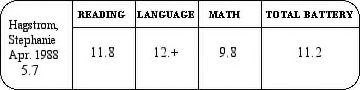
Carmen thumbed through the file and withdrew another folder. This student’s picture showed a skinny blonde with a cocky grin. “This is Rosa’s competition,” Carmen said. “This is the kind of student that will take all your time if you let yourself be seduced by success.”

“Please understand, I don’t know these children. I have met Rosa through her older brothers and sisters, but I don’t know her personally and I don’t know Stephanie at all. I’m just trying to show you the general patterns to look for while you are really getting to know them.

“Stephanie is a top student. That 12.+ means that she got every question right on that particular test. The point is, Stephanie will sound smart because she had mastered her language far beyond what we expect of an eleven year old. Rosa will sound stupid,” Carmen made a face as if the word were distasteful, “because she has not mastered English. The Stephanies of the world always get more than their fair share of attention.”

Neil glanced quickly at Carmen, and caught her face in such an intensity of expression that he could almost see back into her own childhood to the time when she had learned how the “Stephanies” stole attention away from the dark, quiet ones.

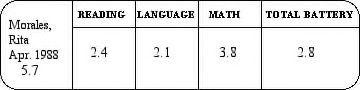
Carmen returned to the file and pulled out a third folder. The girl’s name was Rita. She was skinny and smiling from behind a huge pair of glasses.

Neil looked at her test scores and just shook his head. “Why is she in sixth grade?” he asked. “She can’t do the work if she is scoring at a second grade level. Why wasn’t she retained?”

“I know this one,” Carmen replied. “I had her when I taught third grade. She is almost fourteen. Her family moves back and forth from Mexico even more than most. She went to first grade here. Then she disappeared for a couple of years, and came back for third grade, but she only stayed until Christmas and then we didn’t see her until the middle of fourth grade. She went to three other American schools during that time, for a few months here and a few months there. Who knows what she did in Mexico. Even when she was enrolled in school here, she seldom came. She has seven younger brothers and sisters, and her mother keeps her home to baby sit.

“She hardly speaks English at all. I’ve tried talking to her in Spanish, and her Spanish is terrible, too. Just when I thought I was going to get close to her and make a difference in her life, she went back to Mexico again.” more tomorrow

Symphony 15

“Two years ago a team from the state told us we had to go to a middle school arrangement. It’s the latest thing, putting sixth grade up with seventh and eighth. Never mind how poorly it works! That’s when we put in the portables and built a fence between the two halves of the campus. That’s when we worked out this schedule.”

Neil was surprised at the bitterness in her voice. He guessed that she had fought against the change. The schedule looked beautifully logical and balanced, but he had an idea that it would not work out in practice as well as it did on paper.

He remembered the three brown faces in the road ditch. “What about those students who don’t speak English?” he asked.

“Hopefully, there will only be a few, but some of your students may not read or write.”

“You mean they may not read and write well.”

“I mean they may not read or write at all. In English or in Spanish. That happens when they shuttle back and forth to Mexico every year.”

Neil caught Carmen studying him with a look of puzzled curiosity that she tried to hide. “Have you studied your cumulative folders yet?” she asked quickly.

“I don’t know what they are.”

She led him to the teacher’s lounge and showed him the file cabinet where the folders were kept. The folders for each group of students filled a fat cardboard box. They took the two sixth grade boxes back to Carmen’s room where she took a folder and laid it in front of Neil. It was for Rosa Alvarez. Along the top edge of the folder was a row of six small photographs — Rosa’s pictures in every grade from kindergarten to fifth. She was dark haired and brown eyed with a round face and a solemn expression.

Covering the front outside of the folder were strips of computer printed labels with esoteric columns of numbers. Like the pictures, there was one label for each grade. Carmen tapped the labels with her forefinger and said, “These are test results. You will find them most useful for getting to know your kids quickly. Every year all of our students are given a comprehensive battery of standardized tests. They can be very useful, but you should remember that they aren’t always accurate.”

Carmen smiled for the first time. “You can also use them if you have a weakness for soulful brown eyes. I sometimes develop such an affection for my students that I stop pushing as hard as I should. Lately I’ve made it a practice to come back to these test scores at least once a quarter to remind myself of where each child really is.”

Neil studied her. She was beautifully proportioned. Her hair and coloring were pure Chicano. Her facial features were quite small. She kept her feelings hidden behind the smooth perfection of her face. Neil wondered how much Bill Campbell had told her.

The computer label was covered with data. Carmen said, “Look under the name. You see the 5.7? That is the base of comparison for the other scores. It means fifth grade, seventh month. That is when they took the test. A student who was exactly dead average would score a 5.7 across the board. Now look at Rosa.”

“Rosa’s reading scores show her reading almost a year below grade level. That isn’t as bad as it seems. That kind of variation is still fairly close to the norm. Her language score, though, is nearly two years below grade level — she scored at a high third grade level when she took this test. Her math score is above grade level, which puts her total somewhere near normal.” more Monday

416. Steampunk I II III

If you go to Amazon, select books, and type in Steampunk, you will get a supposed 100 pages of 16 entries each. No, I didn’t tap through all of them.

In the novel I am presently working on, I had cause to quote Samuel Johnson’s A man who is tired of London, is tired of life. I think I could paraphrase that as a man who is tired of steampunk is tired of reading. Steampunk seems to encompass everything, which makes it a little hard to throw a rope around.

I have been reading proto-steampunk all my life, but the genre (if it is a genre) has only been identified as such since about 1980. What is it, other than everything? I feel a little like a wild kid in a permissive household; how can I be a rebel if I can’t find any boundaries?

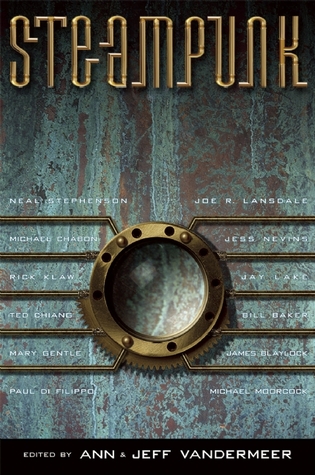
Following that train of thought, I recently got hold of the 2008 anthology Steampunk by Ann and Jeff Vandermeer. There are also a Steampunk II and a Steampunk III, hence the post title, but I haven’t seen them. Let me start by quoting from their preface:

In this anthology, we’ve tried to provide a blend of the traditional and idiosyncratic, the new and the old, while remaining true to the idea of steampunk as dark pseudo-Victorian fun. You’ll find stories about mechanistic golems, infernal machines, the characters of Jules Verne, and, of course, airships

The anthology Steampunk consist of thirteen excerpts and short stories, and three essays tackling history and definition of steampunk. I read only bits and pieces of the thirteen, and that needs explaining. I generally don’t like short fiction. I read tons of it when I was growing up and some of it was superb, but generally it is long on the clever and short on humanity.

Perhaps if someone had held my feet to the fire and required that I finish them, I would have found more to like in these short stories. Probably not. I skipped Moorcock because I had read the novel from which the excerpt was taken. I skipped Blaylock because I am reading one of his novels now. Both authors are excellent.

Many of the other stories left me cold. They were strings of events happening to people I could not care about. Also, the stories seemed universally dark. That is a valid anthologist’s choice, but I don’t care for horror and I outgrew dystopias thirty years ago. Life is a mixture of light and dark, and literature has to mirror that if it is going to hold my attention.

Mind you, most of what I sampled was reasonably well written. It didn’t fail for lack of skill, but there did seem to be a lot of throwing ideas around without linking them together. Short stories can sometimes get away with that. The steampunk novels I am presently reading all seem far better structured.

However, there was one shining light. Jess Nevins’ introduction: The 19th-Century Roots of Steampunk was a superb explanation of steampunk’s precursors. I learned a lot from Nevins.

Symphony 14

He opened all the windows and propped the door open with a chair but it didn’t help much. Then he surveyed the room. He opened the doors under the counter that ran the length of the window wall and found it mostly filled with sealed cardboard boxes belonging to Gina Wyatt. It was just as well; he had nothing to store. All of the paraphernalia he had accumulated during his years of teaching were stored in his mother’s garage in Oregon. They would be of no use to him at this grade level.

The west wall of the room had a generous blackboard. There was a battered metal teacher’s desk jammed against the wall, a row of coat hooks at the back of the room, and some empty bulletin boards on the walls. The walls were of faded blue plaster. The acoustic tile ceiling was discolored where the roof had leaked.

Jammed into one corner, beneath the blackboard and against the counter, was a battered bookcase. Neil sat cross legged to examine it. It contained a dozen dictionaries, an ancient set of encylopedias, and about fifty books. They were a mixture of rescued cast-offs and modern but much worn children’s paperbacks. There was a note taped to the shelf that said, “Don’t let the kids steal too many of these. Good luck, Gina.”

Neil smiled. The note made him feel less alone.

That note was the only piece of paper in the room, so Neil went to the office and filled out a requisition form. An hour later the janitor delivered a cart load of materials: reams of newsprint, binder paper, drawing paper, construction paper in assorted colors, crayons, tape, paper clips, and staples. But there was much missing. There were no colored markers, no stapler, no pencils, no pens, no binders, and no spiral notebooks.

At the bottom of the requisition form was a note saying, “The school doesn’t supply everything you asked for.” Then it went on in parentheses: (Sorry. Low budget. You’ll get used to it. Ask Pearl for help — she’s our best scrounger. Evelyn.)

Neil didn’t know whether to laugh or cry.

Enough. He was spinning his wheels here. He still didn’t have a clear picture of what he was supposed to teach, so he crossed to Carmen de la Vega’s room.

The air conditioning wrapped him up in a rush of cool air. Carmen looked up with a distant, measuring coolness of her own. He reminded her that she was supposed to show him the ropes.

She began by sketching a grid on paper. “The students have seven periods of classes. We teach six and have one period off for preparation. You’ll need that to grade papers. In order to make it all work, our preps are staggered. Yours is fourth period, mine is seventh, Pearl’s is first, and so on. 

“We have about sixty-five students in the sixth grade.  They will be divided into two groups, and they will stay in those groups all day, moving from teacher to teacher as a unit. They will have one period each of math, history, science, and P.E., except that Tom teaches P.E. four days a week and art one day a week. The rest of the day they will spend with you.”

Carmen had sketched in the schedule as she explained, and it was clear enough. She said, “That means that you will actually teach only two classes a day, but each class will be three periods long.”

“Isn’t this a bit of a strange schedule?” Neil asked. more tomorrow

415. Life-long Day Job

After twenty some years of teaching
science, I finally got a lab.  SL

Continuing from Monday’s post — Jandrax came out and I went back to writing full time. Those were the years of A Fond Farewell to Dying, Todesgesanga (FFTD translated to German) Valley of the Menhir, Scourge of Heaven, Who Once Were Kin, and the first iteration of Cyan. I know you’ve never seen half of those books, but you will. I promise.

There is no better feeing than sitting down every day and writing, when the results are good. And they were. However, there are few more frustrating feelings than writing good books that don’t sell. After most of a decade of full time writing, it was clear that I couldn’t go on that way, and equally clear that I couldn’t quit. I needed a day job that would leave me some time for writing.

My wife suggested that I substitute teach. The pay was good (compared to minimum wage) and I didn’t have to look for jobs. I signed up, and the jobs came to me. It worked as a stopgap.

I couldn’t do it again, after being an actual teacher. Substitute teaching is to teaching, as going to the dentist is to being a dentist. The best one word description is probably painful.

However, I didn’t feel that way at the time. Yes, the job was boring, and yes, it was glorified babysitting, but I had made a shocking discovery.

I liked the kids. A lot.

You have to understand, I was an only child, raised on a farm, having little contact with other kids. I never had children of my own — by choice. To me, babies are just pre-humans. Kids under ten bore the hell out of me. But these kids were interesting and fun to be around.

I had discovered that middle school kids are more fun than a bucket of puppies. I realize that I am a minority in that opinion, and I also realize that part of my feeling comes from not having to take them home with me, but there it is.

Most teachers want to teach high school or fourth grade. Not me. My days as a substitute teacher in high school were dismal. My days teaching kindergarten were horrific. But middle school was my Goldilocks age — not too young, not too old.

By that time I had two masters degrees, so it didn’t take long to tack on a teaching credential. I took a job in one of the schools where I had substituted and I was still there twenty-seven years later.

In my mind, it was a day job. I continued writing. I continued working on the novels which weren’t quite right, and I wrote Raven’s Run. Years went by. I wrote a novel about teaching, Symphony in a Minor Key, which is running over in Serial right now.

I could tell you all about my first years, describe my first room, and give you insights into the joys and pains of teaching — except that I already have, in Symphony.

After about ten years, it was obvious that I wan’t going to get back to full time writing any time soon. After another decade, I admitted to myself that I wasn’t just a writer who was teaching. I was a teacher. It took me that long to be able to say it without having it sound like a defeat. I never stopped being a writer. I just became a teacher as well. I had two careers, parallel and simultaneous, and there was nothing wrong with that.

I was a writer, and a good one. I was a teacher, and a good one. Nothing wrong with that. After about twenty five years, I could even call myself a teacher out loud.

Now I am a retired teacher, and a full time writer again, with a new book out and another working its way through the computer. But I wouldn’t trade those years of teaching for anything.