Tag Archives: literature

Symphony Christmas, 3 of 10

Because I intend to publish the novel from which this excerpt comes, Symphony Christmas will not be placed in Backfile.

Rosa desperately needed for someone to hold her, and tell her she was good and pure and valuable.

Neil could not. He could not touch Rosa, or any of his girls.  Carmen could and did, Fiona did when she was so inclined, Pearl mothered them all, and students came from everywhere to be hugged by Donna Clementi. But no student ventured near Glen Ulrich; and Tom Wright, young and friendly as he was, kept them at arm’s length.

Women teachers can hug and touch. It is expected of them. It is “motherly”. But let a man teacher touch his girls and he is a lecher; let him touch his boys and he is a pervert.

It isn’t fair, but it is the way of the world.

After a while, Neil went to his tape collection and put on Art Garfunkle’s first solo album. He juggled the fast forward until he found the cut he wanted, then listened to it twice through. Then he took pencil and paper and ran it through until he had the words copied down, then typed them onto a ditto master. 

*****

On his way to school the next morning, Neil stopped to buy a bag of Christmas candies. The first hour, the students read, and when they returned from their break to start the second period, Neil announced that they were going to have an early Christmas party.

That met with uniform approval, and none of it was silent. He added, “Just stay in your seats. Rafael, please give everyone a paper towel to use as a plate. I have some Christmas candy I’ll distribute as soon as Rafael has finished.”

Rafael worked quickly and a festive atmosphere filled the room. Neil waited until the boy had taken his seat again, then went around giving out candy.

He gave Duarte one piece, Sean one piece, Rafael five pieces, Laura Diaz eight pieces, Raul Fuentes six pieces, Stephanie one piece, and Oscar no candy at all; and so on, around the room.

As soon as they noticed, the fireworks began.

“Hey, you got more than I did.”

“Mr. McCrae, I only got one piece!” (This Neil ignored.)

“Get your hand out of my pile.” – “But you got more than I did.” – “So what?  Its mine now.”

“Mr. McCrae . . .?”

“Hey, what’s going on?”

“That’s no fair!”

“That’s cheap!”    continued

62. A Christmas Booklist

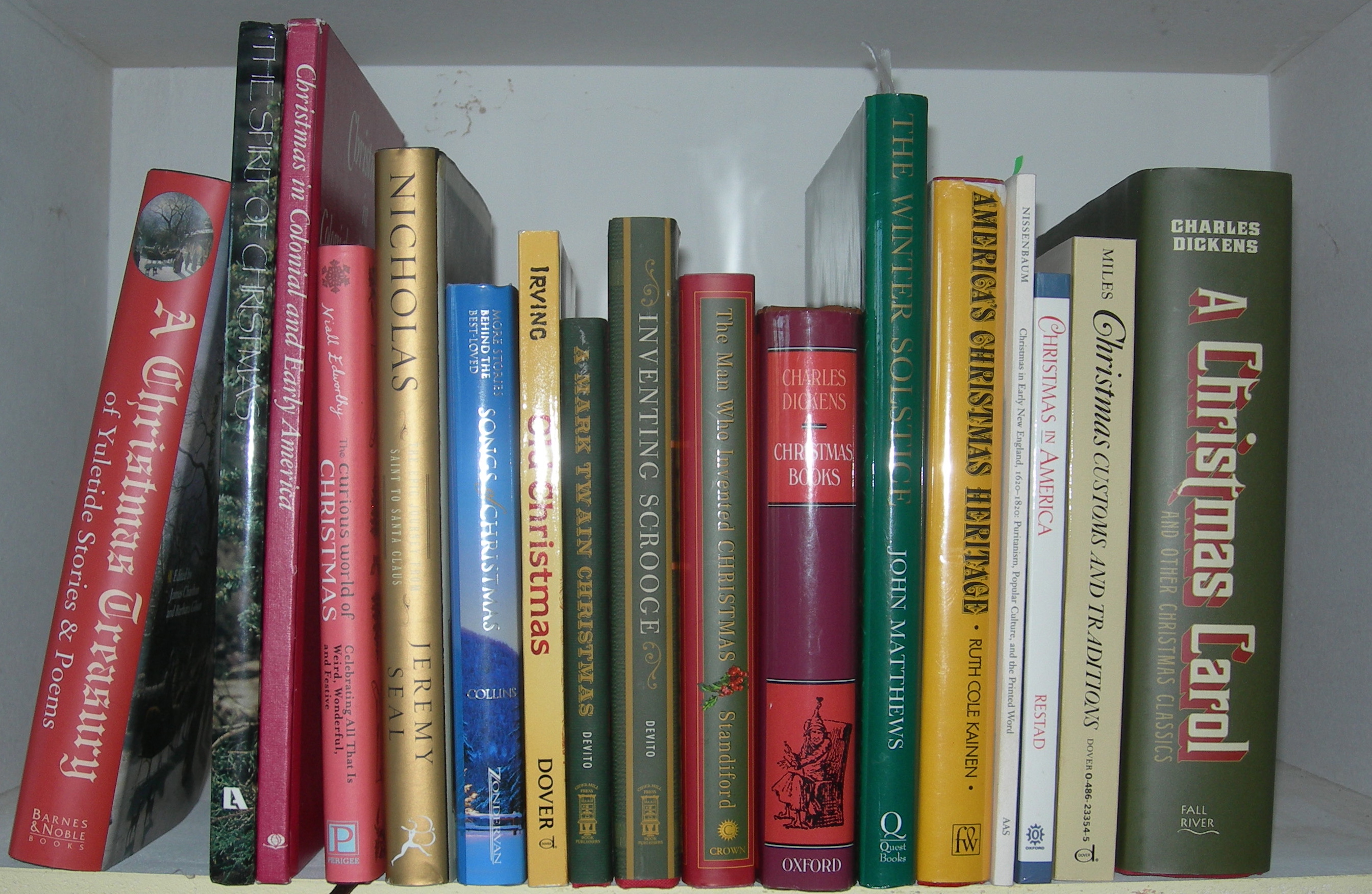
DSCN3974 Here is the annotated booklist I promised you yesterday. You could also Google Christmas or old Christmas, or search either of those subjects on Amazon. I suggest you do. This is not a best list because there are too many books on Christmas for anyone to have read them all. This is simply a list of what I’ve discovered over the years, minus the clinkers. Some of these are easy to find, others will lead you through the back stacks of used bookstores, but there’s no harm in that.

A Christmas Carol by Dickens has to head any list. He also wrote many other Christmas works and gets his own post next Wednesday, the 23rd.

Washington Irving had a powerful influence on Christmas, which is largely forgotten today. Among his followers was Clement Moore of Night Before Christmas fame. They also get their own post, on Christmas Eve.

The rest of this list is in order from decorator froth to historical complexity.

Go to any bookstore and you will find dozens of Christmas cookbooks and books on Christmas decor, sometimes with historical tidbits. You’re on you own here, with one exception. The Spirit of Christmas series by Leisure Arts is classy, has been around since about 1990, and fills up ten pages of Amazon with choices.

Christmas in Colonial and Early America, 1975, by World Book, is an early, sepia toned version of this kind of book with a little more meat in it’s history.

For almost two decades, Ace Collins has been writing books titled Stories Behind . . . , beginning with Stories Behind the Best-loved Songs of Christmas. The title tells the tale; the individual stories are interesting and heart felt.

The Curious World of Christmas is lightweight and breezy, a book of short entries which can be digested one little bite at a time.

The only recent Christmas book I can’t recommend is Nicholas, by Jeremy Seal. I found it dark and tedious, and couldn’t get past page 42, but if you want a detailed look at how St. Nicholas became Santa, it’s the only work I know completely devoted to that subject.

The Man Who Invented Christmas by Les Standiford and Inventing Scrooge by Carlo De Vito each tell the story of the genesis of Charles Dickens’ most famous story. As a writer and a lover of Christmas, I couldn’t choose between them. Read the one that is easier for you to find. Then read the other one next Christmas.

A Mark Twain Christmas has been sitting on my next shelf for a couple of weeks. I will give it a tentative approval based on a thumb-through, and the fact that it is also by Carlo De Vito.

A Christmas Treasury of Yuletide Stories and Poems by Charlton and Gilson has works by every famous author you’ve ever heard of, from St. Matthew through The Adventure of the Blue Carbuncle.

Ruth Kainen’s America’s Christmas Heritage contains well written regional histories of Christmas at a level of detail that is satisfying without being overwhelming.

John Matthews’ The Winter Solstice has a look similar to the decorator/cookbook works above, but with a unique twist. It concentrates on the Roman, Celtic, and Germanic contribution to Christmas. It feels like the Middle Ages, without falling into the trap of New Age Gaia worship.

Christmas Customs and Traditions by Clement Miles is a Dover reprint of a 1912 work. It is an old fashioned history of the evolution of Christmas from Roman times to what was then the present.

Christmas in America by Penne Restad is a scholarly telling of the history of American Christmas. 172 pages of text, 36 pages of notes. You get the picture; a book for the overeducated Christmas nerd, but it is still a good read.

The remaining “recommendations” are probably over the top.

I have in front of me Christmas in Early New England, 1620-1820: Puritanism, Popular Culture, and the Printed Word by Stephen Nissenbaum, published by the American Antiquarian Society. I have already confessed to having two masters degrees, one in Social Science and one in History. This is the kind of thing I used to read for a living. I still read them, but only if they are on a subject that really interests me. Nissenbaum taught at Amhurst; you will find his original research referenced in many of the less scholarly books above. His book The Battle for Christmas was a Pulitzer Prize finalist, but a scholarly work of 400 pages is not something to take on casually. I confess to not owning it; I read it on interlibrary loan years ago. If, however, you are a Christmas nerd and a history buff, it is available in paperback. Go for it; what have you got to lose?

Now it’s your turn. Since blog posts hang around forever, any reply you make to add your Christmas recommendations will remain attached, even if I repost this next Christmas.

Symphony Christmas, 2 of 10

Because I intend to publish the novel from which this excerpt comes, Symphony Christmas will not be placed in Backfile.

Neil is reading papers written by his sixth grade class.

Lauren Turner wrote:

Every year we go to my granmas house for christmas. she has a great big living room where we all put our presents. I get presents from my mom and dad but nobody else gives them to me. I mean I get presents, but my brother always gets twice as many and they are always neater than mine and i don’t think its fair ! ! ! !

Oscar Teixeira wrote:

My Dad gets me chemistry sets and sport shirts and ties and last year he got me a calculator. What I really want is a baseball mitt and a football.

Stephanie Hagstrom’s paper was well written, in beautiful handwriting, and decorated with candy canes in all four corners.  She detailed what presents she got last year, told how happy she was to have Christmas with her parents, and told what she expected to get this year.

Rosa Alvarez’s paper was not so well written, although it showed great progress for her. It said:

This year I don’t think we will have much of a Christmas because my Daddy has lost his job and Mommy’s job at the bank doesn’t give us much money.  My Oldest brother has gone back to Mexico, but Daddy said that what money we have will go to buy toys fo the little kids.  That’s OK, I don’t mind.

Neil lay back on his couch and wiped his eyes.

He remembered fellow teacher Carmen’s voice the first day they had looked at his students’ folders. Carmen had told him about Rosa. Then she had passed him Stephanie’s folder, and had said, “This is Rosa’s competition. She will take all your time if you let yourself be seduced by success. Stephanie will sound smart because she had mastered English; Rosa will sound stupid because she has not.

“The Stephanies of this world always get more than their fair share.”

He thought about them for a long time. He loved both girls, not merely in a vague way as he did all his students, but intensely and personally because they had both come early to his attention and he knew them well. Stephanie knew her own worth; her parents had taught it to her early. But Rosa was one of the meek ones. She desperately needed for someone to hold her, and tell her she was good and pure and valuable.    continued

Symphony Christmas, 1 of 10

This is from the novel Symphony in a Minor Key, a complex book with a number of intertwined story strands. This excerpt describes the experiences of Neil McCrae, a teacher, during Christmas 1989, leaving out a good deal of material you would have to read the whole novel to follow. I particularly like this piece because it is not a story. It doesn’t have a beginning, middle, and end, and everything is not wrapped up in a shiny Christmas bow at finis.

Symphony Christmas
Because I intend to publish the novel from which this excerpt comes, Symphony Christmas will not be placed in Backfile.

On the day appointed for Neil’s evaluation, the principal came earlier than Neil had expected and sat down before the tardy bell had rung. The more mature students tried to look at him without seeming to do so. The others just stared. Neil rapped the desk for attention and took roll. Then he said, “I had intended to tell you today that Mr. Campbell would be coming by for evaluations, but he has gotten here sooner than I had expected. How many of you have been through these teacher evaluations before?”

Probably all of them had; a third of them remembered it well enough to raise their hands.

“Who can tell me what their previous teacher told them at evaluation time?”

Tony Caraveli thought he could remember. Neil distrusted the devilish look in his eye, but told him to go ahead.

“Make me look good!” Tony said.

The children all laughed, but it had a nervous and restrained sound. Bill Campbell did not react, which made them more nervous. Neil said, “Whoever told you that was probably joking.  Who else can tell me?”

Sabrina said, “Ms. Thompson told us to just be ourselves and act like there wasn’t anyone in the room.”

“Good. That is just what I want you to do. Ignore Mr. Campbell; it won’t hurt his feelings.”

This time the children’s laughter was more relaxed, and Bill acknowledged it with a wave of his hand.

Neil read to his class for twenty minutes from The House Without a Christmas Tree. He led a discussion about the story, and from that drew the children into talking about how their families celebrated the season. Neil made notes from their discussion on the chalkboard, then told them to write a paper on Christmas in their homes.

Neil’s lesson plan had been worthwhile but unexceptional. He had not intended for it to be earth shaking, but when he sat at home that night reading the papers, he found that he had cut close to the bone.

Casey Kruger wrote:

We don’t hav Christmas at our house.  My parents say that it is a peagan rittul.  Jesus was born in a stabul and din’t have any presents, so we don’t have any present either.  I wish we did.

I would really like to have a real Christmas this year.  continued

60. Thank You, Harold Goodwin

BOOKSI have a December birthday, which worked out well as a kid since books were my favorite gifts, and winter is a prime time for reading. The gifts I got were locally sourced and cheap, mostly published by Grosset and Dunlap, Whitman, or Golden. For anything by a normal publisher, I depended on libraries.

Heinlein’s juveniles were legendary, but he wasn’t the only writer of juvenile science fiction. Norton made a carreer of it before she branched into fantasy. Donald Wohlheim wrote a eight book series about a secret project of young astronauts called Quicksilver which shadowed the accomplishments of Project Mercury. Joseph Green wrote a six book series built around the character Dig Allen. All of them kept me entertained through long Oklahoma winters.

Nobody, not even Heinlein, did it better than Harold Lee Goodwin, although the comparison is apples to oranges. Heinlein’s juveniles were set in space and used future science reasonably  extrapolated from the present. Goodwin’s stories, with one exception, were set in the present and built on extant science.

If you’ve never heard of Goodwin, its largely because he worked under the pseudonyms Blake Savage and John Blaine. If he gets no respect, it’s largely because he was published by Grosset and Dunlap. That meant Goodwin’s Rick Brant books shared bookstore space with Tom Swift, Jr and the Hardy Boys – series that were written to outline by anonymous hack authors.

I read all three G & D lines as a kid, and enjoyed them because they were all I had. They taught me to read and to love reading. But when I try to reread Hardy Boys books today, they come off dull and dumb. Tom Swift, Jr. – well, I can’t force myself through them, although I still try from time to time.

Rick Brant holds up. A few years ago I reread the whole series from start to finish and they were as good as I remembered them. The same was true of Goodwin’s single outer space adventure, sometimes titled Rip Foster Rides the Gray Planet and sometimes Assignment in Space with Rip Foster.

Rick Brant lived the perfect life. I would have traded with him in a heartbeat. He had adventures, twenty-six eventually, which he shared with Scotty (Don Scott) who was the ideal older brother figure. They appeared to be seventeen and eighteen in the first book and were still the same age forty-three years later. That’s good work if you can get it.

Rick lived with his family on Spindrift Island where his father was the head of a diverse group of scientists. Each had a different specialty, allowing for a wide range of stories, and they formed a dozen of the best uncle figures any boy could imagine.

Rick was bright and a bit precocious, but he wasn’t a wunderkind. Elsewhere he might have seemed nerdy, but on Spindrift he simply seemed a bright young scientist among brilliant experienced older scientists. He was always learning. He often saved the day, but he never had to save the world.

In short, he seemed real.

I wish I could recommend Rick Brant to today’s audience. Certainly it would be hard to match the series’ quality, but the same timeliness that made it work on publication, makes it dated today. A kid with a smart phone is not likely to be impressed when Rick invents a miniature walkie talkie, and that’s just too bad.

Harold Goodwin was a diver, worked for Civil Defense, NASA, NOAA and other agencies, and said that his books “were often a spinoff from my technical work.” His lengthy obit is reprinted in Goodreads at https://www.goodreads.com/author/show/3487756.Harold_Leland_Goodwin?from_search=true


55. Voices in the Walls

220px-Sunnyside,_Tarrytown,_New_YorkIn the 1970s I was an enlisted man, a tech in the oral surgery section of a Naval Hospital in California. It was an interesting position. Like servants in a proper British household, or like house slaves on the plantation, we were seen but ignored when the officers conversed. We knew everything they talked about; they had no idea what we said about them.

Our new Captain, just back from a deployment in the far east and looking forward to retirement, said to his colleagues, “I’m really glad to be back from Japan, but now I can’t wait to get back to America.”

He was joking, but he meant it, too. He was from one of those mythical places like Vermont, and California didn’t look like home to him. I understood him completely. I was born and raised in Oklahoma, but even to me, historical America meant New England. Despite the fact that Washington, Jefferson, and Patrick Henry were all Virginians, and the fact that the Declaration of Independence was written in Pennsylvania, if you say 1776, most Americans will think of New England.

For me, that’s because of textbooks. In the mid-fifties, elementary history textbooks did not contain photographs. No doubt it was a matter of technology and economics, but what those books had instead were beautiful line drawings, frequently sepia toned, which not only showed aspects of the colonial world, but looked like they could have been drawn in 1740. I remember one in particular, representing the tobacco trade. A wagon sized barrel, lying on its side, was hitched directly behind an ox and self-rolling down to the water, where an apple cheeked ship with a single square sail was standing in to receive it. It opened up my landlocked Oklahoma heart and made me love the sea a decade before I saw the sea. I’ve been looking for a copy of that old textbook for many years, but it may be a blessing that I haven’t found it. The reality is unlikely to be as fulfilling as the memory.

As a side note, the thesis I wrote for my second masters degree, thirty years later, was on American maritime history.

I didn’t visit the northeastern part of the United States until I was pushing forty, and it was everything I had dreamed it would be – as long as we avoided the cities. My wife and I spent most of our time in the countryside, and visited cities primarily for the museums. D. C. and Philadelphia were inspiring; Valley Forge and Chadds Ford were beautiful beyond belief, at least at that season. The list could go on.

I also got a gift in New York, in Tarrytown. We were visiting the Washington Irving mansion when a tour guide told us that the house had been a station on the underground railroad, and that the family could sometimes hear noises through the walls when escaping slaves were hiding in the basement.

True, or just a good story? I didn’t know and I didn’t care. I just knew that I had been handed another novel for my to-write list. As of now, I’m 45 pages in and I’ve been stalled there for a long time. I’m not sure if I need to go from first person to third, or if there is some other problem that my subconscious has not yet rolled out into the light, but Voices in the Walls will get finished, eventually. Meanwhile, I will be using it as the centerpiece of an extended discussion of race, starting in mid-January of next year.

53. Irritants

Arrggh!Dear reader, batten down the hatches. I am going to rant.

I work very hard at appearing calm, balanced, and of “an equable disposition”. It’s all a lie. I really live at a slow simmer, ready to break into a full boil.

I hate ignorance, complacency, and sloppiness, which makes it very hard to watch TV news and all but impossible to watch commercials. I can’t drink coffee while watching TV for fear I’ll throw my mug at the screen.

Of all the irritants in daily life, probably nothing grinds my gears as much as those who torture the English language while thinking they are speaking well.

So, get ready . . .

Small means little. Little means small. What does small-little mean? Is it smaller than little, or littler than small? Despite the fact that it makes no sense whatsoever, small-little seems to have completely replaced both small and little in everyday speech.

Arrggh!

First ever — are you kidding me? First ever! First means first. Period. It is an absolute. All reasonable modifiers added to first reduce the field over which it is absolute. The first person to graduate from Harvard is absolute. The first black person to graduate from Harvard is also absolute, but from a smaller set of people. The first left handed, gay, Canadian Mormon to graduate from Harvard is absolute, from a yet smaller set.

Yuri Gagarin was the first man in space. Saying he is the first ever man is space doesn’t make the statement more absolute, it just makes the person speaking seem ignorant.

If you’re first, you’re first. Saying first ever doesn’t make you more first. It doesn’t make you any firster.

What next? Infinity-er, followed by infinity-est?

Arrggh!

The English language changes constantly. What is normal today is likely to seem quaint tomorrow. Despite this rant, I have no problem embracing change, but as users of the English language we still have one obligation.

If the change is stupid, don’t use it.

52. Anthropology 101

220px-Nehru_gandhiFirst I wanted to be a scientist, an inventor, and a spaceman. The word astronaut hadn’t been invented yet. By the time I reached high school John Storer, Peter Mathiessen, and Marston Bates had converted me to ecology. I entered college majoring in biology; following their rules, I took chemistry and math the first year and enrolled in Biology 201 at the beginning of year two. I lasted less than a week, because the whole department was DNA crazy. In the words of Marston Bates, they were only interested in “skin-in” biology, while I was only interested in “skin-out” biology. They were wearing white lab coats; I wanted to wear khaki.

rolling sched...Ten years later, everyone would have been studying ecology. My timing was a fortunate misfortune, because twenty years later the study of ecology had degenerated into fighting with government bureaucracy to save what little of the wild remained. Diplomacy is a skill I never had and never wanted, so it’s a good thing my life didn’t lead me down that path.

Anthropology was the closest thing to behavioral biology that MSU offered. I switched majors and it served me well. I spent two summers on archaeological digs which taught me I didn’t want to be an archaeologist. I did want to look like one. My roommate and I took our first archaeology class in 1967. Professor Cleland was tall and lean, with close cropped hair and a full red beard. We went back to the dorm and threw away our razors. I never went back to bareface, which came in handy a year later when the Summer of Love occurred and suddenly there were hippies everywhere.

All this, you understand, was years before Indiana Jones put on his hat and picked up his whip.

My interests within anthropology soon narrowed down to South Asia, that is from Pakistan, through India to Bhutan and from Nepal to Sri Lanka, including overseas populations in places like Trinidad and Fiji. I mined that knowledge heavily in A Fond Farewell to Dying and made two of the main characters in Cyan Dravidian Indians from Trinidad.

Although I spent a lot of energy studying Hinduism, Islam, and Buddhism, the religion around which I built Jandrax came from a more personal source – from growing up a fundamentalist and then bailing out.

The core concept of Anthropology is culture.

Putting it as simply as possible, we do not see with our eyes or hear with our ears, but every sensory perception is filtered through our cultural upbringing. We have an internalized vision of what the world is like, and every perception is censored by that view.

That is a quote from a paper I gave at Westercon 34 in Sacramento, California in 1981, in which I summarized what the study of anthropology and the writing of novels had taught me about creating alien cultures. Thirty-five years later, it stands up well to the test of time, so I am presenting it on this website. It starts today in Serial.

It’s called How to Build a Culture. Pop over and give it a look.

51. Thanksgiving

DSCN0636My father said, “A man who sits down to eat without saying grace is like a pig eating acorns without looking up to see who’s shaking the tree.”

I like that, even though I no longer think there is anyone up there.

rolling sched...When I lost my faith, it was instantaneous, like a soap bubble bursting; and my father, who had been the shining center of my childhood, was of no help. He was a man of arrogant humility, and I feared him too much to tell him about the change.

I owe you an explanation for that oxymoron. He believed that any man, however good in the eyes of other men, was a worm before God. He also believed that God was all powerful and had given us his Word to follow, and he read that Word daily.

My father had the humility of knowing he was nothing, and the arrogance of knowing he had all the answers in the Bible in his hand. It was a lethal combination. When I was a child, I feared his godlike certainty, though now I see the deeper uncertainties behind it.

So how do you stay thankful when there is no one to whom you can direct your thanks?

You can, you know. I am thankful every day of my life. I put the question into the words of Ian Gunn in the novel Raven’s Run, as he tries to explain to his lover:

“Faith isn’t something you can turn off and on. When it’s gone, it’s just gone.”

Raven said, “I couldn’t live like that. Don’t you ever miss it – miss Him?”

I shuffled the words around in my mind to get them just right. It was something I didn’t want her to misunderstand.

“What I miss,” I said, “is like this: I go out in the evening and I’m alone and I see a beautiful sunset. The clouds are on fire and the sky is so blue it’s almost green. It is so beautiful it makes me hurt and I just want to look up and say, ‘Thank you.’ But there’s no one to say it to. That’s what I really miss. Having someone to say ‘thank you’ to.”

The truth is, I am as thankful today for the good things in my life as I was fifty-five years ago when I carried my Bible to school as a testimony to my faith. Now I direct that thanks to the people around me – most especially to my wife – with a little left over to send toward the (probably) empty sky.

50. Change of Venue

If you googled here to find out how to get your trial changed to another county, sorry about that. This is an entirely different subject.

In point of fact, this is the fiftieth post in A Writing Life, with about sixty posts in Serials on this same website. It is time to revisit some of the things I said in post number one.

Once upon a time I wanted to be a folk singer. It was 1966, and I was a college freshman. I bought a guitar and was getting pretty good when the Summer of Love hit, everybody formed psychedelic rock bands, and the coffee houses went the way of the dinosaur.

rolling sched...I had lost my venue. I wasn’t a Christian, so I couldn’t sing in church; I wasn’t a drunk, so I couldn’t sing in bars. And U-tube wasn’t even dreamed of.

When I started writing, the venue was clear. Books were published by publishers and sold in bookstores, or in bookstands, or by dumps in grocery stores. (Dumps are fold-up cardboard bookstands designed for temporary placement.) Literary agents facilitated the process. Later, agents became virtual guardians of the gates to publication.

There were always other routes to publication. I have a friend who wrote a cookbook for children and self-published. She still has a garage full of unsold books. Twenty years ago there were always stories of authors who had self-published and become rich and famous. Probably a few of them were true; probably for every success there were a thousand garages full of unsold books.

Publicity and distribution are the key issues, and the internet provides new venues for both. You can self-publish e-books, or go e-book with a traditional publishers, as with my novel Cyan coming out from Edge next year. In either case, it is up to the author to publicize his own books.

One could, for example, set up a website and offer free reads on a Serial blog, along with tidbits from forty years of A Writer’s Life. That might build readership for one’s novels.

It has worked so far – you’re here. Stay tuned to find out how it goes in the future.