Tag Archives: memoir

700. Double Lives

Double Lives

By 1984, I had published and perished (see the post from November 12th), but I wasn’t about to give up writing. Nevertheless, things were getting tight and something had to change.

I hadn’t left academia because I hated it. I just couldn’t find my place. I missed out on the popularity of ecological studies by just a few years, but that turned out to be a blessing in disguise. I had wanted to study the beautiful symmetry of animal interactions in the wild, but today ecologists study how fast Earth is going down the toilet.

There was one field I had an interest in, but had never studied, and that was History. I was about to change that, for three reasons.

First, I was writing every day, and making progress slowly, but it wasn’t making me any money.

Second, I was able to make a full day’s progress in a few hours. At that point, the well was dry. I had tried to push on past my limits, and that didn’t work. If I forced twice as many pages as came naturally in a day, the next day I was empty. I could write nothing until the well of imagination refilled.

Third, I really missed college. I had always planned on a Ph. D. and I felt empty sitting alone in a room with a typewriter.

And I still had most of my GI Bill.

The original GI Bill was generous. I had used some of it getting my first masters at University of Chicago, but if I worked things right, there was enough left to get a second MA in History. There was a school in easy driving distance, California State College, Stanislaus. A few years later it became California State University, Stanislaus. I was a California resident, so tuition was low. If I took just enough classes to be a full time student, it would take longer to get my new degree, but that was part of the plan. There would be enough GI Bill money left over after books and tuition to fill in some of the blanks in my personal economy, and I could work all day again — half on novels, half on getting my History degree.

The plan worked for several years. I had something new for my brain to chew on in those dead half days when my novel writing had run dry, yet I was still able to make progress on my novels. I wrote fiction all but the few months near the end when I was writing my thesis.

That thesis would be The Crisis in American Shipping and Shipbuilding, 1862 – 1914. Yes, I started out as a dry land Oklahoma boy, but my grandfather in Florida was in the Coast Guard auxiliary. From him I inherited a fascination with all things maritime.

Plan B worked for about three years, and now I had a second MA. But to twist the words of the old country song, even though I wasn’t completely broke, I was still badly bent.

Plan C was more permanent.

I had worked as a substitute teacher and found I really liked middle school kids. No one else seemed to, so there were plenty of jobs available. I went back to school again at the University of the Pacific — my fourth college — for a summer session, took a one year internship, and worked my way into teaching by the back door.

For a while, there was no more writing, but there was money. Teachers don’t make much, but writers often make nothing, so my salary seemed like a fortune.

Most of my effort in the first few years went to learning my trade. You see, what they teach you in Biology is useful, what they teach you in Anthropology will broaden your mind, what they teach you in Social Science is enlightening, what they teach you in History is wonderful. I know. I’ve been through all of them.

What they teach you in teachers school is pure BS, so the first thing I had to learn was how to teach. Fortunately there were plenty of people to help me, experienced teachers who had learned it just like I was, in the classroom.

There was also a lot of delayed life to be lived. Being a writer is a lot like being a monk, and the pay is a lot like being unemployed. When I was a writer, I couldn’t afford a computer. Now that I wasn’t a writer, I could.

After a few years, I was writing again, now part time. My wife and I finally made it to Europe, and that brought about the novel Raven’s Run. Then I wrote a novel about teaching called Symphony in a Minor Key. The Menhir Series kept limping along, slowly growing, book by book. Before it was completely finished, I wrote a sequel in the same world with a different main character called Who Once Were Kin.

I finally solved the conundrum of Cyan, and the second half became a pleasure to write. When Cyan was finished, it sold to EDGE of Canada.

In support of its release, I started this blog.

More about that next Wednesday.

696. Then Life Happened

Then Life Happened . . .

Donald Maass, noted author and literary agent, said that there are many authors who have “both published and perished”, referencing the publish-or-perish dilemma facing young academics.

In 1984 I was one of those authors.

I had been writing full time for about eight years. Just looking at the dates you would say nine years, but I had taken a 15 month hiatus from writing to become Stanislaus County Red Cross Director, a job of massive satisfaction and hair-pulling frustration.

My third novel publication, Todesgesanga, came in 1984. It was a German translation and renaming of A Fond Farewell to Dying. Todesgesanga means Death Song, which I admit is a more accessible title.

Counting a cover novella in Galaxy in 1978, Todesgesanga was my fourth publication, all by major magazines or publishers. David Hartwell was my agent. If you don’t remember him, he was top notch. He was reading everything I sent him.

Life was good, on the surface, but my two ongoing novels were both fighting back.

Cyan was a bigger SF novel than I had yet attempted. The world building was huge, but by 1984 that part was finished and the novel was well underway. My ten explorers had made the near lightspeed journey to the eponymous planet and had completed their year of exploration. They had returned to a much changed Earth where I provided about 30,000 words of near disaster to disrupt their lives before they returned to Cyan with colonists. They were saved on Earth by the villain of the piece, Salomon Curran, but now that they were all back on Cyan, Curran’s presence had become a problem I couldn’t solve.

Curran was so huge to the story, and such a bastard that he would dominate the rest of the novel if I let him. Cyan would become about Curran instead of being about the colonization process, and I couldn’t have that. I finally killed him off, summarily, and submitted to novel to David Hartwell. He rejected it, and he should have. It wasn’t finished; Curran had to die a different way. But how?

I was alternately writing in Cyan and in The Menhir Series. That work was even bigger in concept. I could write scenes in that world all day long, but which scenes? I still have boxes of lovely, useless text that I wrote before I knew what it was that I needed to write.

I was in the middle of world building, and character building, and arms and armor building, and city building, and religion building, and magic building. Even horse-replacement building. I needed all that to write the right words, but writing words was the way to discover all of that. Some of one led to some of the other, which led to some of the first, which led to . . .

Looking back now, I see that I was doing it all correctly. I just didn’t have a clue how long it was going to take.

Basically, my problem was that I wasn’t making a living.

In those days novelists were given relatively small advances against earnings. If the author’s percentage of the publisher’s earnings exceeded his advance, he got paid more. If he had a best seller, he got paid a reasonable amount, and his next book got a larger advance. Several good sellers in a row, and an author could eat, sleep, and pay his rent. Several best sellers in a row and he would be well off.

That rarely happened. The norm was that a book by a non-best-selling author would never pay back the advance. The authors of those books had both published and perished.

For one cover novella, two novels, and a foreign reprint, I made about $10,000. That is for eight years work. Even in 1970s dollars, I could have made more digging ditches, or on welfare.

Something was going to have to change.

— << >> —

But not right now. Next week we have to talk about Trump again. (Sorry!) Then comes Thanksgiving, which will call out two special posts not related to writing. Our present conversation will continue on December third.

695. The Birth of a Series

We interrupt this post . . .

     Today’s post is still here, a few paragraphs down. However, last night Prop 50 passed in California, and I have to address that first.

     Most Trump haters and most Democrats are celebrating. I am not, even though I am as anti-Trump as anybody. I understand the logic of the proposition. I understand why so many supported it. If it helps move Trump out of power, great. But . . .

     Proposition 50 is a blatant gerrymandering of California. It is Trump’s evil, perpetrated by his opponents. It disenfranchises about one-third of California voters.

     When those who oppose Trump look for moral leaders in the days to come, where will they find them? Not among California Democrats.

Now back to the post in progress…

This is a rune board, a device for divination in the World of the Menhir.

The Birth of a Series

For me, the road to becoming a writer was convoluted, largely because becoming a writer was never my goal.

I wrote well, including snatches of fiction that never went anywhere. I wrote college papers by the dozen and my first masters thesis, without ever considering being a novelist. That would take five more years. I’ll have to zip through those years quickly to avoid boring you.

In 1969 I was a senior in college. In the first draft lottery my number was 41. That would mean a letter from Uncle Sam saying, “Greetings, Boy, you are now in the Army.” That notice would come five minutes after I graduated, so I joined the Navy on a delay program.

I spent the next four years as head surgical tech in the dental service of the Camp Pendleton Naval Hospital. I became head tech almost immediately on arrival because I was the only enlisted man with a college education.

I stood across from the oral surgeon handling the suction and handing him instruments as we extracted about a thousand impacted wisdom teeth. (That’s a calculation, but not an exaggeration.) We were getting Camp Pendleton marine recruits ready to go to Viet Nam, where wisdom teeth would be the least of their worries.

After nearly four years of that, the Navy let me go three months early so I could go back to school for a masters degree. The war was winding down and the military was cutting back, so they were happy to see me go.

One thing happened during those four Navy years that would change my life. I just didn’t know it at the time.

My wife worked at the base library, and early on she took a reference librarian class at a local college. It was a night class, so I went along with her when I could. One night in the stacks, with nothing to do but watch her do her homework, I took down a copy of Beowulf and thumbed through it. One short phrase jumped out at me . . .

— all that lonely winter —

. . . and I had a vision of a young boy, sitting at an open wind hole, high in a stone tower. It was quite visual, and it came with a full understanding of his plight. The vision had nothing to do with Beowulf, beyond being vaguely medieval. Beowulf was just the trigger.

The boy was an orphan. His father was a knight who had been killed in battle. The tower was part of the castle belonging to the uncle who had taken him in, and the boy was destined to become a pawn to his uncle’s plans. He would to be raised as a warrior with only one task, to kill the knight who had killed his father.

That man was his uncle’s primary enemy. The boy was a means to remove him, with no repercussions against his uncle. But the boy didn’t want to kill anyone. He only wanted to live his life in his own way, and that wasn’t going to happen.

The next day I went to work as usual. In the afternoon, we had a patient cancellation, so I took that hour to write the opening chapter of a novel that would tell the boy’s story.

That was nothing new for me. I had written many first chapters of novels to nowhere when I was younger, but this one felt different. I wasn’t a writer then, and had no plans to become one, but this felt like the start of real story. The year was probably early 1972.

Three years later I sat down and actually wrote a novel. It went unpublished, as it should have. I a wrote another one — Jandrax — that was published. Then I pulled out the twenty hand written pages about the boy in the tower, typed them fresh, and kept going. By the time I had written a manuscript as long as Jandrax, the story was just getting started. I knew I wasn’t ready yet to write the rest, so I wrote another science fiction novel instead, A Fond Farewell to Dying, which was published in 1981.

Time passed. Lots and lots of time.

On Jun 9, 2021, I finished the boy’s story. Actually, he turned out to be a great deal more than just a boy. I made a note to myself that said, “Finally, after 49 years, I am satisfied.”

The result was one very large novel, or a series of five moderately short ones. It would work either way. I plan to release it through most of next year. Overall, it will be called The Menhir Series. Tentative dates are:

Let me interrupt. This was posted on November 5, 2025. The dates then given will not be met and have been removed. As I said at that time, things are fluid.

My new best estimate of publication dates, as of Dec. 3, 2025, are:

The Morning of the Gods

May 27, 2026

Firedrake

July 15, 2026

The Lost Get

September 2, 2027

Whitethorn

October 21, 2026

The Scourge of Heaven

December 9, 2026

Caveat — everything is still fluid in this relaunch of A Writing Life. These are the new projected dates, but much of what I will have to do to make them happen is new to me. Stick with me and I will explain things as I learn them, just like I did while Cyan was being prepared for publication.

692. The Space Age Begins

The Space Age Begins

Britain measures eras by the reign of its Kings and Queens. America measures eras by Presidents. In our look at the beginnings of science fiction, we are about to enter the Truman/Eisenhower era, even though neither man will be our focus.

— << >> —

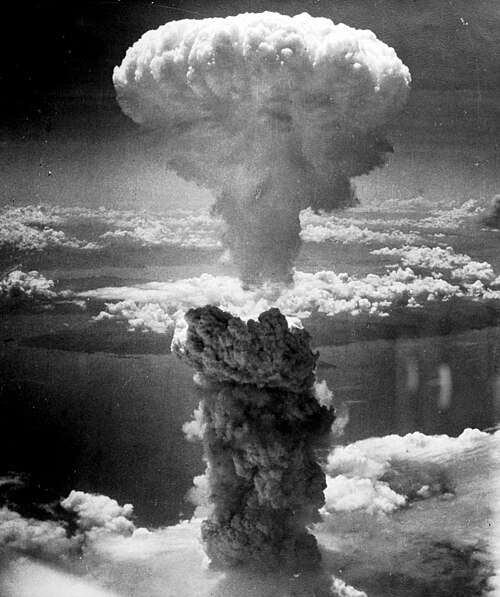
Hiroshima changed everything.

Science fiction people had read Einstein, or had tried to, so they knew about nuclear fission. They knew that an atom bomb could be built, and were expecting it. A few even got in trouble because they used atom bombs in stories, when the FBI was convinced they had it locked into secrecy.

For the rest of the country, Hiroshima was a shock to the heart.

It didn’t take long for the Russians to get the A bomb. Then we got the H bomb. Then the Russians got the H bomb. Welcome to my childhood.

Suddenly the future had become the present. Everybody was still driving ancient looking cars (no cars had been produced during WW II) and dressing like people in the old movies, but their world had been ripped open by futuristic perils.

Literature reacted to the situation. The Saturday Evening Post, that bastion of American norms, broke tradition and published a science fiction short story, The Green Hills of Earth by Robert Heinlein. Colliers Weekly published Wernher von Braun’s article Man Will Conquer Space Soon.

Von Braun also partnered with Disney to produce three episodes of Disneyland (as the Disney TV program was then called). The first, in March of 1955, was called Man in Space. This was followed by Man and the Moon and Mars and Beyond is later seasons. These were humorous and relied heavily on cartoon animation, but they showed American youth what the future held in store.

Eisenhower’s presidency saw a worsening of the Cold War, the rise of ICBM’s to deliver H bombs, and the development of satellites. The push for space flight had been properly begun. NASA was formed in 1958.

Space flight is key to science fiction, but it is by no means the whole of the genre. SF, by its nature, is always out ahead of contemporary science, and the giants of science fiction were producing major works during this period. The main difference from the golden age was that there were more novels, fewer short stories, and people had stopped laughing at the genre.

This was the era of Arthur C. Clarke’s Childhood’s End and Issac Asimov’s Foundation trilogy, while Robert Heinlein revised his novella Methuselah’s Children into a full novel.

This era also saw the rise of near future “science fiction”. The quotation marks are there to point out that this wasn’t really science fiction at all, because it was reacting, not predicting. Atomic power, atom bombs, jets, and rockets had been the stock in trade of science fiction fifty years earlier when they did not exist. Now they were the stock in trade of mainstream writers because they did exist.

Fail Safe was probably the most notable of these near future science fiction novels. It began as a short story in 1959 and was revised into a novel that appeared in 1962. In it, an American bomber is mistakenly on route to destroy Moscow with nuclear bombs. The American President, who cannot call back the bomber, must sacrifice millions of American lives to avert a world destroying all out nuclear war.

On the Beach was even more somber.  Years after a nuclear war, people of Melbourne, Australia wait for inevitable death as fallout from the northern hemisphere drifts down upon them.

No fun novels for a no fun time.

There were many others. Philip Wylie, who was already an established science fiction writer, turned out Tomorrow and Triumph. I read both in high school.

This new sub-genre of science fiction continued to gain readers who might never have read Clarke or Heinlein. In 1984 it reached apotheosis when Tom Clancy published The Hunt for Red October.

— << >> —

Over the course of this blog, fifty year anniversaries of events from the early space program kept happening, and I kept writing about them. By the time of my covid hiatus, those posts had grown into a book to be called Brief but Glorious.

Of all the books I plan to e-publish, it is the most dubious. Not the text — that’s fine — but I want to illustrate it heavily with NASA photos, and I don’t know what kind of technical problems that will cause. I have tentatively scheduled it for October 2027, but that could change. I’ll keep you posted.

The discussion continues next week.

691. Science Fiction Begins

Science Fiction Begins

If you don’t like that title, here’s a longer one.

Science fiction begins as literature, becomes a genre, sinks to a sub-literate state in the eyes of the intelligentsia, regains legitimacy in the Saturday Evening Post, and then consumes the universe.

I like the short one better. And by the way, this is just a quick survey. If you don’t like the way I’ve chopped up history, write your own. After all, most SF “scholars” disagree — on everything.

— << >> —

Science fiction has been around for a long time, although the early stuff is hardly recognizable. You could make the argument that it truly began when writers started using machines instead of supernatural beings to do marvelous things. That is why we look to H. G. Wells instead of Charles Dickens for the beginning of time travel stories.

Scrooge visited the past, present, and future, but it took three spirits (plus Marley) to pull it off. Wells did it with a time machine.

Jules Verne’s Five Weeks in a Balloon (1863) and H. G. Wells’s The Time Machine (1895) are a good enough place to start looking at science fiction. Both were considered literature from the beginning. Verne’s writing style was held up for emulation by the French establishment. H. G. Wells was a respected social commentator. In that same era, Edward Bellamy’s Looking Backward was a call for society to perfect itself — science fiction ideas spoken by the voice of the elite.

But what if you are an outsider, with a coarser voice?

Later, rougher, more exciting writers of science fiction didn’t fit the proper mold. They were frequently not all that interested in uplift, they just liked the idea of the future. Their characters were more likely to carry a ray gun than to address Parliament. Through the early decades of the twentieth century a whole generation of young men (and a few young women) found excitement in reading this kind of science fiction presented in the form of short stories in inexpensive specialty magazines.

This period, beginning in the thirties and lasting until roughly World War II, was often called the Golden Age of Science Fiction. (Remember, golden ages are always in the past somewhere.) A great deal of high quality science fiction was produced, along with the usual kinderdrivel. Science fiction had left the mainstream and become a niche interest, ignored or derided by most people.

Science fiction also acquired its own name. The Time Machine was just called a novel when it was published, but now science fiction had become a genre. Calling it sci-fi was forbidden by those who loved it. Everybody else just considered it cheap trash.

I wasn’t there for all that. For most of the Golden Age, I wasn’t born yet. I saw the science fiction of the golden age when it was reprinted in the paperback books published in the sixties, seventies, and eighties.

My actual connection with Golden Age magazines was brief but exciting. A few of them were still around when I began writing, and my first publication was in Galaxy. It was a novella called To Go Not Gently, and the cover of Vol. 39, No. 6, 1978, showed my character Ram David Singh walking uneasily down the Avenue of Abominations in New Bombay. I was over the moon.

It was also the last issue of Galaxy, although there were later attempts at resurrection.

So science fiction began as just a part of normal literature, then went on the gain an intense fan base as well as the disdain of everyone else. Heinlein and history were about to change that.

The discussion continues next week.

689. Birth of a Blog

I started the blog you are reading on the twenty-ninth of August, 2015. I took a hiatus in 2020, because of covid. Here is what I said that day.

— << >> —

Yesterday, here in California, the Governor requested that all people over 65 self-isolate. That makes sense to me, and I passed that milestone seven years ago, so my wife and I are going to hunker down and become temporary hermits. That isn’t too much of a hardship since we live in the country and keep a well stocked larder anyway.

This change shouldn’t bother my blog, but it does. I’m not worried for my wife and myself, but worrying about the rest of the country and the world beyond weighs on me. It has also been getting harder lately to come up with new things to say, especially on subjects that don’t call for hours of research for a post that will be read in three minutes. This is post 678, after all.

— << >> —

Actually, A Writing Life had more than 678 posts. From day one it was a double effort, a website called A Writing Life with almost daily entries in a blog of the same name (causing some confusion) and a secondary blog on the same website called Serial which provided many of my fiction writings in serial form.

According to WordPress who handles my blog and keeps track of such things, I had 1280 posts when I restarted this blog.

During the hiatus, seven posts trickled through, so make that 1273 posts in less than five years. I know I was working my tail off during that period, but it still boggles my mind.

I made a lot of friends during that period, but after six years off most of them probably don’t even know I’m still alive.

I am.

I disappeared but I never went away. During those years I finally put the last period on a five book series of novels I have been working on since 1972 called The Menhir Series (fantasy). I completed two new novels The Cost of Empire (alternate universe) and Like Clockwork (time travel), and am fighting with another called Dreamsinger, a sideways sequel to Cyan which won’t quite come to heel yet.

You will be seeing all my works, old and new, in e-book format in the next few years. The Cost of Empire and Like Clockwork won’t be published for a while, so I won’t name their release dates. Too many possibilities lie between now and then.

686. It Was Fifty Years Ago Today . . .

It Was Fifty Years Ago Today . . .

If you are my age, music from Sergeant Pepper just popped into your head in honor of that title. But you probably aren’t my age — 77 — so it probably didn’t.

Today, I’m throwing myself a digital anniversary party. I’ve earned it.

Today is September 2, 2025. It’s also the day after Labor Day.

In 1975, on the day after Labor Day — also September second — I sat down at a home-made plywood desk, in the tiny back bedroom of a rented house, in front of an electric typewriter to try something new. I was going to find out if I could write a novel.

I didn’t doubt my intellegence, nor my skill with language. What I doubted was whether I could sit down day after day and think of enough interesting things to say to fill up a novel.

I was going to give it my best shot.

At the time, I was reconsidering my plans. I had always intended to be a scientist, initially in ecology. The problem was that I was a decade too early. No one had heard of ecology in 1966. Michigan State University had only two classes even close to the subject when I arrived and they were both in Fisheries and Wildlife, not Biology.

I switched to anthropology and spent five years pursuing that goal. I loved it as long as I was studying work done by other anthropologists, but the idea of field work (sitting in a mud hut recording local gossip, to be snarky about it) did not appeal.

I had never considered writing novels. I had started a dozen, just for fun, but inspiration always ran out about page ten. Now,  I had a little time on  my hands, so . . .

To my amazement, between September and Christmas, I turned out a novel. It was simple and short — a hunter gets lost in the wilderness and, after many adventures, finds his way back to civilization. I used the local Sierras which I knew well and kept my hero so lost that I never had to worry about absolute accuracy in describing his surroundings.

It was unpublishable, but that isn’t unusual for first novels. The important thing was that in four months I had neither stalled nor stumbled as I worked my way through 45,000 words, which was just long enough for a novel in 1975.

I could write a whole novel! Who knew? Certainly not me.

After Christmas I started doing the research and world building for a novel of science fiction. It was finished by the end of 1976, sold by 1978, and published in 1979. The title was Jandrax, from Ballantine under the Del Rey imprint.

Now I was a published writer. Who would have believed it. Certainly not me.

I’m still working at my trade after fifty years, so it’s happy anniversary to me.

I am also using this anniversary as the starting point for a rebirth of my blog A Writing Life. Keep coming back, mostly on Wednesdays — we still have a lot to talk about.

684. Bible in Schools

I am not really back, but I never really went away. You can expect to hear from me more regularly sometime in the near future, but today I have to respond to something in the news.

Before the Biden-Trump debate stole all the bandwidth, a seemingly minor story crawled across the bottom of our TV screens.

Oklahoma Schools Superintendent Ryan Walters orders schools to teach the Bible.

This is not new, as I can tell you from personal experience.

I was in high school in the mid sixties, in a small town in Oklahoma. Once a year a local evangelist named Reverend Heck was invited to our school. No, that was really his name. For an hour, the auditorium was turned into a church. Attendance was mandatory; respectful silence was also mandatory. No one complained; no one mentioned the constitution. No one asked to be excused. We all knew that the weight of community opinion would fall upon us if we did.

If you are not a fundamentalist Christian, or if you are Buddhist, Muslim, Jew or other non-Christian, I don’t need to convince you that this was not right.

On the other hand, if you are a Christian and you think that Superintendent Walters might have the right idea, you are the person I want to talk to.

Let us reason together. (Isaiah 1:18)

My childhood world consisted of two tiny communities, populations of 121 and about 300, with a consolidated school. There were five churches in the two communities, all Christian, all more or less fundamentalist. Belief that dancing was a sin was so strong that there were no proms. Do you have the picture?

Now fast forward to my adulthood. For twenty-seven years I taught middle school in a small community of a couple of thousand people. The composition of my new community was roughly half Mexican-American Catholics and half White Mormons. This community was in California, not Oklahoma, but I know it well, so I plan to use it in my comparisons.

Superintendent Walters wants the Bible to be taught. Let’s see how that would work.

If my California community were in Oklahoma, would Walters also call for the teaching of the Book of Mormon? He calls the Bible a historical text; the book of Mormon has been around since 1830, just under two hundred years. That’s just 42 years less than the Constitution. You can’t get more American than a Holy Book which was found (or ghost written, you decide) here in the U.S.A.

My childhood community would not stand for Mormonism being taught in the schools. They barely tolerated Catholics.

Speaking of Catholics, how would Superintendent Walters teach Matthew 16:18? It says (King James Version, according to my father the only version authorized by God for speakers of English):

And I say unto thee, That thou art Peter, and upon this rock I will build my church: and the gates of hell shall not prevail against it.

It’s in the Bible, and if you are part of a Bible Church, you have to believe it. But what does it really mean?

To Catholics, it means that Peter (a name meaning rock) was the first Pope and that Jesus appointed him in this verse. By extension only Catholics are true to God’s teaching.

See how well that goes over in my old home town. Or teach it the opposite way, and see how that goes over in Catholic Oklahoma.

Those are the first two problems that come to mind, but there are hundreds of differing opinions among Christians, even in Oklahoma. Most of the people I knew as a child thought that those holding other opinions had been deluded by the Devil. And those other people probably thought the same about my people.

Be careful what you ask for. God may be on somebody’s side, but is it yours? Are you absolutely sure? Do you want to bet your freedom to worship as you please on it?

There is one more thing to consider. How much do you trust the government?

Not much, you say; that’s what I thought. So why do you think they are going to get this right? That they will teach the Bible as you think it should be taught, not as some (insert the group you hate the most) would do it?

Good luck, friends. If you go down this road, you’re going to need it.

Once you have the Bible being taught in school, it won’t be long before the courts insist on fairness. You might find your children being taught Christianity, probably by religious liberals, on Monday and Wednesday while the rest of the week they are being taught the Koran, the Mahabharata, the I Ching, the Epic of Gilgamesh, the Daozang, the Gathas, the Mahayana Sutras . . .

And so forth. The list is very long.

There is an alternative. Accept the first amendment. Accept that all those other people who aren’t as smart as you are, have the right to go to the Devil in their own way. Accept that the only way to ensure your freedom is to let them have theirs – all outside of the schools.

It has worked for 248 years.

683. Dry Oklahoma

Greetings. I have been gone a long time and I did not intend to come back now, but a weird thing happened. Just before covid struck, I had finished two posts; when I decided to bow out for a while, I reset them for a month later than their original posting date. Then again, then again, as the year rolled on.

Then something else weird happened. WordPress completely changed the way posts have to be written. I opened it up one day and couldn’t make heads or tails of what was on the screen. Clearly I had to completely relearn their system, but there was no hurry, since I didn’t plan to post for a couple more months.

Then this morning, I saw that I had posted yesterday. My pushing the dates forward on those two old posts had caught up to me. Since I don’t really know how to post in the new fashion, and the other old post (this one) is scheduled out in three hours, I decided to just add this explanation and let things go. I don’t even know if these paragraphs will be added to the Dry Oklahoma post.

If you don’t see this information, ignore it.

=========================

I grew up during prohibition.

If you are mathematically challenged or historically challenged, that statement might seem possible. Otherwise, you have already calculated that this statement makes me over a hundred years old, which I’m not.

A lie? No, the twenty-first amendment did not end prohibition everywhere. States had the option of continuing it, and Oklahoma did until 1959 when the consumption of alcohol was made legal, but only under stringent conditions. For two and half decades, the Kansas-Oklahoma border was the starting line of a nightly race between bootleggers and the Highway Patrol.

That’s all behind us, right? Not quite. Today the Kansas-Colorado border straddles pot highways, but this time the product is flowing into Kansas. The history of Oklahoma as a dry state in a wet nation might be useful in 2020.

As for my tiny part in the story, when I was five years old our house was fifty feet from Highway 169 which ran from Coffeeville, Kansas down to Tulsa. As I watched the cars go by, many of them were carrying booze for personal consumption, and some of them were carrying booze in bulk for resale. Tales of high speed chases and big busts were common.

There was no checkpoint at the border. Bootlegging was as simple as buying a bottle of whiskey legally in Coffeeville, driving home, and drinking it illegally in your living room. And there were plenty of bootleggers who were willing to save you the trip, for a profit.

Oklahoma was dry. Okies weren’t. Local humorist Will Rogers said that Okies would vote dry as long as they could stagger to the polls.

All this started before statehood and continued until 1959. When national prohibition came along in 1919 with the eighteenth amendment, it only cut off the source of liquor from surrounding states.

During national prohibition no one in America got all that thirsty. There were always stills, along with mass smuggling from Canada and Mexico, and rumrunners on all three coasts. From 1919 to 1933, America was dry, but Americans weren’t. With the advent of the twenty-first amendment, the rest of America could legally drink again. Okies could not, but it didn’t even slow them down.

Actually a few other states also remained dry. Mississippi was dry longer than Oklahoma, and many counties remain dry or moist today. Moist means consumption is legal but only under severe restrictions.

Consumption of alcohol finally became legal in Oklahoma in 1959, fifty-two years after statehood, but only with great restrictions. For example, you could buy beer, but only with 3.2% alcohol or less, and only at room temperature. Cold beer could not be sold. The idea was that you had to take it home to refrigerate it, and then consume it in the shameful privacy of your own house.

So what does this have to do with pot in 2020?

Beyond the obvious issue of people from Kansas having to drive to Colorado to get pot, and bringing it home illegally, there is the issue of why prohibitions get overturned, and how wide is the overturn.

People in Oklahoma were convinced to overturn dry laws in part because of all the tax revenues they felt they were losing and because the cost of enforcement. That should sound quite contemporary.

Of course there was a lot of home brew being made and a lot of stills that went right on selling their wares after 1959 so drinkers could avoid the booze taxes.

The snarky part of me also wants to wonder if the booze tax revenue after 1959 in Oklahoma made up for the gas tax revenue that all those bootleggers were paying, but never mind . . .

In a similar way, there is still a thriving business in illegal pot in California today, causing disappointing tax returns on legal pot. What a shocker! Remember all those million dollar busts of pot in the old days? That was based on street prices. Once pot becomes legal, the street price goes down. Legal pot sales go up, but they never match those old inflated revenues. No problem, raise the pot tax. But then people go back to buying illegal pot, because it is cheaper.

Funny how politicians never think of that until it happens.

Also, to say that pot is legal in California is not quite true. It can still be made illegal county by county and city by city. In Calaveras County, near where I live, it is currently illegal to cultivate pot, illegal to manufacture (which I assume means process) it, but legal to sell it retail. There was a recent battle to change the local laws, with billboards for and against. The argument against was “keep out crime”. The argument for was “tax revenue”.

This should all seem familiar.

682. Hard Road to America

When I taught middle school science, I always took St. Patrick’s Day off from levers, rockets, and chemical reactions to teach a session on history. Irish history, but with a twist.

Those days very few of my students had an Irish background, but about half were Hispanic. There is a connection between St. Patrick’s Day and Cinco de Mayo which I will explain that at the bottom of this post.

The Irish immigrant story I taught on St. Patrick’s Day  was always new, since my student’s were always new. That is also somewhat true of those who read this blog. If you were here the last time I told a version of this story, my apologies. It has been several years and this one is somewhat changed.

It is a moving story, which eighth graders are old enough to appreciate. Potatoes from the new world were perfect for Irish soil; where a crop of oats had supported four people, a crop of potatoes would support eight; when previously hungry people were no longer hungry, they had more babies. Then the potato blight struck, and there was no going back to oats because the population had grown.

The land was largely owned by the English. They continued to export grain throughout the famine. Vast numbers of Irish starved. Those who could raise the money took ship for America.

The passage was hard. Ten percent of those who left Ireland died on the way. Their quarters were cramped, filthy, and unhealthy. Eighth graders both love and hate this part of the story; they have a very human capacity to be simultaneously moved and grossed out. I would walk about the room, measuring out the cubicles with hand movements, mimicking the heaving of the ship in a storm, telling of the bilge seeping up from below, pointing out the sound and smell of vomiting from seasickness, and reminding them that the cedar bucket behind the blanket at the end of the central aisle-way would fill to overflowing with human waste on those days when the hatches had to remain battened down.

Then I would quote a passage from a letter sent back to Ireland by an immigrant, who described the passage then said, “But I would endure all that ten times over, rather than see my children hungry.”

Once in the United States, things were still hard. The Americans who were already here didn’t want them. They could only obtain the jobs no one else wanted. Many were Gaelic speakers and did not speak English. They were segregated into the poorest part of the cities. They were disrespected.

They bettered themselves, generation by generation. They learned American democracy, and elected their own kind to office. They learned American capitalism and many became rich. Eventually, they elected one of their own, John F. Kennedy, to be president.

Along the way, they began to celebrate themselves. St. Patrick Day parades are an American invention. They have only recently begun to be celebrated back in Ireland, but they have been important in America for more than a century.

A teacher has to talk fast to get all that into forty minutes and still have time for the payoff.

St. Patrick’s Day isn’t about shamrocks and leprechauns. Its about Irish pride. Its about saying, “I’m as good as anyone.” It can even say, “I’m here — deal with it.” St. Patrick’s Day is American, not Irish, because America is where the Irish had to speak up for themselves.

Cinco de Mayo is an American holiday. It is not widely celebrated in Mexico. Just as St. Patrick’s Day is Irish Pride Day, Cinco de Mayo is Mexican Pride Day.

It is a message I got across most years, but no one would have listened if I had not first captured their emotions with the story of a politically neutral and sympathetic people with whom both Anglo and Mexican students could identify.