Tag Archives: memoir

Symphony 33

Sean and Duarte were not Neil’s only problems.

Anthony Caraveli had announced himself by testing Neil on the first day of school. He learned at once that Neil had sharply defined and clearly stated limits, and set out to find out how real they were. The first day he was warned. The second day he was warned. The third day found him in detention. The fourth day found him in detention again. After that, he kept his head down around Neil and was content to terrorize Glen Ulrich.

Jesse Herrera was a different and much more difficult case. He was much more intelligent than Anthony. He was probably the most street-wise child at Kiernan, in any grade, and his overriding goal seemed to be to make life hell for everyone around him. This he did with the kind of subtlety and finesse one would have expected in someone much older.

It was the second week of school before Neil realized what a problem he had on his hands, and it would have taken him much longer to accept if he had not been warned by his fellow teachers. Jessie’s technique consisted of faking a wide eyed innocence that bordered on stupidity. As long as the teacher bought the pose, Jesse could get away with murder.

For example:

On Monday, September twentieth, Sean and Duarte spent the morning sniping at each other, keeping their remarks just within the limits of Neil’s patience. Then they went out at noon and got into the fight that got them suspended. Neil had had to take over Carmen’s noon duty so she could take the two of them to the office; that made him two minutes late to his afternoon core and when he got there Jesse had Mickey Kerr’s arm in a lock with his head forced down on the desk.

Neil growled and Jesse let go, but slowly, with a knowing look on his face that irritated Neil. In that moment his whole view of Jesse refocused and he realized for himself what the other teachers had already told him — that Jesse was completely aware of everything he was did. It was not only deliberate; it was coldly pre-planned. The patina of innocence fell away from the angelic face of Jesse Herrera and Neil thought, “That boy would pull the wings off butterflies, and smile while he was doing it.”

Neil sat down and explained why he was late. He wanted to remind the other children that fighting would get them suspended. Jesse said, “They were bad boys!” in his sickly sweet, little boy voice. Neil shot him a dirty look and realized that even his voice sounded different.

“I will have to be careful,” Neil thought. “I saw no fault in him yesterday, and today I am ready to see no good in him.”

They began the period with reading. While the students read, Neil kept half his attention on Jesse, and was amazed at what he saw. The boy was near the back of the room and behind the facade of an angelic face he was tormenting all the students around him. He poked Mickey Kerr in the back with a pencil. He said things to Lisa Cobb that Neil could not hear, but which made her face turn red and her teeth clench. He stole Randi Nguyen’s paper, crumpled it and tossed it toward the door. He kicked Rabindranath Kumar’s chair on his left and Stephanie Carter’s on his right. more tomorrow

429. Scales, digital and ridiculous

Ah, the good old days. They really sucked.

Even the phrase sucked falls into that category. I know that most of those who read this will not remember, but there was a time when nobody said sucked. It ranked up there with the “F” word. I remember when it arrived on the scene in my middle school students’ vocabularies, how it was an issue for a short time, and how two years later teachers were saying it. That’s what happens when a perfectly good forbidden word becomes common; it loses its flavor.

============

I have a great respect for Science Olympiad, but I never liked coaching, so I always volunteered to judge events instead. I enjoyed taking on new events that needed to be shepherded through their first year of implementation, and that led me to build a lot of gadgets to use in judging the contestants’ gadgets.

The people who think up new events in Science Olympiad often show an Olympian detachment (pun intended) from reality. Case in point — and forgive me if my numbers are off, I’m writing from memory — in two events students had to build light structures and test them to destruction. First it was a bridge, and a few years later, a tower. The lightest bridge or tower that held the most weight before failing won the event. There was a formula for weight vs. load, and specifications for what constituted failure.

The students applied the weight by pouring sand into a suspended bucket and there was a set maximum. If the structure held the maximum, the lightest structure won. If the structure failed, the weight vs. load formula was invoked. All in all, it was a well thought out event.

Except for one thing. The load was in pounds — up to ten, as I remember — and the weight of the structure was in grams. Let’s do the conversion.

1 pound equals 16 ounces
1 ounce equals 28.35 grams
Therefore, 10 pounds equals 4536 grams
And 9 pounds equals 4082.4 grams
That is a difference of 453.6 grams

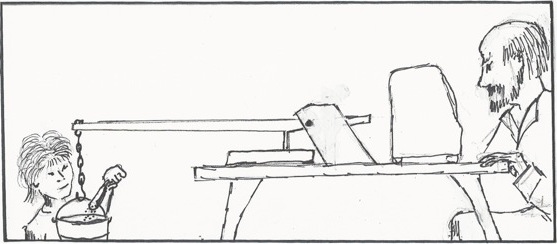
Did I lose you? Just look at the cartoon at the top for a moment, regain your equilibrium, and come back to me. There is no final exam on this. This is just memoir about how much fun teaching science can be on a small budget.

To measure mass in grams, you could use a triple beam balance available in any science class. To measure ten pounds, you have your bathroom scale. But wait a minute, that ten pound maximum-weight bucket of sand has to be measured in grams! How do you do that?

You do it with levers, using the gizmo pictured at the top of the page. I actually built it, and used it all the years I was associated with that event. The lever makes the scale read about 160 pounds when there are 10 pounds in the bucket. That spreads out the difference between two similar weights. The box the adult is staring at is my old Mac SE, with a preprogrammed formula in a database. The formula is:

Scale reading in pounds after the sand has been added (times) conversion factor to grams (minus) weight of bucket in grams ——- all this fed into the formula for comparing load in grams to weight of the bridge or tower in grams, a formula provided by Science Olympiad.

At the event, all I had to do was watch the contestant, and stop her/him at the moment the structure failed. He/she was only given ten pounds of sand to work with, so overfilling could not happen. I typed in the reading from the bathroom scale and the computer gave me the score — after I had built and tested the device, programmed the database, and provided ten pounds of sand, calculated to the nearest gram on the same device.

Fun? Of course it was fun. I volunteered to do this, remember?

Was it accurate? No and yes. No, there was too much friction for the gram readings to be accurate, but the friction was the same for every trial, so yes, the ranking of the contestants was completely reliable.

About three years after Science Olympiad retired the event, digital scales which would measure that much sand to the nearest gram became available for under five bucks at every-guy’s-public-man-cave, Harbor Freight. Thank goodness it didn’t come earlier and ruin my fun.

Symphony 32

Finally there came an awkward pause. They had explored surfaces as far as possible, and both hesitated before plunging into the depths. Finally, Neil asked, “Why did you invite me over? I mean, why tonight in particular?”

“Well,” Fiona said, smiling to take the sting out of what she had to say, “until today, I thought you were pretty dull. You tried so hard to look cool and fair and impartial that you came out looking uninvolved. Today was the first time I saw you stand up on your hind legs and act like a man.”

“When?”

“When you told me that my being Sean’s mother meant nothing to you.”

“That is not exactly what I said.”

“That is exactly what you said. Now don’t spoil it by trying to be polite. I like you better with backbone.”

After a long pause, she said, “Say something.”

“A man can’t always appear to others the way he would like to appear.”

“Why not?”

Neil smiled. “Because then people would ask too many questions.”

“Are you hiding a deep, dark secret? Who did you murder? Did the FBI give you a new identity?”

“Sarcasm doesn’t suit you, Fiona.”

She sighed. “Sarcasm suits me fine. I’m a bit of a bitch, and I know it. But I don’t like dishonesty.”

“I have never been dishonest with you, or with anyone else.”

She snorted. “When you put up a barrier like you do, it amounts to the same thing.”

“You don’t know the situation well enough to say that.”

“So explain it to me!” she snapped.

Life with Fiona, Neil decided, would certainly never be dull. Her temper lay close to the surface. Yet he wasn’t sorry to have aroused it. Anything was better than being ignored.

“Fiona, I have my reasons. They are good ones, but I can’t explain them.”

“Why not?”

“Because I don’t know you well enough.”

Surprisingly, that satisfied Fiona. Neil had expected it to send her temper blazing again, but apparently the honesty of it met with her approval.

It was also the limit of honesty for a first conversation. Their talk slipped back to surfaces and remained there until Neil was ready to go. Fiona walked him out to his car and as he got in, she added a final word. “Neil, you seem like a nice person. I don’t know why you feel you have to be so secretive, but when you are ready to share whatever is on your mind, try me.”

Her concern was a balm. He said, “Thank you. I will.” Then he grinned and said, “I think you are also a nice person. Pretty, too.”

“Why thank you!” Her face lit up with an impish grin. She leaned in to kiss him briefly, but it lasted longer than she had intended. When she drew back, her face held a thoughtful look.

“You taste good, too,” Neil said, as the car slid away from the curb.

She got the last word in, shouting, “Ah, go on with you!” after him in a mock Irish brogue.

# # #

Three days later, Sean and Duarte got into a fist fight on the playground. Carmen caught them, wrote them up, and they were suspended for three days. Neil started to ask Fiona what punishment she had meted out at home, but she was so angry he decided to let it ride. more tomorrow

Symphony 31

There was no sign of Sean anywhere.

“Would you like a beer,” she asked.

“A soft drink, please.”

She disappeared inside and returned with two ice filled glasses. “Don’t you drink?” she asked.

“Only when I’m depressed,” Neil answered honestly.

She made a face. “That’s not healthy.”

“I know, so I try not to drink at all. Mostly, I succeed.”

Neil studied Fiona’s face as she sipped her drink. Her face was very tan — unnaturally tan for someone so blatantly Irish — and her skin was smooth. Neil found himself revising her age downward. He had thought she was forty. Now she seemed closer to thirty-five.

Then she smiled and more years fell off her apparent age. For the first time, Neil realized she was hardly older than he was, and that joy or sexual excitement would transfigure her face and make her beautiful.

“What are you staring at,” Fiona asked, shaking back her hair, and Neil found himself without a reply. He was saved when she suddenly sniffed the air and leaped up to turn the hamburgers over.

“How do you like your hamburger?” Fiona asked over her shoulder. Neil continued to study her. He had not been with a woman since before Alice Hamilton had made her accusation. Lynn, his lover, had been unwilling to touch him after that, and he had been in no emotional condition to go searching for other companionship.

As Fiona fixed their meal, her natural motions brought that half year of stifled desire to a pressing urgency. The slenderness of her arms, the rich creaminess of the finger-width of back exposed by her blouse, the movement of muscle in her lean legs, and the firm motion of her buttocks beneath the thin material of her shorts became a sweet torment.

The essential question — the question that make all other considerations momentarily unimportant — was: Had she dressed provocatively for him, or was she simply being cool and comfortable?

They ate sitting across a tiny metal mesh table. Her glances told him that she was aware of his interest. After dinner, she served expresso in tiny cups. He took his sprawled out on a chaise lounge; she sat across from him on a matching lounge with her feet tucked under and her back straight.

Whatever had prompted Fiona to invite Neil over, seduction had obviously not been uppermost in her mind. Their conversation was light and wide ranging. He found out that she had been born and raised in Ohio. She had moved to San Francisco a decade too late to live the hippie life and that was one of her regrets. She had been caught up in the back-to-the-Earth movement until one week on a commune had shown her that she had an antipathy to pig manure. That realization had sent her back to college, and from that she had gone on to teach elementary school. She had graduated at the time of a teacher glut, and the only job she had been able to get was in this small district. It had suited her well, and she had been her ever since.

If there had ever been a husband, she did not mention him, nor did she make any reference to Sean’s father.

She drew out some of Neil’s history. It was not hard to do. He was hungry for a friendly ear. He told her about how much he missed Oregon and how much he hated the Modesto heat.

Beneath the surface conversation, a second conversation was taking place — a conversation consisting of the intensity of his looks and the softening of her body in response. They were both aware of this undervoice, but neither one acknowledged it directly. more Monday

Symphony 30

The fallout from his confrontation with the two boys was not over yet. Before he had had time to gather up his briefcase and go, Delores Zavala came over to him. She was clearly embarrassed, and the first thing she said was, “I’m sorry for the way Duarte acted today. I am really angry with him. He had no reason to cause you so much trouble.”

In the two weeks she had been working with him, Neil had gotten almost used to Delores’ self-effacement. She was much closer to the traditional picture of a Mexican woman than Carmen. He made light of the incident, then said, “Why are you apologizing for Duarte? You told me you weren’t married, so I didn’t make any connection between you and him.”

“He is my brother’s boy. My brother took his family back to Mexico a month ago, but Duarte does so well in school that I talked him into leaving him with me. If he went back there he couldn’t do anything. He doesn’t read or write Spanish.”

That, Neil knew, was a real problem for those families who went back and forth between Mexico and the United States. The brightest children leaned to speak, read, and write English, but they were illiterate in Spanish. They could speak the lower class Spanish used in their homes, but they usually could not read or write it. Worse, their dialect was no more suitable for a good Mexican school than an American hillbilly dialect would have been suitable for a high school in Boston.

Neil assured Delores that he had the matter under control.  She did not contradict him, but her expression showed no faith in him.

# # #

By the time he got to the parking lot, Neil had heard all he wanted to hear about Sean and Duarte; but he had not heard all he was going to hear. Fiona was waiting for him, standing in the open doorway of her car. Sean was sitting in the passenger’s seat, looking very unhappy. At least Fiona was smiling. She said, “I want you to come over for dinner tonight.”

Nothing could have been further from Neil’s expectations. Few things would have been less welcome. He was in no mood; he said so, very politely.

“Nonsense. I’m cooking hamburgers on the grill. I’d like to feed you and then talk to you.”

“I’m sure Sean would not like to talk to me.”

“You’re right there. Sean isn’t in the mood to talk to anyone, including me — especially me. He is going to eat before you get there, and then he is going to his room without TV, stereo, or anything he likes to read. For the rest of the week I am going to be childless from four P.M. until morning. I do not intend to be embarrassed by my own son’s behavior in the future.”

Fiona shot Sean a look with this last statement and he glowered but did not contradict.

Feeling trapped, Neil agreed to arrive at five.

# # #

When Neil got to Fiona’s, she escorted him directly to the back yard and put two waiting hamburger patties on the grill. She had changed to a faded blouse, knotted in front to expose her midriff, and very short shorts that left her long, lean legs exposed to the cooling wind. Her red hair was a fluffy cloud around her head. Neil began revising his estimation of why he was there, and his opinion of her looks. more tomorrow

427. A Grave Story

The paragraph below comes from Symphony in a Minor Key. Neil McCrae has read a ghost story at Halloween, timing it to end just as the bell rings in his sixth grade class.

Half the students leaped to their feet screaming, then broke into laughter, and went out for their break repeating juicy bits of the story to one another. Neil sat back with a feeling of satisfaction, mixed with amusement at his own self-indulgence.  There was a lot of theater in Neil McCrae, but he kept it on a tight leash. Once in a while, though! Just once in a while it felt good to cut loose.

Since the novel is based on my teaching career, it will surprise no one that Neil and I share a few characteristics. Keeping theatricality on a tight leash is one of them. Telling ghost stories on Halloween is another. This is one of those stories, based loosely on a joke I read in Boy’s Life back in the fifties.

Of course it’s a true story. I wouldn’t lie to you.

=======================

I had two brothers as students. I had one in my class one year, and his younger brother the next. They were always hanging out together. Some brothers get along; come don’t. These two were great friends.

They were outdoors types. The liked to fish and hunt. Their dad would take them canoeing, and sometimes the three of them would camp out together.

The year I’m thinking about, the last year I knew them, their dad had been really busy all fall, so they were on their own. They decided to go off together in the canoe, and go camping along the river.

I didn’t mention, did I, that the Tuolumne River runs along about a mile from the school where I taught? Or that the regional cemetery is right along the river? Of course, the students I told this story to, already knew that.

Since it’s a true story, I have to keep the details straight.

This particular fall had been rainy, and both brothers were involved in soccer, so they kept putting off their canoeing and camping trip. September came and went, and then October, and by the time November was just around the corner, they were getting pretty desperate to go. That’s probably why they decided to go on the last Friday night in October.

I probably wouldn’t have gone, myself, because it was Halloween, but these two had a habit of daring each other, and that often got them into trouble. So they went. They put in the river at Fox Grove and intended to sleep somewhere about five miles west, then paddle on down to Legion Park the next morning. Their mom was going to pick them up there. Too bad she never got the chance.

Everything went along fine for the first hour. They got a late start, but that didn’t matter since they could camp anywhere. It’s pretty wild down along the river. They got past the rapids under the bridge. They were pretty tame rapids. Things went well for the first few miles, but then fog began to form. That was fun at first.

Did I mention it was Halloween?

The fog hung in the old trees along the river bank, but they could still slip along below it. At first. Then it got dark, all the sooner because the fog was cutting off the moonlight.

Did I mention there was a full moon? That was part of the reason they went that night, because they thought they would be able to see by it’s light. They hadn’t figured on the fog. Pretty soon they couldn’t see anything. They got on down the river for a while by instinct. If you’ve been on the water enough, you get a feel for currents, and anyway, you can’t get lost on a river. It only goes one direction.

Still, it started to get dangerous, not to mention creepy, so they pulled up on a mud bank to think things over. They also had been drinking two liter Pepsi’s, if you know what I mean. They had to take care of that little chore, and they did, but while they were looking for a bush apiece, they got separated. They could hear each other clearly, but the river banks threw back such echoes that they couldn’t find each other. And then they couldn’t find the canoe. Finally, Joe – that was the younger brother – found a path up and shouted to Tom – that was the older brother – that they should climb out of the river bottom and meet on the flat land up topside. Tom shouted back to go ahead, so Joe went up.

That might not have been the best idea they ever had. They had made it further down the river than either one realized, and when Joe got to the top, he found himself in the cemetery.

Now Joe wasn’t particularly spooky. Camp fire stories of ghosts just bored him. But this was a real cemetery, and the fog in the trees looked like Spanish moss hanging down – you know, like in the stories of the bayous. He didn’t like it. He hollered for Tom, but got no answer. Then the fog thickened and the moon, which had been mostly obscured, disappeared completely. He found that he couldn’t see anything, so he put his hands out to feel, and found himself moving along, guiding himself by the tops of tombstones. He didn’t like that much either, but what are you going to do?

Tom, meanwhile, thought he had found a trail up, but it only led him into a bramble of raspberry bushes. It took him ten minutes to work his way through them and by the time he made it up to the top, his clothes were in tatters and he had blood all over his hands from fighting the thorns. He staggered out on top, panting with the effort, and found himself in the cemetery, too.

I know all this because I was one of the ones who went looking for them then next day, after someone had found their abandoned canoe. It was easy enough to track them, first by river mud footprints, then prints in the soft soil. We knew which was which because Tom’s shoes were much bigger, and besides, there were all those drops of blood.

What neither boy knew was that there was a funeral scheduled for that Saturday. The groundskeepers had dug the grave, and it was standing open. Tom found it first.

Of course, it was pitch dark, so he found it by falling in. The groundskeepers had done a good job. It was seven feet deep, with straight-up sides, three feet wide and seven feet long and completely impossible for Tom to get out of. And did he try! He leaped. He scrambled. You could see the next day where he had dug his fingers into the sides of the grave, with no success. I’m sure he shouted, but no one could hear him. I wouldn’t be surprised if he cussed a little.

Eventually, he exhausted himself and sank to the ground, curled up in a ball, and decided to wait for morning. He was half asleep when Joe found the grave the same way Tom had.

Joe fell in, and the sound of a body falling into the grave with him sent Tom to his feet. He slammed himself back against the side of the grave, wanting to scream, but no sound came out. It never occurred to him that it might be Joe, but every other monster from every movie he had ever watched went running through his head. He squeezed back into a corner of the grave in abject fear, while Joe picked himself up, turned, and began leaping and scrabbling at the wall of the grave.

About that time, just enough moonlight came down into the grave that Tom could recognize his brother. Joe slid back to the bottom of the grave for the third or fourth time as Tom reached out his bloody hand, with tattered sleeves hanging down, and touched his brother’s shoulder. His voice was hoarse from fright as he said, “You’ll never make it out of this grave.”

But Joe did. He screamed and gave such a leap that he outdid himself, caught his fingertips on the lip of the grave, scrambled like a madman, and was gone.

Tom was still there when we found him the next morning. I won’t say he was all right. I don’t think he was ever all right again. But he was there.

Joe was never found. They dragged the river. Friends, neighbors, and strangers turned out in the search, but it was useless.

Tom and his family moved away soon after, but I get Christmas cards from his mother every year. She tells me what Tom has been doing, but she never mentions Joe.

Me either. Except every year about this time I feel the need to tell his story. Just a cautionary tale, you understand. Nothing to do with me, whatsoever.

I wouldn’t lie to you.

Symphony 29

Neil’s eyes were blazing and both boys drew back. He knew how this kind of wrong-headedness could destroy the good feelings in a whole class, and he felt helpless to stop it. Helplessness always made him angry.

Neil sent Sean to sit against the building a hundred feet away, but in full view, then talked with Duarte for five minutes. Then he sent Duarte away and talked with Sean. It did not take long for him to find the pattern behind their actions. It had exactly the same significance as two bull elk vying for dominance in a herd. It had nothing to do with Anglo and Mexican, but both boys were seeing it in those terms. That made it dangerous.

Neil called Duarte back and tried to get the two of them to talk. He got nowhere; at eleven years old they were simply to self-involved to understand what Neil was trying to do. Finally, as the class bell rang at the end of noon recess, he warned them both strenuously and sent them on to their next class.

# # #

Rumor travels fast. When the last student had gotten on the bus that night, everyone in the teacher’s lounge knew what had happened. Fiona came to Neil and said, “I hear my son Sean gave you some trouble today.”

“Not much.”

“That isn’t the way I heard it,” Fiona said. “I saw him in science five minutes after you finished chewing him out. He was steamed. So was Duarte. There is no love lost between those two.”

“Tell me about it!” Neil laughed.

“They have been going at it off and on for at least three years. What you saw today was nothing new, and no surprise to the rest of us. Did you write them up?”

“No.”

“Well, thanks for that, anyway.”

The remark irritated him. “Fiona,” he said, “I’m half-way insulted. The fact is, I was so angry that I completely forgot he was your son. Personal loyalty had nothing to do with it. The fact that he was your son wouldn’t have mattered if I had thought he needed to be written up.”

A flash of protective anger crossed her face, but she was a rational person and a professional. Her good sense rode down her mother’s instincts, and she said, “Of course not. And I didn’t mean to insult you.”

Fiona moved away and Carmen took her place. She asked him to tell her what happened and he did.

Carmen shook her head when he had finished and said, “I had those two in a self-contained classroom in the third grade, before we were reorganized. They were separated at my request when they went to fourth grade, but apparently somebody forgot and put them together again. I should have caught that when I looked at your class lists before school started.”

“Do you mean this school bases its class lists on who can and can’t get along?”

“Of course not, but we do try to separate poison combinations. It makes life easier.”

“Does it make life better?”

“I don’t follow.”

“They have to learn how to get along with their enemies someday. Life won’t put them in compartments where they don’t have to rub up against people they don’t like. When are they going to learn to deal with that?”

Carmen snapped, “Soon enough!  They’ll learn about life soon enough.” 

She slammed her chair back as she got up, and everyone in the room turned to look. That embarrassed her. Momentary vulnerability came into her expression and transformed her. Then she spun and stalked out of the room. more tomorrow

Symphony 28

The physical and emotionally difference between the sixth graders and the older children was strikingly apparent to students and teachers alike, and the sixth graders segregated themselves. They shared a common playground with the older ones, but they staked out those areas that the older kids did not use.

As Neil watched, a baseball game was getting under way. Duarte and Sean were the captains; they called the rest of the class one by one to make up sides. To Neil’s dismay, Duarte was choosing only Chicanos and Sean was taking only Anglos.

Neil moved closer, thinking he was getting a sad insight into racial tension at Kiernan school. Instead he heard Tim Galloway hanging on Sean’s arm whispering urgently, “Choose Rafael!” When Sean chose Bob Thorkelson instead, Tim gasped in dismay, “He can’t even hit the ball!”

Sabrina Palmer jerked at Sean’s other arm and said, “What’s the matter with you? Choose the good ball players. It doesn’t matter if they are Mexican.” To her it was not a weighty matter of prejudice; she just wanted to win the ball game.

On the other team, Oscar Teixeira threw his glove down and snapped at Duarte, “Why didn’t you get Greg? He’s the best pitcher.”

Before the teams had even been chosen, some of the players on each side had begun to wander off in disgust. Neil heard, “That’s a lousy way to choose a team,” and “What’s the matter with Duarte anyway?” and “That was cheap!”

Neil whistled and waved the kids over to him. They came reluctantly; they didn’t know him well yet and being called in from the playground usually meant that someone was mad at them.

Neil asked them, “Do you want to play baseball?”

“We did,” Sabrina said, “until Sean and Duarte screwed it up.”

“Let’s try again,” Neil said. He pointed to two of the most athletic looking boys and said, “Ramon and Carlos, you choose teams this time. And make it fair. Duarte and Sean, you two stay with me.”

Neil had chosen two Hispanics as captains — he could as well have chosen two Anglos — so this time the children were chosen by ability and there was a fair racial mixture.

Neil led Sean and Duarte away from the ball diamond and asked them, “What are you two doing, trying to start a race riot?”

Duarte shot him a black look and said, “I don’t know what you are talking about.”

“Oh, you don’t? Well, you must be the only kid in sixth grade who doesn’t know. Your teammates knew; they were complaining and walking off before I ever got there. What’s up?”

“Well, Sean started it.”

“I did not! I was choosing fair yesterday when you took all Mexicans.”

“That’s ’cause Mexicans are better,” Duarte muttered.

“Duarte!” Neil snapped, putting boundaries on the confrontation. He continued in a softer voice, “Duarte, do you really think Mexicans are better than Anglos?”

“No. But Sean thinks Mexicans are no good.”

“I do not!” Sean replied, then muttered under his breath, “I just think you are no good.”

Duarte lunged for Sean and Sean’s reaction was only a heartbeat behind. Neil caught them each by the back of his shirt and jerked them apart, none too gently. “Stop it!” Neil’s shout echoed across the playground, and the ball players all looked up. “That will be enough out of both of you. I pulled you aside to talk to you — to help you solve your problems. If you want to fight, that’s a whole different story.” more tomorrow


Symphony 27

September 1988

Neil’s relationship with his fellow teachers was strained for the first couple of weeks. He was naturally friendly and under normal circumstances he would have quickly fitted in, but there was one question each teacher had to ask him, for which he had no answer.

It was clear that he was not used to teaching sixth graders, and if he had any particular aptitude for the younger children, it did not show during those first weeks. So why was he here?

Neil said that he had wanted to try his hand at teaching younger children. That was not entirely a lie, since he used to think about it in that dreamy state of considering unlikely alternatives. But he would never have done anything about it, so he had a hard time putting conviction into his voice when he replied.

That answer only led to the next logical question. Why didn’t he get a job in his home town? Why move away and leave all his friends behind to make the experiment? There was really no way to answer that question.

By the second week, the other teachers knew that Neil would not talk about his reasons for being at Kiernan and his reluctance to share such basic personal information made them all pull back from him. They were unfailingly polite, but that initial friendliness had faded.

That was the situation when circumstances threw him in with Fiona Kelly.

# # #

In any school, some of the students are the sons and daughters of the teachers. Teaching some other teacher’s child can be a little unsettling; under the best of conditions there is a flavor of conflict of interest.

The children of teachers are angels or hellions or something in between, just like the children of bums and businessmen. Sean Kelly was something in between. He was not quite a top student, but close.  He made mostly As and Bs. He loved baseball and he was good at the game. He was open and friendly, and if anyone had accused him of unkindness to any of his fellow students he would have been shocked and angry at the accusation. Yet, he had a weakness; a nemesis; his own personal Dr. Moriarity.

He could not stand Duarte Zavala.

Duarte Zavala was one of the Chicano children who broke the stereotype. Duarte was not quite a top student, but close. He made mostly As and Bs. He loved baseball and he was good at the game. He was open and friendly to anyone, as long as that person observed certain conventions. If someone disliked Hispanics because they were Hispanics, then that person became Duarte’s mortal enemy.

Duarte conceived the idea that Sean didn’t like Hispanics and began a campaign against him.

Sean Kelly liked Sean Kelly a great deal, and generally thought of others as adjuncts to himself. In this, he was almost identical to Duarte but, at eleven years old, neither could see the similarity. Sean’s self-infatuation made him condescending to the other children around him, male or female, Anglo or Hispanic. Duarte saw only that Sean condescended to his Hispanic friends; he could not see that it was an equal-opportunity egotism. Nor did Duarte realize that he also condescended to the same Hispanic children that Sean did.

Eleven year olds are not particularly good at self-analysis.

A prelude to the final confrontation came during the second week of school. Neil was on noon playground duty, wandering about to see to it that none of the larger children took unfair advantage of the new sixth graders. more Monday

Symphony 26

Finally, he circled back. The sun was hanging low above the mountains when he came back into town, but the heat had not relented. He stopped at a mini-mart, bought a liter of Seven-Up and a pint of Seagrams, and returned to his apartment.

Still, he would not face the source of his feelings. He mixed a stiff drink and turned the air conditioning on high. He wandered into his bedroom to the rickety bookcase and made a selection, went to his casette collection and made another. While Eric Clapton sang and played on the stereo, Neil drank and lay back on his couch.  He opened the book and read:

Napoleon I., whose career had the quality of a duel against the whole of Europe, disliked duelling between the officers of his army. The great military emperor was not a swashbuckler, and had little respect for tradition.

Two songs later his drink was empty, so he laid the book aside and made another. Last year he had introduced The Duel into his class for the first time. What would a sixth grader make of Joseph Conrad? Nothing! From Conrad to the insipidity of a sixth grade reader. The thought was bitter gall in his mind.

His drink was empty again and he smiled at that, almost as if he were cherishing his weakness. He had not gotten drunk one time since the whole affair began. He would feel wretched in the morning. Good enough; he was in the mood to feel wretched.

In the months since this all began, he had not allowed himself the luxury of self-pity, but he was ready for it now.

The tempo of the music had changed. Clapton was singing softly about his shy, sweet lady, and how she looked “Wonderful Tonight”. The song brought Carmen to mind. He remembered the liveliness in her face when she was with her students, and the dead stillness when she was with him. He wondered again what Campbell had told her.

Back beyond Carmen’s image was another face, and that face was the source of all his melancholy. For it was not Alice Hamilton who had betrayed him the most. She was just a foolish young woman who had owed him nothing.

But there had been betrayal. When the accusations had come, there had been one he should have been able to turn to. Lynn; a tall girl with wild hair and soulful brown eyes, who had shared his dreams, shared his bed, and who had planned to share his life.

She would share those things, but she would not share his troubles. She was a teacher, too, and she could not afford to be associated with someone accused of sexual misconduct. That was what she said, but it was a thin excuse. Now that alcohol had loosened the iron fist of his self-control, he remembered once again the look in her eyes when he had told her about Alice Hamilton. She had hesitated. She had doubted.

How could she have doubted? Was it some fault in her that prevented belief. Or was there some secret weakness in him that only she had seen.

How could he be the man he wanted to be — the man he had thought he was — if his lover could look at him in the moment of his accusation and have such doubts? more tomorrow