Tag Archives: science fiction

538. Not Like Clockwork at All

I have been writing my latest novel Like Clockwork for ten months and today (October 17) I called it “first draft done”. But it’s not that simple.

I have a file on my computer called ???When???, where I keep track of starts and finishes because I would never remember dates otherwise. I went there to make note of the tentative conclusion of the first draft and took time to remind myself how I got here.

It’s a tangle. I’ve had books that took longer to write, and books that grew well beyond the size I had intended, but I have never before had a book that refused to tell me ahead of time what was going on. I decided to share the file of my progress(?), edited to remove irrelevant family matters.

===============

January 2, 2018. I began the first page of a novel/novella with the working title Clockwork Christmas.

Jan. 13, 2018.  Clockwork Christmas is now titled Like Clockwork, after the toy store where Snap works. As of today, I am about 12,000 words into the thing. I hope it will reach at least 60,000 words to be sold as a novel, but it still could possibly be finished at novella length.

(For reference, SFWA sets novella length at 17,500-40,000 words. F&SF sets 25,000 as the largest piece they will publish.)

Like Clockwork is being constructed of (minimum and approximate) 1000 word chapters.

From roughly 17 to 22 January, 2018, I paused Like Clockwork to write posts for the website. (There were several pauses for colds and other minor illnesses which I will not record.)

On Jan 31, I wrote chapter 10 in which Balfour gets the idea for Jekyll and Hyde. He does not yet know that he already wrote it in another life.

Mar. 6, 2018, things are coming slowly. As of today, about 25 chapters done. That’s a large number, but each chapter is short.

March 11, 2018  Today Stevenson emerged into consciousness, absorbing both Balfour and Hyde. That lasted about a day, then Balfour realized he can’t be the actual Stevenson because he remembers Stevenson’s tombstone. What exactly  is he? As of now, I have no more idea than he does.

April 3, 2018, writing on the chapter Slow Time, I began to show Bartleby’s dogged determination to follow any task to its completion. The question occurred to me for the first time, is Bartleby human, or a robot or android. As of this date, I hadn’t decided if he is a person or an living story character with Melville as Fabulist, and now here is a third possibility.

April 4, 2018, writing the final paragraph of the chapter Slow Time I came to the realization that Like Clockwork is the story of a whole cadre of people who made a Faustian bargain, got what they asked for, and now are suffering from buyers’ remorse. I also came to the realization that yesterday’s question, “Is he a robot?” is answered this way — he is a cold, detached, hard boiled detective type who can’t be pushed aside from a goal or puzzle. He doesn’t need a personality any more than Sam Spade did. Not a machine, but thinks like one.

(Aside — Bartleby’s name changed as the writing progressed. First he was named after the Melville scrivener. Then he became Helmsman. I liked that name but it implied that he was a leader type, which he wasn’t. Finally he became Hemmings, because it’s just a name with no hidden meanings.)

About here, some time was devoted to my personal life, plus the completion of an unrelated short story.

On about June 28, I became aware the Tor would accept novellas beginning July 30. Like Clockwork had been nearing its end at about 70000 words. That doesn’t work for today’s publishing industry, and some of that was less that compelling writing in a long flashback section. I had three choices. Shorten and go for Tor novella publication, stretch even further and try to reach salable novel length, or let it find it’s own length and self-publish. I have opted to make it a Tor novella, although the other choices remain if Tor rejects it.

On July 14, 2018, I finished the Tor novella version of Like Clockwork, now retitled The Clock that Ate Time. I still have to do some e-formating to match their submission engine. The novella version runs 39,365 words. I had to cut out everything relating to Hemmings and Crump, which means cutting out the Babbage and Hemmings’s brief career as a sweeper in a factory, along with the extended memory-retrieved-as-flashback that details how the Founder set up the whole thing and why. I really hated to let go of all that.

I would enjoy the long version better, but the short version is less discursive. If the novella doesn’t fly, I may try it elsewhere (if there is any elsewhere — F&SF maxes out their novellas at 25,000 words) or I may go back and finish the long version. For now, I’m just glad to be at least temporarily done with it.

The novella version went off to tor.com.

You have to understand that writing is schizophrenic. I was sure that it would be accepted. No other outlook would allow a writer to retain his sanity. I was equally sure that it wouldn’t be accepted. The market being what it is, everyone on Earth with a novella ready is going to jump into the tor.com window of opportunity.

From the end of July until the beginning of October, I worked on other projects.

Oct 2, 2018   tor.com rejected The Clock that Ate Time, resulting in disappointment followed by relief. Now I can complete the novel version. Bear in mind, it is not insanity to carefully edit out feelings of irritation and disappointment, as long as you know that you are doing it.

Now I am expanding Hemmings part of the story and grafting it back onto the whole. It is called Like Clockwork again and it is taking forever to complete.

October 17, 2018 I finished both part one and part three of Like Clockwork months ago. I have recently been filling in the middle third, which amounts to a long flashback that explains how reiterant London came to be. Today I wrote the last line of the middle section. I still have several  half-page long dialogs or descriptions to fill in, and I still haven’t quite finished deciding how to integrate Hemmings and Crump into the big finale, but I am calling it “rough draft finished”.

Still, it feels (and is) very unfinished at this stage. I think I need to fill in more of the Founder’s personality. That may take only a few touches here and there, but they have to be the exact right touches, and that can take a long time. I also have four versions to integrate: beginning, middle, and end of the latest version, along with the tor.com version which is the least extensive but most polished.

I need to find something to write next, or perhaps finally decide to begin self-publishing; it may take a long time for all the finalizing of Like Clockwork, a few hours here and a few hours there.

===============

See what I mean? This is my fourteenth book, and the only one that has driven me this crazy. I know that I did a lot of character name dropping, but that was unavoidable. I don’t expect you to understand anything except the level of madness this book has engendered.

Today I started deciding which potential novel will be number number fifteen. I plan to outline this one.

I think.

537. The Bridge of London (2)

. . . continued from Monday, and entirely appropriate for Halloween.

Balfour’s footsteps had led him to this passage outward toward a world beyond the fog, and he was determined to take it. But it was a strange passage. Balfour moved forward to touch the wall at his left and found it solid. The half-timbers were soft with age, but real; the brick infill was cracked and seamed, but real.

The London Bridge of 1850 was a span of steel supported on five stone arches. There had been a time, a brief year, when a man could walk across it and look downstream to the medieval bridge it had replaced, before that rotted hulk had been torn down.

The medieval London Bridge had so many arches that their combined resistance backed up the Thames. In flood time, the wider central gap erupted such a torrent that boats could not pass. On the bridge, over the centuries, houses, businesses and chapels were built until only a single narrow lane remained for human passage.

The house beneath Balfour’s hand was medieval in structure and in its state of decay. The roadway beneath the skiff of snow was the macadam of 1850. The path out over the Thames was narrow and dark.

He walked forward. The houses did not make a continuous line on either side, as the true medieval bridge had done, but left wide openings, first downstream, then up. Balfour could hear the Thames below, flowing quietly at first where the bridge arched high above, then grumbling when it had to force its way around a pier. The medieval buildings passed by him in the fog as he moved forward, but he did not turn aside again to examine them. He did not care about their mysteries. He only wanted to cross and see if London still extended beyond the river and the fog.

Ancient decay flanked him. Modern industry held him up above the water. His breath frosted the air before him, and the fog about him glowed as if there were moonlight.

He walked until he had surely reached the middle of the river. A chapel reared itself up before him. He knew it. It had been destroyed long before he was born, but he had read of the Chapel of Thomas à Becket. Henry II had built it after Becket was martyred at Canterbury. It had stood at the midpoint of the medieval London Bridge. Pilgrims had come here to begin their procession to Canterbury.

He passed inside, where the fog light barely penetrated. It was an empty, barn like structure, full of echoes, looking long deserted. He could see tall windows, devoid of glass, and the half timbers up high where some light penetrated, but the ground level was close to complete darkness.

Balfour heard the sound of footsteps in the dark. He felt a presence near him, and a cold breath on his face. He reached out his hands and touched nothing. He stepped forward, reaching, and found nothing. He said, “Who are you?”

A voice out of the darkness replied, “You call me Nemesis. You used to call me Hyde.”

Balfour lunged forward but whoever spoke remained just out of his reach. He shouted, “Why can’t I see you?”

“You could never see me. When you wrote me as Hyde, you made sure your readers could never see me. Oh, you said I was shrunken and evil, but there was no detail in your description. You didn’t want to know, and you didn’t want them to know.”

“But why?”

“You can no more see me than you can see the back of your own head. Come on, man, read the koan!”

Balfour stopped reaching out. He could hear breathing in the dark, but it might have been breath from his own lungs. The voice said, “Stop trying to write Jekyll and Hyde. You already wrote it, in a far country, a thousand years ago. It’s time to stop reliving and start remembering.”

“How do you know that?”

“How else? I am you. You hived me off. You separated from me because you feared me. You did it in our youth, when God and godly parents ruled your life, and you were afraid to sin. Once you became mature, you wrote a book to try to get me back, but you failed. That is what made you susceptible to the one who made this place.”

“Who made this place?”

“Why ask me? I am you. Ask yourself.”

Balfour went on, “Why did you come to me now?”

“I didn’t come to you. I am within you. I always have been, and you have been seeking me all our life. You simply found me, at last. Why now? Why not now?”

“What . . .?”

“Stop asking. I am not separate from you. We are one, and we’re talking to ourself. It’s time to stop that.”

There was anger in the voice that rang around them. “You wrote the coward Jekyll. You gave him the elixir that would let him destroy me. I sat on your shoulder in your mind and watched you write those first words, then I took over the story.

“You wrote Treasure Island with its prissy squire and its self-certain doctor and its self-centered child actor. I wrote Jekyll and Hyde through your hand and against your will. I am your pride and your lust. I am the fire that lives inside you. I am the one whom you repressed when you agreed to help with the building of the Great Clock. I am the part of you which regrets what we did.

“You won’t even call yourself by our own name. You must stop that. We have a battle to fight together. You can’t fight it without me.”

And then Balfour — or call him Stevenson — was alone. And not alone.

#                   #                   #

There was no other exit from the chapel, although he searched for hours. What lay beyond, if anything, would remain a mystery. He emerged from the door where he had gone in. The bridge lay before him, disappearing into fog, and down its center was the single line of footsteps which he had laid down in coming here. Hyde had left no footprints. It was a mobius bridge, that only carried him back to his beginning.   finis, for now

536. The Bridge of London (1)

These events occur some days later than last post. Balfour has returned to Inner London, where he encountered the assailant who gave him the idea of the nemesis.

It is a story fit for Halloween, and it is continued on Wednesday.

The fog had moved lower. Now the tops of the tenements and deserted warehouses were all lost in quavering masses of shapeless gray. Balfour passed through populated areas to empty stretches, and back again. The ragged men eyed him warily and drew back. The old women did the same. The brash young women chaffed him, and offered him comforts he did not want.

This was the land of the nemesis. Balfour did not expect to see a dead man emerge from the fog, but he hoped to better understand his fictional nemesis by walking where the real man had walked.

A woman in a low cut dress, sour smelling and unwashed, threw herself on him, brushing her face against his shoulder as her hand slipped inside his coat to take his wallet. He pushed her aside; she snarled, cat-like, and called him foul names. A man moved in as if to aid her. He was lean and hard, in stained waistcoat and greasy trousers. Balfour raised his cane and snarled back. The man retreated. Fear had come into his eyes.

As if Balfour were the nemesis.

The fog had come down to the street now. No one accosted him further. He could hear voices in the fog, and the whispers seemed to warn everyone back from him.

It was strange to be feared, and yet familiar.

Balfour continued on his way, now tapping the cobblestones with his stick. He veered from gutter to gutter like a drunken man, but his senses had never been more alert.

He had begun on Cannon Street, but soon he had no idea where he was. None of the streets in Inner London are wide, but for a man picking his way blindly through opaque fog, they were wide enough to leave him stranded in mid-street, with no sense of direction. When he crossed King William’s Street, he lost contact with the gutters, turned about, tapped the ground, turned again, and found himself heading unknowingly southward

There he came for the first time to the ruined Bridge of London.

Of all the dozens of bridges spanning the Thames, only London Bridge had become a household word outside the city. The moment it loomed out of the fog, Balfour recognized it. And yet . . .

The Great Clock had turned time into an Ouroboros worm. The people of London had worked with the Clock to make it so. In fear of death, they had turned their backs on the future and whittled Time down to a single repeating Year.

No one considered that these actions might have jumbled history in the process, yet here was London Bridge, not as it had been in the unmodified 1850 and not as it had been in medieval times, but a scraggly combination of both.

Of all the people in either London, only Balfour would have recognized the discontinuity. He lived in the rolling present of necessity and in the past because his work as a writer took him there, so he was probably the only man in either London who could look at this iteration of the bridge, and know that it was strange.

This was a bridge of steel and stone as it should have been in 1850, but on its margins were medieval houses now gone to rot. It was something that had never existed in reality, but such a bridge as might have been imagined in novels of gothic horror.

Curious.

The fog had thickened even further. Turrets and dormers, and dark gaping eyeholes of absent windows wandered in and out of visibility. It had to be nearly midnight, and that made Balfour smile. It was always midnight in gothic novels, so why not here and now? The cold had deepened. A thin layer of snow crunched under his feet. There was still some light, as if a full moon rode high above the fog.

It was never fully dark in London, and that was another wrong thing that Balfour had never noticed before. In deepest night, every night, whatever the phase of the absent moon, the dome of fog glowed with faint light.

A poor illusion, but good enough for the incurious who lived beneath it.

Balfour was sick of illusions. He had come to Inner London tonight partly to ask about the absence of a world beyond London, and the nemesis that lived in his mind had seduced him into seeking out the dark streets where he made his home. Still, his footsteps had led him to this passage outward toward a world beyond the fog, and he was determined to take it.

Continued Wednesday.

535. Meeting the Nemesis

I introduced you to Balfour two weeks ago. He is, and is not, Robert Louis Stevenson. I don’t plan to explain that here; you’ll just have to read the book when it comes out.

Writers write about writing. It’s inevitable. I have mostly avoided the temptation, but it finally got to me through Balfour. This — somewhat modified to remove references that wouldn’t make sense without context — is Balfour struggling with inspiration.

==========

Balfour got out of bed and went to his desk without bothering to dress. He took paper and pen, and stared out his window at the street below. Everyone in Outer London was going to work. He watched them for a moment, caught up in the novelty of a daily scene he was rarely awake in time to see, but then his eyes moved back to the blank page before him.

An hour later, the page was still blank when he rose to make tea and put on his clothing. It didn’t bother him. There was not one scratch on the pristine paper, but he was weary already with the work he had done.

There weren’t any words — yet. Words would come later. There were not even concepts yet, only inchoate pictures moving behind his eyes. No matter. He had been here before, and he had faith in the process which he had begun. The pictures would sharpen, the concepts would explain themselves to him, and then, finally, the words would come. Most of the early words would be discarded anyway, but that was all right too. It didn’t matter how long it would take, as long as the journey had begun. And it had.

Again. And it had been so long.

It was like filling his lungs with air again, after being trapped underwater until he thought he would not survive. Breathing again, after thinking so long that he would never breathe again.

He was hungry for food, but hungrier still to continue working. He sat the cup of tea on the table beside the still pristine paper and took up his pen. After a while, he put the pen down again and sipped, then took it up again. If you had asked him later where the tea went, he could not have told you. He stared out the window as the day unfolded. If you asked him later who had walked by on the street below, he could not have told you.

It will not be the story of an event. It will be the story of a man.

Who?

For now, just call him the nemesis.

What does he look like?

There was a picture in Balfour’s head. It was mostly the ruffian he had met last night, although he had already begun to morph into something universal.

The picture was clear in Balfour’s mind, but he could not write it yet. It was not wrong, but it was incomplete. His pen moved across the page and he tried a few lines, then impatiently scratched them out.

Balfour stared at the picture in his head and it became more fearsome. The eyes became blacker; the soul became blacker. The creature’s hands moved. They were powerful, like Snap’s hands were, but these were not the hands of a builder. These were the hands of a destroyer.

Looking at the picture in his mind, he knew that he should feel fear. But he didn’t — yet. The picture was fearsome, but it was only a picture. Until Balfour could understand this nemesis, dive deep into his soul and find the source of his anger, his writing would be superficial.

Until he knew this creature well enough to actually fear him, he could not do him justice. But how do you learn fear? Where do you search for it?

In memory. Yet in the clean, ordinariness of Outer London, there was no room for fear, and little enough room for memory.

==========

Poor Balfour. He doesn’t know that he has already written the story he is struggling with, in the Before, when he was actually RLS. If that seems confusing, hang on. There are two more posts coming, which will carry us to Halloween.

534. A Writer Lives for Libraries (3)

Just before I entered high school, the shrinking population of our county caused two school districts to consolidate. They built a new high school and bussed students in from miles away. One room of that new high school was full of empty shelves with boxes of new books sitting on the floor. Since I already knew the English teacher/librarian, and since I was a hard worker (and he wasn’t) I got to empty those boxes and fill those shelves. There is no better way to learn a library than from the ground up.

There were piles of books on science, and I read most of them. There was a copy of Heinlein’s Stranger in a Strange Land which had just been published. It would have been banned if any of the Baptists had gotten hold of it, but I was probably the only one to read it. That was the book in which Heinlein made sex seem dull. They can’t all be winners.

I graduated from high school, went to college, got married, went into the Navy, and returned to graduate school at the University of Chicago, where I got to use the Regenstein Library. Then I started writing. Wherever we went, my wife got a job at the local library — often in the bookmobile.

I has some success writing but not enough to live on, so I got a credential and made teaching middle school my day job. I kept that day job for twenty-seven years, still writing but with much diminished output. Then I retired and I went back to writing full time.

Once, during that period, the school where I was teaching had a special day in celebration of reading. My teacher friend Crystal invited several of us to talk to her class about our early reading habits.

I went to the local library and found an original copy of Star Man’s Son still on the shelf. It wasn’t the same copy — I was fifteen hundred miles from the library where I started out — but it was the same edition. It probably came off the same press the same week.

Thank God for libraries that never throw anything away. When my turn came, I was able to hold it up and say, “Here is the first book I ever checked out.” Then I could hold up copies of Jandrax and A Fond Farewell to Dying and say, “And here are the books I’ve written, because long ago I learned to love to read.”

Now I live in the foothills of the Sierras and, coincidentally enough, I am once again equidistant from three cities. Each one is a county seat, and each one has a library.

One is the city where I lived for all my teaching years. Its library is in a newer and larger building now, and the books are reasonably up to date. I go there often.

One of the other libraries is old and poor. They have lots of books, but some of them are older than I am. They have a full selection of Buchans, mostly in identical bindings from some original matched set. They have a matched set of Jules Verne, as well, and both sets are battered and worn. As I walk up and down the shelves, I see lots of books that I saw in my first library fifty years ago.

I’m glad to have a library where everything is up to date, but it is also nice to have a place where I can step back into the past, to pick up copies of those books I didn’t have time to read when I first encountered them. Not every good book was written this decade.

Now turn off the computer and go check out a book.

533. A Writer Lives for Libraries (2)

Readers today are contemptuous of Tom Swift and his kind, and with good reason. I had loved those books up to my first day in the library because they were all I had. They had filled lots of hours with lots of entertainment, and had opened me up to worlds beyond the farm.

Once I had access to libraries, I took home real books, mostly science fiction, and things would never be the same. With my first book, I met a real writer; Andre Norton had something to say, and she said it with grace and style. Ultimately, I would find Heinlein, Zelazny, Dickson, Le Guin, and hundreds of others beyond science fiction. But Norton was the first and she taught me how to write. Almost sixty years later I still hear the echo of her style in my writing.

In full disclosure, the county library I’m talking about was not quite my first library. My class in grade school – all eight of us – were the last to haunt a building that had housed three hundred students before my town shrank. We discovered a disused closet that still held the books that had once been the library, and there I read my first book for adults, Thomas Costain’s The Black Rose.

The county library in Claremore was where my heart and soul lived, but I also had a dalliance with the library in Collinsville. It was an old, small, red brick building donated by Andrew Carnegie. If you have passed through small town America, you’ve probably seen one just like it. Carnegie libraries all look the same.

That was where I discovered one of the great secrets of life: libraries are time machines. I don’t mean that they have books on history. I mean that they never have enough money, so they never throw anything away. In Collinsville in the sixties, the shelves were full of books published during and before World War II. Not only were they about bygone days, the books themselves were actually, physically old. Hundreds of boys, too young to fight, had sat in that library reading the Dave Dawson war books that I now held in my hands twenty years later.

The same actual books. Match that, ebooks!

So I learned to re-read, and to treasure books from eras past. I still read John Buchan regularly, holding my nose at his imperialism and racism.

While digging through the books at home, I found one rare treasure, Tom Swift and his Electric Rifle, published in 1911. Yes, the taser book, although I couldn’t know that because this was long before tasers were invented.

My grandfather, who lived in Florida and whom I saw only once a year, had read this Tom Swift (Sr.) book fifty years earlier, and he was the one who sent me my first Tom Swift Jr. many years later. Wow!

Libraries are great, but everybody needs to have a stack of books of his own. more on Monday

532. A Writer Lives for Libraries (1)

A bit of this was published in very early posts, but it has been completely rewritten.

A writer lives for libraries.

If you want to be a surgeon, there are a hundred textbooks you will have to read. If you want to be a lawyer, the reading list is even longer. If you want to be a novelist, however, you don’t read textbooks, or how-to books. Oh, you can, but beyond the basics, they are worthless.

If you want to be a writer, you have to read whole libraries.

Of course, for a minimal amount of money, you can live on e-books, and know everything about what people think in 2018. If you want a broader education — if you want to know what people were talking about in 1988, or 1908, or 1758, you need libraries.

(The primary exception to this rule is Project Gutenberg, which I recommend without reservations. Check out this, and this, and especially this.)

I didn’t have access to libraries when I grew up. I was born on a faraway planet called Oklahoma in the fifties, on a farm three miles outside the nearest town, and that town was tiny. We had no plumbing at first and the wind blew through the walls in the winter. Don’t get me wrong; I loved life on the farm, and it wasn’t poverty. This was normal life at the edge of the world on the edge of the modern era.

I learned to read from Little Golden Books. They were cheap, available at the local dry goods store (local means twenty miles away), and Dr Seuss wasn’t writing yet. When I was about ten, my grandfather sent me a copy of Tom Swift Jr. and his Outpost in  Space for my birthday. I was instantly hooked.

We lived midway between three towns, which we visited frequently. If you farmed in the fifties, you spent half your time farming and half your time fixing broken machinery. That takes replacement parts, and that means a trip to the John Deere dealer.

Every time we went to town, my great-grandfather would give me a quarter. Tom Swift Jr., the Hardy Boys mysteries, and Rick Brant adventure books all cost a dollar each. I bought a book every fourth trip. Looking back, most of these books were terrible, but a few were gems.

When I was about twelve my mother dropped my father off to buy parts, then drove to the other end of town and took me into the county library. I had never seen a library and was barely aware that they existed. I almost fell out of my work boots. It was a big room with tables down one side, and ten double shelves of books down the other.

“Library, where have you been all my life?”

The nice lady librarian typed up a temporary library card and told me I could only have one book the first time. She would be a big part of my life until I left for college and I still remember her face, but I never knew her name.

My mother was waiting, so I quickly picked up a book. It was Andre Norton’s Star Man’s Son, and my fate was sealed. more on Wednesday

529. Dystopia Lost

A few days ago, as I was working on Like Clockwork, a matter came up that calls for sharing a thought. Many dystopian stories end in a catastrophe. This is particularly true in movies, where special effects are always a temptation. Walls fall, the city burns, people flee or die, and the old order is disrupted or brought down. End of story.

Things haven’t quite worked out that way in Like Clockwork, although some of that is certainly on the horizon in my pocket London. I know this because I have already written the bulk of the first half and the bulk of the second half, and now I’m trying to stitch up the middle.

Hemmings — who used to be called Helmsman, and before that was called Bartleby after the scrivener, and who may still have another new name before I’m finished — has just destroyed the God he worships, metaphorically speaking. No problem, it happens all the time, but now he has destroyer’s remorse.

I didn’t expect that, as I sent him out to (deleted to avoid spoiler). It is a peculiarity of the way I think, that every time one of my characters does something I ask myself, “What would happen now in the real world?” Not what would Heinlein do, or what would Zelazny do, or what would Neal or Neil do, but what would Life do?

I can’t imagine Hemmings doing what he just did and getting away clean. He would certainly have to wring his hands and cry, “What have I done?”

When you burn down the church, metaphorically, there is no way to avoid ending up hip deep in ashes. To quote yesterday’s draft, “God had hurled Lucifer out of heaven; Hemmings had hurled himself out.” Hemmings didn’t expect that, nor the regrets which followed. Neither did I.

Writing is certainly an interesting way to spend your time.

528. Repeat, with Variations

You hear it said — author Joe Doakes has written the same book thirty times. The phrase is sometimes supercilious and often has more than a touch of envy hidden in it. The implication is, “Hell, I could do that.”

True confession: I couldn’t. Sometimes I feel good about that, and sometimes I wish I could do that, because repetition is one of the main paths to $ucce$$. I keep telling myself it is not the only path.

If you are, or want to be, a writer, you should examine this notion from the viewpoint of a reader, standing in front of a shelf of books, with only enough money and time to buy and read one of them.

The one with the naked woman catches your eye (male viewpoint assumed; for alternate gender, insert your own preference) but you’ve been burned by that advertising gimmick before. One looks likely, but you’ve never read anything by that author before, so you hesitate. If you could find a book by a favorite author, you would be reassured. If you could find a book by your favorite author, featuring a favorite character, your satisfaction would be almost certain.

It’s that simple. In addition, the author has the advantage of not having to invent a new main character for each book. It might be that finding something new for an old character to do would become tedious, but I can’t report on that from personal experience. No wonder publishers want books that can become the first of a new series.

We are talking about comfort food books here; true escapist reading for the times when you want to think, but only just a little. Television substitutes. Something for the long-haul trucker to read at night to take his mind off the fact that his wife is two thousand miles away, and what he would really like to be doing is . . .; you get the picture.

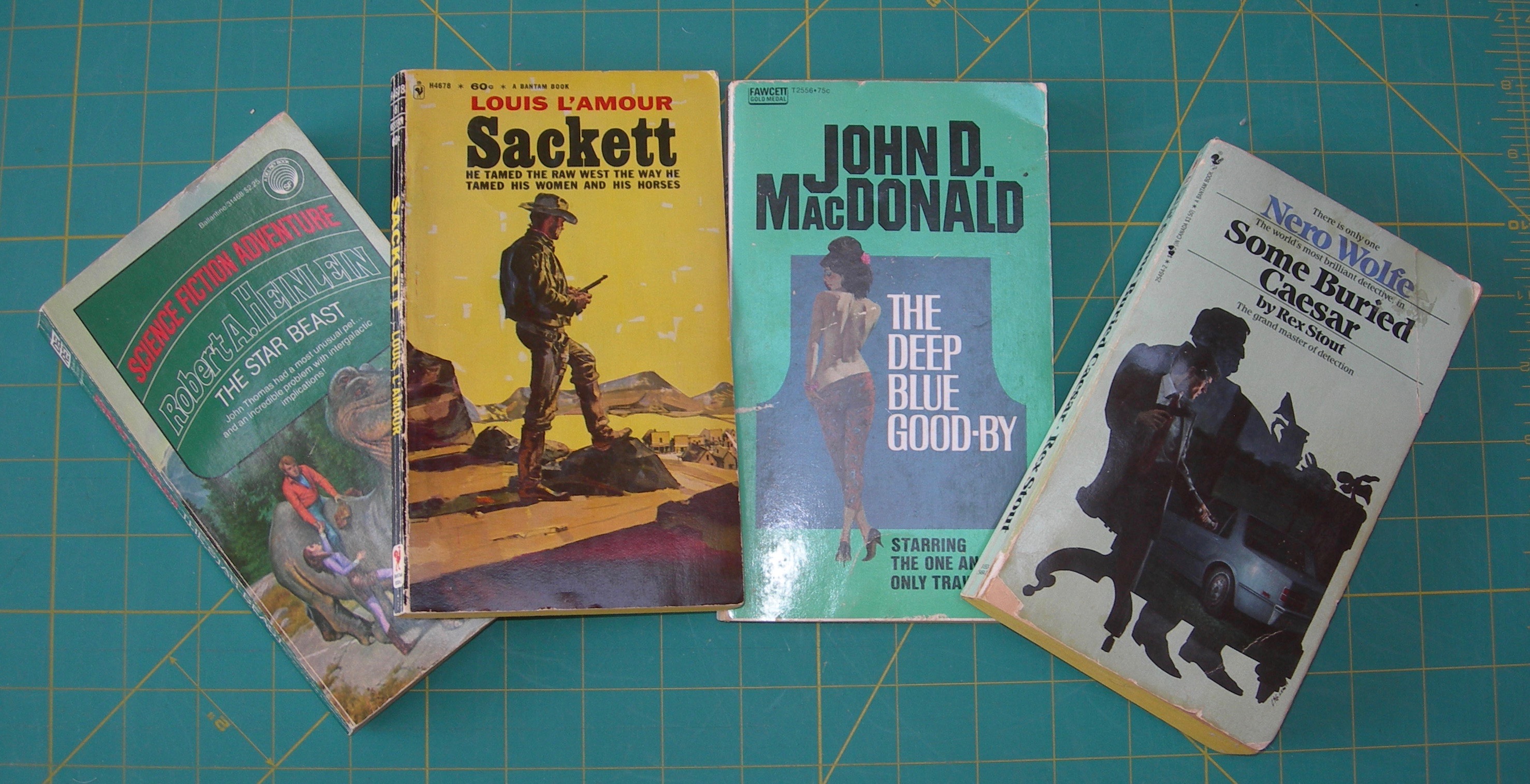
For me, during my first twenty years of writing, my go-to escape was Louis L’amour. I was writing science fiction and fantasy; he was writing westerns. He didn’t exactly write the same book fifty times. If he had, I couldn’t tell his good ones from his bad ones, and he had both. (Read Flint or Conagher, but avoid The Haunted Mesa.)

After beating my head against the typewriter (this was pre-computer) for a few hours, I would pick up a Louis L’amour western and ride off across the plains. Thoughts of interstellar travel were banished until the imagination well refilled itself. It was good stuff, but I don’t read him much any more. I have them all memorized.

I also have Heinlein in the photo at the top, which is a little unfair. He was not guilty of writing the same novel over and over (people who have only read from the second half of his career may disagree), but he only had one character. Male, female, both alternating, old, young — it didn’t matter. Every one was the Heinlein character, so if you liked one of his books, you were likely to like the rest. And if not, not.

The Travis McGee books are a clinic in how to do a series character who can continue to repeat with variations. No one ever did branding as well as John D. MacDonald. Every book contained a color in the title. He wrote The Deep Blue Good-by, Nightmare in Pink, A Purple Place for Dying, the Quick Red Fox, and seventeen more shades. You could recognize a McGee book from across the bookstore. MacDonald’s biography was titled The Red Hot Typewriter. In it, he explained that before he committed to the series, he wrote the first two novels to see if he could stand to be married to McGee for decades. For more, see 49. The Green Ripper.

The Spencer novels belong here as well. I read with pleasure through the first ten or so; each one was reasonably unique and expanded his character. The next thirty were increasingly dreary repetitions; they provided a quick escape and as quickly faded from memory. I still occasionally re-read one of the early novels, but the rest were all one-and-done.

Today, when the writing stalls, I rinse my mind out with Nero Wolfe and Archie Goodwin. I can’t say I really like them, but I always know what to expect.

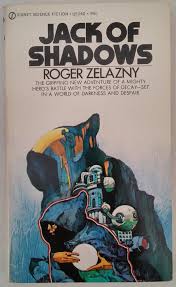
527. Jack of Shadows

This is one of the fifteen that hit the sweet spot. Actually, almost anything by Zelazny belongs on somebody’s best-of list.

If you haven’t read Roger Zelazny, it’s time to start. The border between science fiction and fantasy is his domain, and nobody explores in better than he does.

Zelazny’s magnum opus is the Amber series, ten books detailing the story of Prince Corwin and his family and enemies — frequently the same people. You might start with Nine Princes in Amber, but then you will find yourself hooked, with nine more books to read before you can rest.

He also has a number of stand-alone novels, any one of which would be a proper place to begin to experience Zelazny. To name a few, in publication order:

This Immortal
The Dream Master
Isle of the Dead
Jack of Shadows
To Die in Italbar
Doorways in the Sand
Bridge of Ashes
Eye of Cat

There are also a half dozen between Bridge of Ashes and Eye of Cat which, in my opinion, don’t stack up to the rest. I’ve read and reread all of the above and a few more, along with numerous of his short stories. They always seem to be lurking in the Best Of . . . anthologies.

Isle of the Dead is probably my favorite among the stand-alones, followed closely by Eye of Cat, but as a recommendation for a Zelazny newbie I give you Jack of Shadows. It is close on the heels of the previous two in quality, and it is a more typical Zelazny. If you like Jack of Shadows as well as I do, you’re probably ready to take the big leap into the seemingly endless Amber books. Just make sure you don’t start out of order or it will drive you nuts. Check out the bottom of this post for details.

Jack, our (anti) hero begins his tale at his execution.

His planet is tidally locked with it’s sun like scientists used to think Mercury was. One side is constantly in day and the other constantly in night. Ah, you say, science fiction. Don’t jump to any conclusions. The daysiders are quite scientific, but the nightsiders are denizens of magic. Jack derives his power from shadow, so he is a creature of both and of neither, which is a very Zelaznyesque thing to be.

Nightsiders are immortal, but can be killed. Upon death, they are reborn in the Dung Pits of Glyve, which is at the middle of the nightside of the planet. That is where Jack finds himself shortly after the story begins, and the novel is basically the tale if Jack working his way back past innumerable enemies, to freedom, revenge, questionable redemption, and a cliffhanger ending.

Almost every review, and there are many of them, tells the whole story in brief. But why would you want to know if you plan to read it yourself? I won’t be party to cheating you like that.

If you decide to take the big leap into the Amber series, here is a list to keep you in proper order. There are two sets of five novels, the first being the story of Corwin:

Nine Princes in Amber
The Guns of Avalon
Sign of the Unicorn
The Hand of Oberon
The Courts of Chaos

The second set is the story of his son Merlin.

Trumps of Doom
Blood of Amber
Sign of Chaos
Knight of Shadows
Prince of Chaos

Neither set of novels comes to a proper conclusion. Zelazny was still writing them when he passed. We can imagine that he is somewhere in a luxurious room in Castle Amber, close enough to hear Random’s drumming, writing the ninety-second installment for the amusement of the immortals.

Aside for those old enough to have read Amber when it was being written: Did anybody else out there think the title of book one was a mashup of Nine Princes Waiting and Forever Amber and the second book title a spin on The Guns of Navarone, three best sellers of that era? Considering Zelazny’s sense of humor, it could be.