Tag Archives: science fiction

Alien Autopsy (1)

Kinnison and Tregonsee well visualized,
with Worsel drawn badly as an alligator.
Interior illustration from a 1941 Astounding.

Raven’s Run concluded Monday, May 22. A new novel, Spirit Deer, will begin in Serial on June 5. Meanwhile, I am scheduled to participate in five panels at Westercon this year. Posts relating to the panel “What Makes the Golden Age Golden?” were presented in Serial last week.

This material is for the second panel “Alien Autopsy: the biology of ET”. Posts for the rest of the panels will be published in A Writing Life.

Take one human being. Count his parts. Now start changing the appearance, number, or configuration of those parts. You might come up with:

A two headed mutant on a century ship.
A seven foot humanoid with curving horns coming out of his forehead.
A human who consists of “four-hundred-odd pounds of rawhide and whalebone”, because his ancestors colonized a high gee planet.

See how easy it is. And that, by the way, was a quiz. All three examples are from major writers of science fiction. Their identities are at the bottom of the page. Sometimes, a little tweak all it takes, and for that you don’t need any help. Anyone could do it, although not everyone does it equally well.

     The first of these three was a monster/villain type, and that was all the critter building required to let him do his job.
     The second was an ersatz Amerindian and everybody knew it. By the way, the term Amerindian was used by anthropologists for a short time before Native American took over, and this author may be the only one to have used it in science fiction. Hint, hint.
     The last human variant was a fairly major character, with an actual personality (albeit a cardboard one) and he looked like he did because he had to, in order to play the role assigned to him.

These are all humans, or the galactic equivalent of human. Sentient beings. HILFs. A HILF is a Highly Intelligent Life Form, a term coined by Ursula Le Guin, which should have replaced sentient being, but never caught on. Sentient actually means “having sensation”, not “having intelligence”. An earthworm is sentient in the dictionary sense, but science fiction speaks its own language.

Non-sentient (in the SF sense) beings can also be created by simple tweaks.

The people of Gorth in Star Gate ride larngs; I’m referring to the original novel by Norton, unrelated to the movie or TV series using the same name. A larng is shaggy, clawed, and has a bad temper, but basically he is just a hairy horse with an attitude. On Arzor — Norton, again, in Beast Master and its sequels — humans have to watch out for yoris (think alligators with a poison gland) while they herd frawns (analog to big-horn sheep) across a landscape suspiciously like the American southwest.

I’m not complaining. Beast Master is one of my favorite Norton novels. There is plenty of intrigue, adventure, battle, and family turmoil. It didn’t need a full scale exercise in critter building. In fact, more imagination devoted to that aspect of the novel would just have slowed things down.

Marion Zimmer Bradley, in Hunters of the Red Moon and its sequel The Survivors,  gave us a mammalian snake, complete with nipples, and a giant hyper-fast weasel. She also gave us some sentient beings — there was the cat-critter and the dinosaur-critter. Again, I am not making fun. These sentients had plenty of individuality and charm, but it came from their cultures, not their body structures.

You might call this the minimalist approach; it’s surprising how often it works. Norton was the master of the technique. Gordon Dickson could paint a whole landscape in twenty words. If you have a story to tell, and that story just requires local color, it’s often best not to waste your efforts and your reader’s time in excessive descriptions of the local flora and fauna.

You can combine the minimalist approach with an occasional zinger that brings you reader up short. Marion Zimmer Bradley did that in The Survivors with the proto-saurian Aratak. In the middle of the action, he gets a pheromone soaked calling card from an enemy proto-saurian and disappears. Weeks later he comes back with a smile on his face, ready to take up the quest where they were when he deserted his companions.

I have read hundreds of stories with minimally different aliens. They were all as good, or bad, as the underlying story allowed. I never felt cheated.

However, if you want to go to the next level, and make your aliens really different, that works too. We’ll look at that tomorrow.     

Click here for next post.

================

Oh, yes, I almost forgot. The quiz. The examples were from:

Robert Heinlein, Orphans of the Sky
Andre Norton, the Norbies from Beast Master
E. E. Smith, Galactic Patrol, referring, of course, to Peter vanBuskirk.

359. Westercon Who?

I always think of Westercon as a big deal, but really, most people have never heard of it. Star Trek conventions, sure. Comicon, oh yes: especially since The Big Band Theory showed our four nerds in attendance.

Worldcon is the mother of all science fiction conventions, genealogically, although not in size. It began in 1939. Hugo Awards are handed out at Worldcon.

In 1948, local science fiction fans in the Los Angeles area decided to hold their own convention, because Worldcons were being held on the east coast, and coast to coast travel in 1948 was no small chore. The first Westercon drew 77 people — the first Worldcon had drawn 300.

You might say they have both grown since then. Conventions have also fragmented into specialty venues for fans of fantasy, comics, Star Trek, Star Wars, zombies, manga/anime and who knows how many others.

I love science fiction, but I’m not a fan. That means I read it a lot, read everything my favorite authors write, re-read frequently, and eventually became a writer myself. But since I’m not gregarious, and no one in my world shared my interest, I never talked to anyone about science fiction. Until this blog, that is.

Fans talk about their favorites, and also the %*#*@ jerks who are ruining the genre. They used to write fanzines, and now they produce webzines, websites, and pod casts. And they produce conventions, go to conventions, and volunteer at conventions.

I guess this website takes me half-way into fandom, since I have written quite a few appreciations of Heinlein, Clarke, Norton and others of my favorites. And now I’m volunteering as a presenter at Westercon 70 in Tempe, Arizona over the fourth of July weekend this year.

I’ve actually done this before (see How to Build a Culture), but it has been a while. I’m tentatively scheduled to be on five panels:

What made the golden age golden?
Fantasy world building
Alien autopsy: the biology of ET
Science & Technology versus Magic: what makes this such a compelling trope?
Fake it ’til you make it: a survivor’s guide for the introverted author

I’m not the kind of guy who can flop down behind a table with three or four people I’ve never met and pontificate. Not gregarious; as I said above. I will be preparing my thoughts on these topics over the next month, and as I do, I’ll be sharing them in the form of posts. That way you will be in on things, even it you don’t make it to Tempe. This will work well with Spirit Deer in Serial. That short, short novel is going to turn into a bit of a how-to through posts over on this side, and that will work well alternating with how-to posts made in preparation for Westercon.

This should be fun.

Golden Age of Science Fiction (3)

Raven’s Run concluded Monday, May 22. A new novel will begin soon.  Meanwhile, this is the third of three posts of material for the panel “What Makes the Golden Age Golden?”, to be presented at Westercon.

.  .  .  Some say the golden age was circa 1928; some say 1939; some favor 1953, or 1970 or 1984. The arguments rage til the small of the morning, and nothing is ever resolved.
         Because the real golden age of science fiction is twelve.
                                   David Hartwell

That the golden age of science fiction is twelve — or thirteen — has some validity, but also has limitations. If you are a thinking reader, the golden age of science fiction begins when your maturity begins.

For fun, let’s put that into pseudo-mathematical terms:

MATURITY = ENTHUSIASM – CALLOWNESS

Old age comes when you also subtract enthusiasm — some of us will never reach it. A mature reader loves the good stuff (by his/her lights) but doesn’t love everything.

I had a life crisis just short of my sixteenth birthday that drop kicked me into maturity. From sixteen to college was Hell. Then I escaped. Once I was on my own, I grew like a weed after a rain storm — fast, sprawling, and a little bit prickly. I reveled in being part of a community of scholars, but I didn’t ignore that rack of science fiction paperbacks at the back of the college book store.

I had read The Way of All Flesh in high school. Samuel Butler was good. I read Davy after I was on my own. Pangborn was better.

I had read the stories in the Old Testament in church, sitting in the back pew, with my Bible in my lap so I could look like I was listening to the preacher. They weren’t bad. I read A Wizard of Earthsea after I escaped. Le Guin was better.

I don’t disparage the classics, but consider this. Setting aside the universals of the human experience (which are reason enough to go to the classics), Dickens and Butler were fighting the battles of their day. Those battles were won or lost before we were born. The best science fiction writers are fighting the battles of today and tomorrow.

Is Dickson as good as Dickens? I doubt it. But the Friendlies, the Exotics and the Dorsai are probably more relevant to today than Oliver Twist. Aside from the universals, that is.

My college roommate introduced me to Marvel comics, something that wasn’t allowed in my childhood home. That led to a decade long addiction. I finally kicked Marvel cold turkey, so I would have money enough to eat. I swear the idea of crossovers would make Wall Street proud.

My roommate also introduced me to the Lensman books. Thanks, Bob. It’s hard to read them fifty years later without lip-syncing, but I still do.

If you read enough, and treasure the good stuff, you will create your own golden age.

You can find my golden age in tattered paperbacks on the shelves of my writing room. They are the ones I didn’t get rid of, out of the thousands I read. You will find Ursula Le Guin there, but shoved to the back. Her fantasies would be at the top of my fantasy list, and a long way above Lord of the Rings, but not her science fiction. They are all thoughtful, intelligent, meaningful, and powerful. The problem is the people with whom she populated them. They were all Mrs. Brown’s of both genders (including both genders in alteration in Left Hand of Darkness). How someone who created Sparrowhawk/Ged could fail to write any science fiction protagonist I could like, even while I was enjoying her stories and respecting her skill, is a continuing mystery to me.

You will find Pavane on those shelves. It is my second favorite fantasy and near the top in science fiction. Technically an alternate timeline story, Pavane tastes like fantasy. If they ever put on a panel, “Is there any difference between science fiction and fantasy?”, I’ll propose Pavane as exhibit number one, for the prosecution and the defense.

The Road to Corlay is there, along with everything Zelazny wrote; also everything from Dickson’s Childe Cycle, but very little of his other writing. Everything from Heinlein is there, even For Us the Living. I don’t understand why, but I re-read Heinlein more than any other author. If I could solve the conundrum of Heinlein, and apply it to my own writing, I could make a million dollars and be equally loved and hated by the whole science fiction community.

I could go on for hours, but you would quit reading. It doesn’t really matter what makes up my personal golden age. It only matters what makes up yours.

#              #              #

And then there was New Age.

No concept as fuzzy as New Age has boundaries. It’s even hard to point to a center. Is Michael Moorcock part of it? Certainly. Harlan Ellison? Maybe. Defining New Age is like trying to nail fog to the wall.

During the sixties and seventies, everybody was talking about the New Age. It was going to save moribund science fiction from itself. It was going to destroy science fiction by drowning it in a sea of whining. It depended on who you were listening to.

I never was clear on who was or wasn’t New Age. I just knew there was a lot of weird new stuff coming down and I really liked a lot of it.

J. G. Ballard blew my mind. I never knew where-the-hell his stories were going while I was reading them. I often wasn’t sure after I had finished. If you ever despair of the decency of humanity, don’t read “Deep End”, and least not if you have the means of suicide ready to hand.

Harlan Ellison was the best writer of short stories ever. No qualifiers. If you want a clinic on how to craft the perfect last line, without gimmicks, read “Pretty Maggie Moneyeyes”.

If you want a clinic on how to write a soap opera, in the sense of a story that goes on and on with each sub-climax leading to new start, with suspense and resolution, but no final resolution — in short, a story that can go on forever and keep its readers happily following book after book — read Zelazny’s Amber series. It will take a while. Or if you want to sample Zelazny in a short novel that doesn’t commit you to a lifetime of reading, try Isle of the Dead.

I think there is one golden age that I missed. About mid-eighties I hit a dry spell in my writing — or more accurately, in my selling. It had consequences. When I saw a newly published science fiction novel that wasn’t as good as mine, I got angry. When I saw a newly published science fiction novel that was better than mine, I got depressed.

I was still re-reading old science fiction, and new novels by old favorite authors. I found some new favorites — John Varley, David Brin, and others come to mind — but I largely bypassed a generation of new writers. Recently I have been reading Neil and Neal, Gaiman and Stephenson, but I know I must have missed a feast of others.

I have probably missed more than one feast. Is there a Golden Age of Steampunk? Probably, but I don’t know the sub-genre well enough to talk about it.

So now I’m off to Westercon to participate in a few panels, including the Golden Age panel that prompted this series of posts. While I’m on that stage, I’ll not only be sharing my thoughts, but also taking notes. I have some catching up to do.

These posts called out a short story, which will show up Monday, over in the A Writing Life side of this website.

==================================

This is an insert, placed in the last days before Westercon. The change in the Golden Age panel caused me to write additional material on the subject of political correctness getting in the way of reading old books, but the earliest space available for that post is on July 13. Click here to go there. If you saw me at Westercon, and have arrived here via the Westercon page, I think you can get to the post early. If you click and nothing happens, try again after the 13th. Sometimes posting seems to have all the paradoxes of time travel.

358. X-37b

This picks up where 343. Black Shuttles leaves off.

The Air Force has wanted space for a long time, since it’s beginning actually. NASA took its MISS program and turned it into Mercury. The Air Force wanted the Dyna-soar, but Gemini beat them out in a fight for appropriations. The Air Force coopted Gemini for a manned reconnaissance station, but unmanned satellites did the job sooner and cheaper. There were rumors that Skylab was largely an Air Force observation post disguised as a science station. Possibly true, but it seems doubtful. Finally they got the Space Shuttle, at least part time, but civilian cautions after the Challenger disaster threw off the Air Force schedule and they fell back on their own resources.

Luke Skywalker got to fly a spaceplane and blow up the Deathstar. The Air Force never did. Okay, maybe the Aurora will change that, if it exists.

(What the heck is Aurora? It is either a follow on to the SR-71 or a myth. Conspiracy theorists believe in it, and the rest of us aviation and space crazies want to. I’ll do a post on it some day.)

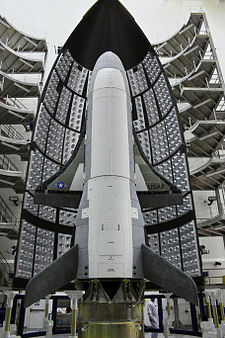
What the Air Force ended up with was a highly capable unmanned vehicle called the X-37b. So far it has only flown four missions, but they are all long duration. The latest ended early this month, May 7th, when the craft landed at the Kennedy Space Center in Florida after a mission of 718 days.

What can I tell you about the mission? That is a lot like the Aurora. Except for the fact that X-37b does exist, and the Aurora may not (probably doesn’t) exist, everything else is classified.

I gave you a link in Black Shuttles for more information, and warned you that it would be frustrating because of the secrecy involved. I have no such link for X-37b. Google it and chase down the conspiracy sites if you want entertainment. If you want facts, join DARPA. Then maybe you can find out which building houses the facts, but they still won’t tell you about them.

I can tell you a bit about the craft itself. It looks like a miniature space shuttle, about 29 feet long, about 10 feet tall, with a 15 foot wingspan. It is launched inside a streamlined shroud on top of an Atlas 5 missile. It has a payload bay about equivalent to a medium pickup bed.

The program started in 1999 and is closely linked to the X-40, which ultimately became a drop-model test bed for data needed to build the X-37b. NASA transferred the project to the military in 2004 and it disappeared into the black world.

X-37b is a scaled up version of the X-40, so early versions had to undergo additional drop tests, this time using a Scaled Composites White Knight (mother ship for the SpaceShipOne program).

To date, there have been four missions, all launched from Cape Canaveral. The first three landed at Vandenberg. The fourth mission landed on the old Space Shuttle runway at Kennedy Space Center.

The future of manned space fighters does not look promising. Most of the new X craft (X-40 through X-57, so far) are unpiloted, but that is simply a cost issue. However, the X-45/46 and X-47 are pilot programs (yes, pun intended) for unpiloted operational fighter jets.

Would-be Luke Skywalkers need not apply. Sorry.

Golden Age of Science Fiction (2)

Raven’s Run concluded Monday, May 22. A new novel will begin soon.  Meanwhile, this is the second of three posts of material for the panel “What Makes the Golden Age Golden?”, to be presented at Westercon.

Yesterday, we looked at Jules Verne. Meanwhile, over in England, there was a fellow named H. G. Wells, but I place him with all the other unreadable Victorians. In my opinion, if he had been a German or a Spaniard or — God forbid — a Hindu, we would never have heard of him. Actually, that is probably true of most of the denizens of British Literature 101. Others differ on this opinion.

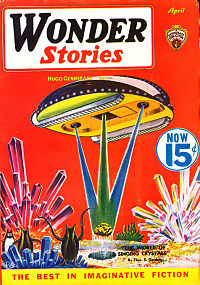
Science fiction, as we know it, got its start in France and England. The next major event in science fiction history, possibly not a golden age, but at least an efflorescence, was the era of the magazines, starting with Hugo Gernsback’s Amazing Stories in 1926 and extending, much attenuated, until today.

The era of John Campbell’s Astounding from 1939 is probably the most cited period in the search for a golden age, and a list of stories from that venue is compelling. The list of authors from the Campbell era is of almost unbelievable quality.

At that time, science fiction was mostly a literature of short stories. Novels existed, but were typically presented serially — a technique that has been in play at least since Charles Dickens. All that changed around the time of the end of World War II, with the rise of mass market paperbacks. It is a complicated story with dozens of players, but no one was more influential than Donald A. Wollheim.

Wollheim began as a fan, went on to write novels and short fiction, and eventually found his métier as an editor. He began with fanzines, moved to the editing of anthologies, then became an editor at Avon books. In 1952 he moved to Ace, where he introduced Ace Doubles. These were twin novels, published together back to back, head to foot. Two for the price of one was a real selling point in the era when paperbacks were introducing cheap literature to the masses. That’s me; I was part of the masses.

Was this a Golden Age? In terms of the availability of new writers like Delany, Le Guin. Zelazny and Brunner, certainly. And Andre Norton’s works finally got to shed their tattered cloth library look and to sport bright, new multicolored covers, sometime two on one double. But technically, this might not be a true golden age, since large numbers of the titles were recycled from the John Campbell era magazines.

It sure felt like a golden age to those of us who were reading the hundreds of titles that were suddenly available to us.

Here lies one of the answers to what makes a golden age. Any time you publish material, some of it will be golden. If your output is large enough, there will be enough gold to make an age, notwithstanding all the rest of the sludge-flow that carries it along. The influx brought about by Ace doubles and the rest of the paperback revolution made huge numbers of new works, and equally large numbers of lost classics from the past, available on every street corner for prices that everyone could afford. If that isn’t a golden age, I don’t know what it takes.

With no intention to disparage the genius of Le Guin, Zelazny, or any other, I am reminded of an old Irish story:

A group of men in an Irish bar were solving the world’s problems one by one. Deep into the night, one of them asked the group, “If every poet in Ireland were all killed tonight, how many years would it take before a new generation of poets rose up?” Another of the group raised his hand with one finger showing, and the rest nodded in agreement.

It is my opinion that for every literary genius who arises, there are a hundred like her or him that we will never know. For every award winning novel, there are many more as good moldering away in typescript, awaiting their author’s death and their final trip to the trash bin.

Literary genius is a part of the whole human race. A golden age comes when opportunity arises for the distribution of genius. Change the venue, change the world.

Today there is a mass of unread eBooks, self published through Amazon. You wanna get rich? Invent the algorithm that winnows through this crop of eBooks, and separates genius from the rest. Of course, if you do, would-be authors everywhere will hate you.

Why? Let’s consider traditional editors as Valkyries. (I didn’t say vultures, I said Valkyries.) They cruise above the field of battle and choose those worthy of Valhalla, or at least publication. Self-publication bypasses this process. An algorithm to decide on quality would be an AI-editor. Now there’s a scary science fiction concept.

The onslaught of paperbacks was not the last golden age. Beginning with the original Star Trek, there was a golden age of television science fiction, although its quality was never very pronounced. CGI, starting with Star Wars, brought a golden age of movies, at least visually. I watch them occasionally, but I have yet to see one which rises to the quality of a good novel. That may be just a personal prejudice.

I watched the Wild Wild West in its original run, and had no idea I was there for the birth of steampunk. I’m still trying to figure out what steampunk is, as something more than a sales tag. Jules Verne, plus sex? That’s puzzlement, not disparagement. I have liked the steampunk I’ve read and watched, but it won’t come into focus for me as a movement. more tomorrow

Click here for next post.

357. Mike Mars and Project Quicksilver

If you Google Mike Mars, you’ll get Mick Mars, lead guitarist for Mötley Crüe. In fact, if that is how you got here, sorry about that. The only connection, besides spelling similarity, is that Mick Mars is of the right age to have read Mike Mars when he was a kid.

Our Mike Mars is a fictional astronaut from a fictional project called Quicksilver. The series was written by Donald A. Wollheim.

The eight Mike Mars books were unique in science fiction. They were so tied to the moment that they became outmoded on publication. They were both strikingly accurate and completely false. They were less of an alternative reality than a conspiracy theory version of the early 60s.

Here’s the setup. Project Mercury has selected seven astronauts, who will conquer space for America – ostensibly. They are all military test pilots of great experience. At the same time, a second, secret space program is being formed to duplicate their work, using hot young (read: expendable) pilots just out of fighter training, but no one will know of their flights. And they will do their thing just a hair sooner than the old guys. The project is called Quicksilver.

I look at that paragraph today with awe at how dumb the notion was. When I found Mike Mars, Astronaut on the shelf at the hobby store where I bought my books, I flipped at how cool it all was. It was 1961; I was 13 years old.

Thirteen is the golden age of science fiction. (I didn’t make that up; it’s a well known cliché.) Thirteen is also the age when you like things you wouldn’t even look at a few years later.

Mike Mars is the nickname of Michael Alfred Robert Samson, one of the young pilots chosen to participate in Project Quicksilver. The first novel takes him through selection and early training until he is chosen as one of the young astronauts. It also includes a murderous saboteur and makes the reader aware that one of the seven, Rod Harger, is a traitor. After all, this is a book for boys, designed to sit on the shelf beside the Hardy Boys and Tom Swift, Jr.. Just being an astronaut isn’t exciting enough to give a climax every fifth page.

In Mike Mars Flies the X-15, the seven Quicksilver astronauts get glide flights in the X-15, and one of them will get to make a powered flight into space. (Guess who gets the powered flight.) We become more aware that six of the young astronauts are patriotic team players, but Rod Harger is in it for the power and the fame, and his father has thugs at the ready to tip the scales his way. This sets the pattern for the books — about half an accurate portrayal of training and flights and about half Hardy Boys style chasing crooks through empty hangers.

In Mike Mars at Cape Canaveral, Mike rides a Redstone rocket in a sub-orbital flight, after spending half the book fighting off more saboteurs.

In 1961 Yuri Gagarin became the first man in orbit, followed shortly by John Glenn. The Russian’s had won — except that those of us reading the Mike Mars series knew that Mike beat both of them in Mike Mars in Orbit. But, of course, he could never tell.

(True believers like me knew that Rick Brant had beaten all of them into space, back in 1958 aboard the Pegasus in The Scarlet Lake Mystery, but that was an accident and, of course, he could never tell either.)

In Mike Mars Flies the Dyna-Soar (see 342. Dyna-soar) Wollheim finally ran out of reality. The first four books had involved real hardware, but the real-life Dyna-soar was never finished. Space kids all over America forgave him however, as we flew with Mike to rescue a fellow astronaut in the coolest spacecraft that was never built.

There were three additional books, Mike Mars, South Pole Spaceman, Mike Mars and the Mystery Satellite, and Mike Mars Around the Moon. They never came to my hobby shop bookshelf, so I never saw them. It would be pointless to seek them out now. Within five years, alternative versions of early space travel had gone from unthinkable to not worth thinking about. NASA and the Russians made the conquest of space real, and I had grown beyond kiddy books.

But God the ride was fun while it lasted.

_____________________

Meanwhile, back in the real world, the secret military space drone, X-37b, recently landed at Kennedy Space Center after it’s longest flight to date. We will see how the Air Force is still trying for a Mike Mars reality in tomorrow’s post.

Golden Age of Science Fiction (1)

I am scheduled to participate in several panels at Westercon this year, July forth weekend in Tempe, Arizona. I intend to research the topics of each panel, and place posts outlining the ideas I will be carrying with me to the convention. Unlike normal posts, I will continue revising these right up to the moment I leave, including after they are published.

This material is for the panel “What Makes the Golden Age Golden?” Material for the other four panels will be published between now and the July 4th weekend, probably some in A Writing Life and some in Serial.

Now for the change-up. After I had written and posted all this, I finally got a proper description of the panel. 

Heinlein and Asimov are two pillars of the Golden Age of Sci-Fi. But reading those works with modern eyes can reveal attitudes that would be unacceptable in modern times. What can we learn from the classics when we look past the sexist and racist attitudes that pervaded the works of that time? Can we still appreciate works that present unacceptable ideologies?

What I had thought would be a panel on SF history is clearly going to be something different. I don’t mind. I am always ready to take up arms in the fight against political correctness, and this looks like it’s going to be a grand brawl!

#                    #                   #

The golden age of science fiction is thirteen. Some say twelve. Yes, that’s an old chestnut, but it’s still around, and people are still repeating it, because it’s true. (The golden age of fantasy would be a whole other panel, which I won’t talk about here.)

You can see it at work in Goodreads, where it can be encapsulated in this theory: The number of stars a novel will get is inversely proportional to the age at which the reviewer first read it.

That doesn’t always work of course, but it goes a long way toward understanding all those low star ratings of Harry Potter by grumpy old people who cut their teeth on Lord of the Rings, and all the five star reviews by people who were young when they first read him.

What makes thirteen a golden age? Duh! Youth, newness, our first realization of our personal uniqueness, and our first real sense of making our own choices. It also makes thirteen the golden age of baseball, science, making money, sexuality, and every other thing that makes life fun.

As for a list of books from my personal version of that golden age — sorry, can’t do it. Most of the science fiction books that gave me joy in the fifties are too dated to be enjoyed by moderns, with the exception of the early Nortons. Since Andre set her stories outdoors and stated her technological wonders without explaining them, they are largely immune to changes in the “real world”. They work when you are thirteen, and still work as long as you can see the words on the page.

We science fiction types always like to invoke Sturgeon’s Law — 90% of everything is #%*%#.” Turn that on its head, and we can say that every era has produced at least some good science fiction. In other words, there is not one golden age, but several, if you ignore the dreck. Let’s look at some of them

The first golden age of imagination was the ancient world. Thor lived then, and he still does. Gilgamesh lived then, and he lives again today, after a long hiatus. Zelazny’s works keep ancient Egypt alive. An odyssey is an odyssey, whether it is carried out by Odysseus or Dave Bowman.

Half-men half-animals, from Ra to the Centaur, abounded in the ancient world and they never really went away. Witness the were-critters inhabiting today’s bookstores. Demigods were everywhere, and they still are. Hercules is still among us and Tarzan is his modern cousin.

The trouble with starting in the ancient world is that it is ancestral to everything in heroic myth, from James Bond to Wyatt Earp to Luke Skywalker to Spiderman. Science fiction proper is not so old.

The first golden age of science fiction is found in the works of Jules Verne. Verne had the advantage of being so far back in science fiction history that he was respected. His works, in France at least, were viewed as literature, not as novelties. Now some modern science fiction writers are now being taken seriously again, but personally, I think this has more to do with sales figures than genuine acceptance.

Between Verne and today stretches the Valley of Critical Disdain, which takes up 99% of the history of science fiction.

Jules Verne invented science fiction, but he didn’t invent all his inventions. His technique was very much the same as the one science fiction writers use today. He took contemporary events and technology, and extrapolated them. That, not his “inventions”, makes him the father of science fiction.

Verne’s Nautilus was not the first submarine. As early as the 1500s there were diving bells and plans for sealed, submerged rowboats. There were numerous unbuilt plans before Drebbel’s first successful submarine in 1620. Every good American knows about Bushnell’s Turtle of 1776.

Kroehl’s relatively modern submarine made its maiden voyage in 1866. Twenty Thousand Leagues Under the Sea was serialized in 1869-70. Verne’s Nautilus was not the first submarine but it was infinitely advanced over the real submarines of the day. That is the manner in which science fiction still operates. 

Americans know Twenty Thousand Leagues Under the Sea, mostly from movies, comic books and juvenile editions, and some Americans know a half dozen other Verne titles. But Verne published from 60 to 80 novels, depending on which list you read. (The difference lies in whether you count French editions or English editions, and how you count the ones that were published in parts and later placed under one cover.) He was a force in French literature, and for at time was studied in French schools as an exemplar of excellence in the French language.

In the English speaking world, we have fewer titles. They are are often indifferently translated, and frequently abridged for the juvenile trade. One of my fantasies-that-will-never-happen is to learn French in order to read Verne in the original. more tomorrow

Click here for next post.

355. Quotations

As I was listening to Trump’s address to the Coast Guard graduates, and his overnight tweets, I was reminded of another voice from years ago. Let me offer all three, side by side.

No politician in history, and I say this with great surety, has been treated worse or more unfairly.
          Trump speaking to Coast Guard graduates.

and also . . .

This is the single greatest witch hunt of a politician in American History.
          Trump tweet.

Setting aside the sound of Andrew Johnson rolling in his grave, let’s hear Robert Heinlein talking about one of his characters:

He had to be the bride at every wedding and the corpse at every funeral.

Yep. That sounds about right.

353. Two Times Gordon Dickson

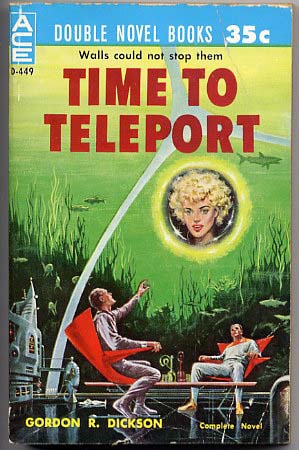
I have on the desk in front of me a book, Ace Double D-449, which was previously owned by Mrs. Elffa E. Philbrick (address redacted) of Urbana, Illinois. I don’t know her. I have never met her, and I don’t know if she is still living. At some point, she placed a return address sticker on the first page – an ordinary person’s version of the ex libris stickers used by fancy people. You don’t see ex libris stickers in Ace Doubles.

I presume Mrs. Philbrick was the first owner of the book. It was published in 1960 and the sticker has no zip code (zip codes came out in 1963). The sticker and the book are equally age-yellowed. That’s all the detective work I could accomplish. There is no way to know how many people owned the book after her, but before I bought it at a local used book store.

One of the minor pleasures of buying used books is occasionally seeing the metaphorical fingerprints of previous owners. They always leave me speculating on how they lived their lives. Was Elffa, perhaps, a suburban housewife with six kids, laundry, PTA, and all the rest, who led a secret life of the mind by traveling, via novel, to distant worlds?

She might also have been a pioneer female engineer working in a local defense plant after a childhood of reading Jules Verne and Edgar Rice Burroughs. But in 1960, which was more likely?

Ace doubles are paired short novels, printed back to back. They are important in the history of science fiction, and will get a post of their own later. This one has The Genetic General on the front, with Time to Teleport on the flip side, both by Gordon R. Dickson.

The Genetic General is part of Dickson’s multi-book Child cycle, AKA the Dorsai books. They include some of my favorites novels and a few that were, in a family phrase, half a bubble off of plumb. Someday I will do a full treatment of them, for the sake of any SF fans – if there are any – who have not already become addicted. Today I’m going to concentrate on Time to Teleport, which is quite a lot better than its title and cover suggest.

(Aside: One of the nicest things about Ace Doubles is that they have two covers, which leaves no space for lying back blurbs.)

Brief summary, sans spoilers:   The world has progressed beyond war, by rearranging its allegiances. Territorial states no longer exist. The Groups which replaced nations are global in scope, and defined by function, such as Communications, Transportation, or Underseas. As the story opens, Groups have been in place for eighty years and have served mankind well, but times have changed and a crisis impends.

The story centers on Eli Johnstone, former head of the Underseas Group. Eli has a secret, deeply buried, that holds the key to the future of mankind.

I bought this book because I realized that, although Ace Doubles had been a staple of my reading during the sixties, I didn’t have one in my library. I chose one which had a proven winner on the front. Since I don’t always like Dickson’s non-Dorsai work, I had small expectations for Time to Teleport, but I was pleasantly surprised. It was a refreshing dip into the-way-things-used-to-be.

It was also a preview of things to come in Dickson’s work. Eli has a bad knee (as did Cletus Grahame), used a cane in the beginning (as did Walter Blunt), and teleportation is a key element. By the second chapter I was expecting an early version of a key scene from Necromancer, but that didn’t happen.

What did happen was a story that tasted like vintage Dickson, and a little like Heinlein’s Lost Legacy (see 148. Lost Legacy). Eli, as the genetically superior man who saves mankind, reminded me of every other science fiction story from the sixties and seventies. So did the heavy reliance on psi forces.

Time to Teleport had an almost naive hopefulness about mankind’s future which I haven’t seen in science fiction lately, and which I miss.

351. Who Is Listening?

When EDGE accepted Cyan for publication, I was less than enthused about publishing in eBook format. I’ve changed my mind.

It wasn’t the notion that science fiction authors should embrace technology that got to me. It was who responded to my website.

Building a website has been a learning experience, and I sometimes feel I’ve only begun. At first, no one was reading, but I expected that. Eventually, views began. Even later, likes began. I kept writing. I knew that gaining readership is a long-haul process.

I found it addictive to view the websites of the people who responded to me. One of the most surprising things I found was the number of respondents who were clearly from somewhere in the world other than America.

I regularly put out eight posts a week, many of which require research, and I have a life to live. That doesn’t leave me a lot of time to spend under the hood of WordPress, but I did find 

           https://wordpress.com/stats/day/(insert your own url here) 

which lets you click see how many views and visitors you had on any given day. More interesting, it shows a map that tells you which countries those views came from.

I was blown away.

To be specific, these are the results from this year, January 1 through April 21.

USA                    45%
Canada              28%
India                   8%
Australia            5%
U K                      4%
Switzerland       3%
South Africa       2%
Hong Kong       about 1%
Morocco           about 1%
Ukraine             about 1%
Romania          about 1%
Singapore        about 1%
Ireland             about 1%
Czech Rep.      less than 1%
Spain               less than 1%
Philippines      less than 1%
Japan               less than 1%
Kenya              less than 1%
Germany         less than 1%
Jordan             less than 1%
Israel               less than 1%

Global, indeed.

So, back to the initial statement — Yes, I would like to have Cyan on every bookstore shelf and in every library, not just available on line. However, no matter what happens from now on, I will insist that whatever I publish in the future will also be released as an eBook.

This goes back the the very beginning, to my childhood. Growing up on a farm, at first I had only G&D books (Tom Swift and the like) purchased from a local hobby store. Then I found the county library. I didn’t see a real bookstore until I was in college.

Those books were my window to the world.

Today, a book hungry young person with access to the internet can find — and afford — eBooks, even if her or she lives in India, South Africa, or Ukraine. I like that, and I’m proud to be part of it.